Implications
Understanding the biological mechanisms of adaptation to hot environments is a challenge to select the most efficient animals in these conditions. We studied these processes in the Bedouin goat, usually considered as adapted to the desert climate. Our results show a dissociation between circulating cortisol levels and the adrenal reactivity to ACTH. Further research should focus on the respective contribution of environmental factors (such as day length, temperature, humidity) and the mechanisms involved in cortisol regulation. The Bedouin goat in its natural desert environment appears as good model for these studies.
Introduction
In order to improve animal production in harsh environments, it is important to understand adaptation mechanisms to extreme environmental conditions (temperature, food availability). Goats are considered to be well adapted to hot and dry climates (Silanikove, Reference Silanikove2000; Aboul-Naga et al., Reference Aboul-Naga, Osman, Alary, Hassan, Daoud and Tourrand2014), but the mechanisms of this adaptation, beyond specific digestive characteristics, are not well understood (Silanikove et al., Reference Silanikove, Tagari and Shkolnik1993; Choshniak et al., Reference Choshniak, Ben-Kohav, Taylor, Robertshaw, Barnes, Dobson, Belkin and Shkolnik1995; Shamay et al., Reference Shamay, Mabjeesh, Shapiro and Silanikove2000; Maltz et al., Reference Maltz, Silanikove and Shkolnik2009). The hypothalamic–pituitary–adrenal (HPA) axis is a critical neuroendocrine system involved in metabolism and adaptation, and circulating glucocorticoid hormone (GC) concentrations or the reactivity of the adrenal cortex to ACTH are often used as stress indicators (Mormede et al., Reference Mormede, Andanson, Auperin, Beerda, Guemene, Malmkvist, Manteca, Manteuffel, Prunet, van Reenen, Richard and Veissier2007).
In most animal species, a circadian timing system has evolved as a strategy to cope with 24-h rhythms in the environment (Dickmeis et al., Reference Dickmeis, Weger and Weger2013). The circadian rhythm of cortisol is paralleled by other physiological parameters such as body temperature and melatonin, demonstrating the power of the circadian pacemaker in the suprachiasmatic nucleus to regulate the timing of physiological rhythms (Pevet and Challet, Reference Pevet and Challet2011; Dickmeis et al., Reference Dickmeis, Weger and Weger2013). Seasonal changes have also been described (Romero, Reference Romero2002; Dickmeis et al., Reference Dickmeis, Weger and Weger2013) but the amplitude and timing of the cycle largely differ across studies, possibly reflecting the variety of environmental conditions of these studies (e.g. Rhind and McMillen, Reference Rhind and McMillen1995; Alila-Johansson et al., Reference Alila-Johansson, Eriksson, Soveri and Laakso2003; Meza-Herrera et al., Reference Meza-Herrera, Bocanegra, Banuelos, Arechiga, Rincon, Ochoa-Cordero, Juarez-Reyes, Cerrillo-Soto and Salinas2007; Al-Busaidi et al., Reference Al-Busaidi, Johnson and Mahgoub2008; Al-Samawi et al., Reference Al-Samawi, Al-Hassan and Swelum2014 in goats). A characteristic feature of the desert climate is the large amplitude of variation in temperature and hygrometry, during the nychthemeron and across seasons. As the HPA axis is extremely sensitive to these environmental conditions (e.g. Marple et al., Reference Marple, Aberle, Forrest, Blake and Judge1972), its activity may be a good index of the intensity of adaptive adjustments. Indeed, we previously described large seasonal changes in HPA axis activity in a wild desert species, the sand rat (Amirat et al., Reference Amirat, Khammar and Brudieux1980).
In order to evaluate the intensity of adaptation processes in the Bedouin buck exposed to extreme environmental conditions around the year in the Sahara desert, we investigated the seasonal changes in circadian plasma cortisol concentrations, rectal temperature, BW and in the reactivity of the adrenal cortex to exogenous ACTH.
Material and methods
Animals
The experimental animals were male goats from the Bedouin breed. They exhibited similar phenotypic characteristics, and were clinically healthy. They were raised in the Béni Abbès research station (30°07' N, 2°10' W, Bechar, South Algeria) located in the Algerian Sahara desert. The lifespan of this domestic species is about 10 years. The males were kept separated from females, under open shelter undergoing the influence of natural variations of climatic factors. Animals were fed forage and a mixture of oats and barley (about 1 kg) once daily (1630 h); water was provided ad libitum.
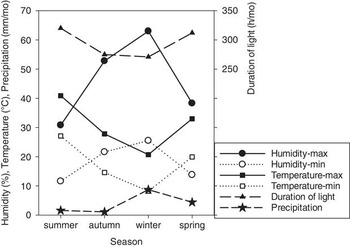
The experiments were conducted over 2 consecutive calendar years under the largely differing environmental conditions, which occur in the Sahara desert during summer (July), autumn (October), winter (February and March) and spring (May) (Figure 1). Each animal was studied only once per season; 1 h before the start of experiments, animals were weighed and housed individually in order to reduce the stress induced by handling. The meteorological data were obtained from the Algerian meteorological center.
Climatic data during the periods of experimentation. Means of the monthly measures obtained from the Béni Abbès meteorological station (30.13°N, 2.17°O, elevation: 500 m) for the 2 experimental years.

Blood samples (3 ml) were collected from the jugular vein by trained personnel using heparinized Vacutainer® tubes (lithium heparinate, Venoject Terumo; Leuven, Belgium) and kept on ice until centrifugation at 3000×g for 10 min at 4°C. Plasma samples were stored at −25°C until assayed.
The rectal temperature of each buck was measured at 0800 and 2000 h using a digital clinical thermometer (Eco Temp Smart, MC-341-E; Omron Healthcare, Hoofddorp, Netherlands) inserted about 3 cm into the rectum in contact with the mucosal wall of the rectum. The value was taken after the thermometer gave an alarm sound (60 to 90 s), indicating that the reading had stabilized.
All experimental protocols were accepted by the ethical committee and the project commission of the institution.
Basal adrenocortical activity
For the study of basal adrenocortical activity, we used seven adult males (2 to 3 years, 31.9±1.9 kg BW). A few animals were culled and eventually replaced, so that six were available in spring, summer and autumn, and three in winter. Blood samples were taken every 2 h for 22 h, from 1000 h on the 1st day to 0800 h on the next day in order to catch the circadian changes.
Adrenal response to ACTH
For the study of the reactivity to ACTH, we used seven young (<18 months, 19.5±0.8 kg BW), three adult (2 to 2.5 years, 24.7±2.1 kg BW) and three old males (5 to 8 years, 40.0±1.6 kg BW). Due to the shift of several animals from the ‘young’ to the ‘adult’ group, and to the culling of several animals, the number of trials available is variable and mentioned in the caption of figures. In order to reduce the possible effect of the circadian rhythm on adrenal reactivity to ACTH (Reinberg et al., Reference Reinberg, Touitou, Levi and Nicolai1983), all stimulations were performed between 0800 and 1200 h. At each season, the animals received two doses (2 then 10 μg/kg BW, 72 h apart) of synthetic ACTH i.v. in the jugular vein (Cortrosyn; Organon, Oss, Netherlands; 1 mg equivalent to 100 IU), diluted in 1 ml of apyrogenic physiological serum. Blood samples were collected in refrigerated tubes at −15, 0, 3, 8, 15, 30, 45, 60, 90 and 120 min, and then at 24 and 48 h after each ACTH injection. The goal was to obtain a maximal response of the adrenal glands, a phenotype that we have shown to be highly heritable in pigs (Larzul et al., Reference Lee, Roussel and Beatty2015).
Cortisol assay
In order to define the main GC hormone secreted by the adrenal cortex of the Bedouin goat, the relative proportions of cortisol and corticosterone were measured in 17 samples, four before and 13 after ACTH injection. Plasma (100 μl) was extracted with 3 ml cyclohexane/ethyl acetate (50/50) at a recovery rate of 71.0±1.5%. Hormones were separated by paper chromatography (Bush B5 solvent system, no. 2 Whatman paper), as previously described (Amirat et al., Reference Amirat, Khammar and Brudieux1980). Next, hormones were measured by radioimmunoassay (RIA) using specific antibodies raised in rabbit, kindly provided by Prof. Claustrat (Lyon, France) and by Prof. Oliver (Marseille, France). Plasma cortisol was then routinely measured by RIA after ethanol extraction without previous separation with Prof. Oliver’s antibody, as described in the study by Désautés et al. (Reference Desautes, Bidanel and Mormede1997). Intra and inter-assay CV were 6.7% and 7.4%, respectively, for corticosterone, and 13.6% and 7.8%, respectively, for cortisol, with a detection limit of 0.1 ng/ml.
Statistical analysis
Data are presented as means±standard error of the mean. The areas under the curve (AUC) after ACTH injection were calculated with respect to ground by the trapezoidal approach (Pruessner et al., Reference Pruessner, Kirschbaum, Meinlschmid and Hellhammer2003). The area was limited to the 0 to 90 min period after ACTH injection because samples taken at 120 min were lost for one experimental group. Cortisol concentrations or AUC after ACTH injection were analyzed using linear mixed effects models (package ‘nlme’ of R) with the animal as a random factor to account for repeated measures and time of the day and season (basal cortisol concentrations), or ACTH dosage, season and age (AUC) as fixed factors. Statistical significance was set at P<0.05. Diurnal variations were also analyzed by cosinor with the R package ‘season’ (Tong, Reference Tong1976).
Results
In the Bedouin buck, basal plasma cortisol concentration ranged between 1 and 18 ng/ml in the analyzed samples, whereas plasma corticosterone concentration was only about 0.1 ng/ml, with a 60 : 1 ratio. This large difference was also found after ACTH injection (1 : 30 ratio). Therefore, immunoreactive cortisol was measured in further experiments.
Seasonal variation in the base levels of plasma cortisol concentrations
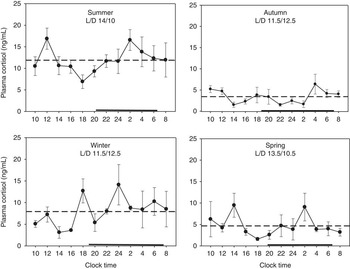
The analysis of basal cortisol concentrations showed a tendency only for the effect of time of the day (P=0.054) and a highly significant influence of season (P<0.0001) with a season×time interaction (P=0.011) (Figure 2). Mean cortisol concentrations were lowest in autumn and spring and highest in summer and winter (P=0.0003 and 0.0001 v. autumn, respectively). Subsequent analysis per season showed that the time of the day was significant in summer (P=0.03), autumn (P=0.04) and winter (P=0.01), but not in spring (P=0.17). However, these variations did not fit the classical sigmoidal curve as analyzed by the cosinor algorithm (all P>0.05).
22-h Plasma cortisol concentration profiles in adult bucks measured in summer, autumn, winter and spring (means±SEM, n=6 except in winter n=3). Dashed lines show the mean value. Black bars on the x-axis denote hours of darkness. LD=light/dark cycle.

Seasonal variation of rectal temperature and BW
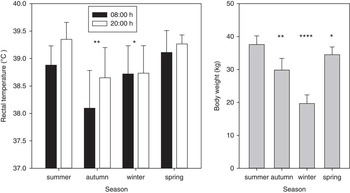
The rectal temperature showed circadian fluctuations, with higher values at 2000 than 0800 h (P=0.01) and no significant time×season interaction (Figure 3). It was also different across seasons (P<0.0001), following the changes of external temperature and day length, with highest values occurring in summer and spring and lowest in autumn and winter. BW varied significantly across seasons (P=0.0001), the mean values being highest in summer and lowest in winter.
Left panel: seasonal variations of rectal temperature measured at 0800 and 2000 h in adult bucks; right panel: seasonal variations of BW (means±SEM, n=6 except in winter n=3). *P<0.05, **P<0.01 and ****P<0.0001 v. summer.

Seasonal variation of adrenal response to ACTH
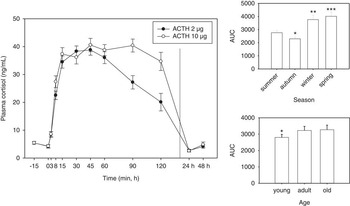
The responses of plasma cortisol concentrations to 2 and 10 μg/kg BW of ACTH are shown in Figure 4. Both doses of ACTH induced a strong increase in cortisol concentrations in all conditions with maximum levels achieved between 15 and 60 min (2 μg/kg) or 90 min (10 μg/kg). The response to ACTH (AUC) did not differ between ACTH doses (P=0.12) but the effect of season was highly significant (P<0.0001), the AUC being lowest in autumn and summer and highest in spring (autumn P<0.05, winter P<0.01, spring P<0.001 v. summer). The global influence of age did not reach significance (P=0.11), although the youngest animals had a lower AUC as compared with adults (P<0.05).
Left panel: kinetics of the plasma cortisol response to two ACTH doses (2 and 10 μg/kg, means±SEM, n=37). Right panels: integrated responses to ACTH (areas under the curve (AUC)) from 0 to 90 min as a function of season (upper right, means±SEM, n=30, 16, 14, 14 in summer, autumn, winter and spring, respectively) and age (lower right, means±SEM, n=26, 24 and 24 in young, adults and old bucks, respectively). Each bar represents the grand mean of all tests available for the specific group. *P<0.05, **P<0.01, ***P<0.001 v. summer (season panel) and *P<0.05 v. adult (age panel). The vertical line in the left panel indicates the rupture of the time scale between 120 min and 24 h.

Discussion
These data show that the Bedouin goat produces both cortisol and corticosterone as adrenal GC hormones, with a clear predominance of cortisol. Basal plasma cortisol concentrations measured here are in the range of previously published values obtained under similar conditions (Rhind and McMillen, Reference Rhind and McMillen1995; Alila-Johansson et al., Reference Alila-Johansson, Eriksson, Soveri and Laakso2003; Meza-Herrera et al., Reference Meza-Herrera, Bocanegra, Banuelos, Arechiga, Rincon, Ochoa-Cordero, Juarez-Reyes, Cerrillo-Soto and Salinas2007). The adrenal steroid hormones play a crucial role in physiological adjustments to various types of environmental and stress factors (Mormede et al., Reference Mormede, Andanson, Auperin, Beerda, Guemene, Malmkvist, Manteca, Manteuffel, Prunet, van Reenen, Richard and Veissier2007).
The daily rhythm of HPA axis activity is well described in most mammalian species with a peak at the beginning of the behaviorally active period, morning in diurnal species. In ruminants, it was described in sheep (Fulkerson and Tang, Reference Fulkerson and Tang1979; Mesbah and Brudieux, Reference Mesbah and Brudieux1982) but it is not very pronounced in cattle and some studies failed to show any diurnal rhythm (see Mormede et al., Reference Mormede, Andanson, Auperin, Beerda, Guemene, Malmkvist, Manteca, Manteuffel, Prunet, van Reenen, Richard and Veissier2007 for discussion). In the present study with goats, there was no clear-cut diurnal cycle, as previously shown by others (Kokkonen et al., Reference Kokkonen, Riskila, Roihankorpi and Soveri2001; Alila-Johansson et al., Reference Alila-Johansson, Eriksson, Soveri and Laakso2003). Although the diurnal cycle is principally driven by light, nutritional factors are also involved (see Blum et al., Reference Blum, Lamont and Abizaid2012 for review). The specific feature of a dampened cycle of nutrients absorption in ruminants may be operative in this reduced diurnal cycle of HPA axis activity, although to the best of our knowledge, this hypothesis has never been examined experimentally.
Circulating concentrations of cortisol were primarily influenced by season, with 3.5-fold higher mean peak levels in summer than at the trough in autumn. Variable effects of season on HPA axis activity have been published, both for the range of change and the circannual shape of the concentration curve (Rhind and McMillen, Reference Rhind and McMillen1995; Alila-Johansson et al., Reference Alila-Johansson, Eriksson, Soveri and Laakso2003; Meza-Herrera et al., Reference Meza-Herrera, Bocanegra, Banuelos, Arechiga, Rincon, Ochoa-Cordero, Juarez-Reyes, Cerrillo-Soto and Salinas2007; Al-Busaidi et al., Reference Al-Busaidi, Johnson and Mahgoub2008; Al-Samawi et al., Reference Al-Samawi, Al-Hassan and Swelum2014 in goats). Part of these variations across studies most probably arises from the large differences in the local experimental conditions (such as the duration and intensity of light, temperature and humidity). It raises the question of the nature of environmental factors driving the changes in HPA axis activity.
A first candidate is day length and the pineal hormone melatonin secreted during the night and in larger amounts in winter (see Malpaux et al., Reference Malpaux, Migaud, Tricoire and Chemineau2001 for review and Alila-Johansson et al., Reference Alila-Johansson, Eriksson, Soveri and Laakso2006; Todini et al., Reference Todini, Terzano, Borghese, Debenedetti and Malfatti2011; Carcangiu et al., Reference Carcangiu, Giannetto, Luridiana, Fazio, Mura, Parmeggiani and Piccione2015 in goats). Melatonin takes part in the regulation of circadian rhythms (Pevet and Challet, Reference Pevet and Challet2011) and exerts direct inhibitory actions on adrenal responses to ACTH in sheep (Torres-Farfan et al., Reference Torres-Farfan, Valenzuela, Mondaca, Valenzuela, Krause, Herrera, Riquelme, Llanos and Seron-Ferre2008). In goats, melatonin was shown to inhibit heat stress responses, including plasma cortisol increase and expression of heat-shock proteins (HSP) in peripheral blood mononuclear cells (PBMC) (Sharma et al., Reference Sharma, Ramesh, Hyder, Uniyal, Yadav, Panda, Maurya, Singh, Kumar, Mitra and Sarkar2013), as well as the cortisol response to weaning stress (Redondo et al., Reference Redondo, Franco, Garcia and Masot2010). More studies will be necessary to know the range of fluctuation of melatonin levels in our experimental conditions and explore its possible influence on HPA axis activity.
Temperature and humidity are well-documented environmental factors influencing HPA axis activity, although their influence is rather complex. As shown in cows (Johnson and Vanjonack, Reference Johnson and Vanjonack1976; Lee et al., Reference Larzul, Terenina, Foury, Billon, Louveau, Merlot and Mormede1976) and in pigs (Marple et al., Reference Marple, Aberle, Forrest, Blake and Judge1972; Campos et al., Reference Campos, Noblet, Jaguelin-Peyraud, Gilbert, Mormede, Donzele RFM de, Donzele and Renaudeau2014) adaptation to heat reduces plasma cortisol levels, but acute exposure to high temperatures (in the range of 40°C as observed during summer in the present experiments) increases plasma cortisol levels and triggers other stress responses such as the expression of HSP in PBMC (Dangi et al., Reference Dangi, Gupta, Maurya, Yadav, Panda, Singh, Mohan, Nitai, Bhure, Das, Bag, Mahapatra, Taru Sharma and Sarkar2012; Sharma et al., Reference Sharma, Ramesh, Hyder, Uniyal, Yadav, Panda, Maurya, Singh, Kumar, Mitra and Sarkar2013). These non-linear effects of increased temperature on HPA axis activity can explain apparently divergent experimental results of the effects of seasons, depending on the range of temperatures encountered at each experimental location. High ambient temperatures and high solar radiation may be responsible for the highest cortisol levels observed during summer in our experiments, similar to findings of Al-Samawi et al. (Reference Al-Samawi, Al-Hassan and Swelum2014) in Saudi Arabia (38.5°C), as compared with the low levels measured in summer by Al-Busaidi et al. (Reference Al-Busaidi, Johnson and Mahgoub2008) in Oman (34°C) and by Meza-Herrera et al. (Reference Meza-Herrera, Bocanegra, Banuelos, Arechiga, Rincon, Ochoa-Cordero, Juarez-Reyes, Cerrillo-Soto and Salinas2007) in Northern Mexico (26.1°C). Indeed, the increase in rectal temperature during the hot season indicates that animals were subjected to heat stress (Minka and Ayo, Reference Minka and Ayo2012; Al-Samawi et al., Reference Al-Samawi, Al-Hassan and Swelum2014).
The seasonal rhythm in BW coincides with reproductive activity; indeed, the gain was observed when bucks were reproductively inactive, between March and mid-August, and the loss during the breeding season, which occurs between late summer and late autumn (Amirat et al., Reference Amirat, Lakdari and Khammar2001; Kumar et al., Reference Kumar, Pramod, Kumar, Negi, Singh, Singh and Mitra2014). Furthermore, energy mobilization is necessary in winter to maintain body temperature, and could be partly responsible for the decrease in BW observed in this period. This same seasonal rhythm in BW has been reported by other authors, which commonly correlates with the influence of the season (photoperiod) on physiological state and reproductive performance of bucks, independently of the feeding level (Zarazaga et al., Reference Zarazaga, Guzmán, Domínguez, Pérez and Prieto2009). For example, Barenton et al. (Reference Barenton, Ravault, Chabanet, Daveau, Pelletier and Ortavant1988) demonstrated that variation in photoperiod has a direct effect on BW: long days stimulate and short days inhibit weight gain. The HPA axis and other neuroendocrine systems may be operative in these effects in rams (Cahill et al., Reference Cahill, Tuplin and Holahan2013; Ebling, Reference Ebling and Lincoln2015).
Different timings of the seasonal rhythm in HPA axis activity can be shown at different levels of the axis. In rams, Ssewannyana et al. (Reference Ssewannyana, Lincoln, Linton and Lowry1990) showed the highest levels of circulating hormones such as ACTH and cortisol from May to July, and β-endorphin in August. The greatest pituitary response (ACTH, β-endorphin) to arginine vasopressin (AVP) and/or corticotropin-releasing hormone (CRH) was obtained in summer and autumn and the maximal adrenal response (cortisol) to dexamethasone/ACTH in spring at the time of the peak in cortisol secretion. Another study reported no significant seasonal changes in plasma cortisol concentrations but a seasonal cycle in the levels of β-endorphin occurring in parallel with the cycle in plasma FSH and BW (Ebling and Lincoln,Reference Ebling1987).
In the present experiments, we investigated the adrenal response to ACTH as the major source of variability in cortisol levels (Mormede and Terenina, Reference Mormede and Terenina2012), including the effect of season (Reinberg et al., Reference Reinberg, Touitou, Levi and Nicolai1983). No significant effect of age or dose was found, the adrenal being already maximally stimulated at the lowest dose (2 μg/kg). Although a marked effect of season was observed, it did not match the variation in plasma cortisol levels, as the largest response to ACTH was measured in spring, when cortisol levels were low. However, the smallest response to ACTH was measured in autumn when cortisol levels were also at their lowest. Therefore, the adrenal reactivity to ACTH may contribute to the seasonal cycle of cortisol but other levels of the HPA axis could be predominant in the transduction of the rhythm. Arginine vasopressin is a potent secretagogue of ACTH, particularly in goats where it is more potent than CRH (Katoh et al., Reference Katoh, Yoshida, Kobayashi, Onodera, Kogusa and Obara2005). This peptide, together with the adrenal cortex hormones, plays an important role in water homeostasis, a critical function in desert animals exposed to high temperatures and dehydration (El-Husseini and Haggag, Reference El-Husseini and Haggag1974; Haggag and El-Husseini, Reference Haggag and El-Husseini1974; Yagil and Etzion, Reference Yagil and Etzion1979), but its possible role in seasonal cortisol secretion rhythms has not been investigated. More studies are necessary to identify the contribution of the various season-related environmental factors and to monitor simultaneously the different levels of the HPA axis potentially involved in their transduction.
Conclusion
The present data show that the Bedouin buck produces both cortisol and corticosterone as adrenal GC hormones, with a clear predominance of cortisol, both at basal conditions and after ACTH stimulation. No clear circadian variation could be seen in circulating cortisol concentrations but large variations across seasons were found with higher levels in summer and winter. However, the adrenal response to ACTH does not follow this pattern, the response being the highest in spring and the lowest in autumn, both seasons with low basal plasma cortisol concentrations; it was low in summer when plasma cortisol concentrations are the highest. The rectal temperature also shows nychthemeral and seasonal variations, with higher values at 2000 than 0800 h in all seasons, particularly in summer and spring. The BW was also different across seasons, with higher values in summer (period of energy restoration) and it was lowest in winter (period of energy deficit). Further experiments will allow to explore the nature of the most important environmental factors influencing HPA axis activity and their mechanisms of action. This will help to better understand the physiological basis of adaptation of goats to harsh environments.
Acknowledgments
The authors thank all the staff of the experimental station of Beni-Abbes (W. Bechar). Special thanks to Zahreddine Djazouli (University Saad Dahlab, W. Blida) and Yann Labrune (INRA, Castanet-Tolosan) for help with statistical analyses, and Nouria Boukenaoui of the Research Laboratory LRZA/USTHB for technical support with cortisol immunoassays. The authors dedicate this work to the memory of their colleague Yahia Lakhdari, LRZA/USTHB. Special thanks to Prof. Byron C. Jones (UTHSC Memphis, TN, USA) for editing the manuscript.