


Modern states and markets depend on ‘good’ money: money that reliably transfers value, large and small, from place to place, and over time. This was particularly true of the early modern period, when broad-based economic and social development required the expansion of market participation on the one hand and enhanced fiscal capacity on the other. Without an adequate and sustained supply of good money, there would have been no deepening of the division of labor, no growing dependence on the market, and no improvement of the public goods essential to market development.
An adequate supply of small-denomination coinage was particularly important to the development of the market economy. Large coins could not be used to pay for the daily necessities of life; only small coins with the right denominations in relation to the price of food, drink, clothing and so forth, would do. During the early modern period in modern-day Europe, certain conditions produced shortage of petty coin, which were sometimes addressed by the Crown, sometimes not (see, for example, Cipolla Reference Cipolla1967; Redish Reference Redish2000; Sargent and Velde Reference Sargent and Velde2002). The main culprit was the technical difficulties associated with commodity money systems in producing coinage that was divisible, portable, durable and recognizable (see Wallace Reference Wallace2003).
Despite major strides in the literature in recent decades, there are some important issues that remain unexplored. To our knowledge, neither the theoretical nor the empirical literature has addressed the role that resource endowments (in this case silver) might have played in allowing for – or limiting – the production of a sensible mix of large- and small-denomination coins. Did the availability of the commodity matter? And if so, how?
In this article we discuss historical evidence from Massachusetts Bay and the Viceroyalty of Peru to illustrate the importance of the resource endowment for monetary outcomes. Indeed, the contrast between these two colonies is remarkable in this respect. The Viceroyalty of Peru had famously rich silver mines that supplied silver to its mint, while Massachusetts Bay had none. The Potosi mint processed 315,540 troy pounds of silver annually in the 1640s (a period of peak output), a massive output compared with 1,200 troy pounds processed by the Boston mint at its peak.Footnote 1 The Potosi mint had a large workforce and a well-developed internal division of labor, while the Boston mint was essentially a silversmith's shop. The dramatic difference in scale between the two mints makes it possible to handily identify the role that the resource endowment played in explaining monetary outcomes in the two colonies.
Interestingly, in both Massachusetts Bay and the Viceroyalty of Peru, the coinage originally came about as a result of demands from local officials or economic groups, whose main goal was to provide an adequate currency for domestic petty commerce (retail trade), to support the development of the domestic market. Despite their similar original goals, their outcomes were markedly different. We focus here on whether their coinage included the smaller-denomination coins that were badly needed for petty commerce, wage payment and some tax payments, as required in their original monetary regulations. In the article we suggest that Massachusetts Bay was relatively successful at the production of petty coinage and that the Peruvian coinage fell somewhat short, as the production of the large silver peso coin overshadowed the production of smaller denominations.
We rely on the economics of commodity coinage production – before full mechanization – to explain the divergent outcomes. The technology of commodity money in the early modern period implied that small-denomination coins were more costly to produce. In this sense, both colonies were primed to favor the production of large-denomination coins. Notwithstanding, we show that the relative abundance (or scarcity) of silver affected these basic incentives. As we discuss below, the main challenge for Massachusetts Bay was attracting silver to its mint, for which purpose the monetary authority sanctioned a relatively light coin. The relative scarcity of silver undoubtedly contributed to the small scale of the mint's operations. We show that, as a result, neither the monetary authority nor the mintmaster faced a significant tradeoff between drawing seigniorage from the mint and producing the costly petty coins. Primary sources, that include the mintmaster John Hull's account books, document that New England's coins – the largest of which was small enough to be useful for trade and taxes – were used in local economic activities connected to the export trade.
In contrast, the abundance of the silver endowment posed a challenge for the Peruvian viceroyalty. The main constraint in Potosi's case was the perverse incentives generated by the success of the heavy peso coin, which overtime enjoyed a high demand world wide, thanks in no small measure to its abundant supply. Historical sources suggest that the success of the peso benefited both the merchant elite and the Spanish Crown. The sheer size of the Potosi coinage heightened the tradeoff between the fiscal and monetary objectives of the coinage, which likely contributed to the Spanish Crown's laxity in enforcing its original coinage laws. Historical evidence drawn from the mint accounts and other sources suggests that colonial authorities ignored the scarcity of fractional coinage, boosting the volume of silver that could be processed into coin with the available labor force. This approach enhanced the global market benefit for the silver merchants and the fiscal benefit for the Spanish Crown.
In the next section, we discuss our analytical framework. Sections II and III apply these basic insights to Potosi and Massachusetts Bay respectively. The last section concludes.
I
The key elements driving the economics of petty coinage were the technology of coinage, the rules set by the monetary authorities (the Spanish Crown in the case of the Viceroyalty of Peru and the General Court in the case of Massachusetts Bay, discussed in further detail below), and the volume of silver presented to the mint. Our discussion applies specifically to full-bodied small coin, that is, coins that were required to have the same fineness and same proportional weight as the large coin, as was the case at both Potosi and Massachusetts Bay. This meant that the mints could not offset higher costs of small coin by producing ‘light’ coin with less silver.
The technology of commodity money presented a number of challenges for the production of petty coinage. Early mints, such as those studied here, used a labor-intensive, craft-based technology that required each coin to be hammered by hand. The literature on early modern European coinage provides ample evidence of the higher production cost of small, hammered coins. Challis (Reference Challis1978) described the production of small change as ‘painstaking and time-consuming’. Under the hammered-coin technology, the moneyer placed the blank on the lower die and covered it with the upper die, then hammered the upper die to impress both sides of the coin simultaneously. With smaller blanks, it would have taken more time for the worker to properly align the lower and upper dies (Challis Reference Challis1978, p. 225). As Allen (Reference Allen2012, p. 178) puts it, ‘flat rate’ mintage fees (fees that were the same for all denominations) ended ‘any incentive to produce the more costly smaller denominations’. Finally, Craig (Reference Craig1953, p. 99) observed that when moneyers were paid by the piece (by the coin), small coins such as groats (4 pence coins) were frequently ‘misstryken’: the moneyers had no incentive to take the extra time required to place small blanks exactly at the center of the dies.
Importantly, both colonies chose to establish the mint as a profit-making semiprivate venture that could share profits with the state, while also delivering a public service in the form of providing a supply of coinage for the domestic economy. The mints were authorized to produce more money from each physical unit of silver they received (the mint equivalent) than they returned to those who brought silver to be coined (the mint price), creating seigniorage. Gross seigniorage revenue in a given period depended on two variables, the gross seigniorage rate (the difference between the mint equivalent and mint price as a ratio of the mint equivalent) set by the monetary authority, and the volume of silver that private individuals consigned to the mint. Notably, both colonies instituted the same gross seigniorage rate for both large- and small-denomination coins. Neither Massachusetts Bay nor the Viceroyalty of Peru subsidized the production of small-denomination coins.
Massachusetts Bay defined its coinage following English practice in terms of pence, shillings (12 pence to the shilling) and troy ounces (1 troy ounce = 31.10 metric grams). Consigners of silver to the mint received 74 pence per troy ounce of sterling silver and the mint was authorized to produce coins valued at 80 pence for each troy ounce consigned, making the gross seigniorage rate 6 pence / 80 pence, or 7.5 percent. Massachusetts coins followed the English standard for sterling fineness (92.5 percent) but weighed around 75 percent of their English counterparts. The Viceroyalty of Peru defined its coinage according to Spanish law and in terms of reales and marks (1 mark was equivalent to 230.05 grams, or 7.4 troy ounces). For every mark a consigner of silver brought to the mint, they received 64 reales, and the mint produced 67 reales, for a gross seigniorage rate of 3 reales / 67 reales, or 4.4 percent. Potosi reales were minted to 93 percent fineness.
The Potosi and Massachusetts Bay mints had to cover their operating costs with their share of gross seigniorage revenue. In the case of Potosi, the Spanish Crown viewed it as its prerogative to collect seigniorage from its mints and reserved 1.4 percent for itself, leaving 3.0 percent as the gross seigniorage rate for the coin producers. Massachusetts Bay, in contrast, did not collect seigniorage from its coinage.
Although the gross seigniorage rate was lower in Potosi than at Massachusetts, because of the sheer size of the Potosi coinage, the gross seigniorage revenue generated by the Potosi mint was many orders of magnitude larger than that generated by Massachusetts Bay. Potosi had an abundance of silver and a group of silver merchants that financed its production and organized its delivery to the mint. At Massachusetts Bay, the monetary authority had to contend with no silver endowment, and a constrained and intermittent supply of silver as it pursued its monetary objectives.
Given both the technology and monetary regulations, minting the largest coin boosted mint productivity and profitability in both areas. The largest coin sanctioned in Massachusetts Bay was the 1 shilling (12 pence), which weighed 4.66 grams. Consider a batch output of 100 coins. If the mint produced 100 1 shilling coins in a day, it produced 100 shillings’ worth of money and processed 466 grams of silver. But if it produced 100 of its smallest coin, the 2 pence, which weighed .78 grams, it would have produced only 16.66 shillings and processed only 78 grams of silver. The largest coin produced at Potosi was the 8 reales coin (the peso or piece of 8), a heavy coin at 27.4 grams. In Potosi, for a batch of 100 coins, if the mint produced 100 8 reales coins, it produced 100 pesos’ worth of money and processed 2,740 grams of silver. If instead it produced 100 quarter-real coins, the smallest denomination sanctioned in the ordinances, it would have produced only 3.125 pesos and processed only 85 grams of silver.
The economics of small coinage production at these two mints, therefore, meant that the more low-denomination coins the mint produced, the higher its operating costs, the lower the quantity of money the mint was able to produce in a given period of time, and the smaller the gross seigniorage revenue. It is important to note that because the difference in weight between the largest and smallest coin was so much larger at Potosi than at Massachusetts, the opportunity cost of producing small coin was much larger in the former than in the latter. Another consideration was that producing primarily pieces of 8 may have been the only way the Potosi mint could keep up with the large and continuous flow of silver consignments. Indeed, in contrast to the intermittent operations of the Massachusetts mint, the Potosi mint operated virtually all the time.
In the following sections, we elaborate on these basic insights, and present the historical evidence for each colony, starting with Potosi.
II
Shortly after the conquest of America, the Spanish Crown attempted to support trade in the colonies with Spanish coinage, but these attempts were unsuccessful (see Céspedes del Castillo Reference Céspedes del Castillo1996, pp. 31–5). At the time, domestic trade in Spanish America rested on means of payment that included a number of productos de la tierra (local produce) like coca, cacao, cotton and textiles (Quiroz Reference Quiroz and Contreras2016, p. 202). Silver circulated as a means of payment, particularly after the discovery of rich silver deposits in Potosi (Alto Peru) in 1545, and in New Spain, shortly after; but irregular silver bars did not help much with the reduction of transaction costs, and were particularly unhelpful for small-scale domestic transactions. As time progressed, a portion of all transactions were carried out with book credit that relied on a variety of units of account (see Luque Reference Luque and Contreras2016).
The Spanish American cabildos (municipal governments) repeatedly lobbied the Crown for the institution of local mints (Lazo Reference Lazo García1992, vol. 1, pp. 158-60). Their key concern was the high transaction costs associated with the lack of a trusted currency. Viceroy Marqués de Cañete communicated to the Crown the dire situation in the viceroyalty and the need for a minting house in 1556:
I understand that the first task to accomplish to advance public order is for Your Majesty to order the establishment of a local mint, because the silver bars currently in circulation are not reliable and one is required to have a scale at all times to avoid being robbed …Footnote 2
As a response to mounting requests, Phillip II issued a Royal Order (Real Cédula) for the establishment of a minting house in Lima, in 1565. Shortly after, in 1572, Viceroy Toledo instituted the Potosi mint.Footnote 3 The latter became the main producer of silver coinage in the viceroyalty in the Habsburg period.
As mentioned above, the Crown established the mint as a semiprivate venture. It auctioned all the main posts at the mint, including the office of the mintmaster or tesorero. Monetary regulations were directly informed by the Ordenanzas de Medina del Campo of 1497, which guided the organization of the Castilian monetary system at the time. However, they were adapted to local conditions, as the availability of silver, and high costs of living, called for alternative arrangements (Céspedes del Castillo Reference Céspedes del Castillo1996, p. 20).
The Potosi coins were ‘hammered coins’, of crude quality; laborers (mostly enslaved Africans and Indians) attempted to produce coins of circular shape, but this was difficult due to the primitive techniques.Footnote 4 Since these coins were ill-shaped the practice of clipping or shaving them was fairly extensive.
The silver content of the real was fixed at 3.19 grams of pure silver (93 percent fineness), which remained the official silver content until the 1720s. As noted above, the mint equivalent for each silver mark brought to the mint was set at 67 reales. The mint price (the amount of money returned to the supplier of silver) was 64 reales per mark. The three remaining reales were shared in the following manner: 1 real for the king, and 2 reales for ‘labor’ payments (this amount was divided among the heads of all offices at the mint, including the tesorero; the head of each office in turn, was in charge of production costs in their respective office). The tesorero received around .64 reales (Céspedes del Castillo Reference Céspedes del Castillo1996, p. 198). Thus, the gross seigniorage rate (4.4 percent) was split approximately in the following manner: 1.4 percent for the king, 1 percent for the tesorero and 2 percent for payments to all other offices at the mint.
The Royal Order that informed the Peruvian mints prioritized the monetary role of the coinage in general, and of small coin in particular:
We are informed of the lack of currency and its negative effects on trade and on our subjects, specially the poor…thus we order that you produce in these provinces silver coins according to the following specifications …Footnote 5
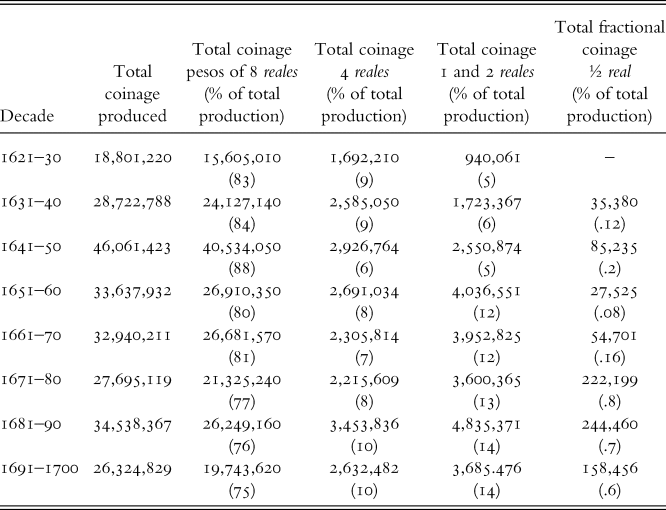
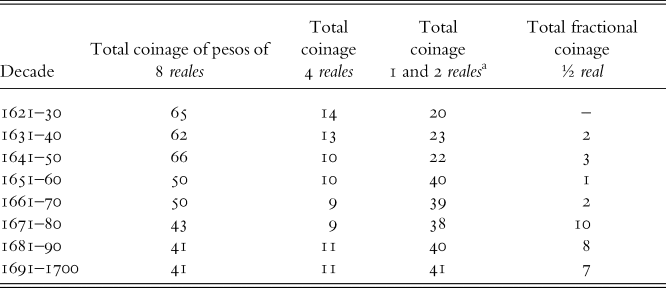
The Royal Order dictated that coin production should include 25 percent coins of 4 and 2 reales, 50 percent coins of 1 real and 25 percent fractionary coins of ½ and ¼ real (quartillo). It is important to note that the ordinance did not contemplate the production of the peso of 8 reales. However, as we show in Table 1, the official reports of the Potosi mint show that the 8 reales coin largely dominated coinage production in the 1600s. The proportion of silver pesos produced was never lower than 75 percent of the total value of the coinage. In Table 2, we show that in terms of the total number of coins produced, the production of silver pesos was also large, and consistently above 40 percent of the total volume. The production of coins of 4 reales, another relatively large coin, was above 10 percent. Fractional coin of ½ real was fairly limited, and the quartillo was not produced in the viceroyalty until 1792.Footnote 6 Unmistakably, these production rates were in violation of the original ordinances.
Potosi mintage 1620–1700 (coinage production in pesos of 272 maravedis)

Source: Elaborated from Potosi mint accounts. The values provided in the table do not add to the total figures because of ‘otras monedas’ (other coins) whose denomination is not specified in the accounts. The accounts are reproduced in Lazo (Reference Lazo García1992).
Potosi mintage 1620–1700 (percentage of total number of coins produced)

Source: Elaborated from the Potosi mint accounts. The accounts are reproduced in Lazo (Reference Lazo García1992).
a We note that according to Lazo, the entry for 1 and 2 reales was mostly composed of 2 reales coins although he does not give the specific relative weights. The numbers have been rounded up, and they do not necessarily add up to 100.
According to the regulations, the mint was required to provide all its accounts to colonial state agencies regularly. The official records should have given the colonial authorities access to the information needed to enforce the law governing denominational mix. Notwithstanding, it is unlikely that viceroyalty officials conducted thorough and regular evaluations of the accounts. Andrien (Reference Andrien1984) has demonstrated the vast inefficiencies of the colonial administration at the time. Particularly relevant for Potosi is Nestares Marín's report. Nestares Marín was a royally appointed official sent to Potosi to investigate the functioning of the Potosi mint. He found that no accurate records were kept at the Potosi Treasury for 20 years (Andrien Reference Andrien1984, p. 7). This situation seems to have only worsened later in the century (for an extensive discussion, see Andrien Reference Andrien1985).
Even if the reports were not evaluated regularly or were not an accurate representation of what was going on inside the mint, the high level of production of large-denomination coins was out in the open. It was clearly the case that the Potosi coinage did not adjust to the original regulations, as they did not contemplate the production of pesos, and the monetary authority could not plead ignorance in explaining its failure to take action.
How do we explain such oversight? It is certainly the case that the Crown sent Nestares Marín to Potosi, to address serious irregularities pertaining to the fineness of the Potosi coinage in the late 1640s. The historical evidence suggests that his focus was the control of fraud and the quality of the Potosi coinage and not the denominational mix (see, for example, Bakewell Reference Bakewell1988, pp. 36–44; see also Lane Reference Lane2017, Reference Lane2019). In terms of the latter, if anything, he sanctioned the reality on the ground. Under Nestares Marin's guidance, the silver peso coin continued to be produced at very large margins, and fractionary coinage continued to be absent (the quartillo) or underproduced (the ½ real coin). This result signals a marked shift in the monetary objectives of the Spanish Crown, from a minting process designed to supply coinage for the domestic market to a process heavily focused on the production of an export good: the silver peso of 8.Footnote 7
What can we say of such a shift? Historical evidence points to a number of explanatory factors. First, the silver merchants that brought silver to the Potosi mint were interested in large-denomination coins to advance their dealings in international markets, primarily the peso, but also the 4 reales coin (see Lazo Reference Lazo García1992, vol. ii, pp. 139–40). By the late sixteenth century, thanks to the massive production and exportation of the peso coin, the peso was already largely accepted as a means of exchange in the world economy (Marichal Reference Marichal, Frank, Marichal and Topik2006, p. 35). Importantly, by the early decades of the seventeenth century the peso became essential to finance the Spanish wars in Europe, particularly of armies in north-central Europe. In this way, as Marichal (Reference Marichal, Frank, Marichal and Topik2006, p. 37) puts it: ‘the Spanish state contributed forcefully to the transformation of the silver peso into a universal currency’. As the silver peso gained ascendancy in international markets, the Crown's incentives became increasingly aligned with those of the silver merchants or coinage producers.
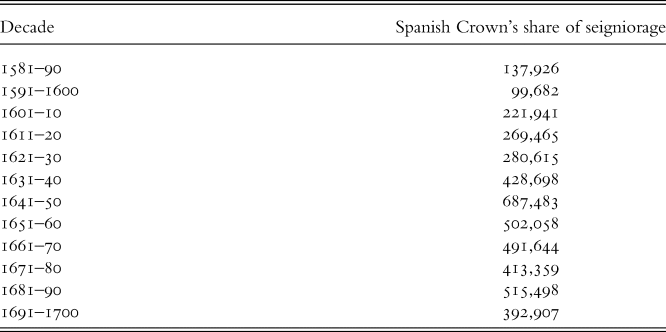
An additional issue to consider pertains to the Crown's fiscal incentives as a collector of seigniorage. As discussed in Section I, the higher the amount of small coinage produced, the lower the volume of silver processed into money and the lower the gross seigniorage produced per unit of time. To illustrate, a standard silver consignment (about 3,360 marks), yielded a total of around 28,140 pesos in around two weeks.Footnote 8 Coining the same consignment into quartillos would have required the production of 900,480 coins and would have taken a minimum of 64 weeks. In Table 3 we present estimates of the Crown's seigniorage from the Potosi mint in the 1600s. Seigniorage revenue was relatively modest compared to other sources of revenues. The Crown's seigniorage revenue was around 680,000 pesos in the 1640s and total remissions from Potosi to the Caja the Lima (the treasury of Lima, and the principal treasury agency in the viceroyalty) was 12.7 million pesos in the same decade. Notwithstanding, in the context of the major financial pressures the Spanish Crown experienced in the period, any losses on this front would not have been taken lightly.Footnote 9
Seigniorage Potosi mint in silver pesos (1581–1700)

Source: Elaborated applying seigniorage rate of 1 real per mark processed at the mint. Figures on silver brought to the mint from mint accounts reproduced in Lazo (Reference Lazo García1992).
Our investigation suggests that the literature has somewhat overstated the scarcity of coinage in the Peruvian viceroyalty.Footnote 10 Recall that the peso coin and the 4 reales coin were destined mostly for international markets. As shown in Tables 1 and 2, these two coins dominated coinage production throughout our period of study. Notwithstanding, the volume of coins of 2 and 1 reales produced was not trivial. In fact, their production was significant and in terms of number of coins produced, almost at par with the production of silver pesos in the late 1600s. It was certainly the case that the colonial state relied on these denominations to finance a number of expenditures, including ‘typical payments’, and war expenditures from the Real Hacienda (treasury). In addition, taxes like the Indian tribute were also paid in specie since the administration of Viceroy Toledo in the 1570s.Footnote 11 In 1643, Viceroy Mancera stated in a letter to the king that the scarcity of reales to cover the Real Hacienda expenditures was a major reason for considering establishing a mint in Lima (Suárez Reference Suárez and Contreras2016, p. 174). Complaints from Viceroy Mancera about the scarcity of reales might have had an impact, as it is during Nestares Marin's tenure, a few years later, that their production shows a significant increase.
All in all, our findings support the general perception that coinage production in the viceroyalty advanced mostly the interests of the elite. The Crown's and the silver merchants’ incentives were aligned with the production of large-denomination coins, while the domestic market – at least with respect to monetary services – was not prioritized. To be sure, the coins for domestic circulation produced at the Potosi mint (the 1 and 2 reales coins) were still relatively large and above the value of a variety of small transactions, such as hourly wages, common goods, etc. For example, 1 real could buy around 5 pounds of wheat in the 1600s, and an Indian laborer at a textile workshop (obraje) received a salary of 1 real per day in the 1670s.Footnote 12 Importantly, fractionary coinage ½ reales and quartillos, which were the ones needed by the poor for most domestic transactions (Quiroz Reference Quiroz and Contreras2016, pp. 201–2), were limited or altogether absent.
III
The Massachusetts Bay coinage, produced in Boston, was organized and managed locally, by the General Court, the government of Massachusetts Bay Colony. The General Court was comprised of a house of Deputies and a house of Magistrates, and exercised legislative, executive and judicial powers. It functioned as the monetary authority in Massachusetts. Britain's colonies in North America are infamous for their scarcity of specie in the eighteenth century.Footnote 13 Our research suggests that specie, while certainly not abundant, was less scarce in seventeenth-century Massachusetts, during the heyday of its mint, than it would be 60 years later.
Massachusetts Bay started down the path of monetary independence in 1642, when the Court increased the official value of silver from 5 shillings per ounce of sterling silver to 5 shillings for a ‘full weight’ piece of 8, effectively a price of 5 shillings 10 pence per ounce. This act was triggered by the desire to retain the foreign silver that Boston merchants received in payment for New England products sold in southern Europe and the West Indies (Jordan Reference Jordan2002, pp. 167–8). The silver coin was initially a welcome sight given the limitations of other forms of current money in Massachusetts (farm produce and wampum, or shell beads). However, records from the period reflect a concern with potential losses to individuals and the Colony from ‘light’ Spanish coin.Footnote 14
Much of the silver circulating in Boston was in the form of ‘cob’ coinage produced in Peruvian mints and exported to trading centers.Footnote 15 As mentioned earlier, the Peruvian cob coins were easily clipped (clipping shaved off pieces of silver that could be melted down and sold). Heavily clipped coins would have to be weighed to determine their value in trade.Footnote 16 At some point, Boston merchants became aware of a more serious problem: some proportion of the cob coinage was fraudulently minted below the required 93 percent fineness standard established by Spanish law. Under these conditions, it was risky for merchants to accept coin by tale, or at face value.
In 1652, the General Court addressed the problem of variable-weight and uncertain-fineness coin. It created a mint and a coin of its own to replace the cob coinage and wampum currency with a ‘better’ money. In setting up its own mint, the Court was taking advantage of a window of almost complete colonial freedom during the Commonwealth and Protectorate governments in England (1649–60).
Unlike Potosi, Massachusetts Bay was not ‘endowed’ with a silver resource, much less a resource as abundant as Potosi's. Silver consignments were a limiting factor for the Massachusetts mint, as shown by the intermittent, periodic nature of its operations. If Massachusetts wanted a coin of its own, it had to bid for the silver owned by local merchants and foreign traders with an appropriately high mint price.
The Colony engaged John Hull, the only silversmith in town, to issue and manage the New England coinage.Footnote 17 In addition to his transatlantic trade and shipping business, Hull held numerous elected and appointed public offices in Massachusetts, including selectman, or city councilor, for the town of Boston (1657–67), town treasurer for Boston (1658–67), deputy to the General Court for (Wenham in 1668, Westfield in 1672–4, Concord in 1676 and Salisbury in 1679), magistrate (1680–3), and treasurer of Massachusetts (1676–80) during King Phillip's War.Footnote 18
The contract between the mintmaster and the colonial state, in effect the mint ordinance itself, was delineated through a bargaining process between the two parties. As noted above, Hull and the General Court negotiated a gross seigniorage rate of 7.5 percent (Crosby Reference Crosby1878, pp. 37–9). If the mint was profitable, a residual of revenue went to the ‘shop’, the silversmith business that Hull owned with a partner, Robert Sanderson. Massachusetts Bay provided a public subsidy for the mint by appropriating funds to construct the mint house and to acquire the necessary equipment (Crosby Reference Crosby1878, p. 40).
The Colony took only a nominal lump-sum fiscal contribution in the renewals of the mint contract in 1660, 1667 and 1675, but no share of the annual gross revenue.Footnote 19 We see this factor, the authority's share of the gross seigniorage, as a significant one for coinage outcomes. First, by allowing the mintmaster to receive virtually all of the gross seigniorage generated by the mint, the General Court made it more likely that the mint would be economically viable and an attractive proposition for the mintmaster. This would be especially important for a small-scale mint that started and stopped throughout the year. Second, it gave no incentives to the General Court to adopt policies that would improve its fiscal return at the cost of the quality of the coinage. In practice, due to the very small scale of the Massachusetts coinage, the Court had no opportunity to secure meaningful fiscal return from its mint.
If the only purpose of the Massachusetts mint had been to produce a trustworthy coin, we would expect a New England coinage comprised of 5 shilling coins with approximately the same value as the peso of 8 they replaced. Instead, Massachusetts Bay authorized only the production of coins with smaller denominations than the peso. The 1652 Mint Act provided for coins of 1 shilling, 6 pence and 3 pence.Footnote 20 This suggests that its mint was established to do more than provide a reliable stock of currency that would circulate at tale, or face value, as significant as that was. Boston merchants did not need coin to settle larger transactions and debts among themselves; these payments were recorded, tracked and executed with entries to the ledger.Footnote 21 Instead, their manifest interest was in small-denomination coins that would support domestic trade (see Peterson Reference Peterson2019, esp. pp. 96–100). Indeed, the mint responded to the need to transform the large peso coin into smaller coins to pay for humble goods, wages, transportation services and some kinds of taxes. Furthermore, in 1662, as the need for even smaller change became apparent, Massachusetts Bay passed a law that authorized the minting of a new 2 pence coin. The mint was to produce 50 Massachusetts pounds of 2 pence coins for every 100 Massachusetts pounds of coins produced in the first year after adoption of the law, and at least 20 Massachusetts pounds of 2 pence coins for every 100 Massachusetts pounds of coins for the following six years (Crosby Reference Crosby1878, pp. 73–4).
The main question that remains to be addressed is whether Hull actually produced small-denomination coins as required by law and demanded by the market. The short answer is, we do not know for sure. Massachusetts did not require the mint to report regularly on total coinage and the number of coins by denomination. We cannot look to harsh sanctions in the Mint Act for denomination violations as a compliance device, because there were no sanctions in the Act for any type of violation. Although the mint was located in Boston, one block away from the Meeting House where the General Court met, the government could not monitor or observe the production of coin to ensure it was produced as the law directed.Footnote 22 If Hull kept a private record, it has not been preserved. Numismatic evidence from private collections allows us only to confirm that some coins of each denomination were produced in the Massachusetts mint, it does not allow us to infer how many coins of each denomination were struck.Footnote 23
Notwithstanding, circumstantial evidence points to an affirmative answer. First, as an upstanding member of the Puritan political elite, Hull cared about his reputation in his (Puritan) community, the leading members of which were users of his coin. If Hull failed to follow the law governing the coinage, he would put his personal reputation and social networks at risk. In this way, social regard and religious identity aligned the mintmaster's private interest with the public purpose.Footnote 24 Second, as a member of the merchant elite, he was interested in the production and circulation of small-denomination coins for the advancement of his own businesses, as his account book illustrates. Finally, based on the data and qualitative evidence at our disposal, we find that there was no major economic payoff to non-compliance. As noted above, because of the relatively small difference in weight between the largest and smallest coins, and the modest size of the coinage, the impact of small-coin production on Hull's income would not have been significant. Because the Massachusetts mint did not operate full-time, but only when it had silver consignments, Hull could accommodate the requirement to produce 2-pence coin by taking more time to process the silver consigned to it. The cost to Hull would have been the difference between the gross seigniorage on the small coins and the income the workers could have produced if they had worked on plate instead of coins.
All in all, there is no evidence, numismatic or otherwise, that Hull minted coins larger than the maximum denomination authorized by law, the 1 shilling coin, a fact sharply at variance with the Potosi case. The largest coin produced in the Massachusetts mint, was small enough to be a useful coin for trade and taxes. ‘Artificers’, or craftsmen, were paid 18 pence per day, with less skilled workers earning less. Gloves cost 2 shillings 4 pence per pair and stockings, 2 shillings 6 pence per pair, and one quart of brandy cost 2 shillings 6 pence per quart in the mid 1650s (McWilliams Reference McWilliams2007, p. 81).
Hull's account book provides evidence that ‘his’ money circulated widely in the Boston economy. The account book presents payments in, specifically, ‘mony’ that he made to meet his own obligations and on behalf of other merchants for customs, freight and cartage. Two new taxes were levied in 1668 that were to be specifically paid ‘in money’, which directed at least some of the New England shillings into the colonial treasury.Footnote 25 During King Philip's War in the late 1670s, Hull's account book records payments of 1 shilling and 2 shillings to soldiers that he made as the colony's treasurer, which were shillings coined in ‘his’ mint.Footnote 26
In sum, the colonial government of Massachusetts Bay did provide a small-denomination coinage to the local economy during the period the mint operated (1652–82). In doing so, the colonial state addressed the needs of a merchant elite, which was well represented in the General Court and actively involved in monetary policymaking.Footnote 27 Although the coinage law in Massachusetts was weak in terms of sanctions, the local usage of the coin provided a venue for the market to monitor compliance. The system relied heavily on reputation, trust and on market-monitoring mechanisms. As mentioned above, the Boston merchants who consigned silver to the mint were willing to receive, and needed, small-denomination coins – and would have noticed, and complained, if they were not provided.Footnote 28
Given the very modest scale of its coinage, it is hard to credit the leaders of Massachusetts with being virtuously willing to forgo revenue in order to provide for the liquidity needs of the local economy. In other work, we have estimated the average annual coinage in Massachusetts Bay at 55,000 shillings, for a gross seigniorage revenue of 4,125 shillings. The estimated average annual coinage is based on an assumption that New England's per capita stock of coin was half that of England at the middle of the seventeenth century, and that the Massachusetts mint operated very occasionally in the 1670s, when silver consignments were very low, about half of the year in the 1660s, and about one-third of the year in the 1650s when the mint was starting up (Jordan Reference Jordan2002; Mayhew Reference Mayhew1995; Palma Reference Palma2018). If the Colony had negotiated a one-fourth share of the gross seigniorage revenue (the Spanish Crown's share), it would have received an estimated 1031 shillings annually, or around 50 pounds. This would have made a marginal contribution to its annual budget; the Colony's annual expenses from 1650 to 1675 averaged between 1,800 and 2,000 pounds (Judd Reference Judd1976, pp. 198–9).
The lack of the resource endowment and the consequent small scale of the Massachusetts mint helped create the right incentives for the production of small-denomination coinage. Because its coinage was so small, Massachusetts Bay faced no meaningful tradeoff between drawing revenue from the mint and achieving its monetary objectives. Similarly, the Massachusetts mintmaster also faced no significant tradeoff between following the colony's coinage laws and the accumulation of private wealth.
IV
The two colonial societies studied here, like all early modern economies, faced the problem of small change. They both instituted the same gross seigniorage rate for large- and small-denomination coins, and neither subsidized the production of small-denomination coins in any discernible way. In this article, we have presented a variety of evidence showing that Massachusetts Bay provided small coinage to the local economy, whereas the Peruvian viceroyalty fell somewhat short, as its provision of fractionary coinage was fairly limited.
The resource endowment mattered. We show that in both realms the relative abundance (or scarcity) of silver was fundamental in shaping key parties’ incentives. The fact that Massachusetts Bay had no silver was both a blessing and a curse. The relative scarcity of silver in the colony set a limit to the opportunity cost of producing small coin, but in the long run made it impossible for the colony to maintain a shilling coin of its own. In the early 1670s an increase in the price of silver in the West Indies forced Massachusetts to raise the official price of silver within the colony, undermining Massachusetts’ ability to attract silver to the mint and keep its own shillings in local circulation. John Hull proposed an important change in 1680 to save the coinage and mint, arguing for a mint price of 90 pence, which would have attracted silver, but would have also made it much harder for the mint to physically produce a durable small coin, which would have been quite small indeed. In any event, Hull's proposal was readily rejected by the colonial authority, which at the time was under intense scrutiny by the English.Footnote 29 The mint consequently stopped operations in 1682.
In contrast, the main challenge to the Peruvian viceroyalty's original monetary goals was brought by the abundance of silver. The richness of the resource in the region was at the heart of the sizable provision of large-denomination coins, particularly the silver peso coin, which had become an extremely popular and well-recognized export good thanks in good measure to its abundant supply. Coins produced in Potosi were heavier, which allowed more leeway for the production of fractionary coins. The quartillo, the smallest coin sanctioned by the ordinances, weighed around .85 grams, whereas as we mentioned above, its close equivalent, the 2 pence coin, was about 10 percent lighter. In the Peruvian viceroyalty, however, the silver merchants’ and Crown's incentives were aligned with the supply of a well-sized and ample global currency, not with the provision of fractionary coinage for the domestic market. And those that were the most affected by the lack of small-denomination coins were not in a position to signal their discontent. At least not in our period of study.
The following century brought several critical changes to coinage production in Spanish America. The Bourbons instituted – albeit progressively – a major reform of the monetary system, including taking over of the administration of the colonial mints and adopting new technologies. Although the evidence suggests that colonial state revenues and seigniorage increased, whether the new administration managed more effectively the viceroyalties’ monetary needs remains to be investigated.
The implications of the abundance (or lack) of the silver endowment in our story might be read, by some, as further evidence for the resource curse hypothesis.Footnote 30 Although this article does not address directly the typical manifestations attributed to the curse of natural resources,Footnote 31 it does give evidence of other potential negative effects. Our study shows that the abundance of silver created incentives that hindered the production of a sensible mix of large- and small-denomination coins in the Peruvian viceroyalty. In contrast, in Massachusetts, the lack of the resource called for a more industrious approach to coinage production.