Inhaled corticosteroids (ICS) are the mainstay in the long-term management of asthma, and their use is recommended in all but its mildest forms.1 After the attacks on the World Trade Center (WTC) on September 11, 2001, in New York City, almost 11,000 firefighters were heavily exposed to airborne pollutants, including particulate dust and combustion products from the collapse of the buildings.Reference McGee, Chen and Cohen2–Reference Banauch, Dhala and Prezant7 Respiratory protection initially was unavailable, with more than half of the firefighters reporting that they never wore a mask or respirator on the first day, and that once protective gear was obtained it proved difficult to wear during subsequent operations.Reference Prezant, Kelly and Jackson8 At the time of the disaster, we were not aware of any data on the use of preventive, inhaled anti-inflammatory treatment to reduce the postexposure risk of developing asthma symptoms and other respiratory problems. This trial evaluated the effect of ICS started shortly after exposure to the WTC dust and combustion byproducts on lung function, the development of persistent respiratory symptoms, and airway hyperreactivity in Fire Department of New York (FDNY) firefighters.
METHODS
Subjects and Setting
Within minutes of the terrorist attacks on September 11, 2001, FDNY initiated a rescue and recovery effort at the WTC site, which lasted until July 2002.Reference Prezant, Weiden and Banauch9 As previously reported, appropriate respiratory protection generally was unavailable during the first days of the rescue and recovery effort.Reference Prezant, Kelly and Jackson8 On September 18–25, 2001, paramedics acting under an FDNY emergency disaster response protocol approached more than 10,000 firefighters who were at the staging area for deployment to the disaster site and offered them participation in a trial of budesonide via a dry powder inhaler (Pulmicort Turbuhaler, AstraZeneca, Wilmington, DE). For those who accepted, proper use of the inhaler was demonstrated and instructions given as to safety profile, off-label use, and dose (2 puffs daily for 4 weeks). Written material was distributed to reinforce instructions for daily use and the fact that clinical benefits would not be expected unless the medication was taken for 4 weeks. The names and contact numbers of physicians from the FDNY Bureau of Health Services were provided to schedule telephone or in-person visits to discuss questions or concerns at any time during this study. Participants signed a consent form that was approved by the Montefiore Medical Center Institutional Review Board.
FDNY firefighters who completed 4 weeks of daily ICS treatment had significantly greater increases in FVC and in perceived well-being
Study Design
This open-label, nonrandomized trial offered budesonide by inhaler to all of the available firefighters present at the WTC disaster site. Approximately 1 year later, the database of questionnaires administered at the time of the first post-9/11 FDNY-WTC Medical Monitoring Examination (MME) was searched to identify firefighters who reported 100% adherence to the 4-week course of ICS and their specific arrival time at Ground Zero, a surrogate measure of exposure to the WTC disaster site. These firefighters (n = 158) were contacted by mail and asked to call the FDNY Bureau of Health Services if they were willing to participate in an important clinical breathing study. Upon contact, a follow-up telephone call described details of the proposed visit and scheduled appointment times. People who were taking corticosteroids, either oral or inhaled, or leukotriene receptor antagonists (eg, Montelukast) were asked to discontinue their treatment 4 weeks before the scheduled visit. Those taking bronchodilators were told to continue use up to the day of the scheduled visit.
A comparison group of firefighters was identified from the same database. The comparison group was selected randomly from those who matched the treatment group by age (within 3 years) and specific WTC arrival time and who denied taking even 1 dose of ICS. We used frequency-matching, so that for arrival time, for example, the proportion of comparison group members that arrived early was the same as the proportion of early arrivals in the treatment group. This enabled us to use data from all of the people who had a follow-up visit. In addition, the same database was reviewed to determine firefighter preference (n = 7773) for use of ICS at future disasters.
FDNY categories for WTC arrival time were as described previously.Reference Prezant, Weiden and Banauch9 Briefly, group 1 firefighters were those who arrived before or during the collapse of Tower 2 and group 2 firefighters were those who arrived in the next 36 hours, either during the afternoon of the day of the collapse or the following day. Other exposure groups and partial treatment groups were excluded from this analysis.
Baseline Assessment
The baseline assessment included spirometry, respiratory symptom data, and information about the intention to use ICS in future disasters from questionnaires obtained at the time of the first post-9/11 FDNY-WTC-MME.
Spirometry (Model Portascreen, S&M Instruments, Doylestown, PA) from the first post-9/11 FDNY-WTC-MME was available for all of the participants. Predicted values were based on published normative data with race corrections for African Americans (National Health and Examination Nutrition Survey III).Reference Hankinson, Odencrantz and Fedan10 Forced vital capacity (FVC) and the forced expiratory volume at 1 second (FEV1) were expressed as absolute values and as percentage of predicted value. Testing adhered to the American Thoracic Society standards. 11–13 Quality review by a board-certified pulmonologist, blinded to participants' treatment status, resulted in the exclusion of 5 FVC and 5 FEV1 measurements due to substandard flow tracings.
Current respiratory symptoms (ie, frequent cough) were obtained from self-administered questionnaires as part of the first FDNY-WTC-MME and from the St George's Respiratory Questionnaire (SGRQ) administered at the final visit.
Final Visit
The final visit included spirometry (Model Portascreen) on all of the participants as described above, excluding 11 FVC and 7 FEV1 measurements determined to be substandard; methacholine challenge testing;Reference Crapo, Casaburi and Coates14 and an expanded self-administered questionnaire that included the SGRQ.Reference Jones, Quirk and Baveystock15
Methacholine challenge was performed on all of the firefighters (n = 64) from the treatment group and 70/72 (97.2%) from the comparison group. Exclusion criteria included: an FEV1 that was 65% of the predicted value or less, nonreproducible flow-volume loops, or use of an inhaled or systemic corticosteroid within the preceding month. Increasing concentrations of aerosolized methacholine (Provocholine, Methapharm, Coral Springs, FL) were inhaled until the FEV1 declined by 20% from the baseline value or the maximum concentration was reached (25 mg of methacholine per milliliter). Airway hyperreactivity was defined as 8 mg of methacholine per milliliter or less once FEV1 declined by 20% from the baseline value. Methacholine challenge testing met the standards and guidelines of the American Thoracic Society.Reference Crapo, Casaburi and Coates14
Questionnaire Data
A self-administered survey, which expanded on the survey given at the FDNY-WTC-MME, collected detailed information about the respondent's health-related quality of life at 2 time points, during the month before the survey and during the month after 9/11. Specifically, we used the SGRQ, a validated survey that measures the impact of respiratory impairment on overall health, daily life, and perceived well-being.Reference Jones, Quirk and Baveystock15 The SGRQ measures 3 domains: symptoms, activity, and impacts. Scores from 0 to 100 are calculated for each component and a total score, which we used in our analyses, summarizes responses for all of the items. A zero score indicates no impairment.Reference Wilson, Jones and O'Leary16
Analyses
Analyses compared results from those who indicated they had taken the prophylactic ICS as prescribed (treatment group) to those from the comparison (no treatment) group. Data were analyzed using SAS version 9.1 (SAS Institute, Cary, NC). Continuous variables were expressed as means ± standard deviation (SD) and assessed for statistical significance using the 2-sample t test. Categorical variables, expressed as frequencies or percentages, were assessed using the chi-square test. Mean differences in FVC rates and FEV1 rates by treatment group were calculated as the difference between FVC (or FEV1) at the final visit and FVC (or FEV1) at the first post-9/11 FDNY-WTC-MME divided by the years between measurements. Differences were considered statistically significant at the 2-tailed P < .05 level.
Multivariate linear regression analysis was used to assess an effect of prophylactic ICS on the dependent variable, mean difference in FVC rate, while controlling in a backward stepwise procedure for potential confounders including baseline FVC, exposure group (group 1 vs group 2), duration of exposure during the first week, age on 9/11, smoking history, recent treatment history (in the last 4 weeks), and mask or respirator use. A second model also used a backward stepwise procedure to assess an effect of prophylactic ICS and other variables on mean difference in the SGRQ total score over time, controlling for potential confounders including baseline SGRQ total score, exposure group (group 1 vs group 2), duration of exposure during the first week, age on 9/11, smoking history, recent treatment history (in the last 4 weeks), and mask or respirator use. The dependent variable was calculated as the difference between SGRQ at the final visit and SGRQ during the month following 9/11 divided by the years between measurements. The denominator was calculated as the difference between the date of the final visit and October 11, 2001.
To examine potential sources of confounding, we performed various additional analyses. Sensitivity analyses examined the impact of the difference in follow-up time between the groups by restricting data from the comparison group to people (n = 29) whose final visit was within the follow-up time of the treatment group (≤2.01 years). Stratified analyses examined the impact of respiratory medication use in the last 4 weeks (other than bronchodilators) on outcome indicators of disease severity.
RESULTS
In the period September 18–25, 2001, more than 10,000 firefighters who worked directly at the WTC disaster site were asked to participate in the ICS trial, of whom approximately 2700 agreed to do so. Only 158 (6%) completed 4 weeks of ICS treatment as per the study protocol.
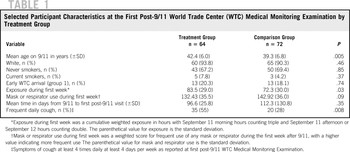
Final assessments were performed on 136 individuals, 64 who reported taking the full course of their prophylactic ICS and a matched comparison group of 72 who reported taking none. The mean time interval between the disaster and the first post-9/11 FDNY-WTC-MME was 104.9 days, which did not differ by treatment group. The groups also were similar in other characteristics (Table 1), except that the treatment group had a longer duration of unprotected exposure to the WTC disaster site during the first week (P = .03) and were, on average, 3 years older (mean, 42.4 vs 39.3 years; P = .005).
Selected Participant Characteristics at the First Post-9/11 World Trade Center (WTC) Medical Monitoring Examination by Treatment Group

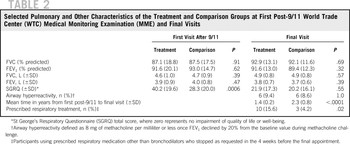
The time interval between the first post-9/11 spirometry and spirometry at the final visit was shorter for the treatment group: 1.4 years vs 2.3 years (P < .01; Table 2). At the time of the final visit, there was an increase in the FVC change rate per year in both groups, but the increase was significantly greater in the treatment group (230 vs 50 mL/y; P = .009). Similarly, there was a decline in FEV1 change rate per year in both groups, although the treatment group may have experienced a slower decline that did not attain statistical significance (20 vs 120 mL/y; P = .11).
Selected Pulmonary and Other Characteristics of the Treatment and Comparison Groups at First Post-9/11 World Trade Center (WTC) Medical Monitoring Examination (MME) and Final Visits

Restricting analyses of the comparison group to the subset of 29 individuals who were seen within the maximum follow-up time of the treatment group, we found an increase in FVC change rate per year of 90 mL, which remains considerably lower than the rate increase in the treatment group (230 mL/y) and no longer statistically different (P = .16). The FEV1 decline rate in the restricted group was 90 mL/y.
There was no difference between the groups in airway hyperreactivity as determined by methacholine challenge (9.4% positive in the treatment vs 8.6% positive in the comparison group; P = 1.0).
In response to the SGRQ at the final visit, the treatment group reported significantly greater impairment in well-being during the month after 9/11 (mean score 40.2 vs 28.3 for comparison group; P < .001), although the groups reported similar levels of impairment within the last month (mean score 21.9 treatment vs 20.2 for comparison group; P = .55). Accordingly, there was a greater decline in the severity of impairment reported by the treatment group (P < .01). To independently assess respiratory symptoms that were reported at the time of the first post-9/11 FDNY-WTC-MME, we examined symptom information from the earlier self-administered survey. These data corroborated the SGRQ data because the treated group was much more likely to report current symptoms of frequent cough (defined as coughing at least 4 times daily for at least 4 days per week) as compared with the no-treatment group (odds ratio [OR] 3.1; 95% confidence interval [CI] 1.5–6.4; P = .002) at the first post-9/11 visit.
To assess whether the 13 people with respiratory treatment in the last 4 weeks had a disproportionate impact on the SGRQ total scores, we reanalyzed the above excluding those with recent treatment. We found the mean SGRQ total score post-9/11 remained significantly different between the groups (38.4 treatment vs 27.4 comparison; P = .002), and similar levels of impairment were reported at the final visit (mean score, 19.6 treatment vs 19.3 comparison group; P = .89). These results are consistent with those from the larger group.
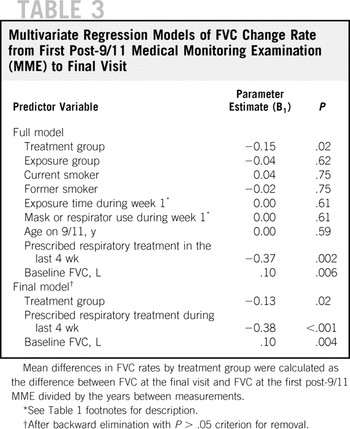
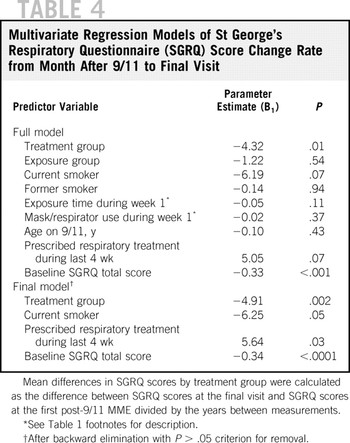
In the final multivariate regression model of FVC change rate, only 3 variables (baseline FVC in liters, respiratory treatment in the last 4 weeks, and prophylactic ICS treatment) were statistically significant correlates, whereas exposure group (group 1 vs group 2), smoking history, duration of exposure during the first week, mask or respirator use, and age on September 11, 2001, were not (Table 3). In the final multivariate model of perceived well-being as determined from the total score of the SGRQ, total score on the survey right after 9/11, current smoking, respiratory treatment in the last 4 weeks, and prophylactic ICS were statistically significant correlates whereas exposure group, former cigarette smoking, duration of exposure during the first week, mask or respirator use, and age on September 11, 2001, were not (Table 4).
Multivariate Regression Models of FVC Change Rate from First Post-9/11 Medical Monitoring Examination (MME) to Final Visit

Multivariate Regression Models of St George's Respiratory Questionnaire (SGRQ) Score Change Rate from Month After 9/11 to Final Visit

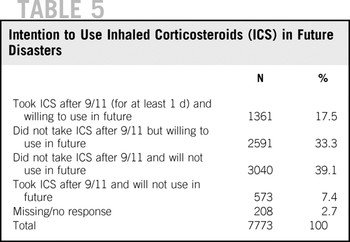
Finally, we examined information about intention to use ICS in future disasters and found a willingness to use it in about half of the people surveyed (Table 5).
Intention to Use Inhaled Corticosteroids (ICS) in Future Disasters

DISCUSSION
This trial evaluated the effects of prophylactic ICS in firefighters exposed to the WTC disaster on September 11, 2001. One to 2 years after the attacks, we found that FDNY firefighters who completed 4 weeks of daily ICS treatment had significantly greater increases in FVC and in perceived well-being on the SGRQ as compared with an age- and exposure-matched comparison group that did not accept treatment. There was no difference in airway hyperreactivity and no evidence of adverse effects from ICS.
The WTC collapse and subsequent recovery efforts released large amounts of particulate dust and other noxious materials that have been characterized previously.Reference McGee, Chen and Cohen2–Reference Banauch, Dhala and Prezant7 A substantial proportion of rescue workers present at the site at the time of collapse and during the ensuring recovery operation experienced heavy inhalation exposure and developed a cough, dyspnea, wheezing, airway hyperreactivity, and/or a decline in pulmonary function.Reference Prezant, Weiden and Banauch9, Reference Banauch, Hall and Weiden17 Acute and chronic airway inflammation initiated by irritant exposure appears to be an important pathway leading to the development of asthma, reactive airways dysfunction syndrome,Reference Tuncale and Brooks18 and/or chronic obstructive airways disease. In 12,079 FDNY WTC rescue workers, pulmonary function (FVC and FEV1) measured during the first year after the attacks was found to decrease by an average of 372 mL, or 12 times the annual decline rate over the prior 5 years.Reference Banauch, Hall and Weiden17 Recently, the WTC Registry, in a study of more than 25,000 WTC workers including a sample of firefighters and other rescuers, found that participant reports of newly diagnosed asthma were increased substantially as compared with the expected rate in the unexposed general population.Reference Wheeler, McKelvey and Thorpe19 This underscores the potential public health impact of our findings that prophylactic ICS be considered along with respiratory protection to minimize lung function insult and perhaps accelerate restoration of respiratory health including improvement in perceived well-being in disaster situations.
We have anecdotal information from non-ICS enrollees and non-ICS adherents. “Steroid fear” was the most often stated reason for nonenrollment. Nonetheless, approximately 2700 firefighters accepted the inhalers. “No immediate effect” of the treatment followed by “steroid fear” were the reasons most often given for nonadherence among those who did enroll in the study. This occurred despite verbal and written instructions that should have addressed these issues, although education time during enrollment was limited and continued education during the 4 weeks to reinforce these issues was not part of this protocol. Although understandable given the conditions at the time, the effort spent addressing these issues apparently was less than adequate. This underscores the importance of education and ongoing support, especially when stress levels are high, risk is perceived, and no immediate health benefit is obvious to the participants. Continuing patient education should focus on fully describing the risks and benefits of prophylactic medication use and on correcting misperceptions of risk and immediate benefit. Of note, no significant ICS side effects were reported.
Other data from this cohort provide encouraging evidence for feasibility of future use of prophylactic ICS. Respiratory problems subsequent to 9/11 are now widely known, and we found a willingness to use ICS in about half of those surveyed—a much higher proportion than the estimated 27% who accepted ICS in the present study.
Although we believe that our results suggest ICS benefit, we urge caution for the following reasons. First, there is likely self-selection bias in the treated group, because the majority of firefighters who accepted ICS did not take the medication as prescribed. Although the multivariable analyses controlled for potential confounders such as baseline values, exposure group (group 1 vs group 2), duration of exposure during the first week, age on 9/11, smoking history, recent treatment history, and mask or respirator use, we could only control for those confounders about which we knew and had data. Those who took prophylactic ICS may have been more health conscious and acted in unknown ways to minimize their risk of adverse respiratory effects. A related problem is that only 41% of firefighters who reported full adherence to the ICS protocol participated in the final visit, raising further concerns about the uniqueness of those who both took their medications as recommended and agreed to participate in the final visit. In addition, most of the study outcomes used rates per year to adjust for the difference in follow-up time between the groups, in an attempt to mitigate the influence of time alone on healing. We performed sensitivity analyses to examine whether the difference in follow-up time could have biased our results. Although this potential for bias cannot be ruled out, it is reassuring that results from the sensitivity analyses were generally consistent with the direction of the full group analyses.
Recall bias could have occurred in collection of information about respiratory symptoms during the time points of interest. At the final visit, the SGRQ queried participants about their current symptoms (in the last month) and their symptoms during the month after 9/11. If recall bias influenced the untreated group to systematically report fewer symptoms of respiratory distress during the 9/11 time period, then this would have made it appear as though the treatment group had more symptoms during the month after 9/11 and, therefore, had greater improvement at the time of the final visit. However, the more likely explanation is that greater actual distress did occur among those in the treatment group because respiratory symptoms independently collected at the first post-9/11 FDNY-WTC-MME indicated that those in the treatment group were more than 3 times as likely as those in the comparison group to report frequent daily cough as a problem. Furthermore, the SGRQ is a validated disease-specific instrument designed to measure impact on overall health, daily life, and perceived well-being of people with fixed and reversible airway obstruction.20 Thus, we believe that SGRQ data did reflect a significantly reduced quality of life in the month after 9/11, at least in the treatment group, that improved over time. Finally, although we did not find a difference in airway hyperreactivity between the treatment and comparison groups, the improvement in both pulmonary function and perceived well-being suggests the benefit of prophylactic ICS in disaster situations.
CONCLUSIONS
We undertook this ICS trial to assess whether prophylactic treatment could assist restoration of pulmonary function and decrease the negative impact on quality of life triggered by massive dust inhalation when started shortly after the exposure. This information could be of great public health importance in other environmental disasters and, if confirmed, may offer a reasonable strategy for first responders in any disaster circumstance because adequate, fit-tested respiratory protection almost never is immediately available and, once provided, is difficult to wear at all times. Although we are cautious in extrapolating these findings to other settings because of the small number of firefighters who participated in this trial and the unique environmental conditions found at this disaster site, it may be reasonable to consider starting prophylactic ICS immediately upon exposure to a disaster site and continue use for 4 weeks while fully complying with the use of respiratory protection as soon as available. With no evidence of adverse side effects, the evidence of benefits of ICS observed here suggests that pending further study with a larger sample, prophylactic ICS should be considered as an adjunct safety measure to appropriate fit-tested respirators for first responders and other workers at disaster sites to minimize possible lung insult.
Authors' Disclosures
The authors report no conflicts of interest.
Acknowledgments
This research was conducted with support from the Investigator-Sponsored Study Program of AstraZeneca, and the use of inhaled corticosteroids may be considered off-label use. The sponsors had no involvement in the design and conduct of the study; in the collection, management, analysis, and interpretation of the data; or in the preparation of the manuscript.