

Although there is growing interest in the effect of orthographic input on second language (L2) phonological acquisition (e.g., Bassetti, Reference Bassetti, Guder, Jiang and Wan2007, Reference Bassetti, Thorsten and Young-Scholten2008; Erdener & Burnham, Reference Erdener and Burnham2005; Escudero & Wanrooij, Reference Escudero and Wanrooij2010; Hayes-Harb, Nicol, & Barker Reference Hayes-Harb, Nicol and Barker2010; Rafat, Reference Rafat2013; Steele, Reference Steele2005; Young-Scholten, Reference Young-Scholten, Burmeister, Piske and Rohde2002), less is known about the interaction between orthographic input and the acoustic properties of the input in the production of L2 sounds by naive speakers. This study has two aims: (a) to investigate whether orthographic input affects English-speaking participants’ production of Spanish assibilated/fricative rhotics (e.g., [ ] in <ahumar>–[auma]); and (b) to determine whether any effect of orthographic input is modulated by the acoustic properties of the assibilated/fricative rhotics in the words in the auditory input.
EFFECT OF EXPOSURE TO ORTHOGRAPHIC INPUT IN L2 SPEECH
A number of studies have provided empirical evidence for both the negative (e.g., Bassetti Reference Bassetti, Guder, Jiang and Wan2007; Erdener & Burnham, Reference Erdener and Burnham2005; Hayes-Harb et al., Reference Hayes-Harb, Nicol and Barker2010; Young-Scholten, Reference Young-Scholten2000; Young-Scholten, Akita, & Cross, Reference Young-Scholten, Akita, Cross, Robinson and Jungheim1999) and the positive (e.g., Erdener & Burnham, Reference Erdener and Burnham2005; Showalter & Hayes-Harb, Reference Showalter and Hayes-Harb2013; Steele, Reference Steele2005) effects of orthographic input in L2 speech learning. This research has generally investigated the role of orthographic input in L2 speech from a phonological point of view, whereas fewer studies have examined orthographic–auditory interactions from an acoustic/phonetic point of view.
With respect to the negative effects of orthographic input on L2 production, Young-Scholten et al. (Reference Young-Scholten, Akita, Cross, Robinson and Jungheim1999) highlighted the effect of the presence of orthographic input at learning and/or during testing on transfer in the production of Polish clusters. They tested Polish word learning by both English- and Japanese-speaking participants who had no knowledge of Polish. Participants were divided into auditory-only and auditory–orthographic groups. Both groups were exposed to the auditory form of words and associated pictures, but the auditory–orthographic group was also exposed to the words’ written forms. During testing, the participants recalled and produced all the words they had been required to learn and then performed a picture-naming task, in which some were exposed to the orthographic forms of the words. In the presence of the written forms, the rate of epenthesis in clusters for the English-speaking group was higher than the rate of deletion (Young-Scholten, Reference Young-Scholten, Burmeister, Piske and Rohde2002). The results were interpreted as orthographic input enhancing the encoding of the input, therefore promoting epenthesis as opposed to deletion.
Hayes-Harb et al. (Reference Hayes-Harb, Nicol and Barker2010) investigated the interfering effect of orthographic input in adult English speakers learning bisyllabic English-like pseudowords. The experiment consisted of three different conditions at training: auditory-only, congruent, and congruent/incongruent orthographic. The incongruent stimuli consisted of items spelled with a “wrong” letter (e.g., <faza>-[faʃə]) and items with an extra letter (e.g., <kamand>–[kaməd]). At test, the participants were shown an image and heard a word, and were then asked whether the auditory word was the correct word for the image. They found a significant effect of training condition on performance on the wrong-letter items, in which participants had a lower rate of accuracy in the incongruent/congruent orthography condition. This was interpreted as first language (L1) grapheme-to-phoneme correspondences interfering in novel word learning, when the L1 and the target language grapheme-to-phoneme correspondences do not match.
Young-Scholten (Reference Young-Scholten2000) also provided evidence of the hindering effects of orthographic input. In particular, she investigated the effect of inconsistency (the degree to which a grapheme corresponds to an individual phoneme) between the L1 and the target language, and the amount of exposure to orthographic input in the L2 production of the final devoicing rule in German by English-speaking exchange students. In German, obstruents are devoiced in syllable-final position; however, this rule is not represented in the orthography. For example, /bʊnd/ is realized as [bʊnt] but is spelled <bund> rather than *<bunt> in writing. Young-Scholten collected data on a monthly basis over a period of 11 months via a production task. Learners were also required to provide ratings of their own amount of exposure to aural and orthographic input. The results showed that the higher the amount of exposure to orthographic input, the lower the rate of final devoicing would be in the learners’ production.
Bassetti (Reference Bassetti, Guder, Jiang and Wan2007) investigated the effect of orthographic inconsistency within the target language. She studied the production of triphthongs in Mandarin. She tested adult Italian-speaking learners of Mandarin studying at a university in Italy, who used the alphabetic pinyin writing system. On average, the participants had studied Mandarin for 33 months. Although the participants had not been exposed to pinyin orthography during the character-reading task, their production of triphthongs was affected by the written representation of these triphthongs in pinyin. For example, learners had a 100% targetlike realization of the vowel /o/ in the triphthong /iou/ when it was written with three graphemes as in <you>. However, erroneous productions were attested when the triphthongs were spelled with only two graphemes (e.g., <iu> for /iou/). This was explained in terms of pinyin generally being a transparent orthographic system, and the learners’ overgeneralization of this aspect of pinyin.
Erdener and Burnham (Reference Erdener and Burnham2005) found both positive and negative effects for orthographic input on L2 production in naive listeners. They studied the effect of exposure to different auditory, orthographic, and visual input on production in adults with L1 orthographies of differing degrees of transparency. Specifically, Spanish and Irish word-repetition tasks were conducted with adult Australian speakers of English and adult Turkish speakers. Although there was evidence of L1-based phonological transfer resulting in nontargetlike productions in the presence of orthographic input, the results also yielded a significant facilitative effect of the orthographic condition in comparison with the auditory-only condition for both language groups. For example, there was a significantly lower rate of Spanish bilabial confusion in the orthographic condition than in the auditory-only condition for the Turkish participants. This pattern was also observed for the Australian participants in the orthographic and auditory-only conditions. However, the facilitative effect was stronger for the Turkish-speaking group than for their English-speaking counterpart. The authors attributed the between-group differences to the degree of transparency of L1 orthography.Footnote 1 Moreover, given the differences in the degree of orthographic transparency between Turkish and English, the authors concluded that Turkish speakers process the auditory–orthographic input using grapheme-to-phoneme conversions, whereas English speakers might develop picture–orthographic representations of new words.
Escudero and Wanrooij (Reference Escudero and Wanrooij2010) found further evidence of both hindering and facilitating effects of orthographic input. In a series of experiments, they tested the perception of naive listeners in addition to beginner and advanced Spanish-speaking learners of Dutch. The Dutch contrasts tested were /a–ɑ/, /i–ɪ/, /y–ʏ/, /ɪ–ʏ/, and /i–ʏ/. All participants were required to perform an auditory categorization task and an auditory–orthographic task that had an XAB format. They found that orthographic input rendered the most difficult phoneme (e.g., /ɑ/), and therefore the most difficult contrast (e.g., /a–ɑ/), in the auditory task, the easiest in the auditory–orthographic condition. Conversely, the easiest contrast (e.g., /y–ʏ/) was the easiest to identify in the orthographic condition. The authors proposed that exposure to orthographic input had both positive and negative effects. The provision of the digraph <ɑɑ> prompted learners to pay attention to the durational difference between /a/ and /ɑ/ and correctly classify /ɑ/ as a longer vowel. In contrast, the digraph <uu> had a hindering effect on the classification of /y/ because /y/ is not long in Dutch.
Escudero, Hayes-Harb, and Mitterer (Reference Escudero, Hayes-Harb and Mitterer2008) found further evidence that exposure to orthographic input can facilitate L2 phonological acquisition. They tested the effect of training with an auditory versus auditory–orthographic task on the acquisition of the L2 English contrast /æ/ and /ɛ/ (e.g., contained in the nonwords /bæskəl/ and /bɛstət/). Participants were 50 highly proficient Dutch speakers, who learned English nonwords by matching their auditory forms to pictured meanings. In the orthographic task, the participants additionally saw the written forms (e.g., <bestet> for /bɛstət/ and <baskle> for /bæskəl/). Upon the completion of the word-learning tasks, researchers used eye tracking to examine the learners’ ability to identify the target spoken word from a set of pictures. The results demonstrated that the group who had received auditory training fixated on both pictures of words with /æ/ and /ɛ/ when presented with auditory tokens of either /æ/ or /ɛ/. However, the participants in the auditory–orthographic condition only fixated on pictures of words containing /ɛ/, when presented with spoken words containing /ɛ/, and on both pictures of words with /æ/ and /ɛ/, when presented with spoken words containing /æ/. Given that the graphemes <a> and <e> map to two different phonemes (i.e., a Dutch low back vowel and a front central vowel, respectively), the authors interpreted the results as learners making use of grapheme-to-phoneme correspondences to establish new phonological lexical representations.
The above studies investigated both negative and positive auditory–orthographic effects mostly from a phonological point of view. A more acoustic/phonetic approach has been adopted in Steele (Reference Steele2005) and Rafat (Reference Rafat2013). Steele (Reference Steele2005) investigated the acquisition of stop-liquid clusters by beginner Mandarin-speaking learners of French. In French, rhotics in voiceless stop-rhotic clusters tend to be realized as a voiceless fricative (e.g., <préfet> /pʁefɛ/ is realized as [pχefɛ]). The results of a word-learning task for the orthographic group showed that the learners outperformed the nonorthographic group by having a lower rate of rhotic deletion in voiceless clusters and a higher accuracy of voiceless stop-rhotic realizations. In the nonorthographic group, the voiceless stop-rhotic clusters were realized as single aspirated stops (e.g., <préfet> /pʁefɛ/ was produced as [pχefɛ] or [pʰefɛe]). Because voiceless stop-rhotic clusters produced with a voiceless fricative rhotic and aspirated stops are similar in Mandarin, Steele concluded that learners perceived these clusters as an aspirated stop in the absence of orthography but realized that the target forms involve two segments in the presence of orthography.
An acoustic–phonetic approach was also taken in Rafat (Reference Rafat2013). She tested 40 naive English speakers of Spanish who had never been exposed to Spanish. Rafat examined the effect of exposure to orthographic input at training and during testing, in addition to the effect of the type of grapheme-to-phoneme correspondence, on the rate of L1-based phonological transfer. Transfer was defined as production of an English phoneme when the grapheme corresponded to a different sound in Spanish (e.g., the production of [v] instead of [b] for the grapheme <v> that corresponds to [b] in Spanish but to [v] in English word-initially). All groups were exposed to auditory input at training only. With respect to the orthographic input, the ortho-training group was exposed to orthographic input at training only. The ortho-training and testing group was exposed to orthographic input at training and testing. The ortho-testing group was exposed to orthographic input during testing only. The auditory-only group was not exposed to orthographic input. The results demonstrated that exposure to orthographic input triggered the highest rate of transfer of the L1 sounds when orthography was present at training. However, the difference between the ortho-training and ortho-training testing groups was not significantly different. Moreover, the ortho-testing group had a lower rate of L1-based transfer compared to the previous two groups. In addition, there was very little L1-based transfer in the auditory-only control group (0.08%). With regard to the effect of grapheme-to-phoneme correspondences that differ between Spanish and English, different grapheme-to-phoneme correspondences resulted in significantly different rates of transfer. For example, in the group where orthography was present at training only, <v>–[b] resulted in 92% transfer, while <ll>–[j] only resulted in 21% transfer.Footnote 2 Rafat (Reference Rafat2013) proposed that the relative degree of acoustic–phonetic salience between a target language and an L1 sound determines the rate of L1-based transfer. The larger the acoustic–phonetic difference between the target language and the L1 sound that correspond to the same grapheme in both languages (e.g., the difference between [j] and [l], which correspond to the grapheme <ll> in both languages, in comparison with [v] and [b], which correspond to <v> in both languages), the lower the rate of L1-based orthography-induced transfer.
Most of the studies reviewed here have considered the relationship between orthography and phonology, with less evidence available for the interaction of orthographic and target language acoustic–phonetic input. The present study aims to fill this gap in the literature by investigating whether the acoustic properties of the input modulate the potential orthographic effects in the speech production of naive speakers of an L2.
ASSIBILATED/FRICATIVE RHOTICS
Across languages, rhotics often alternate with fricatives (Solé, Reference Solé, Dressler, Luschützky, Pfeiffer and Rennison1992, Reference Solé1998, Reference Solé2002), and their unity as a class is questionable. Moreover, their members have been grouped together diachronically mostly because of their orthographic representation, namely, the letter <r> (Ladefoged & Maddieson, Reference Ladefoged and Maddieson1996). Whereas the American English rhotic is typically characterized as an approximant phoneme with retroflexed and bunched variants (e.g., Delattre & Freeman, Reference Delattre and Freeman1968; Westbury, Hashi, & Lindstrom, Reference Westbury, Hashi and Lindstrom1999; Zhou et al., Reference Zhou, Espy-Wilson, Boyce, Tiede, Holland and Choe2008), Spanish exhibits more variation in the acoustics of rhotics. Spanish rhotic phonemes include the tap and the trill, which are contrastive word-medially (e.g., <pero>–[peɾo] vs. <perro>–[pero]) and can have an assibilated/fricative [] and/or approximant [ɹ] realization (e.g., Blecua, Reference Blecua2001), among other variants (Bradley & Willis, Reference Bradley and Willis2012). The assibilated/fricative rhotic in Spanish is characterized as a kind of strident fricative (e.g., Bradley, Reference Bradley, Authier, Bullock and Reed1999; Lipski, Reference Lipski1994; Quilis, Reference Quilis1999; Widdison, Reference Widdison1998) and is found in a number of varieties of Spanish, including the Spanish of the Andean highlands (Bradley, Reference Bradley, Authier, Bullock and Reed1999; Colantoni, Reference Colantoni2001, Reference Colantoni, Toribio and Sagarra2006; Colantoni & Rafat, Reference Colantoni, Rafat, Colantoni and Rodríguez Louro2013; Lipski, Reference Lipski1994; Quilis, Reference Quilis1999; Widdison, Reference Widdison1998), Costa Rica (Vásquez Carranza, Reference Vásquez Carranza2006) and Mexican Spanish, in particular in Mexico City (Harris, Reference Harris1969; Rissel, Reference Rissel1989).Footnote 3 In terms of its distribution, it can appear in onset position both word-initially (e.g., <rico> [i.ko] “rich”; Bradley, Reference Bradley, Authier, Bullock and Reed1999), and word-medially (Bradley, Reference Bradley, Authier, Bullock and Reed1999; Harris, Reference Harris1969). Word-medially, it can be found both intervocalically, where it varies with the trill (e.g., <perro>–[pe.o], “dog”; Bradley, Reference Bradley, Authier, Bullock and Reed1999), and postconsonantally (e.g., <Israel>–[iz.a.el] “Israel”; Harris, Reference Harris1969). It can also occur in coda position both word-medially (e.g., <verde>–[be.ðe] “green”; Bradley, Reference Bradley and Face2002) and word-finally (e.g., <mar>–[ma] “sea”; Bradley, Reference Bradley, Authier, Bullock and Reed1999). In addition to being subject to dialectal variation, it is also constrained by external factors such as prestige and formality. For example, it was reported to have prestige in Mexico City (Rissel, Reference Rissel1989), to be a characteristic of the less formal register in Peninsular Spanish (Navarro Tomás, Reference Navarro Tomás1971) and an informal register in Ecuadorian Spanish (Bradley, Reference Bradley, Authier, Bullock and Reed1999).
Because of their varied acoustic nature, assibilated/fricative rhotics provide an excellent opportunity for examining whether participants’ productions have an acoustic basis when they are exposed to both auditory and orthographic input during training. Assibilated/fricative rhotics have been likened to palato-alveolar sibilants from an acoustic–phonetic point of view in particular for their articulatory and acoustic similarity (Colantoni, Reference Colantoni, Toribio and Sagarra2006; Hall, Reference Hall1997; Solé, Reference Solé2002). Maddieson (Reference Maddieson1984) goes as far as claiming that there are no actual differences between assibilated/fricative rhotics and sibilant fricatives. The results obtained by Colantoni (Reference Colantoni, Toribio and Sagarra2006) also indicate a number of acoustic similarities between assibilated/fricative rhotics and sibilants. For example, she found no differences in the degree of periodicity of assibilated/fricative rhotics and postalveolar sibilants. In addition, they were similar to English sibilants in terms of place of articulation. Based on these studies, it is therefore plausible that Spanish assibilated/fricative rhotics are actually more like fricatives, in particular sibilants, than rhotics. In addition, the general statement by Ladefoged and Maddieson (Reference Ladefoged and Maddieson1996) regarding the unity of rhotics as a class might apply to these “rhotics” as well. That is, assibilated/fricative rhotics might have been classified as rhotics predominantly because of their orthographic representation by the graphemes <r> and <rr> in Spanish.
In contrast, it might be the case that assibilated/fricative rhotics are acoustically similar to both sibilants/fricatives and rhotics, and it has also been proposed that they differ from sibilants/fricatives mainly in the presence of trilling and the frequency of the noise spectrum (Ladefoged & Maddieson, Reference Ladefoged and Maddieson1996; Quilis & Carril, Reference Quilis and Carril1971). The acoustic complexity of these sounds, namely, the potential similarity of these sounds to sibilants/fricatives, the possibility that they might be composed of both assibilation/frication and rhoticity, and that <r> maps on to an approximant rhotic, allow us to investigate how orthographic input may interact with the acoustic information in naive speakers of Spanish.
L2 PRODUCTION OF RHOTICS
Previous studies on the production of Spanish rhotics have focused on the L1 (Bosch, Reference Bosch1983; Carballo & Mendoza, Reference Carballo and Mendoza2000; Jiménez, Reference Jiménez1987) and L2 (Colantoni & Steele, Reference Colantoni and Steele2007, Reference Colantoni and Steele2008; Face, Reference Face, Klee and Face2006; Major, Reference Major1986; Rafat Reference Rafat2008; Reeder, Reference Reeder1998; Waltmunson, Reference Waltmunson2005) production of Spanish tap and/or trill. The general consensus is that both of these sounds pose difficulty for production for learners, albeit the trill does so more than the tap. In addition, some of these studies (e.g., Face, Reference Face, Klee and Face2006; Major, Reference Major1986) show that in the process of acquisition, transfer of the L1 approximant rhotic together with developmental processes, are common phenomena. There have been no previous studies that have examined the production of assibilated/fricative rhotics, an allophone of both the tap and the trill. Moreover, most of these studies have considered the L1 and L2 production of Spanish rhotics without investigating the effect of L1 or L2 orthography (see Rafat, Reference Rafat2008, for a counterexample).
The L2 production of rhotics has also been studied from an acoustic–phonetic perspective. Colantoni and Steele (Reference Colantoni and Steele2007) investigated the production of French /r/ by intermediate and advanced English-speaking learners of French. The results showed that when a segment was composed of multiple parameters (e.g., manner and voicing), learners were more accurate on the more salient (prominent) feature of the segment (e.g., manner before voicing). In addition, there was evidence for a positional asymmetry, in which learners had more targetlike productions with manner in onsets and more targetlike realization of voicing in codas. The results echoed Steriade's (Reference Steriade1999) hypotheses with respect to salience of manner, and voicing and positional asymmetries.
THE PRESENT STUDY
L2 production of assibilated/fricative rhotics has received relatively little attention in the literature, despite (a) the frequency of these segments in the Spanish-speaking world, (b) the production of other rhotics being reported to be difficult in both L1 (Bosch, Reference Bosch1983; Carballo & Mendoza, Reference Carballo and Mendoza2000; Jiménez, Reference Jiménez1987) and L2 (Bosch, Reference Bosch1983; Carballo & Mendoza, Reference Carballo and Mendoza2000; Jiménez, Reference Jiménez1987) acquisition, (c) that Spanish and English share a grapheme (i.e., <r>) that corresponds to different types of rhotics, and (d) that assibiliated/fricative rhotics are variable in nature.
We thus posed the following two questions:
1. Do naive English speakers of Spanish who are exposed to auditory and orthographic input (auditory–orthographic group) show different patterns of production compared with those who are exposed to auditory input only (auditory-only group)?
2. Are the effects of the orthographic input modulated by the acoustic characteristics of the auditory input?
In order to investigate the effect of orthographic input in the participants’ assibilated/fricative rhotic productions, we first examined whether two groups of participants exhibited differential production performance depending on the presence or absence of orthographic input available to them during an exposure phase. The groups analyzed in this paper include the auditory-only group, who were only exposed to auditory input at training, and the auditory–orthographic group who were exposed to auditory input at training and to orthographic input at both training and during testing/production. In order to determine whether any orthographic effects are modulated by acoustic input, we then conducted an acoustic analysis of various dimensions (e.g., assibilation and rhoticity) of the auditory input (six words, one token each, produced by a native speaker of a Mexican variety of Spanish) that the participants were exposed to. This was followed by an analysis of the six individual words in the auditory input, in which we examined the correlation between various acoustic dimensions of assibilated/fricative rhotics in the auditory input and targetlike productions of assibilated/fricative rhotics by the participants in the auditory–orthographic group.
We predict that the patterns of acquisition of Spanish assibilated/fricative rhotics will differ between the auditory–orthographic and auditory-only groups. Exposure to orthographic input will disambiguate the input (Steele, Reference Steele2005); specifically, the presence of the grapheme <r> will trigger L1-based phonological transfer (Rafat, Reference Rafat2013), making rhoticity more salient and resulting in a higher rate of assibilated/fricative rhotic productions in the auditory–orthographic group. In addition, the potential effects of orthographic input on naive participants’ assibilated/fricative rhotic productions will be modulated by the acoustic characteristics of the auditory input. Specifically, the degree of assibilation/frication (e.g., the higher the center of gravity [COG], second formant [F2], duration, relative duration, and relative intensity values) in the assibilated/fricative rhotics in the six words in the auditory input should correlate with the number of assibilated/fricative rhotic productions by the participants in the auditory–orthographic group. This is because the assibilation/fricative features of the target language sounds will be sufficiently salient/robust and will not be overridden by the effect of orthographic input.
METHODS
Participants
Participants were 20 native speakers of Canadian English. They were randomly assigned to one of two groups: auditory-only or auditory–orthographic input. The study was conducted in Toronto. Minimal knowledge of French (which is taught in schools) did not disqualify individuals from participation because it does not have assibilated/fricative rhotics. None of the participants had substantial prior exposure to any languages other than English and French. Further, the study was restricted to only participants whose parents’ native language was English and who had been raised in households where only English was spoken. All participants were over 18 (mean age = 21 years, 8 months; age range = 19–60). They had at least 12 years of education and stated that they did not have any speech or cognitive impairments.
Stimuli
The data presented here were collected as part of a larger study with a total of 108 Spanish word stimuli. Results concerning a different subset of the 108 words are presented in Rafat (Reference Rafat2013); here, only six of the original 108 words are in focus. They are: <ahumar> [auma], <aherir> [aeɾi], <rehogar> [reoga], <ahitar> [aita], <ahotar> [aota], and <ahincar> [aiŋka]. These words all contained an assibilated/fricative rhotic word-finally.Footnote 4
Although they are actual Spanish words, for the purposes of this study, they were assigned new meanings via pictures of common picturable words, including household items, plants, and animals. Such images were chosen in order to increase the possibility of recall by participants (see Saint-Aubin & Poirier, Reference Saint-Aubin and Poirier2005). For example, the image of “castle” was assigned to the word <ahotar>, which actually means “to contrast size and weight” in Spanish. This deception was explained to participants upon the completion of the experiment.
The six word stimuli were trisyllabic words with primary stress on the ultimate syllable. Two native speakers of English (who had training in linguistics) confirmed that the words did not have English cognates. Although we were not aware whether cognates could promote a higher rate of L1-based phonological transfer in naive English speakers of Spanish, cognates have been shown to promote transfer in bilinguals (Patterson & Goldrick, Reference Paterson and Goldrick2007). Given that the target phonetic realizations are present in Mexican Spanish but not in all the other varieties of Spanish, the stimuli were produced by a 36-year-old female Mexican (Chihuahua) speaker of Spanish.
In addition, the words produced by the Mexican speaker were both transcribed and analyzed acoustically in PRAAT.Footnote 5 This was done in order to determine whether there was any variability in the degree of assibilation/frication and the rhoticity dimension of the assibilated/fricative rhotics in these productions so that we could verify our acoustic hypothesis. Segmentation and labeling of these six words was done manually based on spectrograms and waveforms. The measurements related to the degree of assibilation/frication comprised duration (milliseconds), as well as the spectral measures of COG (Hertz), presence of concentration of energy, intensity (decibels), and relative intensity. Third formant (F3) lowering was also measured in order to elucidate the rhotic dimension of some of these words.
Regarding the acoustic correlates of assibilation/frication, although duration of the frication noise is not a perceptual cue for the distinction in place or manner of fricatives (Behrens & Blumstein, Reference Behrens and Blumstein1988; Gordon, Barthmaier, & Sands, Reference Gordon, Barthmaier and Sands2002; Jongman, Reference Jongman1989), normalized duration has been found to distinguish between fricatives such as /s, z/ and /ʃ, ʒ/ (Jongman, Wayland, & Wong, Reference Jongman, Wayland and Wong2000). COG and F2 have been shown to correlate with the size of the front cavity, with higher values associated with fronter articulations. COG values have been shown to vary systematically as a function of place of articulation (see Jongman et al., Reference Jongman, Wayland and Wong2000; Niebuhr, Clayards, Meunier, & Lancia, Reference Niebuhr, Clayards, Meunier and Lancia2011), and so has the onset of F2 at the fricative–vowel boundary or its range (Wilde, Reference Wilde1993). For example, sibilants with a place of articulation in the front of the oral cavity have higher COG values than sibilants that are articulated at the back of the oral cavity (e.g., Gordon, et al., Reference Gordon, Barthmaier and Sands2002). Presence of noise in the upper formants has also been a characteristic of fricatives and assibilated/fricative rhotics (Colantoni, Reference Colantoni, Toribio and Sagarra2006; Quilis & Carril, Reference Quilis and Carril1971). F3 lowering was also included in the measurements because American English [ɹ] is characterized by a lowered F3 (Hagiwara, Reference Hagiwara1995), which often approaches F2 (see Dalston, Reference Dalston1975; Espy-Wilson, Reference Espy-Wilson1987; Lehiste, Reference Lehiste1964), with the low F3 being the most salient aspect of the acoustic profile of [ɹ] (Lindau, Reference Lindau and Fromkin1985; Lisker, Reference Lisker1957; O’Connor, Gerstman, Liberman, Delattre, & Cooper, Reference O’Connor, Gerstman, Liberman, Delattre and Cooper1957).
Duration of the target sounds was measured from the beginning to the end of the frication noise. The beginning of noise was often accompanied by a drop in the first formant (F1), cessation of voicing, and a complete drop in the intensity line. Relative duration was measured as the duration of the segment divided by the duration of the entire token. In order to perform the COG measurements, a 40 ms Hamming window was extracted and the sounds were filtered below 15000 Hz for the whole duration of the assibilated/fricative rhotics. Relative intensity was measured as the preceding vowel's intensity minus the assibilated/fricative rhotic's intensity.
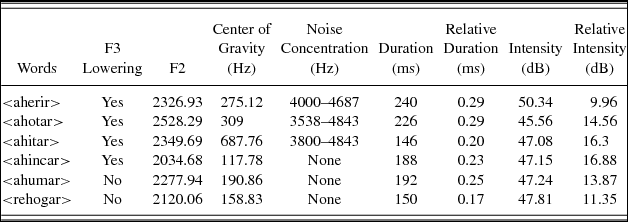
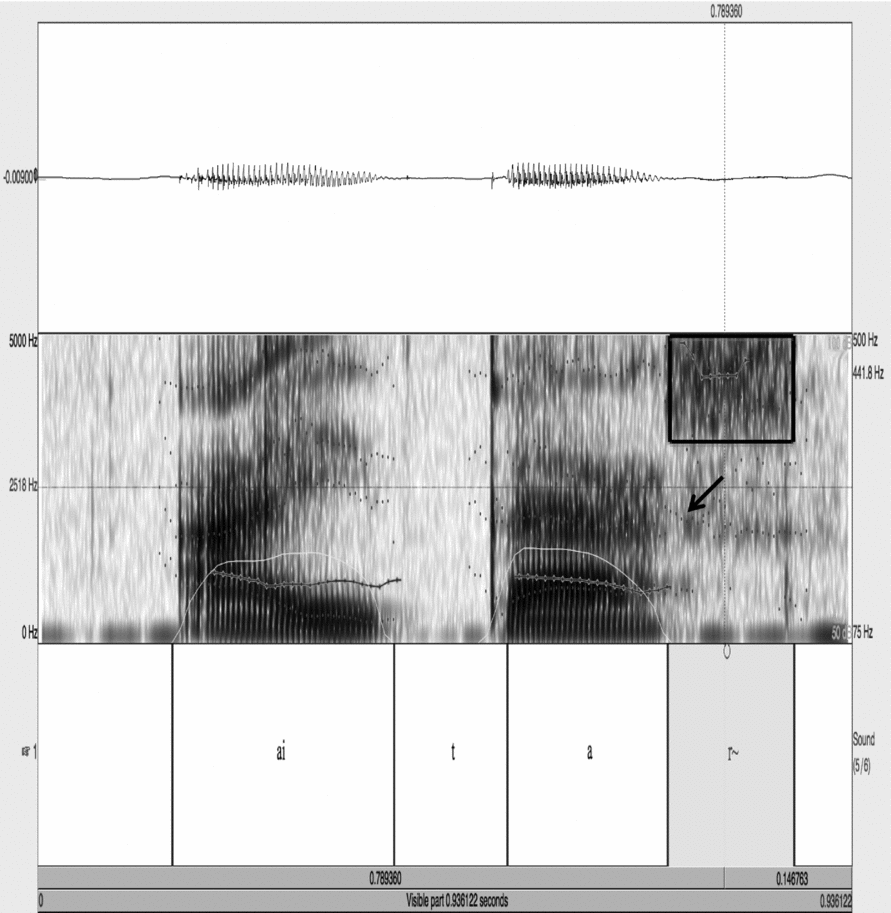
The results of the acoustic analysis of the words produced by the Mexican speaker are summarized in Table 1. The results suggest that the three words <aherir> [aeɾi], <ahotar> [aota], and <ahitar> [aita] seem to share some acoustic properties: they have the highest F2 and COG values, and all exhibit F3 lowering. In addition, there is a concentration of energy between 3000 and 5000 Hz. The spectrogram for <ahitar> [aita] produced by the Mexican speaker is provided in Figure 1. F3 lowering is indicated with an arrow, and the concentration of energy with a circle.
The acoustic characteristics of assibilated/fricative rhotics in the stimuli/recordings of the Mexican speaker

Spectrogram for <ahitar> produced by the Mexican speaker. The square indicates the area of noise concentration and the arrow points to F3 lowering in the assibilated/fricative rhotic.
The other three words, <rehogar> [reoga], <ahincar> [aiŋka], and <ahumar> [auma], do not exhibit a concentration of energy, and F3 lowering is only present in <ahincar> [aiŋka]. In sum, <aherir> [aeɾi], <ahotar> [aota], and <ahitar> [aita], while exhibiting both assibilation/frication and rhoticity, appear to have a higher degree of assibilation/frication than <rehogar> [reoga], <ahincar> [aiŋka], and <ahumar> [auma]. The variations in the degree of assibilation/frication of these six words allowed us to test the hypothesis with respect to the relationship between the degree of assibilation/frication in the auditory input and the rate of assibilated rhotics among participants in the auditory–orthographic group.
Procedures
Participants performed a picture-naming task in Spanish, adapted from Steele (Reference Steele2002). The entire task, involving the full set of 108 stimuli, was completed within a single experiment session. Participants were assigned to two groups: the auditory-only group and the auditory–orthographic group. Training consisted of the presentation of a triplet, and testing consisted of cueing the participants to produce the triplet orally. For each triplet, testing immediately followed the training phase. Both training and testing were done via PowerPoint. Each triplet consisted of two target stimuli and a distracter (e.g., <aherir> [aeɾi], <boruca> [boɾuka], and <te> [te]). Each word was presented auditorily three times in a row, accompanied by an image illustrating its meaning. The auditory–orthographic group was also presented with the written form of the word. The presentation of each auditory word and its image lasted up to a maximum of 2 s, depending on the length of the word, followed by the presentations for the next two words.
Immediately after the training phase for each triplet, the participants were presented with the image corresponding to each word, one at a time, with or without the written form of the word, depending on the group. Each image remained on the screen for 3 s, and participants were required to say the Spanish word out loud. For example, the participants in the auditory-only group were first presented with an image of a castle and at the same time heard the auditory word [aeɾi] three times. Next was the presentation of the image of a shovel and the auditory word [boɾuka] three times, followed by the presentation of the image of a pool and the auditory word [te] three times. Finally, they were presented with the image of a castle, shovel, and pool, one at a time, and were required to produce the corresponding Spanish words, as soon as they saw each image. The auditory–orthographic group were exposed to images that included written words, such as <aherir>, <boruca>, and <te>, at both training and during testing.
As previously explained, both groups of participants (auditory-only and auditory–orthographic) were exposed to auditory input at the time of training, but not at production. The groups differed in whether orthographic input was given. The auditory-only group was only exposed to the auditory input accompanying the image of the word, while the auditory–orthographic group received orthographic input at both training and production. Orthography was included both at training and during testing for two reasons. First, Rafat (Reference Rafat2013) showed that there were no significant differences with respect to the rate of orthography-induced transfer between the groups, in which orthographic input was only present at training or when it was presented both at training and during testing. Second, the inclusion of orthographic input at both phases mimicked classroom situations, in which students are often exposed to the written input both at the time of instruction and at production.
Participants were asked to complete the entire picture-naming task (108 words) three times and were given 2- to 3-min breaks (or longer breaks if needed) in between each round. All participants were given a practice session with a triplet that was not included in the actual task. Upon the completion of the picture-naming task, a background questionnaire was administered. The equipment used to record the participants was an M-Audio Micro-track 24/96 professional two-channel mobile digital recorder and a lavaliere unidirectional microphone. The recordings were made at a sampling rate of 44.2 kHz and a quantization rate of 16 bits. The audio files containing the extracted tokens were downsampled at 22.1 kHz and saved in wave format.
Coding and data analysis
Productions of the target segments included the assibilated/fricative rhotics [] (e.g., Bradley, Reference Bradley, Authier, Bullock and Reed1999; Lipski, Reference Lipski1994; Quilis, Reference Quilis1999; Widdison, Reference Widdison1998); voiced (post)alveolar approximant rhotic [ɹ] (Narayanan, Alwan, & Haker, Reference Narayanan, Alwan and Haker1997); fricatives (Ladefoged & Maddieson, Reference Ladefoged and Maddieson1996; Shadle, Reference Shadle, Hardcastle and Marchal1990; Stevens, Reference Stevens1971, Reference Stevens1998), such as the voiceless palato-alveolar sibilant [ʃ], voiceless alveolar sibilant [s], voiceless (inter)dental nonsibilant [θ], voiceless glottal fricative [h], voiceless velar fricative [x], and a combination of a rhotic followed by a fricative sound such as the approximant rhotic followed by a palatoalveolar sibilant [ɹ+ʃ], (inter)dental nonsibilant [ɹ+ θ], and voiceless glottal fricative [ɹ+h].
Participants’ productions were transcribed by the author and a research assistant, who is also trained in phonetics. The author is a native speaker of Farsi who is fluent in Spanish and English, and has knowledge of other languages. The research assistant is a native speaker of English who is fluent in Spanish.
RESULTS
When the results of the productions of the two groups were collapsed, 34 tokens (9.44%) of the responses were coded as assibilated/fricative rhotics [], 132 tokens (36.67%) as fricatives, 74 tokens (20.56%) as voiced (post)alveolar approximant rhotic [ɹ], and 21 tokens (5.83%) as a combination of an (post)alveolar approximant rhotic and a fricative. Fricative combinations comprised 44 tokens (12.22%) of voiceless palato-alveolar sibilant [ʃ], 3 tokens (0.83%) as voiceless alveolar sibilant [s], 6 tokens (1.67%) as voiceless (inter)dental nonsibilant [θ], 48 tokens (13.33%) as voiceless glottal fricative [h], and 31 tokens (8.61%) as voiceless velar fricative [x].Footnote 6 The approximant rhotic and fricative combinations comprised 12 tokens (3.33%) [ɹ+h], 8 tokens (2.22%) [ɹ+θ], and 1 token (.28%) [ɹ+ʃ]. In addition, the tokens in which the assibilated/fricative rhotic was deleted were coded as “deleted” (72 tokens, 20%), the tokens in which the entire word was not produced (16 tokens, 4.44%) were coded as “not produced,” and the tokens in which other sounds such as [m] were produced were coded as “other” (11 tokens, 3.06%). The “deleted,” “not produced,” and “other” responses were not included in the analyses. The data were aggregated across rounds.
Effect of exposure to orthographic input on L2 production
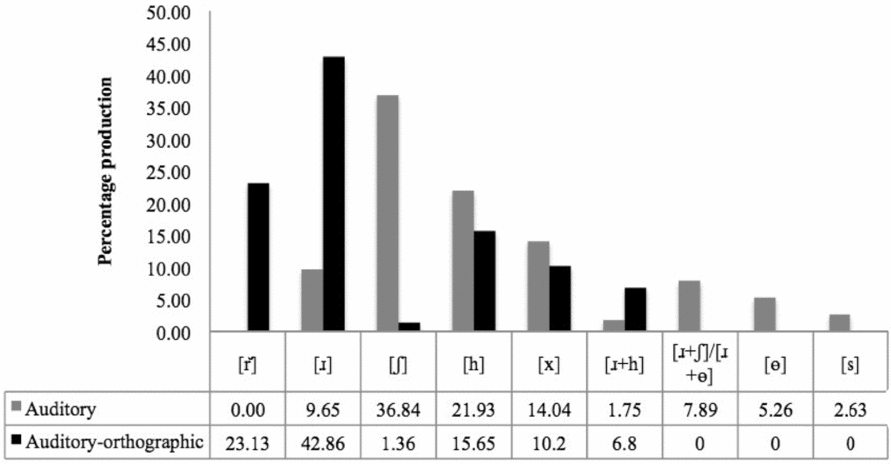
We hypothesized that the auditory-only and auditory–orthographic groups’ patterns of assibilated/fricative rhotics production would differ and predicted a higher rate of [] for the auditory–orthographic group. The dependent variables for this hypothesis were the “type of sound/production.” Figure 2 summarizes the results for percentage production of type of sounds in the auditory-only and auditory–orthographic groups. As shown in Figure 2, there was a higher rate of [] (23.13% vs. 0%), [ɹ] (42.86% vs. 9.65%), and [ɹ+h] (6.8% vs. 1.75%) in the auditory–orthographic group in comparison with the auditory-only group. There was a higher percentage of [ʃ] (36.84% vs. 1.36%), [s] (2.63% vs. 0%), [h] (21.93% vs. 15.65%), [x] (14.04% vs. 10.2%), and [ɹ+ ʃ]/[ɹ+ɵ] (7.89% vs. 0%) production in the auditory-only group than in the auditory–orthographic group. Chi-square tests of independence were conducted in order to address the results with respect to whether the type of sound produced was related to the training condition. When the assumption of fewer than 20% of cells having a count less than five was violated, a Fisher exact text was used instead. The effect size was evaluated using the Crámer V. Crámer V values between 0.3 and 0.6 indicate a moderate effect size, values below this range indicate a small effect, and above this range indicate a large effect (Crewson, Reference Crewson2006). Given that participants in each group could produce any of a number of possible types of sounds, in order to evaluate whether the two groups differed with respect to the specific types of sounds produced, standardized residuals in cross-tabulations were used. The results of this test indicated that the type of sound produced differed significantly between the two groups (Fisher exact test = 145.35, p < .001). The effect size of this difference was large (Crámer V = 0.70). Investigation of standardized residuals indicated that the auditory–orthographic group produced a significantly higher rate of [] (23.13%) and [ɹ] (42.86%) than the auditory-only group (0% and 9.65%, respectively). The auditory-only group produced a higher percentage of [ʃ] (36.84%) than the auditory–orthographic group (1.36%). The hypothesis that the patterns of acquisition of Spanish assibilated/fricative rhotics would differ between the auditory–orthographic and auditory-only groups was thus supported by our findings.
Percentage production of type of sounds: auditory-only versus auditory–orthographic group.
Although a high rate of [] production was observed in the auditory–orthographic group, because this group also had a higher rate of [ɹ] production, a further χ2 test was conducted in order to determine whether the difference between the types of sounds produced by the auditory–orthographic group were significant or not. The results yielded a significant difference between the proportions of sounds of different types in the auditory–orthographic group, χ2 (6) = 136.381, p < .001. Standard residuals were calculated, which led to the conclusion that the proportions of [] and [ɹ] were significantly higher than the proportions of [ɹ+h], and [ʃ]. No other significant differences were found among the six types of sounds. In other words, although the percentage of [ɹ] production (42.86%) was higher than the percentage of [] production (23.13%) in the auditory–orthographic group, the difference between the two was not significant.
Chi-square analyses also yielded a significant difference in the proportions of types of sounds produced by the auditory-only group, χ2 (8) = 113.368, p < .000. Standard residuals indicated that the proportion of [ʃ] productions was significantly higher than the proportion of [h], [ɹ+h], [ɹ+ʃ], and [s] productions. No other significant differences were found among the nine types of sounds. A χ2 test of goodness of fit was also conducted, in which the sibilant and nonsibilant fricatives were collapsed and compared to the approximant rhotic and approximant rhotic + fricative productions. The results of this test were significant, χ2 (2) = 115.11, p < .001, indicating that the proportion of fricatives (sibilants and nonsibilants collapsed) was significantly higher than the proportions of both the approximant rhotics and the approximant rhotic + fricatives. Moreover, [ʃ] production was favored over other fricative productions. Therefore, we can deduce from this that assibilation/frication appears to be more salient for assibilated/fricative rhotics than rhoticity.
Acoustic properties modulate the effect of orthographic input on L2 production
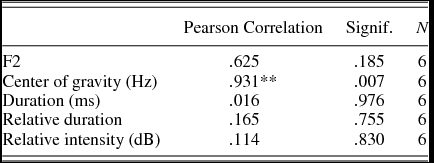
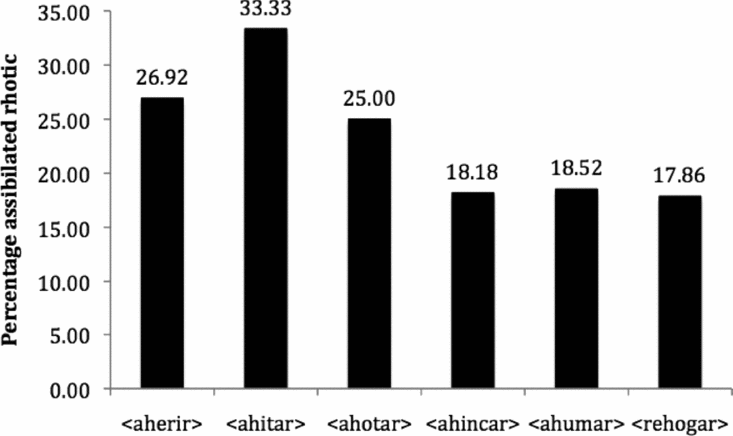
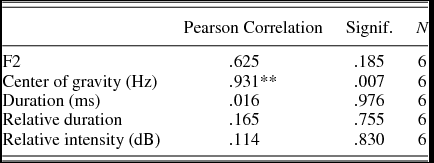
We predicted that the potential effects of orthographic input on naive participants’ assibilated/fricative rhotic productions would be modulated by the acoustic characteristics of the auditory input. Specifically, the degree of assibilation/frication (e.g., the higher the COG, F2, duration, relative duration, and relative intensity values) in the assibilated/fricative rhotics in the six words in the auditory input should correlate with the proportion of assibilated/fricative rhotic productions by the participants in the auditory–orthographic group. An individual word analysis was conducted to test this hypothesis. In order to conduct the word analysis, the rate of assibilated/fricative rhotics produced per word in the auditory–orthographic group by the participants was first examined. Figure 3 shows that not all six words produced by the Mexican Spanish speaker resulted in the same rate of assibilated/fricative rhotic production by the participants. Then Pearson correlations were conducted to determine whether a relationship exists between the type of words produced by the Mexican speaker, more specifically, the acoustic properties related to the assibilation dimension of the assibilated/fricative rhotic (the F2, COG, duration, relative duration, and relative intensity values summarized in Table 1) and the rate of assibilated/fricative rhotic production by the participants in the auditory–orthographic group (see Table 2).
Pearson's correlations: Acoustic properties of the assibilated rhotics in the stimuli (produced by the Mexican speaker) and the rate of assibilated rhotic production of the participants in the auditory-orthographic group
Note: All significances are two tailed.
Percentage assibilated rhotic production per word in the auditory–orthographic group.
There was a strong positive correlation between the COG values and the rate of assibilated/fricative rhotic production by the auditory–orthographic group, r (8) = .931, p = .007. In other words, the higher the COG values (the more front the production of the assibilated/fricative rhotics), the higher the possibility for the participants to produce the word(s) with an assibilated/fricative rhotic when they had access to orthographic input. Although there was a moderate relationship between F2 and assibilated/fricative rhotic production, these results did not reach significance, r (8) = .625, p = .185. No other significant correlations were found.
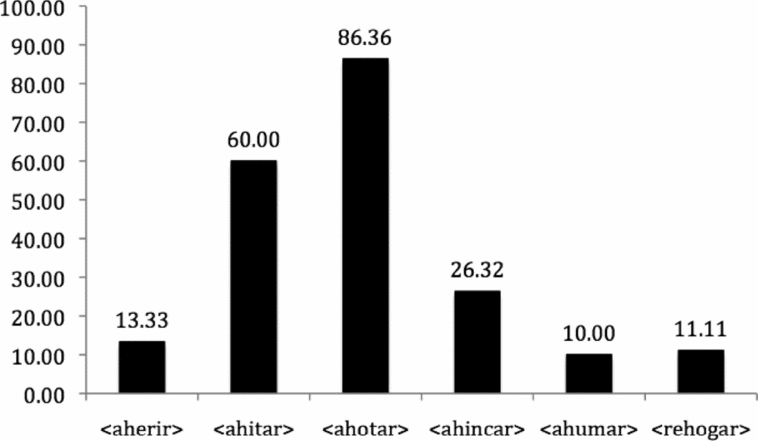
Figure 3 also shows the three words that resulted in the highest rate of assibilated/fricative rhotic production, namely, <ahitar> [aita] (33.33%), <aherir> [aeɾi] (26.92%), and <ahotar> [aota] (25%), are the words that exhibit F3 lowering and a presence of concentration of noise (between 3000 and 5000 Hz). That is, while they exhibit rhoticity (e.g., presence of F3 lowering), they are also highly assibilated/fricativized. Note that the other three words that resulted in the lowest rate of assibilated/fricative rhotic production, <rehogar>[reoga] (17.86%), <ahincar> [aiŋka] (18.18%), and <ahumar> [auma] (17.86%), do not exhibit a concentration of noise, and F3 lowering is only present in <ahincar>. In addition, two of the words that triggered the highest assibilated/fricative rhotic production, namely, <ahotar> [aota] and <ahitar> [aita], also resulted in the highest [ʃ] production in the auditory-only group (60% and 86.36%, respectively; see Figure 4).
Percentage [ʃ] production in the auditory-only group.
In summary, the above results suggest that there is a relationship between the acoustic correlates of assibilation/frication of the Spanish assibilated/fricative rhotics (e.g., COG and F2 values, and presence of acoustic energy in the higher portions of the spectrogram) in the six word productions and their assibilated/fricative rhotic production by the participants in the auditory–orthographic group. That is, the higher the COG and F2 values when there is presence of acoustic energy in the higher portions of the spectrogram, the higher the possibility of assibilated/fricative rhotic production in the auditory–orthographic group.
DISCUSSION
This study investigated the following two research questions:
1. Do naive English speakers of Spanish who are exposed to auditory and orthographic input (auditory–orthographic group) show different patterns of production compared with those who are exposed to auditory input only (auditory-only group)?
2. Are the effects of orthographic input modulated by the acoustic characteristics of the auditory input?
The results showed that there was a significant difference in the production patterns of the two groups, such that assibilated/fricative rhotic production was only observed in the auditory–orthographic group, whereas the rate of assibilated/fricative production was significantly higher in the auditory–orthographic group than in the auditory-only group (23.13% and 0%, respectively), the rate of approximant rhotic production was significantly higher in the auditory–orthographic group than in the auditory-only group (42.86% and 9.65%, respectively), and [ʃ] production was significantly higher in the auditory-only group than in the auditory–orthographic group (36.84% and 1.36%, respectively). In sum, the auditory-only and auditory–orthographic groups diverged significantly in their L2 production patterns.
A comparison of the rate of production of sounds of different types in the auditory-only group suggested that assibilation/frication is the more salient feature of assibilated/fricative rhotics. Moreover, assibilated/fricative rhotics were produced in the auditory–orthographic group. Therefore, when a target language sound such as the assibilated/fricative rhotics is composed of different acoustic–phonetic features (e.g., rhoticity and assibilation/frication), and the less salient acoustic feature of this sound is represented by a shared L1 and a target language grapheme (e.g., <r>), exposure to orthographic input may have a disambiguating effect on the auditory input. Specifically, orthographic input may trigger transfer of a feature (e.g., rhoticity) or an entire phoneme corresponding to the shared grapheme (e.g., approximant rhotic), therefore making the less salient feature (e.g., rhoticity) of the input more salient. This, in turn, can lead to the L2 production of both the salient (assibilation/frication) and nonsalient features of the sound (e.g., rhoticity). Based on the individual word analysis of the six words produced by the Mexican speaker (the auditory input that the participants heard during the picture-naming task), in order for orthographic input to have a disambiguating effect, the acoustic correlates of the more salient feature(s) (e.g., assibilation/frication) also have to be sufficiently salient so that they do not go unnoticed by the participants and cannot be overridden by the transfer effect triggered by the L1 grapheme-to-phoneme correspondence (<r>–/ɹ/).
That orthographic input can override the acoustic–phonetic input when the phonological representation of a particular grapheme and the auditory input share some acoustic–phonetic properties has also been attested in L1 perception. Hallé, Chéreau, and Segui (Reference Hallé, Chéreau and Segui2000) examined the effect of orthographic and phonological inconsistency on the perception of /b/ and [p], its devoiced counterpart, in French-speaking adults. In a phoneme monitoring task, the presentation of words whose orthographic representation and phonetic realizations were incongruent yielded a higher detection rate of [b] than [p] in <absurd>–[apsyʀd]. Hallé et al. (Reference Hallé, Chéreau and Segui2000) attributed the results to a “perceptual illusion” effect, which overrides the input. Given that in the present study the L1 and target language sounds also shared some acoustic features, namely, rhoticity, it is possible that a perceptual illusion effect was at play here as well. In other words, the presence of the orthographic <r> and the shared feature of rhoticity by the L1 approximant rhotic and the target language assibilated/fricative rhotic created the perceptual illusion of an approximant rhotic in the phonology of the participants, such that they thought they heard [ɹ] because they saw the grapheme <r>.
Here we have inferred that approximant rhotic productions by the participants were due to the overriding effect of orthography, when L1 and target language share the feature “rhoticity.” The role of such featural similarity between the native and target languages in inducing L1-based phonological transfer was also highlighted in Rafat (Reference Rafat2013). The findings of that study indicated that in the case of a shared grapheme, the more similar the target language and the L1 sounds (specifically, the less salient the acoustic difference between the L1 and the target language sounds), the higher the possibility of L1-based phonological transfer in the participants’ productions leading to nontargetlike productions. That the degree of acoustic difference between the L1 and target language sounds may determine L2 production was first proposed in Flege's (Reference Flege and Strange1995) speech model, even though his theory is not formulated in terms of salience. In order to further test whether it is the similarity/shared feature between the approximant rhotics and assibilated/fricative rhotics that is triggering an overriding effect of the input, a perception (identification) task with an auditory-only and an auditory–orthographic group should be conducted. The identification task should test the difference between the rate of approximant rhotic identification of assibilated/fricative rhotics and a sound that is acoustically very different from approximant rhotics, such as a voiced bilabial stop /b/. If a shared feature between the L1 sound and the target language sound plays a role in modulating orthographic effects, the auditory–orthographic group should have a higher rate of approximant rhotic identification of assibilated/fricative rhotics in comparison with a sound that is very different from approximant rhotics.
Erdener and Burnham (Reference Erdener and Burnham2005), Steele (Reference Steele2005), and Escudero et al. (Reference Escudero, Hayes-Harb and Mitterer2008, Reference Escudero and Wanrooij2010) showed a positive effect for orthographic input. In the present study, targetlike productions of assibilated/fricative rhotics were attested in the auditory–orthographic group. However, it is difficult to say whether orthographic input had a positive effect on the participants’ productions, overall, for two reasons. First, the auditory–orthographic group also had a significantly higher rate of English approximant productions, in comparison with the auditory-only group. We predict that native speakers of (assibilated/fricative rhotic varieties of) Spanish will perceive English approximant productions as heavily accented. Although approximant rhotics can be found in some positions (e.g., obstruent-liquid clusters; <primo> [pɹimo] “cousin”), in assibilated/fricative rhotic varieties (Colantoni & Rafat, Reference Colantoni, Rafat, Colantoni and Rodríguez Louro2013), we are not aware of any evidence of their occurrence in word-final position. Moreover, even if there are (word-final) approximant rhotics in Spanish, the English approximant rhotic may be realized as a retroflex (e.g., Delattre & Freeman, Reference Delattre and Freeman1968; Westbury et al., Reference Westbury, Hashi and Lindstrom1999; Zhou et al., Reference Zhou, Espy-Wilson, Boyce, Tiede, Holland and Choe2008) and therefore may sound particularly marked/foreign to naive speakers of (assibilated/fricative varieties of) Spanish.
The second reason why we cannot conclude whether exposing the participants to auditory–orthographic input has an advantage over exposing them to auditory-only input is because the auditory-only group had a significantly higher rate of /ʃ/ production. The acoustic analysis of the assibilated/fricative rhotics of the six words produced by the native speaker of Mexican Spanish indicated two groups of assibilated/fricative rhotics: those with a higher degree of assibilation/frication and those with a lower degree of assibilation. Moreover, Colantoni (Reference Colantoni, Toribio and Sagarra2006) points out that assibilated/fricative rhotics are acoustically similar to postalveolar sibilants. Therefore, we predict that native speakers of (assibilated/fricative rhotic varieties of) Spanish might perceive the participants’ /ʃ/ productions as a nativelike production of assibilated/fricative rhotics. In order to elucidate the positive and/or negative nature of the effect of orthographic input on the L2 productions of naive English speakers of Spanish, future empirical studies will need to have classification of the participants’ productions by native speakers of (the assibilated/fricative varieties of) Spanish, including goodness of fit tests.
The present study has also provided further evidence that naive speakers with an opaque orthographic system can be affected by exposure to orthographic input, even when the target language is a transparent language such as Spanish. However, according to the orthographic depth hypothesis (ODH; Katz & Frost, Reference Katz, Frost, Frost and Katz1992), this is a tendency of languages with transparent writing systems such as Spanish and Serbian, and not opaque languages such as English. The ODH posits that speakers of languages with an opaque orthography tend to decode printed words before decoding the phoneme, but speakers of languages with a transparent orthography rely more heavily on their one-on-one grapheme-to-phoneme correspondences. That is, word recognition is prelexical in speakers of languages with a transparent orthography and postlexical in speakers of languages with an opaque orthography. Therefore, ODH would predict that in the context of a nonnative language, English-speaking naive speakers would not make use of their L1 grapheme-to-phoneme correspondence rules to decode the target language sounds. Consistent with the ODH, Erdener and Burnham (Reference Erdener and Burnham2005) found that although naive English-speaking listeners’ production of target language sounds were positively affected by orthographic input, when exposed to a transparent language, such as Spanish, this effect was more robust for Turkish-speaking listeners. Goswami, Ziegler, Dalton, and Schneider (Reference Goswami, Zielger, Dalton and Schneider2003) also found that German children (whose L1 is more transparent than English) showed more evidence of using small size units (grapheme-to-phoneme correspondences) than did English-speaking children, who used both small and large size units (e.g., words). Given the language-specific processing mechanisms outlined in ODH, the findings of Erdener and Burnham (Reference Erdener and Burnham2005), and Goswami et al. (Reference Goswami, Zielger, Dalton and Schneider2003), we speculate that exposure to orthographic input may have a more robust effect in speakers with a transparent L1 orthography. Further research is needed to address this question with respect to the production of assibilated/fricative rhotics. For example, the production of assibilated/fricative rhotics could be tested with speakers of L1s with transparent writing systems.
In all, this study has shown orthographic effects in the L2 productions of assibilated/fricative rhotics of naive English speakers of Spanish. The more novel aspect of this study is that it has painted a fine-grained analysis of acoustic–orthographic interactions and has demonstrated that orthographic effects in the productions of the participants can be modulated by the acoustic characteristics of the input. Specifically, this study has contributed to our understanding of the role of orthographic input by showing that (a) when assibilated/fricative rhotics are strongly assibilated, the provision of the grapheme <r> can make the less salient feature (e.g., rhoticity) of assibilated/fricative rhotics more salient and lead to a higher rate of assibilated/fricative rhotic productions; and (b) in the absence of such robust cues, orthography may have an overriding effect. In order to test our acoustic–orthographic hypothesis, we first showed that there is variability in the degree of assibilation/frication of assibilated/fricative rhotics by conducting an acoustic analysis of six words produced by a native speaker of Mexican Spanish. It is a limitation of this study that the analysis was only based on six words. In the future, to verify the hypotheses put forth regarding acoustic–orthographic interactions, the stimuli should be expanded. In addition, the sample size should also be larger, and perception experiments should be considered. Finally, we examined the effect of exposure to orthographic input on the L2 production of assibilated/fricative rhotics in the word-final position. Future research should consider investigating this in different positions in the word.
Acknowledgments
I am very grateful to the guest editors of this Special Issue and to the two anonymous reviewers for their insightful comments and suggestions, which have significantly improved the manuscript. My special thanks go to Olesya Falenchuk for helping me with the statistical analysis. I am grateful to Laura Colantoni, Jeffrey Steele, and Ana-Teresa Pérez-Leroux. Many thanks to Kimberley Nicole Gauld for assisting me with the data analysis.