


Introduction
Anxiety and depression are among the most common and co-morbid forms of psychopathology, with 14.4% of the Australian population experiencing an anxiety disorder and 6.2% experiencing depression, within a 12-month period (Australian Bureau of Statistics, 2007). Given the high prevalence rates, researchers have been focused on understanding the factors that contribute to the onset and maintenance of depression and anxiety. One such factor is perfectionism, which has been defined as the tendency to hold very high standards, goals and expectations of the self (Flett and Hewitt, Reference Flett and Hewitt2002). Individuals high in perfectionism traits are excessively critical of themselves and are rarely satisfied with their performances (Flett and Hewitt, Reference Flett and Hewitt2002). It can therefore often involve negative self-evaluations, such as a chronic sense of failure, indecisiveness and shame (Egan et al., Reference Egan, Wade and Shafran2011), and lead to a significant decrease in life satisfaction (Hill et al., Reference Hill, Huelsman and Araujo2010). As such, high levels of perfectionism have been found to be an individual predictor of negative psychological outcomes (e.g. anxiety and negative affect) and are associated with a higher suicide risk in adult populations (Chang, Reference Chang2000).
There has been little explanation as to why some aspects of perfectionism can be adaptive and others, not. Serpell and colleagues (Reference Serpell, Waller, Fearon and Meyer2009) have argued that there are three facets that underlie perfectionism traits. The first surrounds the traditional cognitive perspective of ‘perfectionism’, which is defined as having overly high standards for one’s self and is considered dysfunctional to one’s mental health, due to the development of poor self-image from not being able to meet unreasonable goals. The second facet is ‘persistence’, defined as the ability to maintain a behaviour in attempt to reach a goal, even when the task is difficult or takes a long time. The third facet is ‘perseveration’, which is the tendency to continue a particular behaviour or thought, even when it ceases to be effective or rewarding, and is most significantly related to negative psychological outcomes (Serpell et al., Reference Serpell, Waller, Fearon and Meyer2009). Perseverance is commonly observed in safety-seeking behaviours that characterise anxiety disorders (Serpell et al., Reference Serpell, Waller, Fearon and Meyer2009; Salkovskis et al. Reference Salkovskis, Clark, Hackmann, Wells and Gelder1999), which are typically used to prevent a perceived threat from appearing consciously. However, the behaviours actually have the tendency to maintain the unrealistic fears associated with the threat (Salkovskis, Reference Salkovskis and Salkovskis1996). Such cognitive behavioural processes are theoretically consistent with previous associations found between maladaptive perfectionism and constant concerns about making mistakes, ruminating, worrying about one’s performance, meeting high standards and being judged by others (Hill et al., Reference Hill, Huelsman and Araujo2010).
Persevering thought processes have been labelled as repetitive negative thinking (Ehring et al., Reference Ehring, Zetsche, Weidacker, Wahl, Schönfeld and Ehlers2011) or cognitive perseveration (Flett et al., Reference Flett, Nepon and Hewitt2016). They can be concerned with present, past or future circumstances and have demonstrated three primary characteristics: the thinking is repetitive, the thoughts are at least in part intrusive, and that it is difficult to disengage from them (Macedo et al., Reference Macedo, Marques and Pereira2014). As such, cognitive perseveration and self-focus are deeply rooted in a perfectionist’s high need for self-validation and acceptance of their dispositional tendencies. Such tendencies have been reported between different dimensions of perfectionism, through means of rumination and worry (see Flett et al., Reference Flett, Nepon and Hewitt2016).
In the response styles theory (Nolen-Hoeksema, Reference Nolen-Hoeksema, Papageorgiou and Wells2004) it is proposed that thinking styles, such as rumination, may amplify depressive symptoms and extend negative moods through several mechanisms. First, repetitive negative thinking increases depressed moods and salience of unhelpful thinking, making it more likely that people will use the negative thoughts and memories activated by their current mood, to understand their current circumstances. Second, rumination hinders effective problem solving by making thinking more pessimistic. Third, rumination interferes with constructive behaviours that are directed at achieving specific goals or performing specific tasks, causing people to become unproductive and unfocused, leading to increases in stress (Nolen-Hoeksema et al., Reference Nolen-Hoeksema, Wisco and Lyubomirsky2008).
Worry is also characterised by repetitive negative thinking, but unlike rumination which is characterised by past orientated thinking (Beck, Reference Beck1976), is directed at the future and concerned with anticipating perceived threats (Borkovec et al., Reference Borkovec, Ray and Stober1998). Worry is typically used in an attempt to avoid or resolve an issue, and is characterised by a predominance of anxious predictions and fears of possible future negative events (Borkovec et al., Reference Borkovec, Ray and Stober1998). While both rumination and worry can occur simultaneously in either anxiety or depression, and are both similar in process, worry has been considered the central criterion for generalized anxiety, whereas rumination is more central to depressive symptoms (de Jong-Meyer et al., Reference de Jong-Meyer, Beck and Riede2009; Papageorgiou and Wells, Reference Papageorgiou and Wells1999; Wells and Papageorgiou, Reference Wells and Papageorgiou2004).
Wells (Reference Wells2008) explains that metacognition encompasses the self-knowledge and regulation styles that people employ to monitor and control cognition. Importantly, unhelpful (positive and negative) metacognitions are known to maintain worry, rumination, threat monitoring, emotional avoidance and psychological distress (Cooper and Osman, Reference Cooper and Osman2007; Kannis-Dymand et al., Reference Kannis-Dymand, Carter, Lane and Innes2019; Wells and Cartwright-Hatton, Reference Wells and Cartwright-Hatton2004). In Well’s metacognitive model of psychological disorders (Wells, Reference Wells2008, Reference Wells2009), positive metacognitions occur when an individual perceives worry, rumination, threat monitoring and over-controlling thoughts to be helpful strategies for reducing discrepancies between an individuals’ present state and desired state (e.g. ‘ruminating helps me understand my problems’; ‘worrying helps me cope and be prepared; I must control my thoughts or I’ll do something bad’). However, when these attempts fail to reduce this discrepancy, it often leads to increased rumination, worry, negative affect and interference with effective problem solving. Consequently, the individual may develop negative metacognitive beliefs about the uncontrollability and harmfulness of rumination or worry (e.g. ‘I can’t stop ruminating about my problems’, ‘worrying is harmful’; Wells, Reference Wells2008; Wells and Cartwright-Hatton, Reference Wells and Cartwright-Hatton2004).
Research has found that metacognitive therapy, which focuses on identifying and changing the faulty metacognitive beliefs and processes, has shown significant treatment effects for anxiety and depression. For example, Wells and King (Reference Wells and King2006) reported that patients diagnosed with generalised anxiety disorder demonstrated improvements in worry, anxiety and depression, with recovery rates of 87.5% at post-treatment, and 75% at 6- and 12-month follow-ups. Similarly, in patients with treatment-resistant depression, metacognitive therapy resulted in recovery rates of 80% at post-treatment, and 70% at a 12-month follow-up, including improvements on all depressive-related thought processes (Wells et al., Reference Wells, Fisher, Myers, Wheatley, Patel and Brewin2012).
Considering the literature, perseverance appears to be key in understanding the relationship between metacognitive beliefs, with anxiety and depression. Individuals with high levels of perfectionism have shown to be more likely to have stronger positive and negative metacognitions due to their stronger trait disposition to control and avoid failure (Macedo et al., Reference Macedo, Marques and Pereira2014). In particular, people who have reported frequent engagement of perseverance behaviours were more likely to view worry or rumination as necessary and protective to future failures, or as a distraction to avoid thoughts of self-criticism, as their persevering behaviours serve as a similar function. However, repetitive efforts to avoid negative thoughts often counterintuitively increases perseverance behaviours, further developing beliefs that repetitive negative thinking is uncontrollable or harmful, and thus maintaining the associated behaviours, even when they are no longer functional (Macedo et al., Reference Macedo, Marques and Pereira2014).
The reinforcement that perseverance behaviours provide suggests that perfectionism traits have the tendency to contribute to anxiety and depression, because maladaptive perseverance behaviours operate in conjunction with worry and rumination, as a behavioural component. Therefore, the aim of this study was to investigate the relationships between metacognitive beliefs and perseverance behaviours and determine the specificity of these factors among anxiety and depression.
First, it was hypothesised that positive metacognitive beliefs about worry and metacognitive beliefs about the need for thought control would positively influence negative metacognitive beliefs about worry; and that all metacognitive beliefs would positively predict perseverance behaviours, which would in turn predict anxiety levels.
Second, it was hypothesised that positive metacognitive beliefs about rumination would positively influence negative metacognitive beliefs about rumination; and both metacognitive beliefs would positively predict perseverance behaviours, which would in turn predict depression levels.
Third, it was hypothesised that metacognitive beliefs about rumination would be more strongly associated with depression, while controlling for the effects of anxiety; and that metacognitive beliefs about worry would be associated with anxiety, while controlling for the effects of depression.
Method
Participants and procedure
After ethical approval, university staff and students were recruited via email and were provided with a link to participate in the study via an ‘all student’ and ‘all staff’ email. Convenience sampling techniques were also used by recruiting participants via social networking (e.g. Facebook), in a range of social media pages, personal pages, student groups affiliated with the university and community pages. Before proceeding to the survey, participants were required to read an information sheet and consent form and agree to participate. Participants then completed the set of questionnaires. The total sample (N = 1033) consisted of 775 females and 258 males. Participants’ ages ranged from 18 to 30 years (mean = 21.12 years, SD = 3.17 years). Participants were primarily Caucasian (n = 933; 90.3%), had finished high school (n = 627; 45.1%) or university (n = 282; 39.8%), and were sampled from New Zealand (n = 566; 54.8%) or Australia (n = 467; 45.2%). Examination of group means, and an ANOVA showed that no significant differences were present between responses of Australian and New Zealander participants on any of the variables. Participants were offered to enter a draw for one of three $40AUD shopping vouchers as an incentive for their time. These were randomly allocated after data collection.
Measures
Anxiety
The Generalized Anxiety Disorder 7-item scale (GAD-7) is a measure for assessing symptoms of generalised anxiety (Spitzer et al., Reference Spitzer, Kroenke, Williams and Lowe2006). Participants respond to items related to worry and physical symptoms of anxiety (e.g. ‘trouble relaxing’, ‘being restless’) over the past 2 weeks (Spitzer et al., Reference Spitzer, Kroenke, Williams and Lowe2006), by rating each item on a 4-point Likert Scale (0 = not at all, to 3 = nearly every day). Development of the GAD-7 showed high Cronbach’s alpha (.92) and suitable test–re-test reliability (intraclass correlation = .83; Spitzer et al., Reference Spitzer, Kroenke, Williams and Lowe2006). The GAD-7 has been shown to have strong concurrent validity with the Beck Anxiety Inventory and is used widely with clinical and non-clinical samples (Spitzer et al., Reference Spitzer, Kroenke, Williams and Lowe2006).
Depression
The Patient Health Questionnaire-9 item (PHQ-9) is a tool to measure levels of symptoms and functional impairments associated with depression and is anchored on DSM-IV criteria for major depressive disorder (Kroenke and Spitzer, Reference Kroenke and Spitzer2002). The PHQ-9 asked participants about how often they had experienced depressive symptoms over the past 2 weeks (e.g. ‘little interest or pleasure in doing things?’). Participants rate answers on a 4-point Likert scale from 0 (not at all) to 3 (nearly every day). The PHQ-9 is widely used in the health area and has sound psychometric properties (Kroenke and Spitzer, Reference Kroenke and Spitzer2002) with good internal consistency (α = 0.85) and validity (Rawal et al., Reference Rawal, Park and Williams2010).
Perfectionism
The Perfectionism, Persistence and Perseveration Questionnaire (PPPQ-22; Serpell et al., Reference Serpell, Waller, Fearon and Meyer2009) is a 22-item self-report measure related to the perfectionism, persistence and preservation dimensions of perfectionism. Based on previous literature, only the perseveration subscale was used, as perseverance has been considered most influential to anxiety and depression (Serpell et al., Reference Serpell, Waller, Fearon and Meyer2009), because of its theoretical association with repetitive negative thinking. Each item (e.g. ‘sometimes I find myself continuing to do something even when there is no point carrying on’) was rated using a 5-point Likert scale, ranging from 0 (not at all true of me) to 5 (totally true of me; Serpell et al., Reference Serpell, Waller, Fearon and Meyer2009). The PPPQ-22 has demonstrated moderate internal consistency, with alpha levels ranging between .60 and .80 (Leyro et al., Reference Leyro, Berenz, Brandt, Smits and Zvolensky2012; Waller et al., Reference Waller, Shaw, Meyer, Haslam, Lawson and Serpell2012), and also adequate test–re-test reliability (persistence: r =.89; perseveration: r =.79; and perfectionism: r =.79; Leyro et al., Reference Leyro, Berenz, Brandt, Smits and Zvolensky2012).
Metacognitive beliefs
Metacognitive beliefs about worry
To measure maladaptive metacognitions, the Metacognitive Questionnaire-30 (MCQ-30; Wells and Cartwright-Hatton, Reference Wells and Cartwright-Hatton2004) was used. The MCQ-30 is a 30-item questionnaire containing five subscales, concerned with the beliefs people have about their thinking. For the present study only three subscales were used: Positive beliefs about worry (e.g. ‘worrying helps me to avoid problems in the future’), Negative beliefs about the uncontrollability and danger of worry (e.g. ‘my worrying is dangerous for me’), and Beliefs about the need for thought control (e.g. ‘I will be punished for not controlling certain thoughts’). Each construct is considered maladaptive, which is represented with higher scores. Items consist of a statement and are rated on a 4-point Likert scale from 1 (do not agree) to 4 (agree very much). Internal consistency for the individual subscales has been found to be between .72 and .93 (Wells, Reference Wells2009; Wells and Cartwright-Hatton, Reference Wells and Cartwright-Hatton2004). Construct validity and test–re-test reliability have also shown to be adequate (Wells, Reference Wells2009).
Metacognitive beliefs about rumination
Positive metacognitive beliefs about rumination
The Positive Metacognitive Beliefs about Rumination Scale-Adapted version (PBRS-A) was used to measure participants’ perception about the usefulness of rumination (Watkins and Moulds, Reference Watkins and Moulds2005; adapted from Papageorgiou and Wells, Reference Papageorgiou and Wells2001a). The items on the original PBRS (Papageorgiou and Wells, Reference Papageorgiou and Wells2001a) were adapted by Watkins and Moulds to reduce references to negative mood, as it was originally designed to measure rumination in depression only (Papageorgiou and Wells, Reference Papageorgiou and Wells2001a). The scale consists of nine items (e.g. ‘I need to think about the causes of the feelings I experience’) which are rated on a 4-point Likert scale, ranging from 1 (do not agree) to 4 (very much agree). The PBRS-A has shown good internal consistency (Cronbach’s alpha between .85 and .89; McEvoy et al., Reference McEvoy, Mahoney and Moulds2010; Watkins and Moulds, Reference Watkins and Moulds2005).
Negative metacognitive beliefs about rumination
The Negative Beliefs about Rumination Scale (NBRS; Papageorgiou and Wells, Reference Papageorgiou and Wells2001b) is a 13-item questionnaire measuring negative metacognitive beliefs related to the harmfulness and uncontrollability of rumination (e.g. ‘ruminating makes me physically ill’), and about an individual’s concerns with the social and interpersonal consequences of rumination (e.g. ‘people will reject me if I ruminate’). Scoring is indicated on a 4-point Likert scale, from 1 (do not agree) to 4 (agree very much). The NBRS has evidenced good internal consistency (between .80 and .83; Papageorgiou and Wells, Reference Papageorgiou and Wells2001b) and shown good concurrent validity with the Negative beliefs about worry subscale of the MCQ-30, and the Rumination on Sadness Scale (Luminet, Reference Luminet, Papageorgiou and Wells2004). In the current study, the NBRS was adapted to replace the word ‘depressive’ in the instructions with the word ‘negative’ (e.g. ‘most people experience negative thoughts at times’), due to concerns around the applicability of the clinical nature of the word ‘depressive’ in a non-clinical population. In addition, on item 7, the word ‘depression’ was replaced with the words ‘low mood or problems’ as the research was not exclusively targeting a depressed population. In both rumination scales, higher scores indicate stronger maladaptive beliefs about rumination
Data analyses
After data collection, the data were imported into SPSS (v. 22), where the variables were created and tested for approapriate assumptions. Both bivariate and partial correlations were performed on the data to examine additional relationships not present within the individual models, before being loaded into SPSS AMOS (v. 22), where the models were constructed based on the best considered theoretical fits. This involved positive based beliefs as the moderators, negative beliefs and perseverance as the mediators, and psychopathology (i.e. anxiety and depression) as the dependent variable. As discussed, rumination has been more closely linked with depression and worry, than anxiety. Therefore, the models were constructed, using the maximum likelihood method, on this basis, in order to avoid disturbances caused by similarities in the constructs. Model fit was based on values suggested by Hair et al. (Reference Hair, Black, Babin, Anderson and Tatham2006); including: good fit index (GFI; .90), Tucker Lewis Index (TLI; .95) root mean squared error of approximation (RMSEA; <.07), standardised root mean square residual (SRMR; <.08), and a comparative fit index (CFI; 0.92). Bootstrapping of 1000 samples was used, to determine the significance of indirect effects.
Results
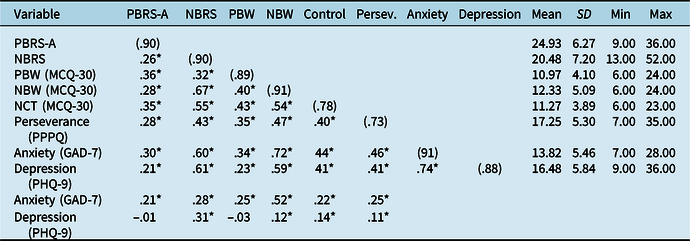
Descriptive statistics indicated that normality, multi-collinearity and linearity were all acceptable. Table 1 displays the minimum and maximum values, means, standard deviations and reliability co-efficient for each variable. Next, two separate structural equation models were created in SPSS AMOS: one for anxiety and one for depression. Each was constructed based on existing metacognitive theory and research, in that positive metacognitive beliefs about rumination or worry are influential to negative metacognitive beliefs about rumination or worry, and that negative metacognitive beliefs are more directly related to psychopathology.
Bivariate correlations (left), reliability coefficients (in parenthesis), partial correlations (bottom-left) and descriptive statistics (right) of all variables

* p < 0.001. PBW, Positive metacognitive beliefs about worry; NBW, Negative metacognitive beliefs about worry; NCT, metacognitive beliefs about the need for thought control; Persev., perseverance.
Hypothesis 1: worry beliefs, perseverance behaviours and anxiety
For the model predicting anxiety (Fig. 1), positive metacognitive beliefs about worry, negative metacognitive beliefs about worry, metacognitive beliefs about the need for thought control and perseverance were entered with respect to Hypothesis 1. The resulting model showed good fit to the data, χ2 (2,1033) = 3.60, p = .166; GFI = .999; TLI = .995; CFI = .999; RMSEA = .028; SRMR = .010; and demonstrated significant associations between all relationships drawn in the model. For direct effects (Fig. 1), positive metacognitive beliefs about worry positively effected negative metacognitive beliefs (F = 0.21, p < .001) and perseverance (F = 0.15, p < .001), beliefs about the need for thought control effected negative metacognitive beliefs (F = 0.45, p < .001) and perseverance (F = 0.17, p < .001), perseverance had a positive effect of anxiety (F = 0.16, p < .001), and negative metacognitive beliefs directly influenced perseverance (F = 0.32, p < .001), and anxiety (F = 0.65, p < .001). The results also revealed several significant indirect effects. As such, metacognitive beliefs about the need for thought control indirectly effected perseverance, through negative metacognitive beliefs about worry (F = 0.15, p = 0.001), and anxiety, through negative metacognitive beliefs about worry and perseverance (F = 0.34, p = 0.002). In addition, positive metacognitive beliefs about worry indirectly predicted perseverance, through negative metacognitive beliefs about worry (F = 0.07, p = 0.001), and anxiety, through negative metacognitive beliefs about worry and perseverance (F = 0.17, p = 0.002). Finally, negative metacognitive beliefs about worry indirectly predicted anxiety (F = 0.05, p = 0.002), through its effect on perseverance. The total effects for the model predicting anxiety were: F = 0.17, p = .002 for positive metacognitive beliefs, F = 0.34, p = .002 for need to control beliefs, F = 0.70, p = .001 for negative metacognitive beliefs, and F = 0.16, p = .003 for perseverance. Modification indices gave no suggestions to improve the model.
A structural equation model involving metacognitive beliefs about worry, perseverance behaviours and anxiety. *p < 0.001.

Hypothesis 2: rumination beliefs, perseverance behaviours and depression
For the model predicting depression (Fig. 2), positive metacognitive beliefs about rumination, negative metacognitive beliefs about rumination, and perseverance were included in the model. The model also showed good fit, χ2 (1, 1033) = .72, p = .396; GFI = 1.000; TLI = 1.000; CFI = 1.000; RMSEA = .000; SRMR = .006; and again revealed significant associations between all relationships projected in the model. For the direct effects (Fig. 2), positive metacognitive beliefs about rumination positively effected negative metacognitive beliefs (F = 0.26, p < .001) and perseverance (F = 0.18, p < .001), negative metacognitive beliefs directly influenced perseverance (F = 0.38, p < .001), and depression (F = 0.54, p < .001). As for indirect effects, positive metacognitive beliefs about rumination significantly and indirectly effected perseverance, through its effect on negative metacognitive beliefs about rumination (F = 0.10, p = 0.001), and depression, through negative metacognitive beliefs and perseverance (F = 0.19., p = 0.002). Lastly, negative metacognitive beliefs about rumination indirectly influenced depression (F = 0.07, p = 0.002), through its effect on perseverance. The total effects for the model predicting depression were: F = 0.19, p = .002 for positive metacognitive beliefs, F = 0.60, p = .002 for negative metacognitive beliefs, and F = 0.18, p = .002 for perseverance. Modification indices gave no suggestions to improve the model.
A structural equation model involving metacognitive beliefs about rumination, perseverance behaviours and depression. *p < 0.01.

Hypothesis 3: differentiating metacognitive beliefs with anxiety and depression
Bivariate and partial correlations were performed on the data to determine whether metacognitive beliefs about worry and about rumination were specifically associated with anxiety and depression symptomology, respectively. Firstly, the bivariate correlation analyses revealed that all the metacognitive variables and perseverance were significantly and positively related to anxiety (r = .30 to .72) and depression (r = .21 to .61). Perseverance also shared significant positive correlations with all measures of metacognitive beliefs (r = .28 to .47). Significant positive relationships were also present between all the metacognitive variables (r = .26 to .67). Beliefs about worry did demonstrate stronger bivariate relationships with anxiety (r = .34 to .72) over depression (r = .23 to 59), but this was not the case for the relationship between beliefs about rumination with depression (r = .21 to .61), compared with anxiety (r = .30 to .60).
Partial correlations were then run on the variables, while controlling for anxiety in the depression model, and controlling for depression in the anxiety model. The results showed that all metacognitive beliefs (r = .21 to .52) and perseverance (r = .25) positively correlated with anxiety, while controlling for depression. Beliefs about worry demonstrated stronger associations with anxiety (r = .23 to .59) over beliefs about rumination (r = .21 to .28). However, for the depression model, all variables except for positive metacognitive beliefs about worry (r = –.03) and rumination (r = –.01) were significantly related to depression (r = .11 to .31), while controlling for anxiety. Negative beliefs about rumination showed stronger associations with depression (r = .31) over beliefs about worry (r = .12). Bivariate correlations are displayed in the top left of Table 1, whereas the partial correlations are in the bottom left.
Discussion
The purpose of this study was to investigate whether metacognitive beliefs about rumination and worry would influence perseverance behaviours, and whether perseverance would further act as a mediator for anxiety and depression. A further aim was to investigate whether beliefs about rumination shared specific associations with depression, while controlling for anxiety; and whether beliefs about worry was specifically associated with anxiety, while controlling for depression. These designs were intended to expand current understandings of how repetitive negative thinking can influence anxiety and depression.
Worry beliefs, perseverance behaviours and anxiety
The first hypothesis regarding metacognitive beliefs about worry influencing perseverance behaviours and anxiety, was supported. First, a significant path model indicated that both positive metacognitive beliefs about worry and metacognitive beliefs about the need for thought control positively predicted negative metacognitive beliefs about worry, which in turn predicted anxiety levels. All metacognitive beliefs were shown to directly influence perseverance behaviours, and perseverance was found to positively predict anxiety. Negative metacognitive beliefs were shown to have the strongest direct influences over perseverance and anxiety. Second, significant indirect effects further supported these relationships, as all metacognitive beliefs were shown to indirectly influence anxiety, through their effect on perseverance behaviours. Positive beliefs and need to control beliefs were also shown to indirectly effect perseverance behaviours, through their effect on negative metacognitive beliefs.
Rumination beliefs, perseverance behaviours and depression
The model explaining depression was similar in nature to the model involving anxiety. As such, the second hypothesis was supported, in that metacognitive beliefs about rumination predicted perseverance behaviours and depression. Specifically, positive metacognitive beliefs about rumination were directly influential to negative metacognitive beliefs and perseverance behaviours, and negative metacognitive beliefs strongly predicted depression and perseverance behaviours. Again, significant indirect effects were present to support the relationships, with positive beliefs having significant indirect effects towards depression and perseverance behaviours, through their effect on negative beliefs, and negative beliefs about depression having an indirect effect on depression, based on its effect towards perseverance behaviours.
Model interpretations
Collectively, these results support current metacognitive models (Wells, Reference Wells2008; Wells, Reference Wells2009), regarding the directional influences that positive and negative metacognitive beliefs about repetitive negative thinking, have in accordance with anxiety and depression. In addition, the results have replicated findings by Serpell et al. (Reference Serpell, Waller, Fearon and Meyer2009), in that perseverance behaviours are predictive of anxiety and depression, and thus may accurately represent a maladaptive dimension of perfectionism. The results further suggest that measuring behavioural dimensions of perfectionism could provide insights into psychopathology manifestations, on top of previous findings, investigating the cognitive dimensions of perfectionism (see Egan et al., Reference Egan, Wade and Shafran2011).
These results were also supportive of notions proposed by Macedo et al. (Reference Macedo, Marques and Pereira2014), in that metacognitive theory surrounding beliefs may be applicable to perseverance-based behaviours, because of their similar underlying processes and functions. In explanation, those who view repetitive negative thinking and thought over-control as adaptive or protective traits, will be more likely to perceive over-cautious behaviours as adaptive. As these beliefs contribute to the development of negative metacognitive beliefs about the controllability and danger of repetitive negative thinking, these safety-seeking behaviours are also deemed as uncontrollable, influencing the individual to continue them, past the point of having functional value, as explained by Nolen-Hoeksema (Reference Nolen-Hoeksema1996).
As discussed, those high in perfectionism are noted to ruminate and worry about perceived pressures, social judgements, their performance and making mistakes (Hill et al., Reference Hill, Huelsman and Araujo2010). Following the preceding discussion, people high in perfectionism traits are likely to have elevated positive metacognitive beliefs about repetitive negative thinking because they may feel the need to protect themselves against perceived threats to their self-image. On the contrary, these beliefs are only likely to strengthen the dysfunctional behaviours that are driven by persevering worry and rumination. Furthermore, negative metacognitive beliefs about repetitive negative thinking and behaviours are also likely to increase, because they have become learned beliefs and responses to both maintain and alleviate the worry.
Differentiating metacognitions with anxiety and depression
The third hypothesis was concerned with metacognitive beliefs about worry and rumination sharing specific associations with anxiety and depression, respectively. First, bivariate correlations revealed strong similarities between the metacognitive beliefs’ types (i.e. worry; rumination) with anxiety and depression. However, partial correlations revealed that distinctions were present among the relationships, in that beliefs about worry were stronger in anxiety, while controlling for depression, and negative beliefs about rumination were stronger in depression, while controlling for anxiety. No positive metacognitive beliefs were related to depression. Contrary to the structural equation model, perseverance behaviours also shared a stronger relationship with anxiety, than depression, although this discrepancy may have been due to the extra variable: metacognitive beliefs about the need for thought control, accounting for some of the additional variance in anxiety.
These results, coupled with previous research surrounding the strong comorbidity between anxiety and depression, may provide further insight. For instance, findings have revealed that 60% of people diagnosed with generalised anxiety disorder will go on to develop major depressive disorder within their lifetime (Kessler et al., Reference Kessler, Gruber, Hettema, Hwang, Sampson, Yonkers, Goldberg, Kendler, Sirovatka and Regier2008). One explanation might be that the those with perfectionist traits who fail to adopt functional behaviours and thoughts to effectively subside their concerns about their self-image, and view these behaviours and worry as uncontrollable, may go on to develop depressive thoughts and concerns for their past actions, in the form of rumination, in order to protect themselves from damaging their self-image further.
Summary
Overall, the findings of this study pose several important implications for both research and clinical domains. Firstly, this study has revealed an unexplored interaction between how metacognitive beliefs are influencing anxiety and depression, through their relationships with perseverance behaviours. Second, this study has shown that while both anxiety and depression are related in cognitive processes, such as repetitive negative thinking, they are distinguishable to present or past orientation and that this may be involved as a linear fashion, before and after behaviours (i.e. perseverance), have failed to accommodate their cognitive and emotional needs. With further evidence, clinicians may perceive value in these findings, as they give an indication of how metacognitive beliefs about worry and rumination may serve as problematic, when perfectionistic behaviours are apparent in anxious or depressed individuals.
However, several limitations were present within the current study. Because of the cross-sectional design and correlational nature of this study, it is difficult to imply if mediation was present in the indirect effects, as outlined by Maxwell et al. (Reference Maxwell, Cole and Mitchell2011). In addition, the sample was recruited from the general population and few participants had notable anxiety or depressive symptoms. Therefore, while the results are applicable to the general population, the study was unable to confirm whether these results are valid in a clinical sample. Finally, only self-report measures were used to assess the constructs, and thus may be subject to inflated responses, not otherwise seen in behavioural measurements or experimental conditions. This may in part explain a lack of evident associations between positive metacognitive beliefs with a brief screening measure for depressions, such as the PHQ-9.
Nonetheless, this study has provided a step towards fortifying an empirically sound relationship on how metacognitive beliefs may develop to effect perfectionism behaviours and psychopathology. Future research should consider the aforementioned limitations and perhaps build on these findings by implementing a more controlled setting (i.e. behavioural observations of perfectionism behaviours; longitudinal designs assessing the development of metacognitive beliefs and behaviours) on clinical populations, to determine whether these current effects are carried forward and whether maladaptive perfectionism behaviours are developed over time, in accordance with the direction of metacognitive beliefs. Finally, future research could evaluate if metacognitive therapy effectively reduces perseverance behaviours through targeting metacognitive beliefs concerning the function of repetitive negative thinking and their associated behaviours.
Acknowledgements
We appreciate the contribution of our participants. We wish to thank the researchers Lucy Serpell, Michelle Moulds, Costas Papageorgiou, Adrian Wells and Edward Watkins for granting us permission to use their respective measures.
Financial support
This research received no specific grant from any funding agency, commercial or not-for-profit sectors.
Conflicts of interest
The authors have no conflict of interest with respect to this publication.
Ethical statement
Institutional ethical approval was sought for and gained, for this publication.




Comments
No Comments have been published for this article.