INTRODUCTION
One of the most common causes of stress is overtaxing work situations (Frese, Reference Frese, Sauter, Hurrel and Cooper1989). Relevant contributions have come from many fields, including psychiatry, psychology, behavioural research, immunology, neurology and physiology (Davidson et al. Reference Davidson, Putnam and Larson2000; Jones et al. Reference Jones, Tanigawa and Weiss2003; Flannery, Reference Flannery2004; Wang, Reference Wang2005; Chandola et al. Reference Chandola, Brunner and Marmot2006; Federenko et al. Reference Federenko, Scholz, Kirchbaum, Bartels, Hellhammer and Wust2006).
Identification of the cognitive-emotional aspects of stress processing reveals a variety of starting points for influencing the stress-coping process (Vogel et al. Reference Vogel, Worringen and Wagner2000). Numerous methods for coping with stress have been developed, ranging from individual to comprehensive treatment programmes (Wagner & Vogel, Reference Wagner and Vogel1996).
The purpose of this study was to determine whether behavioural/psycho-educational group training by the method of Vogel et al. (Reference Vogel, Worringen and Wagner2000) is effective when used (1) as a monotherapy to reduce subjective feelings of stress and anger, (2) to improve two somatic stress-related correlates, blood pressure and salivary cortisol levels, and (3) to improve health-related quality of life in male subjects who suffer from occupational stress. In Germany, it is currently not a simple process to change working conditions, jobs, etc., and therefore we attempt to help people to capitalize their own resources in dealing with stress.
Methods
Study subjects
Men suffering from stress due to overworking were recruited through advertisements (the press, churches and doctors' surgeries). One hundred and thirty-one men (Fig. 1) out of 177 who were interviewed by telephone about their employment situation and stress agreed to take part in the study. A general medical history was taken at the time of the first telephone contact.
Flow chart of patients' progress through the phases of the trial.

The study included subjects aged 18–65 years who had noted subjective overstimulation at work within the past 3 months. This criterion was purely subjective, and non-operationalized. We intentionally left it to the subjects to decide whether they identified themselves as overworked or not; each subject might perceive the matter differently and individually.
The criteria for exclusion were shift work, psychosis and current use of psychotropic medication or psychotherapy. All subjects were tested with the Chronic Stress Screening Scale (SSCS) from the Trier Inventory for the Assessment of Chronic Stress (TICS) in a face-to-face interview. The final qualification for the study was scoring above-average T values on the SSCS (the values are independent of age group).
Design
The necessary sample size was calculated for a type I error of 5% (z 1=1·96) and a power analysis of 80% (z 2=0·842), based on the mean value (m 1=70·5 and m 2=62·0) and standard deviation (s 1=10·5 and s 2=11·6) for the Overwork score (SSCS of the TICS assessment), which were obtained from a small pilot study (six subjects were treated and studied at the beginning of 2005). The formula used was n (per group)=[(z 1+z 2)2 (s 12+s 22)]/(m 1 – m 2)2 (Muellner, Reference Muellner2002). We also calculated an additional approximate 20% for possible drop-outs. This resulted in a minimum group size of about 32 patients.
According to the above-mentioned criteria, 81 (SSCS mean break >64·3) subjects were qualified to take part in the study (Fig. 1). Seventy-two patients were required: 36 of them were chosen for the behavioural/psycho-educational training group (BTG) and 36 for the control group (CG), using randomized numbers generated by an Excel table (Fig. 1). The clinic administration conducted the randomization procedure confidentially. After providing a detailed description of the study to the subjects, written informed consent was obtained. Structured Clinical Interviews for DSM-IV Axis I and Axis II Personality Disorders (SCID-I and SCID-II) were then carried out for each subject.
The study was conducted in 2005 and lasted 8 weeks. All subjects were tested every week. Blood pressure (see Steptoe et al. Reference Steptoe, Kunz-Ebrecht, Owen, Feldman, Willemsen, Kirschbaum and Marmot2003) and salivary cortisol concentration (see Pruessner et al. Reference Pruessner, Hellhammer and Kirchbaum1999) were measured. Subjects were asked to measure blood pressure and to sample saliva for cortisol assessment (described in detail elsewhere, Pruessner et al. Reference Pruessner, Hellhammer and Kirchbaum1999) on all five working days each week during the 8-week period. Blood pressure had to be taken six times a day, upon awakening (after the first cortisol sampling), and at 09:00, 11:00, 13:00, 15:00 and 18:00 hours, and noted in the blinded protocol. Saliva had to be sampled upon awakening and 15, 30 and 60 min thereafter. The sampling period ranged from 05:00 to 07:30 hours because of varying job schedules and waking times. The men were asked not to perform normal morning activities such as brushing teeth, eating breakfast or exercising until the sampling had been completed. The subjects agreed to follow the schedule strictly. The blinded boxes with saliva assays were collected twice weekly.
Treatment
We treated the members of the BTG in 90-min group sessions twice weekly over a period of 8 weeks (16 sessions). This intensive training was designed as an initial measure, after which further sessions followed infrequently. There were 12 subjects per group and both therapists and co-therapists were assigned to them randomly. The standardized behavioural/psycho-educational method ‘Stress und Stressbewältigung’ (‘Stress and Coping with Stress’), recommended by the Association of German Pension Insurance Funds (VDR), was used. The aim of this training was to motivate the participants to think about the topic of coping with stress, and to attempt to change their behaviour. There were three main objectives: the training was to focus the participants' attention on bio-psychosocial connections, to introduce approaches to changing how they dealt with stress at work, and to get them to try out medication. The following components were used:
Component 1 (The Introduction) serves to introduce the speaker and participants, and to prepare the subjects for the content of the seminar. It fulfills an important didactic function in that a cooperative and productive seminar atmosphere should be created from the outset.
Component 2 (Definition of Stress), Component 3 (Levels of Stress Reactions) and Component 4 (Situational Evaluations) serve to impart knowledge. Component 2 primarily develops the personal relevance of the topic in order to derive the central concepts in connection with stress.
Component 5 (Long-term Effects of Stress) aims to foster awareness that stress and some disadvantageous attempts to cope with it often trigger further stress in a vicious circle, and hence further restrict the ability to deal with stress. The starting point is the individual knowledge of the participants.
Component 6 (Individual Experience with Stress) is characterized by a substantial orientation on the participant. The main emphasis is on the experiences of the participants with their personal stressors and stress reactions.
Component 7 (Stress and Level of Aspiration), is the association between stress and personal attitudes is clarified. The participants are encouraged to reflect on their own levels of aspiration.
Component 8 (Stress and Society) is concerned with the importance of societal and environmental factors on individual stress.
Component 9 (Strategies for Coping with Stress) is an indispensable element of the seminar because it offers a contextual overview of the methods for improved stress management and is therefore an important starting point for the participants in dealing with their personal stress.
Component 10 (Compensatory Activities and Recreation) and Component 11 (Exposure to Pleasure) are directed at airing personal barriers and impediments that are connected with relaxing or pleasurable activities at home, and discussing assistance – oriented to the opportunities available to the participants – in overcoming the impediments.
Component 12 (Positive Monologues) and Component 13 (Systematic Problem Solving) serve to introduce the participants to possible techniques for coping with stress through their own experiences. To the extent possible, one of the two components should be integrated into the content of the seminar. However, because of the increased time demand, this is realistic only in the extended version of the seminar (i.e. in a seminar lasting at least 90 min).
Component 14 (Proposals during and after Rehabilitation), here detailed proposals on the seminar, both during and after rehabilitation, are presented to the participants. Feedback from the participants on the contextual, didactic and formal presentation of the seminar enables the speaker to check their own work and makes an important contribution in the context of quality assurance.
The behavioural problem-solving strategy is used therapeutically to help patients to overcome their current problems systematically, to increase their self-confidence, and to convince them that they can deal with any problems that may arise (Vogel et al. Reference Vogel, Worringen and Wagner2000).
In the CG we conducted a procedure of unstructured reports on current events at work as a placebo intervention, also in 90-min sessions twice weekly. There were 12 subjects per group. The therapists and co-therapists were assigned randomly. There were no therapeutic interventions in the CG.
Four subjects (Fig. 1) who failed to appear more than twice for the evaluations dropped out of the study. During the course of the trial, the intermediate results were not analysed. The data were twice fed independently to the computer and automatically checked for deviations. Overall, 3·1% of the entries were identified as erroneous and adjusted. The study was then concluded according to plan.
Assessment
Trier Inventory for the Assessment of Chronic Stress (TICS)
TICS is a 57-item questionnaire that measures various kinds of chronic stress experiences (nine scales, Cronbach's α 0·78–0·89): overwork (UEBE), excessive social stress (SOUE), pressure to succeed (ERDR), dissatisfaction with job (UNZU), excessive demands at work (UEFO), lack of social recognition (MANG), social tension (SOZS), social isolation (SOZI), and chronic worry (SORG). The items are answered according to a five-tiered frequency rating system (0–4 points, Cronbach's α 0·84–0·91). Calculation of a total value for all 57 items is not recommended, although an SSCS was available. The subjects were asked to decide how often the experiences listed occurred during the previous 3 months (Schulz et al. Reference Schulz, Scholtz and Becker2004).
State-Trait Anger Expression Inventory (STAXI)
The STAXI records anger and expression of anger and consists of 44 items, comprising five scales (Cronbach's α for men 0·76–0·89, retest correlation for men after 8 weeks between 0·55 and 0·75):
State Anger (S-A): subjective state of anger during measurement.
Trait Anger (T-A): willingness to react to anger (standard value 18·1, s.d.=5·34).
Anger In (AI): tendency to suppress anger (standard value 16·10, s.d.=4·04).
Anger Out (AO): tendency to direct anger into the environment (standard value 13·0, s.d.=4·02).
Anger Control (AC): tendency to control anger (standard value 22·4, s.d. =5·29).
The range of values varies between 10 and 40 for S-A and T-A and between 8 and 32 for AI, AO and AC (Schwenkmezger et al. Reference Schwenkmezger, Hodapp and Spielberger1992).
Short Form Health Survey-36 (SF-36)
The SF-36 was designed to obtain individual reports from patients regarding their health-related quality of life, independent of their current state of health and age. It consists of a questionnaire with 36 items that are categorized according to several subject areas. The items record eight dimensions of subjective health: physical functioning (PHFU), role limitations due to physical health (role-physical) (ROPH), bodily pain (BOPA), general health perceptions (GEPE), vitality (VITA), social functioning (SOFU), role limitations due to emotional problems (role-emotional) (ROEM) and mental health (PSYC). The items and scales of the SF-36 are calculated so that a higher score corresponds to a better state of health. A higher score on functionality, for instance, indicates better functionality in the subject and a higher score on the pain scale means freedom from pain. The scales' raw values are converted into transformed scale values (T values). Reliability testing shows an internal consistency between approximately 0·77 and 0·93 (Bullinger & Kirchberger, Reference Bullinger and Kirchberger1998).
Data analysis
Data are presented as mean and standard deviation, difference in change between both groups (DI) with 95% confidence intervals (CIs) for reporting the treatment results according to the intent-to-treat principle (Muellner, Reference Muellner2002). The data were examined for normal distribution using the Shapiro–Wilk test.
A repeated measures analysis was performed, with group as the between-subjects factor and time as the within-subject factor. At equal sample size the repeated measures analysis is robust against violations of its assumption. The assumption of sphericity was tested with Mauchly's test. Where Mauchly's test indicated a violation of the assumption, the degrees of freedom were corrected using the Greenhouse–Geisser epsilon (Stevens, 2002). Pre/post-contrasts were also conducted. Because of multiple testing the significance level for the contrasts were corrected according to Bonferroni.
All data were analysed by SPSS for Windows version 12.0 (SPSS Inc., Chicago, IL, USA).
Source of funding and ethical considerations
The study was planned and conducted in accordance with the Declaration of Helsinki and ethical laws pertaining to the medical professions, and its design was approved by the clinic's ‘Ethikkommission’ (the German equivalent to the Committee on Human Subjects). The study was conducted independently of any institutional influence and was not funded. All the subjects were informed and gave written informed consent.
RESULTS
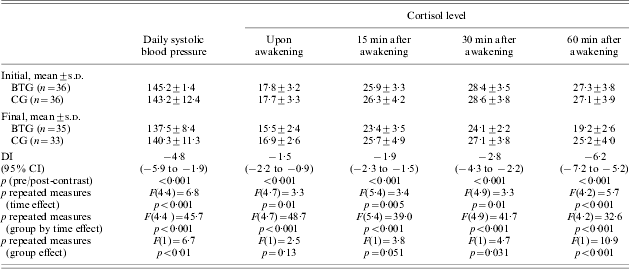
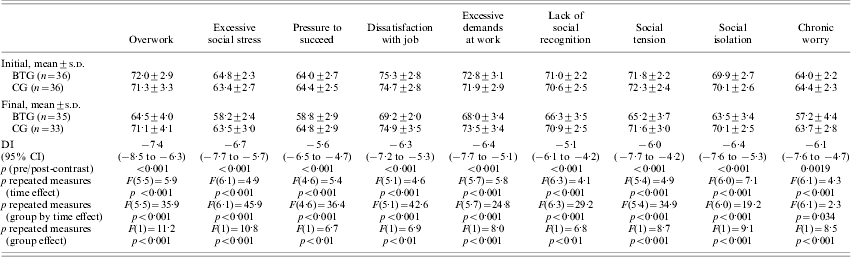
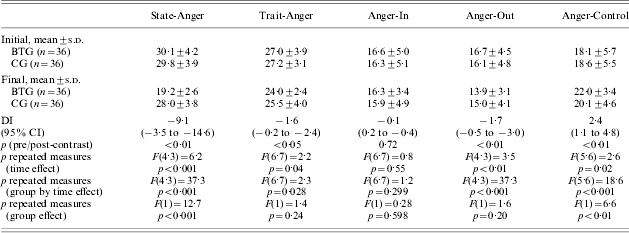
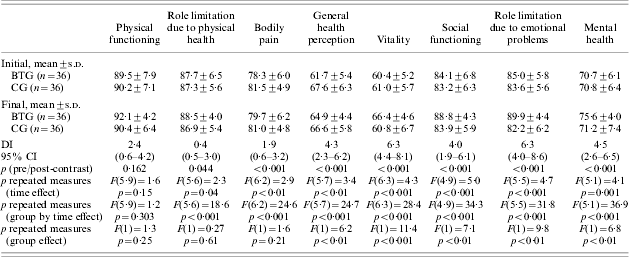
The men in both groups were of comparable age (BTG 33·5±7·4 years, CG 32·0±8·2 years), some lived in a partnership [BTG 21 (58·3%), CG 20 (55·5%)], were blue-collar workers [BTG 11 (30·5%), CG 10 (27·8%)], white-collar workers [BTG 18 (50·0%), CG 18 (50·0%)] or self-employed [BTG 7 (19·4%), CG 8 (22·2%)]. A number of them were employed [BTG 21 (58·3%), CG 19 (52·8%)]; the others had terminated their employment because of stress. Some were diagnosed with anxiety disorders [BTG 4 (11·1%), CG 4 (11·1%)], depressive disorders [BTG 5 (13·9%), CG 4 (11·1%)] and, less frequently, another illness [BTG 1 (2·8%); CG 1 (2·8%)]. Tables 1–4 show the initial mean values for daily systolic blood pressure, salivary cortisol levels, the TICS, STAXI and SF-36 test results. No essential differences between the two groups were found. The assessment of blood pressure and cortisol showed relatively high initial mean values. During testing with the TICS, the STAXI and the SF-36, relatively high stress and anger levels, and a relatively low health-related quality of life, were reported by those in both groups at the time of their entry into the study.
Changes in systolic blood pressure and morning salivary cortisol levels

s.d., Standard deviation; BTG, group treated with behavioural/psycho-educational group training; CG, control group; DI, difference in change between the groups; CI, confidence interval.
Changes on Chronic Stress Scales of the Trier Inventory for the Assessment of Chronic Stress (TICS, T values)

s.d., Standard deviation; BTG, group treated with behavioural/psycho-educational group training; CG, control group; DI, difference in change between the groups; CI, confidence interval.
Changes on State-Trait Anger Expression Inventory (STAXI) scores

s.d., Standard deviation; BTG, group treated with behavioural/psycho-educational group training; CG, control group; DI, difference in change between the groups; CI, confidence interval.
Changes on Short Form-36 Health Survey scales (SF-36, T values)

s.d., Standard deviation; BTG, group treated with behavioural/psycho-educational group training; CG, control group; DI, difference in change between the groups; CI, confidence interval.
Tables 1–4 also summarize BTG versus CG rates of change over the course of the study for primary outcome measures and portray the differences between the groups over the course of time. The repeated measures analysis was performed to verify whether the two groups had changed differently over time (group×time effect=treatment effect). As a part of the standard design of the repeated measures analysis, the main effects for ‘group’ and ‘time’ are also reported. Furthermore, pre/post-contrasts were used to check whether the rate of change between initial value and final value differed significantly between the two groups. The training group experienced a significantly greater rate of change (pre/post-contrast) than the control group (Tables 1–4) in the mean values for daily systolic blood pressure, morning salivary cortisol levels, and all scales of the TICS, the STAXI and the SF-36, except the scales for AI (STAXI) and Physical Functioning (PHFU, SF-36). The repeated measures analysis showed a significant treatment effect (group×time) for all the parameters mentioned above.
Discussion
At the time of randomization, the subjects showed relatively high mean values for daily blood pressure and cortisol level upon awakening. This supports findings from previous studies (Pruessner et al. Reference Pruessner, Hellhammer and Kirchbaum1999; Steptoe et al. Reference Steptoe, Kunz-Ebrecht, Owen, Feldman, Willemsen, Kirschbaum and Marmot2003; Nickel et al. Reference Nickel, Lahmann, Tritt, Loew, Rother and Nickel2005); however, there are also reports that show no salivary cortisol concentration response to chronic stress (Roberts et al. Reference Roberts, Wessely, Chalder, Papadopulos and Cleare2004). Treatment with behavioural/psycho-educational group training resulted in significant reductions in systolic blood pressure and salivary cortisol concentration in comparison with the control group. These results confirm the reports of previous investigations (Yehuda & McEwen, Reference Yehuda and McEwen2004).
The first week's testing showed a sharp rise in morning levels followed by a relatively gradual decline in both groups. This may indicate continued hypothalamic–pituitary–adrenal (HPA) axis) overstimulation in stressed men (see Pruessner et al. Reference Pruessner, Hellhammer and Kirchbaum1999). After behavioural/psycho-educational group training, subjects showed clearly declining curves (see Pruessner et al. Reference Pruessner, Hellhammer and Kirchbaum1999).
At the initial examination, both groups showed relatively high values on all the scales of the TICS and STAXI. Subjects with high T values on this inventory often feel overtaxed by too many tasks, stressed by too many contacts, do not permit themselves to make any mistakes, frequently have to do work that they do not enjoy, receive too little recognition for their achievements, experience more social conflicts, feel left alone in such situations, and suffer from innumerable worrisome thoughts (Schulz et al. Reference Schulz, Scholtz and Becker2004). Persons with high S-A scores experience relatively intense feelings of anger, and those with high T-A scores experience anger relatively frequently. Whether they suppress their anger or direct it inwards can be assessed through the AI, AO and AC scales. Because AI and AO are independent of each other, subjects can have high scores on both scales (Schwenkmezger et al. Reference Schwenkmezger, Hodapp and Spielberger1992). Persons with high AC scores expend a lot of energy on directing and controlling their emotions in situations that provoke anger (Schwenkmezger et al. Reference Schwenkmezger, Hodapp and Spielberger1992). A comparison of the final values showed that all TICS scales, as well as the S-A, T-A and AO STAXI scales, decreased significantly more in the BTG than in the CG. Among our patients, behavioural/psycho-educational group training appeared to influence the intensity of the perceived feelings of stress and anger as well as the threshold for perceiving anger.
At the beginning of the study, both groups had relatively low SF-36 scores, indicating a subjective reduction in health-related quality of life. Treatment with behavioural/psycho-educational group training reduced role limitations due to physical health and bodily pain. The general, personal perception of those problems related to health, vitality, social activities, and emotions that interfered with work or other daily activities, and even mental health, improved significantly (see Bullinger & Kirchberger, Reference Bullinger and Kirchberger1998).
Various studies have shown that behavioural and psycho-educational techniques are effective in treatment of the after-effects of stress (Wagner & Vogel, Reference Wagner and Vogel1996). It is important to identify potential patients' needs for mental health support beyond conventional care and to support patients who want to make healthy lifestyle changes (Nickel et al. Reference Nickel, Nickel, Mitterlehner, Leiberich, Tritt, Lahmann, Rother and Loew2004). This study shows that men could cope fairly well with short-term behavioural/psycho-educational group training. The clear time schedule and the relatively small amount of time needed improved compliance. Furthermore, the subjects learnt a technique they could use whenever needed.
Behavioural/psycho-educational group training appears to be an effective form of treatment for men suffering from chronic stress due to overwork. Reduction in the scores on the chronic stress and anger scales, in the patients' systolic blood pressure, and salivary cortisol concentration after awakening, as well as improvement in the health-related quality of life, may be expected.
Methodological limitations and directions for further research
This study had several methodological limitations. First, the sample size was (despite a valid power analysis) relatively small. Second, the sample consisted only of men. Whether these results could also be replicated with women with increased anger potential is unknown. Third, the length of the trial was only 2 months, which might have kept the drop-out rate low.
Additional research is needed to see if these results can be replicated and how long-lasting the benefits are. Studies with female patients and patients with more severe morbidity are also needed.
ACKNOWLEDGEMENTS
We are grateful to Ann Marie Ackermann for proofreading and translating this article.
DECLARATION OF INTEREST
None.