The ritual use of objects and images designed to serve as effigies or surrogates of specific persons, animals, or spirits is more or less universal across cultures and throughout human history. Verification of this has been well documented time and again by archaeologists and anthropologists working in disparate fields and in different time periods. Effigies have been and continue to be utilised as mimetic devices in a wide variety of ritual contexts, though they are most commonly found in magical rituals to heal, defend, or inflict harm. In ancient Greece, for example, there is abundant material evidence, from as early as the seventh century bce, that such objects were used in both public and private ceremonies to bind enemies for the protection of cities or to resolve personal conflicts.Footnote 1 Scholars of classical antiquity have come to refer to these ancient devices as ‘voodoo dolls’, adopting a popular (apparently misguided) term from studies of comparable practices in Africa and the Caribbean.Footnote 2 In India, prescriptions for the use of effigies (puttalī), especially for the purpose of destroying enemies, appear frequently in the ancient Vedic texts, above all in the Atharvaveda and the Kauśika-sūtra (c. eighth century bce), though such operations are likely rooted in an even more distant Indo-European heritage.Footnote 3 Similar figures are known also in China from at least the third century bce, and much later on from the first centuries of the Common Era in Chinese Daoist and Buddhist rites of sorcery.Footnote 4 Moreover, it seems that the same or similar types of objects, used especially in rites of magic to attract and repel spirits, were introduced to Japan from China, and by the end of the eighth century ce, such practices had been adapted and made popular in distinctively Japanese form.Footnote 5 And finally in Tibet, recent archaeological evidence attests to the use of illustrated effigies possibly as early (or as late) as the eleventh century. So far the earliest known Tibetan images of this sort are anthropomorphic figures inscribed on animal skulls (Fig. 1).Footnote 6 Effigies are also described in the Tibetan Dunhuang manuscripts dating back to the tenth century, but no illustrated figures of the type examined here have been discovered in these texts.Footnote 7 The practical use of effigies in Tibetan rituals, both Buddhist and Bon-po, was almost certainly derived from much older Indian practices transmitted to Tibet.Footnote 8 Indeed, references to ritual effigies are abundant in the Indian Buddhist canonical tantras and tantric commentaries that began to be translated into Tibetan from the eighth century onward.
Anthropomorphic liṅga effigies imprinted on the skulls of horses, Kexiaotu mound, Dulan county, Qinghai, ca. eleventh century. Qinghai Archaeological Institute, courtesy of Amy Heller.

In all cases, the use of effigies in ritual are based on sympathetic assumptions, that persons or things sharing a resemblance can act on one another at a distance; similarity of appearance indicating that the two are linked together by invisible bonds, and thus it is possible for one to be manipulated by the other. In Tibetan practice, effigies sculpted in the likeness of an enemy or figures drawn on paper into which the practitioner directs the power of a deity or demon that he controls are called liṅga.Footnote 9 Such effigies are employed broadly in Tibetan mimetic rituals targeted against enemies, either demonic or human.Footnote 10
In India, traditionally, the liṅga is the phallus of Śiva, at once the quintessential emblem and support of that fearsome god of destruction.Footnote 11 The liṅga, as understood and employed in Tibet, however, is not explicitly linked to Śiva or to his worship but does retain the literal Sanskrit meaning of ‘mark’ or ‘characteristic’ (Tib. mtshan), as well as the symbolism of receptacle open to a host of mundane and demonic entities.Footnote 12 For example, in the masked dances (’chams) of monastic drama performed in Tibet during the New Year's festivities, the liṅga plays a central role as sign and receptacle of the evil forces of the old year.Footnote 13 These forces are summoned and bound within the liṅga effigy (usually made of dough), placed inside a triangular box (brub-khung, thab-khung, or hum-khung zur-gsum), and ‘liberated’ (bsgral-ba) by the leading actor of the drama, a dancing black hat sorcerer who carries a ritual dagger (phur-pa). Like the effigy of the masked dance, in Tibetan rituals of sorcery designed either to repel (bzlog-chog) or to harm (bsad-chog), liṅga embody and make present through sympathetic means the intended target or victim. Paper drawings of liṅga used in such rituals usually depict a naked human figure (predominantly male, but occasionally female) or animal hybrid with hair standing on end, its arms tied or chained behind its back, knees bent and joints pierced or broken. Examples are found scattered throughout the extensive cycles of Tibetan ritual literature, typically drawn as ‘exempla’ (dpe-ris) on one or more separate folios placed at the end of a text or inserted between texts.Footnote 14
In most cases the images conform to generic formal models but their composition and style can often vary from text to text, depending on the specific ritual required. Although the significance and use of moulded, three-dimensional liṅga in Tibetan masked dramas have been repeatedly investigated, the function and form of two-dimensional liṅga drawings on paper have not as yet been properly considered. My primary intention in the following pages, therefore, is to call attention to these types of images, to offer some basic reflections on their distinctive renderings in Tibetan manuscripts and printed texts, and to evaluate the proposition that these figures might in fact have a common iconographic source that can be traced back to a much earlier set of Greco-Persian anatomical illustrations. To begin, let us first review the use of Tibetan effigies in their varied ritual contexts.
1 Basic ritual function of liṅga
The steps involved in rites that require the use of liṅga, either in the form of sculpted figures or paper images, have already been elucidated in some detail by Rolf Stein, Stephan Beyer, and Richard Kohn,Footnote 15 among others; so, briefly in what follows, I wish merely to highlight as background some of the common components of their descriptions, relying also on details provided in a few representative Tibetan works.
There are six operations basic to all liṅga rituals: (1) drawing (’bri) an image or molding a figure resembling the intended target; (2) summoning (’gugs) the target; (3) causing the target's spirit to be absorbed (bstims) into the image or object; (4) separating (dbye) the target from its divine protectors; (5) cutting off its life-force (srog-chod) to achieve the intended goal; and finally (6) ‘liberating’ (bsgral-ba) the spirit of the target.Footnote 16 In cases using an image inscribed on paper, as we shall see in greater detail below, the liṅga should be drawn with a weary and exhausted expression, frightened, dried up and emaciated.Footnote 17 In the second step of the ritual, the ‘soul’ (bla), ‘good fortune’ (phya), or consciousness (rnam-shes) of the victim is summoned and bound within the liṅga by four syllables—jaḥ on the figure's right shoulder, hūṃ on its left shoulder, baṃ on the right knee, and hoḥ on the left knee, respectively. The seed syllable nrī (‘human’ or sometimes the syllable trī) is inscribed at its heart.Footnote 18 To activate the image, the personal and clan names of the target are then written on its forehead, its navel, or its thigh. The liṅga is then surrounded by the requisite mantra spells or curses to be recited in whatever specific ritual is being performed. The final actions of ‘separating’ and ‘cutting off’ are symbolically accomplished by marking X's inscribed with binding syllables above and below the liṅga and sometimes on the joints of the figure itself. In some cases the victim's joints are symbolically broken by folding the inscribed paper at the neck, elbows, knees, and ankles, or by attaching the paper liṅga to the shoulder bone of a goat.Footnote 19 The target is ‘liberated’ and the image discarded at the conclusion of the ritual usually by burning it in a ceremonial fire pit as a burnt offering (sbyin-sreg) or mutilating it with a ritual dagger if moulded from dough, like in the masked New Year's dances.Footnote 20
Usually, liṅga rituals are incorporated as part of a much broader programme that can also include other associated forms of ritual substitution or ‘ransom’ (glud), such as the gtor-ma offering and the rite of the thread-cross (mdos).Footnote 21 Generally speaking, gtor-ma are offering cakes made of various substances (dog faeces in rites of sorcery, for instance, but more often something less extreme like dough or butter) and sculpted in a variety of shapes to be either offered to deities or ritually cast out during specific ceremonies. Thread-cross rites, on the other hand, require the use of an ornate handmade object called nam-mkha’ or ‘sky’, as it represents a type of residential space for particular spirits or demons.Footnote 22 The nam-mkha’ consists of multicoloured threads woven around a frame of wooden sticks like a web. More elaborate frameworks, some built as high as ten feet or more, are also constructed in this basic fashion and are used as a type of cage to ensnare the spirit or consciousness of the intended target. According to the basic instructions for the practice of the thread-cross, the device is to be set up with a triangle as its base. The ritualist is directed to draw a liṅga effigy of the victim on paper or cloth. He is then to place it within the triangular foundation and offer it as gift (yas) to the ‘thread-cross lord’ (mdos-bdag) — the deity whose presence and assistance is being invoked.Footnote 23 Also, while reciting the specified mantra spells, the ritualist is supposed to pelt the thread-cross and its triangular base with various consecrated ‘power ingredients’ (thun), usually mustard seeds.Footnote 24 Finally, the entire framework is to be thrown in whatever direction the target is located or from wherever the enemy is expected to approach. This action is supposed to diminish the life-force (srog) of the intended target and to turn the enemy away (bzlog-pa).
Another practice that operates under similar conditions, but may or may not require the use of liṅga, though often part of the same series of activities, is the ritual of hurling gtor-ma weapons, or gtor-zor.Footnote 25 We are already familiar with the term gtor-ma, but the term zor refers generically to any variety of consecrated objects employed as ritual weapons that are literally thrown (’phen-pa) against enemies—these targets can be demonic entities but are more often domestic or foreign armies (mtha’-dmag).Footnote 26 For this type of programme, the ritualist should imagine a sacrificial fire-pit in front of the enemy's totem deity (’go-ba'i lha).Footnote 27 Concentrating on the gtor-ma as a weapon and taking aim, the ritualist should hurl the gtor-zor in the direction of the enemy and imagine that its totem deity's strength and magical powers are annihilated. The ritualist should then imagine that the enemy becomes paralysed or rendered unconscious. At that point, the ritualist should vividly imagine all the spirits (mi-ma-yin) fighting in his corner emerging from the hurled gtor-ma weapon to strike at the enemy, some eating the enemy's flesh, drinking its blood, devouring its heart, while others bind its hands and feet.Footnote 28
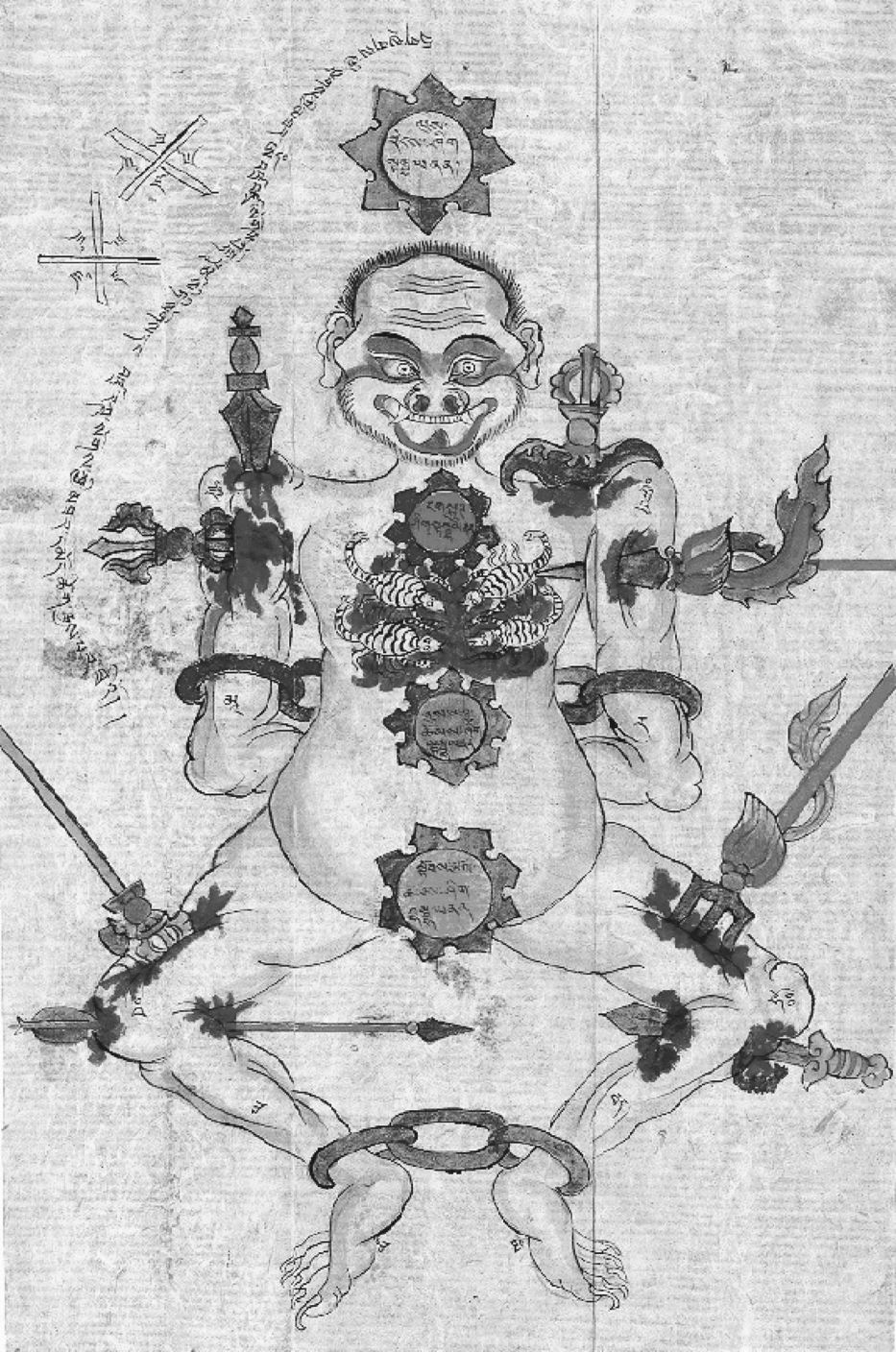
Lastly, to mention another allied defensive rite that may be performed in conjunction with liṅga rituals, there is the procedure for repelling and deceiving human or demonic enemies using a so-called ‘wand of invisibility’ (sgrib-shing).Footnote 29 This requires the consecration of certain power ingredients (thun), namely mustard seeds, and other magical potions (rdzas) — like tiger fangs, the blood of wolves, flesh and bone, and so forth — all placed in small cairns (tho) or piles of stone erected on mountain tops and other key geographical locations.Footnote 30 The power to become invisible or to cloak a particular area for protection is accomplished by the placement of these cairns filled with empowered materials at specific sites. Clearly, the cairns are employed here to mark territory, to stake boundaries, and in this sense, such activity resonates well with age-old Tibetan notions about the geomantic power of certain constructed edifices (temples, etc.) quite literally to nail down the land as a means to control it. We might immediately recall the famous topographic image of Tibet as a ‘supine demoness’ (srin-mo gan-rkyal du nyal-ba) pinned down (gnon) at specific focal points (me-btsa’) by the first twelve Buddhist temples erected by king Srong-btsan-sgam-po (c. 605–650) in the seventh century; the central Jo-khang temple in Lhasa staked at the demoness's heart.Footnote 31 The same symbolism of violent control and constraint is expressed in some Tibetan illustrations of liṅga, in which a demon or human adversary is rendered as a bound anthropomorphic figure with daggers piercing its joints and limbs (Fig. 2). This is a literal depiction of the action of subjugation and destruction of the enemy, the climax, for instance, of Tibetan phur-pa rites.Footnote 32
Manuscript illustration of liṅga for subduing demons (’byung-po), from the Fifth Dalai Lama's Gsang-ba rgya-can dpe-ris dang bcas-pa, ca. nineteenth century, Tib. B. 9517/9518, illus. 41. Courtesy of the St. Petersburg Institute of Oriental Manuscripts.

2 Stylistic features of liṅga drawn or printed on paper
Effigies may in fact be universal but the stylised anthropomorphic figures that appear in Tibetan ritual texts as hand drawn or woodcut illustrations designed to serve as models for the production of effigies, referred to as liṅga by Tibetans, seem to be a phenomenon unique to Tibet and other Tibetan-influenced cultural regions (namely, Nepal, Bhutan, and Mongolia). This type of effigy figure, as far as I can determine, is not found anywhere in India, China, or Japan, where rites utilising effigies, as I noted at the start, are prevalent and predate in most cases similar if not identical practices in Tibet. This raises questions. Is this two-dimensional graphic figure, therefore, an expression of Tibetan artistic innovation, or if not, does the figure derive from some as yet unidentified prototype?
In order to address these questions it is necessary to shift our focus from the framework of ritual to the history of art, but even more precisely we would have to take a closer look at the history and function of drawing in Tibet. However, that task is especially difficult since Tibetan sketch illustration and autonomous drawing have not yet emerged as independent subjects for critical investigation by historians of Tibetan art. Fortunately, it is true that in recent decades some exceptional studies have appeared on the fine arts in Tibet and the Himalayas covering a wide range of pertinent issues, for example the styles and composition of the major works of Tibetan and Himalayan sacred art in paintings and murals, features of Buddhist iconography, principles of Tibetan iconometry, and the biographies of Tibet's greatest artists.Footnote 33 Yet scholars have still largely remained silent about the position of the graphic arts in Tibet, which do not typically conform to the precise and polished procedures customary in the high art of the temples and monasteries. Here I refer to the many collections of freehand drawings and woodcut illustrations that have come down to us in the pages of ritual texts. The liṅga figure is just one fascinating example among many of the types of practical illustration we find in these books. These include naturalistic renderings of a diversity of ritual implements and regalia, as well as technically simple but stylistically expressive depictions of humans of both sexes, assorted animals, and the full array of demons and spiritual creatures that haunt the Tibetan physical and psychological landscape. Marvellous examples of this kind of illustration fill an entire volume in Sangs-rgyas-gling-pa's fourteenth-century anthology, the Bla-ma dgong-’dus (Compendium of the lama's intention)—a veritable bible of Tibetan ritual of almost every sort—and also in the more richly embellished black thang-ka paintings commissioned by the Fifth Dalai Lama (1617–1682) between the years 1673 and 1680 to illustrate his private visions.Footnote 34 I am not equipped to tackle the art historical significance of these drawings, but wish merely to underscore the worthiness of the subject for specialists of Tibetan art.
With that objective in mind, I would like to suggest also that, in addition to the illustrated ritual texts, another potentially valuable medium for future consideration is the artist's sketchbook – that is of course if such books can be determined to have existed in Tibet as they certainly existed in Nepal.Footnote 35 Concerning the latter, Pratapaditya Pal remarks that “these books containing artists’ models, as well as illustrated manuals for priests, were produced in abundance in Nepal between the fifteenth and early twentieth century. . . The texts often consist of litanies, rituals, eulogies, and devotional poems as well as astrological and iconographical information. . . Although these sketches were meant to serve as the artists’ working notes, they were, nevertheless, carefully rendered with great attention to detail”.Footnote 36 The sustained study of ‘model-books’ (exemplum) in Europe, for example, has had tremendous impact on broadening the understanding of production processes, development of drawing styles, and forms of artistic transmission throughout the European Middle Ages, and I suspect that the same could hold true in the area of Tibet and the Nepal Himalayas.Footnote 37
Illustrations of liṅga are themselves ‘models’ (dpe-ris), exemplifying details conveyed in the written texts that usually accompany them, and are designed to be copied time and again for ritual purposes. Also, as noted earlier, they are meant to serve as replicas that imitate the actual shape and expressions of the intended targets of the rites. Other significant collections of similarly explanatory illustration are to be found in the Tibetan medical tradition. The finest examples of such visual aids are, of course, the extraordinary medical paintings illustrating Sde-srid Sangs-rgyas-rgya-mtsho's (1653–1705) late seventeenth-century commentary on the Rgyud-bzhi (Four-fold tantra), Tibet's most authoritative treatise on medicine and therapeutic treatment.Footnote 38 These lavish paintings reflect the breadth and depth of the healing art as practiced in Tibet from perhaps as early as the second half of the seventh century and depict in naturalistic detail much of the basic medical practices prevalent in the time of the Fifth Dalai Lama, notably pulse-reading (rtsa-lta), uroscopy (chab-rtags), dietetics (zas-tshod), bloodletting (gtar-ga), moxibustion (me-btsa’), herbal medicines, and elementary techniques of surgery, among many other procedures.
There has been considerable effort by a few expert scholars to introduce and contextualise these paintings (all of which have survived in modern Mongolian and Tibetan reproductions) in terms of the history and practice of medicine in Tibet, and some effort to outline the main features of their iconography and artistic style. On the other hand, the important role that these paintings play in visually reflecting the peripheral public, social and religious spheres of everyday life—depicted in detail throughout in the scores of miniature tableaux surrounding the medical subjects proper and many even portraying main topics themselves—has not yet been sufficiently explored.Footnote 39 These graphic images show ordinary Tibetans going about their ordinary routines in the towns and villages, monks and lamas performing their customary rituals, the doctors attending to their patients, and so on—simple snapshots of daily life. Such pictures are as much a part of the history of Tibetan art as are the more central and perhaps more artistically appealing images of human anatomy, or the subtle channels of the yogic body, the intricate circular diagrams of pulse divination, or the ever popular maṇḍala of Bhaiṣajyaguru, the Medicine Buddha. All this indicates that there still remains much exciting work to be done and that the future ahead looks promising. But leaving this aside, now that we have come to the topic of medical illustration we are in a position to return to the questions raised above about the source or derivation of the unique stylistic form of the Tibetan liṅga. Let us first review its common features.
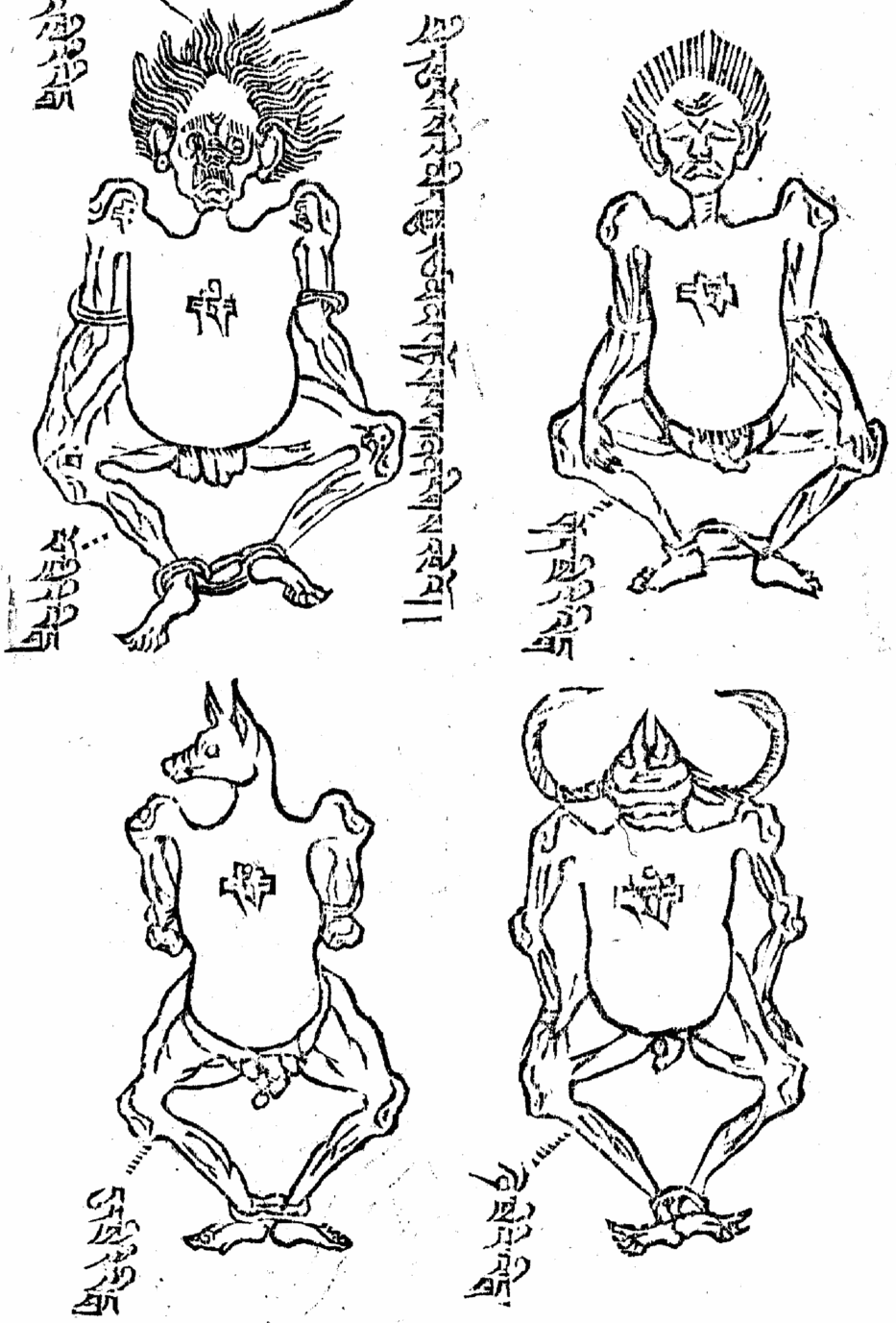
Fig. 3 shows four typical liṅga illustrations in the Tibetan ritual texts. The figures here are detailed from a small collection of such models, the Liṅga'i dpe-ris skor (Collection of liṅga model-illustrations) included in the works of Brag-dkar Sngags-rams-pa Blo-bzang-bstan-pa-rab-rgyas, a little-known seventeenth-century Dge-lugs-pa mystic from Amdo in northeastern Tibet.Footnote 40 These liṅga are models of the effigies to be deployed in rites against various species of sri demon, and thus each one of the naked figures printed on the page is to be viewed as a facsimile of a particular demon in that class.Footnote 41 Noteworthy in these examples are the following characteristics, which again are common to all depictions of Tibetan illustrated liṅga: a naked, emaciated but slightly musculatured human figure standing (or lying flat) bound in chains with legs open and bent at the knees, feet pointed outward, stomach distended, genitals exposed, arms tied behind the back, hair standing on end, and the face (sometimes human, sometimes animal) grimacing in fear or pain. Dotted lines lead to side captions identifying the class of demon represented. In some cases, inscribed around the figure are brief instructions on how to draw the image or what to do with it in the ritual programme. The requisite mantric syllables and the spells or curses to be recited are often written on the body of the figure as well.
Details of Tibetan liṅga woodblock figures from Brag-dkar Sngags-rams-pa Blo-bzang-bstan-pa-rab-rgyas, Liṅga'i dpe-ris skor, vol. 2, fols. 5r-6r. Reproduced with permission of the Tibetan Buddhist Resource Center (TBRC). Weblink: http://tbrc.org/link?RID=W15404, in vol. 2, scans 333–344.

3 Tibetan liṅga and anatomical illustration
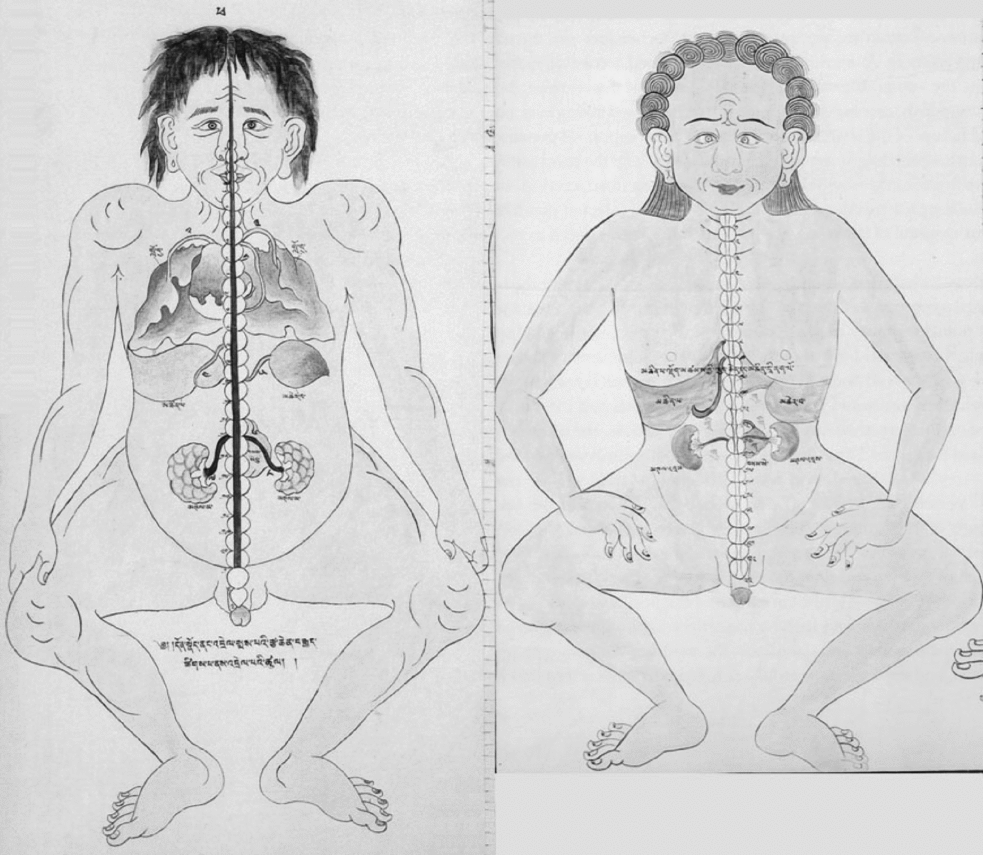
Recently, Fernand Meyer has drawn our attention to the pronounced stylistic resemblance between this generic Tibetan liṅga figure—especially its distinguishing posture—and two images reproduced in the Tibetan medical paintings (Fig. 4).Footnote 42 The first image shown here depicts the “relationship between the aorta, or channel of life parallel to the vertebrae, and the eight hidden blood vessels [sbas-pa'i rtsa-chen] of the viscera”, while the second depicts the “channels which connect the solid and hollow viscera at the spinal column”.Footnote 43 Demonstration of the internal organs and connecting channels above and below the diaphragm is thus the shared objective of both images. Citing the earlier observations of Karl Sudhoff, one of the pioneering historians of medicine, Meyer has also suggested that these two medical figures, and by implication the Tibetan liṅga figure itself, may have a common iconographic source that leads back as far as the third century bce to the ancient Alexandrian tradition of anatomical science.Footnote 44 This is a tantalising suggestion and one upon which Meyer opted not to expound further, as the issue was tangential to his main focus. So here I will try to put some of the links together to assess whether such a thesis is tenable, and because I think this issue is important to answering our questions about the distinctive style of the Tibetan liṅga form.
Detail of two Tibetan anatomical figures demonstrating the viscera and connecting channels, ca. 1920s, from facsimile of the original 1687–1703 thang-ka series preserved at the Buryat Historical Museum in Ulan Ude. Parfionovitch et al., Tibetan Medical Paintings, 1992, pls. 10 and 47. Reproduced with permission of Serindia Publications.

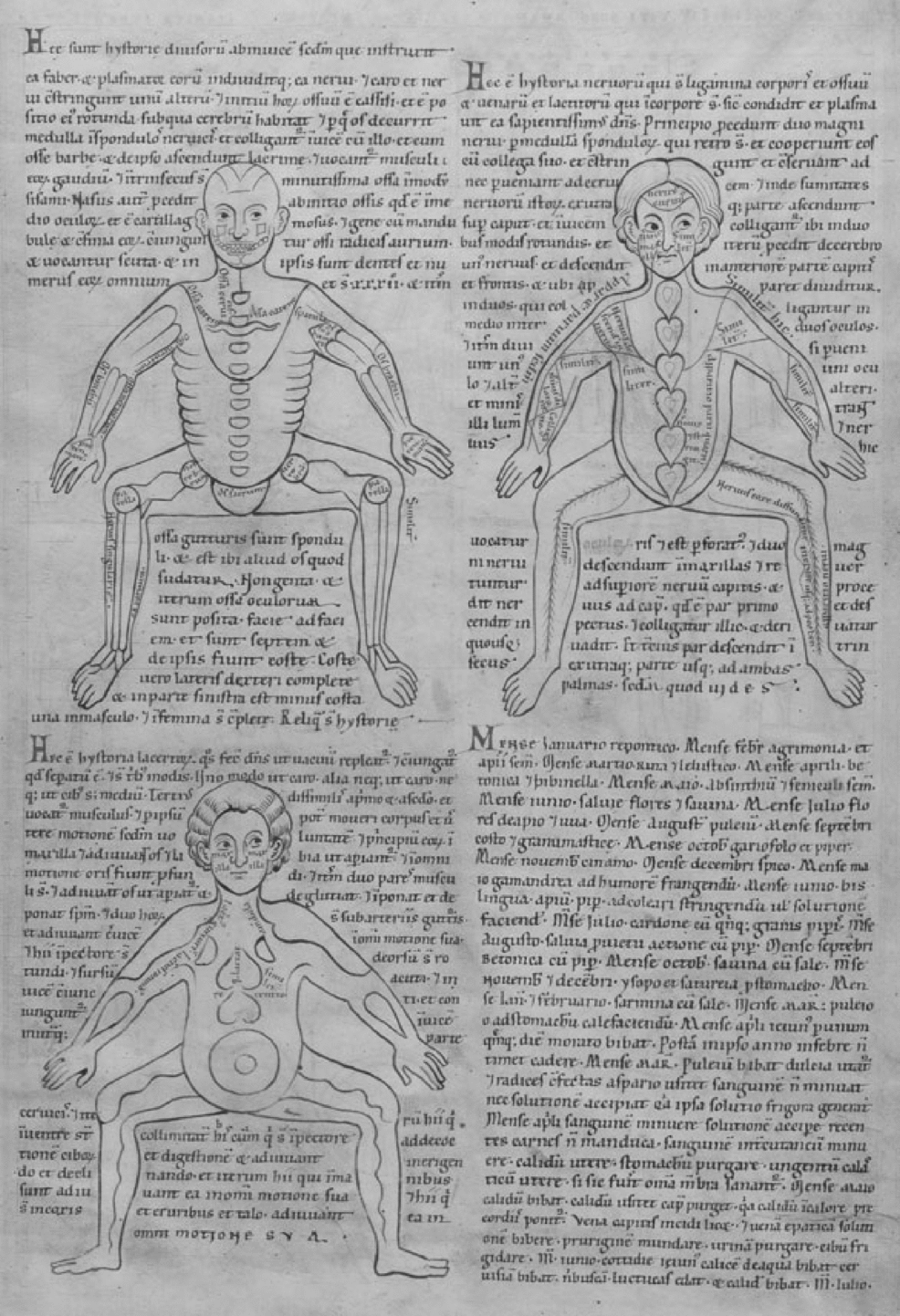
Sudhoff's hypothesis, as it relates to specific anatomical illustrations that have survived in medieval Latin manuscripts from the first half of the twelfth century (and in Arabic sources from the fourteenth century), is that the original model for the figures in similar posture reproduced in European and later Persian medical drawings was first developed in Hellenistic Alexandria and transmitted by way of Byzantium.Footnote 45 This original model, Sudhoff speculated, consisted of a series of five figures (Fünfbilderserie), all in the same position, and each depicting one of the five systems of the body: the arteries, veins, bones, nerves, and muscles (Fig. 5).Footnote 46 Medical historians have since accepted an expanded nine-figure series, with the addition of four figures showing the genitals, viscera (stomach, liver and belly), the womb, and the brain and eyes.Footnote 47
Examples of Sudhoff's ‘five-figure series’ (Fünfbilderserie) depicting the bones, nerves, and muscles, from a manuscript written and illuminated in 1158 at the Benedictine Abbey of Prüfening, Bavaria and now held at the Bayerische Staatsbibliothek München: Cod. lat. Monacensis 13002.

Sudhoff was especially compelled by the unusual posture of these figures, notably the open position of the legs, which he described as a ‘squatting’ position (a position that Fielding Garrison, commenting on Sudhoff's studies, evocatively compared to the position of a ‘reflex frog’).Footnote 48 In considering the explicit didactic function of the European medical figures, however, the noted anatomist Robert Herrlinger advocated instead that they should be more appropriately referred to as “table figures”, since their characteristic posture most directly corresponds to “the position of a corpse laid upon a table (mensa) for dissection. . . the legs are spread apart in order to make the inside of the thighs and genitals accessible”.Footnote 49 As Sudhoff, Herrlinger and others have shown, the ‘squatting’ or open-legged ‘table’ position of these figures appears repeatedly in medieval Latin and Arabic anatomical illustrations, particularly of the arteries, viscera and related systems, and also in schemata for the medical procedures of cautery and bloodletting (Fig. 6);Footnote 50 all of them presumably fashioned exclusively for the purpose of instruction or memorisation. Again, as Meyer has noted, we see this same position in the two viscera figures of the seventeenth-century Tibetan medical paintings of Sangs-rgyas-rgya-mtsho. I should add here that Sudhoff himself was actually the first to acknowledge this comparison after seeing copies of two sets of these Tibetan anatomical figures, one published by E.H. Walsh in 1910 and another obtained in 1902 by Bertold Laufer and subsequently donated to the Field Museum of Chicago.Footnote 51 Let us keep in mind that illustrations of Tibetan liṅga are also drawn in a posture reminiscent of these medical figures.
Manuscript illustration of a ‘bloodletting man’ linked to the ‘five-figure series’ (Fünfbilderserie), fifteenth century. Herzog August Bibliothek Wolfenbüttel: Cod. Guelf. 18.2 Aug. 4°, fol. 110r.

Even with Herrlinger's corrective description, he and Sudhoff both had made it clear, however, that none of the Fünfbilderserie figures—European, Persian, or Tibetan—seem to have been derived from direct practical observation of the displayed cadaver, but rather, following Sudhoff's thesis, preserved the character of a much older and long copied schematic template. This template, Sudhoff proposed, was expressly tied to the Greek anatomical tradition of Galen (Galenos, 129-ca. 217), second-century physician from Pergamum.Footnote 52 Galen's anatomical works which, as often emphasised, were largely argued by analogy from observations of animal dissection, held sway as the authoritative source of anatomical knowledge in Europe until at least the sixteenth century when actual anatomical dissection eventually prevailed as a method of medical instruction—a tradition, apparently, that had already begun to be developed as early as the fourteenth century, primarily in the Italian universities.Footnote 53
The Galenic tradition was also promoted in Persia from about the third century onward based on Arabic translations of Galen's works and continued well into the fourteenth century.Footnote 54 At the end of that period, in 1396, the first of the Arab Islamic anatomical works to include illustrations was produced: the Tashrīḥ-i Manṣūrī (Manṣūr's anatomy), a summary of Galen's anatomical writings composed by the Shirazi physician Manṣūr ibn Muḥammad ibn Ilyās. The five illustrations that traditionally accompanied the Tashrīḥ-i Manṣūrī, known from numerous manuscript copies dating from the fifteenth to the nineteenth centuries, contain decisive examples of Sudhoff's Fünfbilderserie.Footnote 55 Assuming these figures were in fact derived from Alexandrian models, Gül Russell has speculated that “they could certainly have been transmitted either in the cultural context of Byzantine-Sasanian relations when Greek medical works were most likely translated into Pahlavi, or in the subsequent translation movement of Greek works into Arabic, where there is evidence of adaptation of Greek figures to Persian iconographic styles”.Footnote 56 This latter movement in the translation of Galenic texts into Arabic began in the ninth century, though not directly from the Greek but rather from the much earlier translations in Syriac, which date back to the last half of the second century.Footnote 57
Similarly, on the question of the transmission of the Greek tradition to Europe, Ynez Violé O'Neill has established, contrary to Sudhoff, that the source of Galenic knowledge in Europe, and the basis for the European Fünfbilderserie illustrations, was not the Byzantine but the Persian tradition, which was transmitted via Latin translations of the Arabic works beginning in the late eleventh century with Constantine the African (ca. 1020–1087) and his students in southern Italy.Footnote 58 The pre-eminence of the Greco-Arab or Greco-Persian transmission of Galenic models to both Europe and the Islamic world is significant for our interest.
But let us return briefly to Herrlinger's comments about the five (or nine) Alexandrian “table” figures (Sudhoff's Fünfbilderserie) and what purpose they likely served. Herrlinger had made the point that these figures with their peculiar posture should be understood essentially as didactic models demonstrating in abstraction the dissection and exenteration of a cadaver laid out for display—a position adopted also for the demonstration of other related anatomical procedures, such as bloodletting. In my opinion, Herrlinger's point is one we should not pass over when considering possible explanations for the postures of the two Tibetan medical figures first recognised by Sudhoff and later reemphasised by Meyer, and also (to take up Meyer's further observation) those same positions of the anthropomorphic effigies reproduced in the Tibetan ritual texts. The symbolic import of both representations is explicit. The two stylised medical figures are shown squatting in Sudhoff's characteristic pose with viscera exposed illustrating some of the vital blood vessels and central connecting channels inside the human body. Likewise, as we well know, Tibetan liṅga are designed in the same fashion to function not so much as didactic anatomical diagrams but as models (dpe-ris) for drawing ritual substitutions of the literal bodies of persons (living rather than dead, of course, human or demonic) who are to be laid out, harried, and then eviscerated and destroyed through sympathetic means in rites of aggression or defence.
The similarities of stylistic design between the Greco-Arab and Tibetan figures are obvious enough, but can we connect them historically? Is there any evidence to suggest that Tibetans would have been familiar with Alexandrian anatomical models? And if so, why then might these schematic medical figures also show up in Tibetan sympathetic substitution rituals, which presumably lie outside the strictly medical arena?
This is not the place to enter into a discussion of Tibetan medical history, but it should suffice for our purposes to call attention to the generally accepted conclusion in both Tibetan and western scholarship that at the inception of medical learning in Tibet during the first half of the imperial age (seventh to eighth century) Tibetan medicine was influenced to some extent by the importation of Greco-Persian traditions, including the transmission of Galenic anatomical and physiological science from the Iranian world. Though the earliest available historical records from the period are silent about these transmissions, and for that matter the history of Tibetan medicine more generally, later works from the twelfth century onward relate a more or less common historical narrative.Footnote 59 Here I shall simply accept the basic story at face value, since an attempt to prove the case or even to advance the story would take us too far afield, and besides it is best I leave the issue to historians of Tibetan and Central Asian medicine who are much better skilled to unravel the many historical and linguistic knots involved in such matters.
The gist of the Tibetan historical accounts is that during the reigns of Srong-btsan-sgam-po (r. 629–650), Mes-ag-tshoms (r. 712–755), and Khri-srong-lde-btsan (r. 755–797), a number of foreign physicians had been invited to the court, including among them three or four doctors from Persia or the Arabic world. In the seventh century, the first of these physicians, identified in the sources by the curious name Ga-les-nos, is said to have arrived from Khrom/Phrom (Byzantium) or Stag-gzig (Iran).Footnote 60 The name is an obvious reference to Galen, but here of course signifying only that he was probably an envoy of the Galenic tradition or at least perceived as having some affiliation with it.Footnote 61 Ga-les-nos was chosen by Srong-btsan-sgam-po to be the chief physician of the king's court and is said to have fathered three sons in Tibet, each of whom initiated three distinct teaching lineages. The medical texts he brought with him were translated into Tibetan, the Tibetan titles of which are usually given (with few minor variants) as Mgo-sngon bsdus-pa (Compendium of the anterior[?] head) and Des-po rma-bya ne-tso gsum-gyi dpyad (Examination of roosters, peacocks, and parrots). Copies of these works have not survived or at least have not yet been discovered, but from the titles alone it seems safe to speculate, along with Beckwith, that the first work may have dealt with the head or skull, the second with the anatomical dissection of birds.Footnote 62 Indeed, both subjects are considered among the hallmarks of Galenic science, but the extent to which the Tibetan works attributed to Ga-les-nos corresponded to any of the actual anatomical writings of the Greek Galen may never be known. On this point, it is worth mentioning Galen's text De ossibus ad tirones (On bones for beginners), which in its Arabic versions also included suture diagrams of the head. Roger French has conclusively linked the text and its illustrations to Sudhoff's “five-figure series” and has traced its line of transmission from the Greek directly to Persian.Footnote 63 It would certainly contribute much to our case if in addition to the clear indications of iconographic continuity we also had direct textual or material evidence that this Ga-les-nos or any of the other Persian physicians invited to Tibet in this period had brought with them didactic illustrations to accompany their medical books. But alas such evidence is so far not to be found.
The successor of Ga-les-nos at the Tibetan court was the physician Bi-ji (Be-ce) Tsan-pa-shi-la-ha from Khrom, who was invited to Tibet by king Mes-ag-tshoms and later promoted to the position of court doctor by Khri-srong-lde-btsan.Footnote 64 The name is clearly not of Tibetan derivation and Beckwith has conjectured that the title “Bi-ji (Be-ce)” is the Tibetan rendering of a Sogdian term, ßyč-, meaning ‘physician’, signalling Tsan-pa-shi-la-ha's eastern Iranian pedigree.Footnote 65 The sources indicate that he probably arrived in Tibet from Persia by way of China, perhaps following a route well travelled in this period along the Silk Road that may have taken him and the medical books he carried from Samarkand through Kucha, Turfan, then to Dunhuang, and thereafter to China and finally to Tibet.Footnote 66 Tsan-pa-shi-la-ha is recorded as having translated a fair number of medical texts not only of alleged Greco-Persian origin but also medical works from China and India. Interestingly, he seems also to have been responsible for disseminating a physician's oath similar to the familiar Hippocratic oath of the Greek tradition, which along with other Hippocratic concerns of the Hellenistic age had played such a prominent role in shaping Galen's medical philosophy.Footnote 67 The many titles of Tsan-pa-shi-la-ha's works recorded in Tibetan,Footnote 68 especially the few that might have concerned the study of human anatomy or general therapeutic notions, only hint at possible Greco-Arab influences.Footnote 69 Yet here again, unfortunately, we find no proverbial ‘smoking gun’.
What we can take away from all of this is sound assurance that at some point in the development of Tibetan medical science—whether in the seventh and eighth centuries, as the Tibetan histories themselves relate, or perhaps later from the twelfth century when the traditional historical narratives of foreign influence on Tibetan medicine first began to be articulated by indigenous historians—Tibetans came into direct contact with medical concepts, including perhaps anatomical models and therapeutic procedures, derived from or influenced by transmissions of the Greek and Persian medical systems. From this it is not unreasonable, then, to suspect that Tibetans would have also been exposed to the types of didactic or explanatory illustration that so often accompanied the Greco-Persian anatomical works of the sort that have survived in medieval Latin and Arabic manuscripts and connected as prototypes to Sudhoff's Fünfbilderserie. This might help to explain the two unique Tibetan medical figures reproduced in the paintings commissioned by Sde-srid Sangs-rgyas-rgya-mtsho, since they so closely illustrate some of the same medical subjects and can be plausibly linked historically by confirmed avenues of transmission along the Silk routes. Though these two figures perhaps preserve in visual form the only vestiges that remain of the Greco-Arab influence on Tibetan anatomical knowledge, they are almost certainly related stylistically to the much earlier five- or seven-fold set of illustrations based on the Alexandrian Galenic prototype.
As for the similar continuity of style in the anthropomorphic figures (liṅga) that appear as hand-drawn or woodcut models for the production of effigies in Tibetan ritual texts, I can only propose this tentative conclusion in agreement with Fernand Meyer. The form of the liṅga figure, and especially its distinctive bent-knee and open leg posture, quite possibly derives from the same anatomical prototype. It is significant that the earliest known examples of this specific liṅga form in a ‘squatting’ posture (though still rather primitively rendered) date back possibly to the tenth or eleventh century, inscribed on the skulls of horses or mules uncovered from recent archaeological finds in the Dulan region of Qinghai province.Footnote 70 During Tibet's imperial period, coinciding with the Chinese Tang (618–907), the area was a significant trading post situated along the Silk Road.Footnote 71 Researchers have discovered numerous artefacts in Dulan of widely distant and varied cultural influence, including materials of possibly Byzantine, Persian, Sogdian, Tibetan, and Chinese provenance.Footnote 72 If nothing else, the liṅga skulls from Dulan establish a concrete possibility that the unique position and style of the effigy figure in Tibet could have first emerged in this distinctive transnational context, where Greco-Arab and Persian cultural styles met and intermingled with Tibetan and Central Asian traditions. The more fully pronounced iconographic likeness of the later examples of Tibetan illustrated liṅga figures to those of the Alexandrian anatomical series reproduced in medieval Persian and Arabic manuscripts reinforces that possibility.
We conclude then by returning to the question of the stylistic distinctiveness of the Tibetan liṅga figure drawn or printed on paper. When first devising a design for this anthropomorphic image, at whatever point in history that may have occurred, Tibetans could have just as easily illustrated a figure standing straight like the customary stance of ‘voodoo dolls’ or other sorts of sculpted effigies known throughout the world, or a figure stretched out flat or in any number of conceivable human physical positions, but they chose instead to render the figure in an unusual stylistic posture that is practically identical to that of the Alexandrian five-figure series. My suspicion is that the Tibetan liṅga design was not copied directly from this model, but was more likely derived from anatomical sources closer to home. Still, such likely sources would have themselves been shaped by the diffusion of Greco-Persian pictorial influences and probably would have included images like the two Tibetan anatomical figures we have discussed above.
Though deep rooted in a common iconographic source, the figure that was eventually developed in Tibetan ritual texts displays modifications that must certainly represent the product of Tibetan imagination and artistic creativity. A few notable Tibetan stylistic innovations that we recognise in this generic anatomical figure include the depiction of fettered ankles (sometimes with the feet crossed rather than apart), the cords or chains constraining the arms behind the back, the bony shoulders, arms and legs, and exaggerated muscles of the thighs, the expressive faces conveying fear or pain, and variations of the head and hair. I presume that these are uniquely Tibetan flourishes that could be better explained by art historians. But I think there is more than just a visual comparison and contrast to be noted here; there is also a meaningful symbolic significance behind the recognisable use of medical figures to illustrate the anthropomorphic effigy in Tibetan rituals.
It has long been acknowledged that in so-called traditional or pre-modern societies the boundaries between medicine and magic were very often blurred and that, to modern sensibilities at least, the lines separating their practice cannot always be easily discerned (though of course such distinctions are for the most part of our own making). In Tibet the diagnosis and treatment of disease and mental illness, the distinguishing and administering of the healing properties of plants and herbs, the calculation of the stars and planets, the control and manipulation of the energies of mind and body and so on, are all traditional ‘medical’ or healing techniques that are essentially the same as those for many of the conventional practices of Tibetan Buddhist (and Bon) ritual. Indeed, standard Tibetan medical works frequently contain instructions for all such practices while also including alongside them instructions for the rites of exorcism, divination, the use of talismans, and other ‘magical’ operations for healing or protection, enrichment, control, or even for harm, and many of these rites require the use of mimetic substitutions.Footnote 73 It should come as no surprise then, and is by no means accidental, that Tibetan liṅga belong also to the medical tradition and are thus illustrated in both medical and ritual books using the form and posture of anatomical figures. The fact that these figures were originally designed in some distant past as didactic models demonstrating the position of dissected cadavers laid out for the display of the internal organs seems completely appropriate for the image of anthropomorphic effigies set out to be sliced, diced, and eliminated (read: liberated) in the mimetic programmes of Tibetan ritual magic.
I end this discussion of Tibetan illustrated effigies with a translation of a brief work by the famous fifteenth-century treasure-revealer (gter-ston) and patron saint of Bhutan, Padma-gling-pa (1450–1521), giving instructions on how to draw the liṅga for a ritual of defence against human adversaries. This text is found in Padma-gling-pa's larger cycle of rituals called Bla-ma drag-po dmar-chen me-lce phreng-ba (Bright-red wrathful guru, garland of flames) centred on Padmasambhava in one of his wrathful emanations.Footnote 74 The text provides an exceptional second-order description of the features of the liṅga, the exact materials to be used in drawing the figure, the mental exercises required of the illustrator/ritualist, and the signs indicating the successful activation of the image.
Appendix: “The killer's curved blade: a secret manual on drawing liṅga”
[365] Homage to the embodiment of Drag-po Padma.
I Concerning when to draw the liṅga
When the lifespan and merits of all sentient beings have degenerated and, facing southwest (kha lho-nub tu bstan-nas), the sun fades to black (i.e., sets in the west), that is the time to draw the liṅga. Draw it on birchbark (gro-ga) or poisoned paper (dug-shog). Take (bya) the enemy's ‘disturbed mind’, his ‘soul’ (bla), his ‘luck’ (phya), and his ‘consciousness’ (rnam-par shes-pa) [and with the syllables] jaḥ hūṃ baṃ ho summon the soul and cause it to enter [the paper], then dissolve [it all] into the seed syllable nrī. Write [in] ink mixed with poison and blood. First, draw the navel [while] reflecting on bringing (chags) [the figure to] life. Then draw the head and reflect on infusing (chags) [the figure with] the senses. Then draw the limbs and think about giving it form just like [the real enemy]. Then write the [syllable] nrī at the heart and imagine [the enemy] seized by a greenish-yellow planetary demon (ljang-ser gza’). Then on the forehead write the [name of the enemy's] clan (rus). If you don't know the [name of] the clan write the [name of the enemy's] town (khrom) and imagine [the clan or the town] being destroyed by demons. Alternatively, write the [names of] the five great clans—Skeg (wood), Kung (earth), ’U (water), Rdzi (fire), Shang (iron). On the thigh write the [enemy's] given name (bla-dwags). [The figure should] not have the glow of a living being nor [should] it have [the pallor] of a corpse. [Instead it should look like] a living being [who is] weary and exhausted, tied up with [leather] cords and constrained by iron chains. [366] Draw a lone [figure] frightened and trembling, dried up and emaciated.
Then mix the six stains that are truly vile (zag-rdzas su dri-ma drug)—snot and spit, faeces and urine (dri chu gnyis), [discarded] hair and [dirty] clothes (gos)—with the poison and blood [used for the ink]. Warm it over a fire [until the mixture] is soft and smear it on the liṅga. Then [with] your own fierce powers meditate on Padmasambhava. Recite “Enemy! rakta rakṣa jaḥ jaḥ”. Imagine the liṅga as a real living being (i.e., infused with blood). [Recite] “Enemy! raṃ rakṣa jaḥ jaḥ” and reflect on [the liṅga] as infused [with] heat. [Recite] “Enemy! yaṃ rakṣa jaḥ jaḥ” and reflect on [the liṅga] as infused [with] wind. [Recite] “Enemy! rakṣa jaḥ jaḥ” and reflect on [the liṅga] as infused [with] flesh. [Recite] “Enemy! keṃ rakṣa jaḥ jaḥ” and reflect on [the liṅga as] infused [with] bone. [Recite] “Enemy! citta rakṣa jaḥ jaḥ” and reflect on [the liṅga] as infused [with] mind. Recite “tiṣṭa rakṣa hlan” and imagine that the figure itself is [your] actual enemy. Invoke the mantra of summoning the soul. jaḥ hūṃ baṃ ho: nrī aṃ ku sha jaḥ jaḥ: Soul Flesh remati Wanders! : Soul Flesh remati thuṃ thuṃ Summon! thuṃ ril jaḥ jaḥ.
Then attach the collar bones of a crow and an owl to the liṅga, wave it [around]Footnote 75 and invoke the mantra “Enemy! nrīḥ ku ru nrīḥ ku ru: He Himself baṃ nrīḥ tri yaṃ ru tri yaṃ se na ma na yaṃ: Heart Pieces baṃ ril rbad. Vow Breaker! Whatever supports your soul, your lifespan, your life-force. [367] May it all be quickly summoned [here] jaḥ jaḥ” In each session repeat the mantra one hundred times.
II Signs that the soul has been summoned
As signs that the soul has been [successfully] summoned, if you become frightened, develop goosebumps, or feel pity, this is a sign of a [successful] summoning. After that follow the instructions for parting [the enemy] from its deity. Draw [a line] separating (phrol) [the enemy] from [his] protector with no refuge. Above and below that, draw two spikes for cutting off the life-force. [On] the ends write the four letters [of] Viṣṇu/Indra/Mercury (’phrog-byed). Draw four cuts on the four limbs. Draw four immutable spikes. Write nrī inside the heart. On the thigh write the [enemy's] given name.
Transliteration of Tibetan Text
[365.1] bla ma drag po'i ling+ga bri ba'i yig chung gsod byed gri gug gi rgya can bzhugs: drag po padma'i sku la phyag ’tshal lo: ling+ga bri ba'i dus ni sems can thams cad kyi tshe dang bsod nams rgud pa'i dus: kha lho nub tu bstan nas nyi nag gi nyin nub pa'i dus su ling+ga bri ba'i dus yin no: gro ga'aṃ dug shog la bri'o: dgra bo nyon mongs pa can gyi yid ces kyang bya bla zhes kyang bya phya zhes kyang bya rnam par shes pa de jaḥ hūṃ baṃ ho: zhes bla ’gugs gzhug byas la sa bon nrī la bstim: dug khrag bsres pa'i snag tshas bri: dang po lte ba bri srid pa chags par bsam: de nas mgo bri dbang po chags par bsam: de nas yan lag bri gzugs ji lta ba bzhin chags par bsam: de nas snying khar nrī bri: ljang ser gza’ yis bzung bar bsam: de nas dpral bar rus bris: rus mi shes na khrom bris la: bdud kyis gshed byed par bsam: yang na rus chen lnga bris: skeg shing kung sa'u chu rdzi me shang lcags brla la bla dags bris: gson po mdangs yod pa'i rnam pa ma yin no: shi ba ro'i rnam pa yang ma yin no: ngal zhing dub pa gson gyi rnam pa bkyigs thag lcags sgrog gis bsdams [366] pa skrag cing ’dar ba skems shing rid pa gcig bri'o: de nas zag rdzas su dri ma drug ni snabs lud gnyis: dri chu gnyis skra dang gos gnyis te drug po bsres la dug khrag dang sbyar la: ’jam tsam mer bsros la ling+ga la byug go: de nas rang nyid dbang drag padma ’byung gnas su bsgom la: dgra bo rakta rakṣa jaḥ jaḥ: zhes brjod ling+ga la khrag chags par bsam: dgra bo raṃ rakṣa jaḥ jaḥ: drod chags par bsam: dgra bo yaṃ rakṣa jaḥ jaḥ: rlung chags par bsam: dgra bo rakṣa jaḥ jaḥ: sha chags par bsam: dgra bo keṃ rakṣa jaḥ jaḥ: rus chags par bsam: dgra bo citta rakṣa jaḥ jaḥ: sems chags par bsam: tiṣṭa rakṣa hlan: ces brjod pas gzugs de nyid dgra bo dngos su bsam mo: bla ’gugs pa'i sngags ’dren no: jaḥ hūṃ baṃ ho: nrī aṃ ku sha jaḥ jaḥ: bla sha remati ’grims : bla sha remati thuṃ thuṃ khug thuṃ ril jaḥ jaḥ: de nas pho rog ’ug pa'i dang rus ling+ga la btag la g.yo ba cing: sngags ’dren no: dgra bo nrīḥ ku ru nrīḥ ku ru: kho bo baṃ nrīḥ tri yaṃ ru tri yaṃ se na ma na yaṃ: snying tshal pa baṃ ril rbad: dam nyams khyod kyi bla rten dang tshe rten srog [367] rten ci yod pa thams cad ’di la myur du khug cig jaḥ jaḥ: thun re la sngags brgya bzla'o: bla khugs pa'i rtags la: rang nyid ’jigs pa'am: skyi zing zing byed pa'am: snying rje byung na khugs pa'i rtags yin no: de nas lha dang phral ba'i gdams ngag bya: skyabs med mgon skyabs dang phrol cig bri'o: de'i steng ’og gnyis la srog chod kyi gzer gnyis bri'o: tha ma ’phrog byed ’bru bzhi bri'o: yan lag bzhi la gcod bzhi bri'o: mi ’gyur ba'i gzer bzhi bri'o: snying gar rnrī bri: brla la bla dwags bri'o.