Introduction
Human population growth in the 21st century will increase demand for food, feed and fiber well above current production levelsReference Brown1, 2. Agriculture will need to become more resource intensive in a world where nonrenewable resources are increasingly scarce and have significant environmental drawbacksReference Diamond3. Furthermore, these challenges will be addressed when global climate change is acceleratingReference Flannery4, the impacts of which are projected to have overwhelmingly negative effects on agricultural production systemsReference Lobell and Asner5–Reference Shaobing, Huang, Sheehy, Laza, Visperas, Zhong, Centeno, Khush and Cassman7.
To understand how environmental issues will impact agriculture systems in the future, it is necessary to evaluate how the environment is currently impacting agricultural systems. Linkages between the environment and agriculture are most clearly characterized by the delineation of agroecoregionsReference Padbury, Waltman, Caprio, Coen, Mcginn, Mortensen, Nielsen and Sinclair8, where prevalent agricultural practices are defined by climatic and soil attributes within a specified area. The importance of this linkage can be seen in the common use of terms such as ‘Corn Belt’ to define agriculture in the central US, or ‘Cotton Belt’ in the southern US. Within a geographic region, the environment has a strong role in determining the long-term success of a particular cropping systemReference Padbury, Waltman, Caprio, Coen, Mcginn, Mortensen, Nielsen and Sinclair8 or the productivity and relative abundance of native grass speciesReference Epstein, Lauenroth, Burke and Coffin9.
Agriculture has used an industrialized production model, where crops and animals are produced in systems that are increasingly specialized, simplified and concentrated, to address growing food, feed and fiber demandsReference Kirschenmann10. Within this model, external inputs (e.g. irrigation, synthetic fertilizers, chemical pest control) have been utilized to achieve production goals, often at the expense of environmental quality and key ecosystem servicesReference Matson, Parton, Power and Swift11. Based on past performance, continuation of this model of agricultural production may result in loss of ecosystem services, increased ecosystem simplification and species extinctionReference Tilman, Fargione, Wolff, D'Antonio, Dobson, Howarth, Schindler, Schlesinger, Simberloff and Swackhamer12.
Responses to future challenges in agriculture should include the development of novel systems that are highly productive, minimize damage to the environment, and effectively utilize renewable resourcesReference Hanson, Liebig, Merrill, Tanaka, Krupinsky and Stott13. Achieving these multiple goals will be a momentous task, as it will require development and implementation of more complex, diverse and management-intensive production systems than currently employedReference Kirschenmann10. Furthermore, future agricultural production systems will need to be adaptable to respond to unforeseen environmental challengesReference Hendrickson, Hanson, Tanaka and Sassenrath14. Integrated agricultural systems have been purported to possess these attributes. Integrated agricultural systems have been defined as agricultural systems with multiple enterprises that interact in space and/or time in a manner such that the interactions result in a synergistic resource transfer among enterprisesReference Hendrickson, Hanson, Tanaka and Sassenrath14.
For integrated agricultural systems to be a viable future option, two basic questions need to be raised to better understand their responses to, and affects on, the environment: (1) Does the environment impact the adoption of integrated systems? and (2) Do integrated agricultural systems have a lower impact on the environment?
We attempted to answer these questions, realizing the questions are broad in scope and answers may not be forthcoming due to lack of data. For example, acquiring data on integration at a farm-level in the US is difficult. Furthermore, comprehensive assessments of environmental benefits from integrated agricultural systems are lacking because of the limited number of long-term evaluationsReference Russelle, Entz and Franzluebbers15. Because of these restrictions, much of our analysis was done using surrogate variables and focused on specific strategies for achieving environmental sustainability.
We limited the scope of our evaluation to the Great Plains region of the US. We chose this region for several reasons. While unique, the Great Plains can be considered a transitional region from the humid (and farming dominated) east to the arid (and ranching dominated) west. The Great Plains is characterized by a relatively consistent landform and soil type with differences in production driven primarily by climate. Climate on the Great Plains is highly variable with extremes in both temperature and precipitation. Weather variations can test the sustainability of agricultural systems.
Environmental Impacts on Adoption of Integrated Agricultural Systems
An FAO16 report suggested that cheap resources lead to specialization and restricted resources lead to integration. Although this report had a global focus, we were interested in determining if the concept could be applied to US agriculture. Specifically, we sought to determine if environmental resource availability could impact the degree of integration in US production systems. In order to test this idea, we focused specifically on precipitation.
Water is a critically important resource for agricultural production. Vegetation uses and transpires large amounts of waterReference Pimentel, Harman, Pacenza, Pecarsky and Pimentel17 which is supplied through precipitation or irrigation. Regional suitability of crops is often determined by crop water requirementsReference Brouwer and Heibloem18. Occasionally, lack of precipitation is overcome through irrigation, often at a significant cost to the producerReference Gollehon, Quinby, Wiebe and Gollehon19. Therefore, precipitation meets the requirements of a restricted resource, especially in arid and semi-arid areas. If, as suggested, restricted resources lead to greater amounts of integration, then drier areas should have more agricultural diversity than wetter areas. Agricultural diversity should lead to more enterprises, thus forming the basis for integrated agriculture systems.
The central and northern Great Plains is an ideal region to evaluate a potential association between precipitation and integration of agricultural enterprises. The Great Plains are characterized by decreasing precipitation from east to west and decreasing temperature from south to northReference Redmon, Hendrickson, Barnes, Moore, Nelson and Collins20. The primary landscape feature of the Great Plains is gently rolling plainsReference Padbury, Waltman, Caprio, Coen, Mcginn, Mortensen, Nielsen and Sinclair8 and the soils are primarily mollisols21. Therefore, east to west transects within a state should vary primarily in precipitation, with growing season, soil type and landform being relatively constant.
Because of limited data, estimating farm-level integration is difficult. However, the use of surrogates can provide insight into agricultural integration at a broader level. County-level data exist for land area in cropland and pasture22. Data also exist for major crop types grown in each county23. These data provide some broad parameters for evaluating level of integration. For example, pasture lands are primarily grazed by livestock; therefore, existence of cropland and pasture land in a county can indicate the potential for farms to have mixed crop and livestock components or the possibility of mixing crops and livestock between farms16. Accordingly, a relatively diverse mix of crops within a county suggests producers rely on more than one or two crops in their cropping systems.
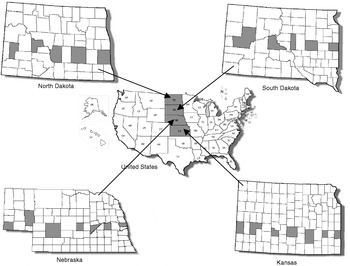
A precipitation gradient was developed by establishing east–west transects in North Dakota, South Dakota, Nebraska and Kansas. Along each transect, every other county was selected for evaluation, beginning at the very eastern edge of each state (Fig. 1). Transects were located to avoid large areas with atypical soils such as the Nebraska Sandhills and the Kansas Flinthills. Variables evaluated were pasture as a percent of total land base and crop diversity. Crop diversity was evaluated using the Shannon diversity indexReference Shannon24, where H′ is an estimate of diversity and is calculated as:
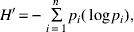
where p i is the proportion of the ith species relative to the total number of species. Shannon's index allows for a calculation of not only diversity, but also evenness, which is defined as the relative abundance of each species, or in this case, crop type.
Transects were conducted in the states highlighted in gray. Counties within each state that were used in the east to west transects are highlighted in gray in the insets. Locations of transects were selected to avoid atypical areas to the greatest degree possible.

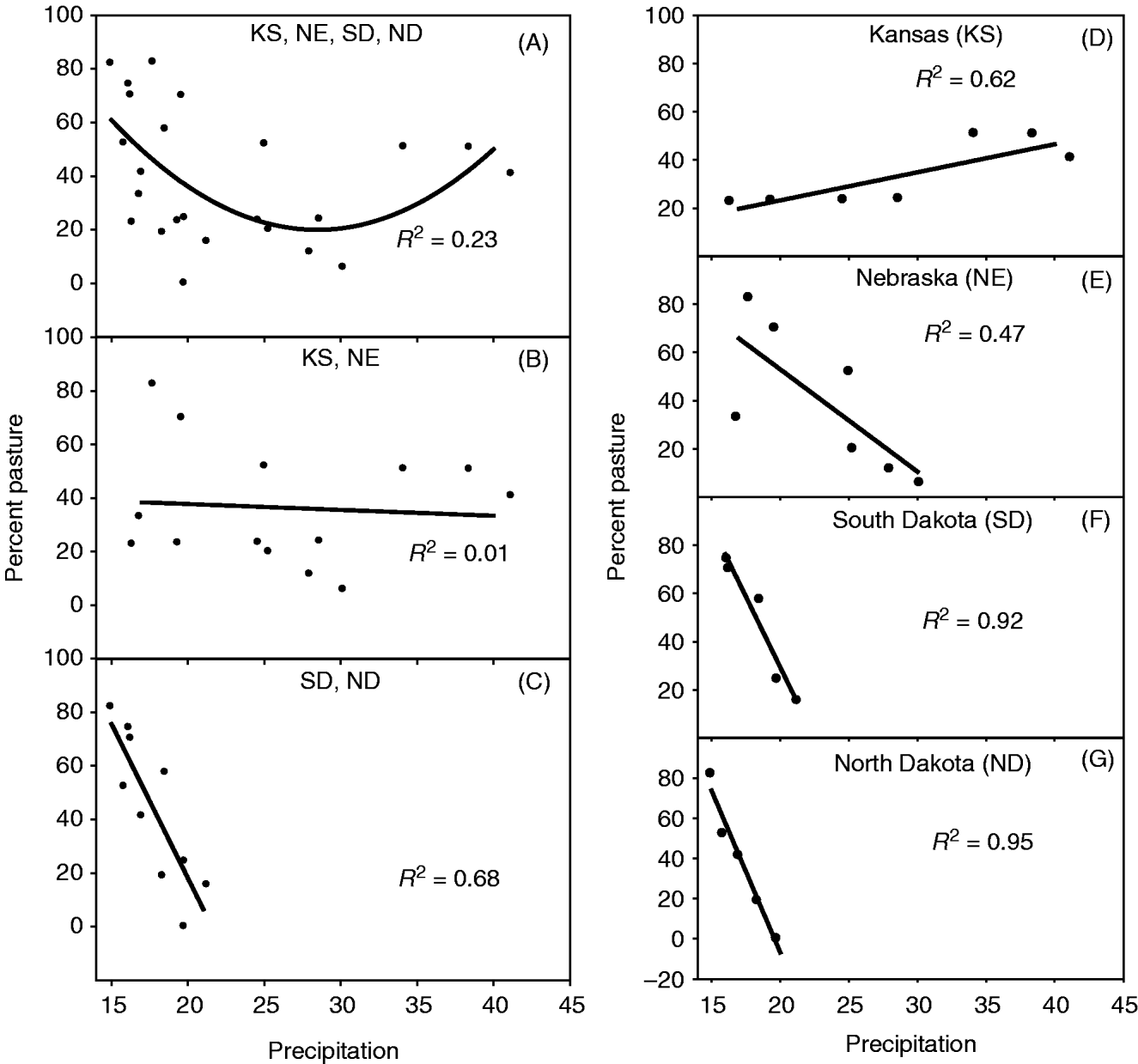
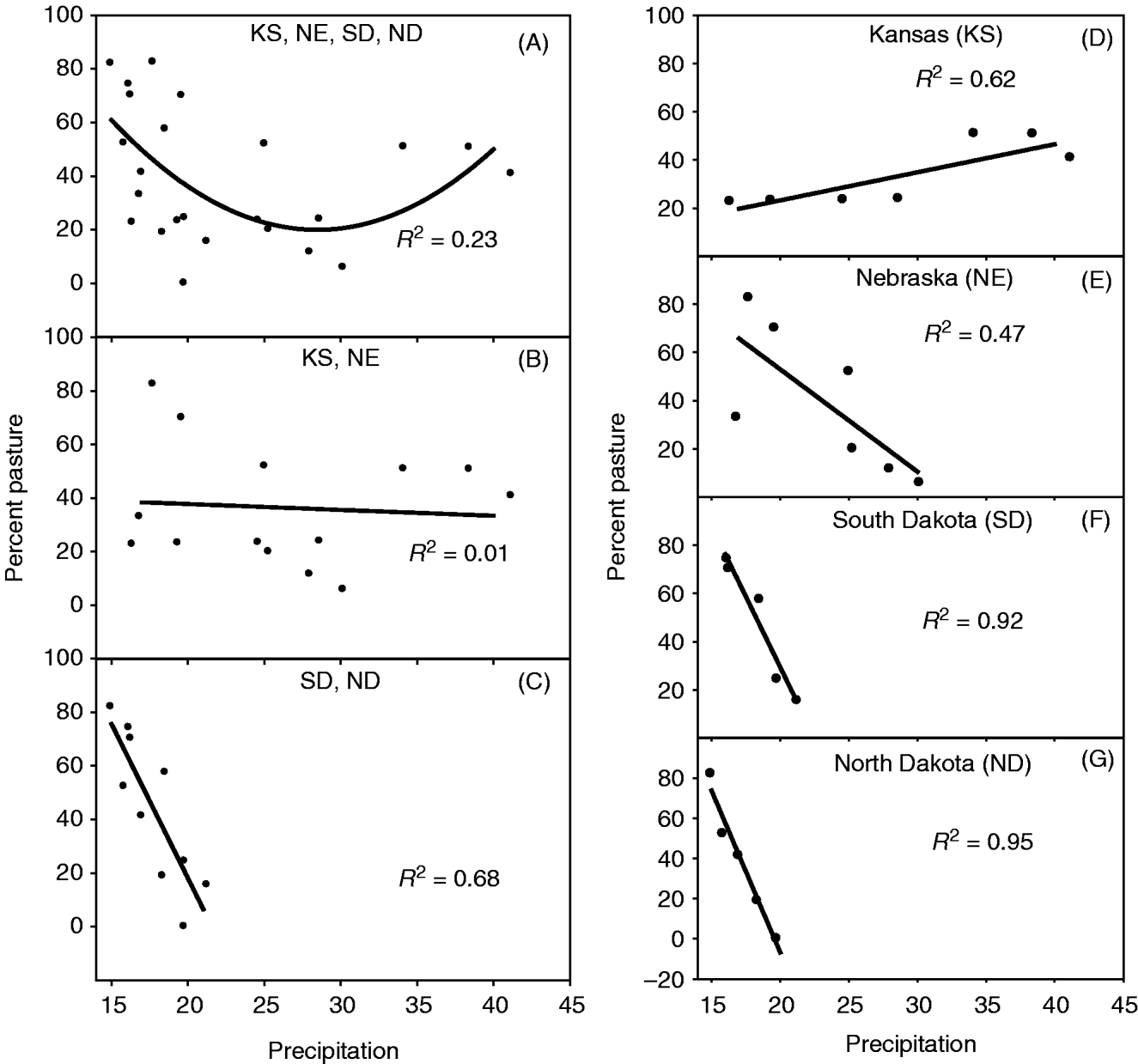
Mixed crop and livestock systems are the best known examples of integrated agricultural production systems16. While integrated crop–livestock systems can be developed in all cropland or all pasture land, in the Great Plains, the greatest potential for integrated crop–livestock systems exists in areas of mixed crop and pasture land. This means that percent of land in pasture is an important determinant of integration potential. In the four-state region (Kansas, Nebraska, South Dakota and North Dakota), percent of land in pasture was the highest at the two extremes of the precipitation continuum (Fig. 2A). This was surprising, because generally the amount of land in pasture would be expected to increase as precipitation decreases. This was true of South Dakota and North Dakota (Fig. 2C) but not of Kansas and Nebraska (Fig. 2B). However, this response was primarily driven by an increase in percent land in pasture in eastern Kansas (Fig. 2D). In the other three states, percent land in pasture decreased as precipitation increased (Figs. 2E–G). Although the amount of land in pasture is a surrogate for actual agricultural integration, the increased pasture land in the drier areas suggests there is greater integration potential in the areas of resource scarcity.
Percent of land in pasture for selected counties on a west–east precipitation gradient (A) pooled over Kansas (KS), Nebraska (NE), South Dakota (SD) and North Dakota (ND), (B) pooled over KS and NE, (C) pooled over SD and ND, (D) KS only, (E) NE only, (F) SD only and (G) ND only in the Northern Great Plains. Information was adapted from the 2002 Census of Agriculture22.
Irrigation may have affected the percent of pasture land in drier areas of Nebraska and Kansas. Kansas and Nebraska have over 3.5 and 7.5 times the irrigated acreage as the Dakotas, respectively25, and the Ogallala Aquifer, a major source of irrigation groundwater, lies under the western parts of both the statesReference Miller and Appel26. Irrigated cropland, as a percent of total cropland, increased with decreasing precipitation in Kansas, but in Nebraska percent irrigated cropland peaked in the area with more precipitation25. In both the states, the driest county in the survey had relatively little irrigation25. Other factors such as land productivity and relative economic benefits also determine land useReference Lubowski, Bucholtz, Claasen, Roberts, Cooper, Gueorguieva and Johansson27.
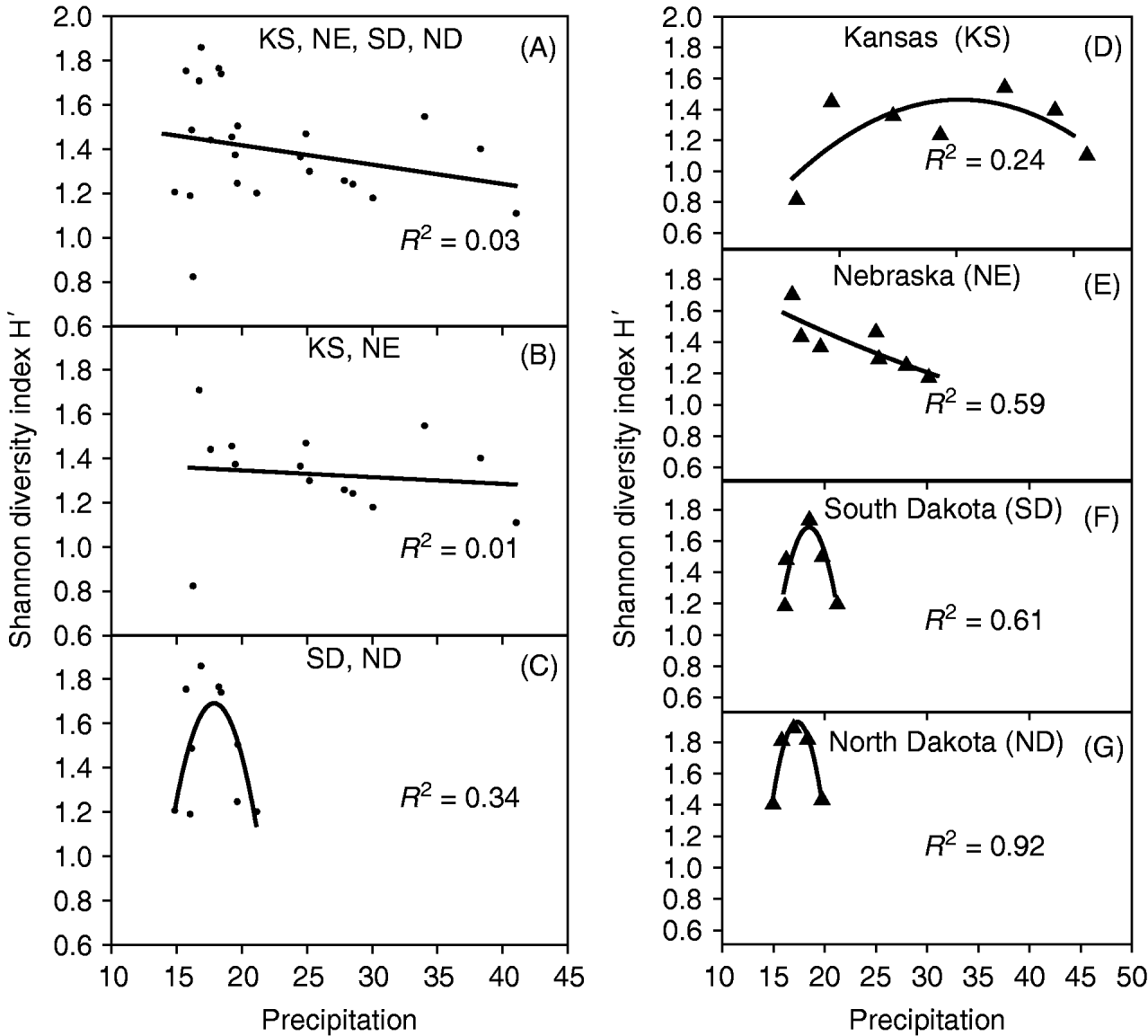
More crops indicate more potential enterprises, which can lead to synergisms in resource flowReference Hendrickson, Hanson, Tanaka and Sassenrath14. Therefore, crop diversity may also serve as a surrogate indicator of integration within agricultural production systems. By combining county-level data for crop type23 with long-term precipitation28, we plotted Shannon diversity index estimates for states in the central and northern Great Plains (Fig. 3). When the data from all four states (Fig. 3A) or from just Kansas and Nebraska (Fig. 3B) were combined, there was no strong relationship between precipitation and Shannon Diversity Index. This was driven by the strong linear relationship between precipitation and crop diversity in Nebraska compared to a quadratic equation in Kansas (Figs. 3D and E).
Crop diversity calculated using a Shannon diversity index (H′) for selected counties along an west–east precipitation gradient (A) pooled over Kansas (KS), Nebraska (NE), South Dakota (SD) and North Dakota (ND), (B) pooled over KS and NE, (C) pooled over SD and ND, (D) KS only, (E) NE only, (F) SD only and (G) ND only in the Northern Great Plains. Data were complied from USDA–NASS state statistical offices.
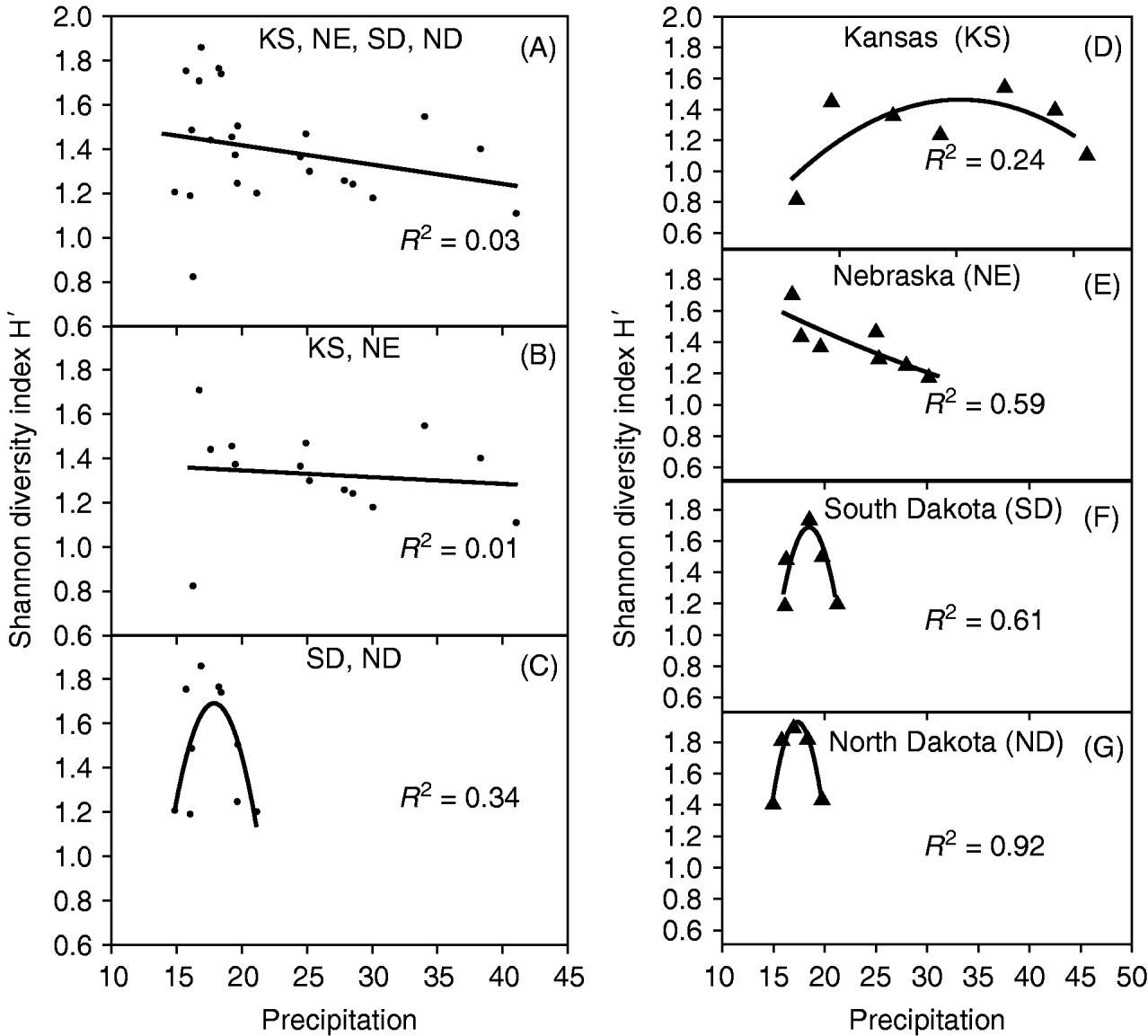
The combined data for North and South Dakota (Fig. 3C) and individual state data for North Dakota, South Dakota and Kansas (Figs. 3D, F and G) had a quadratic response between precipitation and diversity. Lower crop diversity in the wetter and drier ends of the precipitation gradient may be caused by two factors. First, producers may have selected crops that are relatively risk-free in those areas. For example, dryland corn requires at least 25 inches of annual precipitation29, so producers may limit the amount of dryland corn they plant in semi-arid areas because of the risk of crop failure. However, in the middle of the precipitation gradient, greater crop diversity may give producers the opportunity to enhance revenue in good years but still manage risk with safe crops in bad years. Finally, in the more arid areas wheat may be the safest crop to plant because of limits in precipitation. In the Dakotas, the shorter growing season may also impact crop diversity.
The theory of extensive marginsReference Lubowski, Bucholtz, Claasen, Roberts, Cooper, Gueorguieva and Johansson27, Reference Goodwin, Vandeveer and Deal30 may be the second factor driving crop diversity in response to precipitation. In this theory, areas on the economic margin between two or more competing economic uses will see the greatest change in land use for a relatively small change in priceReference Lubowski, Bucholtz, Claasen, Roberts, Cooper, Gueorguieva and Johansson27. For example, in the wetter areas corn and soybean are high-value crops. Because they are well suited to higher precipitation, it would take a dramatic price shift to change to an alternative crop. However with intermediate precipitation, corn and soybean production is riskier and other crops become more competitive. In these regions, small price changes can result in large changes in planted acreages. Finally, with the lowest precipitation, wheat becomes the highest value crop because of greater assurance of production.
It is difficult to explain the linear response of crop diversity to precipitation in Nebraska. The production of dry edible beans, including pinto beans, and sunflower increased the crop diversity in western Nebraska leading to a greater Shannon diversity index. Correlations between the percent of total cropland that was irrigated and the Shannon diversity index were non-significant for both Nebraska and Kansas. Producer familiarity with alternate crops or local market conditions may have contributed to the increased diversity in western Nebraska.
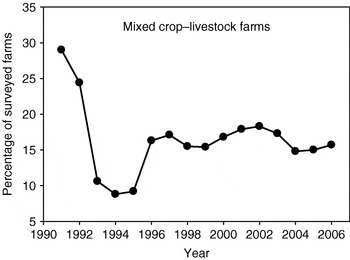
If all external drivers were equal, adoption of integrated agricultural systems would be one way to evaluate their viability in the variable weather patterns of the Great Plains. SwensonReference Swenson31–Reference Swenson35 conducted an inventory of mixed farms in North Dakota, where a ‘mixed farm’ was defined as a farm that received <70% of its revenue from either crops or livestock (Fig. 4). Because participation in these surveys was voluntary, these farms were not statistically representative, and therefore, data would not necessarily match statewide adoption trends. Despite these limitations, the data provided some insight into adoption of mixed, but not necessarily integrated, agricultural systems. The percent of surveyed farms that were mixed dropped dramatically in the early 1990s and then increased and stabilized at about 16% (Fig. 4). Regions of North Dakota with the most mixed farms were the south central and western parts of the stateReference Swenson31, Reference Swenson35.
Percent of surveyed North Dakota farms considered to be mixed farming enterprises. These farms had <70% of total sales from either crops or livestock. Data were collected from the Financial Characteristics of North Dakota Farms seriesReference Swenson31–Reference Swenson35.

Because of the lack of individual farm data, surrogate indicators were used to determine if environmental factors impacted the adoption of integrated agricultural systems. While the data revealed some trends within a state or even combining several states, these trends did not hold up when the data for all the four states were combined. Within the Dakotas, the amount of crop diversity and the even split between cropland and pastureland at the intermediate precipitation amount, suggest that these areas have the greatest potential for integration. In Kansas, the greatest potential for agricultural integration, based on crop diversity and land in pasture, would be in the eastern part of the state while in Nebraska; these same indicators would suggest greater integration potential in the west. While the most plausible explanation for the differences between the Dakotas and Nebraska and Kansas would be the availability of irrigation, the data do not provide strong support for this explanation. Other factors such as landform and length of growing season may also impact integration potential. While the use of the surrogate indicators provided interesting information, it is apparent that evaluating the impact of environmental factors on adoption of integrated agricultural systems requires farm-level data.
Environmental Impacts of Integrated Crop–Livestock Systems in the Great Plains
Agricultural producers tend to use highly productive land for crop productionReference Lubowski, Bucholtz, Claasen, Roberts, Cooper, Gueorguieva and Johansson27. However, marginal lands, which are less productive and more prone to environmental damage, are periodically put into and taken out of crop productionReference Lubowski, Bucholtz, Claasen, Roberts, Cooper, Gueorguieva and Johansson27. The northern Great Plains, in particular, is one of the leading regions of the US in terms of changes in cultivated landReference Lubowski, Bucholtz, Claasen, Roberts, Cooper, Gueorguieva and Johansson27. This practice combined with the variable weather conditions in the Great PlainsReference Redmon, Hendrickson, Barnes, Moore, Nelson and Collins20 and an overall increased social sensitivity to environmental issuesReference Archer, Dawson, Kreuter, Hendrickson and Halloran36 requires an understanding of the environmental impacts of agricultural production systems in the northern Great Plains.
Documenting environmental impacts of agricultural production systems is an essential component of sustainability assessments. Assessments linking management strategies with sustainability goals are particularly useful, as they provide a clear direction for producers to implement new—or improve current—production practices to achieve greater sustainabilityReference Van Loon, Patil and Hugar37. In this regard, DoranReference Doran38 developed a framework for assessing environmental sustainability of agricultural production systems using soil quality as a linkage between management strategies and goals of sustainable agriculture. Strategies proposed by DoranReference Doran38 included conservation of soil organic matter, minimizing soil erosion, balancing production and environmental outcomes, and improving utilization of renewable resources. The objective of these strategies was to provide sufficient food and fiber, while concurrently maintaining environmental stability, ecological integrity, and the quality of essential soil, water and air resources. For purposes of this paper, the four strategies developed by DoranReference Doran38 will be used as a guide to briefly review the environmental impacts of integrated crop–livestock systems, or more generally, of integrated agricultural systems.
Conservation of soil organic matter
Increases in soil organic matter are associated with improvements in soil physical properties and nutrient cycling potential, both of which contribute to higher crop yield potentialReference Liebig and Varvel39, Reference Russell, Laird and Mallarino40. Consequently, it is important to understand the effects of integrated agricultural systems on soil organic matter.
Livestock play a key role in the maintenance and accumulation of soil organic matter through manure addition. Whether applied directly via grazing livestock on cropland or through collection and distribution from concentrated livestock facilities, manure serves as an important carbon source for potential incorporation into soil organic matter. Outside the Great Plains, manure addition to cropland has been well documented to either maintain or increase soil organic matter (see reviews by Johnson et al. Reference Johnson, Reicosky, Allmaras, Sauer, Venterea and Dell41, FranzluebbersReference Franzluebbers42 and Liebig et al. Reference Liebig, Morgan, Reeder, Ellert, Gollany and Schuman43). Within the Great Plains, increases in soil organic matter have been observed with application of beef cattle manure or composted feedlot manure in corn- and sorghum-based cropping systemsReference Eghball44, Reference Schlegel45. It is important to note, however, the effectiveness of manure in increasing soil organic matter is influenced by the quality of material, with manures mixed with bedding material being more effective than manure slurriesReference Russelle, Entz and Franzluebbers15.
Inclusion of perennial forages in integrated agricultural systems contributes significantly to increased soil organic matter. Relative to many annual crops, perennial forages have greater root biomass and deeper rooting depths, both of which contribute to organic matter accumulation over timeReference Al-Kaisi, Yin and Licht46, Reference Liebig, Johnson, Hanson and Frank47. Rates of soil organic matter accumulation are often greatest following establishment of the perennial phase in rotationReference Russelle, Entz and Franzluebbers15, and can be increased through grazingReference Franzluebbers48. Though data are limited, inclusion of a perennial cropping phase in Great Plains cropping systems has been found to increase soil organic matterReference Acosta-Martinez, Zobeck and Allen49, Reference Bremer, Janzen and McKenzie50.
Minimizing soil erosion
Perennial cropping phases are a central component to integrated crop–livestock systems, the inclusion of which can significantly reduce wind and water erosion from agricultural lands. Soil erosion from perennial grass pastures has been found to be nearly zero across a range of soil types and growing conditionsReference Russelle, Entz and Franzluebbers15, Reference Franzluebbers48, Reference Allen, Baker, Segarra and Brown51. In arid and semiarid regions, including a perennial cropping phase in annual cropping systems can also provide significant protection from wind erosionReference Russelle, Entz and Franzluebbers15. Furthermore, positive residual effects from including a perennial cropping phase on wind erosion mitigation have been observed over an entire rotation sequenceReference Padbury, Stushnoff, McRae, Smith and Gregorich52. Although documented effects of erosion mitigation are apparent in integrated crop–livestock systems, use of reduced or no-tillage management techniques during establishment of the perennial cropping phase is critically important to protect soil when it is most susceptible to erosionReference Franzluebbers48.
Balancing production and environmental outcomes
Balancing production and environmental outcomes within agroecosystems requires the application of management practices that effectively optimize variables of agronomic performance and environmental quality. Pragmatically, these management practices must be conservation-oriented, in that there is a clear emphasis on maintaining or enhancing the natural resource base on which agricultural production dependsReference Doran38. Concurrent to an emphasis on conservation is the use of production strategies that take advantage of ecological synergies among production enterprises so that inputs (e.g. nutrients and water) are used as efficiently as possibleReference Tanaka, Anderson and Rao53.
Integrated crop–livestock systems have been documented to balance production and environmental outcomes more effectively than specialized agricultural production systemsReference Russelle, Entz and Franzluebbers15, though definitions of ‘success’ strongly depend on site- and resource-specific contexts within working farms. Notable management approaches with the greatest potential to achieve these outcomes include diversified cropping systems under no-till managementReference Krupinsky, Tanaka, Merrill, Liebig and Hanson54 and inclusion of perennial cropping phases in crop production systemsReference Entz, Baron, Carr, Meyer, Smith and McCaughey55. At least within the Great Plains, both of these management approaches are highly relevant and have proven to impart positive effects on system productivity while conserving natural resourcesReference Grant, Peterson and Campbell56. Additionally, these management approaches can disrupt insect, weed and disease cyclesReference Karlen, Varvel, Bullock, Cruse and Sparks57, Reference Krupinsky, Bailey, McMullen, Gossen and Turkington58, thereby reducing dependence on pesticides.
Improving utilization of renewable resources
Integrated agricultural systems have significant potential to improve utilization of renewable resources over more specialized forms of agricultural production. Expansion of crop portfolios to include legumes in integrated crop–livestock systems have been particularly effective at utilizing renewable resources, since these crops can fix atmospheric N, thereby decreasing requirements for fertilizer NReference Grant, Peterson and Campbell56. Ranges of nitrogen contributions from 6 to 28 kg N ha−1 have been reported for annual legumes or pulse cropsReference Miller, Gan, McConkey and McDonald59, Reference Stevenson and van Kessel60, and when used as green manure, these can contribute between 95 and 192 kg N ha−1 yr−1 to the soil depending on the environment in which they are grownReference Power61. Perennial legumes, such as alfalfa (Medicago sativa L.), add significant amounts of N to soil, often increasing with stand ageReference Kelner, Vessey and Entz62. However, even single-year effects of alfalfa on N status can be significant, as net soil N contribution of 121 kg N ha−1 from ‘Nitro’ alfalfa has been observed in ManitobaReference Kelner and Vessey63.
Utilizing crop residues as a feed resource for livestock represents a simple and economically viable management option to improve production efficiencies within integrated crop–livestock systemsReference Russelle, Entz and Franzluebbers15. For example, grazing plans that utilize corn residue can provide four to five animal unit months of grazing per hectare under favorable weather conditionsReference Sulc and Tracy64. Grazing, as opposed to mechanically harvesting residue for feed, has the added advantage of allowing livestock to distribute manure, thereby reducing operating costs associated with manure spreading. As outlined above, livestock manure can be utilized as an important source of plant nutrients, and when applied in appropriate amounts and times during the growing season, can serve to meet crop requirements for N or P while minimizing damage to the environment.
Environmental impacts: notable drawbacks
Despite the attributes briefly outlined above, it is incorrect to assume integrated agricultural systems have only positive effects on the environment. Nutrient management is of central importance to minimize environmental degradation within integrated agricultural systems, and is perhaps the most significant factor where potential drawbacks exist. Manure can be highly variable as a source of plant available nutrients and it is often difficult to ensure application amounts are spatially relevant across variable landscapesReference Cox65. Where excessive manure is applied to cropland, significant accumulation of N, P and salt in soil can occurReference Eghball44, potentially impairing water quality and soil functionReference Jongbloed and Lenis66, Reference Winter and Unger67. Degradation of surface water quality within integrated agricultural systems can be exacerbated by livestock trampling, which can contribute to near-surface soil compaction and decreased infiltration rates if soils are not dry and/or frozen during grazingReference Sulc and Tracy64. Emission of greenhouse gases represents another potential source of environmental degradation from integrated agricultural systems. Although there is a lack of data on greenhouse gas emissions from these systems, results from manure application rate studies suggest nitrous oxide emissions could be significant when application rates are high and water is abundantReference Chang, Cho and Janzen68. While climatic and edaphic factors will play a central role in determining the net effect of integrated agricultural systems on global warming potential, it is conceivable that emissions of nitrous oxide and methane (from soil and ruminant livestock) could offset increases in soil carbon storage.
How the Environment Affects and is Affected by Integrated Agricultural Systems
This paper has examined associations between the environment and integrated agriculture from two different aspects. First, we explored how the environment affects the adoption of integrated agricultural systems. Integrated agricultural systems may be prevalent in areas where a key resource becomes limited (such as water). This trend may be driven by the capacity of integrated agricultural systems to provide greater economic stability in variable conditions. Secondly, we reviewed the impact of integrated agricultural systems on the environment using four different sustainability strategiesReference Doran38. This evaluation emphasized the potential of integrated agricultural systems, as represented by integrated crop–livestock systems, to enhance environmental sustainability.
Future conditions for agricultural production are difficult to predict, although it seems increasingly certain that fossil-based resources will become more costly and global climate change will intensify. Constraints of resource availability coupled with the likelihood of increased frequency of severe weather events presents significant challenges to agriculturists seeking to design sustainable agroecosystems. With these challenges in mind, KirschenmannReference Kirschenmann10 deftly outlined the immediate need for developing more integrated, complex and diversified agricultural production systems. Such agricultural production systems would be characterized by a ‘mixing’ of production enterprises, as specialized production systems would eventually become obsolete with restrictions in fossil-based resourcesReference Russelle, Entz and Franzluebbers15. Integrated agricultural production systems, then, appear to be well suited to meet the challenges that lie ahead for agriculture. Not only can integrated systems capitalize on potential synergies between cropping systems and livestock production, but they could also confer greater agroecosystem resilience under variable weather conditions by improving soil attributes necessary to sustain critical soil functions.
Developing integrated agricultural systems that can respond to these challenges requires a significant shift in thinking. Researchers and producers need to look at the environment as an ally rather than as an adversary, whose constraints must be overcome through technology and inputs. This will also require that we view agricultural outputs not as products or waste, but as a means to enhance, or at the least not damage the agricultural ecosystem.