A key change in the way work is conducted is the increasing prevalence of part-time work (Organisation for Economic Co-operation and Development [OECD], 2014). In Australia, nearly 50% of women and 14% of men work part-time (Australian Bureau of Statistics [ABS], 2013). Although a range of individual, organisational and economic benefits of this form of flexible working have been identified (Eby, Casper, Lockwood, Bordeaux, & Brinley, Reference Eby, Casper, Lockwood, Bordeaux and Brinley2005; Kelly et al., Reference Kelly, Kossek, Hammer, Durham, Bray, Chermack, Murphy and Kaskubar2008), empirical research has also pointed to a number of significant penalties (Casper, Eby, Bordeaux, Lockwood, & Lambert, Reference Casper, Eby, Bordeaux, Lockwood and Lambert2007; Webber & Williams, Reference Webber and Williams2008). One reason posited for the penalties attached to part-time work is that work is structured to suit an ideal worker; typically a person for whom paid work is their primary commitment, with the demands of family or community as secondary (e.g., Lewis, Reference Lewis1997; Perlow, Reference Perlow1998). Part-time work, by definition, sets limits on work hours and therefore challenges normative expectations associated with the ideal worker (Lawrence & Corwin, Reference Lawrence and Corwin2003; Nentwich & Hoyer, Reference Nentwich and Hoyer2012). Work design, we argue, offers an important but hitherto neglected mechanism through which the penalties attached to part-time work can be explained and subsequently addressed.
In this exploratory study, we examine, using contemporary features of work design, to what extent and how part-time roles are designed relative to equivalent full-time roles. The context for the empirical analysis was professional services work in Australia, where individuals are reported to experience high levels of work–life interference and particularly long work hours relative to other occupational groups (Campbell, Reference Campbell2002; Skinner, Hutchinson, & Pocock, Reference Skinner, Hutchinson and Pocock2012). We examined the changes in work characteristics when professional service workers in areas notorious for long work hours (information technology [IT], legal and accounting firms), requested a transition from full-time roles to part-time arrangements. Where possible, we also interviewed the workers’ supervisors. We identify which work design attributes facilitate and/or constrain work undertaken on a part-time basis and where part-time roles are subject to minimal re-design, how this might explain the reification of full-time work and the penalties attached to part-time work. Our findings contribute to recent conceptualisations of work design as a means to design effective part-time roles that balance organisational and individual objectives.
The article first summarises the extant literature on part-time work, including demonstrated benefits, but also the seemingly intractable penalties that have been associated with this mode of employment. The paper then outlines recent developments in work design and why it is a useful lens through which to explore and understand many of the limitations associated with part-time arrangements. After explaining the methods utilised, the findings are outlined according to five key work design concepts (the process used to transition from full-time to part-time arrangements; the context within which the roles were embedded; work attributes that were significant when transitioning to part-time arrangements; individual characteristics deemed necessary for the role; and the outcomes associated with particular roles). Finally, the implications and limitations of the study are discussed.
Part-Time Work: Benefits and Penalties
Part-time work is variously defined, but we adopt a definition consistent with the Australian study context of 35 hr contracted work or less per week (ABS, 2013). ‘Voluntary’ is the term used to describe part-time work that has been initiated by the employee, and which is typically offered by an organisation in order to attract and retain workers. ‘Involuntary’ is the term used to describe part-time work that has been initiated by the employer, typically to facilitate flexibility in staffing (Webber & Williams, Reference Webber and Williams2008; Australian Bureau of Statistics, 2010). The focus in this article is on voluntary/retention part-time work that is characterised as requiring skills comparable with full-time workers and attracts a salary commensurate with full-time hours (Webber & Williams, Reference Webber and Williams2008; Dick, Reference Dick2009).
Empirical evidence demonstrates substantial benefits associated with part-time work, including encouraging workforce participation, increasing household income, reducing work–life conflict and improving organisational retention (Higgins, Duxbury, & Johnson, Reference Higgins, Duxbury and Johnson2000; Stone, Reference Stone2007; OECD, 2014). Despite this, there are considerable gaps in pay, training opportunities and career prospects between comparable full-time and voluntary part-time roles, even after controlling for observable personal and job characteristics (OECD, 2014). For example, part-time employees frequently report being marginalised and assigned less complex, lower status tasks than their full-time peers (e.g., Charlesworth & Whittenbury, Reference Charlesworth and Whittenbury2007). Furthermore, in many organisations, part-time roles are approved only under certain conditions, such as when there is no direct client contact, where deadlines are flexible and the complexity of tasks is low, and where there are few responsibilities for subordinates (McDonald, Bradley & Brown, Reference McDonald, Bradley and Brown2008; Lirio, Lee, Williams, Haugen, & Kossek, Reference Lirio, Lee, Williams, Haugen and Kossek2008).
Part-time work is predominantly undertaken by women. In Australia, roughly half of all professional workers are women, but over a third of these women work part-time; three times as many as professional part-time men (ABS, 2013). Unequal participation rates in part-time work means that the penalties associated with part-time employment disproportionately affect women, contributing to the (re)production of broader gender inequities including women’s lower rates of ascension into positions of leadership, gender pay gaps and lower retirement incomes (Bennetts, Reference Bennetts2007; Ozbilgin, Tsouroufli, & Smith, Reference Ozbilgin, Tsouroufli and Smith2011; OECD, 2014).
Professional voluntary part-time work is often considered good quality when compared with involuntary part-time work undertaken in the secondary labour market. Yet, professional work is increasingly unbounded in time and space, particularly in the context of technology that facilitates the uninterrupted availability of workers (Wilson, Butler, James, Partington, Singh, & Vinnicombe, Reference Wilson, Butler, James, Partington, Singh and Vinnicombe2004). Part-time professional work challenges these deeply entrenched norms and assumptions because by definition, it sets limits on worker availability to balance private and professional commitments (Corwin, Lawrence, & Frost, Reference Corwin, Lawrence and Frost2001; Kossek & Lee, Reference Kossek and Lee2008; Stone & Hernandez, Reference Stone and Hernandez2013). Consequently, professional part-time workers have been found to experience significant work intensification, often producing the same level and quality of output as full-time workers for less remuneration (Kossek & Lee, Reference Kossek and Lee2008; Dick, Reference Dick2009). Moreover, professional part-time arrangements are typically negotiated privately between an employee and their manager, who may have had little or no guidance in re-structuring the role, resulting in an arrangement that is discretionary, ad hoc and vulnerable to corporate re-structuring (e.g., Webber & Williams, Reference Webber and Williams2008; Dick, Reference Dick2009).
In attempting to redress the penalties associated with voluntary part-time work, attention has been focussed on part-time employees, their managers, the organisations and public policy initiatives (Ryan & Kossek, Reference Ryan and Kossek2008; Dick, Reference Dick2010), however, there are indications that it is the structure of work itself that should change. For example, studies that address why women abandon professional roles show that ‘opting out’ is often not an unmediated choice, but rather the result of a ‘structural straightjacket’ that arises from family-friendly policies that do not take account of ‘institutional structures to support the creation of true and meaningful part-time work’ (Stone, Reference Stone2007: 103; Webbers & Williams, Reference Webber and Williams2008). Other empirical studies, although not explicitly underpinned by work design theory, have revealed ways work that work is re-structured for part-time roles, for example, by reducing the number of clients to which part-time workers are required to respond (Lee, Hourquet, & MacDermid, Reference Lee, Hourquet and MacDermid2002). Similarly, studies in the broader work–life balance literature have demonstrated that paying attention to the design of work, for example, by increasing autonomy, improves outcomes for individuals and organisations (Batt & Valcour, Reference Batt and Valcour2003; Moen, Kelly, & Hill, Reference Moen, Kelly and Hill2011). Despite mounting evidence that work design features could be critical in creating satisfactory voluntary part-time roles, no studies to date have examined part-time work through an explicit work design lens.
Job/Work Design Theory and Part-Time Work
The concept of job design, which is primarily concerned with the content and structure of the jobs individuals perform, emerged from the Industrial Revolution in the 18th century when manufacturing became a predominant economic activity (Oldham, Reference Oldham1996; Morgeson & Campion, Reference Morgeson and Campion2003). The aim of early job design initiatives was to adopt a more scientific approach to work in order to maximise prosperity for employers and employees, and to challenge the notion that employee and employer objectives are inherently adversarial (Taylor, Reference Taylor1911). Original conceptualisations of job design were extended in the early 20th century and again in the 1960s and 1970s (Taylor, Reference Taylor1911; Herzberg, Reference Herzberg1966; Hackman & Oldham, Reference Hackman and Oldham1976). Research and practice associated with job design stalled in the 1980s, and this has been attributed to the need for different organisational responses to increased global competitiveness, a diminished usefulness of the concept for autonomous knowledge workers and more fluid work situations (Guest, Reference Guest2001; Morgeson & Humphrey, Reference Morgeson and Humphrey2008). Recently, there has been a resurgence of interest in work design in light of evidence that without deliberate interventions, individualised arrangements can be inconsistent, inequitable and insecure – consequences typified in voluntary part-time work (Morgeson & Humphrey, Reference Morgeson and Humphrey2008; Oldham & Hackman, Reference Oldham and Hackman2010). Researchers are increasingly exhorted to develop theories and models that adequately reflect the ‘fundamental changes in the relationships among people, the work they do, and the organisations for which they do it’ (Humphrey, Nahrgang, & Morgeson, Reference Humphrey, Nahrgang and Morgeson2007; Grant, Fried, Parker, & Frese, Reference Grant, Fried, Parker and Frese2010; Oldham & Hackman, Reference Oldham and Hackman2010: 466).
Three major elaborations and extensions to job design theories have emerged. The first was in scope and related nomenclature. One of the main limitations of earlier job design theories such as Taylor’s mechanistic job simplification theories (Taylor, Reference Taylor1911) and Hackman and Oldham’s Job Characteristics Model (Hackman & Oldham, Reference Hackman and Oldham1976) based on motivational theories was that the context of work was not considered, whereas notions of work design now encompass the ‘study, creation and modification of the composition, content, structure and environment within which jobs and roles are enacted’ (Morgeson & Humphrey, Reference Morgeson and Humphrey2008: 47). The second significant change was the recognition of the interconnectedness and social orientation of contemporary, team-based work (Morgeson & Humphrey, Reference Morgeson and Humphrey2006; Grant & Parker, Reference Grant and Parker2009). The third shift has been to differentiate between ‘design’ as a noun (i.e., the attributes that make up an individual job), and ‘design’ as a verb (i.e., how work is designed and by whom).
Five core features of work design have been highlighted in the literature summarised above and are central in contemporary work design models (e.g., Morgeson & Campion, Reference Morgeson and Campion2003; Morgeson & Humphrey, Reference Morgeson and Humphrey2006; Grant, Reference Grant2007; Cordery & Parker, Reference Cordery and Parker2012). These five features are key to guiding our empirical analysis. They constitute: the design process, including the circumstances triggering the request and how it was negotiated; work context, for example, organisational policies and leadership; work content, including task and relationship attributes; individual characteristics (of the worker), such as personal attributes that facilitate or constrain the role; and outcomes, including the impact on clients, coworkers and the organisation itself. These features also align with many of the central concerns outlined in the part-time work literature including autonomy, manager support and organisational context (Lee et al., Reference Lee, Hourquet and MacDermid2002; Moen, Reference Moen2008).
Utilising these five a priori features of work design, our research explores the extent to which and how roles are re-designed from full-time to part-time. We addressed the following research questions:
-
1. To what extent and how are part-time professional roles designed, compared with equivalent full-time roles? What aspects of work design (process, context, content and individual characteristics) are utilised?
-
2. How does the utilisation or neglect of work design explain the penalties and benefits associated with part-time arrangements?
-
3. What contribution can work design make to optimising part-time arrangements for individuals and organisations?
Methods
Part-time roles in professional service organisations (legal, IT and accounting) were examined in this exploratory study in comparison with full-time roles that typically involve long hours, extensive travel and unpredictable assignments (Kossek & Lee, Reference Kossek and Lee2008; Hewlett, Reference Hewlett2010). The Australian context was ideal in which to explore such phenomena in that it has one of the highest proportions of part-time workers in the OECD (2014), but also, by international comparisons, some of the longest work hours and highest work–life interference for professionals and managers (Pocock, Skinner, & Pisaniello, Reference Pocock, Skinner and Pisaniello2010). Hence, an examination of voluntary professional part-time work in this context offered highly visible comparative dimensions of full-time and part-time working. A purposeful sampling technique and criterion-based selection were utilised in order to maximise the range of characteristics (e.g., gender, age, industry, profession) theoretically important to the research aims (Maxwell, Reference Maxwell1996). Only individuals engaged in client-facing roles were included in the sample because these are the career-oriented roles in professional service organisations (Von Nordenflycht, Reference Von Nordenflycht2010). The individual, and where possible, their self-nominated manager, were interviewed to ensure that different perspectives of the same part-time role could be triangulated.
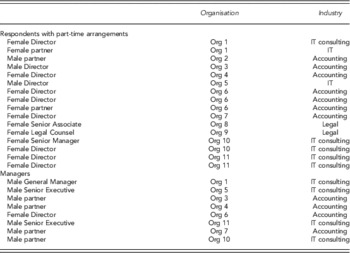
In terms of the sample, 16 part-time workers (three male, 13 female), aged between 34 and 61, in addition to eight supervisors. Interviews were conducted in 2010 across four cities (Melbourne, Sydney, Canberra, Brisbane). The part-time workers had a minimum of 12 years’ work experience and were employed in relatively senior roles. Some had only recently begun working part-time but most had worked part-time for 5 years or more. In total, 11 organisations were represented from a range of professional service firms (four IT consulting firms with seven participants, four accounting firms with six participants and two legal firms with one participant each). The size of the organisations also varied, with six large multinational organisations and four smaller, local firms (50–500 employees).
Despite the prevalence of part-time work in Australia, the majority of participants were the first in their department, and in some cases the entire organisation, to work part-time. Indeed, the uptake of part-time work reported in seven of the 11 organisations (the other four were local firms) was <5% in total. This proportion is substantially lower than the 20% average for professionals and managers in Australia, and even lower than the smallest industry average of 7% in IT (ABS, 2010). This is despite formal flexible work policies being in place for many years, and that some of the organisations had been recipients of ‘employer of choice’ awards for such policies. We found it especially difficult to recruit part-time male participants to the study, as many of the organisations we approached did not have any men working part-time. Indeed, one of the three men interviewed was the only male working part-time in an office of 500 people. Individuals employed in client-facing roles in multinational IT firms were also difficult to find, owing to their overall scarcity, however, the final sample included three men and three people (one man, two women) from multinational IT firms (see Table 1).
Demographics of the sample

Note. IT=information technology.
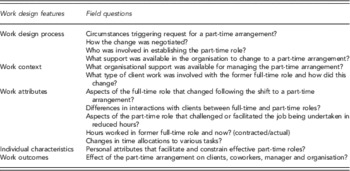
Semistructured interviews were employed as the principle data collection method. To address the difficulty of eliciting tacit knowledge about part-time work design, the interview questions were developed to be consistent with the five features of work design theory (i.e., the design process; the work context; task and relational attributes; individual characteristics; and outcomes) and sought explicit comparisons in characteristics between their previous full-time roles and their current part-time roles. Interviews were digitally recorded and transcribed and, consistent with ethical protocols, individuals and organisations were anonymised, including through the use of pseudonyms in reporting the findings. Table 2 details the attributes of work design explored in the study and corresponding field questions.
Work design attributes and corresponding field questions

Following an initial process of reading and re-reading the transcripts in order to become familiar with the content, the analysis involved a form of axial coding whereby sections of text were identified as being consistent with one of the five a priori work design attributes (Strauss & Corbin, Reference Strauss and Corbin1990). Additional codes were then generated that reflected the various components of these broader categories; some of which are evident in descriptions of work design attributes in the extant literature and others that were newly identified as being important to the effective design of part-time work. Patterns were then identified within and between organisational/sector groupings and across manager/subordinate dyads. This analytic strategy enabled the identification of all work design elements, and the patterns between them, that were relevant to the part-time professional roles examined.
Results
The results section is structured according to the five central features of work design outlined thus far: design process, work context, work content, individual characteristics and work outcomes (Morgeson & Humphrey, Reference Morgeson and Humphrey2008; Cordery & Parker, Reference Cordery and Parker2012).
Design process
For all of the part-time employees who participated in the study, the process of transition from full-time to part-time was negotiated with their line manager. Without exception, the only involvement from human resource specialists in the transitions process was to ratify the agreement. Hence, decisions about how changes would come into effect in the new role were facilitated exclusively at the level of the work group.
For nine of the 16 participants, the core attributes of their roles, and particularly their performance targets, were very minimally re-designed in the transition from full-time to part-time work. For four participants, their hours did not change at all and another four participants were still working in excess of 35 hr/week. Illustrating this was a response by a female accountant working for a large Australian-based organisation who described her manager’s unchanged expectations compared with the time when she had been employed full-time:
I remember asking my boss whether he expected anything different from me to full-time because there were a number of us in these sorts of roles across the country and he said no. He said the only things are I pay you less and I know I don’t phone you on Fridays unless it’s an absolute emergency.
The minimal re-design of a new part-time role reflects the ad hoc and arbitrary nature of part-time work discussed in previous research (e.g., Webber & Williams, Reference Webber and Williams2008; Dick, Reference Dick2009) and was clearly the cause of significant work intensification for individuals who attempted to maintain their personal productivity at a level equivalent to their former full-time role.
Other participants had similarly unchanged expectations from managers, but had managed to re-design their roles in certain ways of their own volition, sometimes but not always intentionally, through strategies such as limiting personal activities, reducing nonbillable work (such as attending networking functions) and delegating work to subordinates. A male from a multinational accounting firm summed up how he reduced his hours: ‘I now don’t do any personal business whatsoever. We have ‘internal company communication site’ where we can chat away to people – I cut that out. I delegate a lot more’. The various strategies used by part-time professional workers to re-design their roles are discussed further in the work attributes section below.
Work context
There was little differentiation in the policies and technologies that supported part-time arrangements between firms. There was also no discernible difference in the type of organisational clients full- and part-time workers were responsible for, either in terms of size, industry or sector. Differences were apparent across organisational contexts in the assumptions pertaining to part-time roles, or as Lee et al. Reference Lee, Hourquet and MacDermid2002 put it, the ‘organisational paradigms’ underpinning different work design processes and the uptake of part-time work itself. The effect of these assumptions on constraining part-time work was especially salient for one manager in a multinational accounting firm who had provided similar services and managed part-time staff for two different firms. She observed:
When I first joined I came from ‘multi-national accounting firm’ where there was a guy who was working part-time four days a week doing client-facing work. When I got to ‘another multi-national accounting firm’ the ‘part-time worker’ was really only doing internal projects … she wasn’t really doing any critical client-facing stuff. And I was astounded at that so I pulled her onto ‘client-facing work’ which was highly intensive and it demonstrated that even if she’s part-time three days a week she can still add a lot of value doing the same stuff as everyone else.
In contrast, a manager in the multinational IT organisation believed that to be appropriately responsive to senior staff in the organisation, a full-time presence was required:
We’re a very response-able organisation. So if somebody asks you something you feel driven to try and get them the response as soon as possible … Does it need to be done? No it doesn’t, but if someone senior has asked for some information, we should try and get it to them as quickly as possible.
Indeed the term ‘response-able’ was one intentionally used within the organisation to encompass the dual expectations around ownership and responsiveness. Not only did this firm have a very low uptake of part-time work (<2% across 1,200 employees), but the two part-time workers interviewed reported they were struggling to manage their reduced hours arrangements. By contrast, a branch of an Australian consulting firm, which had a part-time work uptake of nearly 20%, offered flexible work practices as one of its core business strategies in order to attract talent. The general manager of the firm and manager of the partner working part-time, noted the importance of this strategy: ‘we have a small gene pool, it’s a competitive market, and so we have to have these sorts of approaches so we can attract and retain staff’. He also cited examples where the management team had been proactive in negotiating part-time arrangements with clients and in assisting their employees to contain their working hours to those agreed, for example, by encouraging them to delegate.
Differences in levels of support for part-time work across organisations were also obvious to participants who had moved organisations in order to ‘get it to work’. One female accountant described the differences she had encountered moving from one multinational firm to another, explaining that using flexible work practices with her former employer was considered ‘career limiting’. In contrast, at the firm she had moved to, the partner she reported to described both his own support of her part-time arrangement and indicated that his superiors were encouraging him to ‘push the limits’ to make part-time roles effective. That part-time work is limited more by the organisation than the design of the work itself was clearly evident in an Australian accounting firm that precluded part-time roles for their partners because, as the managing partner outlined:
Our view, is it’s not possible to be a part-time partner because you can’t just – you’ve got to devote all your time to it. So some of them have probably hit, I wouldn’t call it the glass ceiling, but that’s the ceil ‘pause’, that’s the level.
Although findings in relation to gender differences in work design can only be tentative owing to small sample size, gender did not appear to impact the effectiveness of part-time roles. Two of the three part-time men in the sample, in addition to one part-time woman, had moved to a contract basis in the transition from full-time to part-time work. For these two men, who were both effectively semiretired, the decision to contract was to release their retirement income, not to facilitate a part-time arrangement. In contrast, the other male who worked part-time for a multinational accounting firm did so to care for his young children and appeared to face similar difficulties as the women in the sample. Reflecting on the benefits to the organisation of him producing the same outputs for a reduced wage, he commented:
That is a benefit, but do they actually see that as a benefit? Probably not, because they would rather me stay a bit later. And I know reference has been made to another colleague … he was the sort of employee we want because he did all the hours in the day that God had given him, but he didn’t have a family and he just had this one track mind on surging ahead.
Although based on a small sample, our findings indicated that distinctions between work attributes across individual employees appeared to be less related to whether a man or a woman was undertaking them, than the mode of employment – in this case, employee-based or contractual arrangements – and the level of autonomy this afforded. Overall, the findings suggest that the support offered by management, and their assumptions about part-time work per se, have a demonstrable impact on both the roles that were deemed possible to be performed on a part-time basis, as well as the work design process itself. In contrast, other contextual elements that were raised in interviews or through the sample, such as the gender of the individual, the type of professional service work, the type of client and the nature of the organisation (e.g., local, multinational, national, privately owned) did not appear to make a material difference to the nature of the part-time role.
Work attributes
Contemporary work design frameworks list attributes such as autonomy, task variety, task identity, problem solving and job complexity when considering the role or task itself (Morgeson & Humphrey, Reference Morgeson and Humphrey2006; Cordery & Parker, Reference Cordery and Parker2012). Importantly, the data showed that where roles had been re-designed, some attributes remained unchanged, particularly problem solving, information processing, and task variety and significance. There were, however, several attributes that were adjusted when roles were re-designed that participants had found either particularly difficult in managing their part-time role, or alternatively, had contributed to a part-time role in a positive way. We address these work attributes below.
Autonomy
Professional workers have comparatively high levels of autonomy; the importance of which is well established in the part-time work literature (Lee et al., Reference Lee, Hourquet and MacDermid2002; Lawrence & Corwin, Reference Lawrence and Corwin2003). It could be inferred that autonomy is not a significant factor when moving from a full-time to part-time professional role, however, although professionals often have discretion over how they perform work, they often have little autonomy over what work needs to be done and when it needs to be completed (Perlow, Reference Perlow1998; Campbell, Reference Campbell2002). One of our female participants wryly explained the notion of autonomy in her role, a multinational IT consulting firm, as ‘So I know I’ve got to get an output by this date and I’ve got to work out how I get there without killing myself’. Our data suggests that the type of autonomy experienced was highly relevant to both the design of the part-time role as well as its perceived success. For example, autonomy to recruit extra resources was cited by several part-time participants as useful or desirable in facilitating effective part-time arrangements. Most participants in the sample did not have the autonomy to recruit staff, despite the reduction of hours and costs, including an IT professional who described the problematic nature of recruiting: ‘In our organisation that’s a nightmare. You have to get approval from God to hire somebody basically (laughter)’. However, two participants did have the autonomy to engage extra resources. A law professional described how she was able to facilitate the completion of a large task, which would otherwise not have been possible:
So I said to the general counsel for the client, what I suggest is that we engage two junior counsel … and we will get the job done in time for you. The client agreed to that and we delivered the job a day early.
Contrary to the assumption that part-time arrangements and senior roles are incompatible (McDonald, Bradley & Brown, Reference McDonald, Bradley and Brown2009), autonomy in relation to the timing of work in very senior roles was found to facilitate effective part-time arrangements, such as the following from a female partner working part-time in a management consulting firm:
As I got promoted, part of the advantage was that as management … you can do it to suit … you can have a team meeting on a day you want … Whether you are there every day or not doesn’t really matter … there was a lot of autonomy.
For the three participants who contracted to their organisations (one male accountant, one male IT professional and one female IT professional), in contrast to employees, the benefit was considered to be ‘having much more control this way’. In particular, they were able to determine the work they performed compared with their former roles where, as a male accountant described, ‘you are conditioned in your years in a large commercial firm to chase down whatever moves’.
Temporal considerations: predictability, urgency and flexibility of deadlines
The timing of work has only recently been introduced to contemporary work design frameworks (Cordery & Parker, Reference Cordery and Parker2012), but was found to be crucial in designing effective part-time roles. Although this might seem self-evident in relation to part-time work, it is especially important in the context of unbounded work hours in professional services. Importantly, deadlines that were simultaneously rigid, unpredictable and involved short timeframes were repeatedly mentioned as difficult for part-time workers. Illustrating these types of deadlines was the following comment from a female IT consultant who experienced difficulties while working as a part-time project manager: ‘because issues come up every day and people can’t wait for another day … You’ve just got to avoid those sorts of jobs … While I could be involved on those projects, I couldn’t project manage them’. This IT consultant had found that working as a programme director, an even more senior role, was easier to perform part-time because it was ‘more advisory and strategic’ and the demands were ‘less urgent’.
Rigidity of deadlines and those outside of the control of the organisation were also considered challenging for part-time roles. One manager, a partner in an Australian IT consulting firm, explained that with advisory projects, ‘you can always go to a client … and it’s a close personal relationship’, and deadlines can be consequently negotiated. In contrast, with system delivery projects, ‘the client is a lot less forgiving because ‘there is a lot of money tied up’ in the delivery occurring on a particular date. The same notion was expressed in some accounting work, where client requests were differentiated as ‘compliance’, which was planned in advance, or as a ‘live transaction’, which often required long work hours at short notice. One female part-time accountant described how she had deliberately moved from a transaction-focussed area to one that was less so, in order to have a manageable part-time arrangement. An accounting director who managed several part-time workers also emphasised the importance of checking the criticality of the deadline: ‘You’ve really got to look at a deadline. Whose deadline is it? Is it just to make me feel comfortable that I’ve created this artificial deadline or can it wait until tomorrow?’ Some work re-design options had been implemented to mitigate these timing issues, such as developing contingency plans to cater for ‘unpredictability’ and having a team of resources to draw from.
Implicit work
Another relevant design aspect of part-time work found in the data, but that is not discussed in the extant work design literature was the volume of implicit work necessary for providing professional services to clients. Managers and part-time workers listed a number of tasks that were necessary to perform their roles but which were not directly billable to a client, including developing relationships, travel, sales activity, training, internal meetings, mentoring junior staff and compliance activities. A senior manager in a multinational IT organisation described this implicit workload as follows:
The non-business requirements of the roles are very, very high. I figured it out a while ago that 180 days a year can actually be really used for business – and the other sixty or so are caught up with training, with meetings, internal meetings which aren’t necessarily productive.
A substantial implicit workload is likely to be integral to all knowledge-based service work but is arguably amplified in professional services roles, where, as a female accountant noted, there are ‘two bosses; the organisation that employs you and the client’. The challenge for part-time workers in this scenario is three-fold. First, it is impractical to pro-rata many of these activities, for example, attending a fraction of a training course or an international trip. Second, it can be difficult to determine which of these activities are superfluous and which are essential. The third challenge is that chargeable client work can account for most of the employee’s contracted hours, with expectations that implicit work is performed outside standard business hours. As one senior IT consultant described:
It didn’t help me being part-time and trying to juggle a baby and then giving the baby to my husband on the weekend … to progress you’ve got delivery, working on clients, and then you’ve also got all the extras that they expect from you.
The design of some part-time roles had mitigated this problem to some extent. For the men who were semiretired and contracting back to their former employers, a major change from their full-time permanent role was substantially reducing implicit work such as risk management activities, attending meetings and managing subordinates. Employees also reported minimising attendance at nonessential meetings and tasks associated with maintaining internal and external business development networks. Some level of implicit work is necessary to be effective in any professional service role and actively minimising implicit work could explain why promotion and development opportunities can be limited for part-time workers.
Knowledge sharing and specialisation
One of the key reported challenges in effectively performing part-time roles was the continuity of work in a particular context. Several individual and manager respondents explained that because professional services work is based on knowledge and expertise (Teece, Reference Teece2003), absences led to difficulties articulating and transferring knowledge from one individual to another to provide continuous client service. Several managers described challenges in client-facing roles, especially where the employee was the only one to have specialist knowledge on which others were dependent. As a manager and partner in an IT consulting firm noted: ‘If you are running the payroll for xyz company and it falls down on your day off and you are the only person that could fix that … that is an issue’.
One of the major changes to contemporary work design models is consideration of knowledge work and specialisation. The importance of this aspect of work design was explained by a part-time employee in a multinational accounting organisation:
We’ve got a lot of expertise and experience but we’re not making widgets, so it’s not like I clock off and somebody else clocks on and picks up exactly where you are. They need to know what you’ve done in the last eight hours.
Although knowledge transfer was consistently seen as a potential problem for part-time roles, we also found evidence of managers and part-time workers who had successfully mitigated this problem. Two managers provided services as a team so they had ‘multiple points that can step in’, rather than having one person responsible for the entire task. A partner in a multinational accounting firm explained that this kind of strategy had several benefits: ‘We don’t like putting people out on their own. Single persons get disconnected. If they’ve all got people cross-skilled and cross-trained then if someone leaves you’re not left in the lurch’. Although not an intentional design aspect of part-time work, this participant suggested that the team approach had benefitted part-time workers, enabling them to provide continuous client service. Teaming was also used as a design strategy by a manager in an IT firm when a senior architect requested a part-time arrangement. In consultation with the client, they teamed the architect with junior team members to perform the client work. The manager explained that:
Pairing a greybeard with a bunch of junior burgers – that actually works well as a consolidated team. And they’ve got the continuity with the full-time resources they’ve got in, but then they’ve got the sort of strategic high level thinking that [the client] can afford. And also the ability to engage with the executive messaging which the junior guys haven’t got the gravitas to do.
This arrangement resulted in benefits for four different stakeholders: the manager retained a senior architect and the client; the client retained the experience they needed at a similar cost; the individual achieved the work hours he needed; and the junior team members received mentoring and knowledge transfer.
Interdependencies
Another significant design characteristic of part-time work was teamwork and the associated level of interdependence. Where roles had been re-structured, invariably interdependencies had been reduced, either by reducing the number of subordinates or the number of clients. For some part-time workers, high levels and numbers of interdependencies created difficulties because of frequent meetings and interruptions, illustrated by an IT project manager: ‘You can’t necessarily lock yourself away and sit down and get your job done. You will have people rushing at you for … issues that come up … so they can’t actually get to what they need to do’.
Although fewer interdependencies were typically preferable for managing a part-time workload, interdependencies had also helped facilitate part-time arrangements in some instances, as evidenced in the previous example of the senior architect and ‘junior burgers’ where work was re-designed to be team based.
Another benefit of interdependency repeatedly cited by both managers and part-time workers was the ability to delegate. A part-time director and accountant claimed she passed on responsibility to others; a key point of difference to her former full-time role. A general manager in an Australian IT consulting firm, overseeing a large number of part-time arrangements, also found a lack of delegation was often the cause of employees struggling to contain work to their contracted part-time hours: ‘Sometimes it’s just about reminding them they have a good team … Why don’t you start delegating and bring this person in and start mentoring them?’ Interdependence, which has been included in work design frameworks only recently, appears to be critical in re-designing effective part-time arrangements.
Individual characteristics
In comparing part-time to full-time roles, there was one key individual characteristic repeatedly mentioned as being more important when working part-time; the need to be assertive. One female accountant explained that the need to ‘be a bit ballsy’, was important in any senior professional role, but was even more important in a part-time capacity, where it was important to be able to balance ‘saying no’ and ‘setting boundaries’ with being flexible. A female legal practitioner described this balancing act: ‘I’ve had to put firm boundaries around it. Yes, I’m contactable but not to answer questions that can wait until Tuesday. Or not to answer questions that if you picked up the file you could answer yourself’.
The need for assertiveness, although not reflected in work design frameworks, is perhaps not surprising in the context of professional services, where part-time workers have been described as ‘mavericks’ and ‘cultural arbiters’ who (potentially) have both the power and intellectual resources to challenge entrenched norms and transform long-established work structures (Blair-Loy, Reference Blair-Loy2003: 113; Stone, Reference Stone2007: 7; Dick, Reference Dick2009).
Work outcomes
Arguably the crux of job/work design models relates to the outcomes of work, because work is performed to achieve an outcome, irrespective of whether the design is intentional, evolutionary or accidental. Managers from several multinational organisations reported that one of the reasons part-time roles were feasible in their organisation was because they ‘measured by outcomes’ rather than hours on the job. Despite this assurance, both managers and part-time workers from the larger organisations reported a stark difference between performance measurement criteria, which were typically complex, detailed and relatively objective, and promotion criteria, which were deemed ‘more subjective’. A male human resource manager in a large IT organisation, for example, highlighted that despite the organisation having detailed performance criteria, he had no doubt that working part-time put people into ‘a holding pattern’ because the organisation promoted based on a ‘very high achieving culture, where people just do silly hours and really go above and beyond because they are so career driven’.
Another finding in relation to the outcomes of work design was that the increased productivity (relative to remuneration) that resulted from a lack of re-design was not considered in performance measures. At best, a manager in a multinational accounting firm described having ‘a gut feel’ that their part-time workers had higher productivity, often achieving the same targets for less pay than full-time equivalents. In one case, however, a female part-time worker had been advised that despite achieving the same targets as in her former full-time role, she could no longer receive the highest performance rating while she was working part-time.
From the perspective of the organisation, the beneficial outcomes of allowing or supporting part-time work were the increased productivity and retention that resulted from approving requests for part-time work, and assisting managers to cater to peaks and troughs in demand. One part-time employee for an IT consulting firm described how her willingness to adjust her hours had benefitted the organisation:
And then if there was any gap between this job and another, I’d say I’m not coming to work … I’d much prefer to be home. For a small company starting out, they couldn’t believe their luck that I only wanted to be there when I was productive.
Other benefits perceived and cited by managers included that part-time employees were fresher for work, had greater maturity, could read people better and had excellent organisation and time management skills that positively influenced colleagues.
One manager in an Australian accounting practice cited negative consequences for organisations in allowing or encouraging part-time work. From his perspective, the organisation had allowed too many part-time arrangements, with a consequent negative impact on productivity resulting from increased time spent sharing information and re-familiarising with tasks. He also cited the additional costs of catering for part-time employees, including the provision of infrastructure such as office space, and that internal promotion channels were blocked as the firm did not allow part-time partners.
Staff retention is a particularly important outcome of providing part-time and other flexible arrangements for professional service firms, where the main asset has been termed ‘the capital that goes down the elevator each night’ (Teece, Reference Teece2003: 901). Half (eight) of the participants interviewed had changed employers or their employment contractual arrangements in order to negotiate their preferred part-time arrangement. As noted earlier, three participants, including two men, had shifted from a standard employee–employer relationship to a contract basis in order to facilitate reduced hours arrangements. A further four participants also reported that they had moved to a different employer, or had requested an internal transfer to an alternative role, in an attempt to find a more manageable workload for their part-time arrangement.
Both managers and the individuals with part-time arrangements claimed there was generally minimal impact of a part-time arrangement on a client, and in cases where a full-time role involved managing several clients simultaneously or work was not conducted on the client’s premises, the clients were often unaware of the part-time arrangement. Managers and part-time respondents also reported that there were often benefits for the client in engaging a part-time person. In particular, it enabled the client to have access to high calibre skills that would have not otherwise be available in the marketplace or would be too expensive to purchase on a full-time basis. Considering outcomes from the perspective of the client was discussed as a very important aspect of part-time professional service work when the client was a coprovider of the service (Mills & Morris, Reference Mills and Morris1986). This aspect of work design has not been considered previously but in the context of professional services work, was critical to the perceived effectiveness of the part-time role.
Discussion
Although the importance of a focus on work itself in facilitating flexible work arrangements has begun to be acknowledged, this is the first study to examine the design attributes of part-time work through an explicit work design lens. The sample, although small, was purposefully chosen to explore professional part-time roles that challenge the norm – that is, individuals working in demanding industries and client-facing roles, where long work hours and work–life conflict are the norm, and relatively higher still in Australia. The lack of re-design involving many of the part-time roles examined helps explain some of the well-documented detriments associated with part-time work, including work intensification, increased work–life conflict and turnover (Lewis, Reference Lewis2001; Fleetwood, Reference Fleetwood2007). Lack of re-design also explains why career development opportunities are often limited for part-time workers. Where roles are not re-designed, part-time workers often struggle to achieve the same work outcomes in fewer hours, and to reduce implicit work such as networking, which may lead to perceptions of lack of commitment or impact relationships, which are needed for career enhancement. Moreover, minimal re-design may explain why in some circumstances coworkers resent part-time arrangements (Corwin et al., Reference Corwin, Lawrence and Frost2001; Author, Reference McDonald, Bradley and Brown2008), particularly where there is an attempt by the part-time worker to compensate for lack of re-design by delegating tasks to others. Hence, to reduce contracted hours (and commensurate income) without reducing and/or altering the workload and associated productivity, results in extreme part-time roles that are neither equitable nor sustainable for an individual. Interestingly in this sample, human resource specialists were not involved in either training or supporting the transition and re-design of full-time to part-time roles.
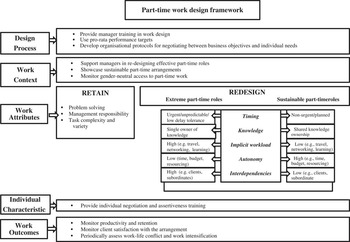
Figure 1 summarises the key attributes identified in the study that were instrumental in facilitating effective and sustainable part-time arrangements. These attributes are detailed according to the five multifaceted dimensions of contemporary work design theory: the work design Process, the Context within which the work is performed, the Content of the work itself, the characteristics of the Individual occupying the role and the Outcomes of the work arrangement. In the areas of Context and Outcomes, Figure 1 identifies specific actions that could redress the limitations of part-time work design that were uncovered in the study, such as the problem of productivity of part-time roles being assessed by ‘gut feel’ rather than objective evaluation, and that certain roles, such as partnership, were not countenanced in one organisation, but were operating effectively in others.
Part-time work design framework

Importantly, Figure 1 also identifies elements of work design that do not appear to impact on effective voluntary professional part-time arrangements. For example, the data revealed numerous examples of part-time workers who were successfully engaged in highly complex project roles involving both management and client-facing responsibilities and where these particular attributes did not need to be re-designed. Indeed, for these part-time workers, retaining the complex and the client-facing attributes of work facilitated engagement with work and protected opportunities for career enhancement. Attention to work design could have provided a specific, structural means to articulate aspects of these individuals’ roles that required additional support, training or re-design to accommodate mutual needs and promote productivity.
The work design framework illustrated in Figure 1 informs pragmatic management, human resource and organisational strategies in re-designing full-time roles. It also offers a promising basis for assessment in challenges to statutory access to part-time work and for comparisons of part-time roles across different industry settings. For example, objectively comparing roles with similar attributes in, for example, law and accounting firms, may determine whether limitations imposed on part-time roles are substantive or normative, and consequently reveal possibilities for part-time work that have not been explored. In organisations where part-time roles are typically not re-designed, individuals may be empowered to seek roles, either internally, or in other workplace settings, that are more sustainable in part-time hours. The application of work design principles and processes may also mitigate other persistent work-related problems such as ‘extreme work’ (Hewlett & Luce, Reference Hewlett and Luce2006: 51). Extreme work hours in excess of 60 hr/week is characterised by unpredictability, tight deadlines, inordinate scope of responsibility and a large number of direct reports; attributes that are very similar attributes to those identified in the current study that were problematic for part-time work arrangements.
Similarly, other studies have identified several important features of work design that may contribute to gender equity in organisations, such as control over work schedules (autonomy), unpredictability, and team/group work and relational support (Bourke & Andrews, Reference Bourke and Andrews2010; Bailyn, Reference Bailyn2011). The difficulty of accessing men who worked part-time, relative to their female counterparts, and the consequent inclusion of only three men in the sample, meant a limited assessment of the impact of gender on work design. Notwithstanding this constraint, the study points to the potential of work design to counter some of the dominant discourses around the ideal worker, and challenge some of the assumptions associated with part-time work that have constrained women’s opportunities in the workplace owing to their disproportionate uptake. For example, a focus on the specific attributes of work may provide a means to challenge widely held views that a physical presence in the workplace is necessary to be an effective worker, or that roles such as partnership, client facing or cognitively complex engagements and management responsibilities are not suitable for part-time work (Author, Reference McDonald, Bradley and Brown2008; Lirio et al., Reference Lirio, Lee, Williams, Haugen and Kossek2008; Nentwich & Hoyer, Reference Nentwich and Hoyer2012). Although fully resolving the penalties associated with part-time work is clearly a complex and challenging task, especially with the interplay of time, gender and professionalism (Ozbilgin et al., Reference Ozbilgin, Tsouroufli and Smith2011), work design offers a multidimensional approach to begin to address these challenges. Moreover, in reinvigorating the practice of work design, the organisation and individual are conceptually separated, allowing for tasks to be assigned as functions that can be divided, rather than an individual who cannot (Nentwich & Hoyer, Reference Nentwich and Hoyer2012). Hence, work design provides a more scientific basis from which to assess whether ‘a job’ can be performed on a part-time basis, and if so, what components need to change in order for it to be carried out effectively and sustainably.
Limitations of the study
The use of purposive sampling in this study was designed to maximise the attributes theoretically relevant to part-time work design and is considered an appropriate strategy for exploratory or field research (Neuman, Reference Neuman2006). The disadvantage of this approach is that the sample was not necessarily representative of the large population of nonprofessional part-time employees (Webber & Williams, Reference Webber and Williams2008) whose arrangements are often employer initiated, precarious, low skilled and/or repetitive. A closer empirical focus on work design for these involuntary, secondary part-time workers is warranted, but it is likely that the critical processes, attributes and outcomes of work design for such employees will be markedly different to those in the professional services occupations examined here. Our findings, although based on a relatively small sample size in one national setting (Australia), were appropriate for an exploratory study of this kind, and could be used to develop a work design model for part-time work as a basis for further empirical testing.
Another limitation of the study is one levelled at much work design literature; that it focusses predominantly on employees’ self-assessment of work attributes and outcomes (Humphrey et al., Reference Humphrey, Nahrgang and Morgeson2007). Future research could address this limitation by examining the individual, organisational and client outcomes of work design processes in other samples, allowing for an objective assessment of the impact of varying work context and content attributes, including insights into the gaps between flexible work policy objectives and outcomes.
Conclusions
We conclude that the application of work design principles offers a number of advantages in facilitating more equitable and sustainable part-time work, particularly through the identification of the attributes of work itself that should be considered in a transition from a full-time to a part-time role. These include the retention of design aspects such as task complexity and management responsibilities, and adjustments to other design aspects, such as the knowledge-sharing and implicit work. Through an explicit examination of part-time work using a work design lens in the Australian context where part-time professional work challenges well-entrenched norms, the study also contributes to explanations of why even generous and well-publicised organisational flexible work policies do not necessarily translate to the outcomes sought by the organisations who offer them and the individuals who utilise them. At the heart of policy-practice gaps are persistent and pervasive difficulties in performing both core and implicit work, managing expectations around commitment, and gaining access to promotion and development opportunities. These disadvantages disproportionately affect women who are the main users of part-time work policies and consequently constrain broader gender equality goals, but they also impact on men who may wish to engage more meaningfully with family or other noneconomic domains but who are all too aware of the price tag attached to the take up of part-time work. Finally, the resulting framework provides a basis for more equitable and sustainable work practices that facilitates organisational effectiveness, particularly via the attraction and retention of talented staff, the integration of part-time professionals into work teams, and the means to redress the gap between policies that espouse part-time (and other flexible) work and the practices that actively support such roles.