Introduction
Date palm, Phoenix dactylifera L. (Arecaceae), is the most important crop in the Arabian Peninsula, where it is closely associated with the culture and heritage of the region. With several new plantations, the United Arab Emirates (UAE) is poised to be a major global producer of dates in the years to come. Ever since the red palm weevil (RPW) Rhynchophorus ferrugineus Olivier (Coleoptera: Curculionidae) was reported from Rass-El-Khaima in the UAE in 1985, it has spread rapidly, infesting approximately 5–6% of the palms in the region (Zaid et al., 2002).
The RPW is known to be a serious threat to young date plantations, where adult female weevils get attracted to palm volatiles for laying eggs that hatch into damage-inflicting grubs, which bore into the palm, leaving behind chewed-up plant fibres (frass) that protrude through the holes on the infested palms. This frass has a typical fermented odour (Abraham et al., Reference Abraham, Al Shuaibi, Faleiro, Abuzuhairah and Vidyasagar1998; Faleiro, Reference Faleiro2006). The concealed nature of the pest makes the detection of infested palms difficult (Abraham et al., Reference Abraham, Al Shuaibi, Faleiro, Abuzuhairah and Vidyasagar1998). A 0–5 scale has been developed to categorize the stages of RPW infestation by El-Ezaby (Reference El-Ezaby1997), where 0 represents an infested date palm showing no stages of the pest or damage symptoms, while 5 indicates a RPW-infested date palm that has toppled. Detecting RPW-infested date palms in the early stage of attack is the key to successfully managing the RPW (Abraham et al., Reference Abraham, Al Shuaibi, Faleiro, Abuzuhairah and Vidyasagar1998).
El-Sabea et al. (Reference El-Sabea, Faleiro and Abo El Saad2009) estimated the annual loss due to the eradication of severely infested date palms by RPW in the UAE to vary from $3 to 16 million. Food-baited pheromone traps have been widely used to monitor and mass trap the RPW in several countries (Faleiro, Reference Faleiro2006). Ethyl acetate (EA) when incorporated in RPW pheromone traps enhances weevil captures (Abdullah et al., Reference Abdullah, Salim and Al-Khatri2005; Al-Saoud, Reference Al-Saoud2009b). Also, trap colour is known to have an impact on the performance of these traps (Hallett et al., Reference Hallett, Oehlschlager and Borden1999; Ajlan and Abdulsalam, Reference Ajlan and Abdulsalam2000; Sansano et al., Reference Sansano Javaloyes, Gomez Vives, Ferry and Diaz Espejo2008; Anonymous, 2009; Al-Saoud, Reference Al-Saoud2010; Al-Saoud et al., Reference Al-Saoud, Al-Deeb and Murchie2010; Abuagla and Al-Deeb, Reference Abuagla and Al-Deeb2012). We carried out field trials in RPW-infested date plantations of Abu Dhabi in the UAE during 2010 to ascertain the combined effect of EA and trap colour on weevil captures in RPW pheromone traps.
Materials and methods
Study sites
The experiment was conducted in five RPW-infested date plantations at Al-Rahba, Abu Dhabi, UAE (latitude 24°28′N; longitude 54°22′E), from January to December 2010. Each farm contained at least 140 date palm trees of different ages (6–30 years).
Traps and treatments
Pheromone traps were fabricated using a 10-litre polypropylene bucket with four rectangular (3 × 7 cm) windows cut equidistantly below the upper rim of the bucket. The distance between each window and the bottom of the bucket was 16 cm. The bucket was covered with a lid that had four windows similar to the ones on its sides. The outer surface of the bucket was rough with a small projection (1–2 mm) to help the weevils climb to the trap and enter. The upper surface of the lid had a small handle to ease the opening of the trap and the lower side had a small knob to which a wire was fixed to hold the pheromone and EA dispensers. Each trap contained the following materials: (1) a dispenser of the RPW male aggregation pheromone (Ferrolure™) containing 700 mg of the active ingredient (4-methyl-5-nonanol (90%)+4-methyl-5-nonanone (10%)) at 95% purity; (2) an EA dispenser (Weevil Magnet™) containing 40 ml of the active ingredient of EA at 98% purity; (3) 350 g of fodder date fruits; (4) 5 litres of water, with a water level inside the bucket of 4–5 cm below the windows.
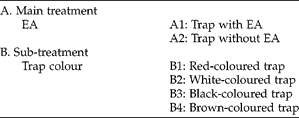
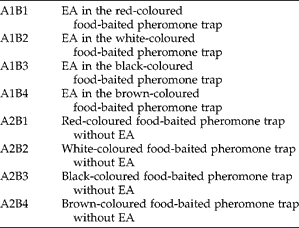
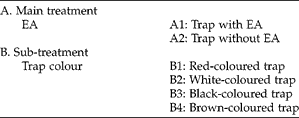
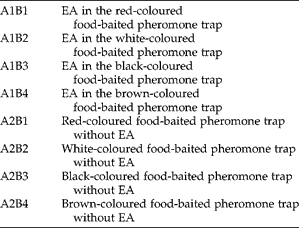
Water in the traps was replenished so as to keep sufficient moisture. Food bait (dates) was changed once a month while a new pheromone lure was added every 45 days during the cold season (October–April) and every month during warmer months (May–September) to sustain the trapping efficiency. The traps were set at the ground level, beside the trunk. The number of weevils captured (male, female) was recorded weekly when the trap content was shaken well to prevent the growth of any fungi/mould. The traps were also moved from one spot to another sequentially to eliminate spot effect (if any) due to the aggregated nature of this pest (Faleiro et al., Reference Faleiro, Ashok Kumar and Rangnekar2002). The main and sub-treatments are described in Table 1. In total, there are eight combinations of treatments presented in Table 2.
Main and sub-treatments tested in the study
Eight combinations of treatments tested in the study
The choice of trap colours in this trial was based on our previous experience, where it was seen that superior captures were recorded in red-coloured traps when compared with traps with lighter colour shades (Al-Saoud et al., Reference Al-Saoud, Al-Deeb and Murchie2010). Hence, we selected red-, black- and brown-coloured traps for this study along with the commonly used white (control)-coloured RPW pheromone traps in the UAE.
Experimental design and statistical analysis
The experimental design was a randomized complete block design with eight treatments and five replicates (five date palm farms), where each farm constituted a single replication. All the experimental sites had the aforementioned eight treatments and serial numbers were assigned to all the traps (1–8) at each of the five test sites. A distance of 50 m was maintained between two treatments. The trial was carried out under a two-factor randomized block design. A monthly record of the number of weevils trapped in the 40 (N) pheromone traps was maintained for the study period (January–December, 2010). Trap capture data were subjected to analysis of variance (ANOVA) and the means separated using Tukey's test.
Results
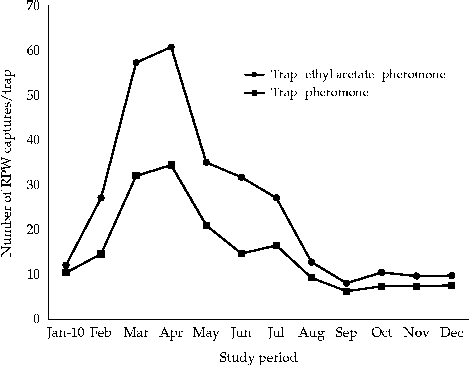
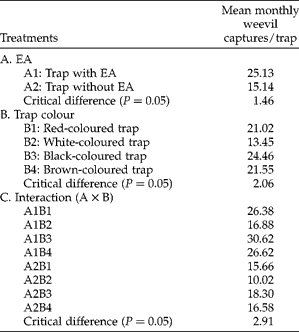
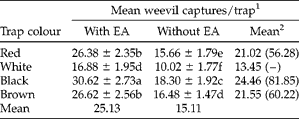
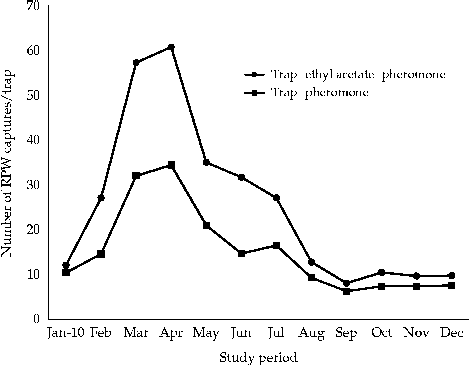
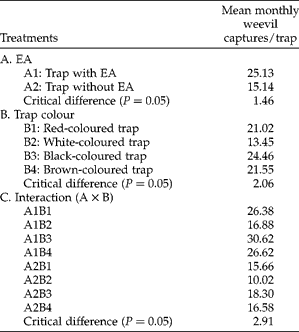
The results presented in Fig. 1 show that the RPW was active throughout the year. Furthermore, Tables 3–5 reveal that both EA and trap colour significantly influenced weevil captures in food-baited RPW pheromone traps. Also, female weevils dominated in the captures in the traps throughout the experimental period, with a sex ratio (male:female) of 1:2.2. Traps charged with EA recorded better weevil captures when compared with those with no EA during all months of the year (Fig. 1). In general, pheromone traps with EA registered statistically higher (P= 0.05) capture rates of 25.13 weevils/trap/month when compared with traps with no EA, which captured 15.14 weevils/trap/month (Table 3).
Monthly Rhynchophorus ferrugineus captures in food-baited pheromone traps with and without EA in date plantations of Al-Rahba, UAE during 2010
Effect of EA and trap colours on the captures of Rhynchophorus ferrugineus in food-baited pheromone (Ferrolure™) traps
Effect of EA and trap colours on the mean monthly captures of Rhynchophorus ferrugineus in food-baited pheromone (Ferrolure™) traps
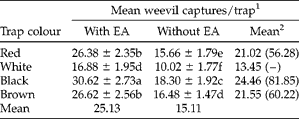
1 Means with unlike letters are not significantly different (P≥ 0.05; Tukey's test, ANOVA).
2 Values in parentheses are percentage increase in weevil captures over the white-coloured traps.
ANOVA for the effect of EA and trap colours on the captures of the red palm weevil in food-baited pheromone (Ferrolure™) traps

Tables 4 and 5 show that black-coloured RPW pheromone traps registered the highest weevil captures of 24.46 weevils/trap/month, which were statistically significant compared with the other three trap colours tested. Brown- and red-coloured traps recorded statistically similar captures of 21.55 and 21.02 weevils/trap/month, respectively, while the commonly used white-coloured RPW pheromone trap in the UAE registered the least captures of 13.45 weevils/trap/month. The percentage increase in weevil captures by the black-, brown- and red-coloured traps over the white-coloured pheromone trap was 81.8, 60.2 and 56.3%, respectively (Tables 4 and 5). Furthermore, interaction effects indicate that black-coloured RPW pheromone traps when charged with EA registered the highest weevil captures of 30.6 weevils/trap/month, while white-coloured RPW pheromone traps with no EA recorded the least captures of 10 weevils/trap/month (Tables 4 and 5).
Discussion
The present results show that RPW pheromone traps charged with EA recorded significantly higher weevil captures. Presently, the most attractive RPW pheromone traps are those containing fermented food that emits the pheromone and EA (Oehlschlager, Reference Oehlschlager2005). EA in combination with fermenting food in RPW pheromone traps was found to increase the trapping efficiency in several RPW-infested countries (Oehlschlager, 1998; Sebay, Reference Sebay2003; Abdullah et al., Reference Abdullah, Salim and Al-Khatri2005; Faleiro, 2005; Abdallah et al., Reference Abdallah, Al Abbad, Munhim Dan, Abdallah Ben and Faleiro2008; Al-Saoud, Reference Al-Saoud2009b). Reports from Italy have suggested that ethyl propionate alone or in combination with EA was found to be a better synergist in food-baited RPW pheromone traps than EA alone (Guarino et al., Reference Guarino, Bue, Peri and Colazza2010). As in this paper (Fig. 1), RPW pheromone traps are known to record female-dominant captures, which is desirable from the control point of view as these female weevils are known to be young, gravid and fertile (Faleiro et al., Reference Faleiro, Rangnekar and Satarkar2003; Al-Saoud, Reference Al-Saoud2009a; Al-Saoud, Reference Al-Saoud2010). Elimination of such weevils through a mass-trapping programme would curtail the build-up of RPW in the field.
In the UAE, white-coloured bucket traps are widely used to monitor and mass trap the RPW. Wood-boring coleopteran insects are known to be attracted mainly to red, brown and black background colour contrasts (Kirk, Reference Kirk1984). Furthermore, trap colour is known to influence the efficacy of RPW pheromone traps (Hallett et al., Reference Hallett, Oehlschlager and Borden1999; Ajlan and Abdulsalam, Reference Ajlan and Abdulsalam2000; Sansano et al., Reference Sansano Javaloyes, Gomez Vives, Ferry and Diaz Espejo2008; Anonymous, 2009; Al-Saoud, Reference Al-Saoud2010; Al-Saoud et al., Reference Al-Saoud, Al-Deeb and Murchie2010; Abuagla and Al-Deeb, Reference Abuagla and Al-Deeb2012).
Ajlan and Abdulsalam (Reference Ajlan and Abdulsalam2000) captured more weevils in green reusable bucket traps when compared with white and yellow traps. Reports from Oman (Anonymous, 2009) have indicated that red-coloured RPW pheromone traps registered the best weevil captures followed by green-, orange-, yellow- and blue-coloured traps. Al-Saoud et al. (Reference Al-Saoud, Al-Deeb and Murchie2010) found that dark-coloured traps, in general, and red-coloured ones, in particular, recorded the best weevil captures. Work done in Spain showed that brown-reddish-coloured traps registered superior RPW captures (Sansano et al., Reference Sansano Javaloyes, Gomez Vives, Ferry and Diaz Espejo2008), indicating the preference of RPW adults to dark colours.
Recently, Abuagla and Al-Deeb (Reference Abuagla and Al-Deeb2012), while standardizing the quantity of food bait and ascertaining the influence of trap colours on weevil captures in RPW pheromone traps, found that using black-coloured pheromone traps can significantly enhance RPW captures in food-baited pheromone traps, which is in agreement with our findings and also with those of Hallett et al. (Reference Hallett, Oehlschlager and Borden1999) who recorded higher weevil captures in black bucket traps when compared with white traps.
Based on the results presented and discussed above, we propose that using black-coloured RPW pheromone traps instead of the commonly used white-coloured pheromone traps along with EA would significantly enhance the efficiency of the mass-trapping programme of RPW in the UAE. As EA is highly volatile, it would significantly increase the cost of the trapping programme. Hence, EA could be incorporated in RPW pheromone traps only during peak seasonal activity from March to June under the environmental conditions prevailing in the UAE and also in and around plantations where weevil activity is high.
Acknowledgements
The author acknowledges with gratitude the support provided by Engineer Sameer Ali Al Dhalei, Director, Banyans Research Station, Engineer Ameen Nasser Al Wahedi, Head, Al-Rahba Extension Center and all others in the Centre for their assistance in carrying out this work.