


Introduction
In the wake of World War I and the Great Depression, governments across the world extended worker protections, introduced employment laws and labor market regulations, and established mechanisms by which certain labor groups became involved in decision-making processes. The spread of worker protections and institutional labor participation in the 1920s and 1930s, sometimes called the global corporatist wave, was propelled forward by powerful domestic and international forces. Working classes mobilized for the expansion of social safety nets; employers demanded labor discipline and higher productivity; technocrats called for order, stability, and work management. The International Labour Organization (ILO) was created in 1919 precisely to institute an international regime of minimum labor standards.
Yet, remarkably, Iran, a founding member of the ILO, is one of the few late-industrializing countries to have largely bypassed the corporatist wave. Despite its longstanding ILO membership, Iran did not introduce participatory mechanisms or basic union regulations. The country banned labor unions, adopted a repressive approach to worker organizing, and introduced barely any national worker protections beyond minimal health and safety measures.
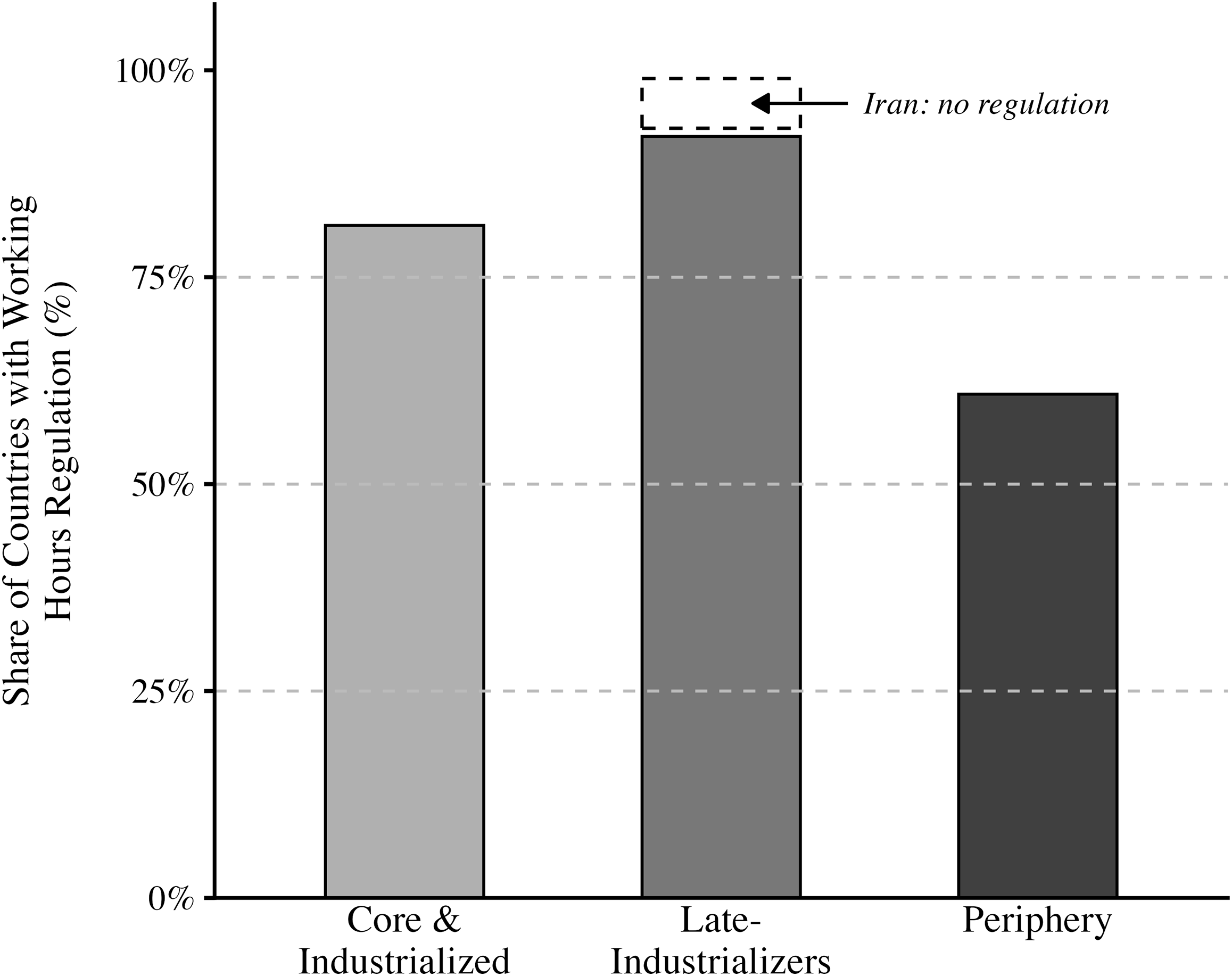
Figure 1 illustrates Iran’s divergence. It plots the share of non-colonized countries, by developmental status, that regulated working hours in 1939. Limits on working hours were a main demand of the international labor movement, a key ILO Convention, and thus a clear comparative indicator for states’ labor-protective attitudes. The figure shows that late-industrializing and semi-peripheral states almost universally regulated working hours by the late 1930s – even more than industrialized states in the imperial core. But Iran is the exception, becoming one of the very few late-industrializers without any statutory limits on working hours. Iran also did not adopt a comprehensive labor code until after World War II.
Share of non-colonized countries with working hours regulation in 1939.
Sources: Rasmussen (Reference Rasmussen2024) (working hours data), Karataşlı (Reference Karataşlı2017) (classification procedure).
Notes: Iran and Egypt are the only late-industrializers without working hours regulation in 1939. Full coding procedure in the appendix in Supplementary materials.

Why were Iranian governments unwilling or unable to introduce national worker protections and participatory institutions? Existing explanations emphasize the informal empire, labor weakness, and comparative underdevelopment. But these arguments cannot fully account for Iran’s particular trajectory of labor policy and incorporation. After all, many other mostly agrarian, industrializing countries in Britain’s orbit, including oil exporters, did pivot to a more protective and inclusionary labor policy in the 1920s–1930s.
This article proposes that Iran’s founding membership in the ILO constrained labor standards. Using original archival sources collected at the ILO Archives in Geneva, I show how Iran was early on positioned within the ILO as a quintessential case of “Eastern” underdevelopment – a categorization that legitimated broad exemptions from the global regime of minimum standards the organization sought to institute. I argue that these formative interactions with international organizations (IOs) and labor policy generated for Iran a persistent founder’s discount as early exemptions became institutionalized into durable logics and affordances of reduced obligation. Iran’s founding status in the ILO persistently disinclined it from adopting more generous and inclusive worker protections.
The article extends the scholarship on IOs by applying imprinting theory to the relationship between IOs and member states – a connection existing scholarship has largely overlooked. More broadly, the case illustrates how flexibility provisions, which IOs frequently offer to facilitate membership growth and participation, can stamp onto member states long-lasting behavioral patterns that run counter to IO mandates.
The article is structured as follows. The next section reviews existing arguments about state-labor relations in 1920s–1930s Iran. Building on existing scholarship, I then develop an alternative argument about how the founding conditions can facilitate IO imprinting on national policy fields. After discussing data and methods, the main empirical sections discuss the evolution of Iran-ILO relations and the country’s labor policy. I conclude by briefly discussing how the findings contribute to our understanding of Iran, the ILO, and the organizational scholarship more broadly.
The insufficiency of existing explanations
Historians converge around three principal explanations to account for the Iranian state’s exclusionary approach to labor in the 1920s and 1930s: dependency arguments that emphasize the informal empire, structural-economic arguments about the small size of Iran’s proletariat, and power resource arguments that highlight the absence of a well-organized labor movement.
By far, the most popular set of accounts, though also analytically the weakest, are structural-economic arguments that emphasize Iran’s low level of development. In this view, Iran did not pursue labor incorporation because the country lacked industry and a sizeable proletariat. Floor (Reference Floor1985: 59), to account for the “failure” of Iran’s worker movements, argues that “the most important reason is … the fact that a considerable share of the industrial labor force had not been divorced from its traditional agricultural and pastoral pursuits.” Writing in the 1950s, Mohammad Ali Jamalzadeh, a nationalist intellectual and by then a senior ILO official, stressed that “trade unionism in the western sense of the term is a recent feature in Iran. It has been the outcome of growing industrialization and in fact only goes back to the early years of the second world war” (Djamalzadeh Reference Djamalzadeh1951: 181, emphasis added).
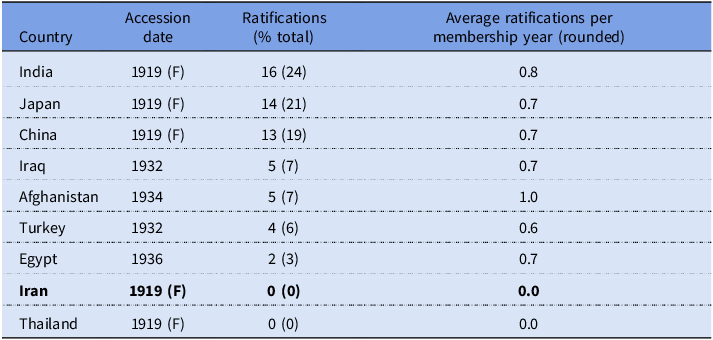
Structural-economic explanations, often grounded in modernization theory, are notoriously poor at predicting the timing, content, and outcome of labor policy (Collier and Collier Reference Collier and Collier2002 [1991]; Haggard and Kaufman Reference Haggard and Kaufman2008). Consider neighboring Afghanistan – one of the least industrialized states in the region – which by the late 1930s had already drafted a labor code and adopted five ILO Conventions (Table 1). If largely agrarian countries with minimal industrial capacity could adopt protective labor legislation, the absence of industry does not sufficiently explain Iran’s exceptionalism. Iran, after all, boasted one of the largest industrial concerns in West Asia – the Anglo-Persian Oil Company (APOC) – and industrialized rapidly throughout the 1930s. As Figure 1 shows, most late-industrializers pursued precisely the labor policies that Iran refused.
Ratification of ILO conventions in the “East,” 1919–1939

Table 1. Long description
A table comparing ratification of ILO conventions in the East from 1919 to 1939. The table has 10 rows and 4 columns. The columns are labeled Country, Accession date, Ratifications (% total), and Average ratifications per membership year (rounded). The row labels are the names of the countries. The values in the columns are the accession dates, the number and percentage of ratifications, and the average ratifications per membership year. Notable trends include India having the highest number of ratifications (16 out of 24) and an average of 0.8 ratifications per membership year, while Iran and Thailand have no ratifications.
Source: ILC (1947: 559).
Notes: (F) indicates a Founder: a founding ILO member state. By 1939, the International Labour Conference had adopted 67 Conventions, which are used to calculate the percentage shares.
Similar limitations beset power resource arguments. In this perspective, worker movements were insufficiently strong to compel Iran’s autocracy to agree to labor rights. The classic argument of interwar fascism rests, of course, on the assumption of worker power: former socialists turned to right-wing nationalist and corporatist ideologies as relatively strong labor movements were unable to grab state power and shape government policy. But neither fascism nor socialism is a necessary condition for labor policy, which was frequently a technocratic response to economic instability (Pinto Reference Pinto2017). This is especially clear in Latin America and southeastern Europe, where many conservative authoritarian regimes, usually without confronting sustained worker mobilization, introduced laws that, on paper, resembled labor legislation elsewhere. Romania, a largely agrarian, oil-producing monarchy like Iran, even produced one of the most famous corporatist intellectuals, Mihail Manoilescu, who inspired, among others, Vargas in Brazil and Salazar in Portugal (Love Reference Love1996; Teixeira Reference Teixeira2024).
Although the Iran scholarship conventionally examines worker mobilization after World War II, recent studies indicate that 1920s–1930s Iran experienced significant episodes of labor unrest, including in the British-run oil industries, notably the 1929 APOC Strike (Atabaki Reference Atabaki2025; Bayat Reference Bayat and Atabaki2007; Cronin Reference Cronin2010), and large-scale manufacturing, such as the 1931 Vatan Strike (Afacan Reference Afacan2018; Paydar Reference Paydar2019: 228–42), as well as routine petitioning (Afacan Reference Afacan2020). But if worker mobilization elsewhere often inspired accommodating legislation alongside repression – “inducements” as well as “constraints” (Collier and Collier 1979) – the Iranian state had no ear for inducements beyond localized concessions. Instead, officials often responded to labor protests with more constraints. Thus, the government banned all labor unions in the late 1920s (Abrahamian Reference Abrahamian1982: 162), cracked down hard on May Day celebrations, and, following the Abadan strike, formally outlawed communism in 1931 (Ladjevardi Reference Ladjevardi1985: 20–22). Iran’s repressive and exclusionary approach to organized labor was uncommon. Even Iran’s neighbor Turkey, whose leader, Mustafa Kemal, Reza Shah regarded as a role model, introduced a comprehensive labor code that formalized, legalized, and regulated labor unions and collective bargaining (Akgöz Reference Akgöz2024: 100–103).
A third family of explanations looks outward rather than inward. Dependency arguments highlight the informal empire exercised through Britain and Iran’s “comprador bourgeoisie.” After World War I, Iranian petroleum became critical to Britain’s energy security (Kelanic Reference Kelanic2016). Unlike other major oil exporters outside the imperial core, like Venezuela (Sallas Reference Sallas1972), Mexico (Middlebrook Reference Middlebrook1995), or Romania (Calcan Reference Calcan2022) – each of which proceeded to advance corporatist-style legislation in the 1920s and 1930s – Iran’s oil industry was dominated not by several, but by a single enterprise – a producer monopoly that gave APOC a high degree of political leverage. It can be fairly assumed that APOC had a stake in minimizing labor costs and maximizing company authority over the workplace (Atabaki Reference Atabaki2013; Bayat Reference Bayat and Atabaki2007). In addition, studies find that labor protections in British imperial territories tended to be lighter and more flexible, at least compared to the French Empire (Cooper Reference Cooper1996; Edwards Reference Edwards2025), with Mandate territories in an especially unfortunate situation (ILO 1939). Iran was of course neither a formal colony nor a Mandate, but the notion that British imperial influence constrained labor policy seems plausible.
At the same time, an exclusive focus on the empire risks overstating foreign control over and imperial opposition to labor policy. Labor constituted only a fraction of APOC expenses (Shafiee Reference Shafiee2012). There is also no clear evidence that Britain directly demanded that the Iranian government refrain from approving worker protections, and in fact occasionally encouraged them (Schayegh Reference Schayegh2006: 546). In other formal and informal colonies, Britain sometimes supported worker rights and bargaining to deal with political conflict, including in India (Gidney Reference Gidney2023; Rodgers Reference Rodgers2011) and Egypt (Abbas Reference Abbas1973; Beinin Reference Beinin and Daly1998), and many British officials believed that rights and controlled participation through state-licensed trade unions could weaken and moderate workers’ movements (Wilder Reference Wilder2026). In neighboring British-controlled Iraq, where APOC also dominated the oil industry, the government adopted a relatively generous labor code and several ILO Conventions (Ahmadzadeh-Nodijeh and Mansourbakht Reference Ahmadzadeh-Nodijeh and Mansourbakht2020: 25; Sallas Reference Sallas1963).
In the 1920s and 1930s, Iran gradually gained sovereignty vis-à-vis foreign powers, giving state elites more leeway in conducting domestic policy. The government abrogated foreign concessions, nationalized certain trades, subdued UK-linked tribal confederations, and renegotiated the d’Arcy Concession, culminating in a new 1933 oil agreement with London (Brew Reference Brew2017). The 1936 Factory Act – Iran’s most comprehensive piece of employment legislation prior to World War II – signaled that the Iranian state did not shy away from regulating labor markets in pursuit of its developmental ambitions (Schayegh Reference Schayegh2006: 545–47). Indeed, the Factory Act was almost exclusively regulatory (and punitive): though it adopted minimal health, insurance, and safety measures, its primary aim was not the extension of rights but state control over civil society – employers and workers alike – including markets in British-controlled areas (Abdollahi Reference Abdollahi2024; Elwell-Sutton Reference Elwell-Sutton2011 [1941]: 219).
Finally, there is little evidence that Iran’s industrial strategy was organized around minimizing labor costs. Following the Turkish, German, and Soviet examples (Link Reference Link2020), newly established factories in 1930s Iran tended to be symbols of nationalist modernity, often designed by famous international architects with few expenses spared.Footnote 1 An ILO report, though biased in sampling design, found that Tehrani factories, on average, conformed more to minimal building standards than those in Baghdad and Istanbul, noting that “with the exception of a knitting factory, which, though well built, seemed somewhat overcrowded, the factories were well situated, roomy, and with adequate light and air” (Weaver Reference Weaver1933: 492).
Taken together, existing theories go some way toward accounting for the general shape of state-labor relations in Iran. Informal empire, nascent industrialization, and low worker power help explain why the Iranian state did not adopt labor standards. What existing arguments cannot explain is why this trajectory persisted and hardened even as Iran claimed growing sovereignty from Britain, industrialized, and became a founding member of an IO explicitly mandated to institute minimum labor standards. Nor do they address why ILO membership, which expanded labor standards elsewhere, appears to have had only minimally positive effects in Iran.
Argument: International organizations, founders, and imprinting
I argue that early participation in international standard-setting imprinted norms and behaviors onto the Iranian state that persistently disinclined it toward a protective and participatory labor policy throughout the 1920s and 1930s. My argument builds on and extends imprinting theory (Burton and Beckman Reference Burton and Beckman2007; Marquis and Tilcsik Reference Marquis and Tilcsik2013; Simsek et al. Reference Simsek, Fox and Heavey2015). Imprinting theory proposes that organizations (in this case, states) are shaped by the conditions present at critical formative periods and that these early influences persist long after.
Imprinting is distinct from policy diffusion. Diffusion concerns the spread of policies, as studied, for example, by the literature on labor standards and ILO membership (Baccini and Koenig-Archibugi Reference Baccini and Koenig-Archibugi2014; Greenhill et al. Reference Greenhill, Mosley and Prakash2009; Strang and Chang Reference Strang and Mei Yin Chang1993). By contrast, the imprinting literature examines how early exposure or adoptions yield legacies that endure even after the original conditions change. One stream of the imprinting literature focuses on environmental, technological, or institutional conditions and their legacies (Marquis Reference Marquis2003; Stinchcombe Reference Stinchcombe and March1965). Another stream examines how actors such as entrepreneurs or founders shape organizations in persistent ways (Becker Reference Becker2025; Fauchart and Gruber Reference Fauchart and Gruber2011; Schein Reference Schein1983; Zuzul and Tripsas Reference Zuzul and Tripsas2020). This article fits in between these two groups. Specifically, I examine how the founding conditions of IOs shape national policy fields and trajectories.
IOs are, of course, shaped by their founders in crucial ways. Christina Davis (Reference Davis2023) conceptualizes IOs as “discriminatory clubs” created by like-minded states with common security interests. Their geopolitical alignment shapes who wants to join an IO, whether they are accepted into the club, and the price of entry. This article turns the causal arrow around. Rather than examining how major powers forge IOs, I study how IOs can imprint behavioral patterns onto member states. The article’s focus is not on powerful founders but on weak, small, and peripheral states that are early on brought into the IO as allies of major powers that have an interest in expanding their voting bloc within the IO.
Generally, scholars tend to be skeptical that IOs leave lasting legacies on sovereign states. The Iranian government could have simply adopted ILO standards without enforcing them, thus minimizing the costs of IO membership for both the government and employers. Such strategies of policy adoption with minimal implementation or enforcement are common. Yet, I find that the ILO had thoroughgoing influence on early Pahlavi state formation, but it was one that diverged substantially from the IO’s own mandates.
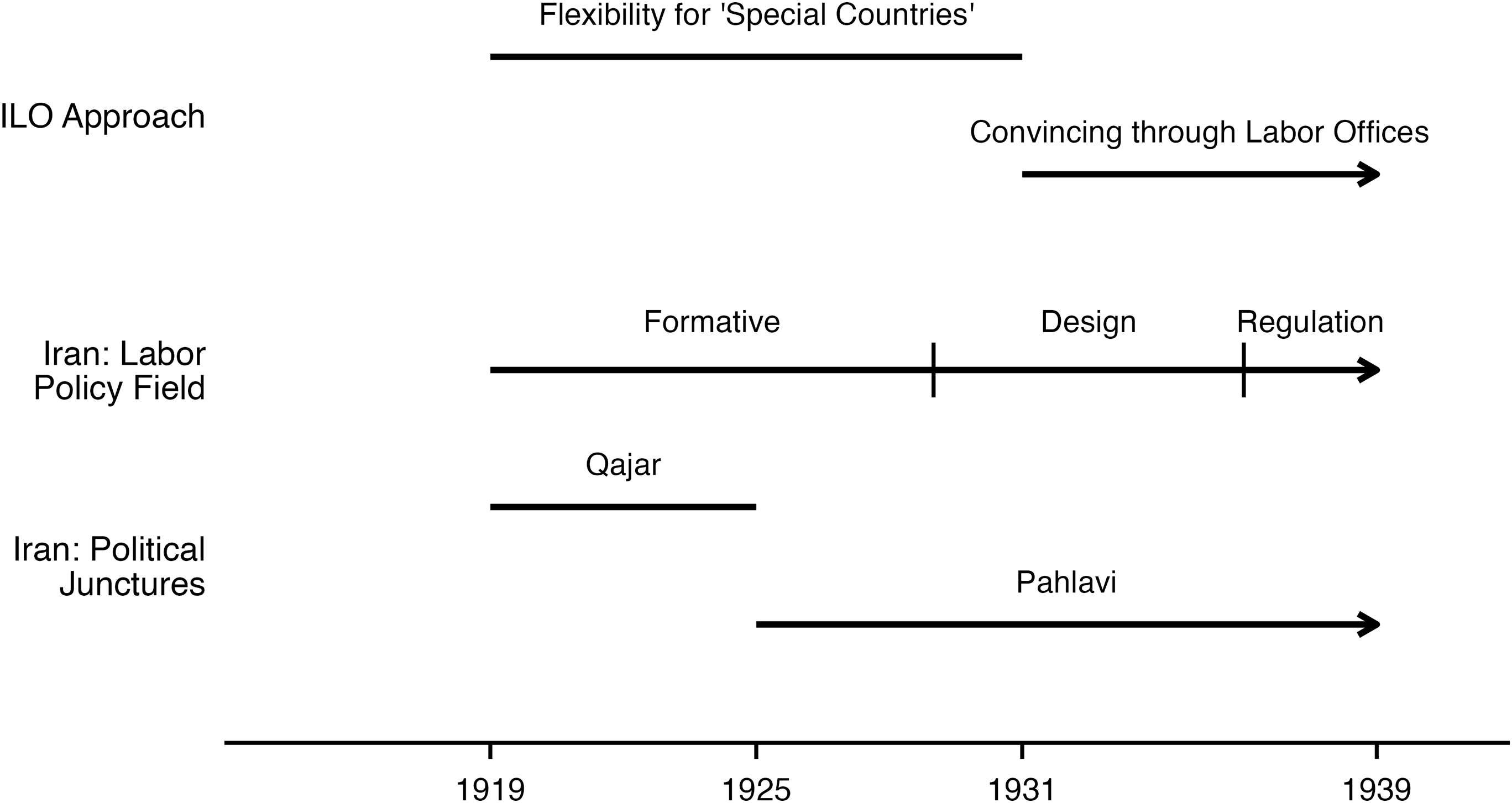
Iran was susceptible to ILO imprinting for two primary reasons. First, employment relations, law, and regulation were entirely new epistemic and policy fields that Iranian statesmen had no familiarity with. The absence of institutional knowledge at the level of national state agencies meant that ILO participation was consequential in shaping how Iranian bureaucrats approached and perceived this new policy field. Second, the Iranian state itself was undergoing major transformations as the Qajar dynasty made way for Reza Khan, who was crowned Shah of the new Pahlavi dynasty in the mid-1920s. Amid these domestic upheavals, IOs and institutions wielded distinct forms of leverage. Reza Shah pursued rapid modernization and reform, and to achieve this, officials relied extensively on international norms and rules. Imprinting is most likely during “sensitive periods of transition during which the focal entity exhibits high susceptibility to external influence” (Marquis and Tilcsik Reference Marquis and Tilcsik2013: 195), which in this case applies to Iran, the field of labor policy, and the ILO itself (see Figure 2). The early post-World War I period was a critical juncture.
Timeline.

I argue that formative interactions with international employment law and labor standards through ILO membership produced norms and institutions that persistently disinclined the Iranian state from adopting protective and participatory worker legislation. My argument goes as follows. As a peripheral state and British ally, Iran early on claimed two core ILO flexibility provisions. In the first instance, Iran was exempted from the ILO’s tripartism requirement. In the second instance, Iran was (temporarily) exempted from ILO policy ratification based on the notion that less-developed member states could delay adoption. In 1919 and the 1920s, Iran was positioned within the ILO as a paradigmatic case of “Eastern” underdevelopment – a categorization that afforded and legitimated broad exemptions from international labor standards. This status had narrative dimensions – ILO participants routinely reminded members that less-industrialized countries could not be expected to introduce international standards without local adjustments. It also had legal dimensions. Notably, Iran became formally exempted from the first ILO convention on working hours.
The ILO’s early flexible approach translated into a persistent founder’s discount as Iran remained committed to delaying worker protections over the next two decades, long after the ILO had changed its position on the matter. Indeed, the ILO did not sit still as Iran’s founder’s discount grew. From the late 1920s and early 1930s, the ILO intensified efforts to gain Iranian compliance, departing from its earlier flexible attitude toward “Eastern” founders as it developed a new proactive compliance approach organized around local labor offices (Figure 2). But these ILO efforts mostly failed, and Iran’s original attitude toward international law and policy persisted. In this, Iran diverged from later IO entrants in “the East” – countries like Turkey, Iraq, Egypt, and even Afghanistan – which became significantly more likely to adopt international worker standards.
Using original primary sources, I identify three channels that help account for Iran’s founder’s discount. First, early interactions between Iran and the ILO transferred the responsibility for labor policy to Iran’s foreign ministry, which meant that national lawmakers remained institutionally distanced from this emerging policy field. Second, early ILO membership helped socialize Iranian elites into the notion that labor policy for less-developed countries primarily serves a regulatory rather than a protective purpose. Third, early ILO membership convinced Iran’s government that modernization required delayed policy adoption, as opposed to later IO entrants who tended to view international compliance as complementary to the broader modernization project. I review these three mechanisms in turn after discussing the development of Iran’s founder’s discount and its relationship to the ILO. But first, I briefly discuss sources and methods.
Sources and methods
The article draws on a longitudinal case study of Iran’s ILO membership from 1919 to 1939. The primary source base is the ILO archival collections. I gathered three types of ILO material. First, I consulted the Record of Proceedings. These contain verbatim records of the annual International Labour Conferences (ILC) between 1919 and 1950, including delegation composition, addresses, conventions, and committee proceedings. Second, I relied on in-person fieldwork conducted at the ILO Archives in Geneva, Switzerland, including all documents pertaining to Iran from 1919 to 1950. The later cutoff date was used to make sure that no important documents were ignored. Third, I collected ILO expert and field reports on 1920s–1930s Iran and other countries in the region through Labordoc, the ILO’s open-access online repository. The ILO sources are primarily in French and English, with some handwritten Persian.
Although I was unable to conduct archival fieldwork inside Iran for this project, the article uses secondary sources recently released in Persian by Iran-based researchers and historians. I benefited in particular from Ahmadzadeh-Nodijeh and Mansourbakht’s (Reference Ahmadzadeh-Nodijeh and Mansourbakht2020) detailed work on Iran-ILO relations, for which they consulted Iran’s Ministry of Foreign Affairs Archives and the National Library and Archives in Tehran. Many of their findings corroborate the evidence stored in Geneva and often cover the same documents and interactions. To situate Iranian legislation in a comparative context, I also reviewed many country-level reports on global “labor law and practice” produced in the 1960s–1970s by the US Department of Labor’s Bureau of Labor Statistics.
These sources have some limitations. Because Persian-language sources enter mainly through published secondary work, the analysis reconstructs Iranian decision-making only partially and focuses on Iran’s interactions with the ILO. Moreover, the ILO offers an institutional archive that reflects what Geneva chose to document and how its officials classified members, so I read it for the categories it produced as well as the information it contains (Stoler Reference Stoler2009). I treat delegates’ addresses at the ILC not as transparent policy statements but as performances in which speakers conveyed what they took to be expected of their country in that setting. To separate Iran-specific framings from generic diplomatic rhetoric, I compare Iranian addresses with those of other delegations, especially Turkey, Iraq, Egypt, and Afghanistan.
The empirical material is presented as follows. The next section examines the Washington Conference, the first ILC in 1919, showing how it positioned Iran as a credible claimant to delayed policy ratification. The second section discusses how this status persisted through the 1920s. The third section reviews how the ILO by the early 1930s transitioned to a more proactive approach, and how this failed to work in Iran. The fourth and final section examines three pathways that account for ILO imprinting on Iranian labor policymaking.
Exempting the East: Iran at the 1919 Washington Conference
Although the infamous 1919 Anglo-Persian Agreement was quickly tabled as Iranian reformers accused the Qajar government of turning Iran into a British colony (Grobien Reference Grobien2024), Britain and Iran (or Persia, as it was then still known) vowed to maintain their deep alliance. After all, they shared a common ground. The Qajars feared communism. Britain regarded Iran as a necessary buffer against Russo-Soviet expansionism and key to the Empire’s future energy security (Kelanic Reference Kelanic2016). In 1919, Britain introduced Iran as a founding member of the League of Nations and the ILO.
IOs often offer members flexibility provisions to secure the geopolitical alignments they express (Davis Reference Davis2023; Gidney Reference Gidney2025). At the first ILO Conference in Washington, Britain assisted Iran in claiming the right to two major flexibility provisions enshrined in the Treaty of Versailles: on tripartism and policy ratification (Plata-Stenger Reference Plata-Stenger2020).
First, Iran claimed an exemption from the ILO’s tripartite requirement. The annual International Labour Conference (ILC) – the ILO’s main governing body – pioneered a tripartite governance model in which national delegations consisted of government, worker, and employer delegates. Voting rights followed a 2:1:1 ratio, favoring governments. But, according to Article 389 of the Treaty of Versailles, “members undertake to nominate non-Government Delegates and advisers chosen in agreement with the industrial organisations, if such organisations exist …” (Treaty of Versailles 1919: Art. 389). With this proviso, Iran and several other countries perceived as less-developed were permitted to only send government delegates. This certainly was politically convenient for Qajar leaders. Iran had an active labor movement, but, inspired by the Bolshevik revolution unfolding on its border, the movement was mostly communist-leaning. Neither Britain nor the Iranian government had an interest in including its leaders, or the time and will to commit to the difficult work of establishing state-sanctioned unions.
Iran’s tripartite exemption was likely consequential. The Japanese government, which regarded Japan as too industrialized to claim this flexibility provision, had selected a labor delegate whom the country’s unions disapproved of, leading to an extensive argument at the 1919 Conference and international press attention that briefly boosted the position of Japan’s labor movement (Cobble Reference Cobble, Jensen and Lichtenstein2016; Thomann Reference Thomann2018). India, a British colony, also sent a labor delegation. Through participation in the ILO Conference, these labor leaders, led by Narayan Malhar Joshi, gained a degree of status and influence that allowed them to put pressure on the colonial government to expand labor legislation, contributing, among other things, to the establishment of the All India Trade Union Congress in 1920 (Rodgers Reference Rodgers2011; Stolte Reference Stolte2012). State participation in tripartism as a new international institution, in other words, had significant downstream consequences for domestic politics and labor law in member states, serving to catalyze worker-friendly institutional innovations. Intentionally or not, Iran, by only sending government delegates, bypassed these potential outcomes.
Second, Iran claimed flexibility on ILO policy ratification. According to Article 405 of the Versailles Treaty:
In framing any recommendation or draft convention of general application the Conference shall have due regard to those countries in which climatic conditions, the imperfect development of industrial organisation or other special circumstances make the industrial conditions substantially different and shall suggest the modifications, if any, which it considers may be required to meet the case of such countries. (Treaty of Versailles 1919, Art. 405)
Article 405 was the ILO’s core flexibility provision, effectively empowering member states to refuse policy ratification. Once ratified, ILO conventions are legally binding (even if the ILO cannot formally coerce countries to implement them), meaning that ratification is a key step in international policy adoption. As such, much of the first 1919 Conference revolved around hammering out Article 405’s interpretation. To do so, conference participants agreed to establish a “Commission on Special Countries,” which examined claims from member states in the “East” and the “tropics” – regions perceived to be less developed and, due to higher heat, naturally predisposed to lower labor productivity – including Greece, Romania, China, Japan, India, Iran, Thailand, South Africa, and “Tropical America” (ILC 1919: 229).Footnote 2
Led by the Belgian socialist bookbinder Corneel Mertens, the Conference’s labor delegation mobilized to minimize Article 405’s applicability. The labor delegates charged that Romanian and Greek demands for flexibility were applied “precisely to those industries in which the physical effort of the workers is most severe,” revealing their exploitative and profit-maximizing nature (ILC 1919: 164). Though acknowledging that Japan was located in the East, Japanese labor delegates emphasized that its “climatic conditions” resembled Western Europe and North America, adding that Japan was also too highly developed to be considered for exemptions: “Special treatment is not needed on account of the condition of the general industrial life of our country, but rather for the protection of autocracy” (ibid: 159).
But the ILC labor delegates did not come to Iran’s defense, likely in large part because they lacked knowledge about the country. To establish eligibility, the Commission relied on country expert reports, and Iran’s report was submitted by the Iranian government’s principal advisor, Henry C. Finkel, a British colonial officer (ILC 1919: 288). The final Commission report lumped Iran and Thailand together. It concluded that “industry in both countries, especially in Persia, is still at a relatively low level of organization,” recommending that ILO conventions should “at the moment … not be applied to either country” (ibid: 232). Not mentioning APOC, George N. Barnes, the British government delegate who chaired the Commission on Special Countries, concluded that “In Persia there are no factories. In Siam there are a few factories in the neighborhood of Bangkok … but there is very little industry” (ibid: 158).Footnote 3
With that, Iran gained the right to delay ILO policy ratification. At the 1919 Conference, this right was applied to the ILO’s first and arguably the most important labor standard of the interwar period: the Convention on Hours of Work. This convention introduced the eight-hour workday and the forty-eight-hour workweek. It also contained separate provisions for several “special countries.” In British India, a sixty-hour week was adopted (Article 10). In Japan, the convention was applied only to factories that regularly employed at least ten workers (Article 9). Meanwhile, Iran, Thailand, and China were all entirely excluded from the convention. According to Article 11, “The provisions of this Convention shall not apply to China, Persia, and Siam, but provisions limiting the hours of work in these countries shall be considered at a future meeting of the General Conference” (ILO 1919).
In sum, Iranian entry into the ILO came with minimal costs. As a founding member and close British ally, Iran was set up as a quintessential case of industrial underdevelopment in the “East” – a position that justified broad-based flexibility in its dealings with international labor standards. This was facilitated by the absence of Iranian labor delegates and minimal knowledge about Iran among the ILO’s worker delegation. Iran was explicitly excluded from the ILO’s first convention on working hours – a crucial piece of international law that shaped subsequent Iranian state behavior and interactions with international labor institutions.
The new normal
The 1920s were a decade of consolidation and continuity. Iran’s privileged position within the ILO was not only maintained but normalized as less-developed ILO member states frequently invoked “special country” status to claim flexibility provisions. For its part, the ILO, focused mostly on securing compliance among its core European members, still had minimal interest in changing its original flexible approach to more peripheral countries. The ILO also lacked capacity and the required personnel. Iran, meanwhile, has scaled back its international participation. Upheaval at home meant that Iranian officials rarely attended ILO Conferences in the early-to-mid 1920s. Reza Khan, commander of the elite Cossack Brigade, staged a coup in 1921. After a few contentious years, he was installed as the first Shah of the new Pahlavi dynasty (1925–1979), displacing the Qajars (1789–1925). As a result, the formative norms established in 1919 had little opportunity to be challenged or revised, and were, in fact, largely inherited across the Qajar/Pahlavi divide.
In these volatile years, international diplomacy and ILO membership were central to the development of labor legislation in Iran, which remained an entirely new policy field. This is indicated by Iran’s first regulatory labor act: the 1921 Kerman decree. With the help of Save the Children, the well-connected British NGO, the British Consul in Kerman, a city in Iran’s southeast, launched a campaign to end juvenile labor and abuse in Kerman’s local carpet workshops. At the 1921 ILO Conference, the British government delegate lamented: “It is in countries where public opinion in matters of social interest appears almost non-existent and where an atmosphere of fatalistic resignation pervades the working classes, that we meet with the most serious hardships and privations in industrial life” (ILC 1921: 1070). The ILO Director-General expressed his concern to Swiss-based Iranian diplomats, and within months, the Kerman Governor had approved a local decree regulating the carpet industries, including workplace sanitation, worker age, wages, and working hours (Ahmadzadeh-Nodijeh and Mansourbakht Reference Ahmadzadeh-Nodijeh and Mansourbakht2020: 16–18; Tatari Reference Tatari2004).
The Kerman decree was a token concession designed to appease the international opinion. It was a regional decree, not national legislation. It was not approved by Iran’s parliament, barely implemented (Ladjevardi Reference Ladjevardi1985: 24), and soon forgotten, with seemingly little impact on later legislation (Delaney Reference Delaney1964: 33, 59). A parliamentary push to draft national policy, supported by Zia O’din Tabatabai during his short-lived tenure as prime minister following the 1921 coup, proved unsuccessful (Schayegh Reference Schayegh2006: 543−44). In 1922, as MP Soleiman Eskandari, the leader of the Socialist Party, continued to demand national labor legislation, one parliamentarian commented: Rationales, 194141i, the leakargar) in Iran, and everybody is an employer (karfarma). If, with God’s will, one day our trade and agriculture improve, and factories are established then we will have to deal with the issue of employer and employed. For now, we do not have workers, employers, railways” (quoted in Afacan Reference Afacan2018: 217).
For their part, British officials used the Kerman campaign to affirm rather than question Iran’s rights to the international affordances granted in 1919. At the 1922 Conference, the British delegate hailed the Kerman regulations: “That may seem a very small thing here, but I venture to say that in that country it is a very great thing indeed” (ILC 1922: 65). A later ILO report underscored the positive impact of diplomatic pressure: “it was largely owing to quicker and surer method of communication with Persian Government established through courteous co-operation … that it was possible … to secure effective results [in Kerman]” (ILC 1924: 988).
When Iran returned to the ILO Conference in the late 1920s, a new cohort of diplomats, assigned by the new Pahlavi government in Tehran (though with significant continuities), learned about the position of “special countries,” which had been codified, written down (e.g., Hetherington Reference Hetherington1920), frequently reiterated in the Conference, and passed down by Qajar-era diplomats. Between 1929 and 1932, the Iranian delegation was led by Anoushirvan Sepahbodi, the ambassador to Switzerland, who played an important role in deepening Iran’s ties with the League of Nations. Sepahbodi’s remarks suggest that his understanding of Iran’s obligations toward the ILO and labor policy was shaped by Iran’s prior positioning within the organization. At the 1930 Conference, he noted: “So far as I know, or can see from the Director’s Report, the trade union movement is not very highly developed in Siam [Thailand] or Persia” (ILC 1930: 223).
The 1919 settlement, in short, survived the 1920s intact. Within the ILO, the early distinctions made between less-industrialized “special” countries and more developed economies located mostly in the West persisted. China, Iran, and Thailand, which had been formally exempted from the first ILO convention, were not substantially pressed to ratify subsequent conventions, including those on unemployment, right of association, maternity benefits, weekly rest, accident compensation, and minimum wages.Footnote 4 As a result, Iran’s early positioning within the ILO increasingly shaped Iranian state attitudes toward labor policy in general. Regime change in Tehran did not alter the situation − Iran’s original affordances under the Qajars were not forgotten by later Pahlavi officials. To the contrary, Reza Shah’s modernization effort compelled state elites to learn from IOs, whose relationship with Iran had been framed under the Qajars.
A new approach: Compliance through Labor Offices
ILO officials became increasingly dissatisfied with their flexible approach for less-industrialized countries but discovered that they could not coerce member states to enforce compliance (Fink Reference Fink, Jensen and Lichtenstein2016). In response, the ILO, like many IOs before and after it (Tallberg Reference Tallberg2002), developed a more managerial approach that aimed to bring members into compliance through dialogue and persuasion. Especially following the start of the Great Depression, ILO officials developed a new proactive strategy organized around so-called labor offices – permanent field offices in member states’ capital cities staffed by ILO representatives (Maul Reference Maul2019; van der Linden Reference Linden2019). The idea was that close, direct, and routine access to government bureaucrats would facilitate policy adoption and compliance. Later ILO entrants, including states such as Turkey, Egypt, Iraq, and Afghanistan, were exposed to this new proactive approach – not the ILO’s original flexible model applied to founders such as Iran and Thailand.
The ILO started applying this new approach to Iran – a country that, by then, was undergoing rapid transformation under Reza Shah. The young Pahlavi state sought all kinds of modernizing reforms, and employment policy was one of them. The ILO hoped that, at this critical moment, it could influence Pahlavi policy design and secure worker standards in foundational labor legislation.
The ILO believed that it had a Trojan horse. In 1931, it recruited Mohammad Ali Jamalzadeh, its first full-time Iranian employee. Jamalzadeh was no ordinary recruit. By the early 1930s, he had already established himself as a top-class economist and famous novelist, author of one of the most comprehensive Persian studies on the Iranian economy (Jamalzadeh Reference Jamalzadeh1917) and an acclaimed – though controversial – book of short stories. Certainly, Jamalzadeh, like most in Iran’s elite, had limited knowledge of labor law and policy, but this did not matter to the ILO. What mattered were his impeccable credentials among the Tehran establishment and the diplomatic corps. He had earlier worked at the Persian legation in Berlin (ILO P.2572: 1–2).
Jamalzadeh seems to have been good at his job (ILO P.2572: 13). He drafted the first Persian information booklet about the ILO, its structure, conventions, and mission for development (ILO 1932). He accompanied senior ILO officials on field trips to India, Iran, Iraq, and Turkey (Weaver Reference Weaver1933). He mingled with Iranian diplomats in Geneva and communicated with the Foreign Ministry in Tehran (Ahmadzadeh-Nodijeh and Mansourbakht Reference Ahmadzadeh-Nodijeh and Mansourbakht2020: 20–24). He climbed the ILO’s internal career ladder. All in all, both Iranian state officials and the ILO seemed to appreciate his work (ILO P.2575: 3).
Jamalzadeh led ILO efforts to establish a labor office in Tehran (ILO RL 48/1/1). This campaign portrayed the labor office as a modern institution already widely adopted by forward-looking governments across the globe (Figure 3).Footnote 5 In an official letter to the Iranian government, the ILO framed its proposal in explicitly developmental terms:
At present, almost all the great industrial countries possess … a special ministry called the ‘ministry of labor’ with distinct powers, charged with dealing with all problems relating to labor, whether industrial, agricultural, artisanal or commercial, etc. Other countries whose industrial development is less advanced have established within one of their ministries … a labor office which in principle must fulfill the same functions as … a labor ministry. In Persia, where laudable reforms are being confirmed in most domains and where industry is developing at an accelerated pace, the authorities … could certainly not remain indifferent to the multiple advantages that the creation of a labor office is capable of ensuring for the country in general and for the working classes in particular. (ILO RL 48/1/1, January 16, 1934)
Persian map of the ILO’s Global Network of Labor Offices Circa 1931.
Source: ILO (1932: 33).
Notes: Picture depicts a Persian map of the global ILO network, with the Geneva headquarters in the center and main offices in, clockwise from top, Germany, Italy, Japan, China, India, the US, France, and the United Kingdom, with smaller branches (thin arrows) in Poland, Czechoslovakia, Austria, Romania, Hungary, Yugoslavia, Brazil, Argentina, Spain, and Belgium.

Figure 3. Long description
A map depicting the global network of labor offices connected to Iran circa 1931. The central circle represents Iran, with arrows pointing to various locations around the world. Key locations labeled include London, Berlin, Paris, Washington D.C., Rome, Tokyo, Geneva, Baghdad, Tehran, Karachi, Mumbai, and Sydney. Each location is marked with a circle and connected to Iran by an arrow, indicating the network of labor offices.
The ILO letter put particular emphasis on regional precedent, especially that set by the Turkish and Egyptian governments, and included copies of recent legislation adopted in those countries (ILO RL 48/1/1), including an Egyptian ministerial decree relating to the creation of a “Labor Bureau in Egypt and its functions.” The proposal noted the urgency of a labor office:
since several Oriental countries have already preceded [Iran’s] Imperial Government in this respect. Egypt, without being a member of the League of Nations and the ILO, requested in 1931 that the ILO send a mission there. … Turkey, for its part, possesses at the Ministry of National Economy a labor office which shows considerable activity. This bureau has already elaborated a draft Labor Code which the Turkish Government, even before having joined the League of Nations, communicated to the ILO so that the various departments might examine it and submit their observations. (ILO RL 48/1/1, January 16, 1934)
Yet the new ILO approach did not catch on, and the Iranian government soon rejected the proposal. The foreign ministry responded: “The erection of factories is a new process in Iran, and hence labor legislation does not appear required. When the time comes for the establishment of a labor office and the elaboration of an industrial code, the [ILO] reports … will be taken into consideration” (ILO RL 48/1/1, June 29, 1934). In short, the ILO pioneered a new approach to convince the Iranian government to comply with international standards. But this strategy largely failed, and Iran instead stuck to the ILO’s earlier playbook. Even as the IO changed, the policy approach it had originally formulated and advocated for less-industrialized countries persisted in Iran. How?
Mechanisms of imprinting
Imprinting theory directs our attention not only to what gets imprinted but also to the specific channels through which early experiences become durable (Becker Reference Becker2025). In this section, I identify three channels by which Iran’s early experiences at the ILO were stamped in as durable norms and attitudes vis-à-vis employment law and policy. I call these bureaucratic channeling, purposive socialization, and developmental framing. First, early ILO participation compelled Iran to transfer labor affairs to the foreign ministry, putting diplomats rather than bureaucrats in charge of labor policy. Second, formative experiences produced understandings of the ILO as a regulatory and developmental vehicle, not a body for worker standards or inclusion. Third, founding ILO membership entrenched notions among Iran’s state elites that less-industrialized countries should delay worker protections as part of their modernization efforts, rather than viewing international compliance as complementary to modernization. The first mechanism is structural; the other two are more ideational.
Bureaucratic channeling
Early participation in the ILO had long-term consequences for the structure of labor policymaking in Iran. A main difference between Iran and regional states that introduced ILO-endorsed worker protections, such as Turkey, Egypt, or Iraq, is that the latter all developed autonomous bureaucratic agencies devoted to employment affairs (ILO RL 48/1/1: 2). These bureaucrats then advocated for domestic policy reform. This was not the case in Iran, where labor policy remained vested in the foreign ministry, rather than, say, the Ministry of National Economy. As such, labor policy was effectively conducted by diplomats who regarded “labor issues as international affairs” (Thomann Reference Thomann2018), rather than as domestic policy.
The concentration of policy authority in the foreign ministry dates to the early 1920s, when the ILO demanded a direct channel of communication, which “has been so difficult and uncertain in the past” (ILC 1924: 988). In response, the Qajar government decided that the foreign ministry, rather than the Ministry of Commerce and Agriculture, should be responsible for communicating with the ILO, which subsequently developed into broader authority over labor policy in general (Ahmadzadeh-Nodijeh and Mansourbakht Reference Ahmadzadeh-Nodijeh and Mansourbakht2020: 16). Iran’s foreign ministry advocated for Jamalzadeh’s recruitment into the ILO (ILO P.2572/B: 2–4), planned ILO field trips, and mediated between the ILO and domestic agencies on labor affairs.
Pahlavi diplomats were eager participants in the League of Nations. Unlike Thailand, which also claimed a significant founder’s discount by 1939 (Table 1), Iran routinely attended annual ILO Conferences from the late 1920s. Iranian delegates were keen speakers and often delivered extended addresses. Iran also actively participated in the ILO’s voting committees. A summary report of the 1919–48 period noted that Iran, though it had not ratified a single ILO convention, had voted on 31 of them (ILC 1950: 485–86).
This mismatch – active voting but non-ratification – was partially produced by the structure of Iran’s labor policy apparatus. Iran pursued an active foreign diplomacy. But not only did the diplomats soon push against the limits of their own expertise or interest in labor policy, Iran’s foreign ministry also had minimal leverage over domestic affairs. State agencies often ignored foreign ministry communications or responded with much delay. One source notes that ILO conventions, documents, and requests accumulated in the Ministry of Foreign Affairs building in Tehran, and few staff members knew what to do with them or to whom they should be directed (Ahmadzadeh-Nodijeh and Mansourbakht Reference Ahmadzadeh-Nodijeh and Mansourbakht2020: 20). In contrast to later ILO entrants in the region, Iran lacked any “offices dependent on one of the departments of the State” that were “specifically devoted to labor questions” (ILO RL 48/1/1: 2). As such, there were few domestic institutional drivers to end Iran’s compounding founder’s discount.
Purposive socialization
Scholars find that states often become socialized into international institutions (Checkel Reference Checkel2005; Johnston Reference Johnston2001). In a similar vein, Iranian state elites became socialized into the functioning of the ILO. Early ILO participation, when members, notably British delegates, routinely emphasized the importance of industrial regulation and reiterated that less-developed countries should be given significant flexibility vis-à-vis labor standards, convinced Iranian officials that for “special countries” like Iran, the purpose of this IO was primarily the extension of labor market regulation and state-led development. This contrasted with later (semi-)peripheral entrants who, early on, were exposed to Great Depression discourses, tended to regard the organization as a vehicle for the expansion of worker protections and inclusion.
By the 1930s, Iranian officials appeared convinced that their positive contribution to the ILO was measured in terms of developmental and regulatory progress. Lengthy addresses at annual ILO Conferences were used almost exclusively to highlight Iran’s industrial progress and barely referenced labor affairs at all, let alone worker protections or social policy. At the 1937 and 1938 Conferences, the Iranian delegate extensively discussed the need for “the State” to intervene in the economy: “We have adopted as our watchword the following words: ‘Look, listen, learn, imitate where necessary, and say as little as possible about it’” (ILC 1937: 162). He discussed industrial development, international relations, and trading partnerships, but did not once mention labor standards. The only reference to workers was a one-sentence side note that “public works has provided work for many thousand workers” (ibid: 163).
Iranian delegations proudly publicized the government’s success in regulating civil society. In the wake of the 1936 Factory Act, one speaker explained that Iran frequently adopts legislation from other countries for regulatory purposes, noting that “our modern factories have certain dangers and risks which require more strict supervision and legislation specially adapted to their conditions” (ILC 1937: 162). The 1938 Iranian delegation acknowledged that child factory labor remains common but hailed that it is now “strictly supervised” (ILC 1938: 83). Regulation, not protection, was the first-order goal of labor policy.
Statist discourse was, of course, common in the 1930s, but addresses at ILO Conferences were generally inflected with corporatist or workerist sensibilities. Participants typically referenced efforts to include producer groups in policymaking, advance social policy, or expand labor rights. Iran’s purely statist addresses differed sharply from those delivered by the Iraqi, Egyptian, Turkish, and Afghan delegations, which tended to be more worker-oriented and worker-friendly. For example, the Iraqi delegation noted that “it has been the continuous policy of the Iraq government to enact the necessary social legislation and to elevate as much as possible the status of the workers” (ILC 1937: 235). The Afghan delegation claimed that the “Government of Afghanistan has always paid great attention to labor problems, and welcomes any international effort to promote social justice and progress” (ibid.). In short, Iran’s regional peers felt obliged to discuss worker standards at the ILO Conference, which they regarded as a vehicle for their advancement. Iranian delegates simply did not see this as a norm. This was at least partly a product of Iran’s formative exposure to the IO, which furnished an environment in which deprioritization of worker standards was regarded as acceptable and even expected for developing countries.
Developmental framing
Third, Iran’s early participation in the ILO entrenched the notions that modernization and development required delayed policy ratification and adoption. In this respect, Iranian officials again differed from many other governments in developing countries, who tended to regard international policy ratification as part and parcel of the broader modernization project.
For example, when the ILO discussed hour reduction in the textile industry, it proposed to put Turkey on a list eligible for exceptions. For the Turkish government, Turkey’s classification alongside “special countries” such as Afghanistan, China, Egypt, India, Iran, and Iraq, which Turkish officials perceived to be less developed than the successor state to the Ottoman Empire, was likely shameful, and its delegation rejected the proposal. “The government delegate of Turkey” – Turkey had also claimed exemption from the tripartite requirement – “intimated that Turkey does not desire its name to appear in the list of countries for which a special regime might be contemplated” (ILC 1937: 677). Turkish state elites understood as modern the country’s ability to both participate in IOs and comply with the latest international standards as modern.
Iranian state elites understood modernity differently. For them, modernity was a road that required flexibility in international compliance. These beliefs corresponded closely to dominant views about the “East” articulated during the ILO’s formative years and were expressed succinctly in Sepahbodi’s 1932 address:
It must not be forgotten that the majority of modern countries, which have a complete apparatus for the adoption of legislation, can, if necessary, … successfully draw up labor legislation in accordance with the principles laid down in the Labor Charter. There are, however, other countries which may already have a tradition of great culture and are only just entering on modern life. The legislative authorities of such countries are generally too much occupied with the urgent necessity of passing legislation corresponding to most urgent need of whole population to have leisure to discuss labor legislation benefiting one class alone. (ILC 1932: 239)
Iranian delegates invoked both tradition and religion to justify their state’s passive attitude toward international labor standards. One Iranian delegate argued that Islam already enshrines basic labor law, noting that the “Mussulman community, of which we are members, is not merely a religion. It represents a whole civilization and embodies principles of interest” to the ILO. He added: “There is a provision in the Koran relating to labor which provides that every man is entitled to the fruit of his labor” (ILC 1934: 180). Another official expressed the belief that Iran deserved “special care” as a “Mohammedan” ILO member state (ILC 1932: 239). Delegates also reframed the conversation by noting significant government progress in protecting peasants and handicrafts. As one speaker noted, “the real producers, constituting the great majority of the working class of my country, are peasants, and the government is doing all in its power to help them” (ILC 1936: 205).
In short, narratives of development served to justify the persistent non-adoption of worker protections and international standards. These narratives partially originated in the ILO, which, during its formative years, routinely invoked Iran as a paradigmatic case of a sovereign but non-industrialized country – one of the only such states in the non-colonized world, or at least then in the League of Nations. Iranian elites adopted this framework and reproduced it throughout the 1930s, even after the ILO had abandoned its original approach.
Discussion and conclusion
Prior to World War II, Iran adopted minimal worker protections compared to most other late-industrializing countries, largely bypassing the 1920s–1930s corporatist wave. This is puzzling in part because Iran was a founding member of the ILO, an organization explicitly mandated to institute a global regime of basic labor standards.
Moving beyond existing explanations, this article advanced an argument centered on IOs and the imprinting of state behavior during critical formative periods. Specifically, I argued that Iran’s early participation in international labor policymaking and debates, organized through and within the ILO, led to a persistent disinclination among Iranian state elites toward international policy ratification and adoption. ILO membership generally raised formal worker protections. But in interwar Iran, ILO membership constrained them. The article traced this paradoxical outcome to the flexibility provisions offered to Iran when it joined the organization in 1919, which, in turn, helped produce durable logics of reduced obligation. Iran thus enjoyed a founder’s discount: early IO involvement lowered the long-term cost of IO membership, which in the Iranian case was a direct function of the country’s peripheral status within the IO.
The findings have two main implications. First, they contribute to our comparative and historical understanding of twentieth-century Iran. They underscore the importance of international law and organizations in shaping the Iranian state at a crucial time of transition and institutional formation. They also shed light on processes of labor incorporation, which are consequential for political development. Scholars find that countries that pursued a more exclusionary labor strategy in the 1920s and 1930s tended to confront larger and more militant working-class movements after World War II (Collier and Collier Reference Collier and Collier2002 [1991]). Similarly, the lack of participatory institutions and worker protections in interwar Iran helps to explain why this industrializing country experienced one of the region’s largest communist movements in the 1940s. These contentious politics prompted a shift toward more inclusionary and protective labor policy, but the Iranian state also retained its claim to flexibility within the ILO, and to this day has only ratified 15 ILO Conventions out of almost 200.
Second, the findings contribute to the scholarship on organizations and IOs. The article advances imprinting theory by indicating how IOs can leave lasting legacies on their founding members. In particular, the article shows how flexibility provisions, which IOs routinely offer to member states, can durably shape state behavior in ways that may complicate later compliance efforts. I demonstrated how IO membership does not always lead to the spread of international policies and standards – as a large scholarship finds – but can equally constrain it, notably among weak and peripheral states. Early IO coherence and planning thus appear critical in shaping national policy fields in ways that do not run counter to the IO’s own mandates. Founder’s discounts are more likely to occur where early members, rather than building IO-aligned domestic institutions, come to regard the sovereignty costs of membership as minimal.
There are certainly reasons to believe that interwar Iran and the ILO tell an uncommon story. After all, labor law and policy were entirely new fields in the 1920s and 1930s. The ILO had only recently been established, with no obvious predecessor organization. And Iran itself was going through major transformations. In other words, the ILO, Iran, and the labor policy field operated on entirely new terrain, and it is in these formative contexts that the kinds of organizational imprinting described in this article are most likely to occur (Marquis and Tilcsik Reference Marquis and Tilcsik2013). Still, the concept of founder’s discount – early flexibilities institutionalized as durable logics of reduced obligation − may apply wherever IOs offer founding members preferential terms. Identifying where, and with what consequences, is a task for future research.
Supplementary material
The supplementary material for this article can be found at https://doi.org/10.1017/ssh.2026.10154
Acknowledgments
I would like to thank Keenan Wilder and Lois Kalb for their insightful remarks on an earlier draft of this paper, Cyrus Schayegh for key logistical support, and Bidemi Oladayo Balogun for splendid research assistance. I also thank the anonymous SSH reviewers and editors for their guidance and helpful suggestions.


 Open access

