The hemlock woolly adelgid, Adelges tsugae Annand (Hemiptera: Adelgidae), found in eastern North America arrived from southern Japan (Stoetzel Reference Stoetzel2002; Havill et al. Reference Havill, Montgomery, Yu, Shiyake and Caccone2006). Since its discovery in Richmond, Virginia, United States of America (1951), it has spread to 19 states, including five bordering eastern Canada (United States Department of Agriculture, Forest Service, Forest Health Protection 2015). This insect can kill eastern and Carolina hemlocks (Tsuga canadensis (Linnaeus) Carrière (Pinaceae) and T. caroliniana Engelmann, respectively) in four to six years (McClure Reference McClure1991), with mortality in some northerly locations taking 10 years or more (Paradis et al. Reference Paradis, Elkington, Hayhoe and Buonaccorsi2008). Eastern hemlock is considered an ecologically important foundation species: when dominant in stands, it creates a unique ecosystem structure critical to the survival of many species (Ellison et al. Reference Ellison, Bank, Clinton, Colburn, Elliott and Ford2005; Adkins and Rieske Reference Adkins and Rieske2013; Orwig et al. Reference Orwig, Barker-Plotkin, Davidson, Lux, Savage and Ellison2013). One of the most significant challenges to detection of A. tsugae, given the stature of eastern hemlock, is that when populations are light they tend to be denser in the middle to upper crown (Evans and Gregoire Reference Evans and Gregoire2007).
The Canadian Food Inspection Agency (Ottawa, Ontario, Canada) uses a survey modified from the ground-based visual survey of Costa and Onken (Reference Costa and Onken2006) to detect A. tsugae in stands (Julie Holmes, Canadian Food Inspection Agency, personal communication). This technique consists of examining lower crown branches at regular intervals along a pre-specified path for the presence of “wool” produced by A. tsugae. Recently, this protocol proved effective at detecting one of the two infestations of A. tsugae recently discovered in southern Ontario, Canada (Fidgen et al. Reference Fidgen, Turgeon, Allison and Humble2014; North American Plant Protection Organization 2014). The response by the Canadian Food Inspection Agency was to implement a policy directive to eradicate all known A. tsugae infested trees. An intensive search (delimitation) for the presence of wool on the lower branches of nearby trees, both visually and with the use of pole pruners, did not detect all infested trees (North American Plant Protection Organization 2014). For example, at the Niagara Gorge, several trees adjacent to the two infested trees had tall crowns, which limited sampling of foliage with pole pruners to a small portion of the lower crown. Because sampling the upper crown with bucket trucks or shotguns is not possible or desirable for this and many other forest situations, we developed a novel technique referred to as ball sampling. We report here a limited evaluation of its sensitivity at detecting A. tsugae wool when densities on lower crown branches are low. Ball sampling could make it possible to sample A. tsugae throughout the crown rather than just from the lower crown.
This study was conducted at two locations in New York State, United States of America: (1) Texas Hollow (hereafter TH) (42.416031°, −76.794492°); and, (2) Cornell Forest (hereafter CF) (42.454407°, −76.450655°). Texas Hollow consisted of semi-mature to mature hemlocks averaging 47 cm diameter at breast height (dbh) (range: 41–54 cm), 28 m in height (range: 23–31 m), and base of live crown 7.0 m high (range: 0.9–11 m). Cornell Forest consisted of mature hemlock averaging 60 cm dbh (range: 47–69 cm), 28 m in height (range: 25–31 m), and base of live crown 8 m high (range: 6–13 m). We sampled 29 trees at TH and five at CF. Our process consisted of first sampling branch tips from a tree to assess its infestation status and follow up with ball sampling to find out if we could detect A. tsugae wool. We carried out ball and branch tip sampling when sistens and progrediens were most conspicuous: from 5–6 May to 9–10 July 2014, respectively.
Branch-tip sampling. We estimated adelgid density by removing five 30-cm long branch tips with pole pruners (maximum reach=8.5 m high) from the lower half of the crown of each sampled tree at TH and CF. We counted the total number of live sistens, progrediens, or dead adults with egg masses (hereafter ovisacs) present on the stem of each twig (previous year’s foliage). We also noted the total length (cm) of all twigs examined in a branch-tip sample. We expressed ovisac density as the average number of ovisacs per 10 cm of twig length.
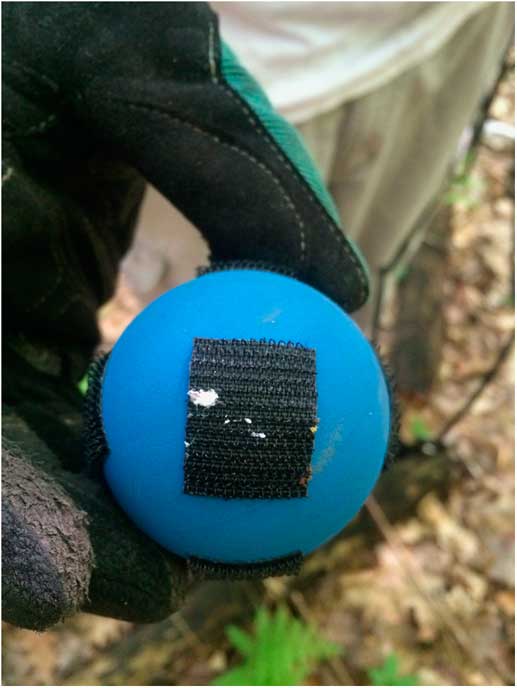
Ball sampling. We modified racquet balls (Penn Ultra-Blue, Pheonix, Arizona, United States of America) by gluing six 5–6 cm2 patches (hook side) of VELCRO® (Velcro USA, Manchester, New Hampshire, United States of America) onto each (total area of 31–38 cm2) (Fig. 1). Patches were spaced uniformly around each ball and all balls were punctured one to two times to reduce bounce when hitting branches and falling on the ground. We launched these modified balls into the live crowns of hemlock trees using a HYPERDOGTM ball launcher (HYPER PETTM, Wichita, Kansas, United States of America).
Modified blue racquet ball used to sample the crown of an infested hemlock tree. Adelges tsugae wool is present on the VELCRO® patch of hooks and smears slightly the blue surface of the ball to the right of the VELCRO® patch.

We considered a ball sample successful when the ball contacted hemlock foliage on the periphery of the crown (distal 40 cm of live branches) of at least three branches as the ball ascended and did not touch the crown of other hemlocks as it descended. We sampled each hemlock 10 times, each time targeting a different section of the crown (e.g., upper and lower and north and south halves of the crown). After each sample, we recorded whether wool was present or absent on the ball. We scored the ball as “positive” if wool was seen on VELCRO® or the ball’s blue surface and as “negative” if none was visible (Fig. 1). Between samples, we cleaned the ball of debris and A. tsugae wool by rubbing the ball with suede gloves.
Of the 34 hemlocks sampled, we detected wool on 27 of them using branch-tip sampling and 28 of them using ball sampling: 25 of those trees were shared. These results suggest ball sampling is useful at detecting the presence of A. tsugae in trees when ovisac densities are low: mean abundance of ovisacs on these trees varied from 0 to 4.54 per 10 cm of twig length. In comparison, ovisac abundance on asymptomatic, infested trees can exceed 30 or more per 10 cm of twig length (Fidgen et al. Reference Fidgen, Legg and Salom2013).
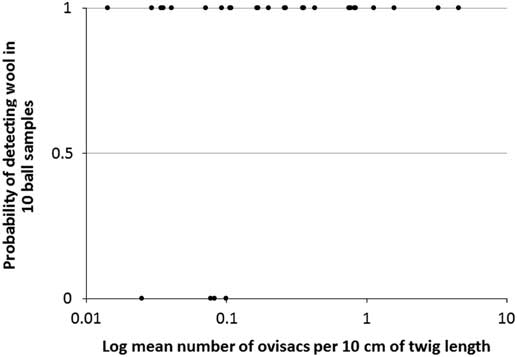
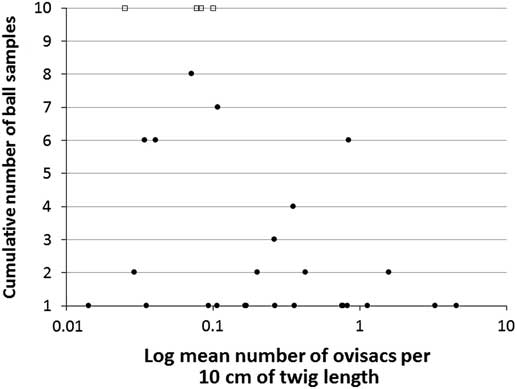
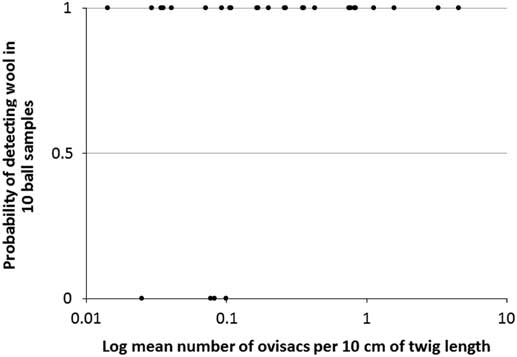
The number of positive ball samples per tree ranged from one to nine out of 10. It took an average of 2.5±0.4 ball samples to detect wool for the observed range of ovisac abundance. Ball sampling detected 100% of the trees with wool when the average number of ovisacs was ⩾0.1 per 10 cm of twig length as determined by branch-tip sampling (Fig. 2). When average abundance of ovisacs was <0.1 per 10 cm of twig length, ball sampling was less reliable: it detected wool on seven of 11 (63.6%) trees. Whether increasing the number of ball samples or targeting a specific part of the crown would increase detectability of A. tsugae remains to be determined. Sampling effort (number of ball samples before first positive) also decreased with increasing abundance of ovisacs on the tree (Fig. 3). For example, we detected infestations on the first or second ball when the abundance of ovisacs determined by branch-tip sampling was >0.8 per 10 cm of twig length. However, the logistics of ball sampling compared to other methods of detecting A. tsugae, particularly when used on very tall trees, requires further investigation.
Relationship between the probability of detecting Adelges tsugae wool after sampling an eastern hemlock with a ball covered with patches of VELCRO® 10 times and log mean number of ovisacs on five branch tips from the lower third of the live crown of that same tree. Branch tips were sampled 5–6 May and 9–10 July 2014 during the sistens and progrediens stages of development, respectively.
Relationship between the cumulative number of ball samples required to detect (●) Adelges tsugae wool in an eastern hemlock and the log mean number of A. tsugae ovisacs on five branch tips from the lower third of that same tree. Open squares (□) were instances where no wool was detected after 10 ball samples. Branch tips were sampled 5–6 May and 9–10 July 2014 during the sistens and progrediens stages of development, respectively.

Detecting A. tsugae early after its arrival and successfully preventing its establishment in eastern Canada requires the ability to identify and treat all infested trees. The ball sampling technique has the potential to increase that ability, but further investigation is needed to evaluate how many samples should be taken and from which part of the crown when populations of A. tsugae average below 0.1 ovisacs per 10 cm of twig. As is, the ball sampling technique can be useful for detection of low level or higher A. tsugae infestations on trees that cannot be surveyed from the ground because foliage is out of reach.
Acknowledgements
The authors are grateful to Chris MacQuarrie and Rob Johns for reviewing earlier versions of this manuscript. They are especially grateful to Janet Craig, Julie Holmes, John Liebherr, and Becky Sibner for assistance with data collection. Special thanks to Cornell University and New York State Department of Environmental Conservation (Texas Hollow State Forest) for permission to use study sites. This project was funded by Natural Resources Canada – Canadian Forest Service.