INTRODUCTION
In the recent work of Ebert & Stehmann (Reference Ebert and Stehmann2013), Carcharhinidae is defined as one of the largest and most important families of sharks, with many common and wide-ranging species. Since requiem sharks are distributed throughout temperate and tropical oceans, with several species occurring worldwide, these are the dominant sharks of both coastal and oceanic basins (Ebert & Stehmann, Reference Ebert and Stehmann2013). In a recent study, Serena (Reference Serena2005) reported the occurrence of 11 species of Carcharhinidae from the Mediterranean Sea.
The first accounts of the occurrence of carcharhinids in Turkey's seas were based on the reports of the Marmaric occurrence of the blue shark Prionace glauca (Linnaeus, 1758) (Ninni, Reference Ninni1923; Deveciyan, Reference Deveciyan1926). Subsequent to these historical records of P. glauca from the Sea of Marmara, Akşıray (Reference Akşıray1987) provided some rudimentary information on the occurrence of Carcharhinus brevipinna (Müller & Henle, 1839), Carcharhinus longimanus (Poey, 1861), Carcharhinus obscurus (Lesueur, 1818), Carcharhinus plumbeus (Nardo, 1827) and P. glauca in Turkey's seas. Although Akşıray (Reference Akşıray1987) states that Carcharhinus longimanus and Carcharhinus obscurus are rarely reported from Turkey's Mediterranean coast, the author did not provide any information on where the examined specimens had been caught or stored. Unfortunately, Akşıray's (Reference Akşıray1987) material is not currently available for inspection. Furthermore, in a more recent study, Mater & Meriç (Reference Mater, Meriç, Kence and Bilgin1996) reported on the occurrence of Carcharhinus brevipinna, Carcharhinus melanopterus (Quoy & Gaimard, 1824), Carcharhinus plumbeus and P. glauca in Turkey's Aegean and Mediterranean waters. Besides the historical records of P. glauca in the Sea of Marmara (Ninni, Reference Ninni1923; Deveciyan, Reference Deveciyan1926), neither Akşıray (Reference Akşıray1987) nor Mater & Meriç (Reference Mater, Meriç, Kence and Bilgin1996) mention the occurrence of Carcharhinus spp. in Marmaric waters. Moreover, neither P. glauca nor Carcharhinus spp. are included in the ichthyological lists of the Sea of Marmara, published between the 1940s and 2010 (e.g. Erazi, Reference Erazi1942; Kabasakal, Reference Kabasakal2003; Keskin & Eryılmaz, Reference Keskin, Eryılmaz and Öztürk2010).
During a survey of a photographical archive, four photographs depicting a shark were found. In the present study, based on these recently discovered photographs, the author reports on the historical occurrence of Carcharhinus spp. in the Sea of Marmara during the 1950s.
REMARKS
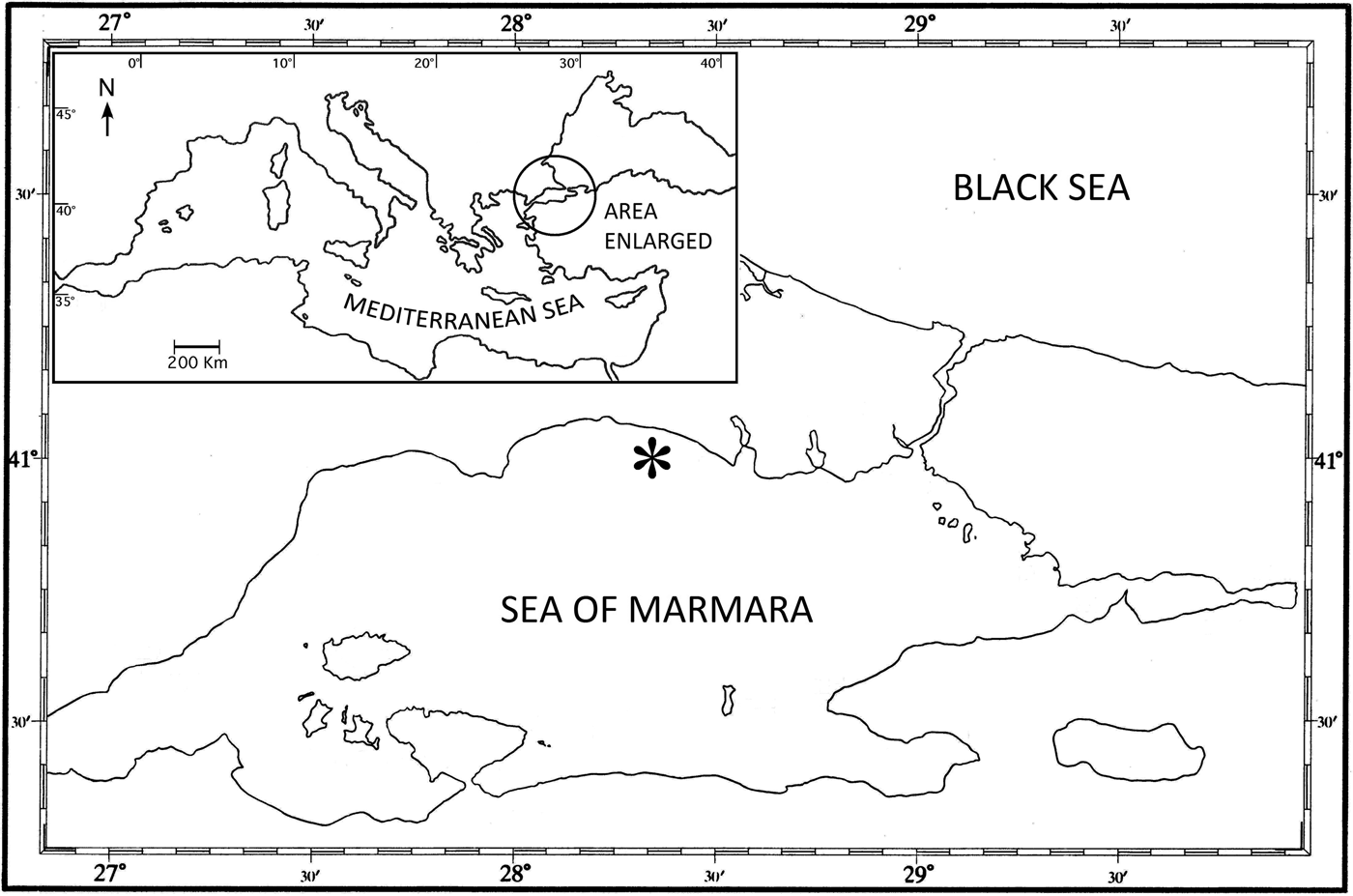
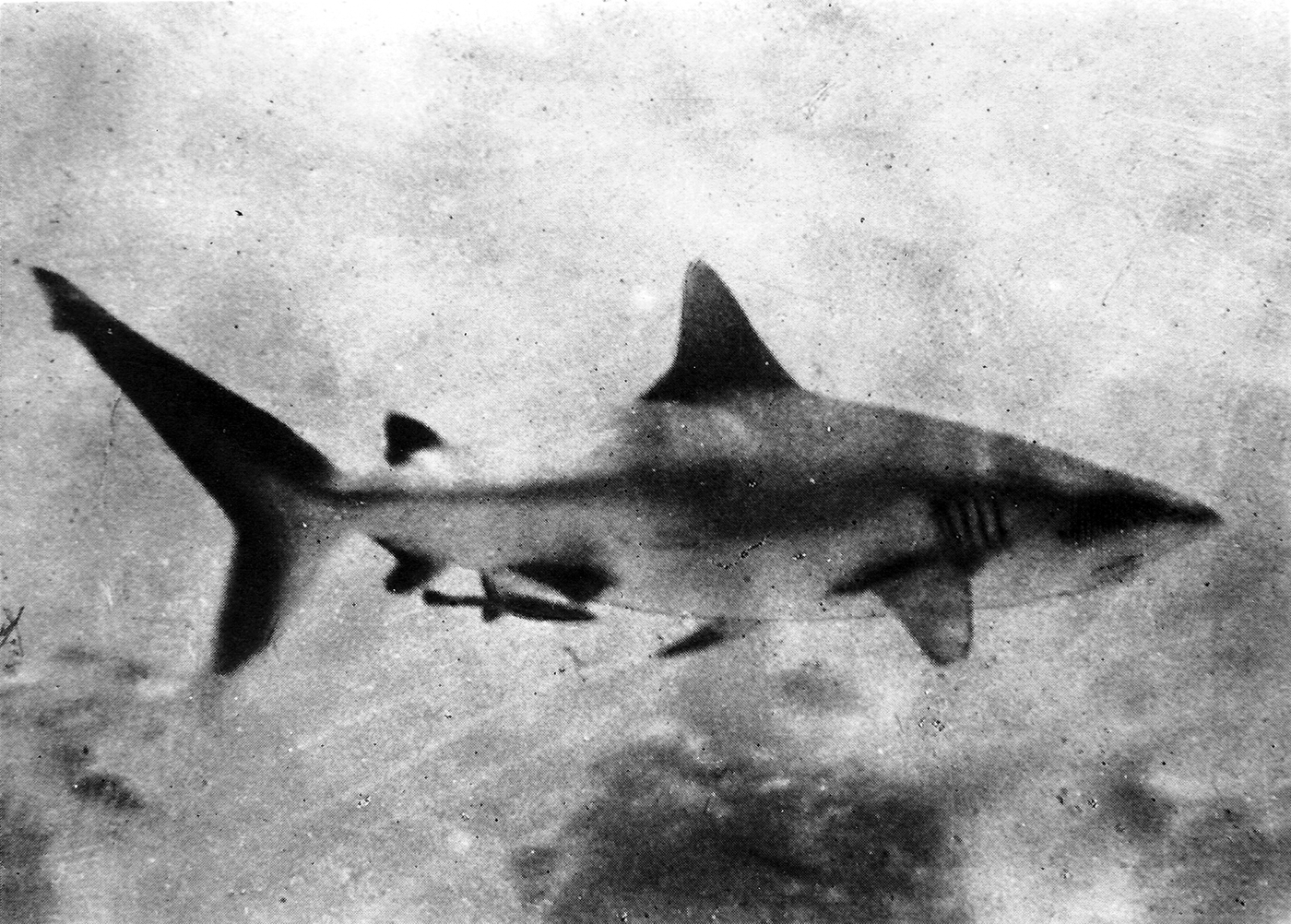
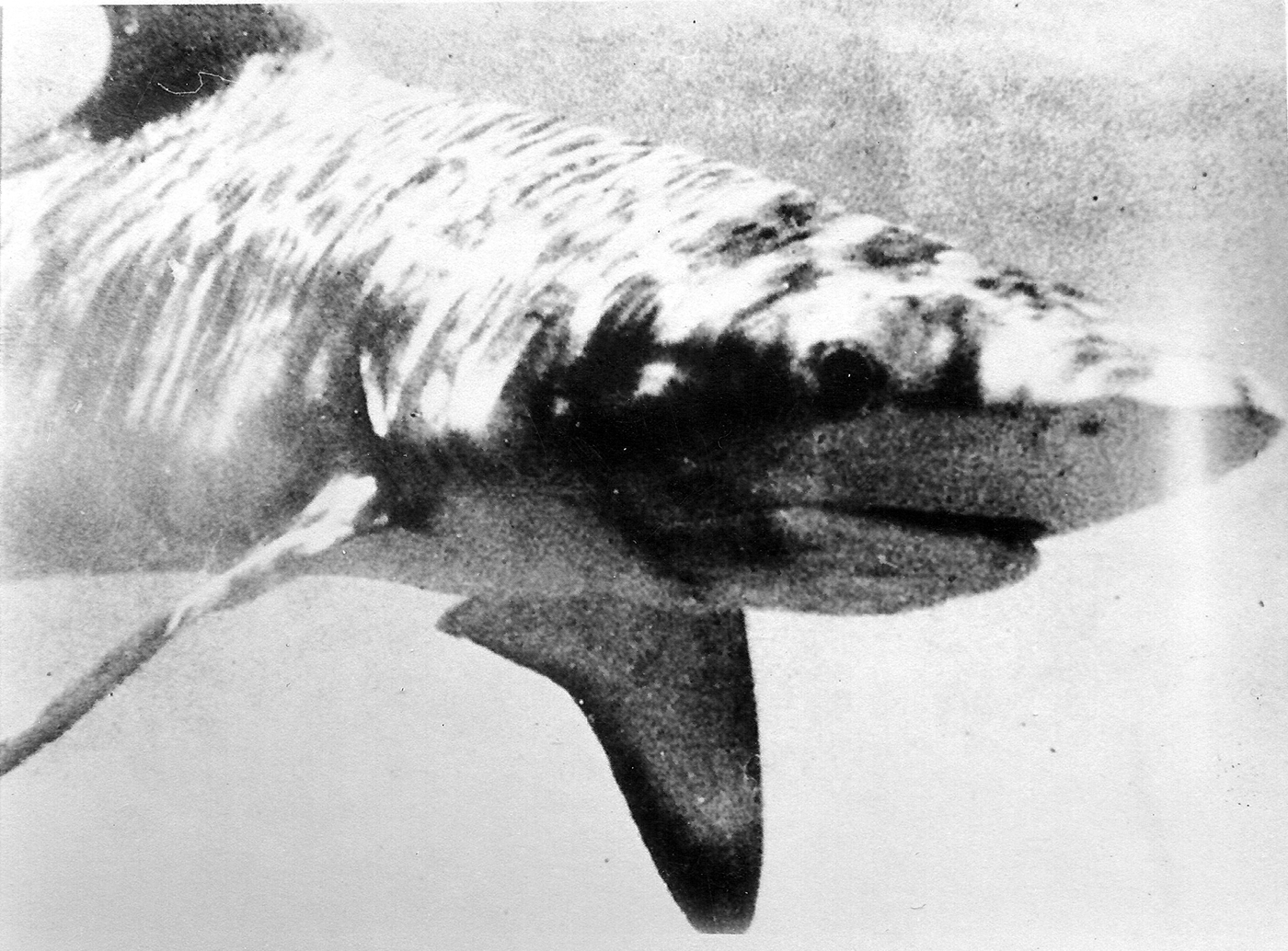
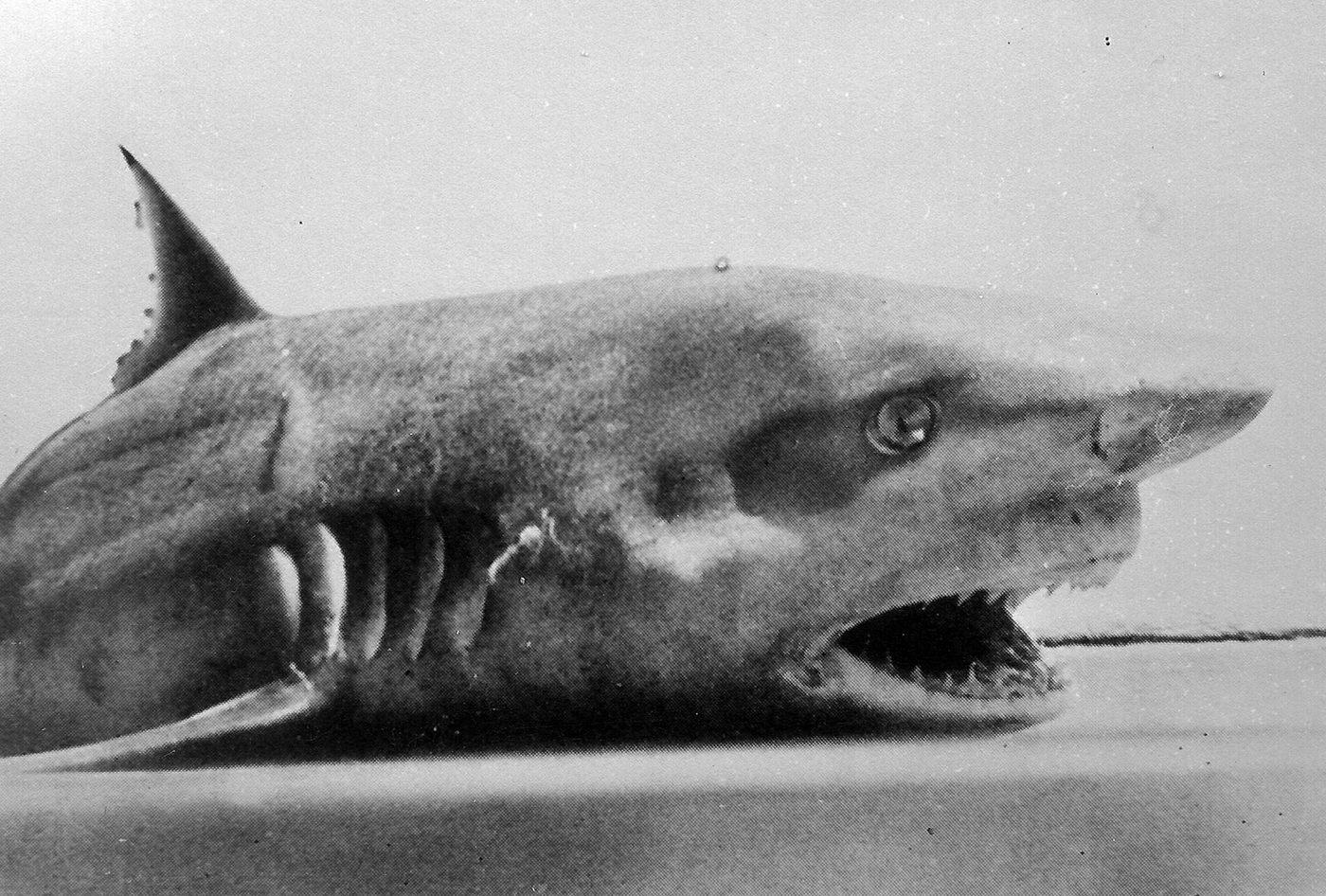
This study is part of an extensive survey of the sharks of Turkey (the KANIT Project), which was initiated in 2000 as an initiative of the Ichthyological Research Society (IRS). The KANIT Project comprises two sub-studies: (1) a survey of contemporary sharks; and (2) a survey of the historical records of sharks in Turkey's seas. In order to analyse the aforementioned historical records, several data sources were examined. These data sources are as follows: (1) private photographical archieves of fishermen and scuba divers; (2) fishing news published in newspapers since the begining of the 1900s; and (3) historical literature on Turkey's fish fauna. The sub-study of the historical records of Turkey's sharks has allowed the author to reveal several remarkable cases of historical shark occurrences from Turkey's seas. The photographs of the shark examined in the present study were shot by Mr Recai Ölçen, an İstanbul-based scuba diver, harpooner and underwater photographer of the early 1950s, and they were taken off the coast of Selimpaşa (northern Sea of Marmara; Figure 1). In these photographs, the lateral view of the entire body (Figure 2), head, pectoral fins (Figure 3), mouth, and upper and lower teeth (Figure 4) of a shark are depicted. The details are examined by means of a 10x magnifier. Identification at family and genera level is based on Branstetter (Reference Branstetter, Whitehead, Bauchot, Hureau, Nielsen and Tortonese1984), Compagno (Reference Compagno1984) and Serena (Reference Serena2005). The taxonomic nomenclature of the Mediterranean carcharhinids follows Serena (Reference Serena2005) and that of Carcharhinus longimanus follows Branstetter (Reference Branstetter, Whitehead, Bauchot, Hureau, Nielsen and Tortonese1984).
Map indicating the approximate locality (*), where the examined photographs of Carcharhinus spp. have been taken in the northern Sea of Marmara.

Side view of the Carcharhinus spp.
Anterior view of the head and pectoral fins of Carcharhinus spp.
Mouth, teeth and gill slits of Carcharhinus spp.
The identification of Carcharhinidae genera can be difficult, due to their similar body shape, colour and overlapping distributions, particularly in Carcharhinus species. Branstetter (Reference Branstetter, Whitehead, Bauchot, Hureau, Nielsen and Tortonese1984) and Compagno (Reference Compagno1984) describe Carcharhinidae based on the following characters: head of normal shape with narrowly pointed to broadly rounded snout; nostrils without barbels, nasal flaps small; mouth parabolic in shape, labial furrows usually confined to corners of mouth; teeth blade-like with a single cusp, with serrate to non-serrate edges, erect to oblique, broadly triangular to narrow and spike-like; eyes are round to slightly oval; internal nictitating membrane present; spiracle present or absent; fifth and usually fourth gill slits are over or behind pectoral fin origin; caudal fin well developed, lower lobe well differentiated, sub-terminal notch present on upper lobe.
Lower lobe of the caudal fin of the specimen depicted in Figure 2 is well developed and a sub-terminal notch is present on the upper caudal lobe. First dorsal fin is large and its origin is anterior to pelvic fin origin (Figure 2). Second dorsal fin is much smaller than the first dorsal fin and its origin is over the anal fin base (Figure 2). Eye of the examined specimen is round (Figure 4). Fourth gill slit is over and fifth gill slit is behind the pectoral fin origin (Figure 4). Teeth on the upper jaws are blade-like, slightly triangular and oblique; teeth on the lower jaws are spike-like and erect (Figure 4). Corners of the arch-shaped mouth extend well behind the eyes (Figure 3). Underside of pectoral fins with dusky tips (Figures 1 & 3); pelvic fins and lower caudal lobe are darker at tips (Figure 1). No spiracle is seen in the examined specimen (Figures 3 & 4). Internal nictitating membrane is slightly visible (Figure 4). Based on the descriptions given by Branstetter (Reference Branstetter, Whitehead, Bauchot, Hureau, Nielsen and Tortonese1984) and Compagno (Reference Compagno1984), observed characteristics suggest that the examined specimen is a carcharhinid shark.
To date, four genus of the family Carcharhinidae – Carcharhinus, Galeocerdo, Prionace and Rhizoprionodon – have been recorded in the Mediterranean Sea (Branstetter, Reference Branstetter, Whitehead, Bauchot, Hureau, Nielsen and Tortonese1984; Serena, Reference Serena2005). Identification of these Mediterranean carcharhinid genera is based on the position of the first dorsal fin relative to the pectoral fin axil and pelvic fin origin, as well as the presence or absense of spiracles and the size of the first and second dorsal fins (Branstetter, Reference Branstetter, Whitehead, Bauchot, Hureau, Nielsen and Tortonese1984).
No spiracle is seen in the examined specimen (Figures 3 & 4); spiracle is present in Galeocerdo. In the examined specimen, the first dorsal fin midpoint is closer to the pectoral fin axil than to the origin of the pelvic fins (Figure 2); in Prionace, it is closer to the origin of the pelvic fins. The first dorsal fin of the examined specimen is much larger than the second dorsal fin (Figure 2); in Negaprion, the second dorsal fin is nearly as large as the first. Finally, the origin of the second dorsal fin of the examined specimen is over the anal fin origin (Figures 2); in Rhizoprionodon, the second dorsal fin origin is over or behind the midpoint of the anal fin origin; however, the eyes of Rhizoprionodon are horizontally oval and pectoral fins with pale hind edge (Branstetter, Reference Branstetter, Whitehead, Bauchot, Hureau, Nielsen and Tortonese1984). Following the identification key given by Branstetter (Reference Branstetter, Whitehead, Bauchot, Hureau, Nielsen and Tortonese1984), the observed characteristics suggest that the specimen depicted in Figures 2, 3 & 4 is a member of the genus Carcharhinus. The presence or absence of the interdorsal ridge is a key character in the diagnosis of the species of Carcharhinus (Branstetter, Reference Branstetter, Whitehead, Bauchot, Hureau, Nielsen and Tortonese1984; Compagno, Reference Compagno1984; Serena, Reference Serena2005). Since the interdorsal area of the examined specimen is not visible on the photographs, the author could not make a decision about its species.
CONCLUSIONS
Our current knowledge on the carcharhinid sharks occurring in Turkey's seas consists of rudimentary data. Based on the available data on the elasmobranchs of Turkey's seas (Akşıray, Reference Akşıray1987; Ulutürk, Reference Ulutürk1987; Mater & Meriç, Reference Mater, Meriç, Kence and Bilgin1996; Başusta et al., Reference Başusta, Erdem and Çevik1998), Kabasakal (Reference Kabasakal2002) reported on the presence of eight species of the family Carcharhinidae – Carcharhinus altimus (Springer, 1950), Carcharhinus brevipinna, Carcharhinus limbatus, Carcharhinus longimanus, Carcharhinus melanopterus, Carcharhinus obscurus, Carcharhinus plumbeus and Prionace glauca – which were considered either with confirmed or questionable occurrence. Except for Carcharhinus longimanus, which is considered a carcharhinid shark of questionable occurrence in the Mediterranean Sea (Branstetter, Reference Branstetter, Whitehead, Bauchot, Hureau, Nielsen and Tortonese1984) and is not included in the shark fauna of the Mediterranean (Serena, Reference Serena2005), the remaining seven species of carcharhinids have been recorded in different localities of the Mediterranean Sea (e.g. Branstetter, Reference Branstetter, Whitehead, Bauchot, Hureau, Nielsen and Tortonese1984; Hemida et al., Reference Hemida, Seridji, Labidi, Bensaci and Capapé2002; Lipej et al., Reference Lipej, De Maddalena and Soldo2004; Serena, Reference Serena2005; Golani et al., Reference Golani, Öztürk and Başusta2006). Although Lipej et al. (Reference Lipej, De Maddalena and Soldo2004) reported on the incidental capture of an oceanic whitetip shark, Carcharhinus longimanus, circa 250 cm total length, in the Adriatic Sea in 1978, the author decided to consider this shark as a questionable species in the studied area because of the lack of definitive evidence of its presence in the Adriatic Sea. Uncertainty of its occurrence status in the Mediterranean Sea, as well as its absence in the recent Levantine ichthyofaunal records (Golani et al., Reference Golani, Öztürk and Başusta2006), is supporting evidence for the question: did Akşıray (Reference Akşıray1987) made a misdescription or not? Since the examined material of Dr Akşıray is not available for inspection, it was not possible to find an answer to this question based on retrospective material or data.
Historical evidence shows that P. glauca has been known to occur in the Sea of Marmara, at least in the first quarter of the 20th century (Ninni, Reference Ninni1923; Deveciyan, Reference Deveciyan1926). Recently discovered photographic evidence also suggests that Carcharhinus spp. have also occurred in Marmaric waters during the 1950s. This evidence also extends the historical distributional range of Carcharhinus spp. into the Sea of Marmara, a northern extension of the Mediterranean basin. The results of previous and recent ichthyological inventories of the Sea of Marmara (Mater & Meriç, Reference Mater, Meriç, Kence and Bilgin1996; Kabasakal, Reference Kabasakal2003; Keskin & Eryılmaz, Reference Keskin, Eryılmaz and Öztürk2010) suggest that, currently, neither Carcharhinus spp. nor P. glauca inhabit Marmaric waters. However, recent records of Alopias superciliosus (Lowe, 1839) in the Sea of Marmara (Kabasakal & Karhan, Reference Kabasakal and Karhan2008) and the reoccurrence of Echinorhinus brucus (Bonnaterre, 1788) in the area (Kabasakal & Dalyan, Reference Kabasakal and Dalyan2011) also suggest that this small land-locked sea in the far end of the Mediterranean basin may be full of surprises and worthy of further studies. Further analyses could provide an answer to the following question: do Carcharhinus spp. and P. glauca still exist in the Sea of Marmara?
ACKNOWLEDGEMENTS
The author is indepted to the following persons for their kind help during the present study: Mr Okan Yeşmil, an İstanbul-based scuba diver and historical diving-equipment collector, for providing the photographs of the examined specimen, depicted in Figures 2, 3 & 4; Mr Mark Taylor, an İstanbul-based scuba diver and underwater photographer, for the English revision of the text. Special thanks to the author's wife (Özgür) and son (Derin) for their endless love and patience.