Changing roles are a feature of museum libraries today. Two years ago, the Art Libraries Society of North America (ARLIS/NA) published A white paper on the state of art museum libraries Footnote 1 in response to ‘reports of a large number of lay-offs and detrimental restructuring in the art museum library community’. Although the report only covered art museum libraries in the United States, many of the challenges can be replicated in other countries. The traditional role of supporting curatorial research is still key, but the importance of research to curators and to the museum, and the status of curators within the museum, have not stood still in recent years. Evolving from a passive to a more active role is one way in which museum libraries can navigate these shifting tides. This paper will describe ways in which the National Gallery Library is adapting itself to join the research conversations within the institution, as well as in the wider arenas of art history and library history.
Cataloguing – exposing the records online
The Eastlake Library at the National Gallery, the founding collection of around 2000 books which belonged to its first Director, Sir Charles Eastlake (1793–1865), and one of the few intact scholarly art libraries assembled during the first half of the 19th century, has been briefly described in a previous article in Art libraries journal. Footnote 2 This article also describes how our rare books cataloguing project, focused on the Eastlake Library, was the driver behind a wider retrospective conversion and online access project, then entering the second phase of a three-year timetable. The third phase of this project is now underway, and at this point the Eastlake Library is fully catalogued online.
Digitisation – selecting what to digitise
As an adjunct to the rare books cataloguing project, we have now also digitised 17 early National Gallery collection catalogues dating from 1824 to 1850. As part of a Gallery-wide Collections Information Project designed to move the Gallery's information holdings about the art collection from print to online, the Library employed a six-month cataloguer to provide online catalogue records for all the Gallery's publications from 1824 up to the present day. The cataloguer was also asked to check the internet for digital versions of early collections catalogues from the mid-19th century, and in fact we found that none of the early catalogues were available in digital form. A typical question we deal with from researchers is: how was a particular painting catalogued over a period of time? For example, during the first 20 years of its life in the Gallery collection, did the attribution change as a result of advances in connoisseurship or scientific enquiry? Did the title change as a result of re-interpretation of its subject? To answer such questions, a researcher might ask to see all the printed catalogues from 1850 to 1870. Once they have the dozen or so catalogues lined up on a trolley, it often takes them no more than 10 minutes to flip through the pages – a lot of retrieval and re-shelving on our part, not to mention wear and tear on the originals, for the sake of a cursory inspection. All this is simplified by offering access to digital versions, which are linked to the records in the online Library catalogue. The scans are text-searchable, using standard pdf commands.
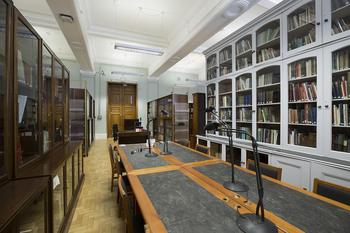
The Research Centre, the National Gallery, London. Photograph by the National Gallery, London.

Collaboration – the Digital Cicognara project
Digitisation of rare titles from the Eastlake Library is also one projected outcome of our participation in the Digital Cicognara project. This initiative exists in a previous incarnation as a vast collection of microfiches, produced by the Vatican Library in association with the University of Illinois Library in the 1990s.Footnote 3 Leopoldo Cicognara (1767–1834) was an art historian who assembled a collection of some five thousand early imprints in the field of art and archaeology. His library, now considered the foundational literature of art and archaeology, was eventually sold to the Vatican where it remains. It may well have been an inspiration to Charles Eastlake in building his own library; he certainly had a copy of Cicognara's two-volume inventory, the Catalogo ragionato dei libri d'arte e d'antichità, published in 1821Footnote 4 and often reprinted since.
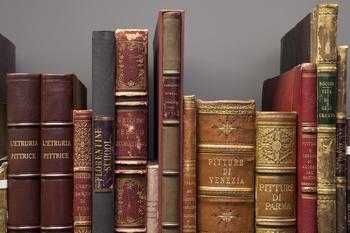
A selection of books from the Eastlake Library at the National Gallery. Photograph by the National Gallery, London.

The Digital Cicognara LibraryFootnote 5 is an international initiative aiming to recreate the Cicognara Library in digital form. The site currently features the 1821 Catalogo combined with modern bibliographic descriptions plus a limited number of images. When complete, the application will consist of the full text of the Catalogo integrated with digital images and full text of every title in the corpus, including black-and-white facsimiles of the original volumes in the Vatican Library, plus one or more high-resolution, colour scans of unique copies owned and digitised by partner libraries, and detailed bibliographic information. The copy-specific characteristics of the newly digitised volumes will provide new information about the early modern literature of art and its readership, Cicognara's own reception and his impact on historical scholarship, and the development of research libraries.
Publication – getting our own research out there
The work of cataloguing the rare books in the Eastlake Library has fed into a long article written for the National Gallery's scholarly Technical bulletin. Footnote 6 Charles Eastlake's most influential publication was entitled Materials for a history of oil painting published in 1847,Footnote 7 referred to below as Materials for short. This book was the result of a series of historical events. In1834 the old Palace of Westminster was destroyed by fire, and designs for the replacement Houses of Parliament by Charles Barry were eventually selected. In 1841, Eastlake was appointed Secretary of the Royal Fine Arts Commission, with the task of finding artists to decorate the interior of the new building. There was considerable interest in the idea of using fresco techniques, and, at the same time, concern that the decorations should be made to last. In 1842, the National Gallery acquired Jan van Eyck's Arnolfini Wedding Portrait (NG186), a painting whose remarkable state of preservation inspired all kinds of theories about lost ‘secret’ painting techniques of the Van Eyck brothers. Five years later, in 1847, and very much as a culmination of this process, Eastlake published the first volume of Materials.
Eastlake was a practising painter himself, very knowledgeable about technique, and in Materials he explicitly set out to de-mystify any ‘absurd hypotheses’. As John Ruskin put it in the Quarterly review for 1848, ‘he has done away with all legends of forgotten secrets’.Footnote 8 The printed sources which contributed to the writing of Materials include standard biographical works such as Vasari's Lives, both the first edition of 1550 and the second edition of 1568.Footnote 9 Eastlake was a scrupulous and methodical reader, collecting and comparing multiple editions. His documentary sources include not only published works but also manuscripts. By the time he was writing, in the 1840s, a fair number of the manuscripts critical for the history of painting had already been edited and published as a result of antiquarian interest. Perhaps the best known is Cennino Cennini's Il Libro dell'Arte, probably written in the late 1390s. The Library includes the English translation by Mary Merrifield.Footnote 10 Mary Merrifield (1804–1889) was a particularly important collaborator in Eastlake's research, travelling to France and Northern Italy in order to transcribe and copy manuscripts in libraries and archives. Two years after Materials, her own landmark publication Original treatises appeared, in 1849.Footnote 11 Perhaps the most notable manuscript discussed in Materials is known as the Strasbourg manuscript, dating from the 15th century.Footnote 12 In the 1840s Eastlake acquired a manuscript copy from a friend. A few decades later, in 1870, fire destroyed the Strasbourg Public Library, taking with it the original manuscript, resulting in Eastlake's handwritten copy becoming the sole carrier of the text.
Materials was a highly successful publication, in spite of the fact that Eastlake died before he could complete the projected second volume. Amazingly, it was still in print, in an Italian translation, at the end of the 20th century. The Technical bulletin article explores the role played by Charles Eastlake's Library in the research and writing of Materials, and it has been another way to raise the profile of the library both within the institution and outside. As for the decoration of the Houses of Parliament, in the event, fresco turned out to be more suited to sunny Tuscany than the muddy banks of the Thames. Along the way, however, Eastlake's research allowed him to draw attention to the technical affinities between ‘the English painters in the 14th century’ and ‘the followers of Giotto’, which was presumably an encouraging thought.
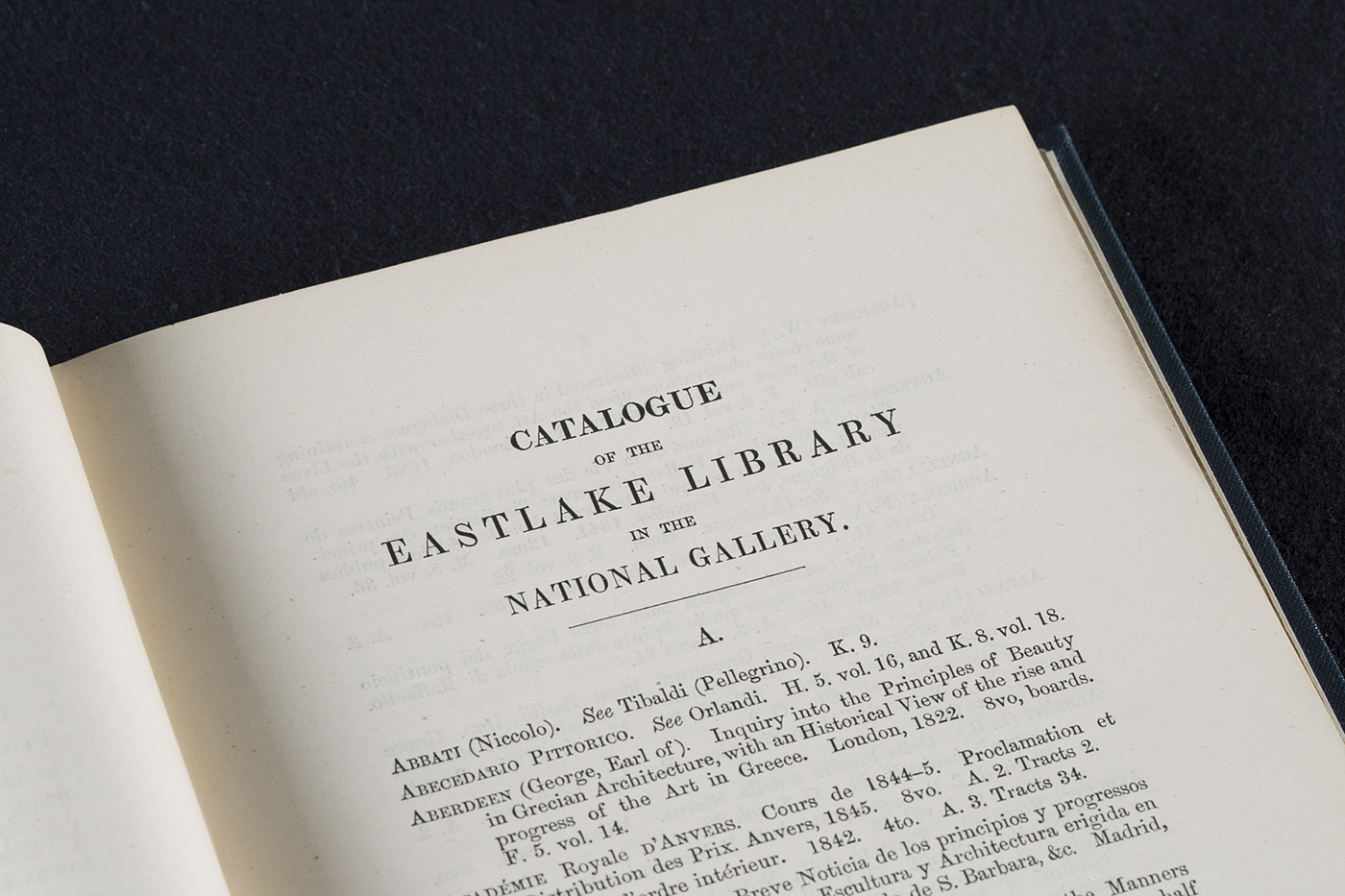
George Green, Catalogue of the Eastlake Library in the National Gallery (London: Her Majesty's Stationery Office, 1872). Photograph by the National Gallery, London.

Creating opportunities – a Collaborative Doctoral Partnership
Finally, we seek to encourage others to carry out research on our collections. To this end we have entered into a partnership with the Department of Information Management at Robert Gordon University in Aberdeen, where Professor Peter Reid has expertise in the field of library history. The National Gallery is recognized by the Arts and Humanities Research Council as an Independent Research Organisation (IRO). Together with Robert Gordon, we will be co-supervising a doctoral student working towards her PhD as she carries out research on the subject of ‘Art history scholarship between the 1820s and the 1870s: the role of the Eastlake Library at the National Gallery’. She will explore the part played by the Library in supporting Eastlake as a scholar and a museum director, as well as the international context for emerging specialist art libraries in the 19th century. This is an area ripe for further study: evidence for the historical evolution of the specialist art library does exist in the form of surviving libraries such as those of Cicognara and Eastlake or in the form of published and unpublished catalogues; but the documentation is scattered, and no attempt has yet been made to synthesize it or to draw conclusions about how these libraries supported, advanced and shaped the intellectual environment of their personal or institutional owners and readers.
In terms of the academic impact of this Collaborative Doctoral project, therefore, the objective is to go beyond a straightforward history of the Eastlake Library, in two ways. On the one hand, the project will provide pointers towards the detailed study of other art libraries and their roles. On the other, it will be guided by the concept of ‘new library history’ originated by Professor Alastair Black. New library history takes the view that studying the history of libraries should transcend a focus on one or more institutions in order to explore the history of wider society and its cultural and intellectual manifestations. Eastlake's public and scholarly life mean that an examination of his books promises to deliver exactly this kind of understanding of broader issues. Art libraries are an integral part of the history of art history. Our hope is that other art librarians will be inspired to explore the history of their libraries, and this in turn will assist them in convincing their institutions of the historical and ongoing value of the library to their programmes and projects.