INTRODUCTION
Movement of threatened and endangered species for the purpose of recolonization of native habitats can have unintended consequences. In particular, communities of parasitic organisms may also be transported unintentionally along with their hosts (Cunningham, Reference Cunningham1996; Van Oosterhout et al. Reference Van Oosterhout, Smith, Hänfling, Ramnarine, Mohammed and Cable2007). Threatened populations of the endangered white-clawed crayfish Austropotamobius pallipes are currently being translocated within Europe to establish new protected populations of the species (Schulz et al. Reference Schulz, Stucki and Souty-Grosset2002). We recently detected branchiobdellid parasites in a population of A. pallipes in the UK. To evaluate the infestation and potential impact of branchiobdellidan worms on A. pallipes, we assessed prevalence, intensity and associated pathology within a UK population.
Branchiobdellidans are clitellate annelids that live ectosymbiotically, either on the outer carapace or in the branchial chamber, of freshwater crustaceans; almost always astacoid crayfishes (Gelder and Brinkhurst, Reference Gelder and Brinkhurst1990). They are widespread with 149 species within 21 genera from 3 continents (Gelder, 1996). Despite numerous studies of branchiobdellidan occurrence in continental Europe (Gelder et al. Reference Gelder, Delmastro and Ferraguti1994; Mori et al. Reference Mori, Pretoni, Salvidio and Balduzzi2001; Klobucar et al. Reference Klobucar, Maguire, Gottstein and Gelder2006; Fureder et al. Reference Fureder, Summerer and Brandstatter2009), there exist only 2 previous reports for the UK and no study of prevalence or impact on the host (Leeke and Price, Reference Leeke and Price1965; Rogers et al. Reference Rogers, Hoffmann, Oidtmann and Holdich2003).
All endemic European branchiobdellidans are of the genus Branchiobdella (Vogt, Reference Vogt, Gherardi and Holdich1999). Sympatry is widely reported, with up to 6 species on an individual host, and variable host specificity (Holt, Reference Holt1976). For example, B. balanica has only been found associated with noble crayfish Astacus astacus whereas B. pentodonta has been found on A. astacus, Austropotamobius torrentium and A. pallipes (Fureder et al. Reference Fureder, Summerer and Brandstatter2009, Klobucar et al. Reference Klobucar, Maguire, Gottstein and Gelder2006). A study from Croatia found very high diversity (B. italica, B. parasita, B. astaci, B. hexodonta, B. pentodonta and B. balanica), and frequency with worms present in 58·75% of Austropotamobius pallipes, Austropotamobius torrentium and Astacus astacus populations studied (Klobucar et al. Reference Klobucar, Maguire, Gottstein and Gelder2006).
In the UK only 1 native crayfish species, the white-clawed crayfish, Austropotamobius pallipes Lereboullet, is present. In 1964 populations of A. pallipes in the river Kennet and Holy Brook were found to be infested with Branchiobdella astaci Odier (Leeke and Price, Reference Leeke and Price1965). The next report was 33 years later when a single worm was discovered on a white-clawed crayfish in the River Ouse, Yorkshire (Rogers et al. Reference Rogers, Hoffmann, Oidtmann and Holdich2003). To our knowledge there are no other reports of branchiobdellidans in the UK.
Branchiobdellidans attach themselves to the host using duo-gland attachment organs on the anterior and posterior segments (Brinkhurst, Reference Brinkhurst1999). Impacts of infestation on the host are little studied and appear to vary between branchiobdellid species. They are generally considered commensals grazing on epibionts on the crayfish exoskeleton (Jennings and Gelder, Reference Jennings and Gelder1979); however, there is evidence of mutualism and parasitism in some species. Brown et al. (Reference Brown, Creed and Dobson2002) found that the presence of branchiobdellidans, Cambarincola spp., increased growth and survival in crayfish host Cambarus chasmodactylus, purporting a possible cleaning symbiosis. Conversely, tracer experiments with the gill-infesting species Branchiobdella hexodonta showed that the worm ingests host tissue (Grabda and Wierzbicka, Reference Grabda and Wierzbicka1969), and there is documented gill damage in the case of heavy infestations of both B. hexodonta and B. astaci, suggestive of a parasitic effect (Vogt, Reference Vogt, Gherardi and Holdich1999).
Populations of A. pallipes have severely declined across its range since the 1980s, and it is now IUCN red-listed ‘endangered’ and a UK BAP species. Further to pollution and habitat loss, its greatest threat is the spread of fatal ‘crayfish plague’ caused by Aphanomyces astaci (Holdich and Reeve, Reference Holdich and Reeve1991). The invasive signal crayfish Pacifastacus leniusculus is a carrier of this fungal oomycete and, since its introduction to Europe in the 1960s, has spread rapidly. Besides plague, A. pallipes potentially suffers chronic losses and fitness impacts due to a number of parasites and diseases including Psorospermium haeckeli, fungal and bacterial ‘burn spot disease’, and the microsporidian parasite Thelohania contejeani the causative agent of porcelain disease (Longshaw, Reference Longshaw2011).
In 2009 the author (P.J.R.) noticed a live juvenile branchiobdellidan on the cephalothorax of an A. pallipes host from the Aire catchment, Yorkshire, an area where white-clawed crayfish remain abundant. We evaluated branchiodellidan prevalence and intensity in this population in relation to sex and size of crayfish hosts. We also looked for evidence of pathology in the gills of the host. Worms were identified on the basis of morphological characteristics as no molecular sequence data were available for the species found. We generated the first molecular data for the species and reconstructed a phylogeny based on mitochondrial CO-I sequences to determine its position within the genus Branchiobdella.
MATERIALS AND METHODS
A total of 107 specimens of A. pallipes were examined from collections made in 2009 and 2010 from Wyke Beck (NGR SE34133636, 53°49′20.93″N, 1°28′58.73″W), a 1st order stream within the Aire catchment, Yorkshire. This tributary contains only native crayfish, although the population is imminently threatened by signal crayfish which are present in 2 locations in the main river (West Yorkshire Ecological Records). The animals were primarily harvested for other research which necessitated sacrifice and subsequent dissection; however, this concurrently enabled detailed examination of individuals for the presence of branchiobdellidans. Crayfish were captured from a 160 m stretch of river in September 2009 and October 2010 using hand-search during daylight hours with 2 people wading upstream and searching under all sizeable cobbles. Modified kick sampling and a drift net were employed to collect juveniles within root bundles. In 2011 a second population of A. pallipes within Adel beck, a watercourse 12 km to the west (SE280400, 53°51′20.80″N, 1°34′29.91″W) was examined for branchiobdellidans using non-lethal methods. Seven specimens of A. pallipes were collected and immediately submerged in 1:1 solution of stream and carbonated water for 2 min (Gelder et al. Reference Gelder, Delmastro and Ferraguti1994). Immobilized branchiobdellidans on the carapace, along with those that had fallen into the sample pot, were then collected and the crayfish returned to the stream after a short recovery period.
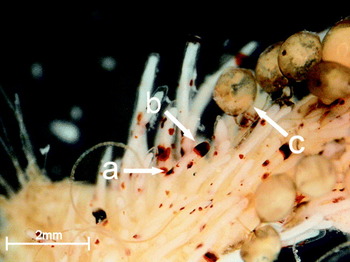
Crayfish carapace length (CL) was measured in all individuals from the tip of the rostrum to the distal edge of the carapace, and sex and visible signs of injury or disease, including porcelain disease (thelohaniasis) caused by Thelohania contejeani recorded (Longshaw, Reference Longshaw2011). Crayfish were either killed and immediately dissected, or individually bagged and frozen for dissection at a later date. The carapace was inspected externally for branchiobdellidans before full examination of the branchial cavity. Branchiobdellidans found in crayfish that had not been frozen were usually alive and still attached to the host, thus enabling determination of their exact location on the host. Where no adult worms were found, the presence of cocoons (eggs and encapsulated larvae) (Fig. 1) demonstrated that adult worms had been present (Gelder et al. Reference Gelder, McCurry and McAlpine2009). The number of worms and cocoons per host was counted and the percentage of melanized gill tissue within each podobranch visually estimated on a 5-point scale: 0=no visible sign of melanization; 1=<1%; 2=1–5%, 3=6–25%, 4=26–50%; 5=>50%. Branchiobdellidans were preserved in 95% ethanol and later mounted for identification using the taxonomic key by Gelder et al. (Reference Gelder, Delmastro and Ferraguti1994).
Portion of podobranch from crayfish Austropotamobius pallipes showing gill filaments with melanization spots (a), melanized tips (b), and attachment of Branchiobdella astaci cocoons (c).

Genomic DNA was extracted from 9 adult branchiobdellid specimens, 7 from Wyke Beck and 2 from Adel Beck, using the chelex 100 resin (50–100 mesh) (Sigma) and proteinase K method (Yue and Orban, Reference Yue and Orban2005). Mitochondrial cytochrome c oxidase I (CO-I) sequences (560 bp) were amplified from purified genomic DNA using the universal primers LCO1490: 5′-GGTCAACAAATCATAAAGATATTGG and HCO2198: 5′-TAAACTTCAGGGTGACCAAAAAATCA-3′) (Folmer et al. Reference Folmer, Black, Hoeh, Lutz and Vrijenhoek1994) and a protocol modified from that of Gelder and Sidall (Reference Gelder and Siddall2001). Amplification reaction mixtures 31·5 μl, comprised 10 μl of 5X buffer, 2·5 mM MgCl2, 0·28 mM of each DNTP, 7 μl of each primer (10 μM), 2·5 units GoTaq DNA Polymerase (Promega) and 3 μl of template DNA (50 ng μl−1) in a 50 μl total volume. The reaction mixtures were heated to 95°C for 2 min and then cycled for 35 cycles at 94 °C for 20 s, 50°C for 30 s and 68°C for 60 s, with a final extension 72°C for 60 s. PCR products were purified using QIAquick PCR Purification kit protocol (Qiagen). Automated sequencing of PCR products was carried out by GATC Biotech (Konstanz, Germany).
Phylogenetic analysis
Mitochondrial CO-I sequences from study specimens were analysed alongside all Branchiobdella sequences available via Genbank and 2 sequences for the outgroup Hirudo medicinalis. Sequences were aligned using ClustalX 2.1 (http://www.clustal.org.html) before construction of a neighbour-joining tree using the K2P model of nucleotide substitution within PHYLIP (http://evolution.genetics.washington.edu/phylip.html); and boot strapped (1000 replicates) to test robustness.
Data analysis
Branchiobdellidan presence versus host size was analysed with logistic regression. General linear models were used to test for a relationship between cocoon number and host size, and gill melanization. The former were log10 transformed to obtain normality prior to analysis. All analyses were performed using SPSS Version18 (SPSS Inc.).
RESULTS
In total, 34 specimens (32%) of A. pallipes in the Wyke Beck population were found either supporting adult branchiobdellidan worms or cocoons. With the exception of 3 worms found on the exterior surface of the carapace, all were found within the branchial chamber of the host; many directly attached to host gill filaments. Multiple cocoons tended to be clustered in groups and generally located towards the anterior or ventral edges of the branchial chamber. Of the 7 crayfish examined from Adel Beck, worms were present on 2 individuals.
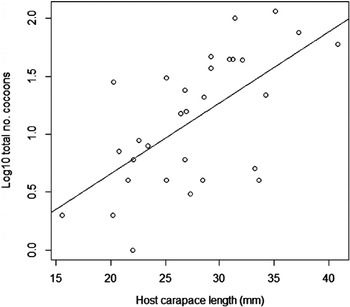
Prevalence did not vary with sex of crayfish, although it was positively related to crayfish size (W=0·42, b=0·427, P<0·01). The number of viable cocoons per host ranged from 1 to a maximum of 116 distributed across both branchial chambers, with a mean count of 26·4±29·7 (s.d.). A strong positive relationship was found between host size (CL) and total number of viable cocoons present (Log10 transformed) (r 2=0·40, P<0·001, n=34) (Fig. 2). The total number of adult worms found on a single host ranged from 1 to 6, and the presence of worms was not always associated with cocoons. No relationship was found between number of adult worms and size of host (r 2=0·09, P<0·97, n=26). Similarly, the mean number of adult worms (t=1·018, P=0·326, d.f.=19) and cocoons (t=1·141, P=0·265, d.f.=24) did not differ significantly with host sex.
Relationship between size (carapace length, mm) of crayfish host Austropotamobius pallipes and the total number of viable cocoons of Branchiobdella astaci found in the branchial chamber (b=0·0614, r 2=0·40, P<0·001, n=34).

Melanization of the gill filaments, ranging from small patches on the stem of the filament to melanization of the entire filament tip (Fig. 1), was observed in 92% of infested individuals, significantly higher than in uninfested (67%) (X 2=31·56, P<0·001, n=107). Mean melanization score per host was also significantly higher for infested individuals (1·90±0·99 s.d.) relative to uninfested individuals (0·65±0·65 s.d.) (t=7·765, P<0·001, d.f.=105); and was positively associated with number of cocoons per host (r 2=0·40, P<0·001, n=107). Visible signs of infection with Thelohania contejeani (porcelain disease) were present in 29% of all crayfish specimens examined; however, no relationship was found between the occurrence of porcelain disease and infestation by B. astaci (X 2=0·046, P=0·153, n=96).
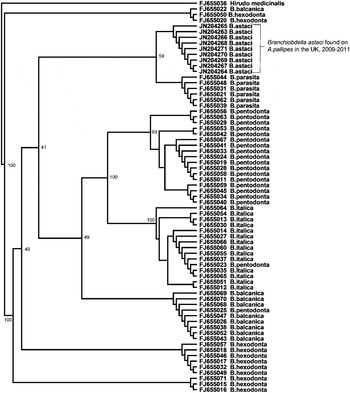
The species Branchiobdella astaci can be distinguished from others by a triangular jaw shape, in particular the large size of the dorsal jaw relative to the ventral jaw (Gelder et al. Reference Gelder, Delmastro and Ferraguti1994). The 21 mature branchiobdellidans identified using morphological characteristics all keyed out as B. astaci. Identification was later verified by a taxonomic expert (S. Gelder, personal communication). Genbank Accession numbers for the partial CO-I sequences from 9 B. astaci specimens are as follows: JN204263, JN204264, JN204265, JN204266, JN204267, JN204268, JN204269, JN204270 and JN204271. Phylogenetic analysis placed B. astaci as a sister group to B. parasita, but with only moderate bootstrap support (59) (Fig. 3). A few sequences from species B. hexodonta, B. pentodonta and B. balanica do not lie with their conspecifics; however, re-analysis of the phylogeny with these sequences omitted did not change the outcome position for B. astaci or improve bootstrap values.
Phylogeny of 6 European Branchiobdella species, including B. astaci, based on mitochondrial cytochrome c oxidase I (CO-I) sequences with outgroup H. medicinalis. Numbers at branch points indicate neighbour-joining bootstraps (1000 replicates, K2P model).

The jaw and tooth arrangement observed in B. astaci specimens would indeed appear to support its proximity to B. parasita as both species share the same triangular jaw shape with one dominant central tooth. They can be differentiated by jaw size as in B. astaci the dorsal jaw is larger than the ventral jaw, whereas in B. parasita the jaws are similarly sized (Gelder et al. Reference Gelder, Delmastro and Ferraguti1994). Mean sequence similarity index between B. astaci and B. parasita was 84±0·4% (s.d.). The 9 B. astaci haplotypes were tightly linked and did not reflect differentiation between the two geographical locations.
DISCUSSION
The prevalence and intensity of Branchiobdella astaci increased with crayfish size reaching up to 116 cocoons per host. As was observed for Branchiobdella italica on A. pallipes in Italy, there was no association with host sex (Mori et al. Reference Mori, Pretoni, Salvidio and Balduzzi2001). Previous studies of branchiobdellidan prevalence in crayfish populations commonly use the non-lethal submersion method (e.g. Oberkofler et al. Reference Oberkofler, Quaglio, Fureder, Fioravanti, Giannetto, Morolli and Minelli2002) which is likely to strongly underestimate prevalence of gill-dwelling worms. The presence of cocoons in the branchial chamber cannot be detected by this method and although worms residing in the branchial chamber were anaesthetized, they may not always fall out of the animal. In contrast, the current study provides accurate measures of B. astaci prevalence in a crayfish population.
Mature worms and cocoons were frequently found directly attached to host gill filaments. The positive relationship between B. astaci burden and melanization of gill filaments, and lower damage level in uninfested crayfish, is consistent with the hypothesis that B. astaci is a causative agent of the observed pathology, as suggested by previous authors (Vogt, Reference Vogt, Gherardi and Holdich1999). This may reflect damage through the attachment of cocoons as well as consumption of host tissue by the mobile juvenile and adult life-stages (Grabda and Wierzbicka, Reference Grabda and Wierzbicka1969). Melanization of tissue is a generic, localized immune response amongst Crustacea due to injury, parasites or pathogens, and impairs the function of affected tissue (Alderman and Polglase, Reference Alderman, Polglase, Holdich and Lowery1988). The potential impacts of branchiobdellidans on gill function have not yet been evaluated.
Using morphological characteristics, we identified B. astaci from the gills of A. pallipes and provide corresponding molecular data to compare it to other branchiobdellidan species. Ours is the only published sequence data for B. astaci, enabling for the first time determination of this species' position within the phylogeny of the Branchiobdella genus (Fureder et al. Reference Fureder, Summerer and Brandstatter2009). The location of B. astaci as a sister group to B. parasita is noteworthy. Both species have previously been found on Austropotamobius pallipes, Astacus astacus and Austropotamobius torrentium crayfish in Europe, but whereas B. astaci is largely gill dwelling, B. parasita is commonly found on the outer carapace of the host (Gelder et al. Reference Gelder, Delmastro and Ferraguti1994; Mori et al. Reference Mori, Pretoni, Salvidio and Balduzzi2001). The phylogenetic tree presented here is solely based on CO-I sequences, and as such is inherently weaker than analyses incorporating morphological data, although the structure of our tree concurs closely with that of Fureder et al. (Reference Fureder, Summerer and Brandstatter2009). Jaw width and number and height of teeth have previously been used to differentiate Branchiobdella species and support the molecular phylogeny (Fureder et al. Reference Fureder, Summerer and Brandstatter2009; Gelder et al. Reference Gelder, Delmastro and Ferraguti1994).
We report a major branchiobdellidan infestation on endangered white-clawed crayfish in the UK. It is notable that whilst we sampled only 3 river drainages, previous examinations of crayfish from this and a neighbouring catchment in the 1970s recovered no worms (Gelder, Reference Gelder1999), raising questions as to whether these are new introductions or just previously undetected symbionts. The branchiobdellidans recorded on the Kennet and Holy Brook A. pallipes populations in 1964 were also B. astaci and although the worm found in the Ouse in 2003 was not identified, it is likely that only this single branchiobdellidan species is present on A. pallipes in the UK. Genetic studies suggest that all UK A. pallipes populations are in fact derived from one or several re-colonizations or introductions from France pre-1500s (Gouin et al. Reference Gouin, Grandjean, Bouchon, Reynolds and Souty-Grosset2001; Souty-Grosset et al. Reference Souty-Grosset, Grandjean and Gouin2003). Low branchiobdellidan diversity in the UK is likely reflective of this population bottleneck; parasite species may have been lost as a result of subsampling of hosts from the source populations, or through selection pressures experienced during translocation and establishment (e.g. Dunn, Reference Dunn2009; Tompkins et al. Reference Tompkins, Dunn, Smith and Telfer2011).
Parasites are frequently transported to new regions through introduction of the host (Tompkins et al. Reference Tompkins, Dunn, Smith and Telfer2011; Prenter et al. Reference Prenter, MacNeil, Dick and Dunn2004). Extensive introductions of commercially important crayfish species P. leniusculus (signal crayfish) and Procambarus clarkii (red swamp crayfish), native to North and Central America respectively brought exotic branchiobdellidans Xironogiton instabilis, X. victoriensis and Cambarincola mesochoreus to Europe (Gelder, Reference Gelder1999; Gelder et al. Reference Gelder, Delmastro and Ferraguti1994). Whilst in Italy native Branchiobdella spp. have switched host from A. pallipes to the exotic P. clarkii, there is no evidence of exotic branchiobdellidans switching onto native European crayfish (Gelder et al. Reference Gelder, Delmastro and Rayburn1999). P. leniusculus was first reported in our study catchment in 1986. Whilst there are no records of B. astaci on this species in either its native North American or non-native ranges, there have been no systematic studies of branchiobdellidans on signal crayfish in the UK and its potential to act as a reservoir of this parasite is of concern.
Current distributional limits of branchiobdellidan species generally are likely to be expanded as new endemic sites are found and, as a result of the importation of exotic crayfishes for aquaculture, sport fishing and the pet industry (Gelder et al. Reference Gelder, McCurry and McAlpine2009). The current translocation strategy of moving imminently threatened populations of A. pallipes to safe sites within the same, or adjacent, catchment is likely to lead to the redistribution of parasites along with their host; and perhaps extend the range of branchiobdellidans in the UK.
Disease is often cited as a key factor in unsuccessful translocations (Viggers et al. Reference Viggers, Lindenmayer and Spratt1993). This study highlights the importance of investigating parasites present in the donor population (particularly those not easily detectable by eye) prior to translocation; as well as the need to further investigate the effect of branchiobdellidans on host growth and survival. Routine health screening of a statistically useful sample from the donor population would make managers aware of what else will be translocated with the crayfish, and thus enable them to make informed, risk-based decisions (Alberts et al. Reference Alberts, Oliva, Worley, Telford, Morris and Janssen1998; Armstrong and Seddon, Reference Armstrong and Seddon2008). In short, considering the vulnerability of many crayfish populations and ongoing re-colonization strategies, understanding what symbionts could be spread is of fundamental importance.
ACKNOWLEDGEMENTS
The authors would like to thank Stuart Gelder for positive identification of specimens and helpful comments, and Matt Longshaw at CEFAS Weymouth Laboratory for preliminary assistance with pathology. We also thank two anonymous referees for invaluable comments and suggestions for the improvement of this manuscript. This work was supported by a Case-Studentship from the Natural Environment Research Council, UK and Tarmac to P.J.R., and carried out under licence from Natural England (20103521).