INTRODUCTION
Chabahar Bay, an inlet located at the northern part of the Gulf of Oman along the Iranian coast, is known as a species rich area which comprises representatives from a number of different taxa such as fish, crustaceans, molluscs, polychaetes and echinoderms (Ghanbarifardi & Malek, Reference Ghanbarifardi and Malek2009; Yazdani et al., Reference Yazdani, Taheri, Sanjani and Seyfabadi2009; Sadeghi & Loghmani, Reference Sadeghi and Loghmani2010; Khaleghi & Owfi, Reference Khaleghi and Owfi2011; Fazeli et al., Reference Fazeli, Savari, Nabavi and Zare2013). From the class of ophiuroid echinoderms, however, so far, only two species have been identified for this area, Macrophiothrix elongata H.L. Clark, Reference Clark1938 and Ophiothrix (Ophiothrix) savignyi (Müller & Troschel, Reference Müller and Troschel1842) (Khaleghi & Owfi, Reference Khaleghi and Owfi2011). Echinoderms identified in zooplanktonic surveys were reported only as ‘not further determined auricularia and ophiopluteus larvae’ (Fazeli et al., Reference Fazeli, Savari, Nabavi and Zare2013). In the present study, Ophionereis dubia (Müller & Troschel, Reference Müller and Troschel1842) was documented as a new species record for an intertidal area of Chabahar Bay. The present study highlights the morphologically relevant structures and taxonomic features of O. dubia. We discuss these in comparison with the published literature. We further discuss ecological aspects of O. dubia in order to better understand the recent finding and addition to the present species inventory of Chabahar Bay.
MATERIALS AND METHODS
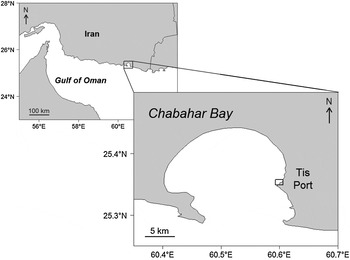
During a monthly faunistic survey from October 2013 to January 2014, ophiuroid echinoderms were collected by hand from the rocky intertidal area of Tis Port, located in the western part of Chabahar Bay at the Gulf of Oman (Iranian coast) (25°21.1′N 60°36.0′E) (Figure 1). During this survey, the focus was solely on the qualitative species composition of this locality. For this reason, no systematic quantitative sampling design was employed. Along a coastal transect of approximately 500 m, brittle stars were collected and up to ten individuals per sampling event were transferred to the laboratory. During the survey all different types of zonations of the intertidal area of Chabahar Bay were included in order to cover a variety of different habitats (i.e. rocky sediment, pebbles, sand and algae). The underneath sides of larger rocks were carefully scrutinized for the presence of cryptic species. All collected ophiuroids were examined under the dissection-microscope. Photographs of Ophionereis dubia were taken using a stereo-microscope equipped with a camera model C-DS model T4AL250 V (21 V 150 W) and selected body parts and morphologically relevant structures were documented and measured to the nearest 1.0 mm and µm, respectively (Table 1). Identification to species level was carried out using the following sources: Clark (Reference Clark1953); Clark & Rowe (Reference Clark and Rowe1971); Clark & Courtman-Stock (Reference Clark and Courtman-Stock1976); Cherbonnier & Guille (Reference Cherbonnier and Guille1978); Price (Reference Price1983); and Pomory (Reference Pomory2007). Subsequent to the laboratory procedures, the specimens were stored in 4% buffered formalin.
Geographical position of the study location (rocky intertidal area) at Tis Port in Chabahar Bay, and its position at the southern Iranian coast of the Gulf of Oman.

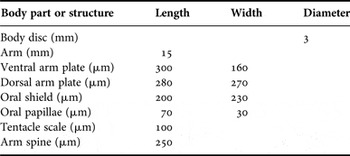
Measurements of selected body parts and morphologically relevant structures of a single specimen of Ophionereis dubia found at Chabahar Bay, Iran. All measurements represent average values of each three individual measurements of the respective structures.

RESULTS
During the survey, three species of ophiuroid echinoderms were identified: Macrophiothrix elongata (N = 14); Ophiothrix (Ophiothrix) savignyi (N = 22); and Ophionereis dubia (N = 1). Due to previous findings of the former two species, the present results refer only to O. dubia which, so far, has not been recorded for Chabahar Bay.
SYSTEMATICS
Order OPHIURIDA Müller & Troschel, Reference Müller and Troschel1840
Suborder OPHIURINA Müller & Troschel, Reference Müller and Troschel1840
Family OPHIONEREDIDAE Ljungman, Reference Ljungman1867
Genus Ophionereis Lütken, Reference Lütken1859
Ophionereis dubia Müller & Troschel, Reference Müller and Troschel1842
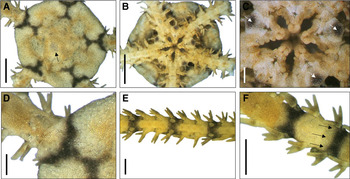
(Figure 2)
Ophionereis dubia from Tis Port, Chabahar Bay (Gulf of Oman, Iran), adult specimen: (A) dorsal view with large central disc scale (arrow); (B) ventral view; (C) mouth frame with dark spots on the oral shields (white arrows); (D) radial section of the dorsal disc at the base of an arm; (E) ventral view of an arm with ventral arm plates, tentacle scales and banded spines visible; (F) dorsal view of an arm with dorsal arm plates and supplementary dorsal arm plates fringing the main dorsal arm plates (both types highlighted with arrows). Note also here the dark banding at the base of each spine. Scale bars: A, B, 1 mm; C, 150 µm; D, 300 µm; E, 250 µm; F, 400 µm.

Ophiolepis dubia Müller & Troschel (Reference Müller and Troschel1842)
Ophionereis dubia: Clark (Reference Clark1953); James & Pearse (Reference James and Pearse1969); Clark & Rowe (Reference Clark and Rowe1971); Clark & Courtman-Stock (Reference Clark and Courtman-Stock1976); Cherbonnier & Guille (Reference Cherbonnier and Guille1978); Irimura (Reference Irimura1981); Price (Reference Price1981); and Price & Rowe (Reference Price and Rowe1996)
Ophionereis spp.: Clark (Reference Clark1953) and Pomory (Reference Pomory2007)
MATERIAL EXAMINED
One adult specimen was found at Tis Port, Chabahar Bay (Iranian coast of the Gulf of Oman) in January 2014. The specimen measured 3 mm in diameter and the disc was pentagon-shaped (Figure 2A, B). The overall disc coloration was pale yellow and loose reticulation patterns were visible in darker yellow or yellow-brownish coloration, following over onto the ventral side. Distinct y-shaped or barbell shaped dark line patterns were visible on the dorsal side of the disc at the base of each arm (Figure 2A, D). The dorsal as well as the ventral side of the disc were covered with minute scales, the primary scale in the dorsal disc centre was distinctly large (Figure 2A). There were no spines, spinlettes or tubercles emerging from the disc. Radial shields were not visible. The oral shields were slightly club-shaped with rounded or even tapered distal edges. Dark spots were found on the distal areas of the oral shields (Figure 2C). The adoral shields were rather short and narrow, and typically did not join completely at the proximal edge of the oral shields. Four rounded oral papillae were located at each side of the jaw originating from the oral plate (Figure 2C). The edges of the bursal slits carried no papillae. The pale and dark yellow coloration of the disc followed over to the arms and was interrupted by regular dark bands (Figure 2E, F). Three short and stout arm spines with rounded tips and similar in length were found on either side of the arms. The length of the spines was approximately the length of an arm segment. Approximately between the base of each spine and its middle, a dark banding was found (Figure 2F). Single rounded tentacle scales were found which measured nearly two-thirds of the length of the first three ventral arm plates. In all further arm segments the tentacles scale covered approximately a third or half the length of the ventral arm plates. The ventral arm plates were quadrangular in shape with pronounced rounded corners and typically longer than wide. The dorsal arm plates appeared nearly as long (on average 280 µm) as wide (on average 270 µm). Comparably large supplementary arm plates were visible on the sides of the dorsal arm plates (Figure 2F).
DISTRIBUTION
Qatari Waters, Arabian Gulf (Al-Khayat & Al-Ansi, Reference Al-Khayat and Al-Ansi2008), Indian Ocean, Red Sea and South Africa (Humphreys, Reference Humphreys1981; Stöhr, Reference Stöhr, Stöhr, O'Hara and Thuy2014 and references therein), Sea of Japan (Irimura, Reference Irimura1979, Reference Irimura1981), Red Sea (Suez Canal) and Gulf of Aqaba (Müller & Troschel, Reference Müller and Troschel1842; Price, Reference Price1981), Persian Gulf (James & Pearse, Reference James and Pearse1969), Pakistan, Arabian Sea, Gulf of Oman (Kidwai & Ahmed, Reference Kidwai and Ahmed1999), Indian Ocean (Mahadevan & Nagappan Nayar, Reference Mahadevan and Nagappan Nayar1967), Sumatra, Indonesia, Pacific Ocean (Price & Rowe, Reference Price and Rowe1996), and Guam, Pacific Ocean (Starmer, Reference Starmer2003).
REMARKS
The presently reported specimen of O. dubia was found at Tis Port, Chabahar Bay, located at the northern Gulf of Oman on the Iranian coast (25°21.1′N 60°36.0′E). This is the first record of O. dubia for this location. It was found at low tide in the rocky intertidal on pebbly substratum.
DISCUSSION
Ophiuroid echinoderms are widely distributed in tropical regions. Price & Rowe (Reference Price and Rowe1996), for example, listed 44 different brittle star species from the Indian Ocean. Representatives of the genus Ophionereis Lütken, Reference Lütken1859 can be found in shallow tropical waters all over the world (Mahadevan & Nagappan Nayar, Reference Mahadevan and Nagappan Nayar1967; Thomas, Reference Thomas1973; Humphreys, Reference Humphreys1981; Al-Khayat & Al-Ansi, Reference Al-Khayat and Al-Ansi2008). Ten species of the genus Ophionereis have been reported from Indo-West Pacific shallow waters down to a depth of about 30 m (Clark & Rowe, Reference Clark and Rowe1971; Rowe & Gates, Reference Rowe and Gates1995). Ophionereis dubia is known from such shallow depths and is typically found on different types of hard substratum such as rocks, pebbles and coarse sands (Mahadevan & Nagappan Nayar, Reference Mahadevan and Nagappan Nayar1967; Irimura, Reference Irimura1981; Price & Rowe, Reference Price and Rowe1996; Al-Khayat, Reference Al-Khayat2005), but has also been found amongst different macroalgae (Humphreys, Reference Humphreys1981). This species has been reported from a number of coastal habitats in the Pacific as well as the Indian Ocean including different areas of the Arabian Sea such as the Red Sea, the Gulf of Suez, the Gulf of Aqaba, the Persian Gulf, the Gulf of Oman and also the Gulf of Mannar (Müller & Troschel, Reference Müller and Troschel1842; Mahadevan & Nagappan Nayar, Reference Mahadevan and Nagappan Nayar1967; James & Pearse, Reference James and Pearse1969; Humphreys, Reference Humphreys1981; Irimura, Reference Irimura1981; Price, Reference Price1981; Price & Rowe, Reference Price and Rowe1996; Kidwai & Ahmed, Reference Kidwai and Ahmed1999; Starmer, Reference Starmer2003; Al-Khayat & Al-Ansi, Reference Al-Khayat and Al-Ansi2008; Stöhr, Reference Stöhr, Stöhr, O'Hara and Thuy2014 and references therein).
In the present study, O. dubia was found for the first time in the rocky intertidal of Tis Port, Chabahar Bay, located at the Iranian coast of the Gulf of Oman. Along with two previously recorded ophiuroid species in Chabahar Bay, O. (Ophiothrix) savignyi and M. elongata (Khaleghi, Reference Khaleghi2010; Khaleghi & Owfi, Reference Khaleghi and Owfi2011), the present finding adds a third species to the local ophiuroid species inventory. According to its distributional ranges in the Arabian Sea, the finding of this species in the present study location in the Gulf of Oman is not surprising. However, despite the fact that Mahadevan & Nagappan Nayar (Reference Mahadevan and Nagappan Nayar1967) report O. dubia being the most common of ophiuroids found among sponges or under rocks in the coastal area of the Gulf of Mannar, this species has typically been reported as rarely abundant (Price, Reference Price1981; Branch et al., Reference Branch, Griffiths, Mranch and Beckley2007; Al-Khayat & Al-Ansi, Reference Al-Khayat and Al-Ansi2008) and has also been reported as a single finding before (Price & Rowe, Reference Price and Rowe1996). According to the above, the single finding of O. dubia in the present study is, therefore, not necessarily to be interpreted as a random finding, but probably rather reflects the overall low abundance of this species. Low abundances of this species resulting in the high probability of overlooking it in the field, might also explain why O. dubia has not been recorded in previous surveys so far. In addition, it must be considered that the present survey took place at low tide in the rocky intertidal area. Even though commonly found in shallow waters, the chance of actually finding O. dubia in this area is certainly higher in the subtidal zones where it is constantly submerged rather than in habitats that fall dry or become secluded in rock pools or humid crevices at low tide.
The individual found in the present study, measured 3 mm in disc diameter. Clark & Rowe (Reference Clark and Rowe1971) reported disc diameters in O. dubia rarely exceeding 5 mm. James (Reference James1982), for example reported only a single individual with a disc diameter of 7 mm. Therefore, the presently found individual can be assigned as an adult specimen assuming we have developed all relevant morphological characteristics for species identification. In fact, basically all relevant structures described in the consulted literature could be identified in the present individual determined as O. dubia.
Possible misidentification or confusion with congeneric species such as O. reticulata (Say, Reference Say1825), O. squamulosa (Koehler, Reference Koehler1914), O. degeneri (A.H. Clark, Reference Clark1949), O. porrecta (Lyman, Reference Lyman1860), O. fusca (Brock, Reference Brock1888) or O. lineata (H.L. Clark, Reference Clark1946) can be ruled out; these species possess genital papillae which are absent in O. dubia (Clark & Rowe, Reference Clark and Rowe1971; Thomas, Reference Thomas1973) and which were absent in the presently found individual. James (Reference James1982) described the disc shape of a large specimen (7 mm) of O. dubia as being round instead of being pentagon-shaped, as it was found in the present study. This however, might be viewed as a variable characteristic; age and therefore also the size of the individual along with its nutritional or reproductive status may have an effect on the outer morphology. For example, individuals carrying fully developed gonads prior to spawning might show swollen inter-ambulacral areas and thus enlargements in their outer shapes to appear rather rounded. Among others, the genus Ophionereis is described as having ‘large broadly rounded accessory aboral arm plates’ which repeatedly occur on either sides of the dorsal arm plates along the entire arms (Pomory, Reference Pomory2007). Morphological features of the dorsal arm plates as well as the accessory or so-called supplementary plates differentiate O. dubia from other Indo-West Pacific Ophionereis species described by Clark & Rowe (Reference Clark and Rowe1971); while the supplementary arm plates are small and short in O. vivipara Mortensen, Reference Mortensen1933, they may be as long as the entire arms segment in O. dubia. Compared to the main dorsal arm plates in O. dubia being at most a little wider than long, they may be up to three times as long in O. dubia amoyensis. In the presently found individual, the dorsal arm plates appeared almost as wide as long, and comparably large supplementary plates could be identified at either side of the dorsal arm plates presently ruling out misidentifications of O. vivipara or O. dubia amoyensis.
The arms of O. dubia were presently found to be yellowish and to be regularly interspersed with dark brown bandings, which were about half to one arm segment wide and appeared every second to third arm segment. Regularly spaced darker bandings have been reported for O. dubia (Clark & Rowe, Reference Clark and Rowe1971; Rowe & Gates, Reference Rowe and Gates1995). The colorations of the arms, however, may be variable and are described, for example, as reddish purple and pale yellow by Irimura (Reference Irimura1981). A number of different congeneric species such as O. reticulata, O. squamulosa, O. olivacea H.L. Clark, Reference Clark1900 and O. dolabriformis John & Clark, Reference John and Clark1954 show similarly spaced dark bandings on lighter coloured arms (Thomas, Reference Thomas1973). They resemble those found in O. dubia (Clark & Rowe, Reference Clark and Rowe1971) and might cause confusion. However, the dark-yellow or light-brown open reticulation visible on the dorsal side of the disc, which typically includes distinct dark-brown y-shaped patterns at the bases of the arms strongly supports the unmistaken identification of O. dubia (Clark & Rowe, Reference Clark and Rowe1971) in the present case. Despite the fact that coloration might sometimes be a characteristic too variable to be used for identification, an additional coloration pattern in the spines in the presently found individual supports the identification of O. dubia as well; dark bandings at the base of each arm spine have been found in the present individual and have been described for O. dubia previously by Müller & Troschel (Reference Müller and Troschel1842).
ACKNOWLEDGEMENTS
The present work is part of the MSc work of A.B. at the Chabahar Maritime University and working space and facilities granted by the university are highly acknowledged. The authors are grateful to Professor Andrew Price for his help with the identification of Ophionereis dubia.