Introduction
Anglerfishes of the suborder Ceratioidei (Lophiiformes) form a cosmopolitan and highly diverse group, ranking among the most species-rich deep-sea fish lineages, with at least 177 valid species (Eduardo et al., Reference Eduardo, Mincarone, Sutton and Bertrand2024). Adults are predominantly deep-pelagic, generally found at depths between 300 and 4000 m (Pietsch, Reference Pietsch2009), whereas larvae inhabit shallower waters. Ceratioids have also evolved some of the most remarkable morphological and ecological adaptations among vertebrates. This includes well-developed bioluminescence systems used for communication and predation-related mechanisms, such as the illicium. This structure is a modification of the first dorsal-fin spine, located at the tip of the snout and converted into a lure with bioluminescence (Pietsch, Reference Pietsch2009).
Scarce resources have likely driven the evolution of extreme sexual dimorphism and sexual parasitism in this group, as physiological pathways of many species enable the male’s tissues to fully fuse with the female’s body skin (Shoemaker, Reference Shoemaker1958). In extreme cases, the male can be approximately 60 times shorter than the female (Bertelsen, Reference Bertelsen1951). Male anglerfish are morphologically atrophied and locate their respective females by following chemical signatures with their highly developed nostrils. Typically, the male attaches to the female’s body by biting her skin, loses metabolic autonomy, and integrates into the female’s circulatory system (Pietsch, Reference Pietsch2009; Swann et al., Reference Swann, Holland, Petersen, Pietsch and Boehm2020).
Despite their wide geographic distribution and remarkable taxonomic diversity, deep-sea anglerfishes remain among the least-studied vertebrate groups, with many species known from only a few specimens deposited in museum collections. About 20 species of ceratioids have been recorded in the Brazilian Exclusive Economic Zone (EEZ) (Mincarone et al., Reference Mincarone, Afonso, Di Dario, Eduardo, Frédou, Lucena-Frédou, Bertrand and Pietsch2021), but only Bufoceratias wedli (Pietschmann, 1926) (Diceratiidae) and Cryptopsaras couesii Gill, 1883 (Ceratiidae) are known from off the northern coast of Brazil (Asano Filho et al., Reference Asano Filho, Holanda, Santos and Cavalcante Júnior2005; Mincarone et al., Reference Mincarone, Afonso, Di Dario, Eduardo, Frédou, Lucena-Frédou, Bertrand and Pietsch2021; Pietsch, Reference Pietsch1986). During the AMAZOMIX expedition off northern Brazil (Bertrand et al., Reference Bertrand, De Saint Leger and Koch-Larrouy2021), approximately 6300 fish specimens were collected. Here we report the ceratioids from that expedition, including four new records in Brazilian waters. In addition, an updated checklist of all Ceratioidei reported in the Brazilian EEZ is provided.
Methods
The specimens examined were collected during the AMAZOMIX expedition (Amazon Shelf Mixing and its Impact on Ecosystems), carried out from 27 August to 8 October 2021. The expedition was conducted by the French RV Antea off the states of Amapá and Pará, including the mouth of the Amazon River, which is characterised by a significant input of freshwater (the Amazon Plume) that extends superficially (about 30 m depth) into the open ocean. Sampling was conducted using micronekton nets (body mesh size: 40 mm; cod-end mesh size: 10 mm) from the surface to 1200 m. Trawl depths were continuously recorded using a SCANMAR depth sensor fitted on the upper part of the trawl mouth. Target depths for each tow were determined based on acoustic scattering layers or patches identified using a Simrad EK60 (Kongsberg Simrad AS) split-beam echosounder, operating at 38, 70, 120, and 200 kHz. Net geometry was monitored in real time using SCANMAR sensors, providing data on headline height, net depth, and wing and door distances to ensure optimal fishing performance. As the trawl lacked an opening and closing mechanism, efforts were made to minimise specimen collection during net deployment and retrieval by reducing vessel speed and increasing winch speed. At target depths, trawling was conducted for approximately 30 min at 2–3 knots.
Among the 6300 specimens of fish collected from 34 deep-pelagic stations, 34 ceratioids were recovered at six stations (Table 1, Figure 1). After collection, the specimens were measured and weighed, tissue samples were taken, and the specimens were fixed in 4% buffered formalin and preserved in 70% ethanol. All specimens were catalogued at the Fish Collection of the Instituto de Biodiversidade e Sustentabilidade, Universidade Federal do Rio de Janeiro (NPM, Macaé, Brazil). Identification of the ceratioids was carried out using the keys provided by Pietsch (Reference Pietsch2009). Some specimens, particularly larvae and juvenile males, could not be identified to species level due to preservation limitations or developmental stage.
Sampling stations of the ceratioids collected by the RV Antea off northern Brazil, including previous records from the literature. Abbreviations: AP, State of Amapá; PA, State of Pará.

Sampling stations of ceratioids collected by RV Antea off northern Brazil

Ethical Statement: All methods were approved and conducted in accordance with regulations of the Brazilian Ministry of Environment (SISBIO authorisation number: 75424). Operations of the RV Antea were approved by the Brazilian Navy Authority (Estado-Maior da Armada) under the Ordinances 142 (18 August 2021).
Results
Melanocetidae Gill, 1879
Body of metamorphosed females short, deep, and globular; mouth large, opening oblique to nearly vertical; teeth generally more numerous and shorter in the upper jaw, ranging from 29 to 178; those in the lower jaw larger, elongated, and sometimes curved, ranging from 32 to 142, and measuring 6.9–25% of standard length (SL); vomer usually well-toothed, with a single row of up to 12 teeth; head smooth and rounded, spines absent on the sphenotic, quadrate and articular bones; illicium emerging from snout, its supporting pterygiophore fully embedded in skin of head; escal bulb simple, sometimes with rounded or conical projections and anterior and posterior ridges; dorsal fin with 13–16 (rarely 12 or 17) rays, anal fin with 4 (rarely 3 or 5) rays, 15–23 pectoral-fin rays, and 9 caudal-fin rays. Males have distinct elliptical eyes positioned laterally, with pupils larger than the lens; unpigmented olfactory organs, with laterally positioned nostrils; and the absence of teeth in the mandible. Larvae are characterised by their nearly spherical body shape, moderately sized pectoral fins, and the absence of pelvic fins (Pietsch, Reference Pietsch2009; Pietsch and Van Duzer, Reference Pietsch and Van Duzer1980). The family is represented by a single genus, Melanocetus, encompassing six species (Fricke et al., Reference Fricke, Eschmeyer and Fong2025; Pietsch, Reference Pietsch2009).
Melanocetus johnsonii Günther, 1864
Material examined
Three specimens: NPM 7261, 1 (110 mm SL; Figure 2), RV Antea, sta. AMX15-2, 05°19’50”N, 50°05’18”W–05°19’50”N, 50°05’18”W, 883 m, 15 September 2021, 14:41–15:41 h; NPM 7262, 1 (28 mm SL), RV Antea, sta. AMX14-3, 02°32’16”N, 45°16’45”W–02°30’11”N, 45°16’06”W, 1200 m, 10 September 2021, 12:13–13:14 h; NPM 7280, 1 (38 mm SL), RV Antea, sta. AMX14-5, 02°33’44”N, 45°18’22”W–02°33’29”N, 45°16’40”W, 1000 m, 10 September 2021, 19:01–19:57 h.
Melanocetus johnsonii, NPM 7261, female, 110 mm SL, 05°19’50”N, 50°05’18”W, 883 m, 15 September 2021, 14:41–15:41 h (preserved specimen).

Diagnosis
Metamorphosed females of Melanocetus johnsonii differ from congeners by the unique combination of the following characters: nearly straight anterior margin of the vomer; least outside width between frontals 13.5–28.6% SL; 48–134 teeth on upper jaw, 32–78 on lower jaw; length of the longest tooth in lower jaw 8.4–25.0% SL; width of the pectoral-fin lobe 10.7–17.8% SL; width of escal bulb 4.3–8.6% SL; length of illicium 32.4–60.8% SL; esca with posterior and usually anterior crests; skin with minute spinules covering most of the body (Pietsch, Reference Pietsch2009; Pietsch and Van Duzer, Reference Pietsch and Van Duzer1980).
Distribution
Melanocetus johnsonii occurs in the tropical to subantarctic waters of the Atlantic, Indian, and Pacific oceans, at depths not exceeding 2100 m (Pietsch, Reference Pietsch2009). Approximately 62% of the material examined by Pietsch and Van Duzer (Reference Pietsch and Van Duzer1980) was collected between the surface and 1000 m. In Brazil, the species has been recorded off the Saint Peter and Saint Paul Archipelago, the Fernando de Noronha Ridge, State of Espírito Santo, and Trindade Island (Mincarone et al., Reference Mincarone, Afonso, Di Dario, Eduardo, Frédou, Lucena-Frédou, Bertrand and Pietsch2021; Pietsch, Reference Pietsch2009; Pietsch and Van Duzer, Reference Pietsch and Van Duzer1980). As reported here, M. johnsonii was taken off Amapá and Pará, between depths of 883 and 1200 m (Figure 1).
Oneirodidae Gill, 1879
Females of the Oneirodidae have a deep, short to moderately elongated globose to laterally compressed body; mouth oblique to nearly horizontal, jaws equal anteriorly; illicium with a bulbous distal light organ; pterygiophore of the illicium usually emerging anteriorly on the snout, extending posteriorly on the back behind the head only in Oneirodes; usually sharp sphenotic spines on top of head, absent in Chaenophryne and short in Ctenochirichthys; quadrate and articular spines usually well developed; skin smooth, dermal spines or spinules absent except in Spiniphryne; 4–8 dorsal-fin rays, 4–7 anal-finrays, 13–30 pectoral-fin rays. Facultative sexual parasitism has been described in some species (Pietsch, Reference Pietsch2009). The family comprises 17 genera and 77 valid species (Fricke et al., Reference Fricke, Eschmeyer and Fong2025).
Oneirodes carlsbergi (Regan & Trewavas, 1932)
Material examined
Two specimens: NPM 7263, 1 female (58 mm SL; Figure 3), RV Antea, sta. AMX15-2, 05°19’50”N, 50°05’18”W–05°19’50”N, 50°05’18”W, 883 m, 15 September 2021, 14:41–15:41 h; NPM 7279, 1 female (44 mm SL), RV Antea, sta. AMX14-3, 02°32’16”N, 45°16’45”W–02°30’11”N, 45°16’06”W, 1200 m, 10 September 2021, 12:13–13:14 h.
Oneirodes carlsbergi, NPM 7263, female, 58 mm SL, 05°19’50”N, 50°05’18”W, 883 m, 15 September 2021, 14:41–15:41 h.

Diagnosis
Oneirodes carlsbergi is distinguished from the other 42 species in the genus, except O. luetkeni, by the presence of teeth on the epibranchial of the first gill arch. It differs from O. luetkeni, recorded only in the eastern Pacific, by the number of teeth on the epibranchial of the first gill arch (1–5 vs. 6–17); number of toothed pharyngobranchials (two pairs vs. a single pair), ratio of lengths of dorsal and ventral forks of opercle (0.51–0.61 vs. 0.60–0.71), and esca with a tapering and internally pigmented anterior appendage (vs. anterior appendage without internal pigment, anterolateral appendage represented by a broad membranous flap) (Ho et al., Reference Ho, Kaway and Amaoka2016; Ho and Shao, Reference Ho and Shao2019; Orr, Reference Orr1991; Pietsch, Reference Pietsch1974, Reference Pietsch2009; Prokofiev, Reference Prokofiev2014; Rajeeshkumar et al., Reference Rajeeshkumar, Meera and Hashim2017).
Distribution
Oneirodes carlsbergi appears to have a circumtropical distribution, with most specimens collected between 18°N and 8°S (Ho et al., Reference Ho, Kaway and Amaoka2016; Ho and Shao, Reference Ho and Shao2019; Mincarone et al., Reference Mincarone, Afonso, Di Dario, Eduardo, Frédou, Lucena-Frédou, Bertrand and Pietsch2021; Pietsch, Reference Pietsch2009). Atlantic records range from 17°49’N–7°37’S, including two in Brazilian waters near the Rocas Atoll and off Pernambuco, at depths ranging from 650 to 800 m (Mincarone et al., Reference Mincarone, Afonso, Di Dario, Eduardo, Frédou, Lucena-Frédou, Bertrand and Pietsch2021; Pietsch, Reference Pietsch1974, Reference Pietsch2009). In this study, the species is reported from off Amapá and Pará, at depths between 883 and 1200 m (Figure 1).
Lophodolos acanthognathus Regan, 1925
Material examined
One specimen: NPM 7275, 1 female (28 mm SL; Figure 4), RV Antea, sta. AMX14-5, 02°33’44”N, 45°18’22”W–02°33’29” N, 45°16’40”W, 1000 m, 10 September 2021, 19:01–19:57 h.
Lophodolos acanthognathus, NPM 7275, female, 28 mm SL, 02°33’44”N, 45°18’22”W–02°33’29”N, 45°16’40”W, 1000 m, 10 September 2021, 19:01–19:57 h.

Diagnosis
Adult females of Lophodolos acanthognathus can be distinguished from L. indicus by the following combination of characters: length of illicium less than 25% SL in specimens > 30 mm; width of escal bulb 4.4–6.7% SL in specimens > 25 mm; length of escal appendages 10.2–20.9% SL in specimens > 25 mm, and 8.7–22.2% SL (usually > 10.0% SL) in specimens < 25 mm; length of the sphenotic spine 4.1–9.2% SL (usually > 6.0% SL) in specimens > 30 mm; length of the quadrate spine 2.9–6.5% SL (usually > 3.5% SL) in specimens > 30 mm; and 5–7 dorsal-fin rays (Pietsch, Reference Pietsch2009).
Distribution
Most specimens of L. acanthognathus have been collected in the North Atlantic, from Greenland and Iceland (around 65°N) to the equator, including the Gulf of Mexico and the Caribbean Sea. A single record is known from the South Atlantic, at 40°S, 26°W. Additionally, it is known from scattered records in equatorial waters of the Indian (Arabian Sea, South China Sea, and Celebes Sea) and Pacific oceans (between 139° and 142°W and off the coast of Peru) (Pietsch, Reference Pietsch2009). The species is typically found at depths between 700 and 1500 m. Lophodolos acanthognathus is recorded for the first time in Brazilian waters, based on a single specimen collected off the coast of Pará, at approximately 1000 m depth (Figure 1).
Centrophrynidae Bertelsen, 1951
Internally, adult females of Centrophrynidae are distinguished from all other ceratioid groups by an asymmetric anatomical feature: a single, elongated ovary (Pietsch, Reference Pietsch1972, Reference Pietsch2009). Other distinguishing features include: the absence of sphenotic spines; a bifurcated opercle, with the ventral arch being twice as long as the dorsal one, approximately equal in length to the subopercle; subopercle with distinct ends: a slender upper end and a lower end with a spine on the anterior margin; 6–7 dorsal-fin rays, 5–6 anal-fin rays, 15–16 pectoral-fin rays, 5 pelvic-fin rays, 9 caudal-fin rays (Pietsch, Reference Pietsch2009; Pietsch and Nafpaktitis, Reference Pietsch and Nafpaktitis1971). The larvae exhibit a digitiform hyoid barbel, an unusual feature shared only with adult females of the genus Linophryne. The family is represented solely by Centrophryne spinulosa (Pietsch, Reference Pietsch2009).
Centrophryne spinulosa Regan & Trewavas, 1932
Material examined
One specimen: NPM 7266, 1 female (21 mm SL; Figure 5), RV Antea, sta. AMX14-5, 02°33’44”N, 45°18’22”W–02°33’29”N, 45°16’40”W, 1000 m, 10 September 2021, 19:01–19:57 h.
Centrophryne spinulosa, NPM 7266, juvenile female, 21 mm SL, 02°33’44”N, 45°18’22”W–02°33’29”N, 45°16’40”W, 1000 m, 10 September 2021, 19:01–19:57 h.

Diagnosis
As for the family.
Distribution
Centrophryne spinulosa occurs across the three major oceans, but appears to be more abundant in the Atlantic Ocean, particularly in the Gulf of Mexico, the Caribbean Sea, and off the coast of Venezuela. In the eastern Atlantic, it was recorded off Cape Verde, the Canary Islands, and further south to approximately 18°S. In the Pacific, the species is known from Japan to Taiwan, as well as the South China Sea and the Bismarck Archipelago. In the equatorial Pacific, it has been recorded off Baja California, southern Mexico, and the Gulf of Panama. The maximum depth recorded for adult specimens is 2325 m, while two larvae were collected between 0 and 35 m (Pietsch, Reference Pietsch2009). In the present study, C. spinulosa is reported for the first time in Brazilian waters, based on a single specimen collected off Pará at approximately 1000 m depth (Figure 1).
Linophrynidae Regan, 1925
Linophrynidae can be characterised by the combination of the following characters: 3–4 dorsal-fin rays, 3 anal-fin rays (rarely 2 or 4), 13–19 pectoral-fin rays, 9 caudal-fin rays, 5 branchiostegal rays, and anus positioned to the left side of the body. Additional diagnostic features include: distance between tip of snout and pectoral-fin base 50–60% SL; horizontal or occasionally oblique mouth opening, with dentition varying significantly among genera (Haplophryne and Photocorynus have shorter, more numerous teeth); one spine at the mandibular symphysis; preopercular spines present (except in Acentrophryne); short illicial pterygiophore and a generally simple esca, consisting of a central lumen and a pore; smooth skin without spines or scales; and bioluminescent hyoid barbels present exclusively in Linophryne (Pietsch, Reference Pietsch2009). Linophrynidae larvae are more elongated than other ceratioids, with the head 45% SL. Both free-living and parasitic males are known in all genera, except Acentrophryne, and can be identified by their large eyes (9% SL), inflated olfactory organs with 3–13 lamellae, and presence of teeth on the lower jaw (only in Borophryne and Haplophryne) (Pietsch, Reference Pietsch2009). The family comprises five genera and 27 valid species (Fricke et al., Reference Fricke, Eschmeyer and Fong2025).
Haplophryne mollis (Brauer, 1902)
Material examined
Nine specimens: NPM 7271, 2 females (38–45 mm SL; Figure 6) and 2 males (∼10 mm SL), RV Antea, sta. AMX14-5, 02°33’44”N, 45°18’22”W–02°33’29”N, 45°16’40”W, 1000 m, 10 September 2021, 19:01–19:57 h; NPM 7269, 1 female (26 mm SL), RV Antea, sta. AMX15-1, 05°20’43”N, 50°09’13”W–05°21’07”N, 50°07’26”W, 500 m, 15 September 2021, 08:14–08:54 h; NPM 7283, 4 females (25–28 mm SL), RV Antea, sta. AMX15-2, 05°19’50”N, 50°05’18”W to 05°19’50”N, 50°05’18”W, 883 m, 15 September 2021, 14:41–15:41 h.
Haplophryne mollis NPM 7271, female (45 mm SL) and male (10 mm SL, attached to the left opercle), 02°33’44”N, 45°18’22”W–02°33’29”N, 45°16’40”W, 1000 m, 10 September 2021, 19:01–19:57 h.

Diagnosis
Haplophryne is monotypic. It differs from other species in the family by the following combination of characters: 3 rays in both the dorsal and anal fins; metamorphosed females with a rounded body and short, circular illicium lacking a stalk; small, numerous teeth; a thin operculum; preopercle adorned with tricuspid spines; and unpigmented skin. Males have 20–24 teeth on each side of the upper and lower jaws, a well-developed premaxilla, moderately elevated epiotic region of skull, and poorly developed or absent sphenotic spines (Bertelsen and Pietsch, Reference Bertelsen and Pietsch1983; Pietsch, Reference Pietsch2009).
Distribution
Haplophryne mollis occurs in the Atlantic, Indian, and Pacific oceans, between 67°N and 45°S (Pietsch, Reference Pietsch2009; Stewart and Pietsch, Reference Stewart, Pietsch, Roberts, Stewart and Struthers2015). The maximum recorded depth for the species is 2000 m, although most specimens have been collected between 550 and 900 m (Bertelsen, Reference Bertelsen, Quero, Hureau, Karrer, Post and Saldanha1990). In the present study, nine specimens were collected off the coasts of Amapá and Pará, at depths ranging from 500 to 1000 m. These are the first records of H. mollis in Brazilian waters (Figure 1).
Gigantactinidae Boulenger, 1904
Females of Gigantactinidae have an elongate, compressed body; a long slender illicium, with variable lengths (less than SL to nearly five times SL), emerging from the anteriormost tip of the snout; length of head less than 35% SL; mouth nearly horizontal, upper jaw extending slightly beyond lower jaw; epibranchial and ceratobranchial teeth absent; caudal peduncle unusually long and slender, more than 20% SL; 3–10 dorsal-fin rays, 3–8 anal-fin rays; caudal fin usually incised posteriorly, 9 caudal-fin rays, usually highly elongate. Adult females are dark brown or black, with skin texture varying between genera and depending on developmental stage. There is no evidence that males are parasitic. Males with small eyes, a diameter not exceeding 5% of standard length (SL), and pronounced sexual dimorphism characterised by the presence of a vomer, symphyseal cartilage, ossified parietals, frontals, and opercles (Bertelsen et al., Reference Bertelsen, Pietsch and Lavenberg1981). Larvae are commonly identified by their large pectoral fins (45–55% SL), spherical body, and absence of pelvic fins (Pietsch, Reference Pietsch2009). The family comprises two genera and 25 valid species (Fricke et al., Reference Fricke, Eschmeyer and Fong2025).
Gigantactis vanhoeffeni Brauer, 1902
Material examined
One specimen: NPM 7051, 1 (260 mm SL; Figures 7 and 8), RV Antea, sta. AMX15-2, 05°19’50”N, 50°05’18”W–05°19’50”N, 50°05’18”W, 883 m, 15 September 2021, 14:41–15:41 h.
Gigantactis vanhoeffeni, NPM 7051, female, 260 mm SL, 05°19’50”N, 50°05’18”W, 883 m, 15 September 2021, 14:41–15:41 h (by Gerson Machado Filho).

Esca of Gigantactis vanhoeffeni, NPM 7051, female, 260 mm SL, 05°19’50”N, 50°05’18”W, 883 m, 15 September 2021, 14:41–15:41 h (by Gerson Machado Filho).

Diagnosis
Females of Gigantactis vanhoeffeni can be diagnosed by the following combination of characters: length of illicium less than 120% SL; escal bulb with a distal, darkly pigmented, spinulose, and elongated extension; bulb and distal extension with flattened papillae; esca filaments short in the distal region and slender proximally; illicium with a posterior pair of papillae below the escal bulb; dentary with three longitudinal rows of relatively long teeth, measuring approximately 2.6–5.0% SL; caudal-fin rays shorter than 45% SL (Pietsch, Reference Pietsch2009). Males and larvae are unknown.
Distribution
Gigantactis vanhoeffeni occurs in the Atlantic, Indian, and Pacific oceans, at depths ranging from 300 to 5300 m. In the Atlantic, the species has been reported from Greenland to South Africa (Bertelsen et al., Reference Bertelsen, Pietsch and Lavenberg1981; Fujii, Reference Fujii, Uyeno, Matsuura and Fujii1983; Mincarone et al., Reference Mincarone, Afonso, Di Dario, Eduardo, Frédou, Lucena-Frédou, Bertrand and Pietsch2021; Pietsch, Reference Pietsch2009; Porteiro et al., Reference Porteiro, Sutton, Byrkjedal, Orlov, Heino, Menezes and Bergstad2017; Sutton et al., Reference Sutton, Porteiro, Heino, Byrkjedal, Langhelle, Anderson, Horne, Søiland, Falkenhaug, Godø and Bergstad2008). In Brazil, it was collected off the Saint Peter and Saint Paul Archipelago and off the State of Espírito Santo (Costa et al., Reference Costa, Braga, Melo, Nunan, Martins, Olavo, Costa, Olavo and Martins2007; Mincarone et al., Reference Mincarone, Afonso, Di Dario, Eduardo, Frédou, Lucena-Frédou, Bertrand and Pietsch2021; Pietsch, Reference Pietsch2009). In this study, the species is reported from off Amapá, at 883 m depth (Figure 1).
Rhynchactis leptonema Regan, 1925
Material examined
One specimen: NPM 7052, 1 (106 mm SL; Figure 9), RV Antea, sta. AMX15-2, 05°19’50”N, 50°05’18”W–05°19’50”N, 50°05’18”W, 883 m, 15 September 2021, 14:41–15:41 h.
Rhynchactis leptonema, NPM 7052, female, 106 mm SL, 05°19’50”N, 50°05’18”W, 883 m, 15 September 2021, 14:41–15:41 h.

Diagnosis
Rhynchactis leptonema is distinguished from its congeners (R. macrotrix and R. microtrix) by the length of the illicium (143–158% SL vs. 109–144% SL in R. macrotrix and 210% SL in R. microtrix), and the absence of secondary filaments at the tip of the illicium (present in congeners) (Pietsch, Reference Pietsch2009).
Distribution
The few known specimens of Rhynchactis leptonema have been captured in widely separated locations. The holotype is known from the western tropical Atlantic, near 8°N, 44°W (1500 m depth). Another specimen was collected off Hawaii, and three additional specimens are from off Taiwan (300–600 m depth) (Pietsch, Reference Pietsch2009). The specimen collected off the coast of Amapá, at 883 m depth, represents the first record of R. leptonema in Brazilian waters (Figure 1).
Discussion
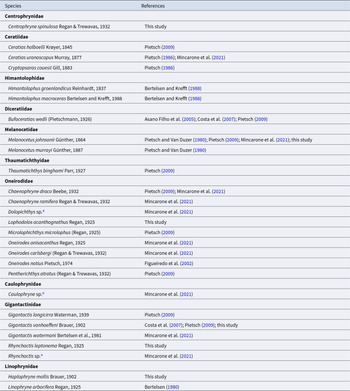
This study reports the occurrence of seven species of ceratioids off the Amazon River mouth, northern Brazil, based on specimens collected by the RV Antea, recording Haplophryne mollis, Linophryne acanthognathus, Centrophryne spinulosa, and Rhynchactis leptonema, for the first time in Brazilian waters. These new records enhance our understanding of the diversity of ceratioids within the Brazilian EEZ, increasing the number of documented species (Table 2). Additionally, Gigantactis vanhoeffeni, a rare species previously recorded in Brazil from only two locations (off the Saint Peter and Saint Paul Archipelago and the State of Espírito Santo; Mincarone et al., Reference Mincarone, Afonso, Di Dario, Eduardo, Frédou, Lucena-Frédou, Bertrand and Pietsch2021), had its distribution extended.
Ceratioids recorded in the Brazilian Exclusive Economic Zone
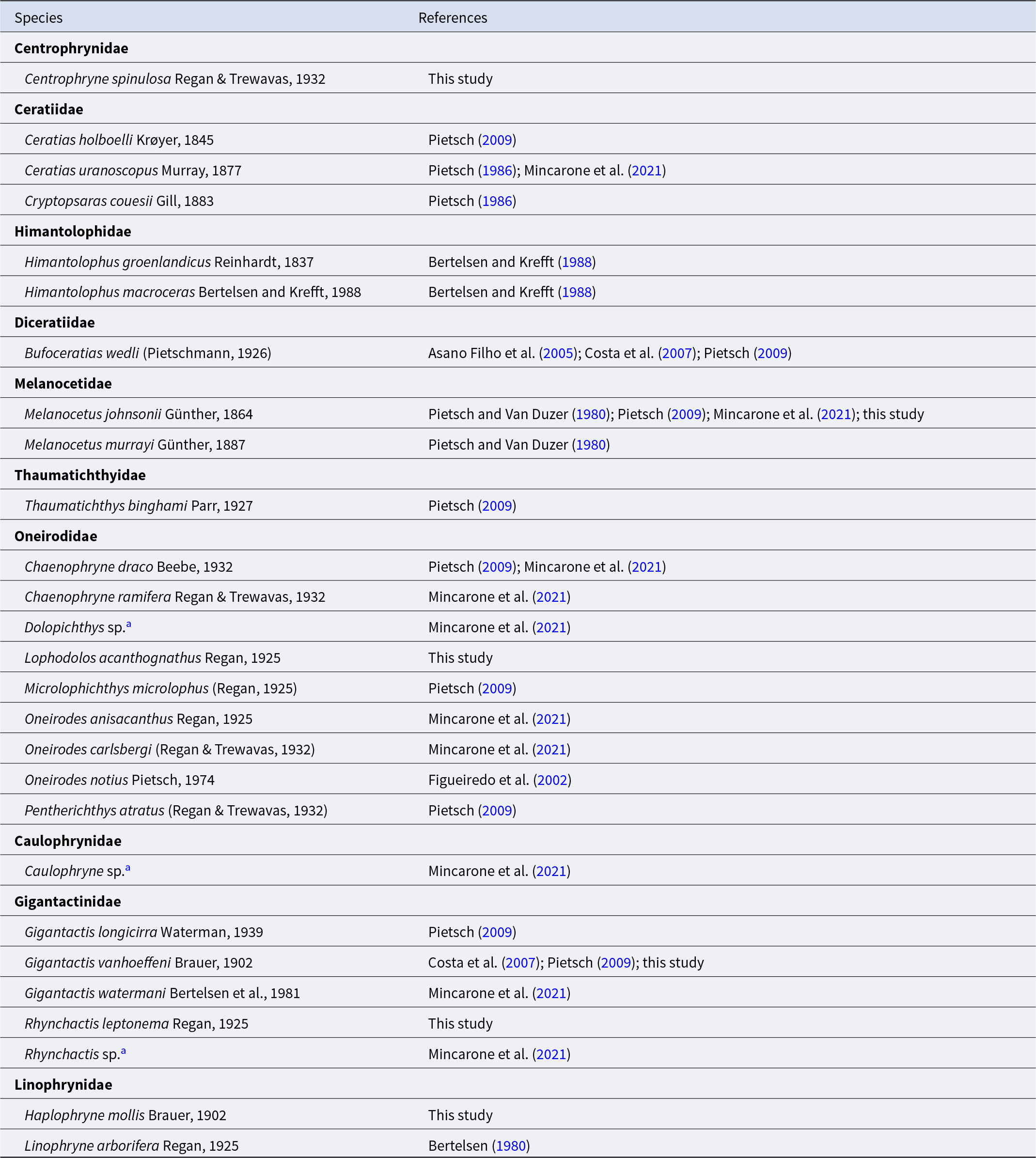
a Indicate records based on larvae, small juveniles, or damaged specimens.
Sixteen additional specimens in the genera Melanocetus (n = 5), Himantolophus (9), Oneirodes (1), and Gigantactis (1) have not been identified to species level. Most of these are larvae, juvenile males, or specimens in poor condition lacking key diagnostic characters, making morphological identification particularly challenging. For some of these specimens, tissue samples have been taken, enabling future molecular studies that may confirm identification.
Only two other ceratioids have previously been reported off northern Brazil: Bufoceratias wedli (Pietschmann, 1926) (Diceratiidae) and Cryptopsaras couesii Gill, 1883 (Ceratiidae). Bufoceratias wedli is widely distributed along the eastern and western coasts of the Atlantic Ocean. Asano Filho et al. (Reference Asano Filho, Holanda, Santos and Cavalcante Júnior2005) listed it off Amapá but without voucher specimens (Figure 1), and additional specimens were subsequently reported off Bahia (Mincarone et al., Reference Mincarone, Afonso, Di Dario, Eduardo, Frédou, Lucena-Frédou, Bertrand and Pietsch2021; Pietsch, Reference Pietsch2009). Cryptopsaras couesii is widely known from the Atlantic, Indian, and Pacific oceans (Pietsch, Reference Pietsch2009). In Brazilian waters, the species was reported off Pará (Figure 1) and off the Saint Peter and Saint Paul Archipelago (Mincarone et al., Reference Mincarone, Afonso, Di Dario, Eduardo, Frédou, Lucena-Frédou, Bertrand and Pietsch2021; Pietsch, Reference Pietsch1986, Reference Pietsch2009). Larvae of C. couesii have also been reported off Trindade Island (Stocco and Joyeux, Reference Stocco and Joyeux2015). Considering that most species of ceratioids predominantly inhabit the bathypelagic zone and that few areas along the Brazilian coast have been adequately explored below 1000 m depth, it is reasonable to assert that the number of species reported in Brazil is still significantly underestimated. This highlights the need for additional deep-sea sampling, particularly in underexplored regions, not only in Brazilian waters but across the entire South Atlantic.
Acknowledgements
The authors thank the French Oceanographic Fleet for funding the AMAZOMIX at-sea survey and the officers and crew of the RV Antea for their effort and technical skills during the expedition. The authors also thank Gianluckas S. O. Souza for his assistance with photo editing. This study is a contribution to the LMI TAPIOCA and it is part of the final paper developed by the first author to obtain a bachelor’s degree in Biological Sciences at the Universidade Federal do Rio de Janeiro. The authors are especially grateful to members of the examination board, Fabio Di Dario and Arthur de Barros Bauer (NUPEM/UFRJ) for their valuable suggestions.
Author contributions
G.M.F.: Conceptualisation and writing the original draft, morphological analysis, species identification, preparation of figures, review and final edition. L.E.: Data and specimens acquisition, data curation, preparation of map, review and final edition. F.L.-F.: Project coordination, funding acquisition, review and final edition. A.B.: Project coordination, data and specimens acquisition, funding acquisition, review and final edition. T.W.P.: Species identification, review and final edition. M.M.M.: Conceptualisation, data curation, species identification, writing the original draft, review and final edition, supervision, funding acquisition.
Funding
Gerson Machado Filho received a student scholarship from the ‘Programa Institucional de Bolsas de Iniciação Científica’ (PIBIC/CNPq). Flávia Lucena-Frédou was supported by ‘Conselho Nacional de Desenvolvimento Científico e Tecnológico’ (CNPq grant 04240/2022–2).
Competing interests
The authors have no conflict of interests to declare.
Ethical standards
Authors declare not applicable.
Data availability statement
The authors confirm that the data supporting the findings of this study are available within the article.