Throughouthistory, Mediterranean cultures have tried to appropriate, with words or weapons, the sea that surrounds them. Sometimes called the “Inner Sea,” “Superior Sea,” or “Great Sea,” the Mediterranean was designated by the Greeks—as the Odyssey testifies—as theirs, “Our Sea.”Footnote 2 In the 1920s, Mussolini revived the Latin mare nostrum to justify the “Italian-ness” of the Mediterranean (and, by extension, of the Adriatic Sea and its immediate eastern coastline, Dalmatia), an act that marked a new step in a long-term process that placed the Mediterranean and Adriatic seas at the core of national identity politics. Yugoslav ascriptions of the adjective “Yugoslav,” or even “Slavic,” to the Adriatic Sea during the interwar period proceeded from the same desire: to appropriate a space in order to articulate a national discourse.Footnote 3
This article explores such discourse through the case study of the interwar Yugoslav association Jadranska Straža (the Adriatic Guard), whose name embodies its raison d’être. I examine how, in the association's monthly journal The Adriatic Guard, Courier of the Adriatic Guard Association [Jadranska Straža, Glasnik udruženja Jadranska Straža] (hereafter Courier) between 1929 and 1933, the Adriatic Sea was mobilized as the spatial, cultural, political, and economic core of what it meant to be Yugoslav, and how this concept of the Adriatic could help the Slavic inhabitants of Yugoslavia to cultivate a collective sense of belonging.Footnote 4
Established in the Dalmatian city of Split in 1922, at a moment of high tension with Italy, the Adriatic Guard aimed to awaken Yugoslavs’ consciousness of and love for the Adriatic Sea, to encourage its defense (both cultural and military), and ultimately to transform Yugoslavia into a sea-oriented nation. The association's activities were extremely diverse, ranging from the establishment of popular and academic publishing houses to the purchase of a school boat for youth, the organization of summer camps, and the promotion of international tourism to the country.Footnote 5
Every subject on which the Courier touched, however—whether domestic or international politics, history, culture, wildlife, or tourism—used the Adriatic Sea as a point of reference. Given Italy's and Yugoslavia's competing claims on the Adriatic, the Courier mobilized a specific narrative that portrayed the Adriatic as a pivotal point in the matrix of Yugoslav national unity and demanded that more resources be allocated to the development of Yugoslav coastal and island areas. This request, reiterated throughout the interwar period, eventually produced a growing resentment among the Adriatic Guard's members themselves, as disagreement grew between the Belgrade authorities’ continental visions for the country's development and the Adriatic Guard's more sea-oriented ones. The Adriatic Guard's narrative hinged on the ontological meaning that the Adriatic held for Yugoslavs: the state ideology of national oneness [narodno jedinstvo], the Italian threat, the underdevelopment of the coast, and the need to defend the Adriatic Sea in order to enable a collective national experience in Yugoslavia.
Although the journal's authors did not frame their discourse in terms of collective identity, nor was the term “identity” even in use at that time, one can, in retrospect, interpret the Adriatic Guard's narratives as attempts to stimulate a particular Yugoslav maritime-oriented identity and to encourage state, regional, and local initiatives in this direction.Footnote 6 Recognizing that the concept and term “identity” are ambiguous, I equate in this article the term “identity politics” with the specific agenda that the Adriatic Guard promoted.Footnote 7 The association continuously promoted recognition of Yugoslavia's ethnic, cultural, and political rights on the sea and its adjacent northeastern and eastern territories. These attempts rested not only on geostrategic calculations, but also on emotional national appeals that mirrored and were intertwined with the newly established kingdom's own often clumsy search for national cohesion.Footnote 8 In this respect, the Adriatic Sea was central to the idea that Yugoslavs share common attributes (language, nationality), interests, and duties (military or otherwise). Disagreements occurred over the Adriatic Guard's understanding of exactly what those common attributes and interests among Yugoslavia's inhabitants were, but for the purpose of this article, what is significant is that the association identified elements for conceiving a collective identity and suggested a platform to promote it.Footnote 9 With its network of local branches and publications, the Adriatic Guard provided a structure through which people endorsing the organization's views could express and share their views with their fellow-countrypeople.
The concept of a collective national experience was, however, marked by inner conflicts. The Adriatic Guard's executive board and membership were neither politically nor ethnically homogeneous,Footnote 10 and some key members of the association experienced very different trajectories in their political lives. This fact sheds light on the qualified political successes of the association. Although the Adriatic Guard may have accomplished its goal of awakening Yugoslavia's inhabitants’ consciousness, it failed to achieve its ultimate objective of transforming Yugoslavia into a maritime country, despite the support it received from Belgrade based on its commitment to unitary Yugoslavism. This failure can be explained primarily by the growing gap between “Adriatic” and “continental” conceptions of the country's needs. Indeed, over the course of the 1930s, the Adriatic Guard became a troublesome association for Belgrade (just as Italian irredentist associations did for Rome at the same moment), one that criticized state policies, albeit mildly, and one whose vehemently anti-Italian tone at times harmed Yugoslavia's relationship with Italy.
The Adriatic Guard: An Association for a New Space, New Time, and New Tasks
In late 1918, directly after World War I—a period during which international boundaries were mapped and remapped—a new entity appeared in the South Slavic political landscape: Yugoslavia. The new state, with its administrative and political structures, not only impacted people's daily lives, but it also redefined the boundaries of their political and cultural space on both land and sea. The Adriatic periphery between Italy and Yugoslavia (including the Julian Alps, Istria, the Kvarner, and Dalmatia) was politically redefined according to diplomatic efforts.Footnote 11 Both Slavs and Italians and, more importantly, nationally mixed or unidentified persons populated this area. This resulted in diplomatic, social, and cultural tensions surrounding the question of state borders.
The so-called “Adriatic Question”—the territorial conflict between Italy and the Kingdom of Serbs, Croats, and Slovenes after World War I—inflamed discourse and mobilized action among both Italian and Yugoslav nationalists.Footnote 12 In 1920, however, Italy and Yugoslavia reached an agreement with the Treaty of Rapallo that set the borders between Italy and Yugoslavia and established Yugoslavia's maritime borders at a little more than 1,500 km. The Pact of Rome (1924) and Nettuno Conventions (1924–1925) solved other details, such as the economic, legal, and cultural rights of Italians in Dalmatia. For a time, tensions seemed to be appeased. However, neither the Treaty of Rapallo nor the Pact of Rome ever fully solved the “Adriatic Question,” which remained a constant bone of contention throughout the interwar period.Footnote 13
From its founding during this turbulent context, the Adriatic Guard demonstrated a faithful adhesion to the Yugoslav state, which, it believed, would provide the necessary resources to develop the coastline. The association's univocal support of the new state was not a surprise, given that its founders and first promoters included politicians and persons such as Juraj Biankini,Footnote 14 a member of the Democratic Party [Demokratska Stranka], Ivo Tartaglia,Footnote 15 mayor of the city of Split, and Silvije Alfirević, who leaned toward Serbian national ideology and before 1914 had written for Zastava, a Split-based newspaper supporting Yugoslavism.Footnote 16
Despite the Treaty of Rapallo, the Italian threat remained real for many Yugoslavs, given that Italian claims to the eastern Adriatic coast and islands found supporters among Italian Fascists and irredentist movements. The establishment of a defensive maritime association was the logical outcome.Footnote 17 The Adriatic Guard framed its role as a national one, stressing the fact that no other association like it existed in the country. Its essential goal was “the creation of a maritime consciousness” [stvaranje pomorske svijesti] among Yugoslavia's inhabitants, and its rhetoric encouraged Yugoslavs to transform their way of thinking and talking about the sea and themselves. The association's journal, for instance, characterized the Adriatic Sea as the element from which the Yugoslav nation found its specific identity and strength, connecting all Yugoslavs as individuals and as members of a single nation. Whenever the journal specifically named the Croatian, Serbian and Slovenian nations, the Courier always mentioned all three of them together (as in the state language formula of a three-name nation) and described their members as Yugoslavs [Jugosloveni] or components of “our nation,” the Yugoslav nation [Jugoslovenski narod]. This orthodox usage followed official state policy which, from the beginning of King Alexander's dictatorship in 1929, systematically nurtured the concept of unitarist Yugoslavism, i.e., that Serbians, Croatians, and Slovenians constituted tribes that belonged to the same nation.
The popularization of its “maritime ideology” [pomorska ideologija] throughout the country was part of the Adriatic Guard's agenda from its beginnings. This “maritime ideology” was not meant to supersede official national ideology, but rather to complement and reinforce it. The first step in implementing this agenda was to persuade people to perceive the sea as being of prime importance to their lives and to the country's future. In August 1930, Adriatic Guard ideologue Niko Bartulović reiterated in the pages of the Courier that all regions of the country owned the coastline and benefited from its development. “Maybe the Sava and the Danube have a primary importance for the regions they cross, but the sea, in a certain way, attracts the interest of all.” Explaining that the sea was not yet used to its full potential as an outlet, he added that: “as soon as [roads leading to the sea] are [built], the sea will be the property of Šumadija and Vojvodina [regions respectively located south and north of Belgrade], just as it is for the coastal regions of Dalmatia… . To create a maritime mentality … means to create an honest conviction that continental interests cannot be secured without maritime [interests].”Footnote 18
Speaking in 1932 about the spirit of the association, Bartulović explained that in addition to “the creation of a maritime consciousness,” the Guard sought to “[try to make] Yugoslavs feel [as if they were members of] a coastal nation [primorski narod] whose governmental policy—national, economic, social and cultural—ought to link continental interests and the needs of all with maritime development.”Footnote 19 The Adriatic Guard emphasized the pragmatic purposes of its goals and ideology. The Courier indeed constantly emphasized that military investments in the Yugoslav navy were vital for the country, as was the economic development of the sea, islands, and coastline, which would provide prosperity to the whole country. These actions were tremendously important not only for internal reasons, but also as a response to Italian Fascists, who actively promoted the Adriatic Sea and its eastern coast as their own.Footnote 20 Defending the sea became a corollary to defending the nation. All these principles constituted a prospective framework for creating a collective identity among Yugoslavs.
In analyzing how and in what circumstances the Adriatic became crystallized as a space of identity, the crucial question is: To what extent was the Adriatic Guard successful in reaching people and shaping their collective identity? Although it remains difficult to provide conclusive answers to this question, the Adriatic Guard was certainly the largest association in interwar Yugoslavia. At the end of 1931, at a time when Yugoslavia's population was about 14 million, it had 507 branches in all regions of the country with 70,000 adult members plus 20,000 children. By the end of the decade, membership reached 180,000 according to Mladinić.Footnote 21 Moreover, the Adriatic Guard was the only organization, alongside the Red Cross, whose activities reached into Yugoslav secondary schools.Footnote 22 All of this indicates a level of popular success. The Adriatic Guard was not a political organization, nor did Belgrade directly subsidize it; the association relied upon support from its membership and private donations. The association's links to official circles suggest, however, that the government may have provided some help to the Guard on different occasions. In the late 1920s, for example, at the association's Belgrade section's request, the Ministry of Commerce purchased copies of its annual almanac.Footnote 23
More important to the present analysis, however, is the fact that the association always sought to be inclusive. It pictured itself as a national and patriotic organization rallying the whole nation “without differentiating between classes, tribes [read ethnic groups], and beliefs, because it [the association] belongs to all of us, Serbs, Croats and Slovenes, as does the sea.”Footnote 24 This assertion, as the Adriatic Guard's president, Ivo Tartaglia, expressed at its second congress in Sarajevo in August 1929, clearly supported a political conception of the country based on unitary Yugoslavism. Ivo Rubić, one of Tartaglia's important collaborators and main secretary of the organization from 1939, wrote what the journal referred to as an “ideological article” that underlined this political side. Rubić explained that the Adriatic Guard was open to all Yugoslavs and that it wanted “to defend the Yugoslav soul, which does not divide us by religion nor by tribe, but unites us as a whole through our love for our sea.”Footnote 25 It is hence surprising to read in Mladinić's 2005 monograph on the Guard that the association's position and editorial direction were apolitical.Footnote 26 One could also point out that support for the Karađorđević dynasty was the sine qua non condition for an association to publish or even exist during King Alexander's dictatorship (1929–1934).
A close examination of the journal reveals that the association was highly political. The journal's editors were not pleased with articles that touched upon politics only indirectly—those on culture or tourism—and the editorial board never hesitated to write about political topics and to enhance (in a sometimes hagiographic way) King Alexander and the Serbian dynasty. Moreover, a more subtle examination of the association's evolution reveals that latent conflicts existed within it, even if it maintained the goal of promoting a collective identity around the Adriatic Sea. As I will explain in the following section, this goal was not without its difficulties. In the 1920s, the Adriatic Guard's leadership balanced between the interests of the Democratic and Radical parties, and the attractiveness of the Croatian national movement also grew among both the Guard's leadership and membership. Additionally, doubts about the sustainability of the unitarist project of Yugoslavism flourished unmistakably in the 1930s.
Hopes under King Alexander's Dictatorship: From Harmony to Dissonance
The Adriatic Guard demonstrated a faithful adhesion to Yugoslav state policies from its inception. In the person of the king, it found an official supporter; and the Guard appointed the King to a kind of honorary presidency, a gesture that demonstrated its strong commitment to the Serbian dynasty. Although this may have reflected the leadership's genuine political leanings, it also rested on the hope that the new state would provide resources to develop the coastline. These initial hopes were dashed, however, over the course of the 1920s, as a series of misunderstandings and conflicts arose, most commonly over what the Adriatic Guard perceived as the government's neglect of the problems and needs of the people living on Adriatic islands or in Dalmatia.
In this context, it is not a surprise that, as the first 1929 issues of the journal note, the association welcomed the king's proclamation of 6 January 1929, which dismissed the parliament, banned political parties, and heralded his personal dictatorship as good news. In fact, this positive reaction was widely shared among Croatian citizens and politicians, among them Vladko Maček, who saw in the proclamation a desire by the king to answer Croatian political demands.Footnote 27 At last, thought the Adriatic Guard, the king will fully support the association's goals, just as the appointment of Ivo Tartaglia as ban (regional governor) of the administrative territory of the coastline district [Primorska Banovina] will guarantee the organization's success. This hope, however, proved to be wrong.
Just as the king expressed it in his proclamation, the Courier interpreted the dictatorship as a historic opportunity to settle the country's problems. In a programmatic article, journal editor Silvije Alfirević announced the national task that awaited the association: “[u]nder the slogan of the historical proclamation, bearer of a happy era …, the Adriatic Guard will further develop its work and educate its members to unitarist thought and unitarist will, always serving the King and the Fatherland loyally and devoutly.”Footnote 28 On the occasion of the association's tenth anniversary in 1932, Ivo Tartaglia even credited its existence to the young Alexander's short visit to Split in 1908, when the city had still been part of Austria-Hungary.Footnote 29 The Adriatic Guard's submission to state ideology allowed it not only to keep its activities alive under the dictatorship but also to develop them further. The association's maritime ideology did offer a variation on the state ideology of “national oneness.”
Equally important to an understanding of the Adriatic Guard's evolution, however, was an internal conflict that also affected its relation to the government, over two subtly different interpretations of the meaning of the slogan “national oneness.” Although supporters of the Radical and Democrat parties used the same slogan, the former understood it as a means to secure Serbian hegemony over the entire country through centralism, and the latter perceived centralism as the best precondition for the maturation and the blossoming of a “genuine” Yugoslav nationality.Footnote 30 The lack of a definitive stand about “national oneness” caused some friction. Members of the association supported the official ideology without envisioning Yugoslavia as a kind of Greater Serbia, whereas the National Radical Party [Narodna Radikalna Stranka] saw Yugoslavia precisely as Greater Serbia.
A quarrel in the mid 1920s over the transfer of the association's headquarters from Split to Belgrade illustrates this conflict. This conflict pitted the association's Split-based leadership against its Belgrade section, led by the Radical Ljubomir Jovanović;Footnote 31 and even though the conflict was resolved in favor of Split, unresolved tensions became a source of further conflicts within the association. The Democratic Party, which appealed to many Croats in Dalmatia, seemed to find an echo among the association's leadership. Moreover, Orjuna, the Democratic Party's paramilitary Organization of Yugoslav Nationalists, cultivated ties with the Adriatic Guard. Footnote 32 It is not a paradox that the Adriatic Guard's ideologues Niko Bartulović and Ivo Lahman participated in Orjuna's activities in the 1920s. Indeed, this organization—considered terrorist by many—defended, in its most extreme applications, the views of an integral and centralist state.Footnote 33
Ever since the creation of Yugoslavia in 1918, Dalmatians—whether Croats or members of the Adriatic Guard—cultivated hopes for the economic development of the coast. Unfulfilled, these hopes gradually transformed into deep disappointment.Footnote 34 Disillusioned by King Alexander's regime, for example, Ivo Tartaglia resigned from his position as governor of the coastal district in June 1932.Footnote 35 Tartaglia did not openly voice his disappointment within the Courier, but he did express reservations about what he saw as the country's ill-conceived continental vision of the country.Footnote 36 Soon after, Tartaglia became close to the Croatian politician Vladko Maček and the Croatian Peasant Party [Hrvatska seljačka stranka] and in 1934 became the editor in chief of the pro-Croatian Peasant Party newspaper Jadranski dnevnik.Footnote 37 Some members of the Croatian Peasant Party (including Maček) even became members of the Adriatic Guard.Footnote 38
The contrasting personal trajectories of the two main editors of the Courier in the 1930s provide evidence of latent centrifugal forces within the Adriatic Guard. Niko Bartulović (born in Stari Grad on Hvar) was also editor of Pobeda, the organ of Orjuna, during the 1930s and sided with the četnik movement during World War II. On the other hand, Jakša Ravlić (born in Makarska), the lone editor of the journal after February 1931, had an utterly different itinerary: He had a literary academic career in Zagreb and was president of the cultural institution Matica hrvatska from 1954 to 1968.Footnote 39
With regard to these opposite trajectories, it is legitimate to ask why the Adriatic Guard did not implode before its forced suppression shortly after the fall of Yugoslavia in 1941. The strong conviction shared by the association's leadership about the development of the Adriatic coast proved to be a sufficient bond to hold it together. This conviction, which clashed with the “continental” government's vision of the country's future, played a cohesive role, but only for a limited period of time. Late in the 1930s, despite its obvious limited potential, the Serbian leadership's interest continued to focus primarily on gaining Yugoslav access to the port of Thessaloniki in Greece.Footnote 40 The continentally oriented Belgrade government showed little interest in the development of the Adriatic coast, probably because of the Serbian position that it was better not to develop the Dalmatian coast if Belgrade could not exert full authority over it, a position that became a growing source of resentment for the Adriatic Guard. Ultimately, the government's position fed the growing disappointment among the Adriatic Guard's members and leadership.
If the Adriatic Guard's criticism of governmental policy was initially extremely mild, the tone sharpened in the beginning of 1933. In January of that year, the president, Tartaglia, pointed to the “wrong” perception that some Belgrade officials held, even quoting an “administrator of one of the biggest national transport enterprises”:
Our country does not have any interest in solving the transport issue on our Adriatic coast. For the interests of our country, this coast lost importance because it is separated from the rich interior by the Velebit and the Dinaric ranges. Therefore, the Danube, which passes through the richest regions and leads us to the sea [the Black Sea], is more important for our country.Footnote 41
With regard to this issue, Belgrade's lack of interest may also have reflected a decline in enthusiasm among continental-dwellers for the Adriatic Guard's mission. If the association established branches in every region of the country in the course of the 1920s, this countrywide support dwindled in the course of the 1930s. At the end of this decade, the least active branches were all located in the eastern and southeastern parts of the country in the cities of Priština, Kragujevac, Cetinje, and Zaječar; whereas the most dynamic branches were positioned along an arc that included the cities of Novi Sad, Osijek, Zagreb, Maribor, Ljubljana, Sušak, and Split.Footnote 42
Some historians have attempted to analyze Belgrade's initiatives—political, cultural, economical, and military—to develop and establish its authority on the Dalmatian coast, but a comprehensive study has yet to be undertaken.Footnote 43 Did Belgrade officials express a genuine understanding of the issues involved in the development of the coast? Did those with such an understanding exclusively fill the ranks of the Adriatic Guard's section in the capital? All things considered, the Adriatic Guard's discourse in the 1930s might almost be read as double discourse. The paradox lay in the fact that although the association always supported the unitarist conception of Yugoslavism, its desire to improve the situation in Dalmatia could also be understood as a defense of Croatian interests.
The Adriatic Sea: Space of Conflicts and Identity
Real or fictive, Italian military and cultural threats to Dalmatia fed the Adriatic Guard's discourse, as well as several political debates in the interwar period. Fears of Italy boosted support in Dalmatia for unitary Yugoslavism or, at least, for bringing regional or Croat nationalists under the aegis of Belgrade. Although one has to be careful not to overemphasize this general assertion, the tense political climate helps to explain the Adriatic Guard's relative success and the functions the association played in interwar Yugoslavia.Footnote 44 As part of its strategy to outline the constitutive elements of a collective identity, the association explained what Yugoslavs were and where they stood by repeatedly comparing the Adriatic Guard to Italian nationalist associations and Yugoslavia to Italy.Footnote 45
This strategic endeavor placed the Adriatic Sea at its center. The Guard interpreted tensions between Italy and Yugoslavia and their diplomatic relations with other European states, such as France, in terms of a fundamental quarrel over Adriatic space. In order to justify Yugoslavs’, rights to the Adriatic and its eastern coast, distinguished members of the Adriatic Guard, such as university professors, published articles in the Courier, as well as brochures and books, in which they attested the early presence of Slavs on the Adriatic and their positive role in the region in a scholarly manner.Footnote 46 These works constituted a direct reply to Italian irredentists and Fascists who portrayed Slavs as barbarians and Yugoslavs as unable to govern their state.Footnote 47 Italian extremists simply reappropriated the “ideological affirmation of difference” that “civilized” Venice previously developed in the eighteenth century toward the “barbaric” Slavs, as Larry Wolff demonstrates in his study of Venice's intellectual discovery of Dalmatia.Footnote 48 The Adriatic Guard also used this intellectual device to benefit its identity politics.
For example, in short pieces addressed to different European circles (a book review published in English in 1928 for The Slavonic and East European Review or a review in Czech of one of his lectures in Prague in 1930), Niko Bartulović presented the idea that the Adriatic Guard's mission was defensive, whereas the goals of Italian associations such as Adriatico Nostro were purely offensive. Bartulović explained to his English-speaking audience the thoughtful position of Yugoslavs: “[w]hereas the most radical of Jugoslav [sic] contentions does not look farther than Istria, which means that it divides the Adriatic in two, the larger share being Italy's, the Italian point of view would claim the whole Adriatic for itself,”Footnote 49 or to his Czech-speaking audience: “[w]e are not megalomaniac, we do not assert that the Adriatic Sea must be our lake… . Our thesis is that all nations that live around the Adriatic Sea must freely use it for their own basic interests.”Footnote 50 Bartulović's aim is clear: to present Yugoslavs and the Adriatic Guard as reasonable and thereby assert their moral superiority over Italians and their associations.
In this vein, Bartulović went so far as to reverse the statements of those who considered Slavs barbaric to their own detriment. In November 1929, in an article entitled “Victory of the Race,” Bartulović reminded them that “they are closer to falling than us.” He explained: “[t]he natural laws similarly apply … to individuals as to nations: youth [equated to barbarian nations], prime of life and old age [equated to wise nations]. We can only be happy that we are still close to youth.”Footnote 51 Bartulović helped establish a distinctive historical narrative that positioned the contemporary conflict between Yugoslavs and Italians in a longer temporality. He explained that Renaissance writers such as Marulić, Hektorović, Lucić, or Držić went to school to Italy and mastered both Latin and Italian, but that their poetry was spontaneously recited in the “language of the race,” that is, their “national language,” which Bartulović purposely neglected to describe as either Croatian or Serbo-Croatian.Footnote 52 This type of article, which presented an implicit cultural competition with Italian culture, was commonplace in the Courier. This discourse, as well as the rhetoric about the fatherland in danger, helped to foster a collective identity whose rationale was partly based on comparisons with Italians and Italy. In other words, the cognitive understanding of what it meant to be Yugoslav was commonly framed in terms of what Yugoslavs were not and what Italians were.
The fear that the Italian threat generated among the Yugoslavs served the Adriatic Guard's long-term goals well. The Courier often reminded its audience that it was the only Yugoslav national organization taking care of “our” sea, whereas several Italian organizations were organizing a massive propaganda effort toward “our” (in the Adriatic Guard's words) Adriatic. Several times a year, starting in 1929, readers of the Courier encountered a section entitled “news from Italy” [glasovi iz Italije], a critical assessment of articles published in Italy or by Italian newspapers in Dalmatia. Even if these critics made use of humor (see the cartoon in Figure 1), the tone was often alarmist. The caption of the cartoon, whose upper part shows the Italian coast and lower part the Yugoslav coast of the Adriatic, reads as follows: “On the Beach” [the café owner in the top left of the picture says:] “I will need to kill my competitor so that his guests finally see that I am a hospitable café owner.”Footnote 53
Figure 1:“On the Beach.” Source: Jadranska straža, Glasnik udruženja, Jadranska straža 8, no. 8 (August 1930): 234.
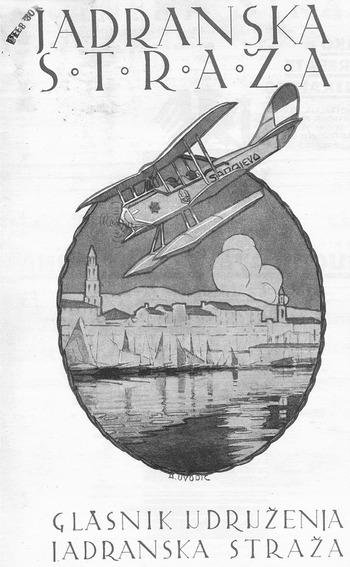
This cartoon shows how the sea became a marker of opposition, and how the Courier's vehemently anti-Italian narrative mobilized different aspects of daily life. This cartoon also echoes some previous threats by the Italian Association of Volunteers, which had circulated a pamphlet in Italian cities in the summer of 1929 that called for an armed crusade against Dalmatia and Split. The Adriatic Guard's audience could hear the nationalist cry of these volunteers: “[t]he horizon of the Roman Empire doesn't have borders… . The flame is burning in the hearts of volunteers and is concretized in one name: Split. We have weapons with which we will knock down the enemies in this disrespectful country.”Footnote 54 In response to this Italian Fascist propaganda, which found its source of legitimization in the legacy of Imperial Rome, the Adriatic Guard reasserted its commitment to Yugoslavia's territorial integrity and made use of highly suggestive and symbolically combative iconography on the journal's cover pages. The organization deployed images of submarines, boats, and seaplanes to serve its objectives. This iconography (see Figure 2 and Figure 3) performs a symbolic appropriation of Adriatic space for the association:
Figure 2:“Our submarine ‘Smeli’ (Brave).” Source: Jadranska straža, Glasnik udruženja, Jadranska straža 8, no. 8 (April 1930): 1.
Figure 3:The seaplane, “Sarajevo.” Source: Jadranska straža, Glasnik udruženja, Jadranska straža 8, no. 1 (January 1930): 1.
Images similar to “our submarine ‘Smeli [Brave]’” (Figure 2, April 1930) were relatively common displays in the Courier, which devoted a large number of its pages to praising the Yugoslav navy and army. The seaplane “Sarajevo” flying over the coast (Figure 3, painted by the artist Anđelo Uvodić), presented on the cover page of the January 1930 issue, completes the symbolic appropriation of Adriatic space: the depths of the sea, the water's surface, and the air can all be controlled by Yugoslavs.
The seaplane was named “Sarajevo” because the Adriatic Guard's Sarajevo section bought it with funds from a lottery and later donated the plane to an aviation school in Boka Kotorska, Montenegro. A seven-page article on the visit of the seaplane to Split asserted that the purchase of this seaplane was “as significant for the work of our association as for the progress of our maritime ideology.”Footnote 55 But to name the seaplane “Sarajevo” was also one of many rhetorical tools used to make the association's mission relevant for the entire country. “The sea and the coast are not the special property of Dalmatia, but a gate for the whole state. This is a window to the world, the lungs with which the state inhales free air,” emphasized the association's chief ideologue.Footnote 56 Hence, as with the association's maritime ideology, the defense of the country lay in the defense of both the Adriatic Sea and its adjacent territories. This task was presented as a national duty, and the Courier delineated the zones, in both the recent past and the current situation, where this duty should be carried out. Mapping what belonged to Yugoslavs was hence an essential element for the association's project of fostering a collective identity centered on the sea.
In this vein, the Courier discussed the country's borders on several occasions. It published articles with titles such as: “Our Western Border” (Naša zapadna granica), “Fights for Our Northern Borders” (Borbe za naše sjeverne granice), or “March of the Serbian Army to the Sea in 1912” (Pohod srpske vojske na more 1912)Footnote 57—a short list that does not mention the numerous articles published over the years with the title “Our Sea.” In one article entitled “Our Sea,” Niko Bartulović positioned the Adriatic space within the context of a national mythology relevant to the whole nation. “For us the Adriatic Sea is a sacred thing, more because of suffering than glory, like Kosovo,” referring, here, to the famous field near Priština in Kosovo where Ottoman Turks had defeated a Serbian-led coalition in 1389.Footnote 58 In 1932, Josip Jablanović, Tartaglia's successor as governor of the coastal district, described Kosovo as an idée-force [ideja-sila] or “key idea,” declaring that the time has come to create a new “key idea” with the concept of “our sea” [naše more].Footnote 59 Yet if the Kosovo myth belonged to Serb nationalist tradition, its significance could hardly be assumed for Yugoslavia's non-Serbian population. The same kind of problem regarding a myth's inclusiveness applied to an Adriatic myth as well.
Alongside using a symbolic iconography to express the defense of Yugoslav borders and making references to the Adriatic as a sacred space, the Adriatic Guard used a vocabulary with military connotations. The association called for “people who will organize the army of the Adriatic Guard,” to mirror the Italian association of volunteers who allegedly prepared a raid on Split, reminding readers in a dramatic tone that “the sea is the basis of our country's grandeur and progress; without a sea, Yugoslavia would be a slave and a toy to foreign will.”Footnote 60
As Italians and Yugoslavs engaged in such verbal parries, their tones grew increasingly aggressive. There was an obvious radicalization of late-nineteenth-century political positions on the question of nationality and intercommunal coexistence. Although Italian autonomists in Dalmatia had fought for bilingualism in the 1870s, their goals changed in the late nineteenth and early twentieth centuries to a strict defense of the Italian language.Footnote 61 Similarly, the territorial claims that Italy and Yugoslavia made in the wake of World War I were made in ethnonational terms and represented the relatively recent historical phenomenon in which a state claimed its right to a territory on the basis of an ethnic conception of the nation. The Adriatic Guard's endeavor to awake a maritime consciousness took place in this new political environment in the aftermath of World War I. The relative novelty of the proposed ideology of national oneness seems to have genuinely awakened people's interests only to decline during the 1930s. This is reflected in the Adriatic Guard's limited success in popularizing its maritime ideology. Despite its initial successes, and its numerous branches in the whole country, the Adriatic Guard lost its impetus as a pan-Yugoslav organization in the course of the 1930s. Indeed, the particular postwar context may in fact have been crucial, if not essential, to the Adriatic Guard's early success.
The qualitative difference between riots that had occurred in the nineteenth century among Dalmatian, Italian, and Slav nationalists and similar incidents during the interwar period are other examples of the radicalization of nationalist tensions in the region. Although both involved forms of ethnic violence, the former were local in character; whereas the latter were linked to the identity politics that concrete national ideologies promoted. One of the most important riots occurred in the city of Trogir, located 30 km north of Split, in December 1932, and resulted in dramatic diplomatic consequences between Yugoslavia and Italy.
On the night of 1 December 1932, the anniversary of the foundation of the Yugoslav state, members of the local Sokol chapter in Trogir destroyed statues and engravings of Venetian lions, local symbols that Italian Fascists often used to endorse their “historical” right to rule the eastern coast of the Adriatic.Footnote 62 What allegedly sparked this incident was the raising of the Italian flag at a local Italian school. Although city officials had at first denied this right to the Italians—in a misinterpretation of the Nettuno Conventions—the Belgrade government later reversed the decision and triggered fierce reactions among the local Slavic population.Footnote 63 Like the Adriatic Guard, the Yugoslav Sokols nurtured strong links to the Serbian crown. Hence, their actions in Trogir cannot be interpreted as an attempt to destabilize the country or as an antistate act motivated by a regional identity, but instead as an explicitly anti-Italian act.
The destruction of the St. Mark lions in Trogir was meant to demonstrate a spirit of resistance to Italians and to translate the Adriatic Guard's concept of collective identity into action. This incident aimed to establish Slavic authority over the eastern coast of Dalmatia. During the incident, both sides, Italian and Yugoslav, looked to the past for legitimization—and their conflicting visions of the past resulted in violence. Reacting to the destruction of the St. Mark lions, Mussolini asserted to Galli, his ambassador to Belgrade, that “it is impossible to stay silent on the Trogir acts of vandalism conducted against the symbols of our civilization [civiltà].”Footnote 64 Galli immediately complained to the Yugoslav Ministry of Foreign affairs about the “barbarian destruction of the Trogir lions,” stating that this act, as well as the destruction of the St. Mark lions on Krk in 1930, “hurt our feelings deeply.”Footnote 65
Fascist Italians, as previously noted, asserted their civilizing mission to the region and that this mission legitimized their national claims in Dalmatia. They claimed that local people appreciated these links to Italy, as Andrea Rainaldi, the Italian consul in Ljubljana, stated in a report on the anti-Italian movements in Yugoslavia:
[a]ll these people do not have hatred or dislike for us, and without saying that Italy, the Italians, and our government are really loved, after living in Croatia for a time, we have the impression that our country, our culture, our institutions are understood, and much more appreciated than are similar things, for instance French, English, American. People from the country [Dalmatia or Croatia] are inclined to find themselves better off in contacts with Italians than with Serbs.Footnote 66
In the aftermath of the Trogir incident and Mussolini's speech about it in the Italian Senate on 14 December 1932, Fascist groups protested in front of the Yugoslav consulates in Zadar and other Dalmatian cities. Although the Adriatic Guard did not explicitly criticize Italian reactions, it used the situation for its own benefit. Ljubo Karaman, an art historian who frequently published in the Courier, interpreted the Italians’ references to the St. Mark lions as establishing a claim to Dalmatia as proof of their “lack of better arguments.”Footnote 67 More important, however, was Tartaglia's speech given in Split on 25 December 1932 shortly after the meeting of little Entente Foreign ministers, who acknowledged that the Trogir incident prompted problems between Italy and Yugoslavia.Footnote 68 Reproduced as an editorial in January 1933, the speech did not explicitly address the Trogir incident, but the president of the Adriatic Guard reasserted that the Adriatic Sea is the “prerequisite for the Yugoslav state formation [za jugoslavensku državnu formaciju]” and dramatically reminded the readership that “today, as ever, the Adriatic is in a severe maelstrom of international complication, combination, and aspirations.”Footnote 69
Indeed, the tensions between Italy and Yugoslavia reached their apex in January 1933, when Belgrade believed that Italy was preparing to wage a preventive war against Yugoslavia. Even if the crisis decreased in intensity in February 1933, and was followed by a period of cooperation between Italy and Yugoslavia sparked in part by Hitler's accession to power on January 1933 and the common fears of a potential Anschluss, the Adriatic Guard continued to treat Italy warily.Footnote 70 In March 1933, a very caustic editorial written by the Adriatic Guard staff warned that people are “today farther from peace than they were right after the last war.” The article also reminded its readers: “[f]or the sake of [good] relations [with Italy] we have sacrificed the Julian Marches, Istria, the Kvarner, Zadar and Lastovo where about 700,000 of our people live. And let nobody be mistaken that this does not hurt us.” The article continued: “[s]ince fascism came to rule Italy, it seems to us that old Venetia has arisen. Every day brings attacks on our nation and country, and recently the motto ‘divide et impera’ has begun.”Footnote 71
All this demonstrates the ongoing importance of the Adriatic both to diplomatic disputes and to the Adriatic Guard's goal of awakening popular consciousness and implementing a specific development policy for the coastal regions. From the early 1920s, tensions over the Adriatic served the identity politics that the Adriatic Guard pursued. The goals of nationalist movements in Dalmatia, both Italian and Yugoslav, coincided, most of the time, with those of Mussolini's Italy or Alexander's Yugoslavia. Indeed, one can see these groups as proxies through which maximalist nationalist demands were voiced. For most of the interwar period, the objectives of the Adriatic Guard's goals matched those pursued by Yugoslav foreign policy. Yet, the existence of these groups was like a sword of Damocles hanging over the state authorities of Italy and Yugoslavia.Footnote 72 In the beginning of 1932, against the background of difficult relationships between both countries and Mussolini's attempts to use Croatian nationalism as strategic leverage against Yugoslavia, the Italian government nevertheless considered temporarily suspending irredentist publications such as Il Littorio Dalmatico, the organ of the Zadar-based Federazione fascista della Dalmazia. It gave special instructions to the editorial board not to publish articles about Yugoslavia with a hostile tone.Footnote 73
Both the Italian and Yugoslav governments carefully monitored the activities of nationalist associations. Galli, the Italian ambassador to Belgrade, observed at the end of 1931 “that one can infer from this information that there has been a diminution of [anti-Italian] agitation” and cited, among other examples, the fact that the “Jadranska Straza in Zagreb does not seem, for the time being, to be carrying out any significant anti-Italian activity, thanks either to the economic depression, or to a shortage of funding.”Footnote 74 Interestingly enough, the Courier also stopped publishing its “News from Italy” section in 1931.
This indicates a policy of moderation vis-à-vis Italy, but the reasons behind this alleged “appeasement” are intriguing. On the one hand, the Adriatic Guard's editorial policy was consistent and clearly established its discourse, as well as its cultural and social actions, as a form of resistance to Italian threats. But it is worth mentioning that the association never promoted direct or violent actions against Italians and Italy. In this respect, the lack of “any significant anti-Italian activity” from the Zagreb branch of the association mentioned in Galli's note does not challenge the Adriatic Guard's strategy of fostering a collective identity among Yugoslavs. Instead, it suggests the inadequacy of the association's financial means and hints at the uneven management of the Adriatic Guard's branches. Although some branches were relatively well managed and very active, others apparently struggled to survive. On the other hand, the restructuring of the Yugoslav state in 1931, with the promulgation of a new constitution and the reconvening of the parliament, attempted to appease both domestic and international public opinion. Although it has not yet been confirmed, it is possible that Yugoslav authorities may have issued directives to the Guard in 1931, as well as in December 1932 and in the first months of 1933, to mitigate the Guard's bitter criticism of Italy. This could explain why the Courier did not reply to or comment explicitly on the Trogir incident. The spring of 1933 now called for warmer relations, and the dramatic tone the Adriatic Guard so frequently used to talk about the Apennine peninsula became embarrassing for the Yugoslav foreign policy and the Belgrade government.
Conclusion
Political struggles in interwar Yugoslavia can be regarded as a site where new collective identities were formed, debated, and transformed. Although the collective identity that the Adriatic Guard promoted was the by-product of the unitarist Yugoslav state ideology, in fact the Adriatic Guard offered a subtle alternative understanding of both the self and the nation to official ideology. The organization employed extensive rhetorical and material efforts to invite each region of the country to embrace its maritime ideology and to participate in its two-fold mission: first, to transform people's consciousness, to make them realize that the Adriatic Sea embodied their essence, and its centrality to the future of their country; and, second, to transform Yugoslavia into a sea-oriented country. This challenging task was supported by a set of strategies that I call identitarian, because the Adriatic Guard evoked, by way of persuasion, a series of common elements of identification that Yugoslavs allegedly shared: nationality, language, duties, and interests.
This assessment of the Adriatic Guard's endeavor to mobilize the Adriatic Sea as the core of a Yugoslav collective identity demonstrates the association's indisputable impact on the population of Yugoslavia. The association's large membership, its leadership composed of political and literary personalities, its monthly journal, published from 1923 to 1941, and the vast array of activities it offered to the Yugoslav population bear witness to this success. Yet, the association also failed in its ultimate goal—to transform Yugoslavia into a sea-oriented country. The reasons for this are multifold, but differences over whether Yugoslavia constituted a unitary state or whether it was to be seen as “greater Serbia” played a central role in its failure. The debate over the national question in which the Adriatic Guard implicitly took part was not framed in terms of federalism versus centralism, but rather in terms of how to anchor the conceptual basis of unitarist Yugoslavism. It is this aspect that makes the study of the Adriatic Guard's identity politics even more interesting for scholars of interwar Yugoslavia and the Balkans in general.
Although the Adriatic Guard did not engage—at least not publicly—in the disputes between the Croatian national movement and Serbian nationalist interests in its defense of strict centralism, the association's objectives may have progressively been interpreted as working in favor of Croatian interests. This certainly would have jeopardized the association's influence, as did the disagreements within the association or those between the association and Belgrade. At the same time, however, these internal disagreements prevented the organization from being transformed into a platform either for Croatian or Serbian nationalist extremism. In 1941, the organization was dismantled, and extremists such as Niko Bartulović channeled their energy into other structures, such as (in Bartulović's case) the četnik movement. Additionally, some Dalmatians and other coast-dwellers may have reconsidered their strategy of turning toward Belgrade in order to protect the Adriatic adequately from Italian threats. Hence, the original organization's principles gradually lost their foundation as the importance of the Italian menace diminished and disillusionment about Belgrade's willingness to work seriously for the development of Dalmatia and other coastal regions increased during the 1930s.
For most of its existence, the Adriatic Guard evolved in a climate of territorial, political, and ideological instability. This particular environment served the association's ideological purpose well, but the inability of the Adriatic Guard to find lasting and concrete solutions transformed the tensions between Yugoslavia with Italy into a burden. These tensions were not new and would not soon fade. The “Adriatic Question,” sparked by Italian and Yugoslav conflicts over the territorial division of Dalmatia, the Kvarner, Istria, and the Adriatic islands, only found a temporary solution with the Treaty of Rapallo, signed in 1920. Throughout the twentieth century, the “Adriatic Question” reemerged on several occasions, under other forms and variable lengths: during the interwar period with the Trogir incident of 1932, after World War II with stalemate over Trieste that lasted until 1954, and in 1975, with the Treaty of Osimi, which definitively settled the maritime borders and the Trieste issue between Italy and Yugoslavia. The study of the Adriatic Guard and its identity politics therefore offers us a way to reassess the roles that the Adriatic Sea played not only in the evolution of Yugoslavia, but also in people's lives.






 You have
Access
Throughouthistory, Mediterranean cultures have tried to appropriate, with words or weapons, the sea that surrounds them. Sometimes called the “Inner Sea,” “Superior Sea,” or “Great Sea,” the Mediterranean was designated by the Greeks—as the Odyssey testifies—as theirs, “Our Sea.”Footnote 2 In the 1920s, Mussolini revived the Latin mare nostrum to justify the “Italian-ness” of the Mediterranean (and, by extension, of the Adriatic Sea and its immediate eastern coastline, Dalmatia), an act that marked a new step in a long-term process that placed the Mediterranean and Adriatic seas at the core of national identity politics. Yugoslav ascriptions of the adjective “Yugoslav,” or even “Slavic,” to the Adriatic Sea during the interwar period proceeded from the same desire: to appropriate a space in order to articulate a national discourse.Footnote 3
This article explores such discourse through the case study of the interwar Yugoslav association Jadranska Straža (the Adriatic Guard), whose name embodies its raison d’être. I examine how, in the association's monthly journal The Adriatic Guard, Courier of the Adriatic Guard Association [Jadranska Straža, Glasnik udruženja Jadranska Straža] (hereafter Courier) between 1929 and 1933, the Adriatic Sea was mobilized as the spatial, cultural, political, and economic core of what it meant to be Yugoslav, and how this concept of the Adriatic could help the Slavic inhabitants of Yugoslavia to cultivate a collective sense of belonging.Footnote 4
Established in the Dalmatian city of Split in 1922, at a moment of high tension with Italy, the Adriatic Guard aimed to awaken Yugoslavs’ consciousness of and love for the Adriatic Sea, to encourage its defense (both cultural and military), and ultimately to transform Yugoslavia into a sea-oriented nation. The association's activities were extremely diverse, ranging from the establishment of popular and academic publishing houses to the purchase of a school boat for youth, the organization of summer camps, and the promotion of international tourism to the country.Footnote 5
Every subject on which the Courier touched, however—whether domestic or international politics, history, culture, wildlife, or tourism—used the Adriatic Sea as a point of reference. Given Italy's and Yugoslavia's competing claims on the Adriatic, the Courier mobilized a specific narrative that portrayed the Adriatic as a pivotal point in the matrix of Yugoslav national unity and demanded that more resources be allocated to the development of Yugoslav coastal and island areas. This request, reiterated throughout the interwar period, eventually produced a growing resentment among the Adriatic Guard's members themselves, as disagreement grew between the Belgrade authorities’ continental visions for the country's development and the Adriatic Guard's more sea-oriented ones. The Adriatic Guard's narrative hinged on the ontological meaning that the Adriatic held for Yugoslavs: the state ideology of national oneness [narodno jedinstvo], the Italian threat, the underdevelopment of the coast, and the need to defend the Adriatic Sea in order to enable a collective national experience in Yugoslavia.
Although the journal's authors did not frame their discourse in terms of collective identity, nor was the term “identity” even in use at that time, one can, in retrospect, interpret the Adriatic Guard's narratives as attempts to stimulate a particular Yugoslav maritime-oriented identity and to encourage state, regional, and local initiatives in this direction.Footnote 6 Recognizing that the concept and term “identity” are ambiguous, I equate in this article the term “identity politics” with the specific agenda that the Adriatic Guard promoted.Footnote 7 The association continuously promoted recognition of Yugoslavia's ethnic, cultural, and political rights on the sea and its adjacent northeastern and eastern territories. These attempts rested not only on geostrategic calculations, but also on emotional national appeals that mirrored and were intertwined with the newly established kingdom's own often clumsy search for national cohesion.Footnote 8 In this respect, the Adriatic Sea was central to the idea that Yugoslavs share common attributes (language, nationality), interests, and duties (military or otherwise). Disagreements occurred over the Adriatic Guard's understanding of exactly what those common attributes and interests among Yugoslavia's inhabitants were, but for the purpose of this article, what is significant is that the association identified elements for conceiving a collective identity and suggested a platform to promote it.Footnote 9 With its network of local branches and publications, the Adriatic Guard provided a structure through which people endorsing the organization's views could express and share their views with their fellow-countrypeople.
The concept of a collective national experience was, however, marked by inner conflicts. The Adriatic Guard's executive board and membership were neither politically nor ethnically homogeneous,Footnote 10 and some key members of the association experienced very different trajectories in their political lives. This fact sheds light on the qualified political successes of the association. Although the Adriatic Guard may have accomplished its goal of awakening Yugoslavia's inhabitants’ consciousness, it failed to achieve its ultimate objective of transforming Yugoslavia into a maritime country, despite the support it received from Belgrade based on its commitment to unitary Yugoslavism. This failure can be explained primarily by the growing gap between “Adriatic” and “continental” conceptions of the country's needs. Indeed, over the course of the 1930s, the Adriatic Guard became a troublesome association for Belgrade (just as Italian irredentist associations did for Rome at the same moment), one that criticized state policies, albeit mildly, and one whose vehemently anti-Italian tone at times harmed Yugoslavia's relationship with Italy.
The Adriatic Guard: An Association for a New Space, New Time, and New Tasks
In late 1918, directly after World War I—a period during which international boundaries were mapped and remapped—a new entity appeared in the South Slavic political landscape: Yugoslavia. The new state, with its administrative and political structures, not only impacted people's daily lives, but it also redefined the boundaries of their political and cultural space on both land and sea. The Adriatic periphery between Italy and Yugoslavia (including the Julian Alps, Istria, the Kvarner, and Dalmatia) was politically redefined according to diplomatic efforts.Footnote 11 Both Slavs and Italians and, more importantly, nationally mixed or unidentified persons populated this area. This resulted in diplomatic, social, and cultural tensions surrounding the question of state borders.
The so-called “Adriatic Question”—the territorial conflict between Italy and the Kingdom of Serbs, Croats, and Slovenes after World War I—inflamed discourse and mobilized action among both Italian and Yugoslav nationalists.Footnote 12 In 1920, however, Italy and Yugoslavia reached an agreement with the Treaty of Rapallo that set the borders between Italy and Yugoslavia and established Yugoslavia's maritime borders at a little more than 1,500 km. The Pact of Rome (1924) and Nettuno Conventions (1924–1925) solved other details, such as the economic, legal, and cultural rights of Italians in Dalmatia. For a time, tensions seemed to be appeased. However, neither the Treaty of Rapallo nor the Pact of Rome ever fully solved the “Adriatic Question,” which remained a constant bone of contention throughout the interwar period.Footnote 13
From its founding during this turbulent context, the Adriatic Guard demonstrated a faithful adhesion to the Yugoslav state, which, it believed, would provide the necessary resources to develop the coastline. The association's univocal support of the new state was not a surprise, given that its founders and first promoters included politicians and persons such as Juraj Biankini,Footnote 14 a member of the Democratic Party [Demokratska Stranka], Ivo Tartaglia,Footnote 15 mayor of the city of Split, and Silvije Alfirević, who leaned toward Serbian national ideology and before 1914 had written for Zastava, a Split-based newspaper supporting Yugoslavism.Footnote 16
Despite the Treaty of Rapallo, the Italian threat remained real for many Yugoslavs, given that Italian claims to the eastern Adriatic coast and islands found supporters among Italian Fascists and irredentist movements. The establishment of a defensive maritime association was the logical outcome.Footnote 17 The Adriatic Guard framed its role as a national one, stressing the fact that no other association like it existed in the country. Its essential goal was “the creation of a maritime consciousness” [stvaranje pomorske svijesti] among Yugoslavia's inhabitants, and its rhetoric encouraged Yugoslavs to transform their way of thinking and talking about the sea and themselves. The association's journal, for instance, characterized the Adriatic Sea as the element from which the Yugoslav nation found its specific identity and strength, connecting all Yugoslavs as individuals and as members of a single nation. Whenever the journal specifically named the Croatian, Serbian and Slovenian nations, the Courier always mentioned all three of them together (as in the state language formula of a three-name nation) and described their members as Yugoslavs [Jugosloveni] or components of “our nation,” the Yugoslav nation [Jugoslovenski narod]. This orthodox usage followed official state policy which, from the beginning of King Alexander's dictatorship in 1929, systematically nurtured the concept of unitarist Yugoslavism, i.e., that Serbians, Croatians, and Slovenians constituted tribes that belonged to the same nation.
The popularization of its “maritime ideology” [pomorska ideologija] throughout the country was part of the Adriatic Guard's agenda from its beginnings. This “maritime ideology” was not meant to supersede official national ideology, but rather to complement and reinforce it. The first step in implementing this agenda was to persuade people to perceive the sea as being of prime importance to their lives and to the country's future. In August 1930, Adriatic Guard ideologue Niko Bartulović reiterated in the pages of the Courier that all regions of the country owned the coastline and benefited from its development. “Maybe the Sava and the Danube have a primary importance for the regions they cross, but the sea, in a certain way, attracts the interest of all.” Explaining that the sea was not yet used to its full potential as an outlet, he added that: “as soon as [roads leading to the sea] are [built], the sea will be the property of Šumadija and Vojvodina [regions respectively located south and north of Belgrade], just as it is for the coastal regions of Dalmatia… . To create a maritime mentality … means to create an honest conviction that continental interests cannot be secured without maritime [interests].”Footnote 18
Speaking in 1932 about the spirit of the association, Bartulović explained that in addition to “the creation of a maritime consciousness,” the Guard sought to “[try to make] Yugoslavs feel [as if they were members of] a coastal nation [primorski narod] whose governmental policy—national, economic, social and cultural—ought to link continental interests and the needs of all with maritime development.”Footnote 19 The Adriatic Guard emphasized the pragmatic purposes of its goals and ideology. The Courier indeed constantly emphasized that military investments in the Yugoslav navy were vital for the country, as was the economic development of the sea, islands, and coastline, which would provide prosperity to the whole country. These actions were tremendously important not only for internal reasons, but also as a response to Italian Fascists, who actively promoted the Adriatic Sea and its eastern coast as their own.Footnote 20 Defending the sea became a corollary to defending the nation. All these principles constituted a prospective framework for creating a collective identity among Yugoslavs.
In analyzing how and in what circumstances the Adriatic became crystallized as a space of identity, the crucial question is: To what extent was the Adriatic Guard successful in reaching people and shaping their collective identity? Although it remains difficult to provide conclusive answers to this question, the Adriatic Guard was certainly the largest association in interwar Yugoslavia. At the end of 1931, at a time when Yugoslavia's population was about 14 million, it had 507 branches in all regions of the country with 70,000 adult members plus 20,000 children. By the end of the decade, membership reached 180,000 according to Mladinić.Footnote 21 Moreover, the Adriatic Guard was the only organization, alongside the Red Cross, whose activities reached into Yugoslav secondary schools.Footnote 22 All of this indicates a level of popular success. The Adriatic Guard was not a political organization, nor did Belgrade directly subsidize it; the association relied upon support from its membership and private donations. The association's links to official circles suggest, however, that the government may have provided some help to the Guard on different occasions. In the late 1920s, for example, at the association's Belgrade section's request, the Ministry of Commerce purchased copies of its annual almanac.Footnote 23
More important to the present analysis, however, is the fact that the association always sought to be inclusive. It pictured itself as a national and patriotic organization rallying the whole nation “without differentiating between classes, tribes [read ethnic groups], and beliefs, because it [the association] belongs to all of us, Serbs, Croats and Slovenes, as does the sea.”Footnote 24 This assertion, as the Adriatic Guard's president, Ivo Tartaglia, expressed at its second congress in Sarajevo in August 1929, clearly supported a political conception of the country based on unitary Yugoslavism. Ivo Rubić, one of Tartaglia's important collaborators and main secretary of the organization from 1939, wrote what the journal referred to as an “ideological article” that underlined this political side. Rubić explained that the Adriatic Guard was open to all Yugoslavs and that it wanted “to defend the Yugoslav soul, which does not divide us by religion nor by tribe, but unites us as a whole through our love for our sea.”Footnote 25 It is hence surprising to read in Mladinić's 2005 monograph on the Guard that the association's position and editorial direction were apolitical.Footnote 26 One could also point out that support for the Karađorđević dynasty was the sine qua non condition for an association to publish or even exist during King Alexander's dictatorship (1929–1934).
A close examination of the journal reveals that the association was highly political. The journal's editors were not pleased with articles that touched upon politics only indirectly—those on culture or tourism—and the editorial board never hesitated to write about political topics and to enhance (in a sometimes hagiographic way) King Alexander and the Serbian dynasty. Moreover, a more subtle examination of the association's evolution reveals that latent conflicts existed within it, even if it maintained the goal of promoting a collective identity around the Adriatic Sea. As I will explain in the following section, this goal was not without its difficulties. In the 1920s, the Adriatic Guard's leadership balanced between the interests of the Democratic and Radical parties, and the attractiveness of the Croatian national movement also grew among both the Guard's leadership and membership. Additionally, doubts about the sustainability of the unitarist project of Yugoslavism flourished unmistakably in the 1930s.
Hopes under King Alexander's Dictatorship: From Harmony to Dissonance
The Adriatic Guard demonstrated a faithful adhesion to Yugoslav state policies from its inception. In the person of the king, it found an official supporter; and the Guard appointed the King to a kind of honorary presidency, a gesture that demonstrated its strong commitment to the Serbian dynasty. Although this may have reflected the leadership's genuine political leanings, it also rested on the hope that the new state would provide resources to develop the coastline. These initial hopes were dashed, however, over the course of the 1920s, as a series of misunderstandings and conflicts arose, most commonly over what the Adriatic Guard perceived as the government's neglect of the problems and needs of the people living on Adriatic islands or in Dalmatia.
In this context, it is not a surprise that, as the first 1929 issues of the journal note, the association welcomed the king's proclamation of 6 January 1929, which dismissed the parliament, banned political parties, and heralded his personal dictatorship as good news. In fact, this positive reaction was widely shared among Croatian citizens and politicians, among them Vladko Maček, who saw in the proclamation a desire by the king to answer Croatian political demands.Footnote 27 At last, thought the Adriatic Guard, the king will fully support the association's goals, just as the appointment of Ivo Tartaglia as ban (regional governor) of the administrative territory of the coastline district [Primorska Banovina] will guarantee the organization's success. This hope, however, proved to be wrong.
Just as the king expressed it in his proclamation, the Courier interpreted the dictatorship as a historic opportunity to settle the country's problems. In a programmatic article, journal editor Silvije Alfirević announced the national task that awaited the association: “[u]nder the slogan of the historical proclamation, bearer of a happy era …, the Adriatic Guard will further develop its work and educate its members to unitarist thought and unitarist will, always serving the King and the Fatherland loyally and devoutly.”Footnote 28 On the occasion of the association's tenth anniversary in 1932, Ivo Tartaglia even credited its existence to the young Alexander's short visit to Split in 1908, when the city had still been part of Austria-Hungary.Footnote 29 The Adriatic Guard's submission to state ideology allowed it not only to keep its activities alive under the dictatorship but also to develop them further. The association's maritime ideology did offer a variation on the state ideology of “national oneness.”
Equally important to an understanding of the Adriatic Guard's evolution, however, was an internal conflict that also affected its relation to the government, over two subtly different interpretations of the meaning of the slogan “national oneness.” Although supporters of the Radical and Democrat parties used the same slogan, the former understood it as a means to secure Serbian hegemony over the entire country through centralism, and the latter perceived centralism as the best precondition for the maturation and the blossoming of a “genuine” Yugoslav nationality.Footnote 30 The lack of a definitive stand about “national oneness” caused some friction. Members of the association supported the official ideology without envisioning Yugoslavia as a kind of Greater Serbia, whereas the National Radical Party [Narodna Radikalna Stranka] saw Yugoslavia precisely as Greater Serbia.
A quarrel in the mid 1920s over the transfer of the association's headquarters from Split to Belgrade illustrates this conflict. This conflict pitted the association's Split-based leadership against its Belgrade section, led by the Radical Ljubomir Jovanović;Footnote 31 and even though the conflict was resolved in favor of Split, unresolved tensions became a source of further conflicts within the association. The Democratic Party, which appealed to many Croats in Dalmatia, seemed to find an echo among the association's leadership. Moreover, Orjuna, the Democratic Party's paramilitary Organization of Yugoslav Nationalists, cultivated ties with the Adriatic Guard. Footnote 32 It is not a paradox that the Adriatic Guard's ideologues Niko Bartulović and Ivo Lahman participated in Orjuna's activities in the 1920s. Indeed, this organization—considered terrorist by many—defended, in its most extreme applications, the views of an integral and centralist state.Footnote 33
Ever since the creation of Yugoslavia in 1918, Dalmatians—whether Croats or members of the Adriatic Guard—cultivated hopes for the economic development of the coast. Unfulfilled, these hopes gradually transformed into deep disappointment.Footnote 34 Disillusioned by King Alexander's regime, for example, Ivo Tartaglia resigned from his position as governor of the coastal district in June 1932.Footnote 35 Tartaglia did not openly voice his disappointment within the Courier, but he did express reservations about what he saw as the country's ill-conceived continental vision of the country.Footnote 36 Soon after, Tartaglia became close to the Croatian politician Vladko Maček and the Croatian Peasant Party [Hrvatska seljačka stranka] and in 1934 became the editor in chief of the pro-Croatian Peasant Party newspaper Jadranski dnevnik.Footnote 37 Some members of the Croatian Peasant Party (including Maček) even became members of the Adriatic Guard.Footnote 38
The contrasting personal trajectories of the two main editors of the Courier in the 1930s provide evidence of latent centrifugal forces within the Adriatic Guard. Niko Bartulović (born in Stari Grad on Hvar) was also editor of Pobeda, the organ of Orjuna, during the 1930s and sided with the četnik movement during World War II. On the other hand, Jakša Ravlić (born in Makarska), the lone editor of the journal after February 1931, had an utterly different itinerary: He had a literary academic career in Zagreb and was president of the cultural institution Matica hrvatska from 1954 to 1968.Footnote 39
With regard to these opposite trajectories, it is legitimate to ask why the Adriatic Guard did not implode before its forced suppression shortly after the fall of Yugoslavia in 1941. The strong conviction shared by the association's leadership about the development of the Adriatic coast proved to be a sufficient bond to hold it together. This conviction, which clashed with the “continental” government's vision of the country's future, played a cohesive role, but only for a limited period of time. Late in the 1930s, despite its obvious limited potential, the Serbian leadership's interest continued to focus primarily on gaining Yugoslav access to the port of Thessaloniki in Greece.Footnote 40 The continentally oriented Belgrade government showed little interest in the development of the Adriatic coast, probably because of the Serbian position that it was better not to develop the Dalmatian coast if Belgrade could not exert full authority over it, a position that became a growing source of resentment for the Adriatic Guard. Ultimately, the government's position fed the growing disappointment among the Adriatic Guard's members and leadership.
If the Adriatic Guard's criticism of governmental policy was initially extremely mild, the tone sharpened in the beginning of 1933. In January of that year, the president, Tartaglia, pointed to the “wrong” perception that some Belgrade officials held, even quoting an “administrator of one of the biggest national transport enterprises”:
Our country does not have any interest in solving the transport issue on our Adriatic coast. For the interests of our country, this coast lost importance because it is separated from the rich interior by the Velebit and the Dinaric ranges. Therefore, the Danube, which passes through the richest regions and leads us to the sea [the Black Sea], is more important for our country.Footnote 41
With regard to this issue, Belgrade's lack of interest may also have reflected a decline in enthusiasm among continental-dwellers for the Adriatic Guard's mission. If the association established branches in every region of the country in the course of the 1920s, this countrywide support dwindled in the course of the 1930s. At the end of this decade, the least active branches were all located in the eastern and southeastern parts of the country in the cities of Priština, Kragujevac, Cetinje, and Zaječar; whereas the most dynamic branches were positioned along an arc that included the cities of Novi Sad, Osijek, Zagreb, Maribor, Ljubljana, Sušak, and Split.Footnote 42
Some historians have attempted to analyze Belgrade's initiatives—political, cultural, economical, and military—to develop and establish its authority on the Dalmatian coast, but a comprehensive study has yet to be undertaken.Footnote 43 Did Belgrade officials express a genuine understanding of the issues involved in the development of the coast? Did those with such an understanding exclusively fill the ranks of the Adriatic Guard's section in the capital? All things considered, the Adriatic Guard's discourse in the 1930s might almost be read as double discourse. The paradox lay in the fact that although the association always supported the unitarist conception of Yugoslavism, its desire to improve the situation in Dalmatia could also be understood as a defense of Croatian interests.
The Adriatic Sea: Space of Conflicts and Identity
Real or fictive, Italian military and cultural threats to Dalmatia fed the Adriatic Guard's discourse, as well as several political debates in the interwar period. Fears of Italy boosted support in Dalmatia for unitary Yugoslavism or, at least, for bringing regional or Croat nationalists under the aegis of Belgrade. Although one has to be careful not to overemphasize this general assertion, the tense political climate helps to explain the Adriatic Guard's relative success and the functions the association played in interwar Yugoslavia.Footnote 44 As part of its strategy to outline the constitutive elements of a collective identity, the association explained what Yugoslavs were and where they stood by repeatedly comparing the Adriatic Guard to Italian nationalist associations and Yugoslavia to Italy.Footnote 45
This strategic endeavor placed the Adriatic Sea at its center. The Guard interpreted tensions between Italy and Yugoslavia and their diplomatic relations with other European states, such as France, in terms of a fundamental quarrel over Adriatic space. In order to justify Yugoslavs’, rights to the Adriatic and its eastern coast, distinguished members of the Adriatic Guard, such as university professors, published articles in the Courier, as well as brochures and books, in which they attested the early presence of Slavs on the Adriatic and their positive role in the region in a scholarly manner.Footnote 46 These works constituted a direct reply to Italian irredentists and Fascists who portrayed Slavs as barbarians and Yugoslavs as unable to govern their state.Footnote 47 Italian extremists simply reappropriated the “ideological affirmation of difference” that “civilized” Venice previously developed in the eighteenth century toward the “barbaric” Slavs, as Larry Wolff demonstrates in his study of Venice's intellectual discovery of Dalmatia.Footnote 48 The Adriatic Guard also used this intellectual device to benefit its identity politics.
For example, in short pieces addressed to different European circles (a book review published in English in 1928 for The Slavonic and East European Review or a review in Czech of one of his lectures in Prague in 1930), Niko Bartulović presented the idea that the Adriatic Guard's mission was defensive, whereas the goals of Italian associations such as Adriatico Nostro were purely offensive. Bartulović explained to his English-speaking audience the thoughtful position of Yugoslavs: “[w]hereas the most radical of Jugoslav [sic] contentions does not look farther than Istria, which means that it divides the Adriatic in two, the larger share being Italy's, the Italian point of view would claim the whole Adriatic for itself,”Footnote 49 or to his Czech-speaking audience: “[w]e are not megalomaniac, we do not assert that the Adriatic Sea must be our lake… . Our thesis is that all nations that live around the Adriatic Sea must freely use it for their own basic interests.”Footnote 50 Bartulović's aim is clear: to present Yugoslavs and the Adriatic Guard as reasonable and thereby assert their moral superiority over Italians and their associations.
In this vein, Bartulović went so far as to reverse the statements of those who considered Slavs barbaric to their own detriment. In November 1929, in an article entitled “Victory of the Race,” Bartulović reminded them that “they are closer to falling than us.” He explained: “[t]he natural laws similarly apply … to individuals as to nations: youth [equated to barbarian nations], prime of life and old age [equated to wise nations]. We can only be happy that we are still close to youth.”Footnote 51 Bartulović helped establish a distinctive historical narrative that positioned the contemporary conflict between Yugoslavs and Italians in a longer temporality. He explained that Renaissance writers such as Marulić, Hektorović, Lucić, or Držić went to school to Italy and mastered both Latin and Italian, but that their poetry was spontaneously recited in the “language of the race,” that is, their “national language,” which Bartulović purposely neglected to describe as either Croatian or Serbo-Croatian.Footnote 52 This type of article, which presented an implicit cultural competition with Italian culture, was commonplace in the Courier. This discourse, as well as the rhetoric about the fatherland in danger, helped to foster a collective identity whose rationale was partly based on comparisons with Italians and Italy. In other words, the cognitive understanding of what it meant to be Yugoslav was commonly framed in terms of what Yugoslavs were not and what Italians were.
The fear that the Italian threat generated among the Yugoslavs served the Adriatic Guard's long-term goals well. The Courier often reminded its audience that it was the only Yugoslav national organization taking care of “our” sea, whereas several Italian organizations were organizing a massive propaganda effort toward “our” (in the Adriatic Guard's words) Adriatic. Several times a year, starting in 1929, readers of the Courier encountered a section entitled “news from Italy” [glasovi iz Italije], a critical assessment of articles published in Italy or by Italian newspapers in Dalmatia. Even if these critics made use of humor (see the cartoon in Figure 1), the tone was often alarmist. The caption of the cartoon, whose upper part shows the Italian coast and lower part the Yugoslav coast of the Adriatic, reads as follows: “On the Beach” [the café owner in the top left of the picture says:] “I will need to kill my competitor so that his guests finally see that I am a hospitable café owner.”Footnote 53
“On the Beach.” Source: Jadranska straža, Glasnik udruženja, Jadranska straža 8, no. 8 (August 1930): 234.
This cartoon shows how the sea became a marker of opposition, and how the Courier's vehemently anti-Italian narrative mobilized different aspects of daily life. This cartoon also echoes some previous threats by the Italian Association of Volunteers, which had circulated a pamphlet in Italian cities in the summer of 1929 that called for an armed crusade against Dalmatia and Split. The Adriatic Guard's audience could hear the nationalist cry of these volunteers: “[t]he horizon of the Roman Empire doesn't have borders… . The flame is burning in the hearts of volunteers and is concretized in one name: Split. We have weapons with which we will knock down the enemies in this disrespectful country.”Footnote 54 In response to this Italian Fascist propaganda, which found its source of legitimization in the legacy of Imperial Rome, the Adriatic Guard reasserted its commitment to Yugoslavia's territorial integrity and made use of highly suggestive and symbolically combative iconography on the journal's cover pages. The organization deployed images of submarines, boats, and seaplanes to serve its objectives. This iconography (see Figure 2 and Figure 3) performs a symbolic appropriation of Adriatic space for the association:
“Our submarine ‘Smeli’ (Brave).” Source: Jadranska straža, Glasnik udruženja, Jadranska straža 8, no. 8 (April 1930): 1.
The seaplane, “Sarajevo.” Source: Jadranska straža, Glasnik udruženja, Jadranska straža 8, no. 1 (January 1930): 1.
Images similar to “our submarine ‘Smeli [Brave]’” (Figure 2, April 1930) were relatively common displays in the Courier, which devoted a large number of its pages to praising the Yugoslav navy and army. The seaplane “Sarajevo” flying over the coast (Figure 3, painted by the artist Anđelo Uvodić), presented on the cover page of the January 1930 issue, completes the symbolic appropriation of Adriatic space: the depths of the sea, the water's surface, and the air can all be controlled by Yugoslavs.
The seaplane was named “Sarajevo” because the Adriatic Guard's Sarajevo section bought it with funds from a lottery and later donated the plane to an aviation school in Boka Kotorska, Montenegro. A seven-page article on the visit of the seaplane to Split asserted that the purchase of this seaplane was “as significant for the work of our association as for the progress of our maritime ideology.”Footnote 55 But to name the seaplane “Sarajevo” was also one of many rhetorical tools used to make the association's mission relevant for the entire country. “The sea and the coast are not the special property of Dalmatia, but a gate for the whole state. This is a window to the world, the lungs with which the state inhales free air,” emphasized the association's chief ideologue.Footnote 56 Hence, as with the association's maritime ideology, the defense of the country lay in the defense of both the Adriatic Sea and its adjacent territories. This task was presented as a national duty, and the Courier delineated the zones, in both the recent past and the current situation, where this duty should be carried out. Mapping what belonged to Yugoslavs was hence an essential element for the association's project of fostering a collective identity centered on the sea.
In this vein, the Courier discussed the country's borders on several occasions. It published articles with titles such as: “Our Western Border” (Naša zapadna granica), “Fights for Our Northern Borders” (Borbe za naše sjeverne granice), or “March of the Serbian Army to the Sea in 1912” (Pohod srpske vojske na more 1912)Footnote 57—a short list that does not mention the numerous articles published over the years with the title “Our Sea.” In one article entitled “Our Sea,” Niko Bartulović positioned the Adriatic space within the context of a national mythology relevant to the whole nation. “For us the Adriatic Sea is a sacred thing, more because of suffering than glory, like Kosovo,” referring, here, to the famous field near Priština in Kosovo where Ottoman Turks had defeated a Serbian-led coalition in 1389.Footnote 58 In 1932, Josip Jablanović, Tartaglia's successor as governor of the coastal district, described Kosovo as an idée-force [ideja-sila] or “key idea,” declaring that the time has come to create a new “key idea” with the concept of “our sea” [naše more].Footnote 59 Yet if the Kosovo myth belonged to Serb nationalist tradition, its significance could hardly be assumed for Yugoslavia's non-Serbian population. The same kind of problem regarding a myth's inclusiveness applied to an Adriatic myth as well.
Alongside using a symbolic iconography to express the defense of Yugoslav borders and making references to the Adriatic as a sacred space, the Adriatic Guard used a vocabulary with military connotations. The association called for “people who will organize the army of the Adriatic Guard,” to mirror the Italian association of volunteers who allegedly prepared a raid on Split, reminding readers in a dramatic tone that “the sea is the basis of our country's grandeur and progress; without a sea, Yugoslavia would be a slave and a toy to foreign will.”Footnote 60
As Italians and Yugoslavs engaged in such verbal parries, their tones grew increasingly aggressive. There was an obvious radicalization of late-nineteenth-century political positions on the question of nationality and intercommunal coexistence. Although Italian autonomists in Dalmatia had fought for bilingualism in the 1870s, their goals changed in the late nineteenth and early twentieth centuries to a strict defense of the Italian language.Footnote 61 Similarly, the territorial claims that Italy and Yugoslavia made in the wake of World War I were made in ethnonational terms and represented the relatively recent historical phenomenon in which a state claimed its right to a territory on the basis of an ethnic conception of the nation. The Adriatic Guard's endeavor to awake a maritime consciousness took place in this new political environment in the aftermath of World War I. The relative novelty of the proposed ideology of national oneness seems to have genuinely awakened people's interests only to decline during the 1930s. This is reflected in the Adriatic Guard's limited success in popularizing its maritime ideology. Despite its initial successes, and its numerous branches in the whole country, the Adriatic Guard lost its impetus as a pan-Yugoslav organization in the course of the 1930s. Indeed, the particular postwar context may in fact have been crucial, if not essential, to the Adriatic Guard's early success.
The qualitative difference between riots that had occurred in the nineteenth century among Dalmatian, Italian, and Slav nationalists and similar incidents during the interwar period are other examples of the radicalization of nationalist tensions in the region. Although both involved forms of ethnic violence, the former were local in character; whereas the latter were linked to the identity politics that concrete national ideologies promoted. One of the most important riots occurred in the city of Trogir, located 30 km north of Split, in December 1932, and resulted in dramatic diplomatic consequences between Yugoslavia and Italy.
On the night of 1 December 1932, the anniversary of the foundation of the Yugoslav state, members of the local Sokol chapter in Trogir destroyed statues and engravings of Venetian lions, local symbols that Italian Fascists often used to endorse their “historical” right to rule the eastern coast of the Adriatic.Footnote 62 What allegedly sparked this incident was the raising of the Italian flag at a local Italian school. Although city officials had at first denied this right to the Italians—in a misinterpretation of the Nettuno Conventions—the Belgrade government later reversed the decision and triggered fierce reactions among the local Slavic population.Footnote 63 Like the Adriatic Guard, the Yugoslav Sokols nurtured strong links to the Serbian crown. Hence, their actions in Trogir cannot be interpreted as an attempt to destabilize the country or as an antistate act motivated by a regional identity, but instead as an explicitly anti-Italian act.
The destruction of the St. Mark lions in Trogir was meant to demonstrate a spirit of resistance to Italians and to translate the Adriatic Guard's concept of collective identity into action. This incident aimed to establish Slavic authority over the eastern coast of Dalmatia. During the incident, both sides, Italian and Yugoslav, looked to the past for legitimization—and their conflicting visions of the past resulted in violence. Reacting to the destruction of the St. Mark lions, Mussolini asserted to Galli, his ambassador to Belgrade, that “it is impossible to stay silent on the Trogir acts of vandalism conducted against the symbols of our civilization [civiltà].”Footnote 64 Galli immediately complained to the Yugoslav Ministry of Foreign affairs about the “barbarian destruction of the Trogir lions,” stating that this act, as well as the destruction of the St. Mark lions on Krk in 1930, “hurt our feelings deeply.”Footnote 65
Fascist Italians, as previously noted, asserted their civilizing mission to the region and that this mission legitimized their national claims in Dalmatia. They claimed that local people appreciated these links to Italy, as Andrea Rainaldi, the Italian consul in Ljubljana, stated in a report on the anti-Italian movements in Yugoslavia:
[a]ll these people do not have hatred or dislike for us, and without saying that Italy, the Italians, and our government are really loved, after living in Croatia for a time, we have the impression that our country, our culture, our institutions are understood, and much more appreciated than are similar things, for instance French, English, American. People from the country [Dalmatia or Croatia] are inclined to find themselves better off in contacts with Italians than with Serbs.Footnote 66
In the aftermath of the Trogir incident and Mussolini's speech about it in the Italian Senate on 14 December 1932, Fascist groups protested in front of the Yugoslav consulates in Zadar and other Dalmatian cities. Although the Adriatic Guard did not explicitly criticize Italian reactions, it used the situation for its own benefit. Ljubo Karaman, an art historian who frequently published in the Courier, interpreted the Italians’ references to the St. Mark lions as establishing a claim to Dalmatia as proof of their “lack of better arguments.”Footnote 67 More important, however, was Tartaglia's speech given in Split on 25 December 1932 shortly after the meeting of little Entente Foreign ministers, who acknowledged that the Trogir incident prompted problems between Italy and Yugoslavia.Footnote 68 Reproduced as an editorial in January 1933, the speech did not explicitly address the Trogir incident, but the president of the Adriatic Guard reasserted that the Adriatic Sea is the “prerequisite for the Yugoslav state formation [za jugoslavensku državnu formaciju]” and dramatically reminded the readership that “today, as ever, the Adriatic is in a severe maelstrom of international complication, combination, and aspirations.”Footnote 69
Indeed, the tensions between Italy and Yugoslavia reached their apex in January 1933, when Belgrade believed that Italy was preparing to wage a preventive war against Yugoslavia. Even if the crisis decreased in intensity in February 1933, and was followed by a period of cooperation between Italy and Yugoslavia sparked in part by Hitler's accession to power on January 1933 and the common fears of a potential Anschluss, the Adriatic Guard continued to treat Italy warily.Footnote 70 In March 1933, a very caustic editorial written by the Adriatic Guard staff warned that people are “today farther from peace than they were right after the last war.” The article also reminded its readers: “[f]or the sake of [good] relations [with Italy] we have sacrificed the Julian Marches, Istria, the Kvarner, Zadar and Lastovo where about 700,000 of our people live. And let nobody be mistaken that this does not hurt us.” The article continued: “[s]ince fascism came to rule Italy, it seems to us that old Venetia has arisen. Every day brings attacks on our nation and country, and recently the motto ‘divide et impera’ has begun.”Footnote 71
All this demonstrates the ongoing importance of the Adriatic both to diplomatic disputes and to the Adriatic Guard's goal of awakening popular consciousness and implementing a specific development policy for the coastal regions. From the early 1920s, tensions over the Adriatic served the identity politics that the Adriatic Guard pursued. The goals of nationalist movements in Dalmatia, both Italian and Yugoslav, coincided, most of the time, with those of Mussolini's Italy or Alexander's Yugoslavia. Indeed, one can see these groups as proxies through which maximalist nationalist demands were voiced. For most of the interwar period, the objectives of the Adriatic Guard's goals matched those pursued by Yugoslav foreign policy. Yet, the existence of these groups was like a sword of Damocles hanging over the state authorities of Italy and Yugoslavia.Footnote 72 In the beginning of 1932, against the background of difficult relationships between both countries and Mussolini's attempts to use Croatian nationalism as strategic leverage against Yugoslavia, the Italian government nevertheless considered temporarily suspending irredentist publications such as Il Littorio Dalmatico, the organ of the Zadar-based Federazione fascista della Dalmazia. It gave special instructions to the editorial board not to publish articles about Yugoslavia with a hostile tone.Footnote 73
Both the Italian and Yugoslav governments carefully monitored the activities of nationalist associations. Galli, the Italian ambassador to Belgrade, observed at the end of 1931 “that one can infer from this information that there has been a diminution of [anti-Italian] agitation” and cited, among other examples, the fact that the “Jadranska Straza in Zagreb does not seem, for the time being, to be carrying out any significant anti-Italian activity, thanks either to the economic depression, or to a shortage of funding.”Footnote 74 Interestingly enough, the Courier also stopped publishing its “News from Italy” section in 1931.
This indicates a policy of moderation vis-à-vis Italy, but the reasons behind this alleged “appeasement” are intriguing. On the one hand, the Adriatic Guard's editorial policy was consistent and clearly established its discourse, as well as its cultural and social actions, as a form of resistance to Italian threats. But it is worth mentioning that the association never promoted direct or violent actions against Italians and Italy. In this respect, the lack of “any significant anti-Italian activity” from the Zagreb branch of the association mentioned in Galli's note does not challenge the Adriatic Guard's strategy of fostering a collective identity among Yugoslavs. Instead, it suggests the inadequacy of the association's financial means and hints at the uneven management of the Adriatic Guard's branches. Although some branches were relatively well managed and very active, others apparently struggled to survive. On the other hand, the restructuring of the Yugoslav state in 1931, with the promulgation of a new constitution and the reconvening of the parliament, attempted to appease both domestic and international public opinion. Although it has not yet been confirmed, it is possible that Yugoslav authorities may have issued directives to the Guard in 1931, as well as in December 1932 and in the first months of 1933, to mitigate the Guard's bitter criticism of Italy. This could explain why the Courier did not reply to or comment explicitly on the Trogir incident. The spring of 1933 now called for warmer relations, and the dramatic tone the Adriatic Guard so frequently used to talk about the Apennine peninsula became embarrassing for the Yugoslav foreign policy and the Belgrade government.
Conclusion
Political struggles in interwar Yugoslavia can be regarded as a site where new collective identities were formed, debated, and transformed. Although the collective identity that the Adriatic Guard promoted was the by-product of the unitarist Yugoslav state ideology, in fact the Adriatic Guard offered a subtle alternative understanding of both the self and the nation to official ideology. The organization employed extensive rhetorical and material efforts to invite each region of the country to embrace its maritime ideology and to participate in its two-fold mission: first, to transform people's consciousness, to make them realize that the Adriatic Sea embodied their essence, and its centrality to the future of their country; and, second, to transform Yugoslavia into a sea-oriented country. This challenging task was supported by a set of strategies that I call identitarian, because the Adriatic Guard evoked, by way of persuasion, a series of common elements of identification that Yugoslavs allegedly shared: nationality, language, duties, and interests.
This assessment of the Adriatic Guard's endeavor to mobilize the Adriatic Sea as the core of a Yugoslav collective identity demonstrates the association's indisputable impact on the population of Yugoslavia. The association's large membership, its leadership composed of political and literary personalities, its monthly journal, published from 1923 to 1941, and the vast array of activities it offered to the Yugoslav population bear witness to this success. Yet, the association also failed in its ultimate goal—to transform Yugoslavia into a sea-oriented country. The reasons for this are multifold, but differences over whether Yugoslavia constituted a unitary state or whether it was to be seen as “greater Serbia” played a central role in its failure. The debate over the national question in which the Adriatic Guard implicitly took part was not framed in terms of federalism versus centralism, but rather in terms of how to anchor the conceptual basis of unitarist Yugoslavism. It is this aspect that makes the study of the Adriatic Guard's identity politics even more interesting for scholars of interwar Yugoslavia and the Balkans in general.
Although the Adriatic Guard did not engage—at least not publicly—in the disputes between the Croatian national movement and Serbian nationalist interests in its defense of strict centralism, the association's objectives may have progressively been interpreted as working in favor of Croatian interests. This certainly would have jeopardized the association's influence, as did the disagreements within the association or those between the association and Belgrade. At the same time, however, these internal disagreements prevented the organization from being transformed into a platform either for Croatian or Serbian nationalist extremism. In 1941, the organization was dismantled, and extremists such as Niko Bartulović channeled their energy into other structures, such as (in Bartulović's case) the četnik movement. Additionally, some Dalmatians and other coast-dwellers may have reconsidered their strategy of turning toward Belgrade in order to protect the Adriatic adequately from Italian threats. Hence, the original organization's principles gradually lost their foundation as the importance of the Italian menace diminished and disillusionment about Belgrade's willingness to work seriously for the development of Dalmatia and other coastal regions increased during the 1930s.
For most of its existence, the Adriatic Guard evolved in a climate of territorial, political, and ideological instability. This particular environment served the association's ideological purpose well, but the inability of the Adriatic Guard to find lasting and concrete solutions transformed the tensions between Yugoslavia with Italy into a burden. These tensions were not new and would not soon fade. The “Adriatic Question,” sparked by Italian and Yugoslav conflicts over the territorial division of Dalmatia, the Kvarner, Istria, and the Adriatic islands, only found a temporary solution with the Treaty of Rapallo, signed in 1920. Throughout the twentieth century, the “Adriatic Question” reemerged on several occasions, under other forms and variable lengths: during the interwar period with the Trogir incident of 1932, after World War II with stalemate over Trieste that lasted until 1954, and in 1975, with the Treaty of Osimi, which definitively settled the maritime borders and the Trieste issue between Italy and Yugoslavia. The study of the Adriatic Guard and its identity politics therefore offers us a way to reassess the roles that the Adriatic Sea played not only in the evolution of Yugoslavia, but also in people's lives.