Introduction
The lichen genus Sticta is one of the larger genera of foliose macrolichens. Kirk et al. (Reference Kirk, Cannon, Minter and Stalpers2008) mention 114 species, and three further species were described recently (Aptroot Reference Aptroot2008; Øvstedal & Gremmen Reference Øvstedal and Gremmen2010; Lumbsch et al. Reference Lumbsch, Ahti, Altermann, Amo De Paz, Aptroot, Arup, Bárcenas Peña, Bawingan, Benatti and Betancourt2011). However, this figure seriously underestimates the real diversity in the genus, as indicated by Moncada et al. (Reference Moncada, Lücking, Parnmen and Lumbsch2012), whose preliminary ITS data suggest that Sticta might contain as many as 500 species worldwide. Sticta is recognized by its cyphellae on the lower side, pores delimited by a distinct, prominent margin and with a membrane separating the medulla from the outside. It is a subcosmopolitan genus, with a number of species occurring in temperate rainforests of the Northern and Southern Hemispheres (Galloway Reference Galloway1994, Reference Galloway1997, Reference Galloway1998a , Reference Galloway and McCarthy2001, Reference Galloway2007; Goward et al. Reference Goward, McCune and Meidinger1994; Galloway et al. Reference Galloway, Stenroos and Ferraro1995; Brodo et al. Reference Brodo, Sharnoff and Sharnoff2001; Takahashi & Deguchi Reference Takahashi and Deguchi2004; Smith et al. Reference Smith, Aptroot, Coppins, Fletcher, Gilbert, James and Wolseley2009; Singh & Sinha Reference Singh and Sinha2010). However, the majority of the species are found in tropical montane and andine regions (Joshi & Awasthi Reference Joshi and Awasthi1982; Chen et al. Reference Chen, Wang and Wang1994; Galloway Reference Galloway, Marcelli and Ahti1998b ; Büdel et al. Reference Büdel, Meyer, Salazar, Zellner, Zotz and Lange2000; Aptroot et al. Reference Aptroot, Sparrius and Lai2002; Farkas Reference Farkas2003; Aptroot Reference Aptroot2008; Lumbsch et al. Reference Lumbsch, Ahti, Altermann, Amo De Paz, Aptroot, Arup, Bárcenas Peña, Bawingan, Benatti and Betancourt2011).
The most common and widespread species of the genus are currently recognized as S. fuliginosa, S. limbata and S. weigelii. Following the aforementioned taxonomic treatments, S. fuliginosa in its traditional sense comprises specimens with broad, rounded, sparsely branched lobes and isidia formed predominantly laminally (i.e. on the upper lobe surface). The underside is more or less pale with scattered, rather large, often irregular to angular pseudocyphellae. However, a few critical revisions and molecular studies suggest that species of Sticta defined by their gross morphology, such as S. weigelii, actually form species complexes (Harris Reference Harris1984; McDonald et al. Reference McDonald, Miądlikowska and Lutzoni2003). Studying samples from the Neotropics, it was realized that the Sticta fuliginosa, S. limbata and S. weigelii morphodemes represent collective assemblages of partially unrelated lineages that evolved similar morphodemes in parallel (Moncada et al. Reference Moncada, Lücking, Parnmen and Lumbsch2012). Revision of type material revealed that most of these lineages are without names, even though many species of Sticta were historically described from Colombia and adjacent areas (e.g. Nylander Reference Nylander1863a , Reference Nylander b ). In anticipation of a larger phylogenetic treatment that will be published separately and requires all included names to be validly published, here we proceed to describe the first of a number of new species in Sticta.
Sticta viviana A. Suárez & Lücking sp. nov.
MycoBank No.: MB802891
Differing from Sticta fuliginosa s. str. in the smaller thallus lobes with shiny, scrobiculate faveolate surface, the corymbose isidia, the dark lower tomentum, the smaller, usually sessile and urceolate cyphellae with one papilla-like outgrowth per cell of the basal membrane, and the K− medulla.
Type: Colombia, Cundinamarca, Guasca, Páramo de Guasca near Bogotá, 3350 m, on branches of paramo shrubs, 18 August 2011, Moncada 4756 (UDBC—holotype; F—isotype).
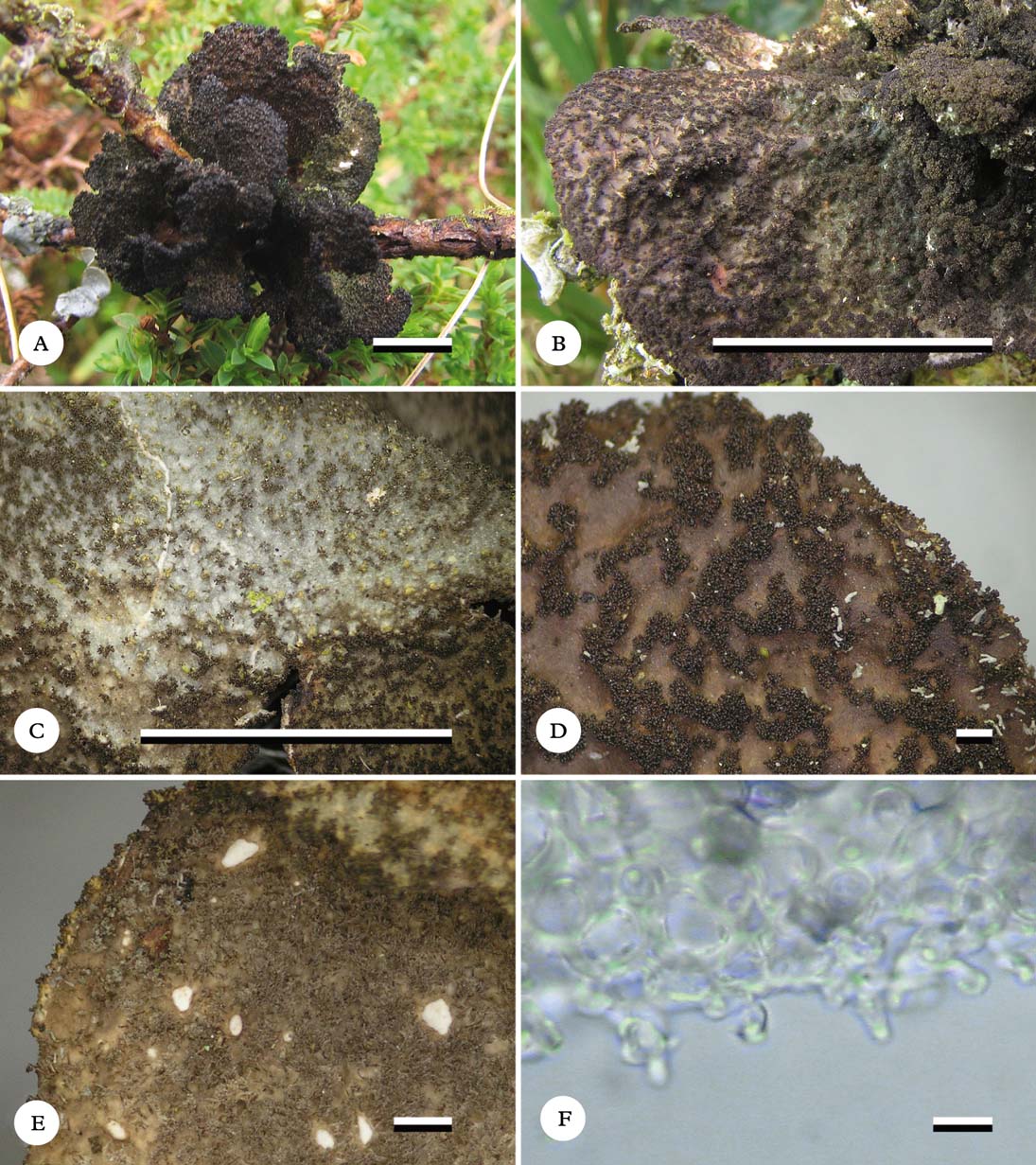
(Fig. 1)
Sticta viviana. A & B, specimens in the field (A, holotype; B, Lücking 33311); C, lobe surface; D, lobe surface detail with isidia; E, lobe undersurface showing tomentum and cyphellae; F, cyphella membrane showing papillae (C–E, Lücking 33311; F, holotype). Scales: A–C=10 mm; D & E=1 mm; F=10 µm. In colour online.
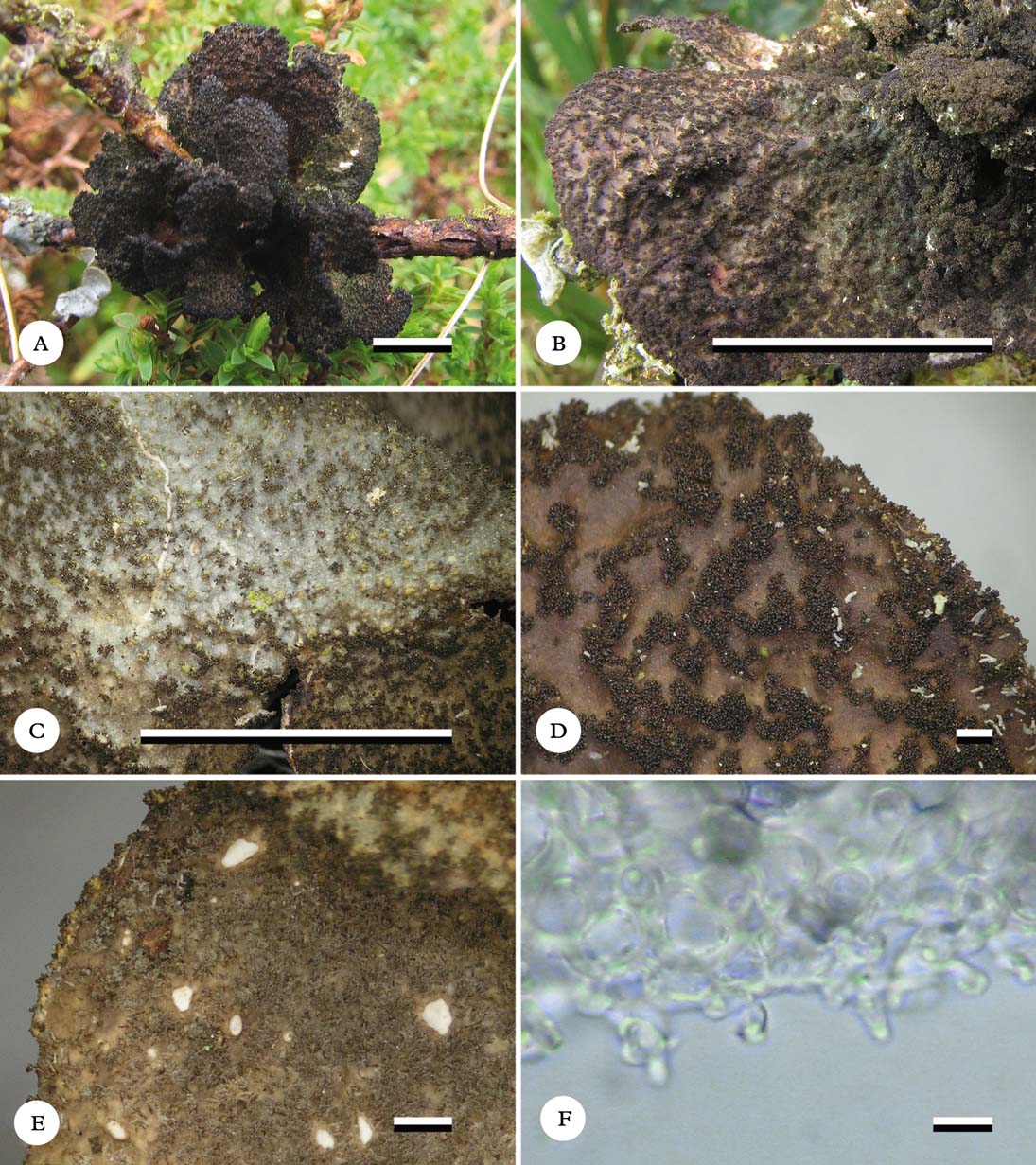
Thallus foliose, orbicular to irregular, up to 5 cm diam., very sparsely branched and if branched, polytomous (not distinctly bifurcating). Stipe absent. Primary photobiont cyanobacterial (Nostoc). Lobes suborbicular, horizontal to subpendulous, imbricate to adjacent or with narrow interspaces, with involute to undulate margins and irregular, revolute and often crenate apices, 5–10 mm long and 7–15 mm wide, subcoriaceous, fragile. Upper surface scrobiculate to faveolate towards the apices, dark brown, shiny, glabrous and lacking papillae and pruina, but with indistinct, cream-coloured maculae; marginal cilia absent. Laminal isidia abundant, cylindrical to coralloid with basal stipe and becoming corymbose (i.e. cauliflower-like), up to 1 mm long including the stipe, dark brown to blackish brown, shiny. Lower surface rugose to undulate, cream-coloured; primary tomentum dense and thick except towards the margin, fasciculate to spongiose, soft, brown, consisting of hairs 340–430 µm long, clustered in fascicles of 12–20 branched hyphae with free, moniliform apices; secondary tomentum (i.e. diminutive tomentum developed between the hairs of the primary tomentum) thinly arachnoid, cream-coloured to beige, formed by hyphae 7–23 µm long, solitary with free, septate apices; rhizines absent. Cyphellae sparse, 1–10 per cm2 towards the centre and 1–20 per cm2 towards the margin, dispersed, irregular to angular in outline, cupuliform to urceolate with wide pore (0·3–0·7 mm diam.), sessile to suprasessile (i.e. with the basal membrane at or above the level of the lower cortex and the cyphellae margin basally constricted), but below the tomentum level, with erect to slightly involute, cream-coloured to golden brown margins lacking tomentum; basal membrane of cyphellae (the cell layer covering the medulla) white. Medulla lax, white.
Apothecia not observed.
Pycnidia not observed.
Anatomy
Upper cortex paraplectenchymatous, 17–33 µm thick, consisting of 3–4 cell layers. Photobiont layer 35–60 µm thick, with the photobiont cells 10–15 µm diam. Medulla 55–165 µm thick, with the hyphae 2·5 µm wide, lacking crystals. Lower cortex paraplectenchymatous, 12–18 µm thick, consisting of 1–2 cell layers. Cavity of the cyphellae 60–100 µm deep; cells of the basal membrane with one external, papilla-like outgrowth per cell.
Chemistry
Medulla K+ orange-yellow, C−, KC+ pale yellow, P−. Cyphellae K+ yellow, C−, KC−, P−. No substances detected by TLC (the K+ yellow reaction of the medulla and cyphellae seems to be caused by tiny crystals deposited on the cell walls but no spots are detectable by TLC).
Etymology
Sticta viviana is dedicated to the Colombian lichenologist Bibiana Moncada who, with her thesis on the systematics and phylogeny of Sticta in Colombia, has provided the basis for a thorough global revision of the genus. The epithet viviana, which is the original form of the name Bibiana, comes from the Latin ‘vivianus' and means living, alive.
Ecology
Epiphytic on branches and twigs of paramo shrubs and treelets, usually rather exposed to light.
Notes
Detailed morphological, anatomical and chemical studies, combined with molecular analyses, have shown that morphologically defined taxa such as Sticta weigelii and S. fuliginosa represent a large number of partly unrelated species (McDonald et al. Reference McDonald, Miądlikowska and Lutzoni2003; Moncada et al. Reference Moncada, Lücking, Parnmen and Lumbsch2012). Many of these have not been named, even considering the high number of several hundred epithets described in the genus. Sticta viviana is one of more than 15 species that conform to the gross morphology of S. fuliginosa (broad, rounded lobes with laminal isidia) and would be included in that species using traditional keys (e.g. Goward et al. Reference Goward, McCune and Meidinger1994; Galloway et al. Reference Galloway, Stenroos and Ferraro1995; Brodo et al. Reference Brodo, Sharnoff and Sharnoff2001; Galloway Reference Galloway and McCarthy2001, Reference Galloway2007; Smith et al. Reference Smith, Aptroot, Coppins, Fletcher, Gilbert, James and Wolseley2009). Molecular data, however, demonstrate that the new species is not even closely related to S. fuliginosa s. str. (for which a topotype from Wales was sequenced), but belongs in a clade of several distinct, undescribed species with S. fuliginosa gross morphology (Moncada et al. Reference Moncada, Lücking, Parnmen and Lumbsch2012).
In addition to molecular data, all these species can be distinguished using morphological, anatomical, and chemical features, such as the upper surface structure (even vs scrobiculate-faveolate and glabrous versus tomentose or hirsute), the nature of the vegetative propagules (shape and branching patterns), the nature of the lower tomentum (pale vs dark, simple versus double with primary and secondary tomentum), the type of cyphellae (size and shape, presence of papillae on the basal membrane), and the medullary K-reaction. Many of these characters have been considered infraspecific variation, such as the shape of the isidia (e.g., Galloway Reference Galloway1994, Reference Galloway1997, Reference Galloway1998a ). However, in the absence of independent evidence such as molecular data, the assessment of variation is circular in conclusion, since that way variation is not ‘detected' but rather ‘generated' by assuming that a set of specimens belongs to the same species. The molecular ITS data show that specimens clustering in supported, monophyletic clades have a very narrow range of variation, each taxon having very uniform isidia, except for ontogenetic, directed variation (Moncada et al. Reference Moncada, Lücking, Parnmen and Lumbsch2012). Thus, Sticta fuliginosa s. str., as represented by the type material, the sequenced topotype, and specimens from North America and Colombia falling into the same clade, is defined by the following characters: the lobe surface is uneven (not scrobiculate-faveolate) and glabrous; the isidia are simple to branched (not corymbose); the lower tomentum is white and a secondary tomentum is present, the hairs of both being comparatively short (up to 100 and 15 µm, respectively); the cyphellae are medium-sized (up to 1·2 mm diam.), rounded to irregular, immersed to erumpent, and each cell of the basal membrane has 2–4 papillae; the white medulla is K−.
While most neotropical specimens initially assigned by us to Sticta fuliginosa do not represent that species (Moncada et al. Reference Moncada, Lücking, Parnmen and Lumbsch2012), it was also found that several ITS sequences available from GenBank from Canada (DQ419943), Finland (AY124095), Japan (AB239345), and New Zealand (AF350310) labelled Sticta fuliginosa do not cluster phylogenetically with S. fuliginosa, but form three separate clades, possibly representing undescribed taxa as well. The presence of unrecognized species of this morphodeme in Northern Hemisphere temperate regions is remarkable, as is the fact that virtually no taxonomic synonyms seem to have been listed for Sticta fuliginosa in its traditional sense (Zahlbruckner Reference Zahlbruckner1925; Galloway Reference Galloway2007).
Additional specimens examined (paratypes). Colombia: Cundinamarca: Guasca, Páramo de Guasca near Bogotá, 3350 m, 2011, Moncada 4739, 4748, 4752 (UDBC); Chipaque, Vereda Marilandia vía Santuario, near Bogotá, 2400 m, 2011, Moncada 4800, 4801, 4808 (UDBC), Lücking 33311 (UDBC, F).
This work was supported by a grant from the National Science Foundation: Neotropical Epiphytic Microlichens – An Innovative Inventory of a Highly Diverse yet Little Known Group of Symbiotic Organisms (DEB 715660 to The Field Museum; PI R. Lücking). We would like to thank the Universidad Distrital Francisco José de Caldas in Bogotá, Colombia, and the Field Museum in Chicago, for providing the laboratory facilities, and Bibiana Moncada for the opportunity to describe this new species. Stephen Chambers provided the topotype material of Sticta fuliginosa. Valuable comments by David Galloway and an anonymous reviewer helped to improve the manuscript considerably.