I am standing on the stage of the Cottesloe Theatre in London. There is a microphone in my hand and I am talking to the audience. The cast members are still onstage even though the show is now over. Next to me stands Samir Yazbek, the Brazilian playwright whose work we have just seen. He thanks the audience for being so attentive; the wonderful cast who brought so many new things to the work; the amazing National Theatre and its staff; and me, the translator and, tonight, his interpreter. The lights go down, the audience starts to leave and Samir hugs me. We feel like we are at the end of a long journey and now it is easy to forget the bumps and turbulence of our joint flight together. There is no such thing as a perfect translation and it is in translation's inherent fallibility that its central core of renewed discovery is located. While The Ritual may have had its own imperfections, some masked and some amplified by its translation, at this moment, standing on the stage, we both know this but are happy to bask in the glory of seeing our mutual endeavour realized in the shared experience of live performance.Footnote 1
Joel and his friends invoke the ritual. Rotherham College performing The Ritual in the Cottesloe Theatre as part of the National Theatre Connections Festival, 2012. Photograph by Simon Annand.

Now, many months on, as I return to the events that led up to that night, two questions emerge and persist: how can translation collaborate in a process of cultural mediation that can actively and deliberately reconstruct and reimagine the source? And how can translation establish its own presence despite this process? These questions seem urgent and increasingly significant to me as I continue to work in theatre translation – an environment where the wider collective community of actors, directors, designers and producers persist in regarding translation as simply a linguistic means to an end. In addressing these questions, I want to first take account of the current theoretical understanding of translation for the stage and from there reflect on the process of translating The Ritual for the Royal National Theatre in June 2012.
Translation theory and the stage
While, in some senses, translation theory has developed in new and exciting ways, in recent years, as it has taken on post-structuralism and post-colonialism and has become increasingly engaged with corpus approaches related to new technologies, the central binary couplings of faithful/playful, literal/free or, more recently, domestication/foreignization persist. While the contributions of translation theorist Lawrence Venuti or philosophers such as Jacques Derrida and Walter Benjamin, who both flirted with an interest in translation, may well point towards a foreignizingFootnote 2 turn in translation theory (despite such a distinction taking us back to the nineteenth-century philosopher Schleiermacher's notion of a pure translation in The Different Methods of Translating),Footnote 3 the evidence of a foreignizing practice becoming present as the evidential corollary of this turn is far from clear or compelling. Translation's invisibility (the apparent disappearance of the translator's hand in a work that reads comfortingly fluently in its new language), to borrow Venuti's now well-established construct, not only persists but, within the area of stage translation, remains an ideal upon which the success of a translation is ratified, stratified and ultimately measured. Moreover, the contribution of theatre scholars to translation theory, particularly around the issue of a necessary and vital ‘speakability’ of theatre translations,Footnote 4 has not been helpful in pushing the boundaries of translation practice, encouraging any translational innovation or furthering our understanding of the specificity of translation for the stage beyond a certain and obvious inevitability that dialogue written must also function as dialogue spoken.
Theatre translator David Johnston has done much to advocate for the role of translators in the rehearsal process; two recent books have demonstrated an active interest in this area of study with an increasing number of case studies emerging.Footnote 5 Perhaps, then, it is understandable that, for those working in theatre translation, the theoretical basis and rigour underpinning our work remains largely unexplored and is largely deemed irrelevant, unlike, for instance, in the interface of performance studies with contemporary performance practice. This is disappointing particularly in view of the increasing interest in the UK of non-English-language plays coming from other countries and the increasing number of plays being produced in translation (perhaps one aspect of globalization, which is a topic I will return to a little later). A dual purpose of this article is to embark on a process whereby theatre translation might begin to be theorized through a reflection on its mediated process as it becomes a mediated product. In doing so, I would like to suggest a way of understanding translation for the stage in ways that acknowledge its inherent imperfections with specific reference to the work of cultural theorist and philosopher Kwame Anthony Appiah and his development of the notion of ‘cultural contamination’.Footnote 6
National Theatre Connections programme
For the past eighteen years, the Royal National Theatre in London, UK, has been commissioning ten playwrights a year to write a play for young people under the rubric of its ‘Connections’ project. While the plays typically have been written by British playwrights, the National did stage an International Connections season in 2002 (although it has to be said that the ‘international’ in the title was more related to the themes of the plays than to the languages in which they were written, as there was only one play in the season that was actually translated from another language into English). However, the National has extended the project to some other countries and most notably the British Council in Brazil has assisted in the formation of a home-grown Conexões – its own annual Connections programme – which runs in a similar way to the British version but with a smaller number of plays (mixing newly written Brazilian plays with those of British playwrights) and a smaller number of partner youth theatres.
In the UK, the plays, each typically lasting for forty-five minutes, are performed by youth theatre groups around the country (with members typically aged between thirteen and nineteen years old) before an annual festival of performances is held at the National Theatre, with ten companies selected from the various participant groups each performing one of the ten plays. In 2010, Anthony Banks, associate director of National Theatre Learning, went to Brazil in order to find a new writer for the 2012 Connections season. Through the British Council's contact lists, Samir Yazbek was shortlisted as one of a potential group of playwrights for the project. Each writer was asked to write a synopsis for their potential play; Yazbek was selected for his piece about the lives of a group of inner-city teenagers who form a weekly ritual renouncing the formations of meaningful loving relationships. A first draft of the play was completed, whereupon in February 2011 I became engaged as the translator.
Translating The Ritual
During the course of writing the play, Yazbek produced three drafts of The Ritual: the first was an initial scoping out of his synopsis; the second resulted from feedback that I, along with literary associate Ruth Little and Anthony Banks from the National Theatre, gave him; the third and final draft was written in response to further comments provided to him shortly before the play was workshopped at the National Theatre Studio in October 2011 (the Connections season actually took place at the theatre in June 2012). In looking at the translation of this play, I will focus on three key moments within its three drafts which, broadly speaking, correspond to the beginning, middle and end of the play. In doing so, I will explore the central dramaturgical role that translation can play in mediating a production process.
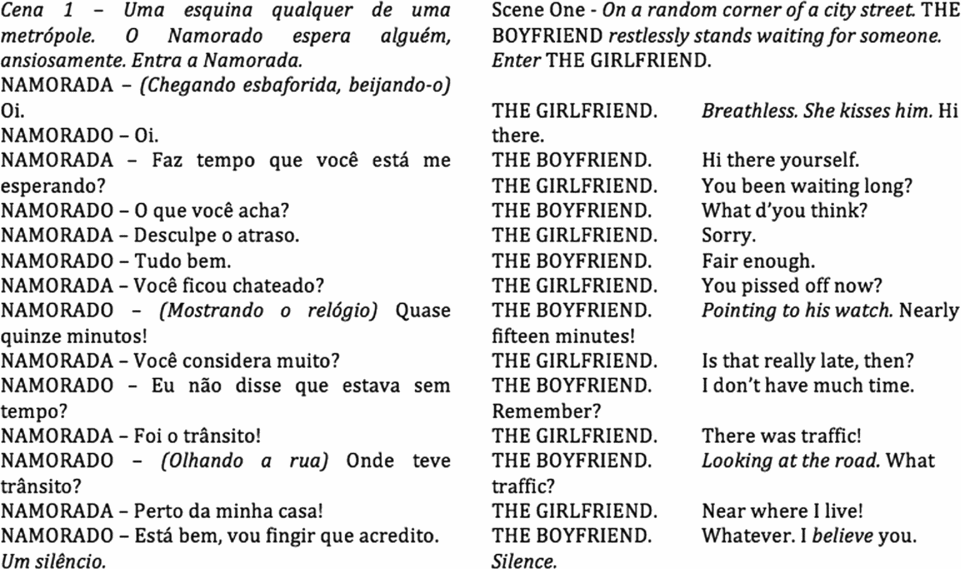
The first draft of The Ritual (Fig. 2) begins with a meeting on a street between a boyfriend and girlfriend who are never named in the text but retain these relational titles throughout. The scene demonstrates a number of themes that Yazbek was keen to develop: the notion that this play could happen anywhere, not necessarily in Brazil, is realized in the randomness of the street in the unnamed city in which the scene takes place. The dialogue is pedestrian and the content might be thought of as quotidian and even mundane. My translation demonstrates some deliberate choices that serve to re-voice the text for a company of British teenagers. Thus the use of the words ‘fair enough’, ‘pissed off’ and ‘whatever’ are in a sense far more specific and subculturally nuanced than the Portuguese tudo bem, chateado, and está bem, which are common expressions across generations and registers. The speakability issue has clearly been addressed in the translation under what might be considered a general consideration of relevance (to both actors and audience) in a way that was of less concern to the playwright. In this sense, it might be useful to think about the translation developing out of an overarching purpose.Footnote 7 So while the ultimate goal at this point in both the play's and the translation's development was not to localize the text but to accelerate it through a production process which formed part of a large-scale cultural production aimed at young people in the UK, some losses had already been incurred from the playwright's point of view. These losses involved the shifting of a generalized vernacular in one language to a far more specific one in the translation in a deliberate act of domestication.Footnote 8
Extract from the first draft of The Ritual.
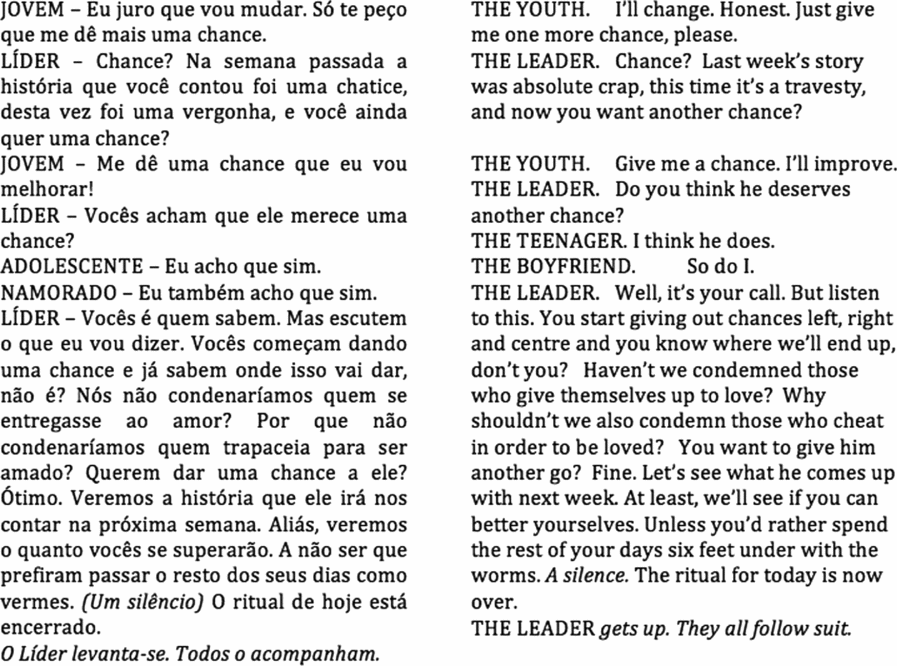
Extract from the first draft of The Ritual.
Later on in the play, we encounter ‘the ritual’ for the first time in a scene which implies that the weekly meetings have in fact been going on for some time. Towards the end of this scene, The Leader (the character in the play who establishes the ritual and convenes its meetings) expresses disappointment in the story that has been relayed by a younger and more naive character, The Youth, in that it is unworthy and does not go far enough. Again there are some deliberate translational choices being made in response to the source text that serve to situate it within a contemporary British vernacular. ‘Absolute crap’, for example, is far more explicit and colloquial than Yazbek's chatice, which has stronger connotations about the story related by The Youth being boring rather than simply being dismissed as worthless in the English translation. The translational decisions made were focused on the need to promote the play through its development process in a way that would lead to a successful outcome – a production within the Connections strand. In doing so, the translation acts as an advocate for the work in a British dramaturgical production process that was unfamiliar to the playwright. Here losses are incurred by the source – losses which, in this instance, become clear gains for the translation's fluency. But this is not to say that the translation has completely domesticated the source under the swirl of its own disappearance. A feeling that this remains a translation of something else, or other, remains present, adding to a sense of strangeness that is not so far off from Bertolt Brecht's notion of defamiliarization or Verfremdungseffekt, or Benjamin's concept of the afterlife of a translation.Footnote 9 The risks here are great; in an art form that necessitates verbal fluency, translators who intentionally estrange the text open themselves up to criticism due to offering work that lacks flow and the possibility to adequately lift off the page and onto the stage. For example, the construction ‘But listen to this’ in The Leader's last speech is a typical form of Portuguese speech which sets the listener up for what is about to follow by prefacing its importance (another popular device, for example, is to begin a point by saying é o seguinte, meaning literally ‘it's the following’. In English, this sounds more than a little unnatural and, in dramaturgical terms, might be construed as unnecessarily labouring a point.
Yazbek's own perception of this process is interesting, particularly in relation to feedback he received as result of (and in fact despite the mitigation of) the translation. Interviewed by the broadsheet Estado de São Paulo about his experience of working with the UK's Royal National Theatre, he reflected,
Eles têm um entendimento de dramaturgia bastante tradicional. E são muito bons. Mas a minha peça ia pelo caminho de um teatro metafísico. Então, a primeira versão causou certo estranhamento.
[Their understanding of playwriting is quite traditional. But it's not necessarily bad. But my play was moving along a more metaphysical trajectory. So the first draft grated a little.]Footnote 10
This sense of estranhamento or ‘grating’ also has implications of strangeness, and of course the idea of the stranger and the friend are common translational metaphors. Estranhamento might also be felt with the passage that begins, ‘haven't we condemned . . .?’, which is highly problematic within the world of the play of teenagers. Its language tends towards a rhetorical register that appears to be antithetical and alien both to its core audience and to performers – a group of people that might be deemed a Skins generation which, through localized responses to globalization, have seen transnational cultural elements such as rap and text talk become part of the everyday fabric of spoken language as well as a range of other language forms.Footnote 11 Yazbek's choice to use a form of rhetorical language runs counter to my natural inclination to adjust the text through translation. Nevertheless, in this case, a deliberate decision was made to retain the rhetoric in order both to highlight this potentially problematic tone for the production team and to register the presence of the translation within the work. Here, then, the translation is mediating the other way – no longer being used to solely promote the work forward, the translation in this instance is used to open up channels for dramaturgical questions to be raised by the producers and for the playwright then to reflect on these in the script's next draft. The translation is far from invisible but takes all the risks of making its presence felt in order for the development process to move forward. Losses, and there are many, open up possibilities for new gains.
Despite the consolidations made in the translation through its deliberate attention to audience, the National Theatre's production team raised concerns that centred around both the play's form and to some extent its content. Due to this feedback, Yazbek made a number of changes to the play where, for example, he attempted to extend the scope of his original idea and opted for giving the characters names. However, Yazbek did not simply follow up on all the suggestions that were made but continued to develop the piece, further merging the dramaturgical input he received with new ideas of his own.
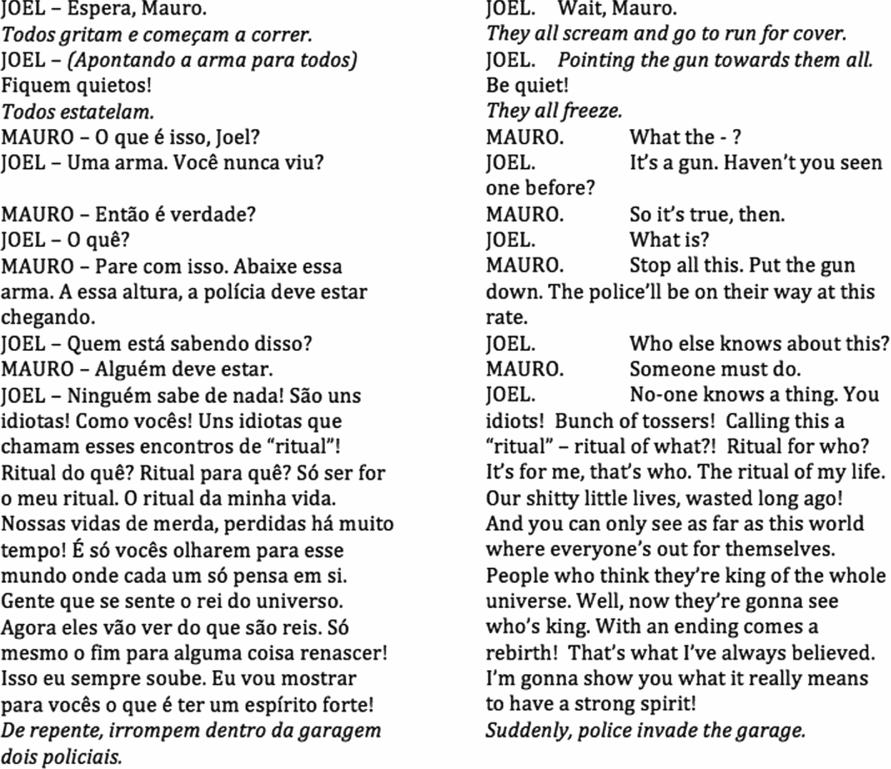
The next section of the translation of The Ritual, an excerpt from his second draft (Fig. 4), reveals how Yazbek resisted calls to bring his play completely into a contemporary British sense of dramaturgy.Footnote 12 This moment occurs just before a final denouement at the end of the play. Here again the source text is particularly vexing in the quest for finding a location in English that facilitates its performability (or speakability) in a way that avoids a potential denigration of the source as unbelievably melodramatic within a British dramatic sensibility. At this point the mediation of the translator is once again pushed to its limits. In order to accommodate certain British dramaturgical conventions and achieve a sense of dramatic credibility, the text would have to be completely rewritten in English and adapted with the potential for a completely different outcome (such as doing away with the gun and the police altogether).Footnote 13 The sarcastic response to the question ‘What's that you got there, Joel?’ (a more literal translation of ‘O que é isso, Joel?’) is reductive with implications of a heightened naturalism which in British contemporary playwriting might simply be denigrated as being overwritten. It therefore would be a relatively easy process to erase the on-the-nose quality of these utterances through a process of rewriting by removal. But as a translator working with a living writer and acting as an advocate for his work, it is also important to recognize the limitations that circumscribe translation for the stage. The translation process here is one that once again enacts a dramaturgical role and provides a basis upon which to create a dialogue between the producer (and its dramaturgical agents) and the playwright. It resists the temptation to disappear under the stone of domestication while at the same time managing to provide a consistency in the dialogue that does meet the expectations of its target (language) audience and performers. The risks for the translator here are enormous. Translated texts that do not read naturally or come off the page in a thoroughly speakable way are often denounced as simply poor translations and any translator who is willing to risk his or her professional standing by openly acknowledging apparent fault lines within an Anglo-American conceptualization of sound playwriting might be thought of as more foolhardy than diligent. But such risks are part of the constant decision-making that occurs in what might be conceived as a contaminated approach to theatre translation and takes place at every translated line, every dialogic exchange and every critical encounter with a living playwright's dramatic rendering.
Extract from the second draft of The Ritual.
In November 2011, the National Theatre held a workshop for all the plays that had been selected for the 2012 Connections season. Yazbek was invited over to London to sit in on a day's rehearsal with a group of actors and a British director working with his text. The purpose of these annual workshops is to allow directors from various UK youth theatres groups to witness a professional director working on the Connections play they have selected. In this way, the National Theatre is able to offer some vital practical training on a given text offering a range of new possibilities for approaching a play.Footnote 14 The Connections team documents approaches used. Production notes, including suggestions on how to work with the play in rehearsal, are later provided to the youth theatres involved in the project. These notes are then published with the collected volume of plays. On arrival at London's Heathrow airport, Yazbek announced that he had rewritten a completely new draft of the play that would need translating – this was only two days before the workshop was to begin. A decision needed to be made whether or not to go ahead with a revised draft that the playwright had already submitted or whether it might be possible to translate the new version in time for the workshops. What then ensued was a frantic few hours at the National Theatre on a Friday evening where I literally typed into the computer in English as Yazbek related, and quite often wrote on the fly, a new version of the play. Clearly this is not the most ideal of scenarios for theatre translators to work in but it did provide proximity between writer and translator, which is hugely beneficial and a rare luxury, particularly when working with playwrights from other countries. Working collaboratively on the translation, even in this pressurized context, facilitated instantaneous mediations and the possibility of contextualizing translational decisions in a way that invited the playwright's consent. This co-presence of playwright and translator, to borrow from Erika Fischer-Lichte's work on spectatorship and performance,Footnote 15 provided important feedback not only for the translator but also for the writer, who was made aware of translational judgement calls and the reasoning behind those calls. The translator here is reconstituted as an interpreter for an absent audience, giving instant responses to the source text that are then relayed to the writer for acknowledgement, confirmation and a closing of the mediation circle that has taken place.
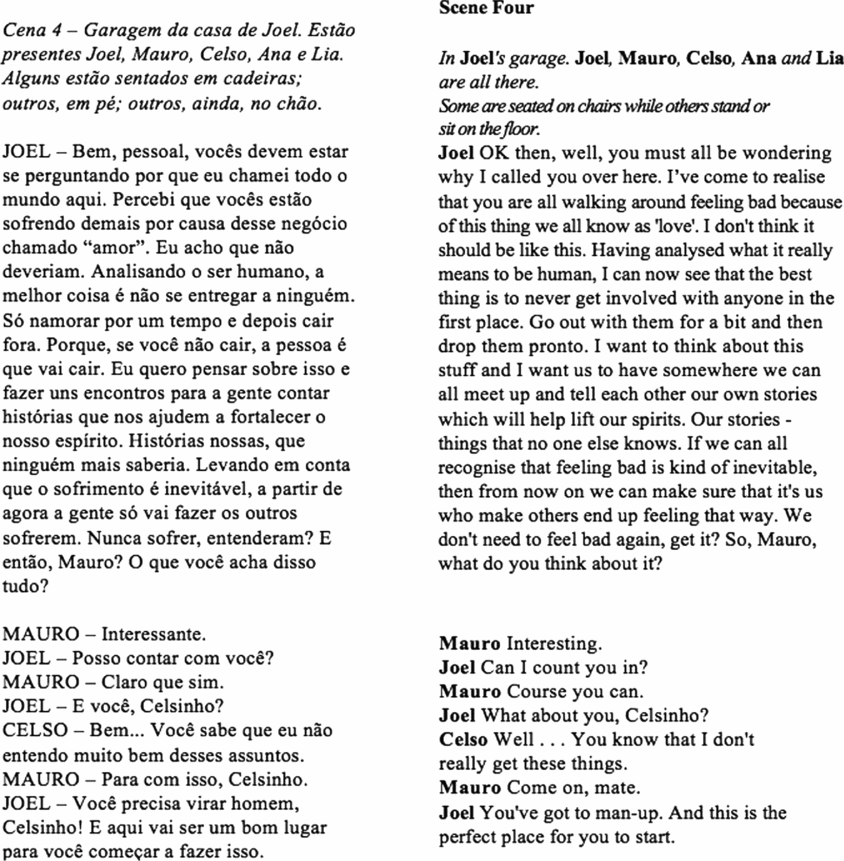
The final excerpt from The Ritual (Fig. 5) was translated after this fateful meeting at the National Theatre. It is now part of the published collection of plays from the Connections 2012 season. Coming at a point in the play where we first see the ritual itself take place, it allows the character of The Leader (in this draft called ‘Joel’) to more fully explain his motivation for establishing the group in the first place. Again while Yazbek has clearly considered the feedback he has been given around the central conceit of the play, the overall justification for establishing the ritual might be a little clunky. The translation attempts to mediate the process of what, at this point, was a commissioned play moving into production by acknowledging the vernacular of its performers and audience (with the use of phrases such as ‘pronto’, ‘count you in’ and ‘man up’). But it also resists the temptation to completely rewrite and redefine the source. In this sense, the translation effects two tasks simultaneously, as it has done throughout the drafting process. First, it mediates the source text as far as it can within the limits of the cultural production for which it has been written by reimagining the language for its actors and audience. But, second, rather than opting for an entirely localized setting, it simultaneously resists complete domestication by registering the source in projecting a construction that implies an otherness slightly unnatural to speakers for whom English is their mother tongue. Theories of translation do not seem to adequately account for this process, which is complex and has as much to do with cultural mediation and the mechanics of cultural production as with the interlingual transfer of Portuguese to English. So in the third and final part of this article I posit an alternative model for thinking about translation for the stage, which finds its locus in theories of globalization.
Extract from the final draft of The Ritual.
Translation, the stage, cultural mediation and cultural contamination
German theatre scholar and translator Katja Krebs has shown how translation has been instrumental in challenging the doxa Footnote 16 of a target language's culture and, in French philosopher Pierre Bourdieu's terms, translation has helped distribute and constitute cultural capital, challenging existing structures and relations.Footnote 17 The translation of The Ritual would not seem to substantiate such bold claims but it does serve to highlight and make visible the production processes that accompany the commissioning of a new work from one of the largest and most powerful theatres in the world. Cultural capital was created here as a direct result of the translation process whereby a play moved countries and languages, and now will ultimately be performed in Portuguese back in its country of origin. Yazbek's original intention, before writing The Ritual, was to locate teenage anomie in a globalized, imagined construct – anyplace and anywhere – while the fact that he was commissioned at all was itself a product of globalization and of the onward march of cultural producers to go global. For the National Theatre, staging the play in the year in which London was the Olympic city carried extra weight. Opening up the potential to form linkages with Brazil indulged the possibility of future funding as well as riding a wave that sought the establishment of new networks in new and fertile territories.
The idea of commissioning a play for young people in the UK that was to be about young people in Brazil and the issues affecting their lives might be conceptualized as a practice that, on the one hand, endorses a notion of the immutability of cultural differences or, on the other, seeks their convergence: teenagers in Brazil are the same as teenagers the world over. An alternative view might be that Yazbek's play – written and conceived to be mapped onto an entirely different cultural canvas than that of the artistically vibrant conurbation in which he lives, São Paulo – through translation into English becomes a new hybridized entity which exists in its own right in relation to only itself. But the translation of The Ritual is not a perfect hybrid and its losses are just as important as its gains. What the translation does is lay bare and make openly visible its otherness. In this sense, theories of global difference, convergence or hybridity provide unsatisfactory tropes to adequately describe the translation process and product, particularly when dealing with the complex field of theatre and performance.
However, Kwame Anthony Appiah's notion of ‘contamination’ as part of his conceptualization of globalization as cosmopolitanism offers a possible way of reconsidering translation for the stage in ways that may offer the possibility of rethinking the roles of writer and translator and the process of cultural production itself.Footnote 18 ‘Contamination’ is a useful word because it conveys the inevitability of an event that has already taken place (the translation) as well as the incidence of its continued presence that lives on – as translations continue to live on in their performance on the stage. Its somewhat negative connotations offer an opportunity to openly acknowledge the risks endured during the translation process as well as the inevitability of its imperfections as a translation, i.e. as something that has a relationship with a pre-existing source. In Venuti's terms, the translation lives on not only in the text but also within the clear glare of the live performance, for all to see and hear. In this way, seen through the frame of ‘contamination’, it might be possible to reassess and reappraise translations for the stage and the ways in which they are commissioned, developed and produced. It also opens up a way in which we can embrace translations that seek to move from offering themselves as pure cultural form to where a contaminated presence is welcomed, as in the examples outlined above. For Appiah, contamination forms part of his conceptualization of cosmopolitanism, which ‘tempers respect for difference with a respect for actual human beings’.Footnote 19 Cultural contamination here includes translational contamination that itself offers the possibility for further research in ways that may serve to develop translational practice as well as translation products. The stage of the Cottesloe Theatre, shared by playwright and translator at the play's world premiere in the summer of 2012, becomes a space for cultural contamination that thus eschews homogenization and instead underscores the difference that coexists within the performance of the translated work.