The expropriation of peasants is one mandatory point in any account of the transition from the European feudal system towards agrarian capitalism. This narrative, the first draft of which was given by Karl Marx in his writings on primitive accumulation, was the subject of the Past and Present, ‘Brenner debate’ (1978 and 1979) in which the whole range of questions relating to the transition from the late Middle Ages to early modern times was under examination. The exchange between the contributors first of all made it possible to construct the historical and historiographical framework necessary for the development of a theoretical discussion. At a distance of 40 years, one is surprised by the lack of the economic aspects of the process in this collection of texts, where Marxist analyses, which highlight the political factors of the process, are opposed to Ricardo-Malthusian lectures, where demography is the master of the game. Though agrarian and industrial prices series are used in certain papers, there is no discussion of the role played in the transition by markets and money, as if there were a convergence among participants in the debate on the ‘neutrality’ of these institutions.
It was not until the decades 1990–2010 that markets and money became central to the debate on transition, making credit and indebtedness essential instruments in the transformation of the economy and society.Footnote 1 By highlighting, in the wake of Richard Britnell, a long-term process of ‘commercialisation’ of European societies, economic historians then replaced the two antagonistic narratives of the Brenner debate with a deterministic common scheme, which sees the construction of market institutions and property rights as the main road towards the emergence of agrarian capitalism.Footnote 2 The evolution of the Netherlands, which had been at the origin of Robert Brenner's reflections, serves as an ideal-type of this evolution, of which other European countries, including England, provide variants. This narrative, currently dominant in the international debate on economic history, is probably no less ideologically marked than those it replaced, but it has not yet been subjected to the same assessment as them, both in terms of sources and theory.
A first reflection to be made addresses the concepts of market, money and property used in these narratives. By using a conceptual framework that is unified across Europe and over several centuries, the debate ignores the discussions that preceded, particularly between the thirteenth and fifteenth centuries, the setting up of the institutions and practices of the market economy. Recent research by Giacomo Todeschini, in particular, has shown that the installation of these notions in the legal, economic and political area was made possible by the intense work of canonists and theologians, whose study is indispensable to the correct interpretation of the sources.Footnote 3 Major progress on these issues has been achieved through the study of judicial or municipal archives for the registration of contracts in the courts and the recording of pawns put up for sale.Footnote 4 If we consider all the questions it raises, the historiographical debate on credit in medieval times ultimately takes the form of a classic diptych, opposing the Mediterranean world economy, where trade is the very substance of the dynamics of evolution, to the North European genesis of capitalism, characterised by the escalation of the holders of financial capital at the expense of other economic actors.
Yet, blind spots in this discussion are still the definition of money and the question of its relationship to monetary value, which cannot be limited to the necessary examination of the conversion of goods into monetary cash. A major contribution by Rodney Hilton, published simultaneously in English and French, opened this discussion in 1990, from which readers did not draw the full implications.Footnote 5 Questioning the rarity of the practice of champart and sharecropping in the English countryside and drawing on a deep knowledge of European history, he suggested that this English peculiarity was due to the special status of the monetary institution, and more specifically the steady status of the sterling system within the English political system. But he also reflected on the circulation of value through the exchange of crops, in which, he suggested, there were poorly documented segments of the markets for goods, land and labour, that were outside the control of the lordship. This reflection, which has recently been taken up and developed for the early modern period by Elisabeth Griffiths and Mark Overton, from the perspective of a history of sharecropping in England, encourages us to carry Rodney Hilton's hypothesis further.Footnote 6 In a society in which crops are an essential part of value and exchange, reflection cannot be limited to the identification between the circulation of money and monetary exchange. More recently, a reading of the circulation of value in terms of social practices has emerged, which seeks to assess the extent of credit relations before considering the interpretation to be given to this phenomenon. Chris Wickham provides the best synthesis of this work:
It is still often thought that an active exchange economy needs coins. This is not true; credit is enormously important in most exchange systems, then as now, and debt-credit agreement can be complicated without any physical money changing hands at all. The medieval economy worked on credit to a very large extent, indeed. We can assume it did in markets, when peasants were buying or selling on too small scale for coins to be useful […] and certainly it did back at home, when grain was needed in advance of harvests, or goods had to be got together for a dowry, or when an extra field needed to be added to a peasant tenure to feed a growing family, but could not be paid for at once […]. Once peasants were forced into market exchange by the need to pay rents in money, coins became steadily more normal in the countryside, which in turn facilitated the next (and more important) change, the growing practice of buying artisanal products rather than making them oneself. This was one essential backdrop to the other side of the economic transformations of this period, the growth of towns.Footnote 7
This process, attested by archaeology and written sources, must be related, Wickham observes, to the evolution of the practices of the dominant group: ‘When lords switched to rents in money rather than produce, they had to have been confident that peasants could at least – so to speak – buy the coins needed for rents by selling goods in local markets.’Footnote 8 The ambiguity of the word ‘rent’ makes this analysis, while largely convincing, complex. Among the historians of feudalism, ‘rent’ is above all a concept, inherited from Karl Marx (and, through him, from David Ricardo), which refers to the surpluses extracted from peasant labour by the seigniorial institution. Before being given concrete form in a quantity of monetary and symbolic value invested by the dominant group for its protection and consumption, ‘rent’ is a hermeneutical tool used by the historian. One of the unintended consequences of this lexical choice has been to introduce a long-lasting confusion into the lexical landscape of credit, where annuities (redditus) hold a considerable place.
While annuities do not play any role in the English credit economy,Footnote 9 it is clear to those who frequent the French archives that deeds relating to the rentes, whatever these may be, constitute an essential part of the documentation. This is well known for the sixteenth and seventeenth centuries, since the investigations of Bernard Schnapper and Katia Béghin showed the diversity of practices associated with these kinds of contracts and drew attention to their function in the construction of public debt. More recently, the work carried out by Philippe Hofmann, Gilles Postel-Vinay and Jean-Laurent Rosenthal on the last centuries of the Ancien Régime has made it possible to describe and quantify private credit stipulated in the form of annuities.Footnote 10 It is no longer possible to discuss the dynamics of credit, finance and taxation without taking into account this considerable mass of capital, the investment of which was mainly carried out by notaries in Paris or the provinces.
Comparable research is not yet available for the medieval period, for reasons that are not necessarily related to laziness or lack of interest on the part of researchers. Anyone who has tackled the considerable mass of sources relating to the constitution, payment, assignment or sale of annuities, that may be contained in a monastic or seigniorial cartulary, a register of notarial deeds or a municipal archive, knows how delicate it is to specify the word ‘annuity’ (in French: rente), which is most often used alone. If rente is defined as the obligation of the tenant of a real property to pay regularly to a given recipient a specific monetary value, it is understandable that it is not always possible to discriminate, in a list of sums or goods due (e.g., a census, the extent of an estate or a probate inventory), what is a mandatory seigniorial levy and what may result from a credit agreement. Combined with this imprecision of definitions, the excessive amount of the documentation has led researchers to carry out partial investigations based on well-identified contexts. Cities such as Paris or Rouen thus offer remarkable observatories on the markets of annuities based on real estate: Philippe Cailleux was able to show in the case of fifteenth century Rouen that the ‘old annuities’ burdening certain plots of land, could date back to the twelfth and thirteenth centuries, and that studying them makes it possible to follow the evolution of town planning down to the end of the Middle Ages.Footnote 11
Lawyers and legal historians have long studied the rentes constituées, relying on the considerable literature written about them since the late Middle Ages. Considered basically as an obligation to pay, the annuity is a complex legal object, subject to both local and general prescriptions that define the legal and normative framework for its enforcement. Most often linked to some real property, i.e. its collateral, and itself held by its recipient as a real property, the annuity is subject to the current local rules for its ownership and transmission. However, because it binds a seller/debtor to a buyer/creditor, it must also be examined from the point of view of its potentially usurious nature, according to the rules described by theologians and canonists. One obscure point remains, however, in most regions, concerning income payable in kind, most often in grain.
The aim of the following pages is to address this problem on the basis of a set of unpublished sources relating to a widespread practice in the Normandy countryside in the thirteenth and fourteenth centuries: the grain rents markets. The specificity of the Norman case in the context of a history of transition had already been raised during the Brenner debate, which saw Guy Bois and Emmanuel Le Roy Ladurie opposing each other on the interpretation to be given to the facts brought to light by Bois in his great book Crise du Féodalisme.Footnote 12 Perhaps the richest and most populous of the provinces of the kingdom of France, long involved in the history of England, Normandy is characterised by the persistence in modern times of strong peasant ownership and the development of proto-industrial activities, some of which are attested to as early as the medieval period.Footnote 13 The spread of grain rents cannot be seen as a sign of its economic backwardness. We propose to see it as an index of another way of articulating product markets, land ownership and the circulation of monetary value. In this perspective, the specific credit market that is highlighted is linked to a movement of investment in the countryside and does not only determine a process of indebtedness.
1. Payment in kind and economic history
Generally speaking, transactions in kind occupy an ill-defined place in medieval economic history. The payment in fruit of part or all of the land rent, to the feudal lord or to the owner of the land, refers first of all to a levy on the harvest, indicative of a situation of domination.Footnote 14 The payment of a share of the fruits harvested or of food to employees is rather considered as an indication of marginality with regard to the market. Some cases, such as sharecropping, combine these two aspects: payment of the rent to the lessor and remuneration of the tenants' work are made in kind. Generally speaking, however, economic historians consider transactions involving such payments as a sign of partial or uncompleted monetisation, which forces the actors to use the products of the land, most often due to a lack of sufficient metallic or fiduciary money. From this perspective, it is the process of converting levies in kind into cash payments that has attracted the attention of researchers, because it can be seen as an element of a modernisation process.Footnote 15
The existence of credit contracts including an advance stipulated in cash and repayment in kind may therefore have appeared to be a sign of asymmetrical market mechanisms, revealing the influence of urban actors on the agrarian economy. In a classic study on the sixteenth century Venetian countryside, Gigi Corazzol showed that credit contracts involving the payment of interest in grain played an important role in the conquest of land ownership by the urban elites of the Terra Ferma. In this context, lawyers and theologians had repeatedly denounced the usurious nature of these contracts, the operation of which the Venetian state tried to regulate by laws limiting their expropriation effects.Footnote 16 Jean Meuvret, in his survey of livelihood (French: subsistances) issues in the kingdom of France in the seventeenth and eighteenth centuries, in which he confirmed the long-term dynamics of the spread of cash payments, insisted on the diversity of local situations: even in the major grain-growing regions, leasehold farming payable in grain and sharecropping coexisted with leasehold farming paid in cash. In addition, his study of cereal markets, particularly around Paris, pointed out that these credit operations were ubiquitous in supplying urban markets. In particular, he observed multiple cases of payment in grain or obligations for future harvests, despite the legal prohibitions on such practices, which were considered usurious and dangerous for public order.Footnote 17
The many charters and notarial deeds instituting perpetual annuities payable in grains, which can be found in the archives of Norman religious establishments, fit uneasily into this historiographical landscape. Consequently, they have not attracted the attention of historians, except to point out their relevance for the history of rural settlement and agrarian systems.Footnote 18 However, as early as 1901, in his thesis on the history of canon law examining the credit practices of monastic establishments between the eleventh and thirteenth centuries, the great legal historian Paul Génestal identified the characteristics of credit by rentes constituées which, in the first years of the thirteenth century, massively replaced the ancient practices of real estate engagement (mortgages and pledges) inherited from Roman law, which certain theologians considered to be usurious.Footnote 19
Génestal also questioned agreements stipulating the payment of the annuity in kind in return for a loan in money. He cited a large number of them, but was more interested in the guarantees offered by the debtor, and the real or personal nature of his obligation, whether it related to a particular piece of real estate or whether it was a liability for all his property. The unequal distribution of these contracts in the Norman countryside seemed to him to be the mark of regions ‘probably more backward’. From certain documents, he also raised the question of the ways in which these annuities were paid, and noted the latitude left to certain creditors to pay in kind or provide a monetary value corresponding to the price of the cereals due. In two charters, of 1225 for the nunnery of Saint-Amand in Rouen and of 1251 for the monastery of Saint-Taurin in Évreux, the creditors could opt for a payment in grain or wine, given as equivalent to the amounts of 8 and 20 sous fixed by contract.Footnote 20 For all that, Génestal does not seem to have considered the possibility of paying in money the very numerous annuities whose term was stipulated in grain measures.
2. Paying on the market
Recently Isabelle Theiller has addressed this question on the basis of an exceptional dossier concerning two prestigious communities in Rouen, the nunnery of Saint-Amand and the Benedictine priory of Bonne-Nouvelle.Footnote 21 The agreement on an annual annuity of 4 muids of meslin (a mixture of wheat and rye), paid by the monks of Bonne-Nouvelle to the nuns of Saint-Amand, set an end to the conflict that had opposed the two communities over the possession of a manor in the Caux region. The nuns' renunciation of their claims was conditioned on the monks paying a rent, by way of compensation. Although it was not strictly speaking related to a credit problem, the settlement used by analogy the most common type of contract in this area. Due to the large amount of grain involved (nearly 50 hectolitres), the deed specified the terms of payment: it was to be made on four Fridays from Michaelmas (29 September) onto the week following Saint Andrew's festival (30 November), in the main Rouen grain market, each muid being estimated at a price for any somme of 4 sous tournois less than the price of the best grain sold on the market.Footnote 22 These indications point to a well-known and conventionally recognised qualitative and quantitative definition for cereals sold on the markets. The reference to a discount in relation to the ‘best grain’, i.e. the most expensive grain that can be found on the market on the reference day, is intended to guarantee the grain quality while prohibiting speculation, by fixing a price lower than the maximum price found on the market. It is a pragmatic way of establishing its ‘just price’. It is also the earliest attestation of a contractual clause that can be found very frequently in Norman archives in the fourteenth and fifteenth centuries.Footnote 23
These contracts, which always specify the local measure of capacity into which the grain is to be paid, implicitly make the market the place of payment of the annuity and define the corresponding monetary price: indeed, from the point of view of both parties, it is equivalent to deliver the quantity of grain fixed at the market, where the conformity of the product can be established indisputably, or to pay there the amount of cash to acquire it. However, unlike the two acts commented on by Paul Génestal, almost all contracts do not specify the price of the annuity but only the quantity of grain. It is therefore the latter that is the vector of the value to be paid, which gives it a very unusual economic function.
An investigation carried out in 1344 in a case opposing the inhabitants of Martragny and Coulombs, near Bayeux, to the collectors of the income of the Duke of Normandy (the future King John ii le Bon), makes it possible to approach more accurately the procedure of monetary evaluation of in-kind rents. In full agreement with a previous inquiry carried out around 1328 on the same matter, the witnesses called and the royal judge reaffirmed the old rule: the grain annuities due at Easter in these villages were to be paid at the price noted at mid-Lent on the market of Caen, without increase.Footnote 24 The judgment, written in such a way as to set a precedent for future cases, provides several important pieces of information. The first is that the grain royalties due to the Duke, many of which were probably annuities, were usually paid in cash. This usage presupposed the agreement of all parties on a system of monetary valuation of the products owed. A second piece of information is that the Caen wheat market, the main one in the region, offered a preferred valuation to that of the closer markets, whatever their size: Bayeux, Creully, Tilly-sur-Seulles, Thaon. In the evaluation process, therefore, not all markets were equal to each other.Footnote 25
This very precise framework, which estimated from a conventional and public evaluation the value to be paid for annuities due in grain, gave rise from the fourteenth century onwards to the production of specific legal documents, the apprecies des rentes, proclaimed annually in court by royal or seigniorial magistrates to serve as a basis for the collection in cash of royalties and annuities stipulated in kind.Footnote 26 It is essential to take into account this institutional framework in order to understand the functioning of credit contracts providing for payments in grain, whose often shortened and very allusive form does not by itself make it possible to reconstruct the entire operation. In some cases, as we have seen, grain payments correspond to seigniorial or estate rents. But a very large proportion of them result from short-term contracts, observable only from the notarial archives, or from rentes constituées, the titles of which can be found in the notaries' records as well as in the seigniorial or ecclesiastical archives.
A small file of 4 agreements passed in the spring of 1388 before the Bernay tabellions (notaries) makes it possible to observe short-term operations on small quantities of wheat (1 to 2 sesters), carried out at the markets of Bernay and Brionne, whose measures are used as references.Footnote 27 Two of them deal with the commitment to pay the quantities of wheat that were received on Michaelmas: the price to be paid was the highest price observed on the market until the feast of St. Clair (18 July), i.e. probably until the beginning of the harvest. The other two are future sales of wheat to be delivered on All Saints' Day for one, and at Christmas for the other, both specifying the price to be paid in relation to that of the ‘best wheat’: 2 shillings less at the sester in the first case, 2 pennies less, probably at the somme, in the second case. The differences between the contracts on the nature of the measure, heaped or razed, or on the presence or absence of an obligation of body clause suggest that such transactions are part of a complex market where each single contract carries subtle nuances that the historian can most often not account for.
However, the way they work is clear: most contracts are concluded on the basis of a payment at Michaelmas, exceptionally at Christmas, i.e. when supply was at its peak on the markets, with the remainder of the last harvest and the arrival of the new harvest, and when demand was also very strong, due to the forthcoming sowing. Under these conditions, it can be expected that the equilibrium price reached on the market will reasonably reflect the value of the locally available stock for the coming year. It will serve as a reference for the payment of annuities at the two terms of Michaelmas, and often for the forthcoming Easter. Contracts for grain to be paid at the ceiling price reached in the days preceding the harvest are less frequent. They never constitute perpetual annuities or even over several harvests. They can be interpreted as a very short-term second market of a clearly speculative nature.
As this is a particular contractual system, it would be interesting to observe its implementation in case of conflict. Information on this point is very scarce, as if these obligations were always enforced by the payers. Only one institution has provided evidence, the priory of Saint-Cyr de Friardel, a cartulary of which holds several sentences pronounced in an unspecified court (perhaps that of the Viscount of Orbec) on unpaid annuities.Footnote 28 A judgment of 1261, relating to an impressive annuity of 36 bushels of wheat on tenured land, mentions the threat of seizing half an acre of land (perhaps the collateral) in case of non-payment. Two other court judgments issued in 1272 and 1275 for unpaid annuities (1 mine of oats and 2 bushels of wheat) required the payers to undertake to pay their arrears, without threatening to seize the land involved. There is therefore no evidence that default could have led to the dispossession of the debtor.
3. Three markets for in-kind annuities: Thaon, Fontenay, Troarn
The system of cereal annuities is best observed in the thirteenth and first half of the fourteenth century, based on two sets of sources. The first is constituted by the contracts (sales and donations) kept in the records of monastic institutions, where they appear in large numbers in files concerning places with a weekly market and a measurement system. For this survey, the region of Caen was favoured, using the records from the archives of the Benedictine abbeys of Saint-Etienne de Fontenay and Saint-Martin de Troarn relating to the monastic market-towns of Fontenay (40 charters, 1217–1324) and Troarn (70 charters, 1240–1317), and those of the Cistercian abbey of Savigny relating to the market-town of Thaon and neighbouring parishes (67 charters, 1216–1296).Footnote 29
In addition, most of the religious establishments in this region have retained so-called ‘amortisation letters’ (in French: lettre d'amortissement), issued by the royal administration, by which the communities were confirmed the goods and income recently acquired (usually over the past 30 years). Letters issued in 1277–1278 by King Philippe III to the abbeys of Savigny, Saint-Etienne de Fontenay and Saint-Martin de Mondaye, and by Charles IV and Philip VI to the hospitals of Coutances (1326 and 1337), Saint-Lô (1326), Bayeux (1326), St-Thomas of Argentan and Rouen (hospitals of the Rue Saint-Ouen and the Madeleine, 1327) are available.Footnote 30 These documents, which are often very long, may discriminate donations from purchases, but do not give the date of the single acquisitions. From the comparison of the royal letters for Savigny and Fontenay, and the charters preserved in their archive, we know that only part of the sales contracts have reached us: the figures they provide should therefore be considered as minimums. This documentation, which brings together hundreds of incomes, makes it possible to describe the management of important ecclesiastical assets, but also to observe hitherto unnoticed aspects of the organisation of cereal markets.
To understand the system, it is necessary to start from the charters witnessing sales deeds. Although there are differences between the three sets of deeds that we have chosen to examine, which we shall return to later, all are written on the same model: a contract drawn up by the debtor, in other words the seller of the annuity, but also the person who will have to pay it to the buyer, i.e. the creditor. It indicates firstly the amount of the price actually paid (or the capital amount paid) by the buyer, then the amount of the annuity, indicating the nature of the grain (one single grain: wheat, barley or oats), the local measure chosen, and the term of payment: always Michaelmas, or the month of September. The place of payment is only rarely specified. The third essential clause, which is carefully drafted, indicates the real estate collateral that guarantees the income: type (house, piece of land, meadow, tenure, mill), location (parish, locality, neighbours). Most of these properties are not cropland: these rents are not the result of a levy on harvests but constitute a market income. The deed indicates that in the case of non-payment of the annuity, its owner will be entitled to have the property seized in order to obtain the execution of the contract. Some deeds supplement this obligation by prohibiting the seller of the annuity from alienating the property, or selling another annuity on it, without the authorisation of the beneficiary. Systematic mention of the sealing of the charter by the seller completes the statement of guarantees offered to the buyer. The majority of charters end with the words coram parrochia, which indicate that the charter has been publicly read before the inhabitants of the parish on three successive Sundays.Footnote 31
The asset on which the annuity is based may be held by the seller himself or by another person. In the latter case, which is not uncommon, the sale implies that it will be up to that third person to pay the annuity. It is conceivable that sales of this kind concern pre-existing annuities of which the seller was the beneficiary. This probably explains why 3 deeds relating to Thaon were not stipulated in the tournois (from Tours) royal currency but in the manceau (from Le Mans) currency, which was out of use after the Capetian conquest of 1204 and legally immobilised at 1.5 tournois for 1 manceau. Such a situation suggests that there was a sort of market, on which buyers could acquire these rents and then resell them. For the same reason, probably, the monastic archives kept deeds of sale passed between private lay individuals, presumably attached eventually to the deed of resale of the same income. In the same way, these annuities could be temporarily transferred: in June 1273, Thomas Lelégart, a citizen and merchant in Caen, sold for four years to another merchant, Roger de Hamars, an annuity of two sesters of barley, for a price stipulated in Le Mans deniers.Footnote 32 In some of these deeds, the indication of ancillary royalties (the ‘regards’), chickens, capons, eggs, gloves or coins (1 to 3 deniers) refers to the feudal system: it may be a mark of the social superiority of the buyer of the sale but, more simply still, an indication that the income transferred was previously a seigniorial one, which does not have to be explicitly mentioned in the deed.
There are local variations of the system, which provide further insight into its understanding. In the large set of records of the Cistercian abbey of Savigny, the large file relating to the estates of Thaon occupies a very special place. The prosperity of the place is witnessed by the splendour of its parish church, one of the most beautiful Romanesque monuments in Normandy, which was built at the end of the eleventh century, even before the arrival of the Cistercians. The monks were unsuccessful in their attempt to create a local priory, but they did painfully manage, in the first decades of the thirteenth century, to acquire or be recognised as having the right of patronage over the church and the possession of the tithes of the parish. The 48 wheat annuities they bought between 1246 and 1296 in Thaon and the neighbouring parishes of Fresnes and Camilly must be considered in this context. All these transactions resulted in the transfer to the inhabitants of at least 348 livres tournois (nearly 30 kg of silver coins). The presence among these purchases of only 3 barley annuities, suggests that the purchases made by the abbey corresponded to a precise choice in a market where different commodities and incomes were exchanged. The monks thus found themselves in possession of a notable amount of grain, since to the 40 sesters coming from the annuities, must be added the income, unknown and uncertain but undoubtedly huge, coming from the tithes of the parish and the seigniorial income acquired by the religious. Surely, such a choice did not answer to the need to ensure the supply of the abbey, which is located on the borders of Brittany, more than 100 kilometres away. The presence of bourgeois of Caen among the buyers or sellers of cereal rents indicates that the grain market of Thaon was part of the supply area of this city, located about twenty km away. In 1232, the religious had acquired a house on the port of Caen from Guillaume de Varaville, one of the main merchants of the city. It can be assumed that the wheat from Thaon, initially stored in Caen, could be transported to the Seine valley or to the kingdom of England, especially since the Cistercian monks were exempt from taxes on the products they transported.Footnote 33
Founded around 1050 a few kilometres south of Caen, the abbey of Saint-Etienne de Fontenay had an important estate in the Orne valley. Between 1217 and 1324, it acquired about forty grain annuities in the village of Fontenay, mostly by donation, exchange or renunciation of pre-existing annuities, but also by purchase in 14 cases, resulting in the transfer of 42 livres tournois to the hands of the inhabitants. This rather modest amount can be explained not only by a small number of transactions, but also by the choice of giving priority to income in barley, both for donations and for purchases: 32, against only 2 annuities in wheat: one is the income of a mill, the other is in fact ‘remitted’ to the religious, who were previously debtors of this annuity. The amortisation letter which was granted in 1278 for assets acquired over the last three decades confirms this specificity; of the 46 estates and incomes listed, 30 are estimated in barley and only 5 in wheat.Footnote 34 Very curiously, this is also the case for the 12 properties on the list, all valued in barley, including the Fontenay fuller mill, whose annual income is estimated at 4 sesters of barley. The whole constitutes an income of 90 sesters, i.e. an estimated value of more than 240 pounds (at the price of the barley annuity in 1278). In this grain-growing region where wheat was dominant, especially in the tithes, the choice made by the religious to invest in barley and to evaluate their patrimony in this grain raises curiosity.
Two points should be noted in the case of Fontenay. The first is that we must consider the annual barley income as a monetary value accepted by all parties, including royal officers. While the purchases recorded in 1277 had to use at least five different local systems of measurement, the King's bailiff, who drafted the deed, took care to specify in a final clause that all estimates were converted to the Caen measure. A second question concerns the choice of barley; in a region with a three-year crop rotation, its production was no less (and perhaps more) massive than that of wheat. Less prized, for reasons which are linked to its colour and the religious significance of wheat, barley was reserved for peasant food and for the brewing of ale. As shown by an inscription engraved in 1298 in the choir of the church of Langrune, north of Caen, to recall the donation by a benefactress of the parish of 4 muids and 2 sesters for ‘the common's barley’, it was also the food of the poor people.Footnote 35 It would be immoral, and it is certainly illusory, to expect any significant benefit from it. One may therefore wonder if there was not a dimension of moral economy in the choice made by the religious of Fontenay, related to the duties of the abbey with regard to the inhabitants of the neighbouring parishes.
The dossier on the charters of Troarn Abbey presents a third different case. Founded around 1050 on the edge of the marshland of the lower Dives valley, the abbey owned rich estates, made of saltworks, pasture rights in the marshlands and vineyards, as well as most of the local tithes. Between 1250 and 1317, the monks spent no less than 300 pounds to acquire at least 66 annuities in cereals in the parishes of Troarn and Touffréville, about two thirds in wheat, the rest in barley (1 annuity only in oats). The amount paid at the same time to acquire cash annuities is only about 20 pounds. There is therefore a deliberate choice in favour of annuities in kind. Unlike the acts relating to Thaon and Fontenay, most of the charters of Troarn indicated the destination of the sums or grains paid: they were intended for the conventual purse (bursa conventualis: 28 cases) or reserved for the uses of the community (usus conventus: 11 cases), paid to the granary (usus granarii: 2 cases) or the chaplaincy (usus elemosinarie: 2 cases).
This type of mention is common for gifts, whose reason and destination are almost always specified. It is more unexpected that sales indicate the destination of the property acquired. In April 1290, for example, the knight Raoul de Moult sold to the abbey, for the not small amount of 70 livres tournois, a set of annuities, probably of seigniorial origin, representing about 12 sesters of wheat and 4 sesters of barley. The charter specifies that the sale was made ‘for the proper use of the conventual purse, [to serve] the obit of the abbot Philippe’. The fact that this mention is part of the form of the deeds of Troarn, while it is found in only two Fontenay charters and in none of those of Thaon, invites one to question its meaning. The precise use of words, in particular the recurrent expression usus proprios, seems to imply that the grain paid for, or its value, was to be converted for the use of the monks, governed by the notion of charity. If they had any real meaning, these words precluded the resale of the grain or the use of the corresponding amount for profit. The rents, which appear in the acts in question, which had to be paid in the autumn on the market of Troarn, thus constituted a kind of levy on the local market, aiming at reserving a share of the grain for the needs of a territory, of which a large part was not under cultivation. The introduction of this clause in the deeds of sale therefore once again gives the transactions a moral content, which must be taken into account in our economic interpretation of rents. A study of the amortisation letters supports this hypothesis.
4. Grain, credit and assistance
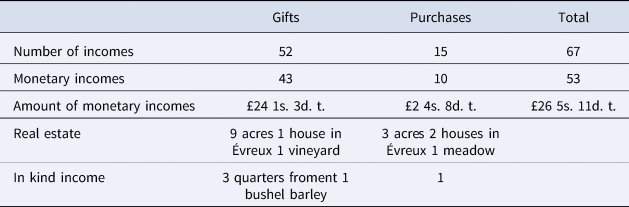
The royal administration could levy a droit d'amortissement (amortisation fee) on religious establishments in return for confirmation of properties recently acquired by donation, exchange or purchase, which it subsequently dispensed with taxing them as transfer duties. The royal letters issued on this occasion offer, through the lists of income they contain, a kind of synthesis drafted by the community itself on one or several decades of management of its estates. In some of them, the distinction made between goods received by way of donation and those acquired by purchase or exchange permits an enlightening analysis of the context and decisions. The comparison of these deeds therefore reveals differences and points to choices. From our point of view, the presence or absence of grain annuities is a first analytical criterion. The Cistercian abbey of La Noë (Eure), for example, presents in its act of amortisation of 1280 a list of 53 monetary annuities received or purchased, and only 1 income in kind, as shown in Table 1.
Abbaye de La Noë: gifts and purchases (around 1247–1280): Delisle (1852), n. 948, p. 239

La Noë was not a very rich monastery: the 26 pounds of rents it acquired in the previous thirty years correspond to a moderate increase in capital, from 200 to 260 pounds. It is possible that the monks devoted their resources to the valorisation of the croplands they received when the abbey was founded in the middle of the twelfth century. In this hypothesis, the acquisition of three houses in Evreux could suggest an opening towards the nearest urban market. The management of La Noë would thus be similar to that of Savigny, another Cistercian community, whose investments seem to be polarized by the urban markets. In its amortissement letter of 1277, in addition to 18 pounds of rents and the income in cereals in Thaon, mentioned above, linked to the Caen market, the abbey reported a series of about ten annuities in wheat received as donations or bought in the villages of Couvains, La Meauffe and Villiers-Fossart, neighbours of the great cloth-making centre of Saint-Lô and presumably involved in its supply.Footnote 36
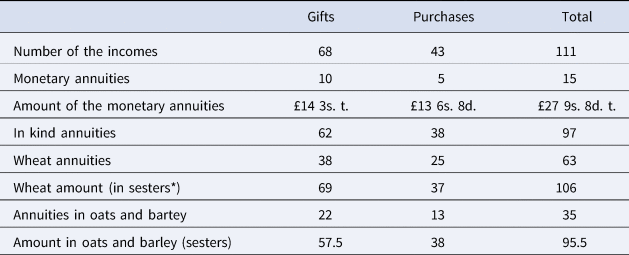
The economic management of the Premonstratensian canons communities usually followed the Cistercian model. The case of the Abbey of Saint Martin de Mondaye, in the south-west of Thaon, allows us to deepen our investigation, thanks to a very precise amortisation letter, offering a precise insight into the community's patrimony (Table 2).
Abbey Saint-Martin de Mondaye: gifts and purchases (around 1247–1277): Delisle (1852), n. 902, p. 215–216

* NB: with one exception (Fontenay), the letters do not indicate the local measures, which are used. In these tables, the sester will therefore be considered as a mere unit of account for an order of magnitude. By convention, and because it seems to be a frequent case in Normandy, we have reckoned: 1 sester = 2 mines = 4 quarters = 12 bushels.
This modest recently founded (1200) community reported comparable amounts to those received in the same period by La Noë and Savigny. Its incomes were located in a very narrow geographical area, which may be the mark of a good local integration. It also had a significant endowment of income in kind, in wheat and spring-cereals. These revenues are not estimated in money, but their analysis sheds light on the principles of distribution of the donations as well as the strategy of investment of the revenues from the donations. The annuities bought by the community on its own resources account for more than a third of its income in kind and half of its annuities in money. This choice reflects the desire to maintain a balance between in kind and monetary income, with a slight bias in favour of the latter. However, the significant quantities of barley and oats acquired by the canons may be explained by the need to provide for the subsistence of the poor in moments of shortage.
In 1326–1328 king Charles IV granted letters to several urban hospitals, which allow us to consider the relationship between monetary and in-kind income from the assistance perspective.Footnote 37 Most of them were large institutions, which also enjoyed high amounts of alms. Their management by the urban clerical elites aimed at consolidating the resources of the institutions and putting them in a position to carry out their tasks of reception and assistance. In order to understand the place held by income in kind in the budgets of these communities, it is first necessary to examine the share of annuities, which are paid in money.
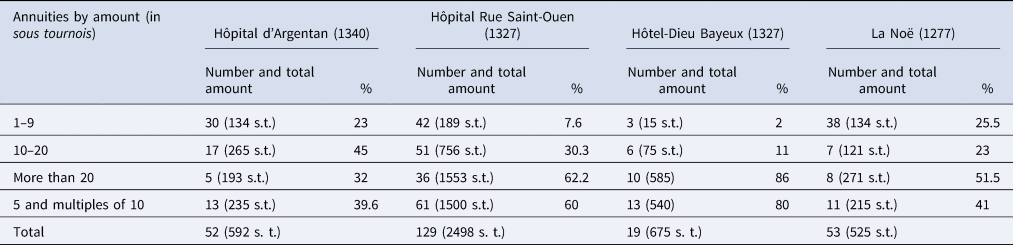
Table 3 gathers information for three hospitals and, for comparison, the previously mentioned abbey of La Noë. All of them present monetary income, mainly annuities, for amortisation. The distribution schemes for the annuities are different (that of the Hôtel-Dieu de Bayeux will require a specific comment): for very small annuities, less than 10 s. t. (£0.5), La Noë and Argentan present similar figures, both in quantity and in proportion, while, for the Rouen hospital and La Noë, annuities of more than £1 make up the bulk of income. If the sums declared by Argentan and La Noë are comparable and modest (£29 and £26), it must be pointed out that small annuities, of less than 20 s. t., constitute the bulk of the donations received by the hospital, a sign perhaps that its benefactors were economically and socially more modest than those of the Cistercians. The Rouen hospital in the Rue Saint-Ouen belongs to another category: nearly £125 declared, of which 30 pensions over 30 s. t. account for half of the total (compared with only 5 in Argentan and 4 at La Noë). All the establishments have one thing in common: the very significant proportion of annuities stipulated in round figures: 5, 10 or multiples of 10 sous tournois: around 40 per cent in Argentan and La Noë, 60 per cent in Rouen, 80 per cent in Bayeux. This is perhaps an indication that these revenues were sold in well-structured markets, providing the buyers with credit instruments that are easy to evaluate. Annuities in kind, which hold a notable place in several letters, should be considered in the same perspective.
Monetary annuities of the hospital Saint-Thomas of Argentan (1340), the hospital of Rue Saint-Ouen in Rouen (1327) and (for comparison) of the abbey of La Noë (1277)

The Bayeux Hôtel-Dieu occupies a very particular place in this picture. The amount of the annuities for which it requests amortisation is higher than that of the Argentan Hospital and the Abbey of La Noë (a little less than 34 pounds), but it is paid by 19 donors only. Moreover, the share of annuities under 20 s. t. is marginal, and annuities in round figures have a prominent place. Moreover, of all the institutions surveyed, this is the only one presenting life annuities for amortisation: 8 in total, with a monetary share of 40 per cent of the total. The barley payments involved in these contracts account for almost all the income in kind. Despite the small amount of data available, a pattern emerges clearly. Close to the Episcopal Palace and well integrated into a prosperous city, the Hôtel-Dieu is apparently an institution that welcomes people with a good level of wealth, capable of offering them expensive annuities.Footnote 38
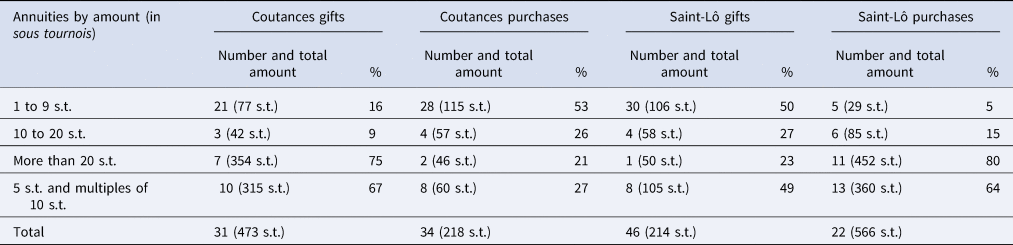
The monetary status of the contracts stipulated in grain measures to be paid in September has so far been emphasised. These are also supply instruments, guaranteeing buyers the regular availability of predictable volumes of grain, which would be valuable in times of high prices. For the rest of the analysis, it should also be remembered that not all localities are the same from this point of view: Argentan, and Bayeux, Rouen, are at the heart of prosperous cereal basins, whose tithes are a major resource for relief institutions. It is reasonable to think that the hospitals of these cities, well endowed with grain, did not seek this type of income. A comparison of the hospitals of Coutances and Saint-Lô, in the Cotentin region, allows us to carry on the analysis. Both were founded at the beginning of the thirteenth century in two towns ruled by the bishops of Coutances, yet they have very different models for organising their income (Table 4).
In-kind annuities of the hospitals of Coutances (1326) and Saint-Lô (1340)

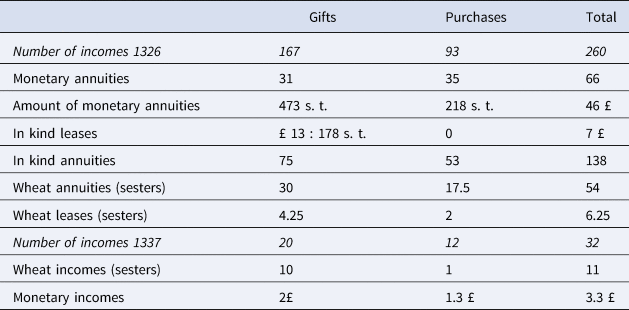
Established in two neighbouring towns, which are also two important drapery centres, these two establishments, which are similar in origin and function, present comparable monetary incomes for amortisation: £34 11 s. t. for Coutances, £39 for Saint-Lô. But the typology of donations is not exactly the same: in Saint-Lô, nearly 80 per cent of the annuities are less than or equal to one pound, as against 75 per cent of annuities greater than one pound in Coutances. The gap between the two increases if we look at donations and purchases separately: annuities purchased out of own funds by the hospital in Coutances account for 31 per cent of the total, compared with 72 per cent (80 per cent of which are more than 1 pound) in Saint-Lô. In other words, while the latter hospital receives small sums from its donors, it pursues a voluntary policy of purchasing monetary assets at a high level. Again, part of the explanation comes from the local context. Around 1340, Saint-Lô was a densely populated town (2 censuses of the 1340s bear the amazing figure of 4300 tax-paying households) and one of the main drapery centres of the kingdom of France.Footnote 39 Since 1230, the town's weavers had been paying the hospital a tax of 3 deniers per woven sheet, which guarantees the institution a perennial income based on the town's main wealth. The amortisation letter witnesses the transformation of this massive monetary flow, though made up of small sums, into a capital of large rentes constituées, perhaps acquired from the cloth merchants, who were seeking capital to invest. Undoubtedly the beneficiary of large tithes and established near a very important urban market, therefore well supplied, the hospital preferred cash income to income in kind: in fact, the letter mentions only 12 grain annuities representing a little more than 4 sesters of wheat, 1.7 received as donations and 2.4 purchased (Table 5).
Incomes of Coutances Hôtel-Dieu circa 1296–1326 and 1326–1337

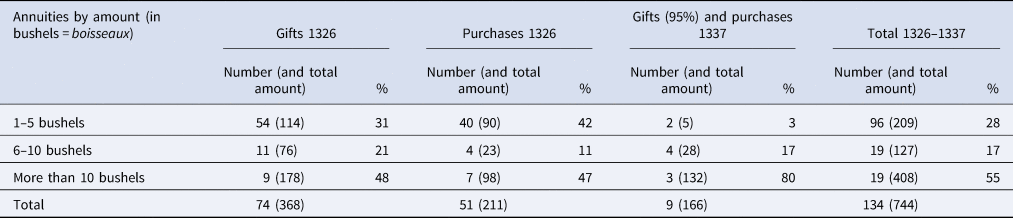
Coutances, with a smaller population than Saint-Lô and landlocked in a region less suitable for cereal farming, was undoubtedly a less affluent market. The Hôtel-Dieu de Coutances, which was probably the city's main consumer, had opted for a wheat-based economy. We already saw the particular structure of its cash resources. The many charters preserved for the thirteenth century tell of the methodical construction of its cereal resources, first by being given annuities based on the mills of the surrounding areas (no less than 18 quarters in the first 10 years), then by using the sums left by the benefactors for their obit to acquire wheat annuities: no less than 57 pounds from 1273 to 1296.Footnote 40 The annuities paid to the hospital guaranteed the annual income of more than 60 sesters of wheat, to which should be added the tithes. In an average year, one can imagine that food for sick and poor people was only marginally bought on the market (Table 6).
Grain incomes of the Coutances Hôtel-Dieu (circa 1296–1326 and 1326–1337)

5. Grain and monetary value: a sketch of an economy
It is now time to consider the economic significance of the set of practices we have just described. The evidence gathered from the records allows us to construct a coherent survey. The variety in the cases, however, calls for caution in their interpretation. The observations that follow do not therefore aim to provide a complete framework for analysis. We will first try to place the system within the landscape of credit practices, before looking at the relationship between value-grain and value-currency.
Since these annuities can be found in a vast and diverse regional area and over a long period of time (over three centuries), they cannot be seen as a temporary solution to a local shortage of means of payment. The in-kind annuities found in the thirteenth and fourteenth century records coexist with the monetary annuities studied by Robert Génestal: they are not a substitutive but a complementary element. This situation persists for the period 1350–1500 in the books kept by the tabellions, where the two types of annuities are observed. In addition, in the same records we find references to loans and testimonies relating to credits granted by Jewish and Lombard lenders, as well as future sales of movable property, from the beginning of the fourteenth century. In a society characterised by the omnipresence of credit relationships, the diversity of instruments used makes it impossible to link the spread of grain annuities to a failure of monetary credit. Each of these systems responds to a specific demand through the use of a particular resource; it is necessary to identify one and the other.
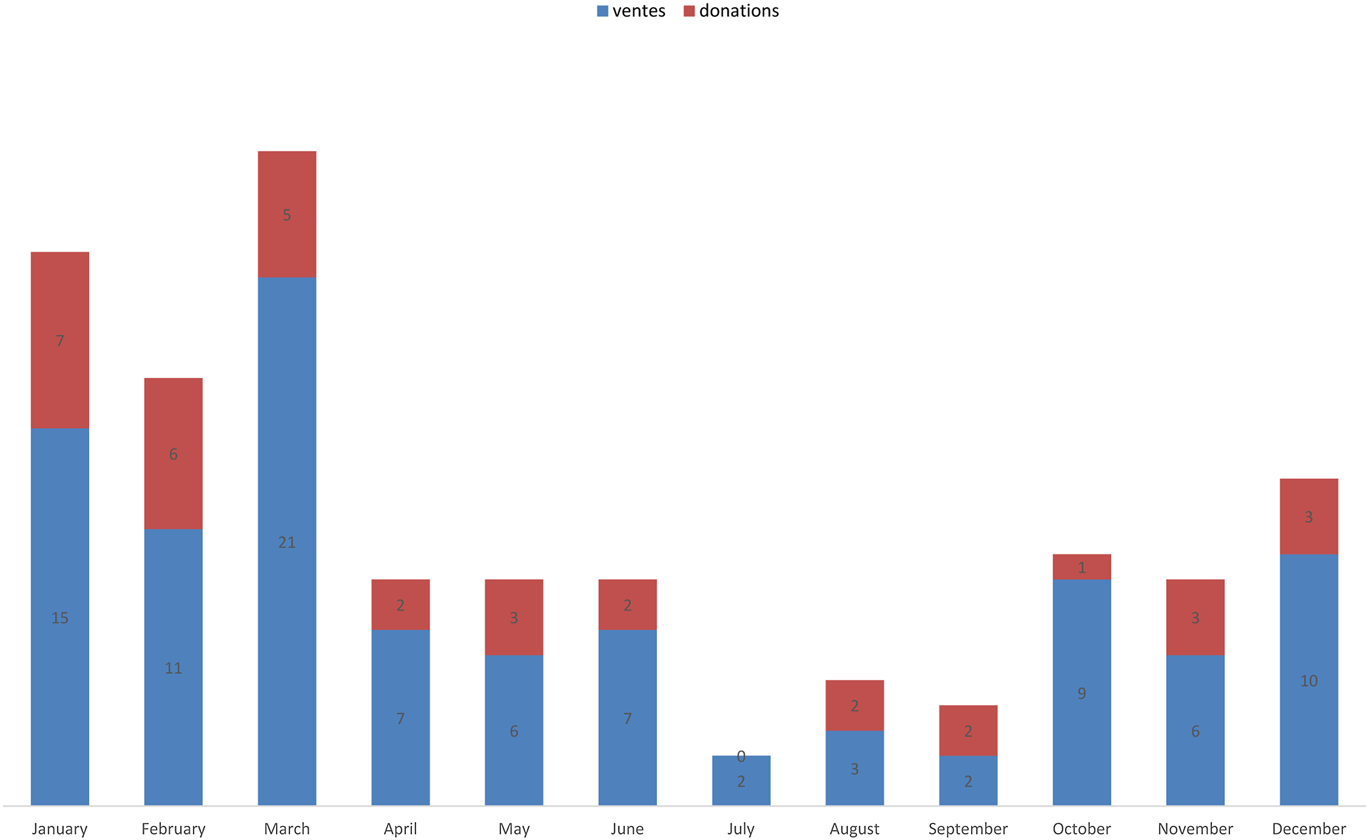
Yearly distribution of contracts helps to open up the discussion. We know the month in which the deed was drawn up for 105 annuity sales and 36 donations. Their distribution is similar for both categories: we can observe the classic summer low: 4 donations and 7 sales, i.e. less than 10 per cent. Conversely, more than half of the charters (57 sales and 21 donations) are concentrated in the four months from December to March. Moreover, the dating formulas adopted even suggest that this high period is in fact the one from Christmas to Easter. Cautiously, one may wonder whether this period, which has no significance in the agrarian calendar, might have been the one in which the monetary capital collected in the autumn was to be invested. If this were the case, it suggests that the grain annuity market was driven and animated by the relative abundance of capital to be invested, particularly by ecclesiastical institutions, rather than by a demand for cash from peasants (Figure 1).
Monthly distribution of annuities sold or donated on the markets of the Caen region (1237–1324)

To go further, we must follow in the footsteps of Robert Génestal, who, in the last chapter of his book, laid the foundations for an economic analysis of this credit system.Footnote 41 As we just did, he placed himself primarily from the point of view of annuity purchasers, i.e. from the point of view of the capital supply. The form of the contracts, which is unequivocal and stable over the long term, if we disregard slight local variations, does not allow us to consider these charters as fictitious sales concealing regularisations of previous indebtedness situations. Selling an annuity is not, for a debtor, a means of obtaining from his creditor a delay in the repayment of his debt. All the charters witness the actual payment to the seller of the annuity of a sum in currency corresponding to the capital indicated. The public reading of the letter before the parishioners (coram parrochia), to which all these contracts were subject, excludes a second meaning of these mentions. Moreover, in the charters and in the letters of amortisation, we find some rare cases of donations which are in fact renunciations, on the part of the benefactors, of annuities previously due by the religious, the amount of which is given; these cases seem to correspond to cancellations of seigniorial royalties. They are not to be confused with the actual rentes constituées.
The amounts paid to buy grain annuities are always more than a pound, which is not negligible; since the recipients are peasants (members of the nobility, clerics or the bourgeoisie of Caen are rare exceptions) they cannot be sums intended for consumption. Rather, they are means of investment, intended for the purchase of land, equipment (draught animals, machinery) or to be spent on wages (land clearing, buildings, drainage works or river regulation).
Contracts never specify the origin of the funds paid by religious institutions. In the case of hospitals, one can think of almsgiving and obituary gifts, which in some cases reach very large amounts. For monasteries, Genestal suggested that the monetary flow invested in nearby villages could be seen as the counterpart of the tithes received from parish communities, implicitly making the hypothesis of a moral economy of these exchanges. Abbeys with estates in England, such as Troarn, Fontenay and Savigny, received the income from their manor houses on the other side of the Channel in money (in ingot or mint). These sums, which were very substantial even after the separation of the duchy and the kingdom in 1204, could be used to purchase annuities. Finally, it can be considered that the coins received in payment of monetary rents could also be reinvested in the purchase of in-kind rents. This is quite probable in the case of the hospital of Saint-Lô, which we have seen above was the beneficiary of multiple cash annuities and purchaser of grain annuities.
While the origin of the capital paid to acquire the annuities does not raise fundamental questions, the same cannot be said for the grain payment that makes them unusual. A first problem is posed by the origin of the grain. These annuities are not a hidden levy on crops. If we take into account the terms of the contracts, we see that most often the assets used to guarantee the payment of the annuity are not fields, but rather enclosed land, meadows or buildings. The rent is therefore not backed by the cereal production system, even though it is paid out of the local harvest. In fact, in most cases, there is no evidence that the debtor himself crops grain. Wheat and barley do not result from his productive work but are purchased on the local market. This point is implicit in the very definition of the rent to be paid. The term, set for the month of September, and the indication of a particular local measure make the grain paid a ‘good, fair and marketable commodity, of good weight and good price’ according to a standard formula. The conformity of the grain paid for requires its passage through the market. Moreover, while documents relating to tithes and seigniorial royalties mention multiple products of the agrarian cycle (straw and hay, beans, vetches and peas, meslin, flax and hemp, cheese, wool), charters mention only annuities in wheat, barley and oats, that is, in the three basic products for mercantile exchange. The fairly clear predominance of wheat annuity purchases suggests that it is specifically in this market segment, which is probably also the most well-structured, that the bulk of in-kind credit is based.
The freedom of the debtor to pay the annuity in kind or in cash representing the value of the grain raises important questions. The first relates to the lawfulness of this type of contract; the impossibility for the payer to know in advance the variations in the price of grain could be considered characteristic of a usurious contract. It was this point that Venetian jurists and theologians objected to the livelli a grano agreements of modern times. But this is not the case here, because of the clauses defining the payment transaction, both in kind and in cash. In our analysis of the lawfulness of the contract, the intrinsic value of the grain, which is unchanged in its definition, must prevail over its monetary valuation, i.e. its market price, which is subject to annual variations. From this point of view, it is the public agreement of both parties on the terms of payment, which makes the contract lawful. Moreover, the procedure for setting the price of grain paid in the fall and on the market, at a time of greater abundance of both supply and demand, makes it a ‘just price'. At this point it should be stressed that the rent paid is linked in all its characteristics to a limited space and time: the area of recognition of the measuring system and the fall period. The inscription of the grain annuities market in a narrow space around the market places mirrors the very narrow territory described by Robert Génestal for monetary annuities acquired by religious in the parishes neighbouring their communities.
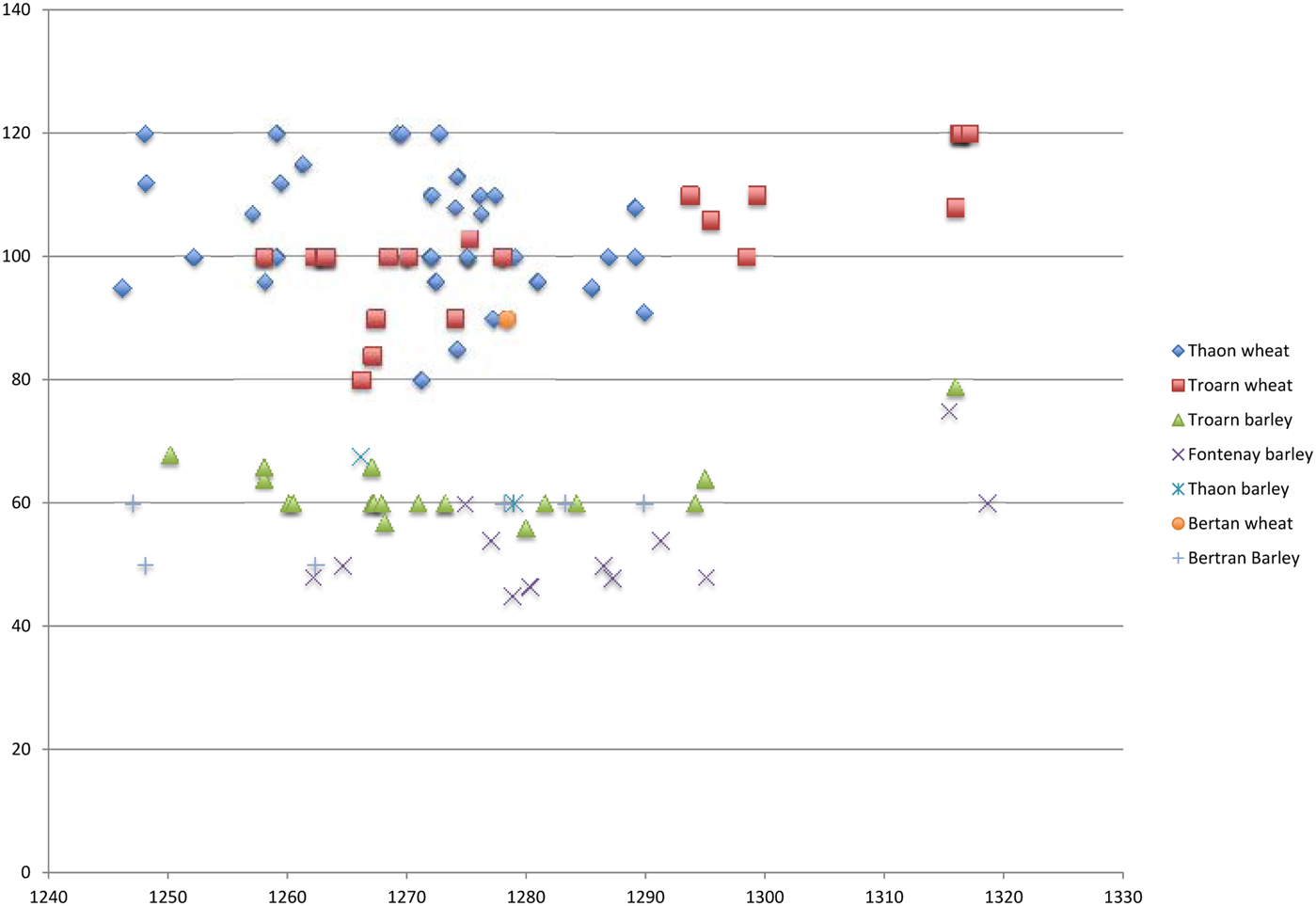
At this point the question must be asked as to the price paid in counterpart of the debtor's perpetual commitment to pay a certain quantity of grain. The number of contracts retained makes it possible to arrange them in series and compare their evolution. Thus we have for the years 1240–1320 important but discontinuous series of annuity purchases on the markets of Fontenay, Thaon and Troarn. To this we can add the purchases of annuities made by two landlords of the Caen region, Jeanne Taisson, lady of Thury and her son Guillaume Bertran in the years 1282–1298: 6 for barley annuities and 1 for a wheat annuity, on the markets of Fontenay-le-Marmion, Condel and Bretteville-sur Laize, in the south of Caen, not far from Fontenay.Footnote 42 Since the contracts are stipulated in bushels, mines, quarters and sesters, assumptions had to be made about the measurement systems for wheat and barley on different markets: sesters of 2 mines, 4 quarters for Thaon (wheat), and Troarn (wheat and barley), sesters of 2 quarters and 1.5 mines for Fontenay (barley). Several charters mentioned abnormally high prices (more than double the average values). Their analysis showed that they were not annuity arrangements but property transfers, in which the payment of the annuity was not the counterpart of a paid-up capital, but of a tenure lease. These contracts were accompanied by the payment of a tribute and honorary royalties. Some of them, dating from the first years of the fourteenth century, were concluded between private individuals. They could perhaps be witnesses to a crisis in the peasant patrimonies. However, their presence in the archives of a monastic community remains unexplained (Figure 2).
Price (in sous tournois) paid for an annuity of 1 sexter of wheat and barley on some markets of the Caen region (1246–1318)

The graphical interpretation of the selected data shows first of all that prices were stable throughout the thirteenth century, without the inflationary trends identified by historians of the European economy.Footnote 43 We can roughly say that the price of the rent of a sester of wheat in Thaon and Troarn is around 100 sous tournois, and 60 sous for the rent of a sester of barley in Fontenay, Troarn and Fontenay-le-Marmion. This ratio 100/60 for wheat to barley is confirmed for Thaon, where two annuities payable in barley (in 1260 and 1278) are worth 60 and 67 s. 9 d. the sester. No data are available for the years 1320–1340, which makes it impossible to know whether the high prices observed in 1315 at Troarn and Fontenay were a temporary effect of the critical situation of the years 1315–1317 or correspond to a change in the evaluation of grain incomes. The long-term stability of these values, while the consensus among historians is rather in favour of a long period of rising prices during the thirteenth century, seems to indicate that the price of these grain market derivatives, i.e. rents, is practically insensitive to the economic situation: the 20–30 per cent increase in the years 1315–1317 must be seen in the perspective of the near collapse of the English market system at the same time.Footnote 44
6. Conclusions and hypotheses
We must now make some sense of the observations collected above. A first point to be stressed is about the geographical distribution of the sources. While there are mentions of annuities made up of grain in most Norman towns in the thirteenth and fourteenth centuries, in particular thanks to the amortisation letters, only a few of them provide abundant records that enable us to observe the system precisely. Further work will be needed to build up other series, but the Norman urban history records published so far do not reveal cases similar to those of Thaon, Troarn and Fontenay for the thirteenth century. Rather than presuming the singularity of these three places, it seems necessary to me to stress their similar (and long-lasting) place in the regional grain trade; these are, among others, three of the supply markets of the city of Caen, which is itself both a consumer market and a place for exporting grain to the Seine valley or to the British Isles. From the point of view of the three abbeys whose sources we have exploited, these are places with a large surplus of grain, whose regularity of production provides the information necessary to set up a credit based on agreements derived from the grain markets.Footnote 45
It is in this perspective that the actions of religious institutions should be considered. As recipients of substantial cash resources, which must be used without incurring the charge of usury or avarice, they found in these local markets a space where they could provide credit in the form of cash rents as well as grain credit. The cash transfers thus made could be invested for the purpose of common profit. In a space restricted to two or three parishes, where information on borrowers and obligations could be easily gathered, the possibility of grain payments opened up the credit market to borrowers whose access to money may have been intermittent, when the grain resource was not in short supply. In addition to exclusively monetary exchanges, reserved for a well-off clientele and open to the wider space where money circulated, grain annuities made it possible to serve a new clientele, eager to invest but with more uncertain financial means. While there is no doubt that grain payments in the markets generated monetary value for the creditors and contributed to the growth of trade, the possible uses of the grain paid out should also be emphasised.
If we consider that the annuities offered for sale are the counterpart of a portion of the harvest available on the markets, it is appropriate to question the use of this resource. Not all communities were equal in this respect; in the case of hospitals, there is little doubt that grain rents filling the barns of the institutions had a food supply function. For Troarn, whose charters all contain a clause prescribing a non-market destination for the grain donated, we can assume that the annuities received as donations or purchased were part of the same charitable destination. In the same way, the choice of a barley economy, which shapes the patrimony of Fontenay, can hardly be explained in any other way. In this context, sales and donations of grain annuities should be seen in a joint perspective as a means of fixing locally a share of the available harvest, with an insurance purpose in mind. By acquiring a not negligible share of the wheat market in Thaon, the monks of Savigny were adopting a different perspective, characteristic of the Cistercian economy, which made markets an essential element of their social construction, particularly with regard to the movement of resources from the countryside to the town. The grain collected on the country markets was to be transported to Caen. There was therefore a dimension of utility involved in the management of these resources, which made it possible to conceive it as a profitable trade, though not tainted by usury.
Taking into account all the economic and social dimensions of this mixed system underlines the early importance of investment credit in the Normandy countryside. It is difficult to estimate the scale of this phenomenon, both in terms of its monetary value and its cereal mass. Its survival until the end of the Middle Ages suggests that this market segment was commensurate to the size of the local trade; the fact that these rents were located in the parishes immediately adjacent to the market towns undoubtedly made it possible, by exchanging information, to avoid the effects of a speculative bubble. There is no doubt that these contracts increased the familiarity of rural inhabitants with the circulation of value and currencies. The practice, which continued until modern times, of courts declaring the local ‘appreciations’ of rents in kind, shows that this credit system, in its simplicity, resisted fairly well the numerous shocks that crises inflicted on the rural economy. What share of the credit markets was accounted for through these rather simple instruments is difficult to imagine. One of their functions, to use a distinction that is still useful, was to extend the functions of the ‘monetary economy’ to the confines of the ‘natural economy’.
Finally, the existence of a market linked to grain annuities raises the question of the connection between credit and land ownership. There is no evidence that the existence of these annuities led in the long term to an expropriation of the payers for the benefit of the buyers. Guy Bois, in his contribution to the Brenner debate, had already observed that the Norman countryside in the early sixteenth century had seen a trend of dispossession of peasants to the benefit, in particular, of the urban elites, but the process had been of limited duration and magnitude, due to the resistance of the peasant populations.Footnote 46 Furthermore, research on land ownership and the land market in Normandy has shown that, until the eve of the French Revolution, Norman people, both peasants and urban dwellers, remained deeply attached to a lignagère definition of property that limited the ability of single individuals to dispose of their possessions and slowed down the emergence of a land market.Footnote 47 An inquiry in several Norman courts records of the fifteenth century had shown that sales of land properties seized for non-payment of annuities (the so-called décrets d'héritages) were infrequent, and that most of them followed the death of the debtor and the abandonment of all rights of the heirs to the part of the inheritance corresponding to the arrears value. Failure to meet commitments could therefore result in partial, negotiated and often post-mortem dispossession of the debtor, but apparently not in his expulsion from the property.Footnote 48
From a broader point of view, evidence discussed in the previous pages attest to the emergence, from the thirteenth century onwards, of a credit market based on cereal annuities guaranteed on the land owned by peasants. This original situation allows a better understanding of the specificity of the Normandy case in the European landscape. The institutional functioning of grain rents markets suggests that the maintenance of a tenure system bound to strong lineage rules was not incompatible either with a monetisation dynamic or with property rights. Under these conditions, it must be admitted that the actors involved in these markets identify as available goods not the land itself, but the fruits cultivated and put on the market. The entitlements on limited shares of crops had, in this system, the same function as plots of land in a land market. The development of this particular market, but also more generally of a cash rents market, did allow the Norman agrarian system to experience a long period of growth without giving up the systems of tenure inherited from the Anglo-Norman period. From this perspective, it is conceivable that other regions of Europe had other forms of distinction between land property and ownership of fruits. In the light of this inquiry in Norman experience, one may wonder whether the growth of a land market is a stage in a process that inevitably leads to the expropriation of peasants, or whether under conditions and according to a chronology that vary from one region to another, this growth can be considered instead as a consequence of a previous process of dispossession. The existence of credit markets based on the mobilization of harvested fruits reminds us that economic analysis cannot separate land ownership and resource exploitation, for these periods as in the contemporary world.
Acknowledgements
Sine its presentation at the World Economic History Conference in Boston (2018), this paper has been fully discussed with Phillipp Schofield, Antoni Furio and Amos Nadan ; the anonymous reviewers and the editors of the review have helpfully contributed to its coherence. Many thanks to every of them.