
I. INTRODUCTION
Titanium dioxide is widely used in implant and healthcare applications Reference Amaravathy, Sathyanarayanan, Sowndarya and Rajendran1,Reference Nagarajan and Rajendran2 due to its known biocompatibility in the anatase form Reference Suker and Albadran3 despite some serious concerns. Reference Wang and Lung4 Reports suggest that titanium oxide improves the mechanical properties of metallic materials such as aluminum, Reference Ravichandran and Dineshkumar5 magnesium, Reference Meenashisundaram, Nai, Almajid and Gupta6,Reference Hassan, Nasirudeen, Al-Aqeeli, Saheb, Patel and Baig7 titanium, Reference Tomohiro, Threrujirapapong, Hisashi and Katsuyoshi8 and zinc. Reference Ranganath, Sharma, Krishna and Muruli9 Magnesium is one of the metallic elements which attracts interest for a wide range of applications from automobile to aerospace, owing to its lightweight and high specific mechanical properties, to biomedical owing to its good biocompatibility. Magnesium degrades in the human body fluid and forms a harmless compound dischargeable through urination. Hence, there is a renewed interest in recent years to use magnesium as a biodegradable implant in cardiovascular stent, bone fixation, and tissue engineering scaffolds. Reference Staiger, Pietak, Huadmai and Dias10,Reference Witte, Hort, Vog, Cohen, Kainer, Willumeit and Feyerabend11 However, large scale of the wide-range application requires a further enhancement of strength with reduced tensile-compressive yield asymmetry and formability of magnesium using various ways including the advanced processing technique, alloying, and reinforcement. Reported studies show the limitation of biocompatible alloying elements Reference Staiger, Pietak, Huadmai and Dias10,Reference Witte, Hort, Vog, Cohen, Kainer, Willumeit and Feyerabend11 on the mechanical properties of magnesium, where strengthening deteriorates the intrinsic limited formability. However, like many other oxide nanoparticle dispersoids, Reference Hassan, Zabiullah, Al-Aqeeli and Gupta12 titanium oxide nanoparticles showed potential in enhancing the strength and/or formability of magnesium without compromising each other. Reference Meenashisundaram, Nai, Almajid and Gupta6,Reference Hassan, Nasirudeen, Al-Aqeeli, Saheb, Patel and Baig7 There is a potential for the development of a titanium oxide reinforced magnesium composite possessing a good combination of mechanical properties with tensile-compressive yield asymmetry. The incorporation method plays a major role in the exploitation of fine particle dispersion in the magnesium matrix composite, Reference Hassan13,Reference Hassan14 which is also apparently evident in the case of titanium oxide reinforced materials. Although the limit of volume fraction of titanium oxide nanoparticles dispersions has been studied using the melt process incorporation technique, the same is not done for the powder process incorporation technique. Hence, the primary aim of this study is to incorporate titanium oxide nanoparticles as dispersions up to a limit of well-studied 1.0 vol% in commercially pure magnesium and investigate their effect on the microstructure and mechanical properties of the matrix.
II. EXPERIMENTAL PROCEDURE
A. Materials and processing
Commercially pure (97.5+% purity) magnesium powder (<0.1 mm size) (from Merck KGaA, Darmstadt, Germany) was reinforced with 0.33–1.00 vol% of titanium dioxide (anatase form) nanoparticles (32 nm size) (from Nanophase Technology Corporation, Romeo, Illinois) using a Fritsch Pulverisette 5 planetary ball milling machine (Fritsch GmbH, Idar-Oberstein, Germany). Physically homogeneous blending of the matrix and dispersoid particles was done, in the absence of any ball and process control reagents, at a rotational speed of 200 rpm for 1 h. Physically reinforced magnesium powders were cold compacted into billets of 35 mm diameter and 40 mm height using a uniaxial hydraulic press. 750 MPa pressure was used for ∼2 min during the compaction process. The compacted billets were graphite coated and sintered for densification for 2 h in inert argon gas atmosphere at 500 °C using a resistance heating electric furnace (MTI GSL-1700X, MTI Corporation, Richmond, California). Sintered billets were hot extruded (at 250 °C) to cylindrical rods with 8 mm diameter (extrusion ratio 19.1:1) in a uniaxial hydraulic press. A colloidal graphite lubricant was used during the extrusion process. Unreinforced magnesium as the reference material was processed using similar steps.
B. Density measurements
Density of the extruded unreinforced and reinforced magnesium was measured using Archimedes’ principle. Samples were weighed in air and distilled water in an electronic balance (Mettler Toledo model AG285, Mettler Toledo, Columbus, Ohio) with an accuracy of ±0.0001 g. Porosity was calculated from the theoretical density calculated using the rule of mixture, assuming fully dense materials and measured density values.
C. Microstructural characterization
The titanium oxide particle distribution pattern, interfacial integrity, and effect on the grain morphology of the magnesium matrix were studied. Energy Dispersive Spectroscopy equipped Field Emission Scanning Electron Microscope (Tescan Lyra-3, Tescan Orsay Holding, a.s., Kohoutovice, Czech Republic) and an optical microscope (Meji MX7100, Meiji Techno UK Ltd., Somerset, United Kingdom) was used in this microstructural characterization. The linear intercept method was applied using a Matlab-based Line-cut image analysis software to determine the grain size of the processed magnesium materials.
D. Mechanical characterization
Tensile and compressive tests were conducted on the extruded unreinforced and reinforced magnesium along the extrusion direction. Tensile tests were done on samples of 5 mm diameter and 25 mm gauge length, with a strain rate of 0.0002 s−1, in accordance to the ASTM E8M-15a standard. Compressive tests were done on samples of 8 mm diameter and ∼8 mm length to achieve an l/d ratio of ∼1, with a strain rate of 0.0002 s−1. An Instron 3367 machine (Instron, Norwood, Massachusetts) was used for tensile and compressive tests. Fracture surfaces of the tensile and compressive tests samples were studied using JEOL JSM-6460 LV scanning electron microscope (JEOL USA, Inc., Peabody, Massachusetts) to identify the fracture mode.
III. RESULTS
A. Macrostructural characteristics
Macrostuctural investigation of the compacted and sintered billets and the extruded rods of unreinforced and reinforced magnesium revealed the absence of any kind of processing-induced defects, including bulging and/or cracks.
B. Density
Density of the extruded unreinforced and reinforced magnesium, as shown in Table I, revealed that the processing route and parameter used has produced near dense materials. However, it was negatively affected once the titanium dioxide nanoparticles dispersions were introduced.
Results of density, porosity and grain morphology characterization.

C. Microstructural characteristics
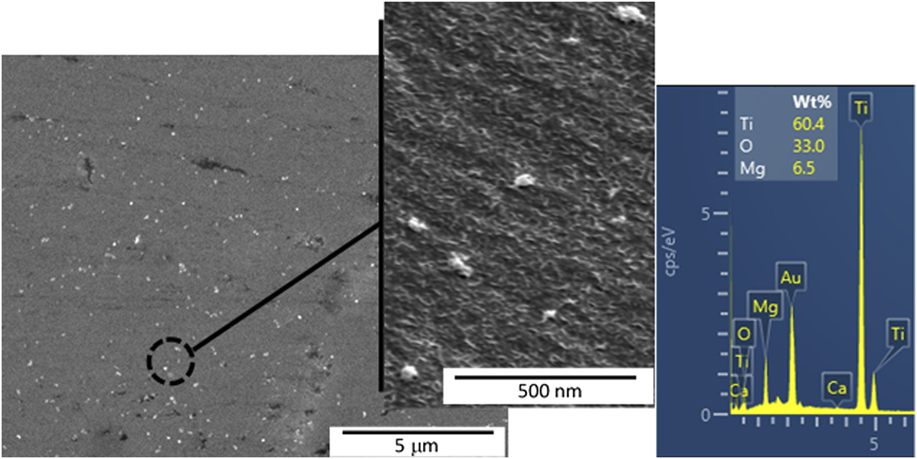
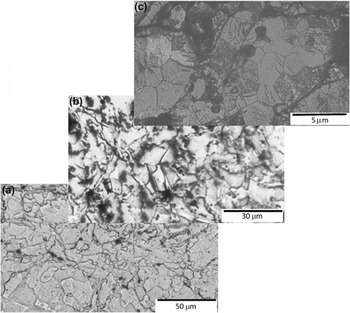
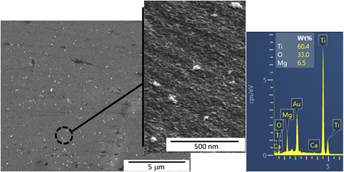
Titanium dioxide nanoparticles were dispersed in a relatively uniform manner with good interfacial integrity with the extruded magnesium matrix (see Fig. 1) and acted as a strong grain refiner of the matrix material (see Fig. 2 and Table I).
Field emission scanning electron micrographs showing the distribution pattern (in different magnification) of titanium dioxide nanoparticles (with 1.0 vol%) in the magnesium matrix.

Optical micrographs showing the grain morphology in: (a) magnesium, and (b) and (c) nano-sized titanium dioxide nanoparticles dispersed in magnesium (with 0.33 and 1.0 vol%), respectively.

D. Mechanical characteristics
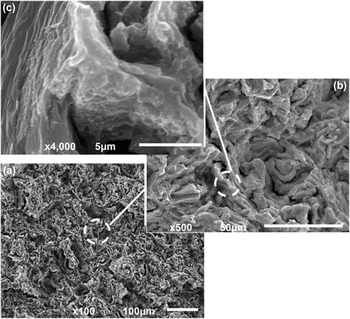
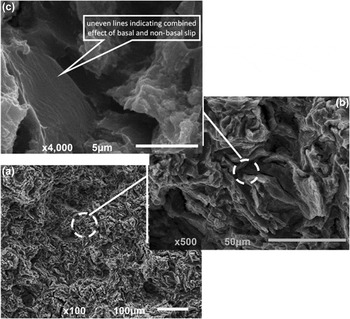
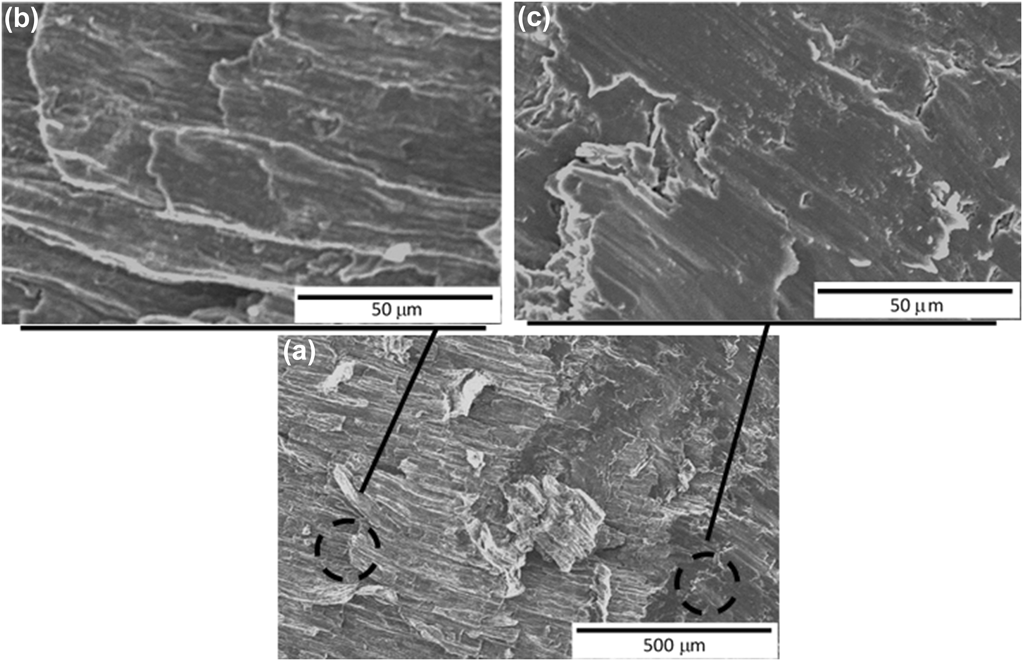
Tensile tests of the processed materials revealed that the titanium dioxide nanoparticles dispersions have increased the yield strength and tensile strength marginally and the ductility toughness significantly (see Table II) for the magnesium matrix. However, the increasing volume percentage of the dispersed nanoparticles diminished the strengthening effect but continued to increase the ductility and toughness of the magnesium matrix. The pseudo-dimple tensile fracture mode (Fig. 3) was assisted with features indicating the ease of nonbasal slip activities (Fig. 4) due to the presence of titanium dioxide nanoparticles dispersion.
Results of tensile properties characterization.

Scanning electron fractographs showing pseudo-dimples in the tensile fracture of elemental magnesium with a magnification of 100× (a), 500× (b), and 4000× (c), respectively.

Scanning electron fractographs showing pseudo-dimples with indication of a nonbasal slip activity in the tensile fracture of 1 vol% titanium dioxide nanoparticle dispersed magnesium with a magnification of 100× (a), 500× (b), and 4000× (c), respectively.

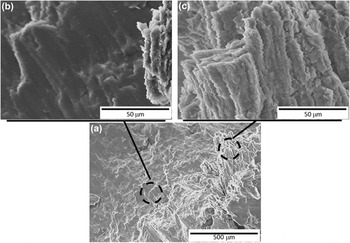
Compression test of the processed materials revealed that the increasing volume percentage of titanium dioxide nanoparticles dispersoid increased the compressive yield, ultimate compressive strength and compressive toughness significantly, and ductility marginally (see Table III) for the magnesium matrix. The compressive fracture mode of magnesium was twinning dominated (see Fig. 5) and remained unchanged, but the shear band became finer and was protruding out of the fracture surface with the increasing volume percentage of titanium dioxide nanoparticles dispersion (see Fig. 5).
Results of compressive properties characterization.

Scanning electron fractographs showing a shear band in the compressive fracture of elemental magnesium with a magnification of 50× (a) and 500× (b) and (c), respectively.

The mechanical characterization also revealed (see Table III) that the increasing volume percentage of titanium dioxide used in this study was effective in eliminating the tensile-compressive yield asymmetry.
IV. DISCUSSION
A. Macrostructural characteristics
Physically blended titanium dioxide particles, with increasing volume percentage, and magnesium matrix composites were synthesized using the traditionally economical blend-press-sinter-extruded powder metallurgy process. Physical processing defects like bulging, surface cracks, or visible oxidation were absent in the green and sintered billets and as well as in the extruded rods. Appropriateness of the processing parameters, including large powder compaction pressure and relatively high extrusion ratio, was reflected in the near dense unreinforced and reinforced magnesium (see Table I) with almost zero porosity.
B. Microstructural characteristics
Microstructural characteristics of the titanium dioxide reinforced magnesium were investigated for: (i) the nanoparticle dispersion pattern and interfacial integrity with the matrix, (ii) the dispersed nanoparticle effect on the matrix grain morphology, and (iii) the porosity distribution pattern in the matrix.
Titanium dioxide nanoparticle dispersion were found to be reasonably uniformly distributed in the extruded magnesium (see Fig. 1), even with their increasing volume percentage, which was also reflected in the almost zero standard deviation in the experimental density values. Blending and extrusion Reference Hassan, Zabiullah, Al-Aqeeli and Gupta12 parameters used have attributed to the distribution pattern achieved in this study. It has to be noted that titanium dioxide nanoparticles stability in the magnesium matrix was secured by using the processing temperature much below than that required for the Mg–TiO2 exothermic reaction. Reference Umeda, Kawakami, Kondoh, Ayman and Imai15 Good wettability between the metal and the oxide system Reference Eustathopoulos, Nicholas and Drevet16 has led to good interfacial integrity between the titanium dioxide and the magnesium matrix in this study, which was assessed by the absence of debonding and/or nanovoids at the interface.
The well-dispersed titanium dioxide nanoparticles induced grain refinement in the magnesium matrix (see Fig. 2 and Table I) as has been reported for other oxide nanoparticles dispersions. Reference Nagarajan and Rajendran2–Reference Hassan14 Relatively stable oxide nanoparticles in the metallic matrix offer a nucleation site during the recrystallization process and further inhibit the growth of the recrystallized grains by retarding boundary movement. The grain refining effect of the titanium dioxide nanoparticles increased significantly when increased in volume percentage to 0.66 and remained almost unchanged with further increase in their volume percentage.
Negligible presence of porosity revealed in the unreinforced and reinforced materials processed in this study was believed to be the cumulative effect of large compaction pressure and extrusion ratio Reference German17,Reference Lloyd18 and good reinforced-matrix chemical compatibility. Reference Eustathopoulos, Nicholas and Drevet16
C. Mechanical characteristics
Mechanical characterization on the strengthening effect (see Tables II and III) of increasing the volume percentage of the dispersed titanium dioxide nanoparticles on the magnesium matrix revealed: (i) almost no effect on the tensile yield strength, (ii) significant enhancement in the compressive yield strength, (iii) substantial strain hardening irrespective of the loading type, and (iv) reduction in the tensile-compressive yield asymmetry.
Tensile strength and compressive yield strength of extruded magnesium were found to be slightly higher than the values reported in the metal handbook, 19 which is common in the case of powder metallurgy processed materials. Yield strength represents the minimum stress required to initiate plastic deformation mainly by slip and controlled by dislocation density and the ease at which the dislocation can move in the metallic materials. Only the basal slip is activated during the room-temperature deformation process in hexagonal closed packed structured elemental magnesium, which could be impeded either in the activation stage due to crystallographic preferential orientation and/or at the propagation stage by grain boundaries. However, easy activation of tensile twinning in compressive stressing parallel to the basal plane along the extrusion direction Reference Hosford20 leads to a relatively much lower compressive yield strength and large tensile-compressive yield asymmetry. Titanium dioxide nanoparticles dispersion had little or almost no effect on the overall tensile strength of magnesium in this study irrespective of their added increasing volume percentage. In contrary, the added titanium dioxide nanoparticles dispersion significantly increased the overall compressive strength of magnesium and further increased with increasing the dispersion volume percentage.
Presence of finer oxide dispersion Reference Lloyd18 in the matrix and the grain refinement Reference Reed-Hill and Abbaschian21,Reference Murr22 added enhanced impedance to the dislocation slip and consequently increase the yield strength of the magnesium matrix both under tensile and compressive loading. Particle-induced recrystallization during thermomechanical processing helps in refining the grain as well in randomizing its orientation and lowering the texturing in the extruded magnesium matrix, and, hence, activation of the tensile twin in the magnesium matrix is significantly reduced Reference Yin, Wang, Liu and Zhao23 when subjected to compressive loading. The reduced number of tensile twins’ propagation is further restricted due to their interaction with finer oxide dispersion Reference Stanford and Barnett24–Reference Partridge26 in the matrix. On the contrary, grain refinement induced randomization of the texture enables tensile twinning to be relatively easy under tensile loading. Under tensile loading, the dislocation slip process also eases in the hexagonal close packed structured magnesium by activation of the nonbasal slip system at room temperature due to the presence of extremely fine hard particle dispersion, as has been reported earlier. Reference Hassan, Paramsothy, Yilbas and Gupta27 The synergic effect of these factors was attributed to be the reason behind the reduced strengthening effect under tensile stressing and, in contrast, the enhanced strengthening effect under compressive stressing in the titanium dioxide nanoparticles dispersed in the magnesium matrix. As an effect the large tensile-compressive yield asymmetry (i.e., 1.82) of pure magnesium gradually reduced to the value of disappearance (see Table III) with increasing the presence of titanium dioxide nanoparticles dispersion used in this study. Relatively less plastic hardening under tensile loading and significant hardening under compressive loading were also visible in the strain hardening effect as seen in the values of the ultimate tensile and compressive strength of the reinforced magnesium.
Mechanical characterization also revealed that the ductility of magnesium was significantly increased while subjected to tensile loading (see Table II) but remained almost unaffected when subjected to compressive loading (see Table III) due to the presence of titanium dioxide nanoparticles dispersion. Increment in tensile ductility could be attributed to the cumulative effect of the grain refinement, Reference Shen, Yin, Wei, Li, Liu and An28 relatively easy activation of the tensile twin, and ease in slip due to activation of the nonbasal slip system. Reference Hassan, Zabiullah, Al-Aqeeli and Gupta12–Reference Hassan14,Reference Hassan, Paramsothy, Yilbas and Gupta27 Presence of an extremely fine harder dispersion in the relatively less ductile hexagonal close packed metallic materials also contributes in enhancement of tensile ductility Reference Cahn29 by arresting the advancing crack front. Study of the tensile fracture surface revealed quite similar features in titanium dioxide nanoparticles dispersed in the magnesium matrix (see Figs. 3 and 4) with the possible indication of nonbasal slip activity [see Fig. 4(c)]. The inability of the titanium dioxide nanoparticle dispersion to enhance the compressive ductility (see Table III) could be attributed to the reduced deformation twining activation due to grain refinement induced texture randomization in the magnesium matrix. Deformation tensile twinning is considered to be the major deformation mode under compressive loading. Study of compressive fracture surfaces indicates that the presence of the shear band parallel to the fracture surface in magnesium (see Fig. 5) became finer and increasingly protruding out of the fracture surface (see Fig. 6) in the presence of titanium dioxide nanoparticles dispersion. The presence of the shear band in magnesium is common and represents the dominating tensile twin mode of plastic deformation. However, both the tensile and compressive ductility of magnesium were remained unaffected by the variation of volume percentage of titanium dioxide used in this study. It should also be noted that the ability of magnesium to absorb energy before fracture under tensile and compressive loading, which corresponds to the area under the stress–strain curve, was significantly higher due to the addition of nano-sized titanium dioxide particles.
Scanning electron fractographs showing a shear band with many protruding out of the fracture surface in a compressive fracture of 1 vol% titanium dioxide nanoparticle dispersed in magnesium with a magnification of 50× (a) and 500× (b) and (c), respectively.

V. CONCLUSIONS
-
(1) The physically blend-press-sinter-extrusion powder metallurgy technique is effective in processing of the titanium dioxide nanoparticle dispersed in magnesium.
-
(2) Reasonably uniform dispersion of nanoparticles with good interfacial characteristics and significant grain refinement with increasing the volume percentage of dispersed nanoparticles indicated the suitability of the processing parameters.
-
(3) Increasing the volume percentage of titanium oxide nanoparticles dispersion is effective in enhancing the ductility of magnesium without disturbing the strength under tensile loading and enhancing the strength of magnesium without disturbing the ductility under compressive loading.
-
(4) Titanium oxide nanoparticles dispersion is effective in reducing the tensile-compressive asymmetry in magnesium and 1 vol% of titanium dioxide nanoparticles dispersion eliminates it.
ACKNOWLEDGMENT
The authors would like to acknowledge the support provided by the Deanship of Scientific Research (DSR) at King Fahd University of Petroleum and Minerals (KFUPM) for funding this work through project No. IN151019.