In 2011, the Fulbright Scholar Program celebrates its 65th anniversary as America's preeminent international educational exchange program. In recognition of its international impact, this is a timely occasion to recall the program's history and note the roles of political scientists who have taught and conducted research around the globe as Fulbright Scholars.
HISTORY
The Fulbright Scholar Program is generally recognized as the “flagship” program (Vogel Reference Vogel1987; Seabury et al. Reference Seabury, Pye, Blitz and Billington1987) that established scholarly exchange as a major initiative to improve international relations. The program was devised in the aftermath of World War II as the United States was constructing its broad new international role. Perhaps this setting helped the legislation's smooth passage; however, much of the credit for the program's creation is usually given to the legislative skills of freshman senator J. William Fulbright of Arkansas. Senator Fulbright designed the program on the premise that “America has much to teach in the world but also much to learn, and that the greater our intellectual involvement with the world beyond our frontiers, the greater the gain for both America and the world” (Fulbright Reference Fulbright, Johnson and Colligan1965, vii). Fulbright proposed the “promotion of international good will through the exchange of students in the fields of education, culture, and science” (U.S. Department of State 2010). His personal experiences as a Rhodes Scholar, law professor, and university president seem to have also provided him with the inspiration for the program's formation (Johnson and Colligan Reference Johnson and Colligan1965; Woods Reference Woods1987).
Fulbright's persuasive skills, combined with the backing of the executive branch, stressed the program's low cost and modest scope and maneuvered a Senate vote when the only likely opponent was not in attendance (Jeffrey Reference Jeffrey1987). In the House, where there was little opposition, a supervisory Board of Foreign Scholarships was added to the legislation, rather than leaving all control in the hands of the Department of State. The Fulbright Program was signed into law as an amendment to P.L. 584 on August 1, 1946, by President Harry Truman. The first exchange agreement was established with China in 1947.
The program's purposes, as specified in the original act, are:
-
• To increase mutual understanding between the people of the United States and the people of other countries
-
• To strengthen the ties that unite the United States with other nations
-
• To promote international cooperation for education and cultural advancement
-
• To assist in the development of friendly, sympathetic, and peaceful relations between the United States and other countries of the world (Title 22 U.S. Code Sec 2451)
Several elements in the program's original design are credited with establishing the solid foundation that has allowed it to endure and thrive. One key element is binationalism: rather than creating a strictly unilateral, U.S.-only system, binational commissions oversee most program operations. These commissions have helped to ensure program quality and insulate the process from political pressures. Another key component is the focus on individual scholars, rather than on projects or institutions (Vogel Reference Vogel1987).
During the program's early decades, funding was an issue. To address the shortage of dollars allocated to the program as the sale of war surplus diminished, in 1954, Congress authorized the use of other currencies that were generated from surplus agricultural sales abroad. Subsequently, nonprofit organizations such as the Carnegie Corporation and the Rockefeller Foundation stepped in to support the program. By the 1970s, funding had gradually evolved to rely mainly on federal budget allocations (Vogel Reference Vogel1987).
After surviving the 1950s intact, the first and only major modification of the program came from the Mutual Educational and Cultural Exchange Act of 1961, known as the Fulbright-Hays Act. Senator Fulbright had become the powerful chairman of the Foreign Relations Committee and kept a keen eye on his namesake program. The Fulbright-Hays Act maintained most features of the original program but permitted greater flexibility and breadth, consolidating several similar programs housed elsewhere in the government. Other changes focused on the rules for establishing bilateral commissions, membership of the Board of Foreign Scholarships, additional funding for scholars' dependents, the expansion of participating countries, the encouragement of joint financing, and empowerment for more long-term planning. The bill (SB 1154) received broad support from a wide range of witnesses and sailed through the Senate with a vote of 70 to 5 (Johnson and Colligan Reference Johnson and Colligan1965).
The House version was introduced by Wayne Hays of Ohio, a subcommittee chairman in the Committee on Foreign Affairs, and passed with little debate, with a vote of 392 to 66. After President Lyndon Johnson signed the bill into law, Secretary of State Dean Rusk described it as “a milestone” advancing “hopes for world peace” (Johnson and Colligan Reference Johnson and Colligan1965, 315). The program continues to this day essentially unchanged since 1961 and with steadily increasing funding.
CURRENT PROGRAM
The Fulbright Program is administered by the Council for the International Exchange of Scholars (CIES), a division of the Institute of International Education (IIE), under the direction of the Bureau of Educational and Cultural Affairs of the U.S. Department of State and the binational Fulbright Commissions and Foundations or the Public Affairs Sections of U.S. Embassies (Institute of International Education [IIE] 2010). Since 1946, almost 300,000 participants from around the world have been supported by the full range of Fulbright programs. American scholars account for approximately 111,000 of those recipients.
In most years, over 1,000 grants are awarded to U.S. scholars to travel to approximately 150 countries (Council for the International Exchange of Scholars [CIES] 2010a). Of these grants, 70% to 80% are “core” Scholar awards, which involve one or two semesters at a host institution and are the focus of this article. (Other shorter awards such as Senior Scholar grants are not addressed here.) While awards are made in 45 disciplines, roughly half of the current grants are open to “all disciplines” and allow applicants to propose “a unique approach to any topic” (CIES 2010b).
Adams and Infeld (Reference Adams and Infeld2011) have examined recent trends among Fulbright scholarships in the fields related to public administration (which is a separate category from political science) and public policy (which is not a separate category and cuts across several disciplines). For the period 2006–11, they identified 41 core Fulbright Scholar awards in public administration and another 112 awards granted to faculty whose research or lecture topics centered on public policy. Scholars in these fields went to 65 countries, especially in Europe and East Asia. Adams and Infeld note that the program often has many vacant positions suitable for faculty in these fields.
PROGRAM EVALUATIONS
The Fulbright Scholars Program quickly earned a reputation as a highly successful initiative. The first major evaluation, which was conducted in 1955 and based on over 2,500 recipients, garnered enthusiastic responses. Overwhelming majorities of political and other social scientists reported benefits that included the expansion of professional networks, the development of new classroom materials, and inspiration for future research. This evaluative study determined that the program's “potential for enriching and stimulating the scientific, social, and cultural knowledge of life in America has been demonstrated” (Mendelsohn and Orenstein Reference Mendelsohn and Orenstein1955–56, 406). Evidence was also found for a “multiplier effect,” in which “an understanding of, and interest in, foreign lands has been stimulated or enhanced, and … this increased understanding has also been made available to the American public” (407). A 1963 evaluation returned another highly favorable verdict: “There is no other international activity of our Government that enjoys so much spontaneous public approval, elicits such extensive citizen participation, and yields such impressive evidences of success” (Johnson and Colligan Reference Johnson and Colligan1965, 316).
The most recent outcome evaluation was conducted by SRI International and was based on surveys of 801 scholars who had participated in the program between 1976 and 1999 (Ailes and Russell Reference Ailes and Russell2002). This assessment concluded that the program met all of the objectives specified in the original Fulbright Act (listed previously). Four out of five social scientists (including political scientists) reported gaining both a deeper understanding of international issues in general and professional expertise they would not otherwise have developed. Over 60% said they developed a better understanding of American society, and about half (49%) said the experience enhanced their professional credentials. Over one-third said that the experience contributed a great deal to insights into their field, helped their career considerably, and was at least partly responsible for subsequent receipt of an award or professional position.
The SRI report is replete with statements from former Fulbright recipients that provide specific examples of the benefits and impacts of the program. A few examples sum up the richness of the experience and recipients' perceptions of its value (host countries are identified in parentheses):
It changed my life and career. It took it in international and multicultural ways that would have been impossible had I not had a Fulbright experience. It also allowed me to impact peoples' lives in ways that make me very proud. (Sri Lanka)
[We must] continually nurture a citizenry which is global in its outlook and understanding. Nothing can substitute for the quality of international learning that results from the face-to-face, personal contact between individuals. (Liberia)
The very name Fulbright carries with it a goal of increasing mutual understanding and respect. Therefore, the Fulbrighter is received in the host country with a warmth and eagerness that goes well beyond the teaching and research missions. (Greece)
Despite the existence of the Internet, global telephones, satellite TV, etc., we cannot understand other countries without living there…. A program such as Fulbright that enables people to understand another culture and country in depth is invaluable. (France)
[It] does more to create mutual understanding—and also simultaneously to advance the frontiers of knowledge … between opinion leaders and researchers in the U.S. and other countries than any other single activity of the U.S. government or NGO programs supported by it. Its small budget greatly understates its enormous impact. (Hungary)
These comments reflect the sorts of praise often voiced by former Fulbright Scholars across disciplines (see also Infeld and Li Reference Infeld and Li2009). Political scientists who have written about their Fulbright experiences have been equally positive.
FULBRIGHT EXPERIENCES OF POLITICAL SCIENTISTS
A literature search found narratives describing the Fulbright experiences of four political scientists between 1978 and 2010 in Turkey, Finland, Russia, and Japan. The earliest account was written by Michael Gunter, a political science professor from Tennessee Technical University who lectured in Turkey in 1978–79 on international relations and comparative government. Turkey's turmoil at the time made for an unusually challenging experience. His wife and children were not comfortable with the cultural differences and practical problems of daily living and returned to the United States. Nevertheless, Gunter concludes:
I probably learned more about real international relations there than an army of armchair scholars could in a lifetime. Maybe even of greater importance, however, living, learning, and surviving in another culture, gave me a confidence and strength of purpose that will serve me well for the rest of my life…. I can look back upon my experience in Turkey as one of the greatest adventures in my life.
(Gunter Reference Gunter1984)John Ross of Northeastern University was another political scientist who specialized in international relations. In 1993–94, he taught European politics and American-European relations in Finland:
When abroad[,] one becomes acutely conscious of many overlapping associations—with the profession, with the university community, with our own nationality. Such a representative role may seem a burden, but it also creates a positive sense of responsibility which, if carried with a modicum of grace, patience and good humor, can do wonders on a small scale for international understanding.
(Ross Reference Ross1995)Barbara Ann Stolz, a Senior Analyst at the General Accounting Office, taught American government in Russia during 1994–95. She described being part of the dramatic changes of that period, confronting organizational and cultural barriers:
Scholars function as change agents just by their presence, although the precise impact of each individual may be hard to measure. After 70 years of communism and with few democratic traditions, democratic change in Russia is slow. To understand the democratic changes going on, however, one must look beyond Moscow, large cities, and government institutions. Quiet revolutions are occurring in other places, including the Russian universities.
(Stolz Reference Stolz1996)Most recently, Paul Sracic, a political scientist from Youngstown State University, taught U.S. government and politics in Japan in 2009–10 (Selak Reference Selak2010). In a video about his exploration of Japanese culture and politics, Sracic explains that to get his Youngstown students involved with his Fulbright, he conducted a joint video session so that students in both countries could “share a common classroom experience” and ask each other questions (Sracic Reference Sracic2010).
RECENT PATTERNS IN POLITICAL SCIENCE FULBRIGHT SCHOLAR AWARDS
Political science is one of 45 disciplines in which Fulbright awards are formally offered. While the program does not strictly construe disciplinary boundaries, the political science category serves as a convenient and fairly accurate indicator of the roles that political scientists play in the Fulbright Scholar diaspora. For the most recent five academic years (2006–11), we searched Fulbright records and identified 260 core Fulbright Scholar awards in the category of political science.Footnote 1
During this five-year period, 250 of the 260 Fulbright Scholars in political science had academic appointments and hailed from 195 different institutions. Six Scholars were from George Washington University (four from the Department of Political Science, one from the Trachtenberg School of Public Policy and Public Administration, and one from the Graduate School of Political Management). Three universities each produced four Scholars: the University of Maryland at College Park, Rutgers University, and the University of Vermont. Five universities had three Scholars each: the U.S. Air Force Academy, Eastern Michigan University, Georgetown University, the University of Florida, and the University of South Florida. Another 31 schools each sent two Fulbright Scholars, and the remaining 155 schools each sent one. Awards have not been monopolized by a handful of schools, and the program has successfully drawn on a wide array of colleges and universities ranging from the University of Alaska at Fairbanks to the University of Puerto Rico at Rio Piedras. The other ten awards were given to individuals who did not hold university positions, with four being independent and “unaffiliated,” two with think tanks, and four with U.S. federal departments.
A plurality of political science Scholars taught abroad, with 41% classified as “lecturing” and another 29% classified as “lecturing/research.” The remainder (30%) were designated as “research,” with no regular lecture commitment. As reported by CIES, this same basic distribution occurs across all disciplines, but such labels do not entirely represent the Fulbright experience. Many lecturers conduct at least some research, and most researchers are likely to give at least a few talks.Footnote 2 Nevertheless, it is noteworthy that so many appointments (70%) do involve the rewarding challenge of regular lecturing in foreign classrooms.
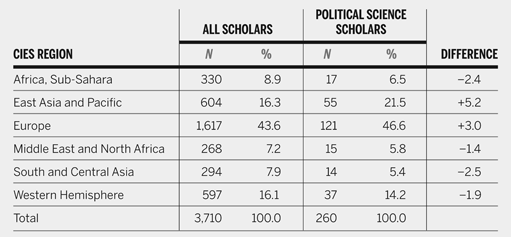
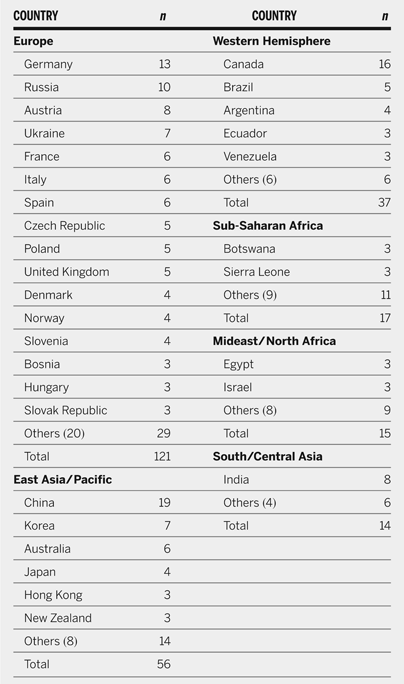
Between 2006 and 2011, 3,652 Americans went abroad for one or two semesters as Fulbright Scholars (excluding the shorter duration programs). A plurality (44%) went to Europe, with East Asia and the Pacific (16%) and the Western Hemisphere (16%) together garnering about one-third of all Scholars (see table 1). Likewise, in political science, a plurality of the destinations (47%) were also in Europe, with 13 Scholars going to Germany, 10 to Russia, eight to Austria, and seven to the Ukraine (see figure 1 and table 2).
U.S. Fulbright Scholars, by Region, 2006–11

Note. Data exclude an estimated 109 Scholars whose spring 2011 awards were not yet finalized at the time this article went to press.
Countries with U.S. Fulbright Scholars in Political Science, 2006–11
Note. Countries with these scholars are denoted by gray.

Political Science Fulbright Scholars and Regions, 2006–11

Note. Data exclude an estimated 109 scholars whose spring 2011 awards were not yet finalized at the time this article went to press.
In contrast to the distribution of Fulbright Scholars overall, the most notable difference within the political science field was that relatively more political scientists ventured to East Asia and the Pacific (22%), with 19 going to China (including Hong Kong and Macau), seven to Korea, and six to Australia. Closer to home, one in seven stayed in the Western Hemisphere (14%), with neighboring Canada garnering nearly half of these awards. Less common, but roughly in line with the distribution of Fulbrighters of all disciplines, were 17 assignments in sub-Saharan Africa (scattered among 11 countries); 15 assignments in 10 countries of the Middle East and North Africa; and 14 assignments in South and Central Asia, with a majority going to India.
Six countries received nearly three out every 10 political science Fulbright Scholars, with 19 going to China, 16 to Canada, 13 to Germany, 10 to Russia, eight to Austria, and eight to India. (Of course, thanks to China and India, these countries also contain about four out of every 10 people on earth.) Nevertheless, political science awards were rather widely dispersed among 81 other countries. While openings are not abundant everywhere, there are few corners of the world where Fulbright opportunities do not exist. Figure 1 shows the wide range of recent political science Fulbrighters; however, it does not depict the only countries for which germane awards are available. Many more countries offer relevant awards for teaching and conducting research but did not have any political science recipients during this recent period.
The destination universities and other institutions within these countries are also quite varied. While it was not uncommon for some foreign universities to have hosted two U.S. political science Fulbrighters during the past five years, the Australian National University in Canberra had a total of five, all under the auspices of a special Fulbright Distinguished Chairs Program in Political Science in Australia. This four- to five-month program promotes collaborative research in U.S. governance, as well as in other areas of political science (Australian-American Fulbright Commission 2010). Furthermore, four political scientists in the field of international relations received lecturing awards at the Diplomatic Academy in Vienna, Austria.
A diverse assortment of 13 other institutions each garnered three U.S. political scientists during this five-year period: in Europe, Charles University in the Czech Republic, the University of Sarajevo in Bosnia, the Polytechnic University of Turin in Italy, the University of Bologna in Italy, the International Peace Research Institute in Norway, Comenius University in the Slovak Republic, and the University of Ljubljana in Slovenia; in the Americas, the University of Buenos Aires in Argentina and McGill University in Canada; in Africa, the University of Botswana and the University of Sierra Leone; and in Asia and the Pacific, the University of Hong Kong and Victoria University of Wellington in New Zealand.
The academic ranks of Fulbright Scholars in political science during this period also varied widely. One-third (34%) were full professors, over one-third (40%) were associate professors, and one-sixth (16%) were assistant professors. Most of the rest held research appointments, were unaffiliated scholars, or were listed with administrative titles.
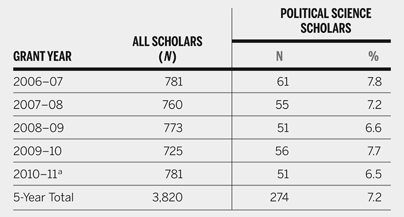
Over the past five grant cycles, political science awards have typically constituted around 7% of total annual awards. The results have been rather stable (see table 3). Political science awards have ranged from a peak of 61 (7.8% of all U.S. Fulbright Scholars) in 2006–07 to a projected low of 51 (6.5% of all Scholars) in 2010–11. This range appears to represent ordinary year-to-year variation of 0.6% around the recent mean of about 7.2%; indeed, if yearly data were treated as samples, the variation would easily be within the margins of error. The number of offered awards for which political scientists are eligible to apply does not appear to have undergone any marked changes during this period. Moreover, the number of suitable awards is far greater than the number of political scientists who are now securing them. For 2011–12, for example, several hundred potential positions are being offered through 86 awards in 52 countries that specifically mention political science among the desired disciplines. Moreover, many hundreds of other Fulbright Scholar positions are open to “all disciplines,” and still other awards are open to groups of disciplines, such as “all social sciences.”
U.S. Fulbright Scholar Trends, 2006–11

Note.a As of October 20, 2010, 672 awards had been finalized for 2010–11, including 44 in political science. The numbers in this table are based on projections from CIES that add awards pending final clearances for spring 2011.
CONCLUSION
In the past few years, many U.S. political scientists—at various ranks in their academic careers and from a diverse assortment of schools—have spent one or two semesters teaching and conducting research under the auspices of the venerable Fulbright Scholar program. They have gone to a total of 87 countries, particularly within Europe and East Asia but throughout many other parts of the globe as well. SRI evaluation data and widespread testimonials suggest that Senator Fulbright initiated a remarkable, large-scale educational exchange program that has stayed true to its mission for over six decades. Yet the U.S. Scholar program still appears to have considerable potential for growth in political science if more scholars would take advantage of its many untapped opportunities.