Many researchers have defined fear as a normal and integral part of development and a normal response to danger. There is a survival value of fear because it warns against danger and motivates to escape or avoid (Gullone, Reference Gullone1999, Reference Gullone2000; Shore & Rapport, Reference Shore and Rapport1998). At the same time, fear has a limiting effect on memory by reducing the capacity of brain to store and process information, on perceptions, problem-solving abilities and learning in general (Bodenhasen, Reference Bodenhasen, Mackie and Hamilton1993; Hamilton & Mackie, Reference Hamilton, Mackie, Mackie and Hamilton1993; Lazarus, Reference Lazarus1991). Fear may damage social interactions and sense of self (Garber & Dodge, Reference Garber and Dodge1991) as well. Moreover, fear is suggested to have close relationships with psychological issues such as anxiety, worry, and phobia (e.g., Gilmore & Campbell, Reference Gilmore and Campbell2008), and also uncontrolled fear may turn into trait-like characteristics (Sylvers, Lilienfeld, & LaPrairie, Reference Sylvers, Lilienfeld and LaPrairie2011). The most common fears of children and adolescents may differ according to age, gender and socioeconomic status. Furthermore, several contextual factors such as social, political, and economical circumstances as well as technological development or negative life events (e.g., earthquakes, terrorist attacks) may determine the common types of fear. Therefore, understanding the onset of the fears may be helpful to monitor and to control their levels and nature, so that the conversion of fear into a psychological dysfunction can be prevented.
In fact, provided that fear is learned phenomenon, many researchers discuss different ways of fear acquisition. Some researchers suggest that the fears of children and adolescents originate from the interaction of biological, environmental and cognitive factors (Du, Jaaniste, Champion, & Yap, Reference Du, Jaaniste, Champion and Yap2008). Since the beginning of fear studies, fear responses to stimuli have been defined as the way of avoiding dangerous situations and objects which can be defined as an evolutionary advantage for the individuals (Mineka & Öhman, Reference Mineka and Öhman2002; Seligman, Reference Seligman1971). Fears such as heights, strangers and loud noises can be shown to be innate (Poulton & Menzies, Reference Poulton and Menzies2002). As well as being biologically programmed, individuals’ preparedness to the stimuli determines the development of fear. To illustrate, individuals who had no contact with snakes reported fear of snakes (Agras, Sylvester, & Oliveau, Reference Agras, Sylvester and Oliveau1969). Some other researchers, such as Gullone and King (Reference Gullone and King1993), suggested a cognitive-developmental model, as well as prepotency and preparedness factors. They stated that the change in children's fears depend on developmental levels and life experiences. For example, the majority of infants have a fear of strangers and separation, whereas school-aged children have fears of criticism and failure.
Among such different explanations of fear acquisition, Rachman's three-pathway theory seems to be one of the most widely studied models. Rachman (Reference Rachman1977) suggested that fears were learned through three pathways (one or a combination of three): (1) classical (direct) conditioning — individuals’ direct exposure to the fearful object or event results with fear; (2) vicarious learning and modelling — individuals’ observations, not direct exposure results with fear; and (3) negative information transmission — negative information about the fearful event or stimulus results in fear. Many research studies have been conducted based on the three-pathway theory (Graham & Gaffan, Reference Graham and Gaffan1997; King, Clowes-Hollins, & Ollendick, Reference King, Clowes-Hollins and Ollendick1997; Merckelbach, Muris, & Schouten, Reference Merckelbach, Muris and Schouten1996; Ollendick, Reference Ollendick1983). For instance, Duff and Brownlee (Reference Duff and Brownlee1999) examined the role of classical conditioning on fear acquisition by utilising a sample of 7- to 18-year-old children and adolescents. Results showed that 63% of the participants recalled a negative experience of injection and 46% reported a high level of injection fear. In another study, Muris, Steerneman, Merckelbach, & Meesters (Reference Muris, Steerneman, Merckelbach and Meesters1996) investigated the relationship between the fears of parents and their children among 40 children and preadolescents between the ages of 9 and 12. Results indicated a direct relationship between the fears of children and mothers’ expressions of fears. Mothers who did not express their fears reported the lowest and mothers who expressed their fears reported the highest level of fears.
Negative information transmission and its relation to fear intensity was studied as the last pathway to fear acquisition by Muris, Bodden, Merckelbach, Ollendick, and King (Reference Muris, Bodden, Merckelbach, Ollendick and King2003) with a sample of 285 children and preadolescents between the ages of 4 and 12 years old. They were told stories about an animal called ‘the beast’, transmitting positive and negative information. Before and after storytelling, these children and preadolescents were given a modified version of the Fear Survey Schedule for Children — Revised (FSSC-R; Ollendick, Reference Ollendick1983). Results indicated that their fear of dogs and fear of predators were increased after they were presented with the story, including negative information about the animal. Conversely, the findings indicated a decrease in fear of dogs and fear of predators of children and preadolescents’ fear scores after the story included positive information about the animal.
Muris, Merckelbach, and Collaris (Reference Muris, Merckelbach and Collaris1997) examined the origins of children's and preadolescents’ fears to investigate if these three pathways have an intensification effect on their fears as well as onset fears of 129 children between the ages of 9 to 13. Participants were given FSSC-R (Ollendick, Reference Ollendick1983) and interviewed for about 20 minutes. The majority of children (87.8%) reported that they had learnt their most feared things or events by negative information transmission, 49.6% of children explained that the origin of their fear was modelling (vicarious learning), while 61.1% explained the origin as conditioning. Results were the same for most of the fear factors (fear of animals, fear of death and danger, fear of failure and criticism, medical fears). In brief, children and preadolescents reported the origin of their fear as negative information transmission, conditioning and modelling, respectively. Youngsters also stated that conditioning intensified their fears of animal, particularly spiders, medical fears, failure, and fears of criticism. They also reported that negative information transmission intensified their fears of the unknown, death and danger.
Researchers examined several factors that may be related to the origins of the fear, such as parental styles (Hadwin, Garner, & Perez-Olivas, Reference Hadwin, Garner and Perez-Olivas2006) and media (Muris & Field, Reference Muris and Field2010); however, the relations of basic demographic variables of age, gender, and SES do not seem to have been fully examined. These variables may be linked to children's reports of fear acquisition, given that existing research has established a relationship between the severity and types of the fear and these demographic variables, particularly SES (e.g., Burnham, Reference Burnham2005; Meltzer et al., Reference Meltzer, Vostanis, Dogra, Doos, Ford and Goodman2008). Among one of those few studies that tested the age and gender differences on origins of fear, Kelly, Barker, Field, Wilson, and Reynolds (Reference Kelly, Barker, Field, Wilson and Reynolds2010) reported that gender and age has no effect on learning fear through information transmission and modelling. Yet, Muris and Field (Reference Muris and Field2010) described gender differences in terms of information transmission when the content of the verbal information is vague. Finally, the study of Muris, Mayer, Eijk, and Dongen (Reference Muris, Mayer, Eijk and Dongen2008) demonstrated that origins of fears may differ among different racial groups of South Africa. The researchers of this study specifically discussed that the differences among these groups may originate from the living conditions, including the impacts of socio-economic and political circumstances of each racial group.
In sum, the existing literature reports supporting findings of three pathways model of fear acquisition. However, the relations of gender, age and SES to the origins of the fear seems not to have been examined extensively despite the fact that the nature, severity and types of fears were reported to be related to these variables (e.g., Burnham, Reference Burnham2005; Meltzer et al., Reference Meltzer, Vostanis, Dogra, Doos, Ford and Goodman2008). Moreover, Rachman's model has not been tested thoroughly other than in a few international contexts in Australia, South Africa, and the United States. Considering that fear and its experiences can be related to a sociocultural context as well as the physiological disposition, the cross-cultural validation of the model needs to be tested. To the best of the researchers’ knowledge, the Turkish literature on origins of children's fear is lacking; only a few studies on the fears of children and adolescents have been conducted in Turkey, the main aim of which has been instrument adaptations. For example, Erol, Şahin and Özcebe (Reference Erol and Şahin1990) adapted an earlier version of the Fear Survey Schedule for Children by Yule, Udwin, and Murdock (Reference Yule, Udwin and Murdock1990) into Turkish. Another study reported by Atılgan, Saçkes, Yurdugül and Çırak (Reference Atılgan, Saçkes, Yurdugül and Çırak2007) adapted the Fear Experiences Questionnaire (FEQ) of Gullone, King, and Ollendick (Reference Gullone2000). Finally, Erol and Şahin (Reference Erol and Şahin1995) examined the fears of Turkish children in a cultural context and reported that female children and children from low socioeconomic status reported higher level of fears than their counterparts.
Therefore, this study aims to test the common fears and their origins based on Ranchman's model with Turkish youngsters and examine how the origins of their fears differ based on age, gender, and SES. The specific research questions of the study were: (1) What are the common fears and their origins among children and adolescents living in Turkey? (2) Do the origins of the children's and adolescents’ fears intensify their fears? (3) Are the variables of age, gender, and SES related to the origins of fears?
Method
Procedure and Participants
Before conducting the research, the necessary permissions from the ethical boards of the university and the Ministry of National Education were obtained. Afterwards, the selected schools were contacted and their participation was requested. Schools agreeing to participate were visited by the first author. The questionnaires were distributed to classes that the school administration suggested, based on availability. Upon obtaining consent forms, questionnaires were administered to the participants in a class hour (50 minutes) and a break (10 minutes). Therefore, participants of the study were recruited through a sampling of convenience procedure. The sample includes 642 females (48.8%) and 673 males (51.2%), a total 1,315 participants from different elementary and high schools with a mean age of 13.15 ranging from 8 to 18 (M = 13.15; SD = 3.18; Median = 13; Mode = 17).
According to Kuppuswamy's Socioeconomic Status Scale participants were divided into two groups: 632 of the participants (48.1%) were from low socioeconomic status and 683 of the participants (51.9%) were from high socioeconomic status.
Instruments
Fear Interview
The common fears and their origins were measured via questions based on a previous study by Muris et al. (Reference Muris, Merckelbach and Collaris1997). First, participants were asked to write in order their top five fears. Then they were requested to answer questions about the origins of fears: conditioning (e.g., ‘Did you have a fearful experience with . . ..?’), modelling (e.g., ‘Did you know someone who are also afraid of . . .?’) and negative information (e.g., ‘Did you hear frightening things about . . .?’). Questions were also asked to investigate if conditioning (‘Did experiencing a fearful thing with this object cause you become more fearful?’), modelling (‘Did knowing someone who are also afraid of this object cause you become more fearful?’) and negative information (‘Did hearing frightening things about this object cause you become more fearful?’) played a role in the intensification of the fears.
Demographic form
This form inquired about age, gender, education and occupation information of the participants’ parents and family income. Kuppuswamy's Socioeconomic Status Scale suggested by Kuppuswamy (Reference Kuppuswamy1981) was used to calculate SES scores by summing up monthly income, education and profession of the head of the family, and the score ranges between 3 and 29. The scores of SES were used to divide the sample into two groups as high and low SES groups.
Results
Most Common Fears of Children and Adolescents
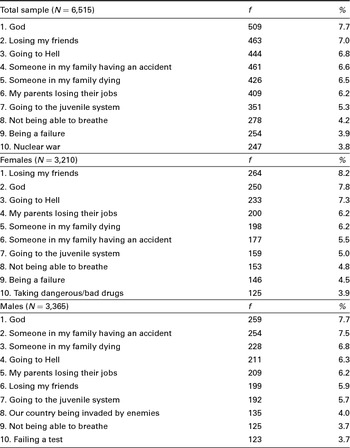
Children and adolescents were asked to write their top five intense fears. ‘God’, ‘losing my friends’, ‘going to hell’, ‘being in closed places’, ‘someone in my family having an accident’, ‘someone in my family dying’, ‘my parents losing their jobs’, ‘going to the juvenile system’, ‘not being able to breathe’, ‘failing a test’ and ‘being a failure’ were reported in the list of most common fears (see Table 1). The order of the fears differed, based on gender. While for females the most common fear was ‘losing my friends’, for males the most common fear was ‘God’. As a common fear, ‘losing my friends’ was observed to be in sixth place.
Most Common Fears

Origins of Children's and Adolescents’ Fears
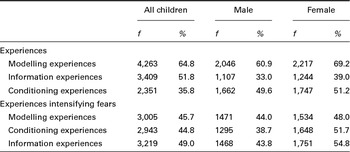
In order to examine the origins of fears, children and adolescents were asked whether they learned their most intense fears by modelling, negative information transmission or experience. For three fear origins (modelling, negative information transmission and experience) and the effect of three fear origins on the intensification of fear, participants provided five answers. For three origins and their intensifying effect 6,575 (1,315 × 5) results were given, as shown in Table 2; 64.8% of all children reported that they learned fear by modelling, 51.8% of all children reported they learned fear by negative information transmission, and 35.8% all of children reported they learned fear by experiences (conditioning).
Origins of Fears and Their Intensifying Effects

Children and adolescents were asked if modelling, conditioning and negative information transmission intensified their existing fear. Results showed that 49% of all children and adolescents reported that negative information transmission intensified their fear, 45.7% reported that modelling intensified their fear, and 44.8% reported that experience (conditioning) intensified their fear.
Gender differences on the pathways of learning fear were examined as well: 60.9% of male and 69.2% of female students reported that they learned fear by modelling, 49.6% of male and 51.2% of female students reported conditioning, and 33% of male and 39% of females reported negative information transmission. Also, female and male children and adolescents reported the intensifying effects in different order: 44% of males reported that modelling intensifies their fears, 43.8% reported conditioning and 38.7% reported negative information transmission while 54.8% of females reported that conditioning intensifies their fears, 51.7% reported negative information transmission and 48% reported modelling.
Relationships of Gender, Age, and SES to Origins of Fears: Multinomial Logistic Method
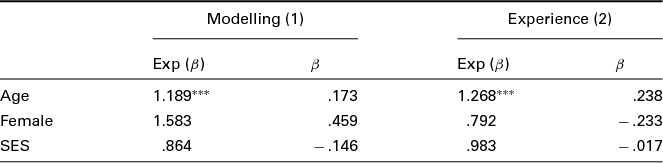
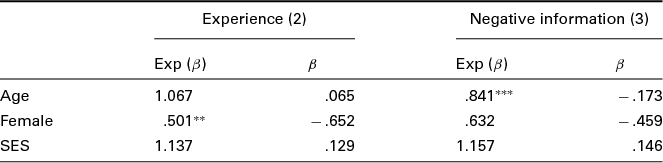
Two independent multinomial logistic regressions were conducted in order to investigate the effects of age, gender and SES on the probability of subject's different ways of fear acquisition. In these regressions, the outcome variable was origins of fear which contains a numeric code (1 = modelling, 2 = experience and 3 = negative information) for the subject's different ways of fear acquisition. The relative risk ratios or odds ratios, exp(β)s, are presented the Tables 3 and 4. A common guideline for interpreting an odds ratio is that a value of 1.00 shows there is no relationship, a value of odds ratios below 1.00 shows a negative relationship, and a value of odds ratios above 1.00 shows a positive relationship (Field, Reference Field2005).
Multinomial Logistic Regression Analysis of Origins of Fear: Comparing Modelling or Experience to Negative Information
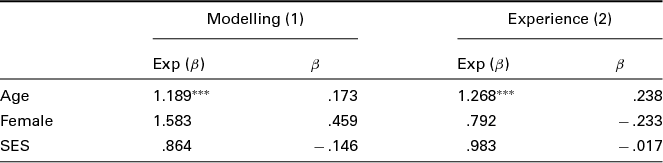
Note: n = 1,315; ***p < .001 (two-tailed). Reference category: Negative information (3). Entries are relative risk ratios for z standardised variables. Odds ratios below 1.00 indicate a negative relationship; odds ratios above 1.00 indicate a positive relationship. Pseudo R 2 for model: .090.
Multinomial Logistic Regression Analysis of Origins of Fear: Comparing Experience to Modelling
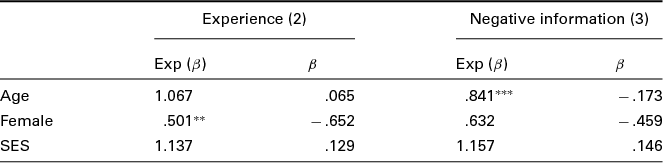
Note: n = 1,315; ***p < .001; **p < .01 (two-tailed). Reference category: Modelling (1). Entries are relative risk ratios for z standardised variables. Odds ratios below 1.00 indicate a negative relationship; odds ratios above 1.00 indicate a positive relationship. Pseudo R 2 for model: .090.
In the first regression, negative information was the reference category. Results revealed that only age was significantly related to origins of fear when comparing the possibility of learning fears through modelling or experience, with the possibility of learning fears by negative information. In particular, the odds of a child whose age is 1 year older learns fears by modelling relative to negative information 1.189 times higher than those of a child who is 1 year younger. Further, odds of a child whose age is 1 year older learn fears by experience relative to negative information 1.268 times higher than those of a child who is 1 year younger. Gender and SES did not show any substantial relationships to origins of fear when comparing the possibility of learning fears through modelling or experience to negative information.
In the second regression, modelling was chosen as the reference category to compare the possibility of learning fears through modelling to experience. The findings indicated that only gender was significantly related to origins of fear when comparing experience to modelling. Specifically, odd ratios indicated that when comparing females to males, females were .501 times less likely to learn fear by experience relative to modelling. Age and SES did not demonstrate any significant relationships to origins of fear when comparing the probability of learning fears through experience to modelling.
Discussion
The aim of this study was to examine the common fears and their origins among Turkish children and adolescents. The results of this current study showed that Turkish children and adolescents reported similar common fears to the previous Turkish study by Erol et al. (Reference Erol, Şahin and Özcebe1990). The study by Erol et al. reported that the most common fears of children were ‘Hell’, ‘death of my mother’, ‘death of my father’, ‘shot with firearm’, ‘hit by car or lorry’ and ‘separation from parents’. In the present study, similar items such as ‘going to Hell’, ‘death of a close person (e.g., grandparent, best friend)’, ‘someone in my family having an accident’, and ‘God’ were reported in the most common fears list, but also items such as ‘nuclear war’, ‘our country being invaded by enemies’, and ‘going to juvenile system’ were reported. Some of these new types of fears may be reflecting current issues; for example, Iraq, the neighboring country of Turkey, has been bombarded by the United States since 9/11 and/or Iran has been accused of possessing nuclear weapons.
The results of the study also provide some evidence for the change of common fears from culture to culture. For instance, as Muris et al. (Reference Muris, Mayer, Eijk and Dongen2008) reported, while the most common fear in China was a ghost, in South Africa snakes, the most common fear in Turkey was ‘God’, followed by ‘losing my friends’ and ‘going to Hell’. In Turkey, children are raised by instilling the power of God. Children learn that God is very compassionate and forgiving, but at the same time God is a harsh punisher. Similarly, hell is a horrific place where sinful people are punished. Moreover, in Turkish culture ‘fear of God’ has other connotations that have very little to do with a religion. ‘People with the fear of God’ are referred to as good people. According to the common belief, regardless of how religious a person is, someone who has a fear of God is a decent person who would not do harm to others. Perhaps such cultural contexts as well as thoughts of religion make this particular fear the most common.
In the present study, Rachman's (Reference Rachman1977) three pathways theory was followed to examine the origins of children's and adolescents’ fears. In this study, children and adolescents reported modelling (64.8%), negative information transmission (54.8%) and conditioning (35.8%) as the ways of fear acquisition. Previous studies reported mixed results about the commonality of conditioning, modelling and negative information transmission as pathways in fear acquisition. For instance, children and adolescents reported negative information transmission, conditioning and modelling in the Netherlands (Muris et al., Reference Muris, Merckelbach and Collaris1997) as pathways in fear acquisition, respectively. In South Africa (Muris et al., Reference Muris, Mayer, Eijk and Dongen2008), modelling, negative information transmission and conditioning respectively were stated to be the ways of fear acquisition. Therefore, the results in this study showed that as with their peers in South Africa, Turkish students are more likely to learn fears by modelling rather than negative information transmission and conditioning.
The findings of the present study indicate that negative information transmission (49%), modelling (45.7%) and conditioning (44.8%) were reported to be intensifying children's and adolescents’ fears. The results indicated that negative information transmission had a more intensifying effect on the children and adolescents’ existing fear than modelling and conditioning. The results highlighted the importance of indirect learning experience, particularly negative information, on the level of fears. Children's and adolescents’ ranking of negative information, modelling and conditioning for their intensifying effect were found to be consistent with the previous study (Muris et al, Reference Muris, Mayer, Eijk and Dongen2008; Muris et al., Reference Muris, Merckelbach and Collaris1997).
In addition, the results of multinomial logistic regression revealed that age is a significant predictor of origins of fear when comparing the possibility of learning fears through modelling or experience with the possibility of learning fears by negative information. The older a child is, the more likely it is for him/her to learn fear through modelling or experience rather than negative information. The change in the way of learning fears of children and adolescences with increasing age is expressed by cognitive and social development. Older children may have more realistic evidence to learn fears than younger children, due to their developing perceptions about the world. Moreover, gender is an important predictor of origins of fears when comparing the possibility of learning fears by experience rather than modelling. Males are more likely than females to learn fears by experience rather than modelling as they typically tend to have more fearful experiences compared to females. Yet, the SES did not show any substantial relationships with origins of fear.
As mentioned previously, fear is an adaptive emotion and has a survival value, but it should be noted that fear may damage the learning process and social interactions. Also, relationships of fear with anxiety, phobia and worry, which may interfere with daily functioning, were emphasised in the literature. To a certain extent, fear is a normal and functional emotion for humans, but should be screened and assessed by parents, teachers and school counsellors. Children and adolescents should be informed about the fears specific to their age and situation (such as victims of earthquakes). Normality and abnormality of fears should be taught to children and adolescents. In this way, they may assess their own fears and protect themselves from the negative effects of fear (such as a decrease in learning capacity) and help to prevent fears from turning into anxiety, phobia and worry. In this study, it was found that 64.8% of children and adolescents learned fears through modelling. Thus, parents, teachers and school counselors have an important role to observe, inform and guide children and adolescents. Parents and teachers set a model for children and adolescents in dealing with and responding to fears, so they should be more attentive to how they express their fears. Negative information transmission was also reported by 54.8% of children and adolescents as their way of fear acquisition. According to the results of negative information transmission, fears can be caused by several information resources such as media images, adult conversations, and stories. Therefore, monitoring children's media viewing, having proper adult conversations near children and telling appropriate stories are very important for not only parents but also teachers. This result emphasises the importance of informative and guiding activities specifically for children and adolescents. Understanding the origin of a fear can contribute to the development of prevention and treatment programs that can be used by school counselling centres to help children and adolescents overcome their negative reactions toward fear.
Finally, this study has several limitations. The results of the present study should be read cautiously due to its cross-sectional nature and the convenient sampling procedure. Furthermore, the generalisability of the results is limited to the children and adolescents aged between 8 and 18 from the participating schools in Ankara. Therefore, the results of the study need to be cross-validated with different methodology and samples.