Children under 6 years of age usually spend over 80% of the day in child care or preschool facilities (ie, day-care facilities or out-of-home care facilities such as sports facilities and camps). As these children are too young to protect themselves,Reference Bullock, Haddow and Coppola 1 - Reference Watson, Mulvaney and Timblin 4 teachers play an important role in their safety. Of the safety-related accidents occurring among children at home or in child care or preschool facilities, 71.1% involved children aged 1-6 years 5 and most were preventable.Reference Watson, Mulvaney and Timblin 4
According to the Child Welfare Law in South Korea, managers of child care centers and preschools must provide annual reports to a mayor or county governor on the results of their disaster-related safety education curriculum. Child care and preschool teachers are also expected to educate children about disaster-related safety education, so that the children are better prepared to protect themselves. 6
Therefore, child care and preschool teachers should also be well educated about disaster preparedness so that they are equipped to teach these topics to the children in their care. However, in South Korea, disaster-related safety education is not mandatory either through on-the-job training or as part of the early childhood education curriculum. From 2011 to 2015, only 18.6% of child care and preschool teachers were reported receiving disaster preparedness education and training.Reference Lee 7 The disaster preparedness of teachers has been reported as the major factor protecting young children’s growth and development from the impacts of disaster.Reference Lee 7 - Reference Uhm, Park and Oh 10
Disaster preparedness and disaster education and training include comprehensive skills, abilities, knowledge, and activities to prevent damage from an unpredictable disaster occurrence,Reference Uhm, Park and Oh 10 - Reference Slepski 12 covering natural, manmade, and social disasters in this study.
The disaster preparedness of teachers are positioned to provide primary protection of young children, and yet little research has explored disaster preparedness and disaster risk perception among child care and preschool teachers in South Korea. We need a better understanding of the level of disaster-related preparedness among child care and preschool teachers in order to improve the safety of the young children under their care. Therefore, the purposes of this study were to measure the current status of disaster-related questions, personal disaster preparedness, and disaster risk perception among teachers in South Korean child care and preschool facilities, and to identify differences in their personal disaster preparedness and disaster risk perception by using demographic characteristics and disaster-related questions.
METHODS
Study Design
A cross-sectional design was used to administer a self-reported questionnaire, which took approximately 20 minutes for teachers to complete.
Participants
To achieve a reasonable sample size for this study, we performed a power analysis using G*power 3.1.5 (SOFTMEDIA) for t-test and ANOVA. The sample size for computation of test with a power of 0.80, an effect size of 0.15, and α of 0.05 was 270. A convenience sample of child care and preschool teachers was recruited from 36 facilities in 2 large South Korean cities. The principal investigator (PI) contacted the directors of 36 child care and preschool facilities to obtain permission for recruitment. Participation was both voluntary and anonymous. Questionnaires were mailed to child care and preschool teachers who agreed to take part in this study; questionnaire packages with cover letters were distributed with a return envelope addressed to the PI. Data were collected from February to October 2014. A total of 450 questionnaires were distributed and 395 were returned (a response rate of 87.8%). Finally, 373 questionnaires were used in the analysis.
Measures
The questionnaire was developed and adapted from those used in previous studies,Reference Uhm, Park and Oh 10 , Reference Kang, Uhm and Nam 11 and consisted of 3 sections: demographic characteristics and disaster-related questions, personal disaster preparedness, and disaster risk perception. In this study, disasters include natural, manmade, and social disasters.
Demographic Characteristics and Disaster-Related Questions
There were 6 demographic characteristics: gender, age, marital status, educational level, children’s age group under a teacher’s care, and career. The disaster-related questions were as follows. (a) Have you ever been exposed to a disaster? (Yes, No), (b) How many times per year have you attended disaster education and training sessions? (Never, once, twice or more), (c) If you had the opportunity, would you attend disaster education and training sessions? (Yes, No), (d) What topics have you learned about disaster preparedness within the last year?, (e) If you had the opportunity to attend disaster education and training, what are the 6 topics you want to learn? (f) What types of disasters do you think can occur easily in South Korea? (g) Do you have fire or natural disaster insurance for your home? (Yes, No) (See supplementary material).
Personal Disaster Preparedness
The personal disaster preparedness questionnaire was originally developed by Uhm et alReference Uhm, Park and Oh 10 and was modified for this study. There were 2 subcategories: household-related preparedness (including 13 survival items, such as bottled water, food in retort pouches, a first-aid kit, an evacuation plan, and an emergency network among family members, household emergency goods such as a battery-powered radio, flashlight, blanket, matches, and generator) and workplace-related preparedness (including 6 survival items, such as an emergency network between facility and parents, workplace guidelines for disaster occurrences, and nonelectrical goods such as a battery-powered radio, flashlight, generator, and blanket).
Responses were dichotomous (Yes/No) and coded as Yes=1 and No=0 with a total score range of 0-19 points. A higher score indicated a greater level of personal disaster preparedness.
Disaster Risk Perception
Disaster risk perception was measured with the question: What do you think about the sentence, “I think that daycare/preschool facilities can be vulnerable to disasters.”? and a 5-point response scale that included “not at all” (1) to “very much so” (5). A higher score indicated a greater perception of disaster risk.
Data Analysis
Data were analyzed using IBM SPSS Statistics for Windows, Version 20.0 (Armonk, NY). Statistical analyses included descriptive statistics, t-tests, ANOVA, and Scheffé tests for post hoc multiple comparisons for ANOVA. Psychometric reliability was calculated using Cronbach’s α.
Ethics
This study was approved by Daejeon University’s institutional review board (1040647-201312-HR-041-03). Prior to beginning the study, we received written consent from all participants, who were also informed that their consent could be withdrawn at any time during the study. The consent was included with the survey and collected at the same time.
RESULTS
Demographic Characteristics and Disaster-Related Questions, Personal Disaster Preparedness, and Disaster Risk Perception
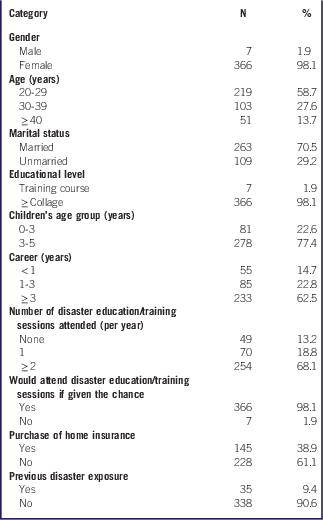
Demographic and disaster-related questions are presented in Table 1. Most teachers were women (98.1%), and their average age was 30.5 (SD±7.18) years. Three hundred sixty-six respondents (98.1%) had studied early childhood education at a college or university. A total of 233 participants (62.5%) reported a career duration of more than 3 years. Two hundred seventy-eight respondents (77.4%) taught children aged 3-5 years. Thirty-five respondents (9.4%) had been the victim of a disaster. Two hundred fifty-four respondents (68.1%) had completed disaster education and training 2 or more times per year; 49 (13.2%) had not attended any. Most respondents (98.1%) would attend disaster education and training if given the opportunity. About 4 in 10 respondents (38.9%) had purchased home insurance.
Demographic Characteristics and Disaster-Related Questions (N=373)

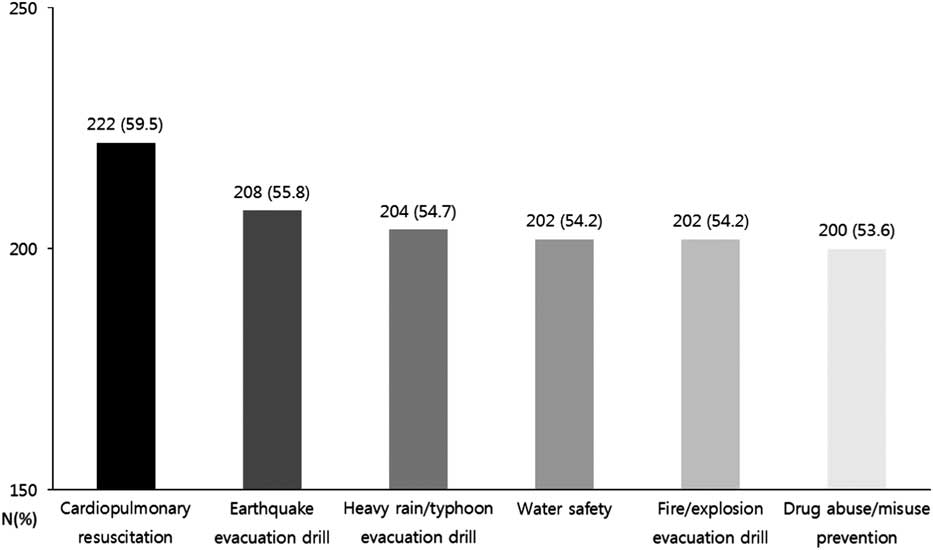
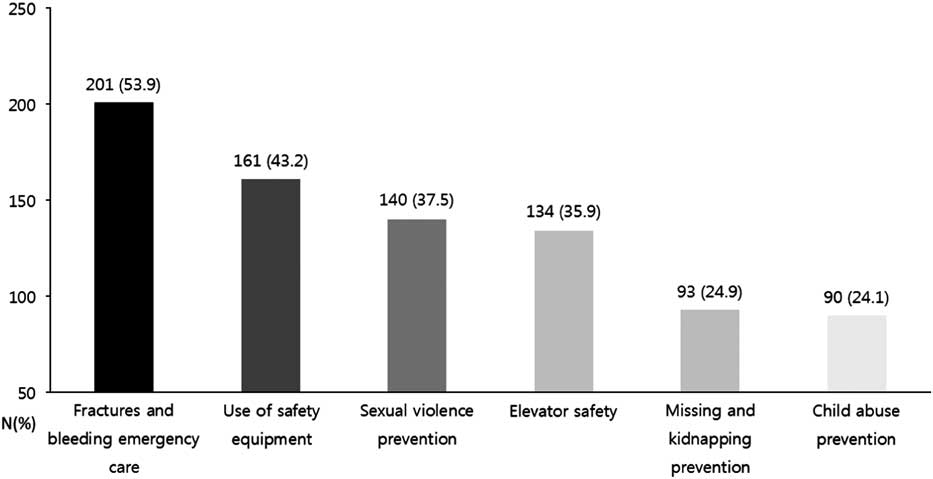
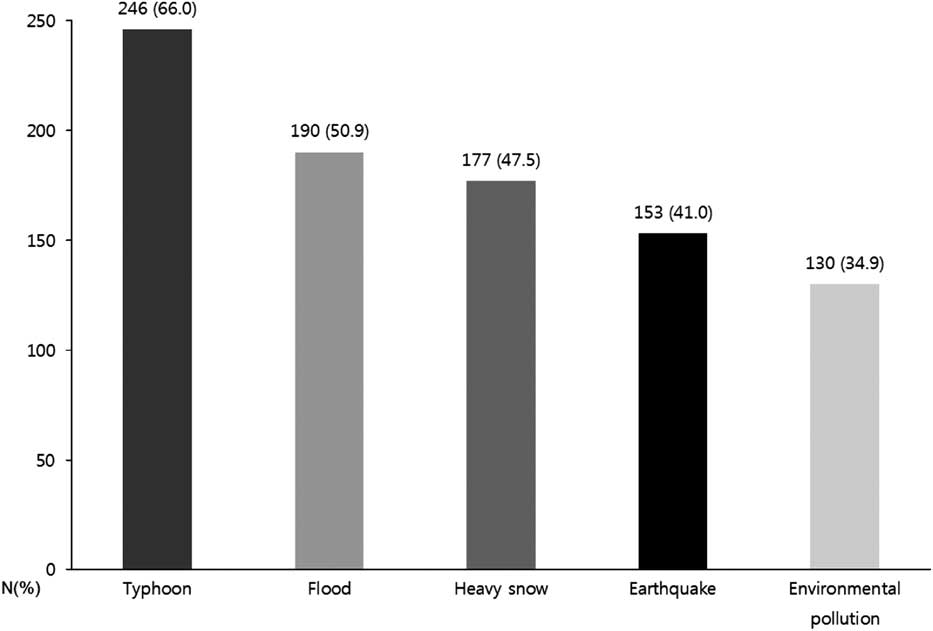
The 6 most frequently mentioned topics on which the teachers had received disaster education and training were “cardiopulmonary resuscitation” (59.5%), “earthquake evacuation drill” (55.8%), “heavy rain or typhoon evacuation drill” (54.7%), “water safety” (54.2%), “fire/explosion evacuation drill” (54.2%), and “drug abuse/misuse prevention” (53.6%) (Figure 1). The most frequently mentioned topics on which they expressed interest in disaster education and training were “fractures and bleeding emergency care” (53.9%), “use of safety equipment” (43.2%), “sexual violence prevention” (37.5%), “elevator safety” (35.9%), “missing and kidnapping prevention” (24.9%), and “child abuse prevention” (24.1%) (Figure 2). The 5 most probable disasters that respondents mentioned as occurring in South Korea were “typhoon” (66.0%), “flood” (50.9%), “heavy snow” (47.5%), “earthquake” (41.0%), and “environmental pollution” (34.9%) (Figure 3).
Top 6 Topics Learned by Teachers (Multiple-Response Questions)

Top 6 Topics Teachers Reported Wanting to Learn (Multiple-Response Questions)

Top 5 Disasters Possible in South Korea (Multiple-Response Questions)

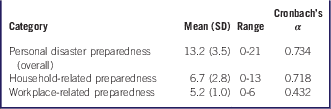
The mean scores for personal disaster preparedness and disaster risk perception were 13.2 (SD±3.5) and 3.9 (SD±1.0), respectively (Table 2). For the 2 subcategories of personal disaster preparedness, the mean scores for household-related preparedness and workplace-related preparedness were 6.7 (SD±2.8) and 5.2 (SD±1.0), respectively (Table 2). The Cronbach’s α for personal disaster preparedness in this study was 0.734; subcategory Cronbach’s α were 0.718 for household-related preparedness and 0.432 for workplace-related preparedness.
Mean (SD), Range and Cronbach’s α for Personal Disaster Preparedness Scores (N=373)

Personal Disaster Preparedness and Disaster Risk Perception Differences Based on Demographic Characteristics and Disaster-Related Questions
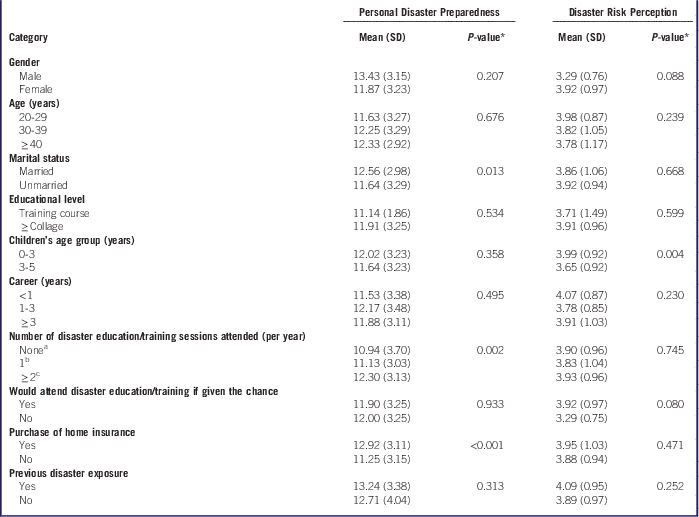
t-Test and ANOVA results for the major variables are presented in Table 3. Personal disaster preparedness differed significantly by marital status, the number of disaster education and training sessions attended, and whether the respondents owned home insurance. In Scheffé’s test of the number of disaster education and training sessions attended, the mean score of respondents who attended more than 2 times (12.30±30) was significantly higher than those who attended only once (11.13±3.03) or never (10.94±3.70).
Differences in Personal Disaster Preparedness and Disaster Risk Perception Scores by Demographic Characteristics and Disaster-Related Questions (N=373)

* t-Test/ANOVA; Scheffe’s test, a<b<c.
Scores for disaster risk perception differed significantly by children’s age group under a teacher’s care.
DISCUSSION
The results of this study indicate that 68.1% of participants received disaster preparedness education and training 2 or more times per year; most participants reported that they would attend disaster education and training if they had the chance. The younger the children under the respondents’ care, the higher the respondents’ disaster risk perception scores were. The most frequently mentioned topic on which the teachers wanted to learn more was first aid such as emergency care for fractures and bleeding for young children. The number of child care and preschool teachers who had completed disaster education and training in this study was consistent with the results reported by Lee.Reference Lee 7 Moreover, the proportion of child care and preschool teachers who had never received disaster preparedness education and training was 13.2%. Most teachers in our sample reported that they would attend disaster preparedness education and training if given the opportunity, which is consistent with several previous studies.Reference Uhm, Park and Oh 10 , Reference Kang, Uhm and Nam 11 , Reference Fung, Loke and Lai 13 , Reference Hsu, Mas and Jacobson 14 Although child care and preschool teachers recognized the importance of disaster preparedness education and training, they had not been actively involved in such training because it is not mandatory either through on-the-job training or as part of the curriculum in early childhood education in South Korea. Therefore, in the interest of child safety, disaster education and training should be included in education curricula.
The most significant advantage of disaster insurance is that it helps victims recover more easily. The rate of home insurance ownership in this study was 38.9%. A previous study by Wang et alReference Wang, Liao and Yang 15 reported that 4% of Chinese people purchased home insurance.Reference Wang, Liao and Yang 15 This result may suggest that teachers of the young children had greater disaster preparedness and greater insight than the general population. Many seriously consider preparing for disaster after receiving education and training or watching an advertisement about disaster preparedness.Reference Wang, Liao and Yang 15 , Reference Brunton 16 Personal disaster preparedness can reduce disaster-related loss of life, significant injuries, and damage. 17 Therefore, the importance of disaster insurance and personal disaster preparedness (including a survival kit and an evacuation plan) should be promoted and advertised continuously worldwide because disaster occurrence can occur anywhere and at any time.
The most frequently mentioned disaster preparedness subjects in which teachers had received education and training were consistent with previous studies.Reference Kang, Uhm and Nam 11 , Reference Ahn, Keum and Choi 18
However, the 6 most frequently mentioned topics on which these teachers most wanted information were on practical education and training related to safety in everyday life, and for rescuing young children. This may be related to the impact of the Child Welfare Law in 2015. 6 This finding was also consistent with previous studies.Reference Kambas, Antoniou and Xanthi 19 - 21
Fractures and bleeding emergency care was the highest ranked among the topics that teachers reported they wanted to learn. Fractures and bleeding are also the most frequent injuries among young children in everyday life. 5 This finding reflects a concern of teachers with daily safety for young children. Learning to cope with safety accidents in daily life is equivalent to preparing for future disasters. Therefore, disaster education and training should reflect common accidents in daily life and general safety.
The result regarding knowledge about possible disasters in South Korea was also consistent with several previous studies.Reference Uhm, Park and Oh 10 , Reference Kang, Uhm and Nam 11 , Reference Wang, Liao and Yang 15 , Reference Brunton 16 Because of South Korea’s geography, losses from natural disasters may be greater than from manmade or social disasters.Reference Kang, Uhm and Nam 11 In this study, the mean score for personal disaster preparedness was higher than that in previous reports.Reference Uhm, Park and Oh 10 , Reference Kang, Uhm and Nam 11 , Reference Kim, Kwon and Back 22 In particular, the mean score for workplace-related preparedness was higher than that for household-related preparedness. This may be related to the impact of the Child Welfare Law in 2015, 6 which led to facilities with young children bearing greater responsibility for disaster prevention than other facilities.Reference Watson, Mulvaney and Timblin 4 The mean disaster risk perception score was consistent with that of Noh.Reference Noh 23 The Cronbach’s α of 0.734 for personal disaster preparedness in this study was somewhat lower than that in the study by Uhm et al.Reference Uhm, Park and Oh 10 In this study, personal disaster preparedness scores were significantly higher among those who were married. This may be because married respondents have greater responsibility for their homes and families than do those who are unmarried. Personal disaster preparedness scores were significantly higher among those who had attended 2 or more disaster education and training sessions than among those who had attended once or never. A previous study reported that acquired disaster information influenced preparedness against disaster occurrence.Reference Kwak and Lee 24 This may be attributed to disaster education and training.Reference Juran and Trivedi 25 , Reference Grothmann and Reusswig 26 LeeReference Lee 27 reported that child care and preschool teachers’ personal disaster preparedness was related to their age, marital status, facility type, age range of the children whom they were caring, and appraisal accreditation.Reference Lee 27 Consistent with Lee,Reference Lee 27 in this study, there was a significant difference in disaster risk perception by children’s age group for whom the respondents were caring.Reference Lee 27 However, in other studies, the type of disaster, previous disaster experience, gender (female), fear, education level, and home ownership were found to influence disaster risk perception.Reference Grothmann and Reusswig 26 , Reference Ho, Shaw and Lin 28 , Reference Qasim, Khan and Shrestha 29 These differences could be attributed to the fact that participants in this study were limited to child care and preschool teachers in South Korea. Disaster risk perception influences disaster preparedness behaviorsReference Kwak and Lee 24 ; therefore, future studies should include other variables.
Young children separated from their caregiver during a disaster occurrence are unable to understand what is happening and may respond fearfully by crying, fussing, or becoming irritable,Reference Murray 30 indicating that young children are vulnerable to becoming disaster victims. Studies have reported that 56% of deaths among children under 10 yearsReference Rimsza, Schackner and Bowen 31 and 95.5% of childhood accidentsReference Watson, Mulvaney and Timblin 4 were preventable. Teachers should play a very important role in preventing harm to young children in a disaster occurrence. It is also important that teachers act according to the knowledge gained through disaster preparedness education and training. This is, in part, because young children learn by watching how their teachers conduct disaster prevention activities in their daily lives. In particular, in a real-world disaster occurrence, teachers should act as rescuers; thus, their disaster training should prepare them to care not only for young children but also for themselves.
One of the limitations of this study was that the study sample was not fully representative of child care and preschool teachers in South Korea, because we only selected respondents from 2 big cities in South Korea. The results of this study may not be generalizable to all Korean child care and preschool teachers. Thus, future studies should include a more diverse range of child care and preschool facilities. Second, this study was cross-sectional in nature; therefore, caution should be exercised in interpreting the causality of the antecedents of personal disaster preparedness and disaster risk perception. Longitudinal study designs are needed to test these influential factors and their effects. Our findings provide a baseline of personal disaster preparedness for child care and preschool teachers in South Korea, which is important because child care and preschool personnel have been neglected in disaster education and training, as well as in academic disaster research.
CONCLUSIONS
The results of the study showed that child care and preschool teachers recognize the importance of disaster preparedness. However, the teachers had not undertaken disaster education and training because it is not compulsory for gaining or maintaining teaching certification in South Korea. The topics on which the teachers wanted to learn more disaster education and training were related to children’s everyday safety such as fractures and bleeding emergency care.
Moreover, the respondents considered that in South Korea natural disasters were the most likely type to occur. Child care and preschool personnel have increasing responsibility for children’s safe because young children now spend most of their day in the care of a teacher. Thus, educational opportunities including children’s everyday safety as well as for natural, manmade, and social disasters should be offered to meet the demand from child care and preschool teachers and to improve their capacity to respond effectively to disaster occurrence.
Acknowledgments
The authors wish to express their appreciation of the participants who took part in this study.
Funding
This research was supported by Daejeon University funds (2014).
Author Contributions
Dr Uhm and Dr Oh together did the entire process of this research (from choosing a topic to making a thesis) through discussion.
All authors report no conflicts of interest nor any potential conflicts of interest relevant to this article.
SUPPLEMENTARY MATERIAL
To view supplementary material for this article, please visit https://doi.org/10.1017/dmp.2017.68