

Introduction
In Kenya, pig production plays important socio-economic roles at both household and national levels. Besides income generation, pigs are assets representing a store of wealth, whereas from sociological perspective, they play roles in traditional ceremonies and beliefs (Mutua et al., Reference Mutua, Arimi, Ogara, Dewey and Schelling2010; FAO, 2012). With regard to gender roles in agriculture, they form key income generator for women and youth within society where they are reared. Pig rearing is mainly by smallholder farmers who constitute about 70 percent of the total pig farmers (MOLD, 2006). Over the years, smallholder pig production has remained relatively unexploited despite the country having an established pig industry. The production potential remains underutilized due to lack of properly defined production practices and organized breeding programmes to facilitate genetic improvement. There is lack of systematic selection and crossbreeding programmes. The common trend is to keep bigger and ‘improved’ breeds because of expected higher cash revenue. However, this implies an economic risk for the resource-poor farmers due to higher-input requirement (Lemke et al., Reference Lemke, Kauffman, Thuy, Emrich and Valle Zárate2007).
Development of sustainable pig breeding programmes should integrate appropriate breeds that can efficiently use the limited resources within specific production systems (Lemke et al., Reference Lemke, Kauffman, Thuy, Emrich and Valle Zárate2007; Roessler et al., Reference Roessler, Drucker, Scarpa, Markemann, Lemke, Thuy and Valle Zárate2008). In addition, animal selection should be based on high-value traits that farmers understand, easily measure and derive direct economic value (Tada, Muchenje and Dzama, Reference Tada, Muchenje and Dzama2013). Different animal trait preferences are influenced by various factors, including the production system, infrastructural and environmental constraints and availability of feed resources (Scarpa et al., Reference Scarpa, Drucker, Anderson, Ferraes-Ehuan, Gómez, Risopatrón and Rubio-Leonel2003; Roessler et al., Reference Roessler, Drucker, Scarpa, Markemann, Lemke, Thuy and Valle Zárate2008). Kahi, Rewe and Kosgey (Reference Kahi, Rewe and Kosgey2005) point out that, in Kenya and other developing countries, the important components for design of breeding programmes such as definition of breeding objectives, choice of selection criteria, genetic evaluations, selection and design of appropriate mating systems and strategies for the dissemination of genetic superiority are missing. On the other hand, the lack of farmer involvement in the planning and design of breeding programmes often leads to failure of some well-intended livestock improvement initiatives (Roessler et al., Reference Roessler, Drucker, Scarpa, Markemann, Lemke, Thuy and Valle Zárate2008).
For genetic improvement programmes to be successful there is the need for appropriate understanding of the production systems so as to address improvement within constraints such as feeding, breeding, health, management and marketing infrastructure. By implementing the breeding goals reflected by pig farmers, sustainable genetic improvement can be achieved through utilization of the genetic variation with the limited resources of smallholder farmers. The objective of the study was therefore, to analyse the breeding practices and breed and trait preferences necessary for the design of pig breeding programmes in Kenya.
Materials and method
Study sites
The selected study sites were Kiambu and Kakamega administrative Counties of Kenya. Kiambu County is located in Central Kenya to the north of Nairobi at 1° 10′ 0″ S/36° 50′ 0″ E and covers a total area of 1323.9 km2. It lies at an altitude of about 1 720 m a.s.l. The annual rainfall is between 800 and 1200 mm. Kakamega County is located in Western Kenya at 0° 17′ 0″ N/34° 45′ 0″E and covers an area of 1 395 km2. It lies within altitude 1 250–2 000 m a.s.l. The area receives an average annual rainfall of 1 250–1 750 mm.
These are among the regions with high smallholder pig production in the country but with very divergent production systems. The distinct production systems differ in remoteness, market access, resources availability and pig production intensity. In Kiambu, pig production is mainly under semi-intensive commercial systems (Wabacha et al., Reference Wabacha, Maribei, Mulei, Kyule, Zessin and Oluoch-Kosura2004) while in Kakamega, production is mainly under smallholder extensive/free-range (Kagira et al., Reference Kagira, Kanyari, Maingi, Githigia, Ng'ang'a and Karuga2010; Mutua et al., Reference Mutua, Arimi, Ogara, Dewey and Schelling2010). Kiambu is located on the outskirts of Nairobi, the capital city and characterized by high-potential farming. Pig production is driven by the high demand for pork and pork products. Kakamega is a rural setup and production is driven by availability of farm resources. The contrasting study areas were selected assuming the economic and resource availability would influence the management practices and farmers’ preference for important pig breeding traits.
Data and information collection
Data and information were collected through personal interviews using a structured questionnaire and direct observations of pigs and management practices. In the two Counties, 102 pig farmers were interviewed; 52 in Kiambu and 50 in Kakamega. Data on herd structure and breeding management relied on information recalled by the farmers over the last 12 months. Pigs were classified as piglets (birth to weaning), growers (non-reproducing males and females, castrates from weaning to sale as porkers or baconers), sows (reproducing females) and boars (reproducing males). Ranking of trait preference was first done separately for performance (body weight, size and growth rate), reproduction (prolificacy and fertility), functional (disease tolerance, heat tolerance, drought tolerance and temperament) and other formal/aesthetic traits (colour, shape and meat quality). Farmers were asked to state which traits they prefer for the sows and boars and to state if they consider a number of predefined traits to be good (1), average (2), poor (3) or if they do not consider the trait (4) for the specific breed.
Data analysis
Quantitative data were analysed using descriptive and inferential statistical procedures in SAS 9.1 (SAS Institute, Cary, NC). Tests for the statistical significance or otherwise for particular comparisons were done with Chi-square (χ 2) or t-tests as appropriate. The perception of the importance of traits was done to obtain a more balanced objective view on the production and/or breeding objectives. Indices were calculated to provide an overall ranking for the traits preference. The indices represent weighted averages of all rankings for a particular trait or reason. The following equation from Bett et al. (Reference Bett, Kosgey, Kahi and Peters2009) was adopted to calculate the index (I i ) for each trait or purpose
 $$I_i = \displaystyle{{\left( \matrix{3 \cr 2 \cr 1 } \right)\left[ {\sum\nolimits_{\,j = 1}^3 {X_j}} \right]_i} \over {\sum\nolimits_{k = 1}^n {\left[ {\left( \matrix{3 \cr 2 \cr 1 } \right)\sum\nolimits_{\,j = 1}^3 {X_j}} \right]_k}}},$$
where X j is the percentage of respondents ranking the trait i in the jth rank and k is the sum of ranks for n number traits. Spearman's non-parametric correlation coefficient (r) of ranks was used to compare the ranking of traits perceived by farmers as being of primary importance and the logical trade-offs in the choice of traits.
Results and discussion
Herd structure and breeding management
Descriptive data for the pig herd structures in the semi-intensive and extensive systems are presented in Table 1. Pig production intensity differed between the systems with herd sizes higher in the semi-intensive. In the extensive system, herd sizes were generally small probably due to lack of or inadequate housing and feed resources. Pigs were sourced from within the local village or from neighbouring villages. The sources of breeding boars were: hired boar 64 percent, own bought boar 25 percent and boar bred on-farm 11 percent (n = 44) in the semi-intensive system. Corresponding figures for the extensive system were 72, 21 and 7 percnet (n = 29). In the semi-intensive system, boar services were charged in cash (|KES 1 000–1 500 per service: 1 US$ = KES 86 at the time of study), while in the extensive system the charges were cash (KES 500–1 000) or alternatively a piglet after weaning. This practice is common among smallholders in the tropics (Ajala, Reference Ajala2007). The reason why most farmers do not keep their own boar is related to the small number of sows kept per farm rendering it uneconomical (Wabacha et al., Reference Wabacha, Maribei, Mulei, Kyule, Zessin and Oluoch-Kosura2004). Most farmers did not know the boar genotype and used any boar that was readily available. In breeding their pigs, all farmers practiced hand mating. Artificial insemination was not used in any of the herds surveyed. In the extensive system, relatedness of boar and sow were reported. This can be an indication of some levels of inbreeding which might be higher than in the semi-intensive system.
Pig herd sizes by category in semi-intensive and extensive pig production systems in Kenya.

Across the systems, pigs were mainly removed from the herd after attaining market weight depending on the target market. However, breeding sows and boars were culled due to old age. In addition, 10 percent of the farmers in the semi-intensive system reported culling their sows due to poor fertility. Diseases also contributed to culling (4 percent) in this system. Body condition such as small size, deformities, hernia and undesired colour were the main contributors to culling at the piglet stage.
Pig herd sizes are mainly driven by resource availability. It is common for smallholder farmers to keep small herds and to try and match the resources available to pig numbers (Halimani et al., Reference Halimani, Muchadeyi, Chimonyo and Kennedy2012). Herd sizes fluctuate with season and feeds availability especially under free-ranging conditions (Chiduwa et al., Reference Chiduwa, Chimonyo, Halimani, Chisambara and Dzama2008). In the dry season, farmers cull and give away pigs to other households as a feed shortage coping strategy. After food harvesting, pigs are not confined and therefore random and uncontrolled mating take place. This results in high frequency of farrowings during the rainy season. However, this is not the case in semi-intensive system where there is total confinement of pigs. This system relies mainly on cereals and oil seeds and their by-products. These are in plenty during the rainy season and after harvesting, making the prices affordable to most pig farmers. As a result of improved nutrition, sow fertility and piglet survival are expected to improve.
Reproductive performance
The age at first mating ranged from about 4.5 to 9 months for gilts and 6 to 9 months for boars in the semi-intensive system. In the extensive system, a higher range of 5–14 months for gilts and 7–12 months for boars was reported. Some farmers attributed the wide range to a lack of breeding boars in the vicinity. In both systems, the modal age at first service for gilts was 6 months. In the semi-intensive system, weaning was done at 8 weeks whereas in the extensive system an early weaning of 4 weeks was practiced. The reported farrowing intervals differed significantly (P < 0.05), and were on average 6.0 and 7.6 months in the semi-intensive and extensive system respectively. Mating was done at 3–7 days post-weaning.
Litter size at birth and farrowing intervals differed significantly in the production systems. As presented in Table 2, sows in the semi-intensive system had larger litters at both farrowing and weaning and lower farrowing intervals than sows in the extensive system. The long farrowing intervals and small litter sizes could be attributed to poor husbandry practices and feeding management. Diseases such as pneumonia and adverse weather conditions were mentioned as major contributors to pre-weaning mortality.
Reproductive performance (means, medians and range) in semi-intensive and extensive pig production systems in Kenya.

Means in rows followed by different superscripts differ significantly at P < 0.05.
The reproductive performance (weaning to service interval, litter/sow/year and piglets born/sow/litter) in the semi-intensive system compares well with those reported for purebred Landrace and Yorkshire and their crossbreeds in the tropics (Kunavongkrit and Heard, Reference Kunavongkrit and Heard2000; Tantasuparuk et al., Reference Tantasuparuk, Lundeheim, Dalin, Kunavongkrit and Einarsson2000). The total number of piglets born per litter was also within the range reported here. Even under conditions of identical feeding, similar genetic and health status, the reproductive performance of outdoor production systems is significantly lower than of indoor systems (Akos and Bilkei, Reference Akos and Bilkei2004). Similarly, Chiduwa et al. (Reference Chiduwa, Chimonyo, Halimani, Chisambara and Dzama2008) reports high incidences of farrowing under confinement than under free range in indigenous pigs. Indoor systems record lower percentage of productive days, culling rate and annual mortalities with the outdoor systems having fewer piglets born per litter, born alive and weaned. It is also reported that fluctuation in weather plays a major role in determining reproductive performance than management factors such as housing, hygiene and feeds in outdoor systems (Chiduwa et al., Reference Chiduwa, Chimonyo, Halimani, Chisambara and Dzama2008). However, these factors may be interrelated. The reproductive performance potential of sows in the tropics fail to be realized due to many interacting factors, including the environment, diseases, feed quality, poor genetics and substandard management (Kunavongkrit and Heard, Reference Kunavongkrit and Heard2000). The performance can be improved by investment in housing, disease control, nutrition and genetics.
Considering that most farmers kept scanty records on litter traits only, such as litter size born alive, piglets weaned per litter, it is difficult to estimate the reproductive efficiency of such herds. This is because such breeding records do not account for age at first mating, infertility, repeat breeding and conception rates and therefore time loss between farrowings all which affect the overall profits.
Breed and trait preferences
Breed preference
In the semi-intensive system, farmers mainly kept Large White and Landrace and their crossbreeds. These breeds were preferred for their faster growth rates and high mature weights. In addition, the Large White was preferred due to high prolificacy and mothering ability. Similar observations were reported by Wabacha et al. (Reference Wabacha, Maribei, Mulei, Kyule, Zessin and Oluoch-Kosura2004). Their performance is good under tropical conditions if they are properly managed.
In the extensive system, pigs were usually crossbred between the Large White, Landrace Hampshire, Duroc and Pietrain and therefore could not be clearly described/classified. The Large White was the preferred sire breed in this system. The crossbreeds were preferred for the moderate growth rates, mature weights and disease tolerance. However, most farmers in this system preferred breeds that require low investment and maintenance cost. This is expected in such conditions where feeds are of low nutritional value and availability fluctuates with season. Given that housing is not provided throughout the year, disease tolerance and adaptability to local environment and husbandry conditions become important traits in breed selection.
It was apparent that farmers did not have elaborate plans to implement genetic improvement. Therefore their breeding management disregards the genetic and economic implications of such endeavours. Although improved breeds yield higher cash revenues due to higher biological performances and resulting higher output, they pose economic risks due to the converse high-input requirements (Lemke et al., Reference Lemke, Kauffman, Thuy, Emrich and Valle Zárate2007). As such, appropriate breeds which suit the divergent production systems in this study need to be analysed for productivity performance and adaptability to ensure efficient resource use.
Trait preference
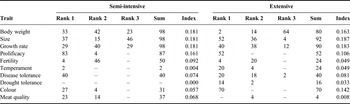
Farmers in the different production systems had different trait preferences. The ranking of traits perceived by farmers as being of primary importance are presented in Table 3. High body weights, large size and faster growth rates were highly preferred in the semi-intensive system. This was mainly because marketing these animals was on a weight basis. Farmers wanted pigs which attained high market weight early so as to achieve faster and higher returns per cycle. The price of meat was determined by the age of the pig and carcass quality. Prices were high for porkers and lowered as the pigs aged for those farmers who sold to the leading pig products processor in the country (Farmers Choice Limited). Carcass quality did not influence prices among the local butchers who offered an alternative market for these pigs. In the extensive system, farmers’ preference was for moderate body size and faster growth rates. The breeds kept in this system are smaller in size and suspected to be indigenous or crossbreeds of indigenous and exotic (Kagira et al., Reference Kagira, Kanyari, Maingi, Githigia, Ng'ang'a and Karuga2010). In such systems, breeds with traits closely related to exotic breeds are disliked due to high monetary requirement for purchase of supplementary feed (Roessler et al., Reference Roessler, Drucker, Scarpa, Markemann, Lemke, Thuy and Valle Zárate2008). Under conditions of sparse feeding or low nutritional levels, small animals have an advantage over large ones because more energy is left for production when the maintenance requirements have been met. Additionally, small-sized breeds yield convenient carcass sizes for rapid disposal in such areas with limited marketing channels, inadequate transport network and freezing facilities (Philipsson, Rege and Okeyo, Reference Philipsson, Rege, Okeyo, Onjango, Malfmors and Okeyo2006). Market is mainly to local butchers and therefore carcass quality does not tend to affect prices.
Ranking of traits perceived by farmers as being of primary importance in semi-intensive and extensive pig production systems in Kenya.

Prolificacy was perceived as the most important reproductive trait relative to fertility. This was because additional piglets meant more income for farmers in the different production operations (farrow to weaner and farrow to finish). The trait is also easy to monitor and record compared to other reproductive traits. According to Mutua et al. (Reference Mutua, Arimi, Ogara, Dewey and Schelling2010), pigs are preferred to other livestock in the extensive system because they breed easily, have a shorter gestation period and produce many piglets in a single farrowing.
Disease tolerance received a reasonable ranking in both systems indicating that farmers dislike animals that fall ill more often. This is particularly important for exotic breeds because they could be more susceptible to tropical diseases implying a high production risk through animal losses (Roessler et al., Reference Roessler, Drucker, Scarpa, Markemann, Lemke, Thuy and Valle Zárate2008). However, it is reported that high-income farmers tend not to rank disease resistance highly probably due to their ability to purchase drugs for treatment (Halimani et al., Reference Halimani, Muchadeyi, Chimonyo and Kennedy2012). Drought tolerance was not ranked in the semi-intensive system. This could be because farmers do not mainly depend on fodder production to feed their pigs and normally supplement the normal diets with commercial concentrates. This was not the case in the extensive system where most of the time pigs are left to scavenge for their feeds.
In the semi-intensive system, colour, other than white was mainly associated with crossbreeding (crossbreds of Hampshire, Duroc or Pietrain) and influenced selection and marketing. White pigs were mainly Large White, Landrace and their crossbreds. In the extensive system, black pigs were regarded as local/indigenous breeds and the spotted as crossbreds. These form the majority of pigs in this system of production. However, these local and/or crossbreds are mainly non-descript and have not been characterized. Their preference stems from the perception that they are more tolerant to diseases. In terms of marketing local buyers prefer white-coloured pigs; therefore, the more common black-coloured pigs have a low market value (Mutua et al., Reference Mutua, Arimi, Ogara, Dewey and Schelling2010).
As reported by Roessler et al. (Reference Roessler, Drucker, Scarpa, Markemann, Lemke, Thuy and Valle Zárate2008), in demand-driven production systems such as the semi-intensive reported in this study, productive and reproductive performance are the most preferred pig breeding traits while adaptive traits play a lesser role. In the resource-driven extensive system adaptability to fibre-rich diets is the most important trait. In general, farmers in the semi-intensive system preferred faster growing pigs which attain high market weights to meet the high market demand for pork. Exotic genotypes with suitable adaptable traits can be effectively utilized in this system. For the farmers targeting the formal markets such as Farmers Choice Limited, crossbreeding with terminal sire genotypes is recommended for desired carcass quality to be achieved. In the extensive system, farmers should focus on medium-sized pigs which are highly adaptive to utilization of fibre-rich diets and show disease tolerance as well as being compatible with the limited resources available. Under such divergent circumstances, these preference differences should be put into consideration in order to ensure efficient design of breeding programmes (Roessler et al., Reference Roessler, Drucker, Scarpa, Markemann, Lemke, Thuy and Valle Zárate2008). Prolificacy should be supported with piglet survival which is fundamental in determining the herd size and consequently farm profitability.
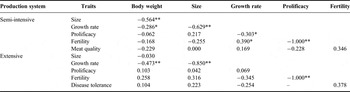
The Spearman's non-parametric rank correlations were calculated for ranking of traits of economic importance to indicate the directional effects and plausible trade-offs between traits (Table 4). In the semi-intensive system, correlations were moderate between growth rate and body weight, and size growth rate. Preference for body weight was negatively correlated with all other traits. This indicates the importance of this trait relative to the other traits. This is because of the marketing structure where animals are sold on weight basis and therefore a heavier animal is expected to fetch a higher market price. Fertility and prolificacy showed a very strong correlation, probably resulting from the expected genetic correlation between the traits. There was no correlation between size and meat quality.
Correlations of farmer's preference rankings for traits of economic importance in semi-intensive and extensive pig production systems in Kenya.

*, Correlation is significant at the 0.05 level (two-tailed); **, Correlation is significant at the 0.01 level (two-tailed).
In the extensive system, correlations were moderate for body weight and growth rate and size growth rate. Here growth rate was more important and therefore correlations were negative. Although positive, correlations between prolificacy and all other traits were too low to be meaningful. In this system, the importance of disease tolerance was the most importance functional trait. Correlations of the different traits with disease tolerance in the semi-intensive and for meat quality in the extensive systems, respectively, were not calculated due to the low ranking the traits received. In general, there were logical trade-offs in the choice of the traits by farmers in both systems.
Consideration of farmers’ breed and trait preferences is important in design of sustainable improvement programmes. This would ensure that animal selection is based on traits that farmers understand, measures and records easily and derives direct economic value (Tada, Muchenje and Dzama, Reference Tada, Muchenje and Dzama2013). The biological traits preferred by the farmers in this study are variables that are partly determined by the genotype of the animals and are considered potential breeding objective traits. As a result, it is extremely important that they are set at a level where they truly reflect the needs of the locality, and that farmers support the direction of change (Philipsson, Rege and Okeyo, Reference Philipsson, Rege, Okeyo, Onjango, Malfmors and Okeyo2006). Development of village breeding programmes has been suggested as a key entry point in the improvement of smallholder pig production (Roessler et al., Reference Roessler, Drucker, Scarpa, Markemann, Lemke, Thuy and Valle Zárate2008). These programmes should integrate appropriate breeds that can efficiently utilize available resources for the improvement of production traits in line with profit maximization. Such breeds are available in the country and can be obtained from breeders or farmers can improve their own replacement stock. In addition to concentrating on production traits improvement, reproduction rates and adaptation to farm-produced feeds should be maintained (Roessler et al., Reference Roessler, Drucker, Scarpa, Markemann, Lemke, Thuy and Valle Zárate2008). By developing a community-based organization for the genetic improvement of livestock (CBOGIL), a group of farmers can form a dispersed nucleus consisting of groups of elite herds among which selection decisions are made and from which improved germplasm is disseminated into populations that are not participating in the genetic improvement initiative. The group's mandate should focus on genetic evaluation, selection of parental stock and dissemination of genetic material (Kahi, Rewe and Kosgey, Reference Kahi, Rewe and Kosgey2005). To support their efforts, farmers should embrace proper animal identification and performance recording. The records are important in day-to-day management activities, for genetic evaluation and improvement, performance monitoring and evaluation and increased market value (Bett et al., Reference Bett, Kosgey, Kahi and Peters2009).
The information on biological trait preference from this study was integrated with economic variables to develop a bio-economic model for estimating economic values in different smallholder production systems in a subsequent study.
Conclusions
In the two production systems evaluated, indices for trait preference were high for performance traits such as body weight, size and growth rate and the reproductive trait, prolificacy. In these systems opportunities exist for breeding management improvement. As such, appropriate breeds which suit the divergent production systems in this study need to be identified and utilized based on performance and adaptability to ensure efficient resource use. Further studies are required to assess the trait preferences in the different production systems that suit the farmers’ production objectives and market demand.