Key messages
• New Cooperative Medical Scheme (NCMS) is a publicly funded insurance scheme for rural populations in China.
• No differences in reimbursement rates and transaction costs were found between the public and private administrations of the NCMS.
• People were more likely to be satisfied with the public administration of the NCMS for its ease of reimbursement arrangement compared with the private administration model.
• The hoped-for benefits associated with private administration of the NCMS have so far failed to realize.
Introduction
Private administration of publicly funded programs has been encouraged in many countries in the hope that it would help improve quality and efficiency. Examples include the introduction of managed competition in Latin America (Vargas et al., Reference Vargas, Vázquez, Mogollón-Pérez and Unger2010), the rise of innovative social enterprises in a range of low- and middle-income countries (Bhattacharyya et al., Reference Bhattacharyya, Khor, McGahan, Dunne, Daar and Singer2010), and the increasing popularity of public–private partnerships worldwide (Hanlin et al., Reference Hanlin, Chataway and Smith2007). Many countries have been attracted by the assumption that inefficiency is deeply rooted within public systems (Bryce, Reference Bryce2000) and that greater efficiency can be achieved through a clear separation between funders and providers of health services, as this would help to introduce competition among providers (Walsh, Reference Walsh1995; Rechel and McKee, Reference Rechel and McKee2009). The split between funders and providers enables governments to enter into contract-like arrangements with providers from both the public and private sector.
In the academic community, debates continue on whether the private sector is more efficient than the public sector in managing and providing health services (Duckett and Jackson, Reference Duckett and Jackson2000). Some researchers argue that commissioning the private sector to deliver public services could further reduce the already inadequate resources in the public sector, a problem that has surfaced in many high-income countries with public–private partnerships (Duckett and Jackson, Reference Duckett and Jackson2000; McKee et al., Reference McKee and Edwards2006). Contract-like arrangements have also been criticized for weakening governmental capacity for protecting public interests (Schick, Reference Schick1998).
Despite these debates, many industrialized countries have opted for contract-like arrangements, decoupling policy-making functions from the administration and delivery of services and giving rise to ‘internal markets’ (Schick, Reference Schick1998; Palmer, Reference Palmer2000). Various forms of contracts and contractual relationships have evolved in countries such as Australia, New Zealand, the United Kingdom and the United States (Palmer, Reference Palmer2000), in the hope that contract-like arrangements allow governments to focus on outputs rather than inputs, enhancing organizational performance (Schick, Reference Schick1998). Furthermore, there is growing interest in applying management techniques from the private to the public sector, often labelled as ‘new public management’, which has underpinned a range of public sector reforms since the 1980s (Lane, Reference Lane2003). At the same time, theories of polycentricity have emphasized that traditional divisions of the public and private sector are often misleading, and that diverse organizations, including private enterprises, can deliver public goods (Ostrom and Ostrom, Reference Ostrom and Ostrom1999).
Given the limited resources and inefficiency of public administrations in developing countries, it is understandable that many have considered adopting contract-like arrangements. However, most developing countries are unlikely to achieve the same level of success as their more developed counterparts, as the conditions of success for contract-like arrangements are often absent, including a robust market sector and established mechanisms for enforcing contracts (Schick, Reference Schick1998).
China has now progressed into a transitional stage, moving from a planned to a market economy. The last four decades have witnessed dramatic economic growth. This ‘miracle’ of economic development has been attributed, at least partly, to ‘contract responsibility’ arrangements between governmental departments and executives of state-owned enterprises (Tsui et al., Reference Tsui, Wang and Xin2006). In recent years, attempts have been made to extrapolate a similar model into the health sector. Some local (county) governments have contracted private health insurance companies to administer the New Cooperative Medical Scheme (NCMS), a government-subsidized medical insurance scheme for rural residents. It is unclear, however, whether these reforms will produce the results hoped for by local governments. The intention of our study was to evaluate the efficiency and effectiveness of private administration of the NCMS in selected counties of the country.
The NCMS
Over the last decade, China's health reforms have gathered momentum. The development of the NCMS has become one of the fastest growing and most significant elements of reforms. The NCMS is a revised version of the earlier Cooperative Medical Scheme (CMS), which collapsed after 1978 with the dissolution of collective farming through which the CMS had been funded (Wagstaff et al., Reference Wagstaff, Yip, Lindelow and Hsiao2009; Sun et al., Reference Sun, Jackson, Carmichael and Sleigh2009b). By 2003, nearly 80% of rural residents did not have any form of health insurance and poor health had become an important cause of rural poverty (Zhang et al., Reference Zhang, Cheng, Liu, Zhu, Tang, Bogg and Dobberschuetz2009). In 2003, the Chinese government established the NCMS, hoping that it would improve the health of rural populations, safeguard economic development and enhance social cohesion (Ministry of Health et al., 2003; Klotzbücher et al., Reference Klotzbücher, Lässig, Qin and Weigelin-Schwiedrzik2010).
The NCMS is jointly financed by enrollees and governmental agencies at the county, municipality, provincial and national levels. It is a national initiative, based initially on fee-for-service payment method. The NCMS covers medical services only, excluding preventive care and public health services. Enrollees are reimbursed for medical expenses when they incur those expenses through eligible medical facilities. The NCMS's main objectives are to improve access of rural residents to medical care, reduce catastrophic medical expenditure, and diminish inequities in access to medical care between rich and poor (Yip and Hsiao, Reference Yip and Hsiao2009; Sun et al., Reference Sun, Liu, Meng, Tang, Yu and Tolhurst2009a). In contrast to the mandatory medical insurance schemes for urban employees (Wagstaff et al., Reference Wagstaff, Yip, Lindelow and Hsiao2009), the NCMS is a voluntary scheme, in which individual contributions are matched by government contributions (Klotzbücher et al., Reference Klotzbücher, Lässig, Qin and Weigelin-Schwiedrzik2010). A distinguishing feature of the NCMS is that counties enjoy considerable autonomy in determining the design and administration of the scheme (Brown and Theoharides, Reference Brown and Theoharides2009; Zhang et al., Reference Zhang, Cheng, Liu, Zhu, Tang, Bogg and Dobberschuetz2009; Babiarz et al., Reference Babiarz, Miller, Yi, Zhang and Rozelle2010; Klotzbücher et al., Reference Klotzbücher, Lässig, Qin and Weigelin-Schwiedrzik2010). Consequently, policies vary considerably across counties with regard to the funding level of per capita premiums and entitlements for the insured, such as medical conditions that are not covered by the NCMS and requirements for deductibles and co-payments (Lei and Lin, Reference Lei and Lin2009; Sun et al., Reference Sun, Liu, Meng, Tang, Yu and Tolhurst2009a).
By 2010, the NCMS had grown to more than 800 million enrollees (Alcorn and Bao, Reference Alcorn and Bao2011). There is evidence to suggest that this has improved the accessibility of primary care in rural China. For example, a nationally representative study of 160 village primary care clinics and 8339 individuals in 2004–2007 found a decline of out-of-pocket expenditure and a reduced exposure to financial risk (Babiarz et al., Reference Babiarz, Miller, Yi, Zhang and Rozelle2010).
With the rapid growth of the funding pool, fund management has attracted increasing attention from national and international observers. So far, two fund management models have emerged. The majority of counties have adopted a public administration model, in which county health departments are responsible for managing the NCMS funds. At the same time, a number of counties, scattered throughout approximately a quarter of all provinces, have adopted a private administration model, in which private for-profit insurance companies have been contracted to manage NCMS funds (Lv, Reference Lv2005; Zhang et al., Reference Zhang and Huang2006). By the end of 2006, 66 counties had implemented the private administration model, accounting for 4.6% of all counties that had started to introduce the NCMS (Chen, Reference Chen2007). A growing number of insurance companies are competing to administer NCMS funds, arguing that they are better prepared than the public administration, with both skilled human resources and extensive experience in financial risk management. Yet, while more and more counties are considering the option of out-contracting the administration of the NCMS to the private sector, little is known on whether the insurance companies can deliver on their promises.
A considerable number of studies examining the NCMS have been published in recent years, covering such aspects as reimbursement for catastrophic payment for illness (Yip and Hsiao, Reference Yip and Hsiao2009; Sun et al., Reference Sun, Jackson, Carmichael and Sleigh2009b), enrolment (Wang et al., Reference Wang, Gu and Dupre2008), participant satisfaction (Liu et al., 2008), out-of-pocket expenditure (Lei and Lin, Reference Lei and Lin2009), medical impoverishment (Yip and Hsiao, Reference Yip and Hsiao2009), financial protection of patients with chronic disease (Sun et al., Reference Sun, Liu, Meng, Tang, Yu and Tolhurst2009a), and prescribing behaviour of village doctors (Sun et al., Reference Sun, Jackson, Carmichael and Sleigh2009b). However, the management of the scheme has so far failed to attract attention. Although a number of articles on the two management models in the NCMS have been published in Chinese-language periodicals (Wang et al., Reference Wang, Wang and Chen2005; Zhang and Zhang, Reference Zhang and Zhang2006; Zhang et al., Reference Zhang and Huang2006; Guo, Reference Guo2007; Meng et al., Reference Meng, Luan and Honghui2007; Shu, Reference Shu2007; Zhou and Zhengzhong, Reference Zhou and Zhengzhong2009), our study is, to our knowledge, the first empirical investigation of the performance of the two models.
Methods
Our study aimed to answer the following two research questions:
1. What is the impact of private administration on the benefits of the insured as compared with public administration?
2. Is the private sector more efficient in managing the NCMS funds than the public sector?
Research setting
The study was undertaken in Ningbo city of Zhejiang province, one of China's most affluent provinces, located on the eastern coast of China. In 2006, the average per capita income of rural residents amounted to 8847 yuan (GBP 837/USD 1296). Of the 87 counties in Zhejiang, eight had commissioned private insurance companies to manage NCMS funds in 2006.
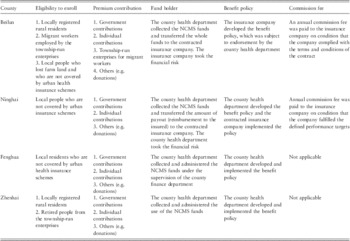
Ningbo has ten counties. Two counties, Beilun and Ninghai, had respectively commissioned the local branches of China Life (the biggest life insurance company of China) to manage the NCMS fund, while the other eight had opted for a public administration model. In our study, we compared the two counties with a private administration model for the NCMS with two counties (Fenghua and Zhenhai) that had chosen the public administration model. Fenghua and Zhenhai were specifically chosen for having similar demographic and economic characteristics as Beilun and Ninghua. In Ningbo, NCMS enrollees contributed about 36% of premiums, except for Beilun, where township-run enterprises made a significant contribution (Table 1). Until 2007, due to its advanced economic status, Ningbo was ineligible to receive a central government financial subsidy for the NCMS. Since 2007, more affluent eastern areas of China, including Zhejiang province, have received central subsidies comparable to the country's western and middle areas.
The fund management arrangements for the NCMS in the four counties of Ningbo (in 2006)

NCMS = New Cooperative Medical Scheme.
In 2004 in Beilun, the local government invited the insurance companies that had a local branch to bid for the administration of the NCMS fund. Three insurance companies submitted proposals. China Life eventually won the bid, as its proposal contained the lowest administration costs, while still being committed to a serious investment in human resources, including one or two full-time staff managing the NCMS in each town (for a total of eight towns). Competitors doubted the financial viability of the plan, while China Life's projected costings were clearly influenced by strategic considerations, including the large commercial life insurance market of the rural population. The responsibilities of the Beilun branch of China Life included assisting the government with premium collection, training staff in NCMS fund management, administering reimbursement claims, compiling financial reports and accepting financial audit. The local government retained the ownership of personal data gathered in the course of private fund management. The contract was valid for three years and renewable on condition that the performance of the contracted insurance company (including financial management and the benefit of enrollees) were satisfactory to the local government.
Ninghai adopted a simpler approach. The local government commissioned China Life to manage the NCMS fund based on the assumption that the company had a strong track record in financial risk management. China Life was only allowed to administer claim reimbursement. In contrast to Beilun, the terms and conditions of the contract between Ninghai county government and China Life were not well articulated and somehow ambiguous.
The per capita premium level varied across the four counties. While Ninghai maintained a stable premium level over the years 2004–2006, the other three counties increased their premium levels to differing extents. Overall, Zhenhai took the lead in terms of contributions from the government and individuals. However, the governmental contribution in Beilun was larger than that of Zhenhai in 2006. The significant surge in government contribution to Beilun was made to equalize its premium level to the others (Table 2).
Premium contributions per capita in the four counties in 2004–2006

*In Zhenhai, township-run enterprises made two-fold increased contributions on behalf of their retired workers.
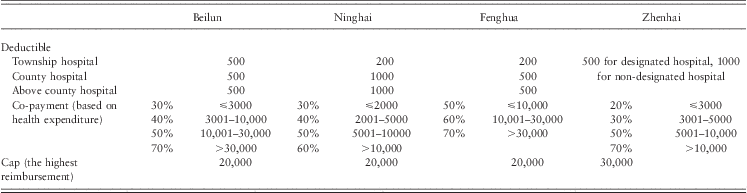
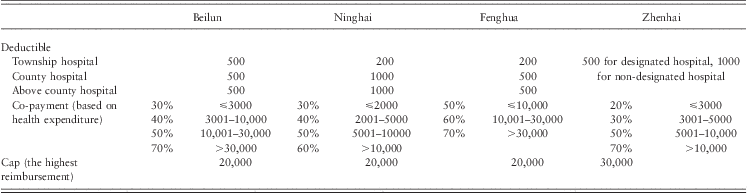
The benefit policy for the insured also varied across the four counties. However, all imposed a reimbursement cap (30,000 RMB in Zhenhai and 20,000 RMB in the other three counties) for an episode of hospital care beyond which no compensation would be made to the insured (Table 3).
Benefit policy for hospital inpatient services in the four counties (in 2006)
Sampling and data collection
Data were collected using a set of standardized survey instruments developed by the Ministry of Health for routine reporting on the operations of the NCMS (Mao and Jiang, Reference Mao and Jiang2005). The data sets used for analysis in this study included administrative and financial accounts of the NCMS for the period of 2004–2006 and a questionnaire survey undertaken in 2006 on enrollee satisfaction. We also interviewed four local health officials (one for each county) and two hospital managers (from Beilun and Fenghua, respectively) to provide additional information on the development and managerial arrangements for the NCMS.
A stratified random sampling strategy was employed to select the questionnaire respondents. Townships of the four counties were first classified into three strata according to their economic status. One township from the middle band was randomly selected from each of the counties. Then, villages of the selected townships were divided into two economic categories; one village from each category was randomly selected for each county. This amounted to a total of eight villages. In each selected village, 23 households were randomly selected. The questionnaire was administered through a face-to-face interview by a group of trained postgraduate students and researchers from Huaxi School of Public Health of Sichuan University. One respondent from each of the selected households (usually the household head or the person who was believed to be most familiar with the NCMS by the household members) was interviewed.
The questionnaire was composed of 36 closed-ended questions and one open-ended question, measuring (1) demographic characteristics; (2) health status; (3) health service utilization; (4) reimbursement from the NCMS; and (5) satisfaction with the NCMS. In total, 180 households were approached and completed the survey. From the 180 returned questionnaires, 176 (98%) were valid for analysis, including 89 from the counties with privately administrated NCMS and 87 from the counties with publicly administrated NCMS. The 176 questionnaires contained information for 479 household members.
Data analysis
Four indicators were calculated to compare the two management models.
1. Proportion of enrollees compensated for inpatient care: this indicator represents the proportion of enrollees who had been subsidized for inpatient care by the NCMS in a given year. Although the indicator was not adjusted for the respective demographic and morbidity profile (due to the unavailability of these data), it gives a rough estimation of the accessibility of NCMS benefits, in particular in view of the widespread speculation in China that claim reimbursement is more difficult from private insurance companies than from a publicly administered fund.
2. Average reimbursement-expense ratio per episode of inpatient care: this indicator represents the extent to which hospital expenditure was compensated for by the insurance scheme.
3. Overall administration cost: the administration cost includes investments and payments made by the county health department for running the insurance scheme.
4. Enrollee satisfaction with the administration of the NCMS: this indicator measured the responsiveness of the NCMS to the needs of enrollees.
The statistical analysis was performed using the STATA 10.0 package. Wilcoxon signed-rank tests were performed to test the differences between the two groups of counties in ‘reimbursement per 100 RMB expense’ and ‘head counts compensated for inpatient care per 100 enrollees’. Chi-square-test was performed to test the difference in enrollee satisfaction between the groups of counties.
Results
Social-economic profiles of the study counties and questionnaire respondents
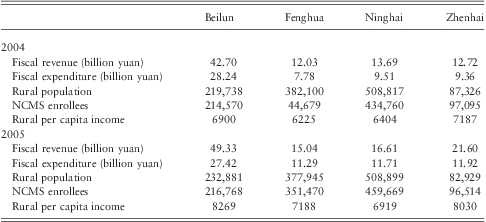
The two groups of counties had similar demographic and social-economic characteristics, with a 13.77% variance in average rural per capita income (Table 4).
Population and economic characteristics of the four counties
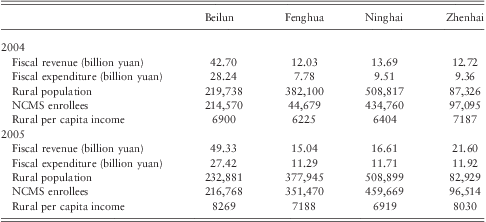
NCMS = New Cooperative Medical Scheme.
Source: Health Departments of Beilun, Ninghai, Fenghua and Zhenhai.
Note: In Zhenhai, the number of enrollees is greater than the rural population, as it also includes retired workers from township-run enterprises; in Fenghua, there were only two townships involved in the NCMS in 2004, the number of enrollees increased significantly in 2005.
Reimbursement for inpatient care
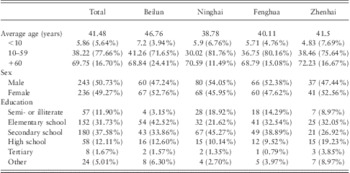
Demographic and hospital services data for 479 enrollees were collected from the 176 questionnaire respondents (Table 5). The 479 enrollees had an average age of 42 years and 22 (4.59%) had been admitted to hospital in 2006. No significant differences in age and gender composition were found between the four counties (p > 0.8).
Demographic characteristics of enrollees

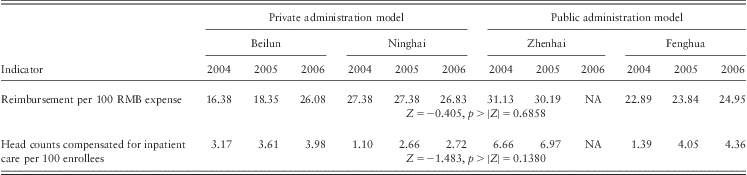
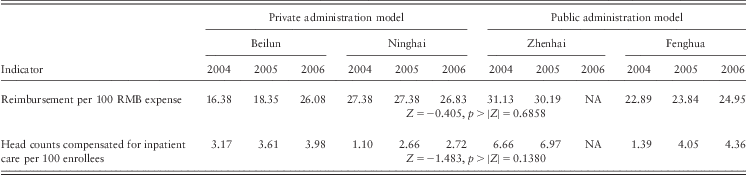
The administrative and financial accounts showed that the majority of hospitalized patients were eligible to claim reimbursements from the NCMS. Only 0.4–3.2% (1.44% in Beilun, 0.44% in Ninghai, 1.14% in Fenghua and 3.22% in Zhenhai) of inpatients failed to receive reimbursements because of the deductible barriers. The proportion of enrollees who were compensated for inpatient care ranged from 1.1% (Ninghai 2004) to 6.97% (Zhenhai 2006).
It seems that enrollees in the counties with a public administration model were more likely to receive compensation from the NCMS than those in the counties with private administration. However, this difference was not statistically significant. Similarly, enrollees in the counties with a public administration model were more likely to receive a greater percentage of reimbursement from the NCMS than those in the counties with a private administration model, but, again, the difference was not statistically significant (Table 6).
Comparison of benefits between enrollees covered by the private administration model and those covered by the public administration model
Government investment and transaction cost
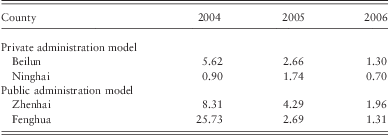
Local governments invested into the infrastructure that enabled the smooth operation of the NCMS, regardless of whether the scheme was run publicly or privately. This infrastructure included office supplies, human resources and electronic information systems. Despite a substantial variation across counties, no clear association between government investments and administration models emerged (Table 7).
Fixed asset and annual recurrent funds for managing the NCMS per enrollee (unit: yuan per capita)
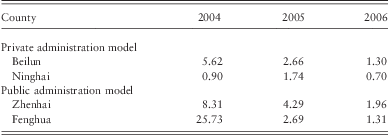
NCMS = New Cooperative Medical Scheme.
Note: The value of the fixed asset has been adjusted by appreciation from 2004 to 2006 in accordance with the Law on Enterprise Income Tax of 1 January 2008.
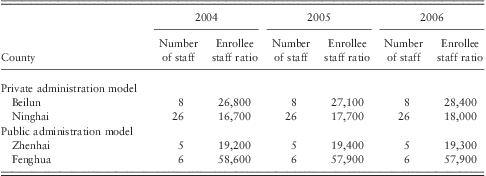
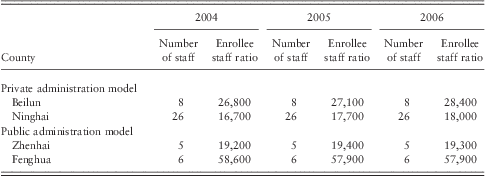
Table 8 shows the actual number of staff members paid for by the local government for managing the NCMS funds. The capacity of county governments to hire staff for managing the NCMS funds was restricted by their stringent financial budget. This led to low staffing in the two counties with a public administration model. Fenghua had the highest enrollee staff ratio, with one staff member serving 58,000 enrollees. As shown in Table 8, there were eight staff working in Beilun on managing the NCMS, but this number did not include those working in the townships, which the insurance company failed to cover. Private administration thus involved a higher number of staff members paid for by the local government than public administration, although this did not seem to have been a major cost factor for overall government investment and transaction costs.
Human resources for managing the NCMS fund, 2004–2006
Enrollee satisfaction
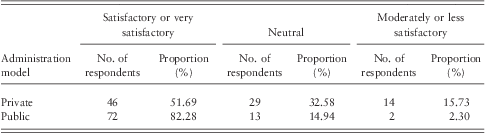
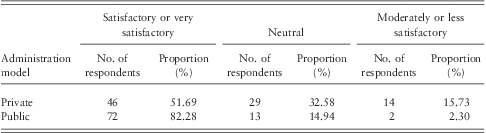
Of the 176 returned questionnaires, 42 chose ‘neutral’ as the answer to the satisfaction survey. Respondents covered by the publicly administered NCMS were more likely to be satisfied with the NCMS compared with those covered by the privately administered NCMS. Over 80% of respondents covered by the publicly administered NCMS were satisfied or very satisfied with the NCMS, 30% more than those covered by the privately administered NCMS (χ 2 = 20.8040, p = 0.000; Table 9). More than half (98) of the 176 respondents held an indifferent attitude towards ‘willingness of accepting an insurance company to manage the NCMS’.
Enrollee satisfaction
Discussion
A growing number of low- and middle-income countries are developing government-subsidized health insurance schemes with the aim of sharing risks and protecting households against catastrophic illness. These schemes range from community-based initiatives to national programmes run by governments (Sun et al., Reference Sun, Liu, Meng, Tang, Yu and Tolhurst2009a). Whether publicly subsidized health insurance schemes should be run by public or private agencies is debated internationally, including in such high-income countries as the United States (Chernichovsky and Leibowitz, Reference Chernichovsky and Leibowitz2010). There is also an ongoing debate about how best to reform the Chinese health system (Wagstaff et al., Reference Wagstaff, Yip, Lindelow and Hsiao2009).
Our study is one of the first attempts to empirically investigate the two administration models used in the NCMS. We found no evidence to support the argument that private agencies are better prepared than public agencies to manage the NCMS funds. With regard to the benefits enrollees enjoyed and the transaction costs for managing the NCMS, we found virtually no difference between the public and private administration models (although private administration was associated with a higher number of government-paid staff). This finding is somewhat surprising. A number of earlier studies have identified a lack of managerial capacity of local governments to run the NCMS (Zhang et al., Reference Zhang, Cheng, Liu, Zhu, Tang, Bogg and Dobberschuetz2009). Concerns have also been raised about the high transaction costs of the public administration of the NCMS (Lei and Lin, Reference Lei and Lin2009; You and Kobayashi, Reference You and Kobayashi2009). In China, private insurance companies are generally assumed to be able to work more efficiently than government agencies in administering health insurance schemes.
We also found that enrollees covered by the publicly administered NCMS were more likely to be satisfied with the NCMS. This does not necessarily mean that people are more satisfied with the public administration of the NCMS than the private administration. Indeed, there has been a lack of trust in government institutions in rural communities, which is one of the major reasons for introducing the NCMS as a voluntary scheme (Yip and Hsiao, Reference Yip and Hsiao2009). Over the past decades, local governments have imposed too many taxes and fees and misuse of the funds collected has not been uncommon (You and Kobayashi, Reference You and Kobayashi2009). However, it is likely that enrollees are more concerned with the benefit plan itself than with who manages the schemes, an observation emerging from our interviews that was also made in previous studies (Wang et al., Reference Wang, Ye, Wang, Yue and Luo2003). Given the small proportion of respondents who got real financial benefit from the NCMS fund, it seems more appropriate to interpret the ‘satisfaction’ as a preference for public administration. The success of contract-like arrangements for public services depends on the maturity of formal market mechanisms (Schick, Reference Schick1998). As a transition economy, China is still facing many uncertainties. The capacity of the government to regulate the market is limited, with many legislative and regulatory measures still waiting to be put in place. An example of this, and one that has so far failed to attract much attention, relates to personal information. We noticed that only one of two county governments engaging with private health insurance companies realized the potential problems associated with commissioning private companies to run the NCMS. It was unclear who would own the enormous amount of personal data gathered in the course of administering the NCMS and how abuse of the data for the purpose of making profit (such as through the sale of the data to other commercial companies) could be prevented.
Another issue deserving attention is the capacity of the private sector. As often seen in many other low- and middle-income countries, China's private sector has its own problems. Private sector companies usually have poor access to technology And the skills and education of their staff is beyond the control of the government. A strong argument in favour of contract-alike arrangements is that the government can be freed to act as an effective agent on behalf of consumers (Schick, Reference Schick1998). However, such a role could be seriously jeopardized when the government has to keep a very close eye on the activities undertaken by the contracted private agencies. In the case of the counties included in our study, Ninghai returned to the public administration model after 2007, while Beilun decided to retain the private administration.
Our study is one of the first attempts to empirically investigate the public and private administration of the NCMS. Restricted by the availability of data, our study only evaluated a limited number of indicators associated with the short-term performance of the NCMS. Moreover, we could not adjust indicators for the demographic and morbidity profile of the covered population, as these data were not available. Many NCMS schemes are still at an early stage of development and further, more comprehensive and rigorous, studies will be needed to evaluate the medium- to long-term performance of different administration models for the NCMS. These will need to take account of hospital utilization structures, as expenditures differ significantly across hospital levels.
Conclusions
In our sample of counties, private administration of the NCMS did not deliver the results expected by local governments. It neither reduced transaction costs, nor improved the benefits of enrollees. Although our findings are preliminary and cannot be easily generalized to the rest of the country, they indicate that it should not be taken for granted that private insurance companies operate more efficiently and to the greater satisfaction of enrollees. We believe that greater caution needs to be taken in extending the privatization of the administration of the NCMS. In particular, local governments need to evaluate the capacity of the private sector prior to commissioning services from it.
Acknowledgements
The authors would like to thank research staff and postgraduates of Huaxi School of Public Health, Sichuan University for their time given to fieldwork. The authors would particularly like to thank all scholars for their comments on the manuscript. Authorship: Zhou conceived and designed the study and drafted and revised the manuscript. Mao contributed to conceiving the study and collecting the data. Rechel contributed to interpreting the data and drafting the manuscript. Liu helped in interpreting data and revised the manuscript. Jiang helped in data analysis. Zhang helped in data analysis and interpreting results. All authors have seen and approved the final version of the manuscript. Ethical approval: Ethical approval was obtained by the Ministry of Health of China and the free and informed consent of subjects was obtained. Funding: This work was supported by the Ministry of Education (Grant number 20050610082) and the Ministry of Health of the People's Republic of China. B.R.'s involvement in this study was supported by the European Observatory on Health Systems and Policies. Liu's contribution in this study was supported by La Trobe University.