The “democratic peace”—the regularity that democracies rarely (if ever) fight with other democracies but do fight with nondemocracies—is one of the most important findings in international relations scholarship. According to Jack Levy's famous formulation, the democratic peace “comes as close as anything we have to an empirical law in international relations.”Footnote 1 However, while there is general agreement about the existence of this empirical regularity, there is far less agreement about its causes. An important recent development in the literature has been to use survey experiments on mass publics to examine whether the content of public opinion might explain the democratic peace.Footnote 2 These studies have found that democratic publics are less willing to use military force against democracies than nondemocracies, and have been used in support of the proposition that public opinion may provide an important mechanism that helps explain the democratic peace.
Such a claim, however, relies on an implicit but untested assumption that the content of public opinion in democracies differs in this regard from nondemocracies.Footnote 3 We test this assumption by investigating public attitudes toward the use of force in a nondemocracy. Using an original, large-scale, and national survey in China that carefully maps Tomz and Weeks's survey experimentFootnote 4 into a substantially different setting, we show that Chinese citizens display similar preferences to those of citizens in liberal democracies: Chinese citizens are systematically less likely to support the use of force against democracies in otherwise identical scenarios. This finding expands the empirical scope of previous findings that mass publics are reluctant to use force against democracies and has implications for our understanding of Chinese foreign policy. However, it also forces us to rethink how public opinion operates as a mechanism that might underpin the democratic peace. If the content of public opinion varies little in this regard across regime type, it alone cannot provide a compelling explanation for variation in the behavior of different regime types or the democratic peace.
Public Opinion as an Explanation for the Democratic Peace
The democratic peace—the finding that democracies never (or rarely) fight with each other but that democracies are not more pacific than nondemocracies in general—is among the most important findings in international relations scholarship and is backed by a large body of empirical literature.Footnote 5 There is relatively little contestation of the basic empirical facts that make up the “separate peace”—democracies fight each other rarely, but are as warlike as other states in general—though some scholars argue that the democratic peace is in important ways a monadic rather than a dyadic phenomenon,Footnote 6 that democracies have come close to conflict,Footnote 7 or that perceptions of democracy are endogenous to the likelihood of conflict.Footnote 8
The existence of the democratic peace, however, has been disputed far less than its causes. Scholars have variously proposed that liberal ideas,Footnote 9 the size and nature of domestic “winning coalitions,”Footnote 10 norms,Footnote 11 the ability to make stable bargains,Footnote 12 or the information-revealing properties of democratic institutionsFootnote 13 lead to a causal connection between joint democracy and peace. However, many proposed mechanisms linking democracy and peace have been challenged on the basis that they imply democracies should be more peaceful in general, rather than peaceful only in their dealings with other democracies,Footnote 14 that is, they imply monadic differences between democracies and nondemocracies rather than the dyadic democratic peace we observe. Other scholars are more skeptical of the causal role played by democracy per se, arguing that the correlation between joint democracy and peace is explained by omitted variables correlated with both joint democracy and peace, such as territorial disputes,Footnote 15 political similarity and/or shared foreign policy interests,Footnote 16 Cold War alliances,Footnote 17 capitalism and “contract intensive” economies,Footnote 18 American hegemony and great power politics,Footnote 19 systemic factors,Footnote 20 or unmeasured but time-invariant differences among dyads.Footnote 21 And, in turn, some of these critiques of the democratic peace literature have themselves been criticized by scholars who argue that the effect of joint democracy on interstate conflict remains robust.Footnote 22
An important recent development in this ongoing debate has been the use of survey experiments to examine whether the content of public opinion could provide one causal mechanism underpinning the democratic peace.Footnote 23 These studies have built on previous work in which the substantive beliefs of liberal publics play a theoretical role,Footnote 24 and have provided individual-level empirical support for the idea that liberal publics may differentially support the use of force against democracies and nondemocracies. This work has demonstrated that publics in liberal democracies are less willing to use force against democratic states than nondemocratic states in otherwise identical scenarios.
This research agenda has made important contributions. It offers the possibility of identifying individual-level microfoundations that might explain the macro-level finding of the democratic peace.Footnote 25 The use of experimental methods ameliorates some of the difficulties associated with drawing causal inferences from observational, country-year data that have led to disputes about the reliability of previous findings.Footnote 26 This work has therefore been used to infer support for the proposition that “the preferences of ordinary voters contribute to peace among democracies.”Footnote 27 While this work focuses on only one part of the causal chain connecting public opinion to the democratic peace (for example, it does not examine how public opinion ultimately affects foreign policy decision making), and examines only one of many potential mechanisms that might underpin the democratic peace, it represents a significant step forward.
The scope of the empirical finding that mass publics are less supportive of the use of force against democracies, however, has not been tested outside of liberal democracies. As Tomz and Weeks argue, it is important to test the robustness of existing findings in other countries.Footnote 28 Indeed, whether the finding that publics are disinclined to attack other democracies extends to nondemocratic publics has important implications for the democratic peace. Existing studies that argue public opinion can provide a unique mechanism underpinning the democratic peace implicitly rely on an untested assumption that the content of public opinion in democracies differs from public opinion in nondemocracies. If mass publics in liberal democracies are disinclined to attack democracies but mass publics in nondemocracies are not, or are more inclined to attack democracies than they are to attack nondemocracies, then public opinion would appear to offer a plausible explanation for the core findings of the democratic peace literature: that democracies rarely engage in conflict against each other, but are not more pacific than nondemocracies in general. But if mass publics in nondemocracies share democratic mass publics’ disinclination to attack democracies, then public opinion could explain why democratic dyads should indeed be relatively peaceful (since both states in such dyads would be disinclined to attack each other) but could not directly explain why democracies are not involved in less conflict in general (since all states should be disinclined to engage in conflict with democracies). In short, if the content of public opinion is to explain the key findings of the democratic peace on its own, there should be variation in the content of public opinion between democracies and nondemocracies. Of course, democratic and nondemocratic institutions could differ in their sensitivity to public opinion, even if the content of public opinion does not vary by regime type. However, it would then be the differences in domestic political institutions, rather than variation in public opinion, driving the empirical findings of the democratic peace.
Despite the importance of this assumption to the claim that the content of public opinion may explain the democratic peace, there are reasons to question its validity. Many proposed logics underpinning the idea that mass publics in liberal democracies should be more reticent to use force against democracies might also apply to publics in nondemocracies. For example, Tomz and Weeks cite a number of mechanisms that might lead democratic mass publics to oppose using force against other democracies: threat perception, anticipated costs of conflict, the likelihood of success in battle, and moral considerations.Footnote 29 But of these, many should also be expected to lead mass publics in nondemocratic regimes to be disinclined to attack democracies. If democracies are less threatening—either because they are believed to externalize peaceful norms of solving disagreements,Footnote 30 or because democratic institutions slow the process of military mobilization or provide information about intentionsFootnote 31 —these mechanisms should also lead them to be less threatening to nondemocracies. If wars against democracies are especially costly and likely to lead to defeat,Footnote 32 then publics in all states, not just democracies, should be reticent to engage in conflict against democracies. Even some morality-based mechanisms—for example, a belief that the policies of democratically chosen governments inherently have greater popular legitimacy and that the bar for military action against democracies should therefore be higher than against nondemocracies—might plausibly constrain support for attacking democracies among mass publics in nondemocracies as well as those in democracies.
The content of mass public opinion in nondemocracies may, therefore, diverge less in this regard from mass public opinion in democracies than scholars have previously thought. If so, this would have implications for whether variation in public opinion can offer a compelling explanation for the core empirical findings of the democratic peace. These propositions provide the motivation for our analysis of public opinion in China. We choose China for two reasons. First, it is the nondemocracy whose preferences regarding the use of force are likely to be most consequential for global security in the future as China's power continues to rise. Second, it might be expected that China—a state challenging the western-led liberal world order in important ways—would have mass publics particularly unlikely to share the preferences of mass publics in liberal democracies.
Examining public opinion in nondemocratic states, and in China specifically, is also important in its own right. Scholarship increasingly challenges the utility of the binary distinction between democratic and nondemocratic states,Footnote 33 and emphasizes the ways in which mass publics in nondemocratic countries can constrain leaders. Although it remains a subject of ongoing study, there is an emerging consensus among scholars that favors the idea of “two-way interactions,” in which public opinion constrains leaders but elite actions can also influence public opinion.Footnote 34 Even separate from its implications for theoretical debates about the democratic peace, this scholarship renders the content of public opinion in nondemocracies an important object of study in its own right. Indeed, with respect to China, the latest research challenges the assumption that Chinese elites are insulated from public pressure.Footnote 35 And on Chinese foreign policy in particular, many scholars and officials have emphasized how the Chinese government has become increasingly sensitive to nationalistic public sentiments. Reviewing the latest trends, for example, Zhao highlights a “strident turn” in Chinese policy, with the government becoming “increasingly responsive to public opinion,” creating “a heated political environment to harden China's foreign policy.”Footnote 36 Chinese public preferences about the use of force could therefore have nontrivial implications for Chinese foreign policy.
Research Design
We conducted a large-scale survey experiment in China to examine public opinion regarding the use of force. Our experimental module was embedded within an online national survey on a respondent sample recruited by a major survey company in the second quarter of 2015. The company used sampling with population targets to match the national census adult population (eighteen years and older) on gender, ethnicity, geography, and income, providing us with a sample size of 2,920.Footnote 37 Because our work builds explicitly on previous scholars’ work, it is important that our results be as comparable as possible to theirs. Therefore, our survey scenario and wording deliberately shadow the scenario and wording used by Tomz and Weeks (and are also similar to that used by Johns and Davies) with careful adjustments made to maintain the plausibility of the scenario in the Chinese context.Footnote 38 Here, cultural sensitivity is important since the same words may carry different connotations across contexts, especially in a large country such as China. To ensure fidelity and accuracy to the original Tomz and Weeks scenario, our survey was pretested with a sample of native speakers from different backgrounds coming from the different regions of China. The experiment began with an introductory paragraph:
There is much concern these days about the spread of nuclear weapons. We are going to describe a situation China could face in the future. For scientific validity the situation is general, and is not about a specific country in the news today. Some parts of the description may strike you as important; other parts may seem unimportant. Please read the details very carefully. After describing the situation, we will ask your opinion about a policy option.
Participants were then presented with the scenario from Tomz and Weeks: a country is developing nuclear weapons and will have its first nuclear weapon within six months.Footnote 39 Participants were told that once it acquired nuclear weapons, the country could use its missiles to launch nuclear attacks against any country in the world, including China. The participants were given various facts about the scenario that mirror those used by Tomz and Weeks, including that the country's nonnuclear military capabilities are half those of China's,Footnote 40 that the country has refused all requests to stop its nuclear program, and that the country's motives for acquiring nuclear weapons are unclear. Participants were randomly assigned to a democracy treatment or a nondemocracy treatment in the vignette.Footnote 41 Following Tomz and Weeks, we also randomized the contextual variables of alliance and trade relationships in our vignette. The full experimental instrument appears in the online appendix.
Finally, participants were told that China and other countries are considering various policy options to deal with this problem, and that one of the policy options would be to attack the country's nuclear sites. Participants were told that attacking the country's nuclear development sites would prevent the country from producing nuclear weapons.Footnote 42 Participants were then asked: “Would you favor or oppose the Chinese military participating in an attack on the country's nuclear development sites?” The response set consists of five options from “Favor strongly” to “Oppose strongly,” which generates a five-point scale.
Results and Discussion
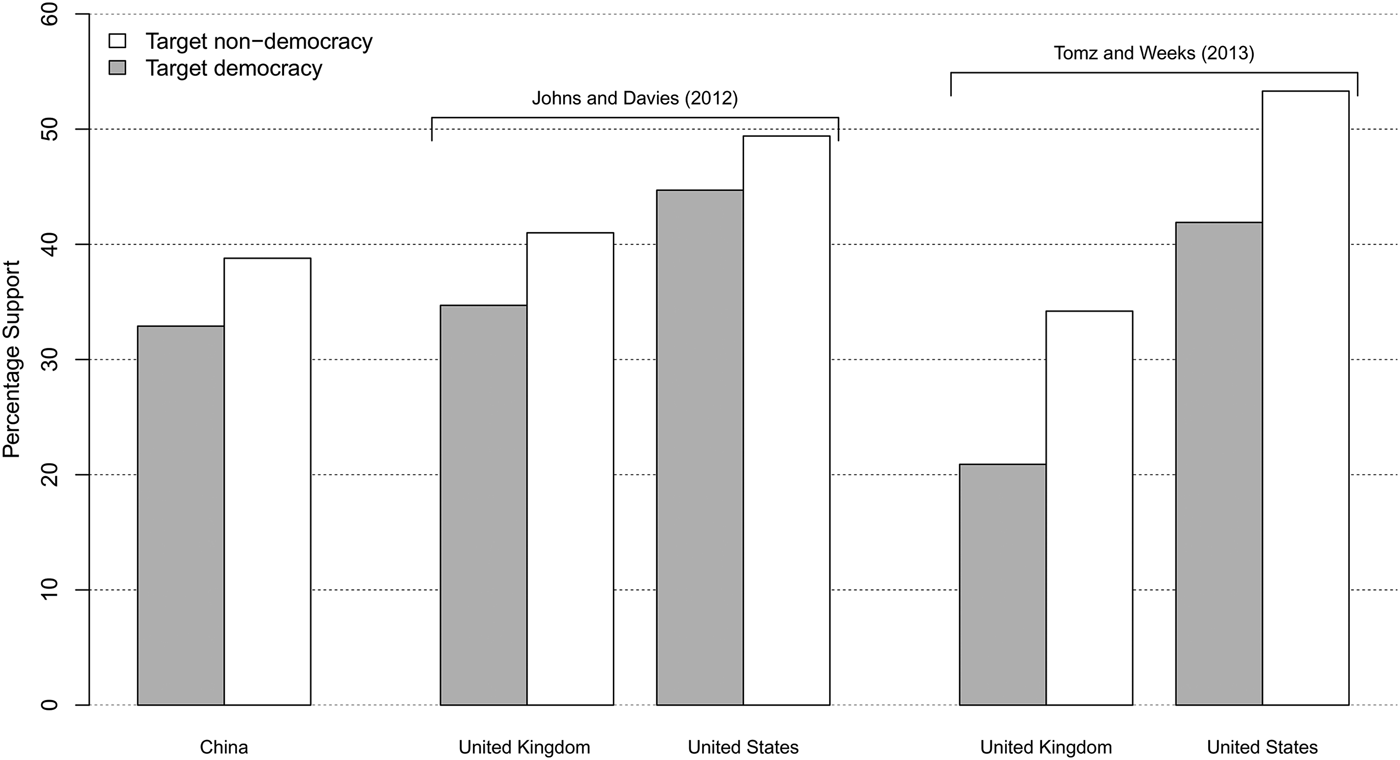
Figure 1 shows the results from China and compares them to the results found by Johns and Davies and Tomz and Weeks. Chinese citizens are significantly less willing to attack a democracy than an otherwise equivalent autocracy. This difference is statistically significant (p < 0.001) and around six percentage points. This effect is similar in size to the effects found in democracies—it is within the range of the effect sizes found in the United States and United Kingdom by Johns and Davies and Tomz and Weeks.Footnote 43 The absolute levels of Chinese support for military action in the different scenarios are also within the range of those reported by Tomz and Weeks and Johns and Davies: somewhat lower than the levels of support found in the United States, but higher than or equal to the levels of support found in the United Kingdom. In short, the content of public opinion in China on this question looks surprisingly similar to public opinion in the United States and United Kingdom.Footnote 44
Support for participating in military strike scenarios in which the target is democratic or nondemocratic in China, the United Kingdom, and United States

These findings are robust across a wide range of additional checks. First, the results are not driven by particular subsets of the population. For example, the treatment effect of democracy is present across respondents with all levels of education (although it is largest among those with advanced degrees), age groups (although older respondents show a somewhat larger treatment effect), and genders (although women display a somewhat larger treatment effect than men). Second, there may be a concern that the democracy treatment is a proxy for other variables or that respondents have particular countries in mind when presented with the scenario.Footnote 45 However, the online appendix shows that the treatment effect of democracy does not vary significantly across the different trade or alliance treatments. If democracy were a proxy for some other variable such as alliance status, we would expect the treatment effect of democracy to be different when other treatments that may be correlated with democracy are explicitly manipulated in the scenario. This does not appear to be the case.Footnote 46 Similarly, the online appendix shows the findings are the same if we remove respondents who thought that the scenario was about North Korea or Iran.
Our findings thus both confirm and expand the scope of the empirical findings in previous studies. A disinclination to attack democracies appears not to be a feature of public opinion in only democratic states, but seems more widely observable. Although we examine China only, the finding that publics in the most consequential nondemocracy in world politics are disinclined to use force against democracies may have important implications. For example, as China's military power rises in the future, many scholars anticipate that China may expand its interests in world politics and behave increasingly aggressively toward its neighbors and other great powers.Footnote 47 If Chinese citizens even modestly restrain such impulses toward democracies, this could have significant consequences for patterns of interstate conflict in the twenty-first century.
The results also force us to rethink the content of public opinion as a mechanism underpinning the democratic peace. Most obviously, a variable that varies little between democracies and autocracies could not explain on its own, for example, why democracies would act differently than autocracies. It is, of course, possible that public opinion is mediated in different ways by domestic political institutions in autocracies and democracies in ways that explain differences in the behavior of democracies and autocracies. It may not be the content of public opinion, but how it interacts with domestic institutions, that explains the democratic peace. If this is the case, institutions would provide the crucial causal variable driving observed variation in state behavior rather than the content of public opinion.
More broadly, and as we discussed, if mass publics in both autocracies and democracies are similarly disinclined to attack democracies and those domestic preferences shape international outcomes, then particularly low conflict rates among joint-democratic dyads would make sense, since these would be the only dyads in which both states were relatively disinclined to engage in conflict against one another. Yet such an argument would also anticipate that democracies should be involved in less conflict in general, and in particular, be less likely to be attacked by states of all kinds. But these conclusions have generally been rejected by the empirical literature on the democratic peace, which has concluded that democracies are not less likely to engage in conflict in general. If the content of public opinion is to provide an explanation for the core findings of the democratic peace—that democracies do not fight each other but do engage in conflict with nondemocracies—the content of public opinion in democracies must differ from public opinion in nondemocracies. Our findings suggest that this may not be the case.
It is important to be clear about the scope of our findings. They do not cast doubt on the empirical findings of the democratic peace itself (that democracies do not fight each other, but do fight with nondemocracies), and do not speak to the plausibility of many other mechanisms that might underpin those findings. But our findings do have significant implications for one prominent mechanism—the content of public opinion—that has been believed to play an important role in explaining the democratic peace. The content of public opinion appears to vary less by regime type than scholars had previously assumed, and thus is less persuasive as a mechanism that might explain variation in state behavior or the democratic peace.
Similarly, our findings in China could be driven by a range of different mechanisms. For example, it could be that democracies are viewed as more trustworthy or less threatening, or that democracies fight harder in wars and so are more dangerous to attack. Alternatively, the mechanism might be more specific to the particular counterproliferation example that Tomz and Weeks employ. For example, perhaps democracies are less likely to be emboldened by nuclear weapons and taking military action to prevent proliferation is therefore less attractive.Footnote 48
It is worth addressing two potential objections to our argument. First, its significance hinges on whether or not Chinese public opinion matters in determining Chinese foreign policy; and second, Chinese citizens may have a very different understanding of which countries are “democratic” than citizens in liberal democracies.
An increasing scholarly consensus suggests that the Chinese government (as well as some other nondemocratic governments) is not immune to public sentiments, including on matters of foreign policy. Even if the Chinese government was fully insulated from public opinion, however, the finding that public opinion on the use of force in democracies and nondemocracies has important similarities remains significant. It is true that if public opinion everywhere is opposed to the use of force but only democratic political institutions are responsive to those views, this would provide an explanation for the democratic peace. However, it would be domestic institutions rather than the content of public opinion that provided the variation explaining the empirical findings of the democratic peace. Public opinion, in short, would not vary across countries, and thus would be a background or permissive condition rather than a variable that could explain the democratic peace. Thus, even if nondemocracies are unresponsive to the views of their publics (an assumption that contradicts findings from current research on China), our findings still cast doubt on the idea that the content of public opinion offers an explanation for the democratic peace.
A second potential concern is that Chinese citizens may have very different understandings than western citizens have of which countries are democratic. If so, the comparability of our results from China with previous results from western countries would be in question. A number of factors indicate that this should not be a major concern. First, we use the term minzhu, which is the primary way that democratic is translated. It is well-known to the average Chinese, and is often used by Chinese people and in mass media (including school textbooks) to refer to democratic regimes, including the United States or Britain. In short, the word is the standard term used in Chinese discourse to refer to a set of countries similar to those western audiences would be comfortable labeling as “democratic.”Footnote 49 Second, if it were the case that Chinese citizens on average have very different understandings of which countries are democratic than western citizens, it would be expected that Chinese citizens who are more exposed to the wider world would have understandings of which countries are democratic closer to those of western publics. If so, they would respond differently to the treatment compared to other Chinese citizens. In fact, however, when we examine the treatment effect of democracy among respondents who have more than high-school education, who speak a foreign language, who have friends who have lived, worked, or studied abroad, or who are interested in international news, the treatment effect of democracy varies little.Footnote 50 In short, Chinese respondents whose identification of democratic countries is likely to be closer to those of western publics respond to the treatment in a similar way as respondents in general. Thus, there is little reason to believe that our findings are incomparable with previous findings, or that they do not identify important similarities in public opinion between China and western democracies.
Conclusion
Our findings suggest that it is not just mass publics in liberal democracies that are disinclined to use force against democracies. In fact, Chinese citizens appear to hold remarkably similar views, a finding that suggests that the same preferences may exist across the populations of very different states. This fact expands the scope of the empirical claim that mass publics are disinclined to use force against democracies. But the finding also suggests the content of public opinion by itself cannot explain differences in state behavior between nondemocracies and democracies, or explain the empirical findings of the democratic peace.
The findings here also suggest several avenues for future research. First, examining why mass publics in autocracies are disinclined to attack democracies would be particularly useful. For example, are democracies viewed as more trustworthy or less threatening by publics even in nondemocratic states? Or are democracies viewed as having greater moral legitimacy even by citizens of nondemocracies? Or do citizens of nondemocratic states believe that fighting democracies is more costly or dangerous than fighting nondemocracies and should therefore be avoided? Additional research along these lines would shed further light on the mechanisms and microfoundations that underpin mass public opinion on foreign policy and the extent to which they differ across different regime types.
Second, future research should further investigate whether the same pattern is indeed found in states of all types, or whether China is unusual among nondemocracies for having mass publics disinclined to use force against democracies. China is the nondemocracy whose international behavior is likely to be the most consequential in the coming decades, and is therefore an appropriate place to start in seeking to understand public opinion in nondemocratic states. Seeking to better understand the dynamics of public opinion in other nondemocracies, and the ways in which they differ from Chinese public opinion, would be theoretically and empirically productive. Similarly, while we used a scenario similar to Tomz and Weeks's to maximize the comparability of our findings, assessing whether regime type matters (and how much it matters) in a broader range of scenarios would also allow scholars to generalize the findings here.
Third, while the content of public opinion may vary less between democracies and nondemocracies than has previously been thought, the extent to which leaders and institutions are sensitive to public opinion may nonetheless differ between democracies and nondemocracies. Given recent scholarship suggesting that nondemocratic leaders may be constrained by public sentiment in important ways, future research should continue to examine how public pressure affects policy in nondemocracies and how this differs in democracies.
Fourth, our findings reinforce a productive strand of scholarship that shows how the finer-grained institutional features may matter more than the binary distinction between democracies and nondemocracies.Footnote 51 The simple democracy/nondemocracy dichotomy may obscure important variation within democracies or within nondemocracies in terms of how domestic audiences affect political leaders, as well as important similarities between certain types of democracies and nondemocracies. Similarly, research suggests that differences in institutional features between democracies—such as variation in political competition and information—may also affect the extent to which effects akin to the “democratic peace” hold among democracies.Footnote 52 Future studies should continue to explore the interaction between public sentiments and the details of the institutions that mediate the relationship between policy and public preferences.
Supplementary Material
Supplementary material for this article is available at <https://doi.org/10.1017/S002081831700042X>.