INTRODUCTION
The standard method used to assess psychopathology in suicide completers is the psychological autopsy (Hawton et al. Reference Hawton, Appleby, Platt, Foster, Cooper, Malmberg and Simkin1998). Under this proxy-based interview process, best informants provide data that serve to investigate a number of risk factors relative to the suicide death. Psychological autopsy studies have demonstrated that approximately 90% of suicide cases presented a psychiatric disorder (Lesage et al. Reference Lesage, Boyer, Grunberg, Loyer and Chawky1994; Hawton et al. Reference Hawton, Appleby, Platt, Foster, Cooper, Malmberg and Simkin1998; Isometsa, Reference Isometsa2001; Kim et al. Reference Kim, Lesage, Séguin, Vanier, Lipp, Chawky and Turecki2003; Arsenault-Lapierre et al. Reference Arsenault-Lapierre, Kim and Turecki2004; Zouk et al. Reference Zouk, Tousignant, Séguin, Lesage and Turecki2006) or psychosocial difficulties (Hawton et al. Reference Hawton, Appleby, Platt, Foster, Cooper, Malmberg and Simkin1998; Cheng et al. Reference Cheng, Chen, Chen and Jenkins2000; Angst et al. Reference Angst, Stassen, Clayton and Angst2002).
However, for some clinical researchers, the identification of risk factors, especially psychosocial ones assessed at a single point in time, has hit a wall in terms of clinical utility (Mann et al. Reference Mann, Watermaux, Haas and Malone1999; Cassells et al. Reference Cassells, Paterson, Dowding and Morrison2005). The investigation of suicide death could benefit from the use of complementary methods, especially with regard to the distribution of adversity over the life course. We know little about the burden of adversity and how it accumulates over the years, as the psychological autopsy method describes the end-point of the trajectory and not the trajectory as it develops over time. The life-course method will measure burden of adversity to determine whether, on this basis, there exist differential profiles in order to, ultimately, arrive at more targeted preventive intervention.
The aim of this study was to introduce the life-course method (Forest et al. Reference Forest, Moen and Dempster-McKain1996; Rutter, Reference Rutter2002b) in suicide research to shed more light on the longitudinal and cumulative impact of psychosocial factors. The opportunity to conduct this research arose in a Canadian province when, following a string of heavily mediatized suicides, the New Brunswick Government commissioned a study to investigate all suicide deaths that occurred over a 14-month period in order to make recommendations on how to improve prevention. In this article, we report the results of the first application of the life-course method to assess burden of adversity in differential profiles of suicide mortality.
METHOD
For the period from 1 April 2002 to 31 May 2003, the Chief Coroner of New Brunswick reported 109 suicide deaths, for an incidence of 12·4 per 100 000 inhabitants. We investigated 102 of these. The other seven were excluded for any of the following reasons: over-riding legal factors, absence of informants (deceased had cut himself off from society altogether), and family questioned the relevance of the study. Based on the coroner's charts, the seven cases involved adult males 27–59 years of age and did not differ from the others in demographic terms.
Recruitment of survivor families
The Coroner's Office sent families a letter explaining the aim of the study, and a member of the research group followed up by telephone to solicit their participation. If the family agreed, their names were forwarded to the project coordinator, who then asked to interview the persons who had known the suicide victim best. A mental health clinician trained as an interviewer then contacted the persons in question to arrange an appointment. The interviews started between 3 and 4 months after the death. Two to six interviews, each approximately 3 hours long, were conducted for each suicide. All participants signed a consent form. In some cases, participants preferred to be interviewed by telephone. Once the interviews had been completed, the research team accessed medical files and social services charts. Thirty hours on average were invested in data collection for each case. The methodology used has been presented in greater detail elsewhere (Séguin et al. Reference Séguin, Lesage, Guy, Daigle, Girard and Turecki2006).
Data collection
Interview to determine diagnosis
To determine the post-mortem diagnoses, we administered the Structured Clinical Interview for DSM-IV Axis I and II Personality Disorders (SCID I and II) (Spitzer et al. Reference Spitzer, Williams, Gibbon and First1992; First et al. Reference First, Spitzer and Gibbon1995) to an informant who had known the deceased well, according to a procedure described previously by our group (Lesage et al. Reference Lesage, Boyer, Grunberg, Loyer and Chawky1994; Kim et al. Reference Kim, Lesage, Séguin, Vanier, Lipp, Chawky and Turecki2003; Dumais et al. Reference Dumais, Séguin, Tousignant, Lesage, Lalovic, Chawky and Turecki2005). In addition, hospital files were examined to corroborate the information thus gathered and to determine the resources that the deceased had used. A series of studies in the past decade has demonstrated the concordance of DSM diagnoses generated from informant report and chart diagnoses (Brent et al. Reference Brent, Perper, Moritz, Allman, Roth, Schweers and Balach1993; Kelly & Mann, Reference Kelly and Mann1996; Zhang et al. Reference Zhang, Conwell, Wieczorek, Jiang, Jia and Zhou2003; Schneider et al. Reference Schneider, Maurer, Sargk, Heiskel, Weber, Frolich, Georgi, Fritze and Seidler2004). In all these studies, the reliability of the method proved to be good to excellent.
Interview to map the burden of adversity over the life course
The life history calendar procedure, also referred to as narrative rating, is designed to elicit sufficiently detailed accounts of events to allow a panel of trained raters to evaluate their key characteristics. The interview method using the life trajectory calendar was borrowed from life-history calendar research (Caspi et al. Reference Caspi, Moffitt and Thornton1996; Ensel et al. Reference Ensel, Peek and Lin1996). We developed a semi-standardized interview (available from the authors on request) and trained interviewers in its use. Prior experience (Tousignant et al. Reference Tousignant, Séguin, Lesage, Chawky and Turecki2003) in using the Life Events and Difficulties Scale (LEDS; Brown & Harris, Reference Brown and Harris1978) and the Childhood Experience of Care and Abuse (CECA) instrument (Bifulco et al. Reference Bifulco, Brown and Harris1994) made us sensitive to the contextual aspects of life events and adversities to be covered using retrospective measures.
The life calendar is used to map the events that mark an individual's trajectory in 10 spheres of life: place of residence, parent–child relationship, emotional-romantic relationships, family life, episodes of personal difficulty, academic and professional life, losses/separations/departures, other social adversity, protective factors, and help seeking/services and drug utilization. For example, place of residence included moving to another location and placement in foster homes. The parent–child relationship covered abuse, neglect, physical and sexual violence, and household violence. With the aid of a visual calendar, the approach serves contemporaneously to record sequence and to investigate event characteristics. Lists of questions addressing different themes and events are used to probe informants for narrative details. For each sphere, the interviewers identify whether events were situational or permanent and determine their duration, intensity, frequency and context.
The interview usually took place at the participant's home and a conversational approach was used. The duration of the interviews seldom posed a problem. Informants included parents (n=34), siblings (n=43), spouses (n=35), ex-spouses (n=3) and adult children (n=16), who were helpful in describing different experiences that occurred at different periods in time. In a number of cases we met two people from the same family at the same time. This double presence often helped to recall narrative details.
The life trajectory was reconstructed on the basis of events recalled by family and friends and, for every case, we had access to medical and psychosocial reports as obtained through the office of the Chief Coroner. Written documents belonging to the deceased and the informants, including agendas and diaries, were also used if available. However, despite the tremendous efforts deployed to gather data, the quality and quantity of information for the suicide victims was uneven, being at times too scant for the early childhood period or the last decade of life. Consequently, of the 102 cases investigated, only those with complete data sets for all stages of life (n=79) were considered in the life trajectory analysis. For the 23 cases thus dropped, we had less contact with family members and had to rely on medical and social services charts to obtain details of life events. These allowed us to obtain sufficient information to establish a current mental health diagnosis, but there was insufficient qualitative information on burden of adversity. These 23 cases comprised 22 men and one woman aged 27–59 years. These did not differ from the rest of the sample in terms of presence of current mental health problems: 95% of the cases for whom we were able to map a trajectory had a recent mental health problem compared with 91% of those for whom we could not.
Coding procedures
After all the data were collected, each individual life trajectory was written up by the interviewers into a case vignette summarizing all life events, their context, adversities and protective factors, psychopathology and utilization of services. The research coordinator reviewed each interview and verified any inconsistencies in the narrative details and spot-checked the audiotape interviews. When details were found to be missing, we recontacted informants and corrected the interviews before the panel of raters coded burden of adversity. Adverse events and types of event were tallied for each 5-year segment. Then, each vignette was submitted to the panel of raters independent of the interviewers.
The raters were trained to evaluate the likely ‘contextual threat’ of events by assessing their place within the respondent's developmental circumstances. Interviewers seek to accumulate sufficient narrative detail about life events to allow trained raters to pass judgement on the key characteristics of the events (Dohrenwend, Reference Dohrenwend2006). Our raters had prior experience with this type of narrative rating with the LEDS and CECA.
The panel rated each 5-year period in terms of burden of adversity. This conceptualization was borrowed from the morbidity burden or low disease burden approach (Powers & Peckham, Reference Powers and Peckham1990; McGinnis & Foege, Reference McGinnis and Foege1993; Forest et al. Reference Forest, Moen and Dempster-McKain1996) used to identify overall morbidity that appears to affect health. It is associated with the allostatic load concept, which links psychosocial stress to the neurobiological and genetic dimensions of mental disorders and suicide (McEwen, Reference McEwen1998; Forrest & Riley, Reference Forrest and Riley2004). The rating scale used in this study was inspired by the scales developed by Brown & Harris for the LEDS (Brown et al. Reference Brown, Andrews, Bifulco and Harris1990). The LEDS rating includes four different intensity levels for coding, intra-pair agreement has run from 78% to 91% in samples with diagnoses of depression and schizophrenia (Brown & Harris, Reference Brown and Harris1978).
Our panel evaluated burden of adversity by taking into account the inventory of life events and the intra-category variability of events, using a scale of 1–6 to rate accumulation and concurrence of adversity across the individual's life at 5-year intervals. The overall burden assessments ranged from severe (rating of 1 or 2) to moderate (3 or 4) to low (5 or 6). This evaluation took into consideration number of risk factors, their importance, duration and severity, extent of consequences, and concurrence of events, as well as counterbalancing protective factors. For example, a burden of 1 corresponded to multiple risk factors in each sphere of life prevailing over the entire 5-year period, with no protective factors. Conversely, a burden of 6 corresponded to normal difficulties, lasting a shorter period of time (less than 1 year), affecting only one or two spheres of life, and the presence of protective factors. Over the course of the research, we developed dictionaries to define variables and to provide examples of cases for each codification to maintain regularity in coding and to minimize rating drifts by panel members. Intra-rater reliability was assessed as follows: in all cases the raters coded independently each trajectory before consensus discussion. Intra-pair agreement for the ten 5-year segments ranged from 76% to 97%, the lower agreement was found in the 0–5 age segment.
Data analysis
Data analysis for the life trajectories was carried out with SAS group-based modelling of longitudinal data (Jones et al. Reference Jones, Nagin and Roeder2001; Nagin & Tremblay, Reference Nagin and Tremblay2001). The SAS-based traj procedure (Nagin & Tremblay, Reference Nagin and Tremblay2005) provided the capacity to: (a) identify subgroups of persons who followed distinct trajectories, (b) examine the pattern of variation and stability over time for the subgroups in question, and (c) estimate the proportion of individuals in each group. To identify models with the optimum number of groups, we assessed models with two, three and four groups. In so doing, we evaluated models with various specifications for stable, linear, quadratic and cubic shapes of the trajectory groups. For each group, the significance level for each parameter was given in the output. In addition, the statistical procedure yielded for each subject the probability of being classified in other groups and assigned group membership based on the highest probability of classification. Together, these indices provided estimates of model fit.
RESULTS
Clinical profile
The sample included 64 males and 15 females, nearly all Caucasians (95%). Most of the suicides (63%) occurred between the ages of 30 and 59; 41% of the deceased were part of a couple, 37% were separated, divorced or widowed, and 22% were single.
As expected, 95% of the sample presented a mental health disorder and 52% met the criteria for an Axis II condition; 72% had co-morbid conditions. Concerning the 6-month prevalence of specific Axis I disorders, mood disorders (66%) and substance abuse or dependence disorders (59%) were the most common. Regarding lifetime prevalence (i.e. prior to last 6 months), substance abuse and dependence disorders were the most frequent conditions (61%), followed by mood disorders (51%).
Life trajectory profiles
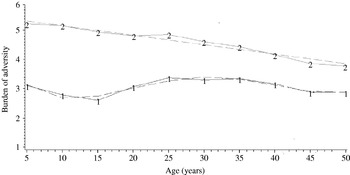
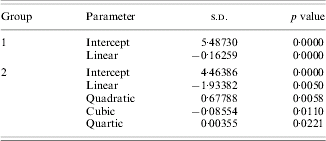
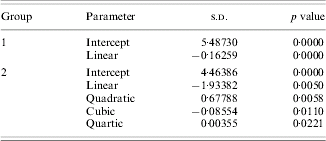
The procedure proc traj (SAS application) is based on mixture models for estimating developmental trajectories, serves to fit non-linear models without a closed-form solution. The alternative to closed-form solutions is to iteratively search the parameter space for the maximum likelihood solution. The modelling calculates group-intercept spaces based on the range or standard deviation of the dependent variables for linear, quadratic and cubic shapes. As shown in Fig. 1, the x-axis corresponds to age and the y-axis to burden of adversity, with ratings of 1 and 2 indicating high burden and ratings of 5 and 6, low burden. The burden ratings for the slope parameter of these trajectories proved to be statistically significant (Table 1).
Developmental trajectories and burden of adversity in two different groups of suicide mortality. Percentage of individuals in each profile: 1–1–1, 39·74%; 2–2–2, 60·26%.

Mean assignment probabilities for each trajectory
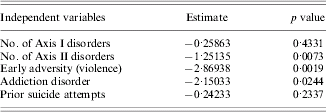
As the model performed data sequence grouping with different parameters, it could incorporate risk factors influencing the probability of group membership, thereby identifying distinct subpopulations (Table 2). The results indicated that the number of Axis I diagnoses and prior suicide attempts did not discriminate the profiles, even though subjects in profile 1 had made more suicide attempts than those in profile 2. The number of Axis II diagnoses (p=0·0073), the presence of early physical and sexual violence (p=0·0019) and the presence of an addiction diagnosis (p=0·0244) were predictive of profile 1.
Predictive variables indicating type of profile
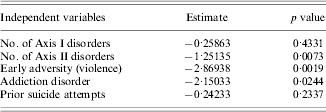
Individuals who followed trajectory 1 represented 40% of the suicide population. These included 27 men and five women with a mean age of 44 years. They had been exposed to considerable early adversity and trauma, especially physical and sexual violence (p=0·0019), which accumulated until age 15 (slope=−1·93382). This period was followed by a gradually lesser degree of burden exposure until age 45, after which they encountered more adversity leading up to suicide.
Individuals who followed trajectory 2 represented 60% of the suicide population. These included 37 men and 10 women with a mean age of 45 years. These began life with a low burden of adversity (rating just above 5) but were regularly exposed to growing adversity (slope=0·16259). They committed suicide at a time when burden was still only moderate.
DISCUSSION
The procedure identified two categories of suicides by clustering subjects on the basis of longitudinal patterns of adversity. The first is characterized by early adversity and more Axis II disorders, and the second by late adversity associated with addiction disorder. Although a new method was used, the findings were consistent with previous findings, as expected. This should bolster the generalization of results.
Theories from developmental research may help to explain the two trajectories identified. First, authors (Bifulco et al. Reference Bifulco, Moran, Baines and Brown2002; Rutter, Reference Rutter2002a) have suggested previously that childhood exposure to a harmful environment has profound effects on adult health and that childhood exposure to different types of abuse directly increases the risk of maladaptive attachment styles (Brière & Runtz, Reference Brière and Runtz1990; Bryant & Range, Reference Bryant and Range1995; Rutter, Reference Rutter2002b) and of mental disorder in adulthood (Kendler et al. Reference Kendler, Gardner and Prescott2002). Individuals who followed trajectory 1 were all exposed to early adversity, especially physical and sexual abuse. In trajectory 1, we also noted a high number of prior suicide attempts (although this was not statistically significant), a higher number of addiction disorders, and a higher number of Axis II psychopathologies. In the past 5 years, we also observed an accumulation of personal problems, particularly with regard to difficulties between suicide victims and their children or the death of a close relative. Individuals who followed this life trajectory committed suicide on average at age 44. Trajectory 1 was characterized by early burden of adversity coupled with multiple addiction disorders and later Axis II pathologies. This group was more likely to present co-morbid disorders, which suggests that some individuals never manage to overcome harsh early experiences and that the burden they bear grows over time. Trajectory 2 was characterized by a reaction to major difficulties later in life. The individuals who fell under this second profile had fewer difficulties identified over the lifespan, except for the last 5 years, which suggests a later accumulation of difficulties. This second trajectory was marked by a slower decline over time and is accompanied and compounded by Axis I disorders, such as mood disorders.
Limitations of the approach
There are a number of limitations to using the psychological autopsy and life-history calendar methods. These include factors related to third-party assessments (Hawton et al. Reference Hawton, Appleby, Platt, Foster, Cooper, Malmberg and Simkin1998), such as recall biases and inaccurate information (Burgess et al. Reference Burgess, Pirkis, Morton and Croke2000; Conner et al. Reference Conner, Conwell and Duberstein2001). Moreover, caution must be exercised in the interpretation of results when using the life-history calendar method. This methodology requires a large quantity of data and a large number of informants, as seldom can a single party provide all the information needed.
Bereavement after a suicide death generates feelings of guilt, anger and rejection. Family members need to find answers, they search for meaning, and while doing this they examine their own level of responsibility in the death of their close relative. Therefore, participants do not need to make a major effort to recall events in the victim's life. As bereavement progresses with time, there is a period when participants are willing to openly discuss and remember the life of the deceased. They go through photographs and try to put events in a historical sequence to lend meaning to it all eventually. We have learned from our own experience with this type of research that there is a time-frame (or window of opportunity) during which it is easier to recruit bereaved family members to conduct this type of investigation. If the interview process starts too close to the death, (under 3 months), while people are still in the first stages of bereavement, denial might have an impact on quality of narrative detail (by being overly positive). If it is too long after the death (12–16 months), people may be ready to move on and so may be less willing to engage in a long and detailed discussion of the life of the deceased.
Although close family members are usually good informants, researchers need to corroborate the data that they provide with other sources of information as well: friends, written documents, medical and psychosocial reports, agendas, and so on. Even then, however, the life description will mostly be based on events of public knowledge. In addition, the events can be highly or moderately intense and painful for families and friends to remember. Consequently, part of the life trajectory will always remain incomplete. The events recalled were of public knowledge and usually severe enough for the immediate family to notice and remember. However, informants might not have been privy to all of the deceased's personal and private events, setbacks, frustrations and letdowns. Nevertheless, numerous authors suggest that narrative-rating instruments provide large gains in reliability and validity in the measurement of major stressful events (Brown & Harris, Reference Brown and Harris1978; Dohrenwend, Reference Dohrenwend2006). Studies have shown (Lin et al. Reference Lin, Ensel, Lai, Gotlib and Wheaton1997) that recall errors usually tend to under-report rather than over-report and that their impact tends to be greater for chronic and routine changes than for personal and family events.
Another limitation of our study lies in the absence of a control group, which would have helped to establish the population distribution of the life trajectories. We must also bear in mind that our findings are based on a small sample, albeit one that represents all the suicide cases that occurred in New Brunswick over a 14-month period. A larger sample might yield more than just two types of trajectories, especially among younger suicides. Nonetheless, our study has provided valuable leads on different life trajectories followed by persons who commit suicide.
CONCLUSION
The life calendar approach presented here for the first time in suicide research adds to the identification of life events, both distal (e.g. sexual or physical abuse, childhood separation) and recent (e.g. spousal separation), previously associated with suicide. It also quantifies the burden these events may represent over each period of life. The theoretical frameworks of the life calendar and psychological autopsy methods are very different and, to investigate the relationship between adversity and health outcomes, they require that the measures used be distinct so that their separate and joint contributions can be assessed. This narrative rating methodology is time-consuming and labour-intensive. However, to our knowledge, there is no good economical way to investigate the relationship between adversity and health outcomes. This is in line with the work of Brown & Harris in the UK and Forrest & Riley in the USA to independently assess the role of adversity in health outcomes.
We hope that, with time, as more data are accumulated and the approach becomes more systematized and replicated by other groups, this methodology will become better established. It should be used to explore whether events of finer temporal resolution and more subtle sequences might provide more information about each trajectory. Concerning the distribution of burden of adversity in the population, the addition of a control group would allow an assessment of variance in this regard attributable to the subgroups identified in this study. Moreover, larger samples might yield different subgroups within the two broader groups discerned here.
Regarding aetiological studies of suicide, a methodology that assesses quantitatively over time the accumulation of burden of psychosocial adversities would fit better with models of cumulative burden and allostatic load formulated for stress and diseases. It would also help to distinguish pathways to suicide that may represent the ‘wear and tear’ of cumulative adversities from other pathways in which depression may play a greater role, not to mention the neurobiological abnormalities and genetic predispositions that may be associated with each of these (McEwen, Reference McEwen1998; Forrest & Riley, Reference Forrest and Riley2004). This would contribute to the refinement of suicide prevention strategies. At this point in time, common-sense suggests that prevention strategies for reducing childhood adversities and increasing resilience would be beneficial (Rutter, Reference Rutter2002a), given that these events and difficulties accumulate in suicide trajectories.
In relation to clinical practice and services delivery, the trajectories obtained here can contribute by suggesting that action should not be considered only in the later years. Although we observed an accumulation of mental health problems in the suicide victims, lifetime prevalence indicates that problems were not of recent onset, particularly where Axis I disorders such as substance abuse are concerned. These and their associated life adversities, together with burden, had previously been present in the life of the individuals. This suggests that potentially effective or more effective interventions should be encouraged to prevent relapse. In addition, better knowledge of each distinct trajectory, of the accumulation of adversity over time, and of the specific period of life when these factors have greater weight may contribute to better identify at an earlier stage people at risk for self-harm. This may contribute to establish targeted interventions at specific stages of development, such as more prevention/early intervention strategies for addictive behaviours in the early teens as a means of suicide prevention. The life-course perspective clearly illustrates that no single suicide prevention policy can fit one and all (Forrest & Riley, Reference Forrest and Riley2004). This is why it is essential to introduce health-care measures based on a life-course model in the field of suicide prevention.
ACKNOWLEDGEMENTS
This work was supported by the Ministry of Health and Well-being of the New Brunswick Government.
DECLARATION OF INTEREST
None.