





In the 1460s, Liu Guiming 劉貴銘 (b. 1420) handed his commercial operations to his son and retired to his hometown in Huizhou.Footnote 1 He purchased large tracts of land and built an expansive garden estate that became a stage for refashioning his persona. Within the garden, he created ten named sites, each with a moralistic or poetic title—such as the Hall of Upholding Righteousness (Dunyi tang 敦義堂) and the Pavilion of Plum, Moon, and Zither (Meiyueqin xuan 梅月琴軒). He also invited renowned scholar-officials to commemorate them. The most central of these was the Studio of Enjoying Plowing (Legeng xuan 樂耕軒), from which he adopted the style name Legeng. He commissioned an essay for the garden from a former minister of war, Sun Yuanzhen 孫原貞 (1388–1474). Typical of garden discourse, Sun’s essay uses the garden to praise the owner’s moral cultivation, interpreting the name “enjoying plowing” as a statement of the owner’s desire to retire to the countryside and cultivate himself.Footnote 2 Contrasting Liu with “ordinary people” (zhongren 眾人) who chased fleeting pleasures, Sun emphasizes Liu’s more enduring joys of cultivating integrity and helping others. The studio thus became a site of moral cultivation, where the retired merchant reconstructed his identity on the foundation of personal moral cultivation.
The son who inherited Guiming’s business, Liu Rubang 劉儒邦 (b. 1443), however, pursued a different mode of identity construction, one centered on his parents rather than himself. In 1479, he visited Suzhou official Zhang Xi 張習 (b. 1433) to solicit a preface for a book Liu was compiling.Footnote 3 The book, a tribute to his parents, featured portraits with colophons and poems, death eulogies with epitaphs, and essays celebrating his father’s birthday and a pavilion at his mother’s grave. All came from prominent local and national literati. By assembling them, Rubang produced a unified reading that, as Zhang explained, would “elucidate the hidden [virtues]” (faqian 發潛) of Rubang’s parents. Though they were commoners, the writer claimed, the writings about their virtuous deeds would “grant infinite longevity” to their reputation.Footnote 4 That enduring reputation, in turn, enhanced Rubang’s own image as a filial son committed to continuing his parents’ moral legacy. But rather than focusing on himself, his identity strategy focused on his family.
Six decades later, all the writings were rediscovered by Liu Hao 劉灝 (b. 1498), a distant relative who shared the same great-great-great-great-grandfather with Rubang’s son.Footnote 5 Unlike his predecessors, Liu Hao did not construct an identity based on personal or family morality.Footnote 6 Instead, he focused on shaping the identity of a much larger kin group, what would become a formally articulated lineage. Called the Mining Lius 敉寧劉氏, this lineage would encompass not only the families of Liu Hao and Liu Rubang but also over a hundred alleged kinsmen across multiple settlements.Footnote 7 Its identity was based not upon scattered commemorative texts (like Sun Yuanzhen’s essay) but on a genealogy that wove all such texts into a unified whole.Footnote 8 By making a genealogy, Liu Hao repurposed texts first composed to honor individual or family virtue into a moral archive for the entire lineage. By positioning himself as a member shaped by the lineage’s moral character, Liu Hao also established himself as a virtuous man. This case reveals a third mode of identity construction: cultivating personal identity through the collective identity of the lineage to which one belonged.
The Lius’ stories highlight Huizhou merchants’ three strategies of identity construction (See Figure 1). The first strategy was self-fashioning: using Confucian moral language to cultivate a respectable self-image, as seen in Sun Yuanzhen’s portrayal of Liu Guiming as a virtuous recluse. The second was parent-fashioning, or more generally, ancestor-fashioning, seen in Liu Rubang’s compilation of writings on his parents. By elevating their parents as moral exemplars, merchants like Liu Rubang framed their own virtue as a direct outcome of parental influence, thereby laying a good foundation for their own identity. The third was lineage fashioning, exemplified by Liu Hao’s genealogy, which cast the lineage as a moral engine whose collective virtue defined each member’s moral identity. In the Lius’ case, the three strategies evolved chronologically from self-fashioning and ancestor-fashioning in the late fifteenth century to lineage-fashioning around 1541. The broader trend in Huizhou was similar, with lineage-fashioning rising to prominence in the late fifteenth and sixteenth centuries. Lineage identities, as expressed through the publication of genealogies, became the new focus of merchants’ identity construction.
Three modes of identity fashioning. Solid arrows denote father–son relationships, ellipses (…) represent unspecified numbers of brothers, and broken arrows indicate ancestor–descendant ties across an unspecified number of generations. Each node represents a man with his spouses, and all relationships are patrilineal.

Figure 1 Long description
The diagram consists of three panels labeled 1 through 3 from left to right.
* Panel 1, Self-fashioning: Contains a single bold circular node at the bottom labeled Self. There are no connections to other nodes.
* Panel 2, Ancestor-fashioning: Displays a vertical column of six nodes. At the top is a node labeled Founding Ancestor. A broken arrow points down to the second node. Solid arrows then connect the second, third, fourth, and fifth nodes in a direct vertical line down to the sixth node at the bottom, which is a bold circle labeled Self.
* Panel 3, Lineage-fashioning: Shows a complex branching structure.
* The central vertical axis is identical to Panel 2, starting with a Founding Ancestor at the top and ending with a bold Self node at the bottom.
* A horizontal broken arrow extends from the Founding Ancestor to the far right, pointing down to a vertical line of solid arrows interspersed with ellipses.
* From each intermediate node in the central axis, horizontal lines branch out to the right, leading to additional vertical columns of solid arrows and ellipses.
* At the bottom of every vertical column, including the one under the Self node, broken arrows point downward toward ellipses, indicating future descendants.
The question of how merchants constructed their identities has been central in the study of late imperial China. Earlier scholarship, drawing on literati accounts, argued that merchants defined their identities in relation to the scholarly elite, seeking to elevate their status by imitating, pursuing parity with, or merging with the literati.Footnote 9 More recent studies have challenged this literati-oriented paradigm, emphasizing instead merchants’ own practices and showing that they asserted distinct identities not necessarily with the scholarly elite in mind.Footnote 10 Both approaches generally assume that merchants acted based on an independent mercantile self. This individual-based identity has been challenged by Qitao Guo’s latest work, which argues that Huizhou merchants cultivated identities by embedding themselves in their ancestral lineages rather than becoming independent merchants.Footnote 11 My discovery of these three-layered strategies advances this discussion by proposing that individually based and lineage-based identities should be understood as parts of a dynamic system. I argue that both were essential for merchants, but from the mid-Ming onward a clear shift occurred towards the ascendence of lineage identities. This marked a profound shift in the cultural logic of identity in late imperial China from individual to collective.
Focusing on a group of merchants who identified themselves as the Wus of Xianshi 縣市吳氏, this article traces how Huizhou merchants shifted the base of identity construction from the individual, through family and ancestry, to extensive lineages that encompassed dozens or even hundreds of families. By situating the rise of lineages within the evolution of identity strategies, this article adds a new dimension to the voluminous scholarship on late imperial lineages, showing that in the mid- and late Ming, lineages emerged not only as key socio-economic institutions but also as salient entities of identity.Footnote 12 Methodologically, this perspective suggests that the study of lineages should move beyond mining genealogies for evidence of institutional operations and instead treat genealogies as coherent technologies of identity construction in their own right.Footnote 13 Within this analytical framework, the proliferation of genealogies was not merely a byproduct of lineages’ expanding socio-economic functions that required documentation; rather, genealogies themselves constituted an emerging textual regime. In the particular context of Huizhou, this textual regime was developed primarily by Huizhou merchants, helping them to fashion stable and robust moral identities.
Personal identity
Although Huizhou merchants had gained visibility since the Southern Song, they did not rely on textual production for their public identities until the 1440s. During that era, many merchants began commissioning literati to compose poetry and prose for them. Because the mercantile occupation was stigmatized in Confucian ideology, such texts did not celebrate commercial success but instead foregrounded merchants’ moral cultivation as the foundation of their public images. This is seen in Sun Yuanzhen’s essay, which portrays the retired merchant as a recluse gentleman devoted to self-cultivation. This strategy reflected a broader pattern in mid-fifteenth-century Huizhou, where merchants systematically used Confucian values to distance themselves from their occupational achievements and anchor their identities within accepted moral frameworks.
The development of this strategy is illustrated by a group of merchants who organized as the Xianshi Wu lineage in the sixteenth century. Although their ancestors had been landed elites in the Yuan and early Ming, they turned to commerce in the 1430s and gained considerable wealth. They then commissioned literati for various types of writing to cultivate public images. One such merchant, Wu Xiu 吳修 (1412–1483), offers a window into how merchants secured legitimacy at the beginning of their rise.
Earliest explorations
Wu Xiu was an active collector of writing. His commissioned works fall into two categories: those highlighting his filial devotion and those extolling his mother’s chastity, both framed as embodiments of Confucian ideals. This emphasis reflected his personal circumstances. Wu Xiu was three sui when his scholar father passed away, leaving his widowed mother to raise him. Despite limited means, she insisted on giving him a formal education, which strained the family’s resources and eventually pushed him into commerce. His commercial venture was brief, probably ending in his early thirties, but it yielded sufficient wealth to build a new residence and fund identity-construction projects.Footnote 14
Wu Xiu’s first project was the commemoration of his new residence in 1448, for which he commissioned literati to compose poems and essays. At thirty-six sui, his ability to attract such attention was clearly enabled by his commercial wealth. Over the following years, he expanded his network through interactions with local literati and occasionally the national elite. His education allowed him to write for others, while his expertise in geomancy and medicine further enhanced his standing.Footnote 15 These networks paved the way for two grander projects: securing the state award of a chaste widow for his mother in 1460 and the title of filial son for himself in 1480. Both succeeded, producing a stream of texts that collectively established him as a respected local leader.Footnote 16 Wu Xiu’s rise raises the question of whether he should be regarded as a merchant, given the brevity of his commercial career. Yet if we return to 1448, when he returned to Huizhou with commercial wealth, the challenge he faced was emblematic of many Huizhou merchants: how to build a legitimate identity enabled by commerce.
Wu Xiu used the estate building as a chance to publicize his moral undertaking. He named the house the Hall of Spring’s Sunshine (Chunhui tang 春暉堂), evoking Tang poet Meng Jiao’s 孟郊 (751–814) verse: “Who will say that the inch of grass in his heart is gratitude enough for all the sunshine of spring?” (誰言寸草心, 報得三春暉)Footnote 17 By invoking the child’s unrepayable debt to parents, the name turned the hall into a monument of filial devotion. He enlisted local scholar-officials to compose commemorative poems, which provided the first layer of local recognition for his morality. One of the clearest affirmations came from Hu Fu 胡富 (d. 1522) of Jixi 績溪 County, who framed Wu Xiu’s filial piety and his mother’s chastity as mutually reinforcing virtues, declaring that their “filial devotion and wifely integrity shall be remembered forever” (孝節並流芳).Footnote 18 This praise cemented the hall’s symbolic status as a site of filial and marital virtues.
Beyond Huizhou, Wu Xiu sought the endorsement of Huang Zan 黃瓉 (b. 1398), a high-ranking official from Jiangxi, whose elevated status allowed Wu to define moral exemplars for a wider audience. His rhetorical strategy was to transform Wu Xiu from an otherwise ordinary commoner into a figure worthy of comparison with legendary sages. He begins his essay with an unequivocal assertion: “There is nothing in human deeds greater than filial piety.” He then invokes a pantheon of paragons (Great Shun 大舜, King Wen of Zhou 周文王, King Wu of Zhou 周武王, the Duke of Zhou 周公, Can You 參由, and Min Sun 閔損) whose reputations, he insists, shine like the sun, the moon, and Heaven. Having established filial piety as the supreme human virtue, Huang laments its subsequent decline. Against this backdrop, Wu Xiu’s hall for his widowed mother emerges as a beacon of righteousness. Huang explicitly appeals to imperial authorities, hoping that “inspectors of customs” (guanfeng zhe 觀風者) would present Wu Xiu’s deeds to the court, and he even imagines future historians recording Wu Xiu in official annals. The essay’s climax declares that Wu Xiu “can be mentioned in the same breath as the ancients.”Footnote 19 This rhetorical elevation erases the boundary between commoners and sages, highlighting moral excellence—rather than office or learning—as the true foundation of social legitimacy.
At the heart of this moral persona, however, lies a striking absence: Neither the essay nor the poems mention Wu Xiu’s profession. Though he experimented with learning, trade, geomancy, Daoism, and medicine, none became the basis of his self-fashioning. Unlike successful scholar-officials who could ground their identity in career, Wu Xiu built his public image on moral virtue alone. This absence of occupational anchoring reveals a mode of identity formation that valued ethical over professional achievement. This strategy allowed figures like Wu Xiu to be remembered not for their careers but for their pursuits of virtue.
A widespread practice
Wu Xiu’s filial devotion may have been shaped by his unique experience of being raised solely by his widowed mother. Over time, however, the discourse of repaying maternal care spread more widely among merchants without comparable experiences. Wu Zongjing 吳宗靜, for instance, built the Hall of Remembering the Daylily (Muxuan tang 慕萱堂) upon his mother’s death, the daylily being a flower long associated with maternal love. To make its moral meaning explicit, he commissioned an official to compose a commemorative essay in 1458. Like the writings for Wu Xiu, this essay casts Zongjing’s act as proof of exceptional filial devotion while downplaying his mercantile identity.Footnote 20 What began as Wu Xiu’s personalized strategy thus became a shared model within his kinship network. Several cases from the early sixteenth century illustrate this trend. In 1523, the merchant Wu Min 吳鈱 (b. 1478) commissioned the official Cheng Chang 程昌 (b. 1475) to commemorate a shrine he had built beside his mother’s grave.Footnote 21 Five years later, his brother Wu Tie 吳鐵 (b. 1461) invited another scholar to write an essay for a hall he built to honor his deceased mother, also named Muxuan tang.Footnote 22 In these texts, women appear more as objects of commemoration than as participants in identity construction, and the virtue of female chastity is strategically foregrounded to serve the commemorators’ own identity construction. The texts consistently frame the commemorators’ identities around filial piety while minimizing their mercantile background. By the early sixteenth century, it became common for the Wu merchants to turn commercial success into filial reputation through texts.
Beyond the Wus, this moral strategy developed widely across Xiuning. In addition to filial piety, they frequently invoked loyalty, female chastity, and especially righteousness (yi 義). Righteousness emerged as the favored virtue that Huizhou merchants sought to fashion through acts of generosity.Footnote 23 Consider Su Shigong 蘇士恭 (b. 1413), a salt merchant whose family had engaged in long-distance trade since the fourteenth century.Footnote 24 In 1457, when the government began awarding official robes and sashes to those who donated grain for famine relief, Su contributed 800 jin of rice and received an official title. His participation shows his desire to be recognized for charitable giving, an embodiment of righteousness. Later, Su publicized his award with local officials, who in turn commissioned a congratulatory essay from Wang Jing 汪敬 (b. 1392) of neighboring Wuyuan 婺源. Without mention of Su’s trade, Wang’s essay portrays Su as a man of long-standing benevolence. Wang links Su’s generosity to his grandfather’s bridge repairs, thereby recasting virtue as a hereditary family trait rather than a product of their occupation. Wang further praises “helping others” (jiren 濟人) as Su’s highest virtue and even compares his righteousness to the emperor’s benevolence toward the people, bridging the gap between merchant and monarch on moral grounds.Footnote 25 In this way, Su was remembered not for commerce but for ethics. This case shows how Ming merchants navigated Confucian values by grounding their identities in virtue rather than occupation. The widespread use of such strategies suggests their routinization into standardized templates that merchants could easily follow without creative design.
The moral industry
By the late fifteenth century, the practice of soliciting literati writings to construct moral identities had developed into a mature cultural industry of moral legitimacy in Huizhou. This industry thrived on the coordinated participation of merchants, literati brokers, and writers, who shared the expectation that such texts should recast merchants as moral exemplars. This is reflected in quantitative evidence. My dataset of 4,444 texts from fifty genealogies includes 911 with precise dates, revealing clear patterns of expansion. As Table 1 shows, the number of writings solicited by Huizhou men began to rise around 1450 and surged again after 1488, reaching major peaks in the Hongzhi, Zhengde, Jiajing, and Longqing eras (1488–1572). The same trend appears within individual lineages. In the Xianshi Wu genealogy of 1528, for example, seventeen texts date from before the Ming, six from 1368–1449, seventeen from 1450–1500, and thirty-five from 1500–1528.Footnote 26
Numbers of commissioned writings according to reign periods. For full data, see https://xinyuhistory.com/projects/databases-for-the-huizhou-project/

Table 1. Long description
The table contains three columns: Reign Period (Years), Number of Commissioned Pieces, and Number of Commissioned Pieces/Year.
* Hongwu (1368–1398): 26 pieces, 0.84 per year.
* Jianwen (1399–1402): 0 pieces, 0.00 per year.
* Yongle (1403–1424): 20 pieces, 0.91 per year.
* Hongxi (1425): 0 pieces, 0.00 per year.
* Xuande (1426–1435): 8 pieces, 0.80 per year.
* Zhengtong (1436–1449): 23 pieces, 1.64 per year.
* Jingtai (1450–1456): 9 pieces, 1.28 per year.
* Tianshun (1457–1464): 17 pieces, 2.13 per year.
* Chenghua (1465–1487): 59 pieces, 2.57 per year.
* Hongzhi (1488–1505): 107 pieces, 5.94 per year.
* Zhengde (1506–1521): 102 pieces, 6.38 per year.
* Jiajing (1522–1566): 352 pieces, 7.82 per year.
* Longqing (1567–1572): 44 pieces, 7.33 per year.
* Wanli (1573–1619): 125 pieces, 2.66 per year.
* Taichang (1620): 0 pieces, 0.00 per year.
* Tianqi (1621–1627): 12 pieces, 1.71 per year.
* Chongzhen (1628–1644): 7 pieces, 0.41 per year.
* Total: 911 pieces, 3.29 per year.
Textual sources reveal how eagerly merchants engaged in this cultural industry. Around 1450—the beginning of the first wave—the official Zhou Xu 周敘 (1392–1452) noted how actively Huizhou merchants sought the national literati’s writings. They relied on Huizhou literati as cultural brokers to connect with wider literati circles. Zhou describes how, when a Huizhou merchant departed from his sojourning place, Huizhou literati there would host banquets to introduce him to officials and literati there. As a prominent official from Ji’an 吉安, the hometown of the most prominent literati in the early Ming, Zhou received numerous such requests, which he found hard to decline under pressure from Huizhou literati.Footnote 27 The role of these brokers is vividly shown in the case of Wang Xun 汪循 (b. 1452), who, while sitting for the provincial examination in Nanjing, solicited poems for his merchant patron Ye Zhidao 葉志道 (b. 1419) from more than twenty literati he had just met as fellow examinees or examiners.Footnote 28 The coordinated efforts of merchants and their literati intermediaries not only expanded access but also drove up fees for commissioned writings.Footnote 29
Writers well understood the rhetorical conventions of such commissions. Prominent local authors such as Cheng Minzheng 程敏政 (1446–1499) and Wang Xuanxi 汪玄錫 (1477–1544) recognized the cultural industry at work and did not treat literary requests as personal favors. In 1491, Cheng remarks that in his hometown “every self-respecting man [upon finishing a new studio] inscribes its name on a signboard, and some seek essays and poems from reputable men to explain its meaning.”Footnote 30 In 1537, Wang likewise notes that “in our prefecture, one who celebrates another’s birthday ought to commission an essay from a scholar-official, and only then will he be regarded as respectful.”Footnote 31 Writers thus not only acknowledged these conventions but also actively catered to them. When asked to write about the merchant Ye Zhidao’s Pavilion of Retaining Spring (Liuchun xuan 留春軒), Cheng readily frames the garden construction in moral terms. Instead of reading “retaining spring” as a desire to preserve beauty, he interprets spring—the start of the four seasons—as a metaphor for the beginning of all things, including moral order. He then equates Ye’s wish to “retain spring” with an aspiration to uphold ren 仁 (benevolence), the foundation of all virtues.Footnote 32 Cheng granted the moral elevation the merchant sought. By the late fifteenth century, virtue-based identity construction had become a mature cultural industry, structured by clear conventions and supported by the joint efforts of merchants, literati brokers, and writers. Its basic logic was to elevate merchants’ moral standing by recasting their economic pursuits as moral exemplarity through moral discourse.
Ancestor-based identity
While the emerging cultural industry of morality helped merchants counteract the stigma of profit-seeking and gain a positive identity, as more merchants participated, having literati praise their virtues became insufficient. When merchants could easily claim virtue, the question shifted to whose virtue was more deeply rooted. Therefore, some merchants turned to constructing ancestral virtue, portraying their ancestors as moral exemplars and themselves as inheritors of ancestors’ moral legacy. This new strategy lent historical depth to merchants’ claims of moral excellence and distinguished them from other merchants. As a result, this strategy, which I call ancestor-fashioning, became increasingly widespread alongside self-fashioning, which is clearly seen in the Wus’ case from the fifteenth to the sixteenth century.
Funerary biographies as an identity device
The most common form of ancestor fashioning was epitaph writing. Long before the rise of Huizhou merchants, the production of funerary biographies had already become a well-established cultural industry, with standardized formats, a large pool of writers on the market, and recognized conventions of circulation. Funerary biographies also reflected the resources of the commemorating family. The most prestigious was the formal epitaph bearing various names, such as muzhiming 墓志銘, mujieming 墓碣銘, shendaobei 神道碑, which followed the structure comprising a prose preface (xu 序) detailing the deceased’s life, followed by a shorter rhymed elegy (ming 銘) poetically reiterating the major points and expressing mourning. Such epitaphs were meant to be engraved on stone and most were buried underground, though some were also erected in front of the grave for public display.Footnote 33 The high cost of commissioning these works meant that access to this market remained limited. More common was the xingzhuang 行狀, or “record of conduct,” typically written by close relatives or friends in preparation for an epitaph.Footnote 34 At the bottom of the hierarchy were xiaozhuan 小傳, biographical sketches written by lesser-known relatives, often intended as preliminary material for a xingzhuang or muzhiming. While many people prepared xiaozhuan and xingzhuang for the deceased, only a few were able to eventually secure a formal epitaph from a reputable writer. Regardless of genre, however, the production of these texts constituted a mature funerary writing industry.
The reason why merchants became customers in this industry was that funerary biographies provided an additional tool of identity construction. They not only affirmed the deceased’s identity and status but also memorialized the filial devotion of the living. Pursuing a prestigious epitaph served as a public expression of grief and a lasting testament to the fulfilment of familial duty.Footnote 35 For Huizhou merchants, funerary biographies could transform the deceased into virtuous ancestors. By proving ancestors’ virtues, such texts also suggested that the virtues had been transmitted to their descendants, thus providing merchant descendants with a solid, inherited moral foundation for their own identity.
The entry of merchants
In Huizhou, before the rise of merchants, the market for funerary biographies primarily served scholar-officials and the landed elite, even though the scale of the market experienced periodic contractions and expansions. The late Yuan to early Ming, between 1350 and 1430, seems to be an era of contraction. Among over a dozen Wu men who died between 1350 and 1430, according to the 1528 Xianshi Wu genealogy, only one received a funerary biography not long after death.Footnote 36 This rarity reflects early Ming state policies that targeted wealthy families, which discouraged overt displays of status through writing. Accordingly, landlords such as Wu Baoning 吳保寧 (1369–1445) and Wu Dean 吳得安 (1377–1434) earned praise for their frugality, which enabled them to evade government sanctions.Footnote 37 The only known funerary biography (from 1415) from this period, for Wu Enshi 吳恩釋 (1392–1414), further supports this pattern. It was not composed to show off lineage prestige, but to preserve the precarious memory of a scholar whose only son, being an infant at the time, retained no recollection of him. The text was a xingzhuang, from which no formal muzhiming was gained, suggesting that its purpose was private remembrance rather than public display. Furthermore, its author, an in-law and scholar, wrote the biography out of kinship obligation rather than using his own reputation to endorse the family’s reputation.Footnote 38 The rarity of funerary biographies, as well as the private nature of the only surviving example, suggests the shrinkage of the funerary writing market in the early Ming.
With the loosening of state control in the 1430s, Huizhou landlords began to shift from restraint to assertiveness in commemorating ancestors. One telling case is the xiaozhuan biography for Wu Biao 吳彪 (1345–1398), composed in 1431 after a delay of over thirty years.Footnote 39 Having remained unobtrusive for decades, his remaining sons—already aged 62 and 54 sui—suddenly took action to commission a biography, suggesting a new opportunity for epitaph writing. The choice of a provincial degree-holder as the author marked a new emphasis on prestige, given the scarcity of such degrees in early Ming Huizhou.Footnote 40 This turn toward display is also seen in the biography’s rhetorical strategy: Instead of offering a comprehensive account, it highlights only two episodes from Wu Biao’s life. The first recounts how, at twelve sui, he braved the dangers of the late Yuan to retrieve his deceased brother’s body downstream, an act the author interprets as an embodiment of fraternal affection.Footnote 41 The second recounts how the subject held back from actively pursuing adoption and inheritance from a wealthy, childless uncle, which the author reads as evidence of his moral indifference to profit.Footnote 42 Both underscore Wu Biao’s high morality, which provided a “moral admonition against those who lack fraternal affection and chase after profit.”Footnote 43 By orchestrating this act of ancestor fashioning, the two landlord sons helped shift commemoration from preserving the memory of the dead to fashioning exemplary identity for the living.
By the mid-fifteenth century, funerary biographies became more common among the Wus, but more strikingly, their subjects and commissioners began to show increasing social diversity. This turning point coincided with the rise of Huizhou merchants, who began investing in funerary writing. Among the twelve men of Wu Enshi’s generation (most died before 1460), five received funerary biographies, marking a sharp rise from the previous generation, in which only one of a dozen (most dying before 1430) was commemorated.Footnote 44 Of these five, three still belonged to the landed elite: the scholar Wu Enshi, who “engaged in a career of preparing for civil examinations” (xi juzi ye 習舉子業), and his two landlord brothers, both commemorated by sons who were almost certainly landlords as well.Footnote 45 The remaining two biographies, however, signal a shift to merchant participation. The 1444 epitaph for Wu Xuannu 吳玹奴 (1382–1429), still a landlord, was commissioned by his son—one of the lineage’s earliest merchants—who produced the lineage’s first engraved-stone muzhiming during the Ming.Footnote 46 The final biography was for Wu Shanming 吳善銘 (1379–1466), the first merchant ever commemorated in the lineage, who turned to trade late in life and sent all three of his sons into long-distance commerce in Shandong. Although a fire in the 1460s delayed the writing of his epitaph, his merchant great-grandson still took the initiative to commission it over sixty years later, demonstrating the growing interest among merchants in ancestral commemoration.Footnote 47 By the second half of the fifteenth century, merchants had become important customers on the market of funerary writing, seeking to establish a foundation for their moral identity by praising their ancestors.
Merchants as inheritors of ancestral virtue
Deep in the fifteenth century, merchants started to dominate not only as subjects but also as commemorators. Three of thirteen men in the next generation received funerary biographies. One was certainly a merchant and two were landlords, but their sons who commissioned the biographies were almost all merchants.Footnote 48 The most prominent example is Wu Shoutong 吳壽童 (1408–1469), who had commissioned the earliest muzhiming among the Wus for his father in 1444. After his own death, he was commemorated with both a xingzhuang by a metropolitan degree holder and a muzhiming by prominent Huizhou man Cheng Minzheng.Footnote 49 These prestigious texts were commissioned by his three merchant sons and a fourth son who was a scholar-official.Footnote 50 In this case, we see the emergence of a new mode of commemoration that started with merchant sons, depended on literati collaboration, and ultimately fostered a shared cultural identity that transcended occupational lines among descendants.
This shared identity is clearly articulated in the epitaph by Cheng Minzheng. Unsurprisingly, Cheng emphasizes the subject’s moral virtues over professional accomplishments. Yet instead of focusing on how the merchant gained virtue through his own actions, Cheng equally highlights how the merchant inherited virtue from his ancestors, virtue that had been transmitted along the bloodline for centuries. Cheng then meticulously traces the transmission of this virtue from antiquity all the way to the merchant Wu Shoutong:
The gentleman is from the Wu lineage, which had been living in Huizhou’s Xiuning for generations. The genealogies record that the lineage originated from the descendants of the Lord of Fan. Fan borders Huizhou, and therefore the descendants of the Lord of Fan settled in various places here. In the Tang era, a person named Shaowei served as a left censorate inspector and first appeared in historical records as a figure renowned for his literary talent. His son Wu Gong served as a secretariat drafter. Numerous former residential sites and grave sites [of the lineage] still remain. Since the Song dynasty, renowned figures have emerged in successive generations. His grandfather, Jinghe, and father, Shixuan, lived in the local community, uninterested in official careers; they accumulated [virtues] but did not use them, bestowing all the accumulated upon the gentleman.Footnote 51
This passage exemplifies what I call a “lineage definition” of the subject, a common element of epitaphs that locates the subject within a long-standing family line. Historians have noted a shrinkage of this section from the Tang to Song, which reflects a shift from ancestral prestige to contemporary achievements.Footnote 52 In mid-Ming Huizhou, however, we see the trend reverse. While Song-era Huizhou epitaphs often trace remote ancestry briefly, those from the mid-Ming onward tend to include lengthier accounts of remote ancestors.Footnote 53 This lengthier style was favored by Cheng Minzheng, who traces the subject’s ancestral line to the Han era’s Lord of Fan 番君. He highlights two of the line’s traits: its long-standing residence in Huizhou, marked by surviving homes and graves, and its tradition of officeholding during the Song era, when Huizhou shifted from a peripheral region to a cultural center noted for its flourishing scholar-official class.Footnote 54
In contrast to the scholar-official ancestors, however, the subject’s immediate ancestors in the Yuan and early Ming were undistinguished commoners. For an epitaph meant to assert prestige, this rupture in status posed a problem. Cheng Minzheng resolves it by adopting a moral lens: Instead of judging the Yuan–Ming forebears by the standard of office-holding, he presents them as models of virtue. Their inability to obtain office thus becomes a means of accumulating virtue. In this way, the ancestral line turns from one of inconsistent office-holding to one of consistent moral excellence. This shift allows Cheng to elevate the status of non-official descendants by defining status in moral rather than occupational terms.
Within this moral framework, the merchant Wu Shoutong is presented as a rightful heir and transmitter of his ancestors’ virtue. Cheng illustrates this by selecting four episodes from Wu’s life. First, Cheng foregrounds Wu’s filial piety through the extreme act of gegu liaoqin 割股療親 (“cutting one’s flesh to cure a parent’s illness”), a practice that was becoming a potent display of filial devotion.Footnote 55 When his father fell ill, Wu prayed to assume the illness himself. When this failed, he cut flesh from his thigh, cooked it into porridge, and fed it to his father, who then recovered. After his father’s death, Wu also took on the parental duties of caring for his younger sisters and providing them with generous dowries. Second, Cheng casts Wu’s commercial activity as the pursuit of righteousness, which Qitao Guo identifies as central to the moral self-fashioning of merchants.Footnote 56 Wu’s long-distance trade along the Yangtze River is described not in economic terms but as a means of funding public works, such as road construction. Third, another of Wu’s economic pursuits, forest development, is also depicted in moral terms. His transformation of natural forests into cultivated forests and paddy fields—part of a broader transition noted by Ian Miller—is reinterpreted as a filial act, as he used the resulting profits to maintain ancestral graves.Footnote 57 Finally, even Wu’s arrangement of his youngest son’s scholarly career—a common Huizhou merchant strategy of diversifying sons’ occupations across commerce, landholding, and study—is cast as a moral act aimed at restoring ancestral virtue.Footnote 58
Cheng further reinforces this interpretation in the elegy section, opening with the verse: “The Wu lineage of Xin’an originates from the Lord of Fan; adhering to the Way in both reclusion and prominence, they were known for their ancestral virtue.” (新安吳宗出番君, 隱顯有道世德聞).Footnote 59 It casts the ancestral line as one of shared moral quality, with both official careers and other paths as legitimate expressions of this same inherited virtue. Wu Shoutong’s commercial wealth is thus justified as an outcome of the inherited virtue.Footnote 60 He also served as a bridge between virtuous ancestors and his descendants, laying a moral foundation for descendants’ identities. For them, ancestor fashioning became a powerful means of constructing identity. It complemented self-fashioning by placing the individual within a moral line of descent.
Incorporation into the moral industry
As discussed earlier, by the late fifteenth century, Huizhou merchants had developed a mature cultural industry to translate economic activities into moral identities. This industry initially revolved around self-fashioning but soon expanded to include ancestor-fashioning which, like self-fashioning, became a standardized formula for merchants’ identity formation. The broadening of this industry reflected the further commercialization of economy in the sixteenth century. The Wus illustrate this shift: As more members engaged in commerce, the group evolved into what Qitao Guo calls a “mercantile lineage,” and merchant descendants routinely commissioned funerary biographies for their merchant ancestors.Footnote 61 Around 1500, twenty-one men of the thirtieth and thirty-first generations (out of a total of ninety) received such biographies, eighteen of them merchants.Footnote 62 The descendants who commissioned these biographies were mostly merchants as well.
As ancestor-fashioning became routine, sons who failed or postponed commemorating their father’s virtue might experience anxiety over a rupture in moral transmission. Consider the case of Wu Qie 吳妾 (b. 1485), who finally secured a funerary inscription for his father eighteen years after the latter’s death. His unease emerges clearly in the belated text, voiced with striking emotion: “The trees above the grave stand lush and arched, yet the memorial stone has not received an inscription by a renowned figure. Each time I reflect and recall, my heart feels as if cut by a knife.” Although the author he commissioned was not a prominent figure and the piece amounted to only a few lines, it nonetheless filled a critical gap, enabling Wu Qie to claim a legitimate inheritance of virtue.Footnote 63 Moral transmission required continuous textual reaffirmation.
The most salient example lies in the decades-long effort to commemorate Wu Zongren 吳宗仁 (1427–1487). At his death, his two sons—then aged twenty-six and eight sui—were away on a business sojourn and could not conduct a proper funeral with an epitaph, leaving them exposed to the charge of unfiliality. Although they later obtained a xingzhuang, it was soon lost in a fire. This lack of funerary texts deeply troubled Zongren’s grandson Wu Jin, an educated merchant, who feared that his grandfather’s good deeds would vanish without a trace. “Unable to sleep or eat in peace,” he drafted a xingzhuang himself and used it to commission a formal epitaph from the licentiate Cheng Zeng 程曾 (1468–1542).Footnote 64 By the time this was completed—forty-three years after Zongren’s death—Wu Jin was less concerned with prestige than with mere existence, preferring a modest author to secure the commemoration quickly. Without an epitaph, he realized, the transmission of virtue would have appeared to end with his grandfather.
For the same reason, in 1528, Wu Jin again turned to Cheng Zeng—then serving as a genealogy editor—to compose a biography for Zongren’s younger brother, Wu Zongli 吳宗禮 (1435–1490), the only sibling without any epitaph thirty-eight years after death.Footnote 65 That same year, Cheng also wrote a xingzhuang for Wu Jin’s cousin, Wu Hao 吳浩 (1489–1518), who had died young.Footnote 66 Not valued for their literary quality, these texts mattered because they secured the descendants’ place in the chain of moral transmission. Such repeated efforts to fill gaps reveal how moral legitimacy had come to depend on the very existence of textual records. In the process, the expanding moral industry turned legitimacy into a quantifiable enterprise, where the number of commemorative texts itself served as an index of inherited virtue.
Lineage identity
Rise of genealogies in the moral industry
While the accumulation of commemorative texts allowed merchants to display inherited virtue, repeated commemorations of similar types of ancestors produced homogeneous narratives, typically stressing filial piety, charitable giving, and local respectability. Because few merchants could boast numerous officials among their direct forebears, many searched beyond immediate family lines, enlarging their moral inheritance by incorporating more distant kin. In Wu Jin’s case, this expansion took the form of integrating hundreds of nearby Wus, including those in the southern part of the city (Chengnan 城南) who traced descent from Song–Yuan officials. Although this merger did not make Wu Jin their direct descendant, it placed him within an office-holding lineage. This strategy offset their direct ancestry’s lack of prestige by embedding the individual in a broader and more prestigious kinship framework. In this context, lineage identity emerged as a new foundation for merchants’ identity. Like essays and epitaphs, genealogies—the principal medium for lineage identity—entered the moral industry of legitimacy.
Here, lineage refers to an expansive kinship network that encompasses not only a vertical line of descent but also a wider community of individuals who claim common descent and a shared identity.Footnote 67 Figure 1 illustrates the differences among personal, ancestral, and lineage modes of identity construction. While the personal mode emphasized individually gained virtues, and the ancestral mode relied on virtues inherited from ancestors, the lineage mode positioned each individual as a microcosm of the lineage as a whole. In this framework, personal virtue was understood as a reflection of lineage virtue, and belonging to a virtuous lineage brought virtue on its members. The central task of lineage-based identity construction, therefore, was to demarcate the lineage clearly and to publicly proclaim its virtue, thereby establishing its status as one of Huizhou’s prominent lineages.Footnote 68 I should emphasize at the outset that the lineage in this context functioned more as a cultural brand than as an institutional reality. Because the choice of a common ancestor could shift, a lineage’s boundaries were highly malleable. This flexibility enabled people to fashion a version of the lineage most advantageous to them by redefining its scope. Boundary-drawing, however, was only one of many techniques for constructing lineages and enhancing their reputation. By the early sixteenth century, a full repertoire of tactics had developed to construct lineages.
The most influential model was systematized in the late fifteenth century by the eminent official Cheng Minzheng. Despite his stature at court, when he arrived in his purported hometown in 1478, he faced a predicament familiar to many Huizhou merchants: the lack of a prestigious lineage affiliation.Footnote 69 Cheng Minzheng launched a series of historical, anthological, and genealogical projects, mobilizing his powerful networks to elevate his Peiguo 陪郭 lineage as one of Huizhou’s most prestigious lineages. These projects revolved around five elements: 1) roots; 2) virtues; 3) space; 4) order; 5) visibility. He creatively restructured the genealogical system of the Huizhou Chengs to establish himself as a direct descendant of the neo-Confucian thinker Cheng Yi 程頤.Footnote 70 He compiled epitaphs commemorating his alleged ancestors, using them to portray his lineage as a virtuous one.Footnote 71 He rediscovered the graves of nineteen generations of ancestors, tracing back to the tenth century, and incorporated them into his genealogy to underscore his lineage’s continuous burial and residence in Huizhou.Footnote 72 He revitalized rituals to unite members of the Peiguo lineage.Footnote 73 Finally, he publicized his lineage’s elevated status by publishing two genealogies.Footnote 74
Only a figure as powerful as Cheng Minzheng could undertake such sweeping projects, but once systematized, his methods became readily adaptable in Huizhou. Central to his methods were the compilation and publication of genealogies. His two genealogies, representing the genres of lineage genealogy (benzong pu 本宗譜) and composite genealogy (tongzong pu 統宗譜), set enduring formulas for constructing lineage identity. Following his genealogy projects, Huizhou merchants began to launch similar initiatives. They enlisted Cheng Minzheng’s protégés, such as Cheng Tianxiang 程天相, Wang Zongzhi 王宗植, Cheng Tianbao 程天保, and Cheng Zeng to compile and publish genealogies for them.Footnote 75 Just as literati writings and funerary biographies had been central to shaping personal and ancestral identity, genealogies emerged as the chief instrument of lineage identity. The moral industry of identity construction was reshaped to revolve increasingly around genealogies.
The leading merchant among the Wus, Wu Jin, thus led the Wu merchants to adopt Cheng Minzheng’s methods of lineage construction. He hired Cheng Zeng to assist in editing and publishing a genealogy. Cheng Zeng had played a crucial role in Cheng Minzheng’s Composite Genealogy of the Chengs in Xin’an. Footnote 76 The following analysis explores how, with Cheng Zeng’s expertise and the backing of dozens of merchants, Wu Jin used the genealogy as a tool to establish a lineage and refine its public image.Footnote 77
Roots
The first step in establishing a lineage was to define its boundaries. This began with identifying a common ancestor, or “root,” whose purported descendants would constitute the lineage. Although this might appear straightforward, the choice of root ancestor was highly flexible. Wu Jin’s case illustrates this flexibility well. With a genealogical chart that his great-grandfather had compiled in 1485, which recorded eighty-nine generations from the Wu surname-founder to himself, he had nearly ninety options for the root ancestor.Footnote 78 The most meaningful candidates were those who migrated from one residence to another, as such movement often marked a fresh beginning in geographic terms. Wu Jin had five such migrant ancestors to choose from (see Figure 2), and the following analysis will examine them from the most recent to the most remote.
Wu Jin’s options for the “root ancestor” and the corresponding scopes of the resulting lineages. The horizontal axis represents the timeline. Note how choosing different root ancestors leads to lineages of different scopes. Sources: XSW, 1.5a–12a.

Figure 2 Long description
The diagram features a horizontal axis representing time with six circular nodes. From left to right, the nodes and their associated lineage branches are:
* Wu Shaowei (663 to 749): An arrow branches upward and then right, labeled 5. Huizhou Wus = Xianshi + dozens of lineages.
* Wu Jin (born circa 1000): An arrow branches upward and then right, labeled 4. Xianshi = Chengbei + Yiqian + Chengnan + extinct lineages.
* Wu Gong (born circa 1110): An arrow branches upward and then right, labeled 3. Chengbei + Yiqian.
* Wu Gui (born circa 1200): An arrow branches upward and then right, labeled 2. Chengbei (including abandoned Micun).
* Wu Xuannu (1382 to 1429): An arrow branches upward and then right, labeled 1. Chengbei.
* Wu Jin (born 1499): A final node on the far right of the timeline with no upward branch.
Each lineage branch is represented by a right-pointing arrow that extends to the edge of the frame, illustrating how choosing an earlier ancestor encompasses a broader scope of descendants.
The most recent option was Wu Xuannu, Wu Jin’s great-great-grandfather, since he was the first to migrate from Micun 糜村 to Chengbei 城北 (the Northern City).Footnote 79 If adopted, this configuration would have produced a lineage of thirty-five men in Wu Jin’s generation, together with their families. These families lived in close proximity, had well-documented genealogical ties, and could trace almost every deceased member to a known burial site. In fact, this had been the assumed lineage in the members’ tomb inscriptions.Footnote 80 However, most of the members were merchants, and thus this design risked branding the group as nouveau riche, an image that merchants were especially anxious to avoid.
A second option was Wu Gui 吳桂, an earlier ancestor who had migrated to Micun, the village that Wu Xuannu later left in the early Ming.Footnote 81 This line extended back twelve generations and three hundred years from Wu Jin. Although it encompassed two places of residence, both lay in or near the county seat, allowing them to still claim their lineage as a localized one. Moreover, ten generations of graves remained under descendants’ care, providing tangible proof of continued residence. In addition, kinship ties among the descendants were clearly traceable in the 1485 genealogy. The major drawback, however, was still the lack of elite status: Among the nearly two hundred recorded individuals spanning twelve generations, only one had gained entry to the county school and secured a minor official post.Footnote 82
A third option was to trace the lineage three generations further back and designate Wu Gong 吳珙, Wu Gui’s great-grandfather, as the root ancestor. This would incorporate other descendants of Wu Gong, notably the Yiqian 邑前 Wus near the county yamen. Like the Chengbei Wus, the Yiqian Wus produced only one minor official during the Ming, but they possessed other valuable resources.Footnote 83 First, their genealogy preserved a 1335 preface by Wu Leitai 吳雷泰 and a 1334 record of his effort to establish sacrificial fields for ancestral graves. These documents testified to a long-standing genealogical tradition and ritual order.Footnote 84 More importantly, one male and one female from the Yiqian group received the state awards of “filial son” and “chaste woman,” with the official certificates still preserved.Footnote 85 By merging with the Yiqian Wus, Wu Jin and the Chengbei Wus could appropriate their moral heritage and present filial piety and female chastity as defining traits of the merged lineage. This option thus offered significant symbolic advantages.
A fourth possibility was to trace five generations further back to Wu Jin (進)Footnote 86 and to define all his descendants as members of a single lineage.Footnote 87 This configuration would merge the Chengbei and Yiqian Wus (both descended from Wu Jin’s (進) seventh son) with the Chengnan Wus (descended from Wu Jin’s (進) eldest son).Footnote 88 Although the Chengnan Wus had declined in population, wealth, and literary patronage by the sixteenth century, their major advantage lay in their distinguished past.Footnote 89 From the late Southern Song through the Yuan, four successive generations had held office, most famously Wu Ne 吳訥 (1331–1357), a Yuan general who committed suicide when the Ming forces took Huizhou. His act of loyalty was widely celebrated in Huizhou, and he was later enshrined in the xiangxian 鄉賢 shrine.Footnote 90 The Chengnan Wus also preserved a rich corpus of Song-Yuan documents, including a 1267 genealogy preface, a 1255 record of grave management, and Wu Ne’s tomb inscription by the famous scholar-official Yang Weizhen 楊維楨 (1296–1370).Footnote 91 Wu Ne’s poetry even drew the admiration of Cheng Minzheng.Footnote 92 Taken together, these materials offered powerful evidence of the Chengnan Wus’ elite standing in earlier centuries and provided a potent reservoir of symbolic capital for the proposed lineage.
The last possibility was to trace the root ancestor back to Wu Shaowei 吳少微, the founding ancestor of most Wu lineages in Huizhou, and to compile a composite genealogy uniting them all.Footnote 93 Such an endeavor, however, demanded vast resources, and Wu Jin had no intention of attempting it.Footnote 94 Instead, he designated Wu Jin (進) as the root ancestor and consolidated the Chengbei, Yiqian, and Chengnan Wus into a lineage known as the Xianshi (County-Market) Wu. In doing so, he transformed the biographical and textual resources of the other groups into the lineage’s shared assets.Footnote 95 The following analysis will show how Wu Jin further refined and curated these materials to construct a unified lineage identity. Through this act of strategic consolidation, he obscured his family’s modest origins and embedded himself in a lineage with the greatest potential for fashioning into a prominent lineage.
Virtues
The next step was thus to systematize the three groups’ cultural resources to construct a coherent portrait of the lineage’s collective character. In this process, genealogy editor Cheng Zeng played a pivotal role. He not only helped gather materials from the three groups but also reworked them to build an evidentiary base for the lineage’s enduring moral excellence, culminating with over 260 poems and essays that were later incorporated into a genealogy. Although each text carried its own context and meanings, Cheng Zeng was tasked with streamlining the multifaced layers of meaning into a single interpretive aim: to highlight the virtue (de 德) exemplified in each piece. As the editorial principles stated: “Writings and calligraphy serve to elaborate the inherited virtue of the lineage (shide 世德). All collected writings and brushwork by ancestors and eminent figures are arranged according to chronological order, categorized by type, and appended at the end, so that the documents may serve as valid evidence.”Footnote 96 They imposed a moral lens onto the collected materials, narrowing their meanings into proof of inherited virtue. The texts that had once served to testify to individual virtues were reframed as evidence of the lineage’s collective moral identity. Thus, the very act of collecting texts became a means of collectivizing virtues.
To guide readers towards a moral interpretation of the genealogy, editor Cheng Zeng composed a dedicatory essay titled “A Brief Account of the Inherited Virtues of the County-Market Wu Lineage” (“Xianshi Wushi delu xulüe” 縣市吳氏世德錄序略).Footnote 97 First, in the title itself, he deliberately used “County-Market Wu Lineage” rather than naming any of the three constituent branches, signaling an intention to present the newly merged lineage as a unified whole. Having established this singular identity, Cheng opens with a sweeping historical narrative that traces the lineage from Taibo 泰伯, the Zhou progenitor of the Wu surname, down to Wu Shaowei, the first ancestor to settle in Xiuning. He then narrows the focus to the newly constituted Xianshi lineage, portraying it as the direct continuation of a line extending from Zhou nobility to Song and Yuan officials. This rhetorical move grounds the Xianshi lineage in what Cheng terms “inherited virtues.” To reinforce this point, he enumerates prominent Song-Yuan figures in meticulous detail, listing every official rank and honorific title while omitting any mention of divisions among the three original groups.Footnote 98 By assuming a single, seamless descent, Cheng naturalizes the new lineage as a coherent collective, creating the impression of a lineage that consistently produced eminent officials across generations.
However, a close examination of the genealogical records reveals striking incoherence. The official Wu Riqi 吳日起, highlighted in the essay, did not belong to any of the three groups but descended from a line that had already died out by the Ming.Footnote 99 Similarly, Wu Ne of the Yuan era, though tied to the Chengnan Wus, left no descendants.Footnote 100 By the early sixteenth century, then, most of those who identified as the Xianshi Wu lineage were not descendants of these officials. Because Wu Jin (進) had been designated as the founding ancestor, all of his progeny (whether extinct or not) were incorporated into the new lineage. Cheng Zeng’s essay thus effectively reclassified these Song-Yuan officials as members of the Xianshi lineage, transposing the virtue of loyalty (as embodied in office-holding) into the moral character of the entire lineage.
In presenting Ming-era figures, Cheng Zeng highlights the filial son and the chaste widow from Yiqian, inferring that filial piety and chastity were the defining virtues of the entire Xianshi Wu lineage. Notably absent are any references to the merchants’ commercial accomplishments. By enumerating officials, filial sons, and faithful wives while omitting merchants, Cheng distilled moral qualities from exemplary individuals and projected them onto the lineage as a whole. Placing his essay at the very beginning of the genealogy further guides readers to interpret the compilation as an archive of virtues: loyalty embodied by the officials, filial piety by the filial son, chastity by the widow. He further enriched this archive by grouping the merchant epitaphs elsewhere in the genealogy and emphasizing another virtue, righteousness (yi 義), often expressed through generosity and philanthropy. Through these textual strategies, the Xianshi Wu lineage came to embody four cardinal virtues: loyalty, filial piety, chastity, and righteousness (zhong 忠, xiao 孝, jie 節, and yi 義). From this point, Wu Jin began to refer to the County-Market Wus as the Zhongxiaojieyi Wu lineage (忠孝節義吳氏), a designation that persisted into the Qing as the Zhongxiao Wu lineage, indicating the formation of a lasting moral identity for the lineage.Footnote 101
Space
Just like Cheng Minzheng, Wu Jin also sought to present the Xianshi Wu lineage as deeply rooted in local space. However, beyond genealogical descriptions, there was little material evidence to substantiate a continuous history of residence in Xiuning. Although the Wus had claimed settlement there since the Tang, particularly near the county seat, almost no burial records survived for the first twenty-four generations.Footnote 102 Only from the Yuan onward (corresponding to the twenty-fourth generation) did relatively complete burial records appear, making earlier burial and residence unverifiable. Moreover, mercantile sojourning further dispersed the lineage from its original locales. The Xianshi Wu lineage was thus acutely vulnerable to charges that its claims of rootedness lacked evidence.
The absence of documentation of physical burial sites was remedied through textual techniques. One strategy was the visual representation of ancestral graves in the genealogy. The genealogy includes sixteen illustrations of tombstones in a section titled “Pines and Catalpas” (songqiu 松楸), a poetic allusion to ancestral graves.Footnote 103 Each illustration corresponds to an epitaph but is rendered in an identical format: uniform size, shape, layout, and calligraphic style. Figure 3, for instance, presents the epitaph of Wu Riqi in thirty-two characters arranged in vertical columns, enclosed within a uniformly shaped stele with a rounded top and rectangular body. Such stylization, repeated across all illustrations, makes clear that these were not realistic depictions but schematic templates designed to emphasize legibility over physical accuracy. Such standardization had significant narrative consequences. By presenting each burial in the same format, the genealogy effaced distinctions of location, condition, or visibility. Many of the graves represented had long since been lost. For instance, the burial site of Wu Riqi, shown in Figure 3, was located in faraway Guangzhou 光州 and had not been visited for a long time.Footnote 104 Yet once rendered in visual form, such inaccessible sites were reabsorbed into the imagined geography of the lineage, as if materially present. Through such visual simulation, the editors reclaimed lost burials on paper, folding them back into a coherent landscape of ancestral presence.
Representation of Wu Riqi’s gravestone in XSW, 10.7a. The diagram mimics an actual tombstone, which was not accessible to Ming-era genealogy editors. The stele is inscribed with the elegy from his epitaph. Photo: National Library of China. Reproduced with permission.

Figure 3. Long description
The diagram is structured into three distinct textual zones.
1. Top Header: A horizontal row of thirteen large Chinese characters spans the top of the frame, identifying the titles and lineage of Wu Riqi.
2. Central Stele: A line drawing of a tombstone with a rounded top and a flared trapezoidal base.
- The rounded top section contains two large characters spaced apart.
- The main body of the stele contains four vertical columns of Chinese calligraphy. Reading from right to left, these columns contain the elegy from his epitaph. The characters are rendered in a clear, formal script.
3. Left Margin: A single vertical line of smaller Chinese characters is positioned to the left of the stele, providing additional biographical or editorial context.
The background is a neutral, light-colored paper texture with visible vertical binding lines on the far left edge, indicating its origin from a printed genealogy book.
Moreover, as in Figure 3, most of these stones lay buried underground and were never seen by the editors themselves. Relying only on textual records, they imagined the form of each gravestone and simulated it through visual conventions: The stele in Figure 3 is drawn as a square slab with a rounded top, mimicking the silhouette of a stone with an epitaph cover (zhigai 誌蓋).Footnote 105 The epitaph is inscribed in tightly spaced vertical columns to evoke the engraved format of actual tombstones. Such visual choices approximated what a proper stele ought to have looked like, lending textual inscriptions the material authority of carved stone. In doing so, the editors produced textual monuments, visual surrogates for graves that no longer existed or were beyond reach. These monuments created the illusion of continuity, allowing readers to perceive an unbroken ancestral lineage despite disruption, distance, or material loss.
Another way to assert the lineage’s deep roots in Xiuning was to claim an exclusive connection to the grave of Wu Shaowei, the common ancestor of most local Wu lineages. Since proximity to the earliest migrant’s residence or burial site suggested long residence, the editors emphasized that the Xianshi lineage was the only Wu lineage that had continuously resided near Shaowei’s grave and maintained it. To substantiate this claim, the editors inserted a full-page explanatory text beside the illustration of Wu Shaowei’s tombstone.Footnote 106 This inserted text carefully details the Xianshi Wu’s historical involvement with the grave. It recounts the lineage’s donations of land, construction of a shrine and pavilion, commissioning of commemorative essays, and successful registration of the surrounding land in the Hongwu reign. Collectively, these accounts reinforced the claim that the Xianshi lineage had not only protected the grave for centuries but also secured state recognition of its ownership.
Furthermore, the explanatory text provides a detailed account of the lineage’s residential history on the backside of Fengshan 鳳山, near Wu Shaowei’s grave. It traces ownership of the ancestral residence from the Tang to the early Ming, highlighting four plots of land registered in the Hongwu-era government register. Even after the lineage moved into the city, these landholdings were still recorded to signal a continuing tie to the original site. Although the editors admit that most of the land had been lost—“only one or two out of ten plots remain”— they frame this loss within a broader narrative of continuity.Footnote 107 By preserving and presenting this residential history, the editors remind future generations that their true origin lay in Fengshan, where Wu Shaowei had first settled. Even though the descendants no longer lived there, the text underscores that they continued to live nearby and maintain the ancestral tomb. Through this layered historical narrative, the genealogy transformed physical displacement into a history of local embeddedness.
Order
Another dimension of defining a prominent lineage was order. A lineage was considered orderly when its members were perceived as living harmoniously and observing ancestral rituals regularly. One strategy to demonstrate such order was to highlight the institutions the lineage had in place to maintain order. For this purpose, the editors of the Xianshi Wu genealogy appended a series of regulatory texts to showcase the lineage’s institutionalized order. These include, in sequence: 1) a 1487 preface to a grave record; 2) a 1485 preface to a New Year-gathering liturgy; 3) a 1528 proposal for an ancestral hall; 4) a 1523 preface to a set of gravesite ritual regulations; 5) a detailed set of sacrificial regulations; 6) a model prayer (jiwen 祭文) to the village worship association’s (lishe 里社) deities; and 7) a set of regulations for managing the lishe.Footnote 108
These texts collectively narrate the Wu lineage’s institutionalization across several phases. The first began in 1485, when merchant Wu Zongren introduced new ritual regulations, including collective ancestral rites and New Year greetings. In 1487, the official Wu Yan continued this effort by compiling an illustrated manual of ancestral graves and drafting a covenant prohibiting the transfer of ancestral burial lands. These efforts were revived and expanded two generations later in the 1520s by Wu Jin. In 1523, he introduced collective gravesite rituals during the Qingming festival, issuing formal regulations and compiling supporting materials such as a register of ancestral names, liturgical procedures, and an account book of ritual offerings.Footnote 109 He also investigated sacrificial lands—many of which had been fragmented or sold—and urged their restitution as communal property. To support these reforms, Wu Jin established accounting, managerial, and investment protocols. Concurrently, he led the lineage to take control of the local lishe and standardize its operation, a common trend in Huizhou at the time.Footnote 110 Finally, in 1528, Wu Jin and fifty-six lineage leaders pooled resources to build the Hall of Loyalty, Filial Piety, Integrity, and Righteousness (Zhongxiao jieyi citang 忠孝節義祠堂), an ancestral hall for collective meetings and rituals. These texts portray the Xianshi lineage’s transformation into a highly institutionalized entity through the coordinated development of ritual, landholding, and organizational frameworks over several generations. They create the impression of the lineage as one with “ritual unity” and “corporate holdings.”Footnote 111
However, without further documentation, we cannot assess how effectively the lineage was institutionalized. Yet this is not the central issue here. What matters is that the institutionalizing efforts generated a rich body of texts that furnished the genealogy editors with abundant raw materials for crafting an image of the lineage as orderly and well-regulated. This impression of lineage order was sufficient for gaining external recognition of the lineage.Footnote 112 To keep this impression sharp, the editors did not indiscriminately include every available document; doing so would have made the genealogy bloated and difficult to read. Instead, they selectively excerpted and organized them to maximize their rhetorical and symbolic value.
First, the editors arranged the institutional texts in roughly chronological order to suggest a progressive development from rudimentary to fully articulated lineage governance. Two brief prefaces from 1485 and 1487 mark the initial efforts to routinize ritual and regulatory practices, followed by more elaborate documents detailing contemporary initiatives, including sacrificial rites and managerial reforms. The contrast was deliberate: The early regulations are represented only by short introductory texts without procedural rules, whereas the contemporary materials are far more extensive, even including an architectural plan of the ancestral hall still under construction.Footnote 113 This editorial strategy creates a powerful temporal arc that invites readers to perceive the lineage’s institutionalization as gradually unfolding across generations.
Secondly, the editors placed particular emphasis on meta-discursive texts, especially prefaces by prominent literati. These external voices, drawing on the rhetorical resources of Confucian discourse, elevated proposed institutional designs from pragmatic measures to ideological expressions of virtue, thereby enhancing the lineage’s symbolic standing. For the 1485 and 1487 regulations, the editors included only the prefaces and omitted the regulatory content itself, since the prefaces were what endowed the lineage with symbolic standing. When Wu Zongren and Wu Yan submitted their new ritual for New Year gatherings to Kang Yongshao 康永韶, a vice minister of rites and thus an authority on ritual, he responded not as if it were a draft awaiting implementation but as if it had already been enacted.Footnote 114 He describes how, in Xiuning, ordinary families typically held small-scale New Year gatherings among close agnates, but only “great lineages” (shuozong jushi 碩宗巨室) were capable of organizing sacrifices to the founding ancestors and full-scale lineage assemblies. He then treats the Wu lineage’s proposed ritual as a realized practice and, by comparing it to the practices of other “great lineages,” concludes that the Wus’ design was even more complete and exemplary, so much so that their status ought to surpass that of the existing great lineages.Footnote 115 This rhetorical strategy, whereby an external authority reimagines a proposal as accomplished fact and infers order from it, enabled the lineage to be symbolically incorporated into the ranks of great lineages.
Thus, the institutional texts selected in genealogies were not lineage laws regulating daily conduct but illustrative evidence of a lineage’s orderly character. This explains why documents essential to daily institutional operations (such as account books, full grave records, internal rules, and land certificates) were usually excluded from genealogies. These materials, often in manuscript form, were private and restricted to internal use. Genealogies, by contrast, targeted external readers who read them to evaluate a lineage’s moral and social standing. For example, the official Jiang Yigui 江一桂 (1484–1545) was such a reader, who, upon reading selected lineage regulations, concludes that
Now the Wu lineage establishes ancestral halls to house the spirits of their forefathers, pays tomb visits to settle their souls, allocates ritual lands to provide for sacrificial needs, and cultivates righteousness to clarify the hierarchy between elders and juniors. In doing so, the lineage demonstrates a true grasp of the profound intent behind the sage-kings’ legislation, thereby far surpassing the ordinary.Footnote 116
This reading response was included in the Xianshi Wu genealogy, meant to guide future readers to read the institutional texts as evidence of the lineage’s orderly identity. What mattered in constructing lineage identity was less the actual operation of institutions than the display of them.
Visibility
The above analysis reveals that the construction of lineage identity relied on transforming diverse source materials—textual records, oral traditions, material objects, exemplary individuals, and notable events—into a coherent evidentiary framework. This framework took its definitive form in the genealogy, whose printing marked the final step in identity construction. According to Dorothy Ko, understanding a text requires attending not only to its content but also to its “instrument,” “craft,” “materiality,” and “medium.”Footnote 117 Thus, the effects of printing should be understood not only in terms of textual change but also in how it transformed the genealogy in the material sense. In this case, printing objectified the abstract concept of the lineage into a portable book that lineage members could display whenever necessary.
The printing process itself was framed as a demonstration of lineage harmony, a point Wu Jin emphasizes in his retrospective accounts of the project. He repeatedly describes the genealogy as the fruit of collective deliberation: It was approved by his father, brothers, and “the lineage community” (zuzhong 族眾), and aided by “ancestors’ unseen blessings” and “worthy kin’s assistance.”Footnote 118 After the genealogy was printed, he organized a public ritual in the ancestral shrine of Wu Shaowei, where he and other leaders collectively recited a sacrificial text (jiwen 祭文) to announce the completion to the ancestors.Footnote 119 This ritual affirmed both the spiritual significance and cooperative basis of the printed genealogy.Footnote 120 Stressing that although genealogies had been compiled before, and that this was the first to be printed, Wu highlights the unprecedented scale of coordination, which he made tangible through a detailed colophon: five months of proofreading, 97,234 characters printed, 262 woodblocks carved, and eighty taels of silver expended.Footnote 121 These figures rendered visible the labor and resources involved, underscoring that only a cohesive lineage could have carried the project to completion. The publication of these numbers also conveyed a degree of transparency that reinforced mutual accountability within the lineage. For Wu Jin, printing was a ritual: It produced objects that embodied collaboration within the lineage, the approval of the ancestors, and the collective labor that together defined the lineage as orderly.
Wu Jin also described a range of concrete measures to guarantee the genealogy’s credibility. First, to prevent forgery, he petitioned the county government for an official seal to stamp on every copy of the genealogy. The seal, titled “Wu Lineage Genealogical Books of Loyalty, Filial Piety, Integrity, and Righteousness” ("Wushi zhongxiao jieyi tushu" 吳氏忠孝節義圖書), marked the genealogy as the sole authorized version, printed under the auspices of the ancestral hall and the government.Footnote 122 Second, Wu claimed that all the printing blocks were burned after use to forestall unauthorized reprints.Footnote 123 Third, he appended a list of ninety-four copies, each annotated with its recipients’ names, assigning custodial responsibility and ensuring verifiable distribution.Footnote 124 These procedures aimed to establish clarity, discourage manipulation, and minimize disputes. Whether these procedures were actually implemented or existed solely as textual ideals remains uncertain; yet their articulation alone powerfully showed off the lineage’s capacity to maintain order through institutionalized means.
In addition, printing offered the advantage of multiplication. Though replication was tightly limited at ninety-four copies, printing greatly expanded the visibility of the genealogy and the lineage it represented. The recipients could present it to external literati as material proof of their lineage identity. This function was especially important for traveling merchants.Footnote 125 At home, they could use a copy of the genealogy to demonstrate their lineage affiliation. In their sojourning places, as Yongtao Du has shown, this affiliation with a Huizhou lineage—demonstrable through the genealogy—was also essential for maintaining a Huizhou native-place identity in these places, a prerequisite for participation in the community of fellow Huizhou natives there.Footnote 126 Each act of displaying the genealogy cumulatively enhanced the lineage’s image as one grounded in “loyalty, filiality, chastity, and righteousness.” As a result, when sixteenth-century Huizhou leaders compiled the Prominent Lineages of Xin’an, Wu Jin’s genealogy became the major grounds for establishing the lineage’s place in the forest of prominent lineages. The lineage’s entry, somehow referred to as the Chengbei Wu, was copied almost verbatim from the 1528 genealogy, showing that its narrative had entered the literati’s evaluative framework and was fully accepted. It ranked even higher than the prestigious Huangyuan 璜源 Wu lineage, which had produced dozens of officials during the Song.Footnote 127 The Xianshi lineage’s prestige was also recognized by other Wu lineages in Xiuning: When members of the Houtian 厚田 Wu lineage, who had already settled in Zhejiang, undertook their own genealogical project during the early Qing, they consulted a copy of Wu Jin’s 1528 genealogy and explicitly endorsed its contents.Footnote 128 The only reason this lineage remains legible after its later collapse is precisely that printing extended the genealogy’s visibility, transmissibility, and longevity.Footnote 129 Printing was thus the decisive final act in announcing the lineage’s fully articulated identity in material form to the broader world. Printed genealogies enabled that identity to circulate and reproduce itself over time.
Conclusion
This article has traced a three-stage evolution in identity construction among Huizhou merchants, revealing how strategies of moral legitimacy responded dynamically to shifting cultural and social pressures. Initially, merchants facing the stigma of profit-seeking employed morality-centered self-fashioning to align themselves with Confucian ideals of virtue, positioning their personal conduct as the foundation of public legitimacy. Yet as this mode of identity became widely adopted, its symbolic value diminished. To maintain distinction, some merchants turned to ancestor-fashioning, drawing on the reputations of virtuous forebears to deepen the historical roots of their moral persona. Eventually, this logic extended further to encompass lineage-based identity construction. In this third phase, moral legitimacy was no longer confined to individual action or family inheritance; it was imagined as a collective asset distributed across an entire kinship network. It was this shift in the foundation of identity from the individual to the lineage that motivated Huizhou merchants to construct lineages as identity units.
This transformation in the basis of identity construction also brought about a corresponding evolution in the medium through which such identities were expressed and solidified. When virtue was framed primarily as a personal attribute, identity was performed through ephemeral, interactional texts such as occasional poems and essays crafted in the intimate context of literati exchange. As the locus of legitimacy shifted to ancestors, commemorative texts such as epitaphs gained prominence; these texts were designed with greater temporal durability in mind, aimed at preserving family virtue across generations. But when moral identity became a collective, lineage-based construct, the symbolic needs of an entire kin group required a medium that was not only enduring and public but also highly coherent and legible. It was under these new representational pressures that the printed genealogy emerged as a popular medium of identity construction.
Although genealogies had existed in Huizhou for centuries, it was during this period that their systematic printing as books became widespread. This surge reflects not just an interest in documenting kinship lines, but a pressing need to produce a visible, shareable “face” for the lineage. In this context, the genealogy functioned less as a comprehensive archival dossier, and more as a cover letter: a curated, structured narrative designed to highlight the lineage’s moral, cultural, and historical strengths. Moreover, from the case of the Xianshi Wu, we also see that the genealogy functioned as an identity machine: one that received existing memories, documents, literature, objects, and collectivities as fuel and then generated a coherent lineage identity as the output. Therefore, in cases where a lineage’s internal cohesion or institutional integration remained limited (like the Xianshi Wu) or even nonexistent, the genealogy could still project an image of an orderly lineage. The genealogy crafted a fictionalized vision of moral unity and institutional strength, one that could be circulated, cited, and believed. This strategic fictionality—achieved through various textual and visual techniques in the genealogy—helps explain why the printed genealogy flourished so strikingly only in Huizhou, where the symbolic utility of lineage identity had become particularly vital.Footnote 130
The publication of the Wu genealogy in 1528 invites speculation as to whether it was connected to the Great Ritual controversy, which in 1536 loosened restrictions on ancestral halls and led to their widespread construction across Huizhou and elsewhere.Footnote 131 The connection is unlikely. The 1528 genealogy was not a Huizhou innovation in response to the Jiajing national climate; it was a relatively late adoption of a local genealogical style that had emerged in dozens of works since the rise of merchants around 1450. But it is productive to consider the timing. If we accept David Faure’s characterization of the written genealogy as a defining feature of “the lineage of the scholarly style” that developed in late imperial China, then the rise of the written genealogy (or, more precisely, the printed genealogy) in fifteenth-century Huizhou indicates that lineage builders there (mostly merchants) embraced the “lineage of the scholarly style” decades earlier than their counterparts elsewhere, who tended to be scholar-officials.Footnote 132 With more research, we might find that merchants were at the forefront of the state transformations that started around 1450.
This article also reveals a paradox at the heart of merchant identity construction: what I call “appearance through disappearance.” Regardless of the specific strategies employed, Huizhou merchants consistently anchored their identities in ethical abstraction. To achieve moral legitimacy, they effaced their own particularity: first, by transforming themselves into vessels of virtue beyond profession or class; second, by abstracting their parents and forebears into moral icons; and finally, by dissolving individual identity into the collective frame of the lineage.Footnote 133 Through these layers of strategic disappearance, the figure of the merchant was emptied of commercial specificity and reconstituted as a universal moral subject indistinguishable, in ethical terms, from the farmer, the scholar, the craftsman, the official, or even the ruler. The disappearance of the merchant helped him appear as a moral paragon.
Finally, the lineage culture emerging from this process was not a class culture, but a shared ethical culture that transcended occupational divisions. It was not forged by merchants alone; literati played crucial roles as editors, translators, and curators of the moral narratives. As more and more Huizhou merchants nurtured sons and grandsons who entered the ranks of the examination elite in the sixteenth century, lineage culture depended more and more on literati members to sustain it. What began as a merchant-led initiative to secure legitimacy ultimately produced a lineage culture that all Huizhou people came to uphold. In this light, the rise of merchants in Huizhou, as Qitao Guo points out, did not give rise to a distinct “merchant consciousness” akin to that of early modern Europe. Rather, it catalyzed the formation of the lineage as a shared cultural framework, one that blurred class boundaries and invited cross-strata participation.Footnote 134 This challenges any rigid interpretation of merchant identity through the lens of class or profession. Instead, it urges us to see the common ethical culture that emerged from merchant-literati collaborations not as a battleground between merchants and scholars, but as a collective imaginary negotiated and sustained across status lines.
Acknowledgments
ChatGPT (GPT-5) was used to improve the clarity and readability of portions of this manuscript in September 2025. The author reviewed and revised all AI-generated suggestions and takes full responsibility for the final content.
Competing interests
The author declares none.
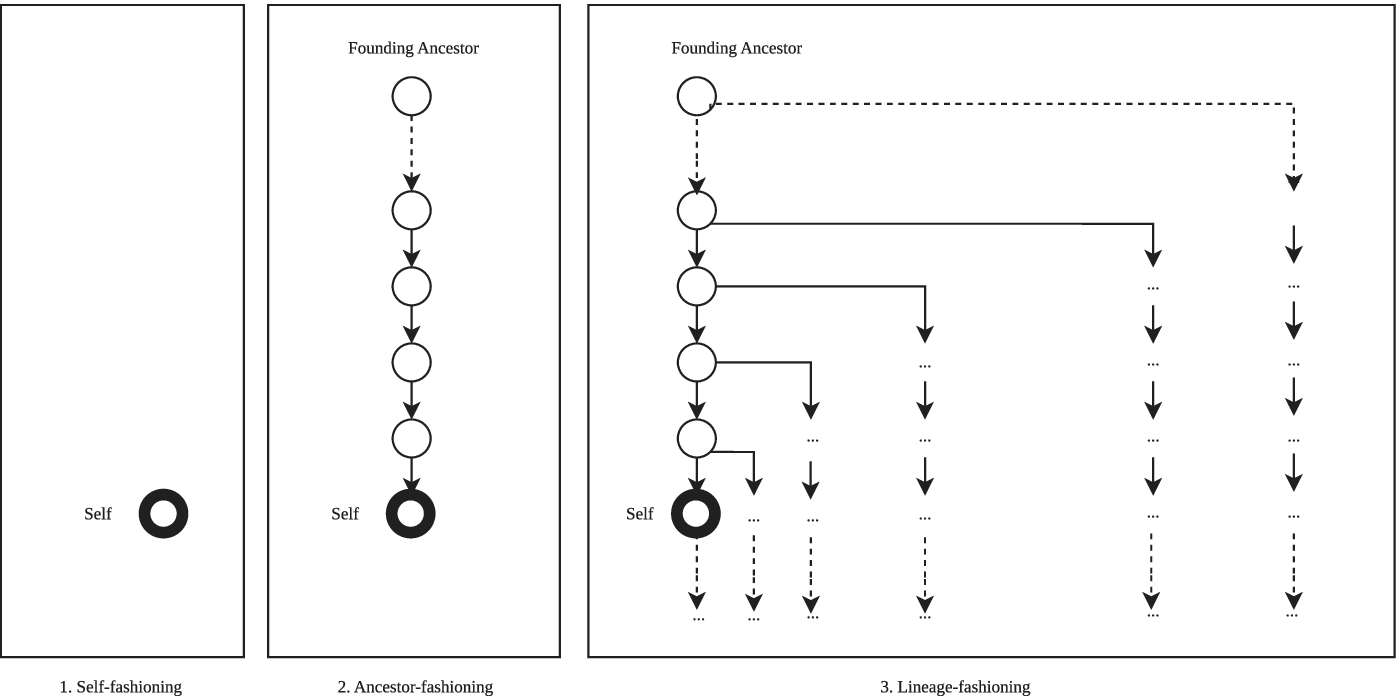

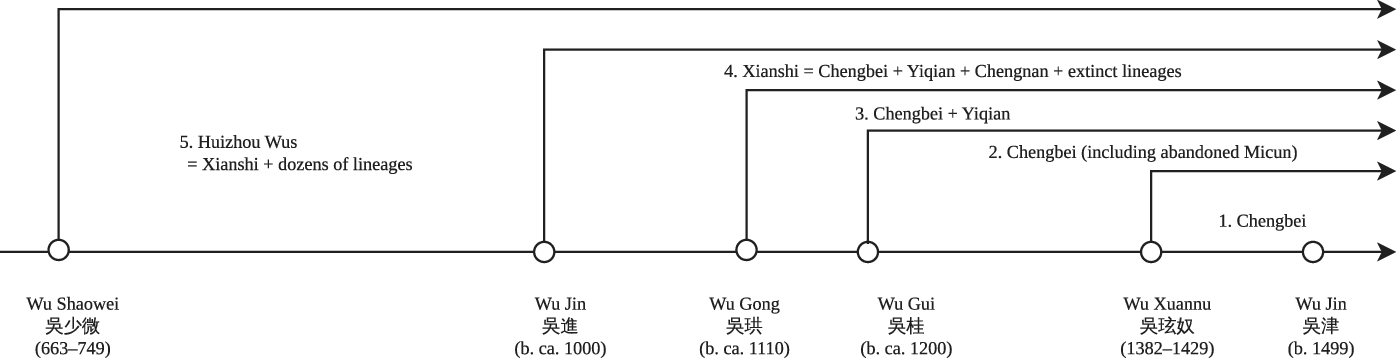


 Open access

