INTRODUCTION
Knowledge of the social structure of a species or a population is crucial to understanding many aspects of its ecology. Social structure has a strong influence on gene flow (Whitehead, Reference Whitehead1998), fitness, habitat use (Baird & Dill, Reference Baird and Dill1996; Ersts & Rosenbaum, Reference Ersts and Rosenbaum2003), spread of diseases (Lee, Reference Lee, Slater and Halliday1994) as well as on the manner in which knowledge is retained and transmitted among members (McComb et al., Reference McComb, Moss, Durant, Baker and Sayialel2001; Wittemyer et al., Reference Wittemyer, Douglas-Hamilton and Getz2005). In the past, however, it was often assumed that the study of one population was representative of the social structure and behavioural repertoire of an entire species, as was believed to be the case for chimpanzees (Pan troglodytes) in the 1960s and 1970s (Boesch, Reference Boesch and Boesch2002). However, ecological constraints such as prey availability, defence against predators, care of calves and defence of territory are now known to play an important role in shaping social structure, and these factors are likely to vary, sometimes dramatically, between habitats. Therefore, intra-specific investigation of social structures of populations residing in different habitats, and subject to varying ecological factors, help to explain the diversity of social organization as well as highlight a species capacity for adaptation. Furthermore, intra-specific comparisons of social organization represent a valuable tool for gaining insights into the selective forces of social evolution, and are important for the development of hypotheses relating to ecology and behaviour (Moehlman, Reference Moehlman and Gittleman1989; Chapman et al., Reference Chapman, Wrangham and Chapman1995).
Intra-specific variation in social organization is known in many terrestrial and marine species and has been related to differences in predation pressure and site-specific ecological variables such as the availability of food and shelter. For example bottlenose dolphins (Tursiops truncatus) form larger groups in pelagic waters than in shallow areas (Wells et al., Reference Wells, Irvine, Scott and Herman1980). Increased predation pressure, as well as the presence of large schools of prey in open water, are thought to be responsible for this increase in group size (Connor et al., Reference Connor, Wells, Mann, Read and Mann2000). Giraffes (Giraffa camelopardalis) also show varying degrees of group stability depending on local habitats, with the most stable groups found in the most vegetated areas (van der Jeugd & Prins, Reference van der Jeugd and Prins2000). The spinner dolphins (Stenella longirostris) from Midway Atoll live in a stable society of long-term associates, while off the large Hawaiian Islands they live in a fission–fusion society with great day-to-day variability in group size and membership (Karczmarski et al., Reference Karczmarski, Würsig, Gailey, Larson and Vanderlip2005). The authors suggest that the differences in the availability of sheltered shallow-water habitats between the large Hawaiian Islands and Midway Atoll were responsible for the differences in social organization between these populations. Similarly, chimpanzees from the Taï National Park (West Africa) spend most of their time with other members of their community while chimpanzees from East Africa spend most of their time alone (Lehmann & Boesch, Reference Lehmann and Boesch2004). The authors note that the differences in sociality are probably due to lower food availability and lower predation pressure in East Africa than in the Taï National Park. These studies suggest that ecological conditions play an important role in shaping social organization.
The social organization and mating systems of sperm whales (Physeter macrocephalus) have been studied in detail in the South Pacific for the past three decades (Whitehead et al., Reference Whitehead, Waters and Lyrholm1991; Whitehead, Reference Whitehead2003; Coakes & Whitehead, Reference Coakes and Whitehead2004). These studies show that sperm whales have a highly structured social organization in which females and their offspring form stable units of about 10–12 individuals that stay together for decades (Christal et al., Reference Christal, Whitehead and Lettevall1998). Often two or more of these units associate for periods of days to form what is called a ‘group’ (about 20–25 individuals on average). As members of a group move in a coordinated fashion, the group is considered a social entity (Whitehead, Reference Whitehead2003). Vocal clans form the highest known level of social structure (Rendell & Whitehead, Reference Rendell and Whitehead2003), they have a large geographical extent and probably persist over generations. Clans are composed of many units that share a similar coda repertoire (Rendell & Whitehead, Reference Rendell and Whitehead2003). Sperm whale mating systems are characterized by large breeding males roving between groups of females/immatures spending only a few hours with each group (Whitehead, Reference Whitehead1990, Reference Whitehead1993). Two populations that were studied in detail (off the Galápagos Islands and off northern Chile) showed that both populations had similar social organizations and mating systems despite differences in productivity, bottom topography, sea-surface temperature, movement patterns and diet between both areas (Coakes & Whitehead, Reference Coakes and Whitehead2004). Similarly, studies of sperm whale social structure in the Seychelles Islands showed that mean group size was similar to that found in the South Pacific (Whitehead & Kahn, Reference Whitehead and Kahn1992). On the other hand, investigations of sperm whale group sizes in the Atlantic Ocean showed that, in the northern Gulf of Mexico (Jaquet et al., 2005a,b), Caribbean Sea (Gero, Reference Gero2005) and Sargasso Sea (Gero, Reference Gero2005), sperm whales formed significantly smaller groups than in the South Pacific or Indian Ocean, suggesting geographical differences in sperm whale social organization.
Defence against predators and increased resource acquisition are widely accepted as principal factors determining the formation of groups in most animal species (Alexander, Reference Alexander1974; Wrangham & Rubenstein, Reference Wrangham, Rubenstein, Rubenstein and Wrangham1986; Connor, Reference Connor and Mann2000). However, the effect of these factors on sperm whale social structure and/or group size are not yet fully understood, as few detailed investigations with large enough sample sizes and similar methodology have been conducted in areas other than the South Pacific, precluding meaningful comparisons. Therefore, a detailed study of a population found in a different geographical area experiencing different ecological factors (in terms of predation pressure, whaling history and/or food resources) may help understand how these factors lead to the observed social organizations.
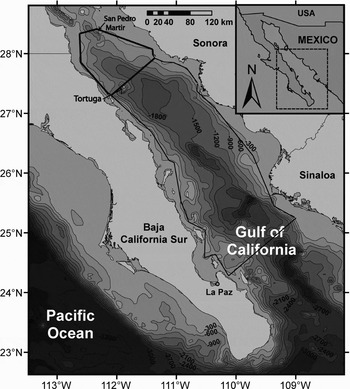
Sperm whales are abundant in the Gulf of California (GoC), Mexico, and have been studied extensively since 1998 (Gendron, Reference Gendron, Alvarez-Casteñeda and Patton2000; Jaquet & Gendron, Reference Jaquet and Gendron2002; Jaquet et al., Reference Jaquet, Gendron and Coakes2003; Davis et al., Reference Davis, Jaquet, Gendron, Bazzino, Markaida and Gilly2007). The GoC is located in the tropical waters of the eastern North Pacific and is a highly productive marginal sea, with some of the greatest surface nutrient concentrations of any ocean of the world (Santamaría-del-Angel et al., Reference Santamaría-del-Angel, Alvarez-Borrego and Müller-Karger1994; Gaxiola-Castro et al., Reference Gaxiola-Castro, García-Cordova, Valdez-Holguin and Botello-Ruvalcaba1995; Valdez-Hoguín et al., Reference Valdez-Hoguín, Gaxiola-Castro and Cervantes-Duarte1995). The underwater topography of the GoC is characterized by a narrow continental shelf, a steep and narrow slope and large deep depressions (up to 3500 m deep; Figure 1). The GoC is exposed to few anthropogenic activities and low levels of vessel traffic. From stable isotope studies and indirect evidence, it is believed that Dosidicus gigas (jumbo squid, a large muscular Ommastrephidae) form a large part of sperm whale diet in the GoC (Jaquet & Gendron, Reference Jaquet and Gendron2002; Ruiz-Cooley et al., Reference Ruiz-Cooley, Gendron, Aguíñiga, Mesnick and Carriquiry2004). Modern whaling occurred on the coast of California and in the eastern Tropical Pacific until 1980 (Taylor & Barlow, Reference Taylor and Barlow1997). From photo-identification and genetic studies, the home range of the GoC sperm whale population has been suggested to reach beyond the GoC itself (Jaquet & Gendron, Reference Jaquet and Gendron2002; S. Mesnick and J. Barlow, unpublished data) thus, it is possible that modern whaling has had some effect on the population.
Gulf of California: the study area is delineated by black lines. The area delineated in bold represents the area where 65% of the effort was conducted.

The goals of this study are twofold. First, we examine group size and patterns of associations of sperm whales in the GoC and compare these results to other published studies. Second, we contrast variability in predation pressure, food resources, diet, habitat and/or whaling history among populations and relate this variability to observed variation in social organization.
MATERIALS AND METHODS
Data were collected from a 13 m ocean-going sloop (RV ‘Adia’) and an 8 m converted sport-fishing boat (RV ‘CICIMAR-XV’) during six field seasons: (1) early June to mid-July 1998; (2) mid-May to early July 1999; (3) May 2002; (4) mid-October to mid-November 2002; (5) late April to late May 2003; and (6) mid-October to early November 2004. The study area covered the deep waters of the GoC (>200 m deep) from 24°20′N to 28°30′N with ~65% of the effort conducted in the area between the islands of San Pedro Martir and Tortuga (Figure 1). Opportunistic identification photographs of sperm whales collected during GoC research cruises between 1992 and 1998 were also added to the database by colleagues from the Centro Interdisciplinario de Ciencias Marinas Instituto Politécnico Nacional, the Southwest Fisheries Science Center (National Oceanic and Atmospheric Administration's National Marine Fisheries Service; Jay Barlow, personal communication) and the Ocean Alliance's Voyage of the ‘Odyssey’ (Ian Kerr, personal communication).
In 1998–1999, sperm whales were located by stopping the research vessel every half hour for 2 min to listen through an omnidirectional hydrophone with 20 m of cable for their characteristic clicks (Backus & Schevill, Reference Backus, Schevill and Norris1966). From 2002 to 2004, sperm whales were also located by listening continuously through a 2-element towed hydrophone array with 100 m of cable in addition to listening every half hour with the engine stopped. In the GoC, both hydrophones had a detection range of about 10–18 km. Once located, sperm whales were followed both visually and acoustically using a directional hydrophone for periods lasting between a few hours and a few days. The date, vessel track, individual behaviour, dive locations, fluke-up time (to the nearest second) and surfacing time (to the nearest five seconds) were recorded using custom-written software on a Hewlett-Packard 200LX palmtop computer linked to a Garmin 12XL GPS. Fluke photographs were taken at the start of each dive with a Nikon F4 or a Canon EOS 1D and a 300 mm lens.
Group size and abundance of aggregations
Sperm whales were individually identified using the marks on the trailing edge of their flukes (Arnbom, Reference Arnbom1987). All photographs were graded for quality and given Q values from 1 to 5 (5 being the best quality) following the standard method described by Arnbom (Reference Arnbom1987). Individual sperm whales were ascribed to the same group if they were identified on the same day, as we stayed with a single group throughout a day. We followed the methodology described by Whitehead (Reference Whitehead1999) to link individuals sighted on different days: when individuals were identified on more than one day, they were considered to belong to the same group if 50% or more of the individuals identified during the day with the fewest identifications were re-sighted during the other day. Group sizes were calculated by dividing each day into two equal sections (i.e. first four hours with the group and last four hours with the group), and using mark–recapture techniques and a Petersen estimator of group size with the Chapman correction for small samples (Seber, Reference Seber1982; Whitehead, Reference Whitehead2003; Coakes & Whitehead, Reference Coakes and Whitehead2004). When the days were divided in ‘before noon’ and ‘after noon’ instead of ‘first few hours’ and ‘last few hours’, the results were similar and thus not presented here.
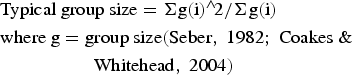
Group sizes estimates with CVs < 0.25 and those with CVs < 0.40 were taken into account separately. With CVs < 0.25, group sizes estimates are more accurate, but bias the data towards smaller groups, while group sizes with CVs < 0.40 are less precise but take into account larger groups (Whitehead, Reference Whitehead2003; Coakes & Whitehead, Reference Coakes and Whitehead2004). Group sizes experienced by individual sperm whales are generally larger than those experienced by an external observer, as relatively more individuals are found in larger groups (Jarman, Reference Jarman1974). These group sizes are called typical group sizes and were calculated following the methods of Jarman (Reference Jarman1974):
The mean time searching for whales can be used as a rough indicator of the abundance of aggregations of whales (Kahn et al., Reference Kahn, Whitehead and Dillon1993) and thus mean search time was calculated for the GoC and compared to other areas.
Social organization and temporal patterns
Standardized lagged association rate (SLAR) is the probability that if two individuals were associated at time ‘t’, one will be an associate of the other after a time lag ‘τ’. The SLARs were used to model the temporal aspects of sperm whale social organization (Whitehead, Reference Whitehead1995) and were calculated with the suite of Matlab (MATLAB 7.1, release 14) programs SOCPROG 2.3 (written by H. Whitehead and available from http://myweb.dal.ca/~hwhitehe/social.htm) especially designed for this purpose. The four models of the exponential family which are available within the SOCPROG program and which correspond to: (1) ‘constant companions’; (2) ‘casual acquaintances’; (3) ‘constant companions and casual acquaintances’; and (4) ‘two levels of casual acquaintances’ were fitted to the data. Additionally, a custom model (Equation 2) based on previous sperm whale studies (H. Whitehead, personal communication, May 2006)) was fitted to the data using maximum likelihood and binomial loss:

where td is the time lag, a1*20 the unit size, a2*40 the group size and a3/5 the disassociation rate. This model is equivalent to the constant companions (unit size) and casual acquaintance (group size) model but differs from model (3) above by the fact that it had been re-parameterized using previous sperm whale studies in the Pacific Ocean (Coakes & Whitehead, Reference Coakes and Whitehead2004).
The best model was chosen using the quasi-Akaike information criterion (QAIC), and the model with the lowest QAIC was selected. Jackknife standard error for the SLAR estimates were calculated by sequentially omitting data from 30-day periods (Whitehead, Reference Whitehead1995). Typical unit size, typical group size and rate of disassociation were calculated using these models.
Large males
Large adult males are easily recognizable in the field as they are substantially larger than mature females (about 16 m on average compared with 11 m; Rice, Reference Rice, Ridgway and Harrison1989), have a characteristic bump at the end of the head and produce specific vocalizations called slow clicks that have never been heard from females or immature males (Weilgart & Whitehead, Reference Weilgart and Whitehead1988). The number of large adult males and other whales (adult females and immatures of both sexes) were counted in each group (Kahn et al., Reference Kahn, Whitehead and Dillon1993). To be consistent with other studies (Kahn et al., Reference Kahn, Whitehead and Dillon1993) and allow for comparisons between them, the relative abundance of mature males was calculated as the total number of different males identified, divided by the number of other whales identified (adult females and immatures of both sexes). To reduce possible bias in the proportion of large adult males, data collected opportunistically were not used in this context.
RESULTS
A total of 128 days was spent at sea, and 58 groups of females/immatures were identified. The average time span during a day between the first good-quality identification photograph and the last one was 7 hours (SD = 2.8, range = 3 hours to 11 hours). On average we identified 13.1 individuals per day (SD = 6.65, range = 5 to 43) on days where whales were sighted. During the study, we took 1782 good-quality (Q ≥ 3) identity photographs (including 69 opportunistic ones) and identified 612 individual female/immatures. The highest density of sperm whales was found in the area between the islands of San Pedro Martir and Tortuga (Figure 1).
Group sizes and abundance of aggregations
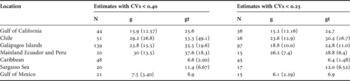
Using group size estimates with CVs < 0.25, typical group sizes for the GoC were 24.7 individuals, and thus similar to those found in the South Pacific, but much larger than those found in the Atlantic Ocean (Table 1). When group sizes were calculated using estimates with CVs < 0.40, typical group sizes in the GoC were smaller than in the South Pacific but still substantially larger than in the Atlantic Ocean (Table 1). Typical group sizes in the Seychelles were smaller than in the GoC but larger than in the Atlantic Ocean (mean typical group size = 18 individuals, SD = 3.2; Whitehead & Kahn, Reference Whitehead and Kahn1992). However, these group size estimates were calculated slightly differently than the ones presented in Table 1, and thus were not added to the table.
Group size estimations for sperm whales in the Gulf of California and comparisons with other areas where similar estimations were calculated: Chile (Coakes & Whitehead, Reference Coakes and Whitehead2004), Galápagos Islands (Whitehead, Reference Whitehead2003), mainland Ecuador (Whitehead, Reference Whitehead2003), Caribbean Sea (Gero, Reference Gero2005), Sargasso Sea (Gero, Reference Gero2005), northern Gulf of Mexico (Jaquet et al., Reference Jaquet, Gordon, Würsig, Jochens and Biggs2005a,Reference Jaquet, Gendron, Gordon and Würsigb). Group sizes were calculated using the Peterson mark–recapture method with day's individual identification split in half; N, the number of groups; g, the estimated group size (Seber, Reference Seber1982, Coakes & Whitehead, Reference Coakes and Whitehead2004); and gt, the estimated typical group size (Jarman, Reference Jarman1974); whenever available standard deviation is mentioned in parentheses.

Search time was short (average = 12.1 hours, SD = 15.27, range = 0.25 to 80 hours) suggesting high relative abundance of sperm whales in the GoC. However, as group and aggregation sizes vary between areas, it is not possible to infer differences in sperm whale abundance between areas.
Social organization
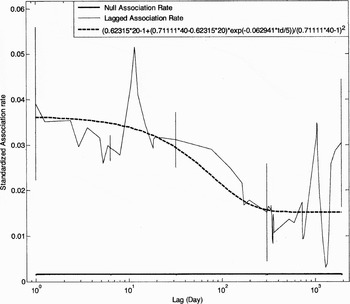
The SLAR for sperm whales in the GoC was always considerably higher than the null association rate (Figure 2) and confirms that sperm whales maintain relationships for multiple years. The SLAR stayed relatively constant for about 80–120 days before decreasing substantially and levelling off again well above the null association rate, suggesting permanent associations between individuals, at least over the duration of the study.
Standardized lagged association rates for data on female and immature sperm whales from the Gulf of California (1992–2004). The black line represents the data and the vertical lines the approximate standard errors (using the conservative jackknife method; Efron & Gong, Reference Efron and Gong1983). The dash line represents the best fit model (custom model for constant companions and casual acquaintances) and the bold line the null association rate.

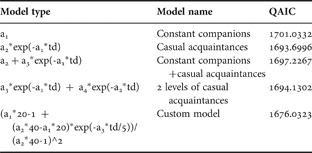
The custom model (Equation 2, equivalent to the ‘constant companions + casual acquaintances’ model of SOCPROG but with custom parameters) best fitted the data (lowest QAIC; Table 2), and as the smallest difference in QAIC was ΔQAIC = 17.667, there was no support for any of the other models (Table 2). The values for the parameters and standard errors for the custom fitted model are shown in Table 3, and suggest that permanent units of about 12.5 individuals associate with other individuals to form groups of about 28.4 individuals on a time scale of about 79 days (SE = 33.6 days).
QAIC values for each fitted model calculated using the SOCPROG program and SLARs estimates.

Typical group size, unit size and disassociation rates (SLARs estimates) for sperm whales in the Gulf of California (GoC) and comparisons with the Galápagos Islands (Whitehead, Reference Whitehead2003; Coakes & Whitehead, Reference Coakes and Whitehead2004), Chile (Coakes & Whitehead, Reference Coakes and Whitehead2004), and the Gulf of Mexico (Jaquet et al., Reference Jaquet, Gordon, Würsig, Jochens and Biggs2005a,Reference Jaquet, Gendron, Gordon and Würsigb). Standard errors are shown in parentheses.

Occurrence and seasonality of large breeding males
Large mature males were photo-identified on 21 occasions and on only two occasions were the males alone, without any females either in visual or acoustic contact. Out of these 21 occasions, 18 different males were identified representing 3.2% of the population (Table 4). One of these males was seen in two separate years, July 1998 and April 2003, and thus the maximum time span between first and last sighting of a male was 4.8 years. There was one match between field seasons and two matches within a field season. The average time span between first and last sighting of an individual male within a season was 1.58 days (SD = 1.742), and 82.4% of the males were seen only on a single day. A maximum of three large males were observed in one day with the same group of females, however, it was only possible to photographically identify two of the males.
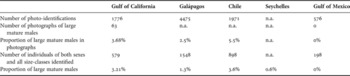
Proportion of large mature males identified in the Gulf of California and comparisons with other areas where similar observations were made: Chile and Galápagos Islands (Coakes & Whitehead, Reference Coakes and Whitehead2004), Seychelles (Kahn et al., Reference Kahn, Whitehead and Dillon1993), northern Gulf of Mexico (Jaquet et al., Reference Jaquet, Gordon, Würsig, Jochens and Biggs2005a,Reference Jaquet, Gendron, Gordon and Würsigb).

n.a., not available.
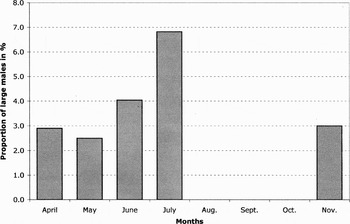
Large males were observed during all months of fieldwork except during October (Figure 3). The proportion of males was relatively constant for April–May–June and November (about 2.5% to 4%), highest in July (6.8%) and lowest in October (0%; Figure 3). The average time span between first and last identification of a male was 1.45 hours (maximum = 7 hours 11 minutes). However, males were often observed for longer periods within the group of females without being photo-identified.
Seasonal relative abundance of large males in the Gulf of California (=number of large males identified each month/number of female/immatures identified each month). No fieldwork had been conducted in August or September. Only the data collected between 1998 and 2004 as part of the dedicated study were used for this analysis.

DISCUSSION
Sperm whales were abundant in the GoC as an average of only 12.1 hours were spent searching for a group of whales, allowing for large data sets to be collected during the six field seasons. The methodologies used for data collection in this study were comparable to those used in the South Pacific, the Seychelles, off Dominica, the northern Gulf of Mexico and the Sargasso Sea, and thus results from these different studies are comparable. Sample sizes varied considerably between these studies and thus detailed examinations of social organization and standardized lagged association rates have not been performed for all studies.
Group size
Typical group sizes calculated using the daily data with CVs < 0.25, CVs < 0.40 and the SLAR estimates (gt = 24.7, 25.6 and 28.4 respectively) were similar, although the SLAR estimates provided slightly larger group sizes. Typical group sizes in the GoC were similar to those in the Galápagos Islands (Coakes & Whitehead, Reference Coakes and Whitehead2004), and if only group sizes calculated using CVs < 0.25 were considered, they were also comparable to the one in mainland Ecuador and Peru (Tables 1 & 3; Whitehead, Reference Whitehead2003; Coakes & Whitehead, Reference Coakes and Whitehead2004). Typical group sizes in the GoC were slightly smaller than in Chile (Tables 1 & 3), and slightly larger than in the Seychelles (Whitehead & Kahn, Reference Whitehead and Kahn1992). These results suggest that group sizes are consistent between populations in the Pacific and Indian Oceans and that there are only minor differences in typical group sizes despite large differences in productivity, diet and whaling histories.
On the other hand, there were large differences in group sizes between the GoC and the three areas from the Atlantic Ocean. Typical group sizes in the GoC were three to four times larger than in the Caribbean Sea and northern Gulf of Mexico (Gero, Reference Gero2005; Jaquet et al., Reference Jaquet, Gendron, Gordon and Würsig2005b; Table 1), and twice as large as in the Sargasso Sea (Gero, Reference Gero2005; Table 1).
It has been argued that the two main reasons for animals to form groups are predation pressure and resources distribution (Alexander, Reference Alexander1974), and that by balancing costs and benefits, variations in these factors may result in varying group sizes. Killer whales (Orcinus orcas) are the main predators of sperm whales and are found in all oceans of the world and at every latitude (Baird, Reference Baird and Mann2000). Although some knowledge on the distribution and movement of killer whales exist in the GoC (Guerrero-Ruiz et al., Reference Guerrero-Ruiz, Gendron and Urban1998), there is little information on density and seasonal abundance of killer whales in this region, or in the other areas considered in this paper. However, there are no records of killer whale attacks on sperm whales in the Gulf of Mexico, Caribbean or Sargasso Sea, while several attacks have been documented in the Galápagos Islands and off California (Jefferson et al., Reference Jefferson, Stacey and Baird1991; Pitman et al., Reference Pitman, Ballance, Mesnick and Chivers2001). While the impacts of killer whale predation on sperm whale populations is unknown, it is likely that the effects of predation pressure differ significantly between the eastern Pacific (GoC, Galápagos Islands, mainland Ecuador/Peru and Chile) and the areas of the Atlantic Ocean considered in this paper.
Predation pressure by killer whales is likely to exert a strong selective force on sperm whales (Pitman et al., Reference Pitman, Ballance, Mesnick and Chivers2001). Increased predation pressure tends to result in larger and tighter groups (Wrangham & Rubenstein, Reference Wrangham, Rubenstein, Rubenstein and Wrangham1986), and thus we would expect larger and tighter groups in the eastern Pacific than in the Atlantic Ocean. Our results are consistent with this hypothesis as group sizes were two to five times larger in the eastern Pacific than in the Atlantic Ocean.
The significant difference in group sizes between sperm whale populations in the Atlantic Ocean and those in the eastern Pacific, may also be driven by differences in food resources. Despite slight differences in productivity between Chile, the Galápagos Islands and the GoC, all three coastal upwelling areas are characterized by relatively high productivity and thus are very different from the oligotrophic waters of the Sargasso Sea or the Gulf of Mexico. Competition for access to food is usually considered as one of the major costs of group living (Wrangham & Rubenstein, Reference Wrangham, Rubenstein, Rubenstein and Wrangham1986; Chapman et al., Reference Chapman, Wrangham and Chapman1995; Baird & Dill, Reference Baird and Dill1996), and thus it is expected that, all conditions being equal, larger groups will form when food resources are plentiful, compared with when resources are scarce. The patchy distribution of squid over large spatial scales, in combination with high sperm whale feeding requirements, make sperm whales highly susceptible to intra-specific competition. Thus large groups are likely to be disadvantageous as they increase competition for food (Wittemyer et al., Reference Wittemyer, Douglas-Hamilton and Getz2005) as well as increase the speed in which squid patches are depleted. Therefore, by reducing group sizes, sperm whales may be able to reduce intra-specific competition for food in less productive areas.
The largest groups were found in Chile, in mainland Ecuador and Peru, and then in the Galápagos Islands; all these areas are characterized by very high productivity year round (Houvenaghel, Reference Houvenaghel, Boje and Tomczak1978; Berger, Reference Berger and Berger1989). Group sizes were slightly smaller in the GoC, an area also characterized by high productivity (Santamaría-del-Angel et al., Reference Santamaría-del-Angel, Alvarez-Borrego and Müller-Karger1994). In the oligotrophic waters of the Sargasso Sea and the northern Gulf of Mexico (Biggs & Ressler, Reference Biggs and Ressler2001), group sizes were substantially smaller than in the GoC, Galápagos Islands or Chile (Coakes & Whitehead, Reference Coakes and Whitehead2004; Gero, Reference Gero2005; Jaquet et al., Reference Jaquet, Gordon, Würsig, Jochens and Biggs2005a,Reference Jaquet, Gendron, Gordon and Würsigb). These results suggest that it is possible that the amount of food resources available play a role in determining group size.
The impact of differences in whaling histories on group size is difficult to assess. Whaling could be viewed as predation, and thus higher whaling pressure would be expected to result in larger group sizes. Similarly, by disrupting social systems, whaling could increase group size and lead to increased aggregation. However, group sizes were similar between the Galápagos Islands and the GoC, despite the fact that the sperm whales in the Galápagos Islands were not subjected to modern whaling, while the animals along the Pacific coast of Baja California were subjected to commercial whaling as recently as 1980, well within the lifespan of a sperm whale observed during this study (Taylor & Barlow, Reference Taylor and Barlow1997). Furthermore, group sizes in the Atlantic Ocean were substantially smaller than in the Galápagos Islands, although no modern whaling was conducted in any of these areas. It seems therefore, that the impact of recent whaling is unlikely to explain this difference in group sizes.
Social organization
The model of social organization in the GoC was similar to the one found in the Galápagos Islands area and off Chile (Coakes & Whitehead, Reference Coakes and Whitehead2004). In all three areas the model that best fit the pattern of temporal associations was one of ‘constant companions and casual acquaintances’ (with custom parameters), with permanent units of about 12.5 individuals and typical group size of 28.4 individuals. However, our data suggest that groups are more stable in the GoC than in the Galápagos Islands or Chile, and that, in the GoC, groups stay together for at least one to two months, instead of about one week to ten days in the South Pacific (Coakes & Whitehead, Reference Coakes and Whitehead2004). It would therefore be important to investigate group stability and casual acquaintance disassociation rates in other areas of the Pacific to shed some light on the possible factors determining disassociation rates.
In the Atlantic Ocean, groups were less than half the size of those in the Pacific Ocean. Gero (Reference Gero2005) followed a group of seven sperm whales for 40 days off Dominica, and the consistency of group membership over such a long time period suggests that this group was in fact a unit, and thus that unit sizes are also smaller in some areas of the Atlantic Ocean than in the Pacific Ocean. Preliminary results from the northern Gulf of Mexico (Table 1) also suggest sperm whales form small unit sizes. It has been suggested that the need for communal care of calves while the mothers are making deep foraging dives of about 40 minutes, is the main driver for the formation of long-term bonds between female sperm whales (Whitehead, Reference Whitehead1996; Gowans et al., Reference Gowans, Whitehead and Hooker2001; Whitehead, Reference Whitehead2003). Therefore, lesser predation pressure, associated with reduced food resources, could lead to generally smaller long-term units. However, the scarcity of data in the Atlantic Ocean does not allow firm conclusions to be drawn. It is also possible that, on average, units are of similar sizes than those in the Pacific Ocean, but that due to lower predation pressure and reduced food availability in these areas of the Atlantic Ocean, units do not associate with other units to form groups.
If care of calves while mothers are undertaking deep long dives in search of squid was the only reason for sperm whale social units, one might expect that other species of odontocetes that are also pelagic teuthivorous deep divers would have similar social organization. This has been shown not to be the case with bottlenose whales (Hyperoodon ampullatus). Despite similar ecological constraints, female bottlenose whales do not form long-term bonds (Gowans et al., Reference Gowans, Whitehead and Hooker2001). These recent findings suggest that other factors may also be responsible for the formation of units by sperm whales. Obtaining larger sample sizes on sperm whale social organization in the Atlantic Ocean is a priority, as these comparative data would shed light on the stability of unit sizes between areas and help us to understand the factors that determine unit formation in sperm whales.
Mating systems
The proportion of large, mature males in the GoC was similar to the proportion in Chile, but larger than in the Galápagos Islands and in the Seychelles (Kahn et al., Reference Kahn, Whitehead and Dillon1993; Coakes & Whitehead, Reference Coakes and Whitehead2004; Table 4). No large mature males were observed during three field seasons in the Gulf of Mexico (N Jaquet, personal observation; Table 4). These differences are unlikely to be a result of the timing of field seasons as research was conducted roughly during the peak of the mating season in all three areas (Best et al., Reference Best, Canham and MacLeod1984). The absence of observations of large males in the Gulf of Mexico, as well as the low proportion in the Seychelles, are puzzling and unlikely to be the result of differences in whaling histories as the Gulf of Mexico was not subjected to modern whaling while the Seychelles were subjected to modern whaling until 1979 (Kahn et al., Reference Kahn, Whitehead and Dillon1993).
The peak in proportion of males found in July in the GoC during this study is probably an artefact, as few females/immature were identified in July. If a single male was present with a group of female/immature, additional effort was usually made to obtain an identification of the male, possibly biasing the results if few females/immature were identified. The proportion of large males was roughly similar during all the other months of this study, suggesting an extensive breeding season. Similar results were found in Chile where large males were identified during eight months of the 10-month field season (Coakes & Whitehead, Reference Coakes and Whitehead2004).
Similar to what was found in Chile, most males in the GoC were observed on a single day (73% and 82.4% respectively), were only observed with a group for a matter of hours, and up to three males could be observed with a single group of females/immature. When the same male was re-identified twice during the same field season it was each time with a different group of females. These results suggest that, like in the South Pacific, the breeding season is extensive, encompassing most months of the year, and that males rove between groups of females staying only a few hours with each group.
Conclusions
The results of this study suggest that environmental factors such as predation pressure and/or food availability play a role in shaping social organization in sperm whales. Sperm whale social organization and group sizes were similar in the GoC, Galápagos Islands and Chile despite slight variability in productivity and whaling histories. This result was consistent with the conclusion of Coakes & Whitehead (Reference Coakes and Whitehead2004) who suggested that ‘the environment was not a short-term driver of sperm whale social systems’ and that foraging factors had little impact on sperm whale sociality. However, comparisons of sperm whale social organization between areas of the Pacific and areas of the Atlantic Oceans suggest that differences in food resources and predation pressure impact group, and possibly unit, sizes. In addition, it is possible that the occurrence of large males in the Gulf of Mexico shows strong seasonality in contrast to the three areas of the Pacific where they can be found almost year round. Further research on sperm whale social organization and mating systems in the Atlantic Ocean would be of great value to elucidate whether a system exists which is fundamentally different than the patterns described for the Pacific Ocean. In addition, research on the abundance of killer whales in the GoC and in other sperm whale habitats would help shed some light about the possible importance of predation in determining group size and group stability.
ACKNOWLEDEGMENTS
The study was funded by the Center for Field Research (Earthwatch, USA), Wildlife Conservation Society (USA), Comisión National para el Conocimiento y Uso de la Biodiversidad (CONABIO, Mexico), the Société Académique Vaudoise (Switzerland), the National Geographic Society and the Sierra Club. The Centro Interdisciplinario en Ciencias Marinas, Instituto Politécnico National in La Paz, Mexico loaned some equipment, as well as their research vessel (‘CICIMAR-XV’) for the two autumn seasons in the Gulf of California. We are very grateful to all those who helped to collect data at sea. We would like to extend special thanks to Ciro Arista de La Rosa who skippered the ‘CICIMAR-XV’ and greatly helped with data collection. John Botke loaned the research vessel for all the spring/summer seasons in the Gulf of California. We also would like to thank Hal Whitehead for his ongoing help with SOCPROG. This research was conducted under scientific permits No. 040598-213-03 (1998), No. 140598-213-03 (1999), No. SGPA/DGVS/6400 (2002), No. SGPA/DGVS/00624 (2003) and No. SGPA/DGVS/10168 (2004) from the Secretaria de Medio Ambiente Recursos Naturales. The manuscript was much improved by comments from Hal Whitehead, Sofie van Parijs and Trudi Webster.