An under-recognised aetiology in the patient with a failing single ventricle is activation delay (bundle branch block) leading to mechanical dyssynchrony and progressive dysfunction. Using strain echocardiography, a pattern of activation-delay-induced mechanical dyssynchrony can be differentiated from non-specific discoordinated mechanics.1 To our knowledge, however, there are no published descriptions of this aetiology in infants with a failing single ventricle. Identification of this strain pattern may identify candidates for cardiac resynchronisation therapy in this population whose only choice is often transplantation.
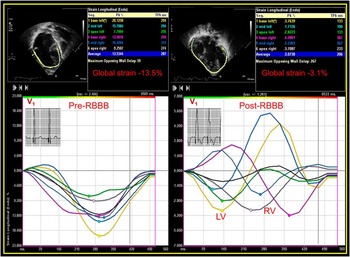
Here we present the case of a 4-month-old infant with heterotaxy syndrome and a functional single ventricle with a right-dominant unbalanced atrioventricular canal defect, pulmonary stenosis, and well-balanced circulation. She developed a permanent right bundle branch block (QRS duration 136 ms) during catheter manipulation at her pre-Glenn catheterisation. Over the following months, her strain pattern evolved from synchronous contraction with near-normal function (longitudinal global peak strain, 13.5%) to a dyssynchronous strain pattern with severely diminished systolic function (longitudinal global peak strain, 3.1%) (Fig 1). Ventricular systolic function was compromised by the dyssynchronous, paradoxical wall motion between the left and the right ventricular free walls at the time of the bundle branch block and then progressively effected by diminished contractility over the following months; the diminutive septum was not analysed. Within months of developing bundle branch block and dyssynchrony, this previously thriving infant developed severe heart failure in the absence of other identifiable underlying aetiologies of dysfunction; there was no arch obstruction, no Glenn obstruction, normal pulmonary vascular resistance, no significant valvular dysfunction, and no evidence of myocardial infarct. She required multiple ICU admissions and medications for heart failure. A strain analysis was performed on this patient because of the increasingly dyssynchronous visual contraction pattern with dysfunction, significant heart failure symptoms, and a dominant ventricular bundle branch block. She died 1 week before a planned cardiac resynchronisation procedure, which was delayed because of late recognition of the aetiology. Further research is necessary, but this case highlights that increased awareness and earlier diagnosis of this aetiology in the failing single ventricle may be important.
Echo and electrocardiographic data before the development of right bundle branch block (left) and after right bundle branch block (right). Lead V1 demonstrates a new right bundle branch block. Two-dimensional images with strain tracking and strain analysis demonstrate increased ventricular dilation, dysfunction, and dyssynchrony following bundle branch block. Longitudinal strain curves show the evolution from normal, synchronous mechanics in the left and right free walls degrading to the pattern of activation-delay-induced mechanical dyssynchrony with severe dysfunction post-right bundle branch block.

Acknowledgements
None.
Financial Support
This research received no specific grant from any funding agency, commercial or not-for-profit sectors.
Conflicts of Interest
None.