Introduction
Pregnancy is a period of rapid growth and cell differentiation for both the mother and the fetus. Nutrition before and during pregnancy plays a critical role not only in fetal growth and development, but also influences the health of the mother. Adequate and appropriate nutrition leads to optimum weight gain in pregnancy, which in turn has maximum potential to promote optimum growth of the fetus. This is not easy to accomplish unless proper care is taken.
Weight gain reported for Indian mothers is 5.1 to 8.3 kg.Reference Srihareni and Laxmi 1 , Reference Pinheiro, David and Joseph 2 The relationship between maternal weight gain and pregnancy outcome is complex and is the result of physiologic adaptations necessary for proper fetal and maternal growth. Individual variation exists in the amount of weight gained during pregnancy and depends upon a number of maternal characteristics other than nutrition including maternal age, height, pregravid body mass index (BMI), parity of the mother, smoking habits and occurrence of gestational diabetes or hypertension. Moreover, maternal pregravid BMI and weight appear to be the most significant factors determining the rate of weight gain during pregnancy. 3
Many studies that have been conducted in the past have consistently linked total maternal weight gain in pregnancy to the baby's birth weight.Reference Scholl, Hediger and Schall 4 – Reference Shapiro, Sutija and Bush 6 There are potential adverse effects of inadequate or excessive weight gain on the mother and her baby. Inadequate weight gain during pregnancy is an important risk factor for low birth weight (LBW). On the other hand, excess body weight could be a contributory factor for large-weight infants and also postpartum weight retention by the mother.
In addition to the total weight gain during pregnancy, the pattern of weight gain and rate of weight gain are also associated with reproductive performance. Many researchers propose strong association of maternal weight gain to fetal growth in the first half as compared with the later half of pregnancy.Reference Abrams, Selvin and Gunderson 5 , Reference Neufeld, Pelletier and Haas 7 , Reference Winkvist, Stenlund and Hakimi 8
A strong relationship exists between the rate of maternal weight gain in early gestation and measures of fetal linear growth and size. This relationship is independent of maternal pregnant weight and height, thus indicating that early gestation may be a sensitive period for fetal linear growth. The influence on fetal size could be exerted through the adequacy of placentation and expansion of plasma volume, both of which are necessary for adequate nourishment of the fetus.Reference Neufeld, Haas, Grajeda and Martorell 9
Some researchers have suggested that maternal weight gain during the second trimester is related to birth weight. According to these researchers, weight gained during the earlier part of the pregnancy is reflected in maternal tissues such as expanded blood volume, uterine and mammary tissues and fat stores. The weight of the fetus at this point of time is very meager, and hence cannot be much influenced.Reference Winkvist, Stenlund and Hakimi 8 , Reference Strauss and Dietz 10
The rate of weight gain is more important than the actual weight gained by the mother and is affected by a number of factors including pregravid BMI, parity of the mother, maternal nutrition and her general health status. Particularly in developing countries, women from lower socioeconomic groups typically demonstrate malnutrition leading to inadequate weight gain during pregnancy. In contrast, women from high- and middle-to-high-income groups demonstrate overconsumption of macronutrients, excessive pregnancy weight gain, as well as downstream pregnancy complications associated with maternal overweight. In India, maternal and neonatal outcomes related to inadequate weight gain in the lower strata of society have been extensively studied and reported,Reference Gopalan 11 , Reference Clausson, Cnattinguis and Axelsson 12 but little data are available on weight gain and its effects on pregnancy outcome in women in higher income groups. The present study is thus important as it reports data from an important segment of society in a developing country undergoing major transitions in nutrition. The study aims to determine the effect of these components of weight gain on pregnancy outcome among high-income group women.
Methodology
This longitudinal study was conducted in Private Maternity Homes in the central suburbs of Mumbai. A total of 180 normal, healthy pregnant women (20–35 years) belonging to an upper middle-income group with a per capita income of Rs 10,000/month were recruited in consultation with the statistician in their 10–14th week of pregnancy on the basis of their willingness to participate in the study. Subjects were followed up three times during the pregnancy, that is, in their 10–14th week, 20–24th week and 30–34th week, and one follow-up visit was arranged after delivery within 2 months. Base line data were collected for 180 women at the entry level. Fifteen women dropped out of the study in the first trimester because of non-availability of time. Eighteen dropped out in the second and ten in the third trimester as they moved to their parental place for delivery. Thus, a total of 137 women completed the study.
The following measurements were taken:
-
(a) Pregravid weight
Subjects who were planning pregnancy visited their gynecologists regularly, and hence accurate pregravid weight was obtained from their hospital records. Many others consulted a gynecologist in the 4–5th week after the last menstrual period date for confirmation of pregnancy, and hence their weights were recorded by the respective hospital/gynecologists. Subjects, who were ambiguous about their pregravid weights, were not included in the study as this parameter was significant for the study.
-
(b) Weight gain during pregnancy
Subjects were weighed in each trimester during home visits. Weight of the subject was recorded using a standardized Beurer digital weighing scale with the capacity of 120 kg and a least count of 0.5 kg. The subjects were asked to remove shoes and heavy clothing, if any. They were made to stand erect at the center of the scale, hands kept straight without touching anything and then the weight was recorded. To have more accurate results, the weight of the subjects recorded in the hospital was also noted down and compared with the weights recorded by us.
Total weight gain and rate of weight gain were calculated for each subject:
Total weight gain: Total weight gain was calculated by subtracting pregravid weight from the maternal weight at the termination of pregnancy.
Rate of weight gain: Trimester-wise record of weight gain was used to calculate the rate of weight gain. It was calculated by dividing the trimester-wise weight gain by the number of weeks in that trimester.
-
(c) Birth weight of the neonate
This was obtained from the hospital records where the women had delivered.
Statistical analysis
Statistical analysis was performed by using the SPSS Computer Package (Version 11.5). Mean values were compared by analysis of variance across tertiles for all parameters with post hoc least significance difference tests such as student's t-test. Karl Pearson correlation coefficients were used for studying the relationships between different variables and pregnancy outcome. Multiple linear regression analysis was used to study the variations in the outcome variable with independent variables.
Results
Pregravid BMI
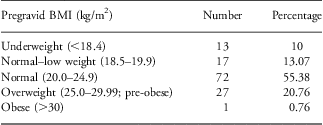
The pregravid BMI ranged from 15.23 to 33.70 kg/m2, with mean ±s.d. being 23.61 ± 3.42 kg/m2. On the basis of the pregravid BMI, the pregnant women were grouped as being underweight, normal, overweight and obese (Table 1) as per Institute of Medicine (IOM) classification. Almost one-fifth of the mothers were overweight.
Distribution of subjects based on BMI

BMI, body mass index.
Total weight gain
The total weight gain during pregnancy ranged from 7 to 23 kg, with mean being 13.44 ± 3.44 kg. Overall, 46.67% subjects gained between 11.1 and 16 kg and 19.17% subjects gained in the range of 16.1–20 kg. Overall, 1.67% gained more than 20 kg and 33% gained <11 kg.
When the total weight gain was calculated according to the categories of pregravid BMI, the weight gain was highest for the low BMI group (14.04 ± 2.49 kg) with a marginal difference found in the mean weight gain values in normal BMI and high BMI groups (13.17 ± 1.86 kg and 13.33 ± 1.74 kg, respectively).
The trimester-wise pattern of weight gain
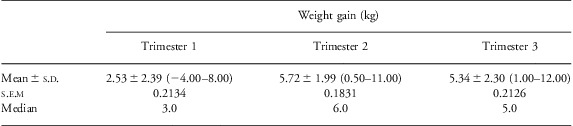
The mean, median and range of maternal weight gain in the three trimesters is shown in Table 2.
Trimester-wise weight gain of the mothers

-
(a) Weight gain in the first trimester: weight gain in the first trimester ranged between −4 and 8 kg, with the mean being 2.534 ± 2.3 kg and the median 3. Weight loss was observed in 14% subjects, and 3.3% subjects did not show any change in weight, whereas 33.06% subjects showed an increase in their weight by more than 4 and up to 8 kg. The remaining subjects showed an increase of up to 4 kg during this period.
-
(b) Weight gain in the second trimester: the weight gained in the second trimester was higher than that gained in the first trimester for all the mothers. The mean weight gain in this trimester was 5.720 ± 1.99 kg and the median was 6 kg. In all, 22.5% subjects showed up to 4 kg weight gain, whereas 68.33% showed a gain of 4–8 kg. A large gain in weight (8–11 kg) was observed in 9.2% subjects. In all, 54.54% mothers gained more weight in trimester 2 as compared with trimester 3. The highest gain in weight was recorded in this trimester in comparison with the other two trimesters (Table 2).
-
(c) Weight gain in the third trimester: weight gain ranged between 1 and 12 kg, with the mean being 5.34 ± 2.29 kg and the median 5 kg. More weight gain was recorded in this trimester as compared with the second trimester for 45.45% subjects. In all, 40% subjects gained up to 4 kg and 49.16% subjects showed 4–8 kg gain in weight. A large gain in weight (8–12 kg) was observed in 10.83% subjects.
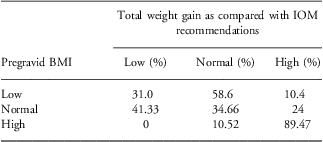
IOM (1990) has given recommendations of weight gain on the basis of pregravid BMI. As compared with IOM recommendations, 28.9% of subjects showed higher weight gain, whereas 29.7% showed lower weight gain. It was also seen that 89.47% subjects having high pregravid BMI had a tendency to gain more weight than recommended. None of the subjects with high pregravid BMI showed low weight gain (Table 3).
Distribution of mothers according to BMI category vis a vis weight gain

BMI, body mass index; IOM, Institute of Medicine.
Source: IOM 3 .
Rate of weight gain
Table 4 gives trimester-wise mean weight gain and rate of weight gain according to pregravid BMI classification. Women with low pregravid BMI showed the highest rate of weight gain in the first trimester and lowest rate in the third trimester as compared with mothers from the other two BMI categories.
Mean and rate of weight gain as pregravid BMI

BMI, body mass index.
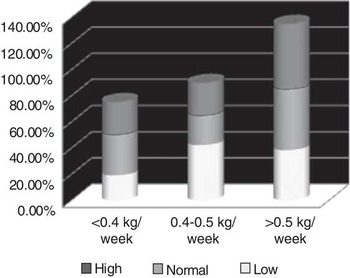
Mothers having a high pregravid BMI had a tendency to gain more weight/week, with 50% of them showing >0.5 kg weight gain/week. The women with normal BMI also showed more inclination toward higher weight gain, with 46.48% having more than 0.5 kg weight gain/week. More women with low BMI showed weight gain between 0.4 and 0.5 kg/week (Fig. 1).
Percentage of rate of weight gain according to body mass index (BMI) category.

Pregnancy outcome: neonatal birth weight
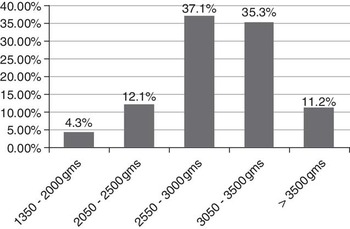
In the present study, birth weights of neonates ranged from 1350 to 4300 g, with the mean birth weight being 2970 ± 493 g. As shown in Fig. 2, 4.3% of babies were born with birth weight in the range of 1350–2000 g and 12.06% babies had birth weights between 2050 and 2500 g. Thus, overall 16.36% of babies were LBW babies (<2500 g). In the present study, only one infant was classified as large for gestational age with a birth weight of 4300 g.
Percentage of neonates as per their birth weights.

Maternal weight gain and birth weight
When the birth weight was examined according to the weight gain category of the mother, the mean birth weights of the neonates of mothers in the low weight gain category (2.84 ± 0.53 kg) and those of normal weight gain category (2.93 ± 0.42 kg) were lower than those in the high weight gain category (3.15 ± 0.43 kg; P < 0.001).
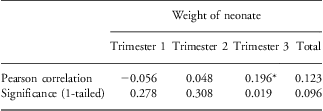
When the effect of trimester-wise weight gain on neonatal weight was considered, significant correlation was seen at 0.05 levels (1-tailed) between weight gain in the third trimester and birth weight of the neonate (Table 5).
Trimester-wise weight gain and birth weight of the neonate

*Correlation is significant at 0.05 level (1-tailed).
When weight gain pattern was observed in light of pre-pregnancy BMI of the subjects, weight gain in the first trimester was found to be most contributory to the fetal growth in all the three BMI groups. The correlation was statistically significant at the 0.05 level (1-tailed test) with P = 0.019, indicating that weight gain in the early pregnancy plays an important role in the fetal growth.
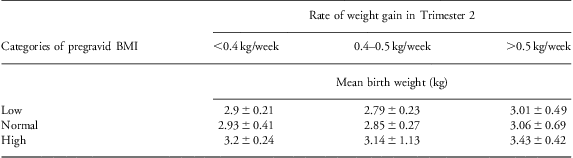
Further mean birth weight was examined according to the rate of weight gain and pregravid BMI (Table 6). The mean birth weight was highest for women who had high pregravid BMI and exhibited highest rate of weight gain. The rate of weight gain as per the categories of BMI also influenced neonatal birth weight significantly with P = 0.027 at 0.05 level (1-tailed test).
Rate of maternal weight gain and birth weight

BMI, body mass index.
The rate of weight gain irrespective of the category of BMI was found to influence birth weight of the neonate significantly with P = 0.022 (1-tailed test).
Discussion
On the basis of pregravid BMI, 55.38% women in the present study population had normal weight, and the remaining were either underweight or obese. Underweight mothers are at an increased risk of preterm delivery along with the risk of delivering an infant who is small for gestational age.Reference Kac, Benício, Velásquez-Meléndez, Valente and Struchiner 13 On the other hand obesity before pregnancy is associated with an increased risk of fetal macrosomia and perinatal mortality. Obese pregnant women and women who gain excess weight during pregnancy have been shown to retain more weight postpartum, thereby perpetuating the cycle of obesity. In the present study, we demonstrate that in this developing country, which is undergoing a nutrition transition, there exists in pregnant mothers the dual problem of underweight and overweight at least in high socioeconomic groups, with uniquely similar perinatal complications.
Total weight gain recorded in our study population tended to be higher as compared with other reports for weight gain for Indian populations;Reference Srihareni and Laxmi 1 , Reference Pinheiro, David and Joseph 2 however, these values were for women from the low-income group. More weight gain of 12.9 kg was observed in the high-income group in a cohort of pregnant Brazilian women.Reference Brown, Murtaugh and Jacobs 14 Present study populations constituted women from higher income groups.
Typically, maternal weight gain in the first 10 weeks of pregnancy is low and is the result of the growth of the uterus and expansion of the mother's plasma volume; daily deposits of protein and fat are relatively low. It has been reported that a significant number of women undergo weight loss at this time.Reference Winkvist, Stenlund and Hakimi 8 In the present study, 14% of investigated mothers demonstrated weight loss. This study was not powered to investigate the causes, but this loss may be due to decreased food intake owing to nausea and morning sickness. If mothers eat as per their appetite, they should gain a total of 0.9–1.8 kg by the end of the first trimester.
By the second trimester, most of the women get adapted to the physiological and hormonal changes associated with pregnancy. They start enjoying the food and their food intake increases as compared with that in the first trimester. There is also moderate fetal growth taking place along with deposition of fat and other nutrients in the maternal body. Thus, overall there is a high rate of maternal weight gain in the second trimester. The mean weight gain observed in the present study in trimester 2 was 7.7 ± 2.9 kg, which was found to be similar as reported by some workers,Reference Abrams, Selvin and Gunderson 5 whereas others reported a mean weight gain of 7.0 ± 2.0 kg.Reference Dawes and Grudzinskas 15 Whether the reported rates of weight gain were more or less as compared with the present study, one common trend that was observed over here was that all these studies have reported higher weight gains in the second trimester as compared with the first or third trimester, which was also observed in the present study. Hence, the present study is in agreement with these reported studies as far as the pattern of weight gain in the second trimester is concerned.
In the third trimester, fetal growth is very rapid, and toward the end of pregnancy fetal growth accounts for the largest portion of maternal weight increment. In the present study, the mean weight gain in the third trimester was 5.85 ± 2.06 kg. Other studies have reported higher mean weight gain 5, 14 with the respective figures of 6.6 ± 2.7 kg, 6.21 ± 0.23 kg and 6.3 ± 2.4 kg. However, lesser maternal weight gains (3.12 and 4.50 kg, respectively) were reported by studies of developing countriesReference Winkvist, Stenlund and Hakimi 8 and Central Java.Reference Shobeiri and Nazari 16 Our data are consistent with previous reports that overall maternal weight gain during the final trimester of pregnancy is less than that observed during the second trimester.
Overall, most of the studies have shown a common pattern of less mean weight gain in the third trimester than the second trimester. Thus, the pattern of weight gain observed in most of the studies compares well with that observed in this study.
Lower rate of weight gain (0.34 kg/week) as compared with the present study was reported among women in Central JavaReference Winkvist, Stenlund and Hakimi 8 Overall, 2nd trimester onwards, addition of weight was reported to be about 0.45 kg each week. The rate of weight gain in European women was reported to be 0.38 kg ± 0.16/week and 0.363 kg ± 0.236/week. This amounts to 4.56 kg weight gain in the second trimester.Reference Abrams, Selvin and Gunderson 5 , Reference Dawes and Grudzinskas 15
In the present study, we demonstrated that pregravid BMI was significantly associated with total weight gain in pregnancy along with the rate of weight gain. Women with low or normal BMI demonstrated less weight gain. Weight gain in women with an initial BMI of >26 was comparable to that which is recommended by IOM (1990). The trends observed in the present study were similar to those previously reported in Indian populations,Reference Shobeiri and Nazari 16 where initial BMI was found to have a definite influence on total maternal weight gain. Mothers from the high and normal BMI groups showed more weight gain/week compared with those with low BMI who demonstrated tendencies toward normal weight gain (Fig. 2).
This study demonstrated an effect of trimester-wise weight gain on neonatal birth weight. Previously, it has been reported in an Indian study that significant associations were found between weight gain in the third trimester and birth weight among both high- and low-income groups.Reference Shobeiri and Nazari 16 We report a much stronger association (P < 0.01) between weight gain in the third trimester and birth weight among the high-income group in this study.
Our findings suggest that maternal weight gain in the first trimester of pregnancy more strongly influences newborn size than does weight change in the second or third trimester, a notion that is supported by other studies.Reference Neufeld, Haas, Grajeda and Martorell 9 , Reference Dawes and Grudzinskas 15 When assessed as ponderal index, newborn weight for length was predicted by maternal weight gain in the first trimester and was weakly predicted by weight gain in the third trimester. It could be speculated that the fetal weight/growth trajectory may be influenced by early maternal weight gain in pregnancy but not modifiable by late pregnancy weight gain.
Observations based on overall research suggest that the fetal weight trajectory may be influenced by early maternal weight gain in pregnancy and late pregnancy weight gain may not really modify it. However, the fetus does not accumulate fat or much lean tissue in the first trimester, but early maternal weight gain may act to predispose the fetus to differing levels of fat and lean tissue gain later in gestation, thereby resulting in proper birth size.
Conclusion
In the present study, we have observed that in this developing population that is undergoing a nutrition transition there exists in pregnant mothers the dual problem of underweight and overweight at least in high socioeconomic groups, with uniquely similar perinatal outcomes and complications. Our data have suggested that maternal pregravid BMI significantly influences fetal growth and birth weight outcome and speculate that maternal BMI influences maternal adaptation to pregnancy to a large extent.
Weight gain in the first and third trimesters was significantly correlated with the birth weight of the neonate in all the three BMI groups. The rate of the weight gain as per the categories of BMI or irrespective of it was found to influence birth weight of the neonate significantly.
Acknowledgments
The authors are greatly indebted to university grants commission for giving financial assistance of Rs 800,000 for a period of 2 years for the study.
Special thanks are expressed to Prof. J.C Sharma, Ex-Biostatistician (TISS) for his valuable contributions toward statistical analysis of the data. The work could not have been completed without total cooperation from Dr Jayashree Tamhane of Abhimanyu Foundation, Snehal Hospital, Deodhar Hospital and Vaidya Hospital (Mumbai) for providing pregnant subjects for this project and Miss Devaki Gokhale for helping in compilation of the manuscript.
Statement of interest: the undersigned authors hereby declare that the article is original, is not under consideration for publication anywhere else and has not been previously published anywhere. We have declared all vested interests. We have meticulously followed the instructions. The article, if published, shall be the property of the Journal and we surrender all rights to the Editor.
Ethical Considerations: the present study was ethically approved by Internal Review Board of Post Graduate Department of Food Science and Nutrition, S.N.D.T Women's University, Mumbai.