Introduction
Imagine yourself as an immigrant to 1950s New Zealand, arriving as a young adult only a year or two ago, and now this is your wedding day in this new land – a sparse church, all but empty except for a few very recent acquaintances – no childhood friends, no parents. But smile. You are in love and full of hope, ready for your new, young family and a house, all of your own, to be built or bought immediately. And with a garden! This would never have been possible back home. Time passes and now imagine raising children with no family support, no little cousins for them to play with, even though you have a boisterous extended family. Imagine wanting your sister's input about a matter, writing it in a letter, and then waiting three weeks for the response (by which time her advice is irrelevant). Think of the shock the day that you realise that your children and parents may never meet – you had never thought of it before. But on the other hand, what freedom! You can decide what is best for your family, with no family opinions to tip-toe around. You learn to trust and enjoy your own decisions as you make a go of it. Time keeps passing, and decades of work later, it dawns on you that if you had stayed home, you might have done better. When you left, your home country was in a state of shambles, but the economy there has finally bounced back. Now, your old friends and siblings have nicer homes and clothes than you do. They go on more holidays, drive newer cars. But, you console yourself; you have the clean air and mountains, big open spaces and the freedom to use them. Later still in your life, when your children have moved out and your spouse has passed on, imagine missing your family intensely again, but by this time, communication technologies have changed. In a breath-taking second, you can hear old voices on the phone easily and receive photos through email instantly. You have made a few trips back to visit over the years. Time has passed and the journey home is now only 24 hours on a plane (instead of the six weeks by boat that it originally took). However, in the most recent years, even this now seems too taxing, and your retirement budget does not allow for the airfare. Besides, your original home has changed and some of these changes shock you: the buildings torn down and replaced, the apple orchards bull-dozed, the family home with strangers in it, the familiar faces grown so much older, the ‘sudden’ absence of those who have died. The deaths of family and friends back in your homeland hurt even more because you missed so much time with them over these last 50 years. Now in these later stages of your life you realise that you have no one in your day-to-day world to reminisce with about your old holiday traditions, the clothes your mother used to wear, the lessons learned in school. You have friends here but their childhoods were different. Still, you can watch your kids and grandkids with pride – they are well-adjusted, happy and better off here – real Kiwis. Your lifetime has encompassed the bridging of two cultures, two countries – this has brought both challenge and opportunity. There is doubt at times; there is mostly happiness and some loss too. You cannot really imagine it any other way.
Living through globalisation and transnationalism
The preceding narrative captures many of the key experiences of the 22 long-term migrants to New Zealand (from 11 different countries) who participated in this study. By virtue of ‘ageing in place’ they have lived a migrant experience which straddles the time and space compression of globalisation and the simultaneous lowering and raising of international borders known as transnationalism. Relinquishing ‘home’ as consenting young adults, these folk have lived from four to six decades of their life in New Zealand – gradually growing older while on a journey of identity transformation and cultural adjustment – a project upon which the researchers are similarly embarked (although at earlier stages). Dunedin, the place where we have all ended up, is a provincial, university town of 100,000 people, semi-rural, with no ethnic enclaves. Instead, migrants pepper the suburbs within a demographic best captured by the web banner for the local Polynesian Students Resource Centre: ‘Yes it's cold, yes it's white, but just get over it!’ Their bon mot elegantly captures the key cultural motifs of Dunedin society – conservativism, stoicism and a social world that favours sameness over diversity while fiercely celebrating individual ingenuity in overcoming the vicissitudes of living.
Warnes et al. (Reference Warnes, Friedrich, Kellaher and Torres2004: 311–2) suggest that there are currently two increasing older migrant populations: those who migrated in early adulthood from the 1940s to 1960s and have since aged in place (such as the participants in this study), and those who migrate later in life such as those finding a place in the sun as part of the recent social and economic phenomenon of International Retirement Migration (IRM). The challenges are often unique; however, commonalities do arise between the two types of older immigrants such as their focus on the creation of continuity in their lives (seeBecker Reference Becker2002). Furthermore, although retirement migrants migrate in older age, they often live 20 or more years in their host country. Thus, as in our own work, the IRM literature explores the experience of transnationalism with regard to transnational identity formation and mental constructions of home (seeHuber and O'Reilly Reference Huber and O'Reilly2004; Oliver Reference Oliver2008; Warnes et al. Reference Warnes, Friedrich, Kellaher and Torres2004).
Transnational migrants form identities that both ‘draw upon and contest national identities’ (Yeoh et al. Reference Yeoh, Lai, Charney, Kiong, Yeoh, Charney and Kiong2003: 3). They identify, to some degree, with both their relinquishing and receiving countries and are assisted in this task by the contemporary communication and transportation technologies which have so altered the migration experience for those able to make use of them. Within such a ‘world of expanding horizons and dissolving boundaries’, taken-for-granted concepts such as ‘home’ can adopt new meanings (Morley and Robbins Reference Morley, Robbins, Eley and Suny1996: 457). No longer demarcated or fixed, home is permeable and cognitive rather than physical and localised and thus an increasingly complex and ambiguous entity. The phenomenon is more intense and prolonged for those immigrants who have aged in place.
Several studies consider the experience of a specific immigrant group that has now reached old age in their specific host country, such as Japanese women or Italians in England (Ganga Reference Ganga2006; Izuhara and Shibata Reference Izuhara and Shibata2001), Estonians in America (Tammeveski Reference Tammeveski2003), Iranians in Sweden (Torres Reference Torres2001), Irish or Bengali in London (Leavey, Sembhi and Livingston Reference Leavey, Sembhi and Livingston2004; Gardner Reference Gardner2002) and Germans in New Zealand (Bönisch-Brednich Reference Bönisch-Brednich2002). These studies address topics such as the myth of return, the role that family plays in turning a host country into home, definitions of successful ageing depending on context, and the problems faced by older immigrants from a social services perspective such as social isolation or the loss of a second language in old-old age. Our work interfaces with this body of research by asking the question: what is it like, in a New Zealand context, to live with the concerns and issues raised in the ageing in place literature, through the dramatic social and economic developments that have facilitated IRM?
All but three of the immigrants in this study travelled to New Zealand by boat, the journey from Europe, for example, taking six weeks. After emigrating, most participants did not return to their country of origin for 10, 20, even 30 years. Phone calls were rare, brief and extraordinarily emotional. As one immigrant recalled, ‘We spent most of the three minutes for the phone call crying at the sound of each other's voice’. International foods and newspapers were cravings left unsatisfied. However, after 24 years without a visit back to her homeland of Ireland, Alice, for example, has now been back about six times in the last 26 years. Her letters have largely been replaced by clear, inexpensive phone calls to numerous relatives. Some immigrants use email themselves, many are assisted by their children in sending and receiving precious photographs. Elena uses Skype to talk with and see her relatives in Spain. Many watch TV shows from home via satellite while preparing a meal consisting of international ingredients. Our project has explored identity transformation, the concept of home and the experience of ageing across these complex social changes.
Methods
Following ethical review by the University of Otago Human Ethics Committee, recruitment into the study began through both authors' informal networks (of friends and co-workers) and subsequent snowballing. Advertisements were also placed in the University of Otago newsletter and a free community newspaper distributed throughout Dunedin. The response became overwhelming, suggesting that these immigrants have few opportunities to openly reflect upon their lives in New Zealand. Recruitment stopped, however, at 22 participants when the interviews, while most enjoyable and thought provoking, were no longer generating completely novel conversations or ideas. The immigrants came from England, Scotland, Ireland, the Netherlands, Denmark, Finland, Hungary, Spain, Italy, Southern Rhodesia (Zimbabwe) and Zambia, United States of America (USA) and Australia. All were of white European descent and so their stories are those of migrants who could physically blend into the dominant Pākeha (white) society of New Zealand. They arrived in New Zealand between the ages of 17 and 29. By purposefully speaking with those who had immigrated as adults (rather than as children) the hope was to explore how migrants negotiate identity and concepts of home when two countries have been integrated into one life experience over time. The participants were aged between 59 and 80 and had been living in New Zealand from 38 to 60 years.
In keeping with other New Zealand-based studies of ageing immigrants (Bönisch-Brednich Reference Bönisch-Brednich2002) the data that the participants offered (along with many bottomless cups of tea) was in the form of a narrative. These narratives constituted the primary tool through which people created meaning out of events in their lives. Bönisch-Brednich has suggested that there are three types of migration narrative – stories about leaving and arriving, stories about the adjustments during the first year in New Zealand, and narratives constructed around the on-going comparison of life between the home country and New Zealand. She suggests that key narratives are retold often and thus always ready for presentation – for this reason she calls them ‘Ready-Mades’ (Bönisch-Brednich Reference Bönisch-Brednich2002: 70). We set out explicitly to delve beyond the ‘Ready-Mades’ to the complexity and paradoxes, even the discomforting elements, of life journeys that began 40 or 50 years prior to the interview and were still unfolding. The interviews (conducted by the first author) were frequently lengthy (from 45 minutes to 3.5 hours) and open ended in nature. They yielded a characteristic pattern in which any story of hardship or displeasure in New Zealand was quickly followed by a positive statement of appreciation. This was in part, we suggest, because ending stories on a ‘good’ note allowed the raconteur some reassurance that they had made the right choice after all. It also reflected the imperative that migrants felt to avoid appearing ungrateful or overly critical of New Zealand society – an expectation keenly felt at times by the authors in their own migration experiences.
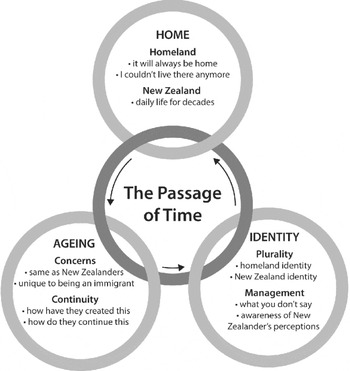
The yield from the interviews was particularly rich and several subthemes wound together around the broader themes of Home, Identity and Ageing. Underpinning and interconnecting these themes was the passage of time, which operates in specific ways for migrants. As time moved forward in both the homeland and host country its effect was experienced both in relation to the migrants' ageing selves and in relation to social changes in both places.
Figure 1 illustrates the final interpretive pattern that emerged from the interview analysis which drew on grounded theory (Strauss and Corbin Reference Strauss and Corbin1998). The second author reviewed the interview data and the emerging themes produced by the first author to provide additional interpretive consistency and (as is customary with a grounded theory approach), emerging categories were checked for significance and meaning with the interviewees as the categories were being developed. The first author's attendance at a writing workshop for immigrants produced an additional stream of critical reflection on the interview narratives allowing for theoretical sampling of the emerging coding relationships. At this point, we now move on to discuss the emerging interview themes in more detail and to place the specific findings of this project against the wider international literature.
Results of a thematic analysis of the interview narratives.

Identity
In asking the immigrants in this study to describe their national identity, their answers indicated that they identified both with New Zealand and their homeland. In doing so, they reveal the significance of context – in this case post-World War II New Zealand – on identity negotiation. All had arrived in a country that had only very recently loosened its ties to Great Britain and was beginning a journey to define itself and develop confidence as a nation. Through World War I, New Zealand had remained closely and tightly bound to the United Kingdom both economically and in terms of its cultural identity. Through World War II, New Zealand's immigration policy specifically sought British immigrants and actively discouraged and discriminated against non-European immigrants (Brooking and Rabel Reference Brooking, Rabel and Greif1995: 39). Though it was never officially declared as such, many New Zealand historians refer to the ‘White New Zealand’ policy that was in place through World War II (Ward and Lin Reference Ward, Lin, Liu, McCreanor, MacIntosh and Teaiwa2005: 196). When New Zealand needed more immigrants to fill the labour force of its burgeoning economy, it looked to the Dutch, who were considered the least different and most likely to assimilate (Beaglehole Reference Beaglehole1990: 13). This suited New Zealanders who were not only suspicious of people who were culturally different, but also felt that immigrants must assimilate fully and quickly. As New Zealand began to recognise the value in its own unique culture, it was particularly threatened by any challenge to this early identity formation.
As opposed to Pacific Island immigrants, who were also beginning to arrive in large numbers at this time often through extended family chains, European immigrants arrived in relative isolation – perhaps with a spouse or sibling at most and did not settle in concentrated areas. Elena, who arrived from Spain in 1964, believes that her family was the only Spanish family on the South Island. Ann's story of arrival from the Netherlands is also typical:
I came here four and half weeks on the boat, then we ended up in the railway station, eventually. My husband … they sent him straight to Roxborough [a remote village] to work on the dam because he was a carpenter. And I was left standing on the railway station. And I could not speak English. (Ann)
At that time, concentrations of villages or suburbs inhabited by the same European ethnic group were very rare (Brooking and Rabel Reference Brooking, Rabel and Greif1995) and as a result ‘the forces of assimilation were consequently more powerful in New Zealand’ (Beaglehole Reference Beaglehole1990: xi). Furthermore, when these immigrants arrived in New Zealand, they arrived to a unique cultural circumstance. Unlike many white-majority nations, New Zealand has a ‘label’ for its white born citizens, ‘Pākehā’, which has largely, though not without controversy, been adopted into common use. Pākehā and Māori together constitute New Zealand's formal bicultural status. At the heart of this bicultural history is the Treaty of Waitangi, signed in 1840 by the Tangata Whenua, the indigenous people, or Māori, and the colonisers/invaders (Spoonley and MacPherson Reference Spoonley, MacPherson, Spoonley, MacPherson and Pearson2004: 175). Contemporary Māori and Pākehā are still very much engaged in the conscious establishment of a political and social partnership of the type that was envisaged by the Treaty of Waitangi but has not been achieved – a nation within which Māori are equal partners and their culture, language and land rights are protected (MacPherson Reference MacPherson and Spickard2005: 216, 232).
Echoing around this national vision of biculturalism, another debate is under way, this time over whether New Zealand's vision of nationhood should be not bicultural but multicultural. New migrants have an ambiguous status in a bicultural society, and there is an implicit suggestion that immigrants must ‘wait their turn’ to negotiate their place in New Zealand's identity (Ward and Lin Reference Ward, Lin, Liu, McCreanor, MacIntosh and Teaiwa2005: 169). The immigrants in this study, obviously not part of New Zealand's indigenous population, and with white skin (the dominant marker of Pākehā) were expected to assimilate into Pākehā society.
There is often an assumption that when white immigrants move to a white-majority nation, they will assimilate easily and completely. This assumption negates the importance of white immigrants' homelands and cultures and the possibility that they will have hybrid identities in the same manner that non-white immigrants to a white-majority nation might have. Just two immigrants, Erik and Inger, defined themselves easily as New Zealanders, saying that after so much time in this country, and particularly in relation to other Danish people, they felt they were New Zealanders. By far the majority, however, described feeling like they were some sort of hybrid identity – a combination of their homeland and New Zealand. Consider Huberta's description of her national identity:
Every time we've gotten the forms to become naturalised … we just, you know, ‘hm’ [shrugs shoulders] … I am Dutch, and that is the weirdest about it all. That I can't get rid of my Dutch passport which means that I still see myself as being Dutch … And yet, when we're overseas, we're only just too proud to say we're from New Zealand … we don't hesitate, ‘Oh no, we're from New Zealand’. (Huberta)
Identity theorist Stuart Hall has described the multiplicity and changeability of identity, noting it is ‘a process never complete’ (1996: 2). For a long-term immigrant there is an un-ending process of negotiation including what Hall describes as ‘what is left outside’ (Hall Reference Hall, Hall and du Gay1996: 3). In other words, identity is partly solidified in relation to what it is not. As New Zealand has become more and more a part of these immigrants' individual identities, it has not consumed them. They are not only New Zealanders but rather are two or more nationalities, a situation in which ‘ambiguity is not a threat but a resource’ enabling plurality and the integration of several identities without trade-off (Sokefeld Reference Sokefeld1999: 424). This complex identity was reinforced by the migrant's frequent feeling that New Zealanders do not consider them to be New Zealanders. For example, Simon, an immigrant from Hungary who has been in New Zealand for 50 years, when asked if New Zealanders thought of him as a New Zealander, was unwavering in his response: ‘Until I die’, he said with gusto and a hand on the table ‘I will be a foreigner…’ He shared the following story:
A few years ago, I went to the supermarket. I happen to say to a particular couple … ‘Oh, isn't the mince expensive?’ And she turned around and she said, ‘But it's cheaper than in Hungary’. And I said, ‘Oh, yeah’. I've learned to keep my mouth shut. You know. It's hurt, but you don't say anything. She could have said, ‘Oh, yes, it is’. But just the way she said, ‘It's cheaper than in Hungary’. Other words, ‘You're still a foreigner’. You know, and I was here many, many years by then, but you're still a foreigner. (Simon)
Identity in such circumstances is ‘increasingly fragmented and fractured; never singular … constructed across different, often intersecting and antagonistic, discourses, practices and positions’ (Hall Reference Hall, Hall and du Gay1996: 4).
Sokefeld (Reference Sokefeld1999: 424) argues that the self manages these conflicting and competing identities, and within New Zealand's post-World War II society, the immigrants in this study often learned to hold their tongue, resulting in a continual process of self-editing. To mention so little of oneself is an act of great diligence and self-control, particularly as newly arrived migrants often feel great need to pass on stories of who they are (Bönisch-Brednich Reference Bönisch-Brednich2002: 178) in order to create a bridge between then and now. Forty years of editing can make splits in the fabric of time and space so that childhood memories are not only of a foreign land but become foreign to the assimilating self. Such efforts continue through one's life as Huberta describes:
I was really involved with church groups … we'd have … potluck dinners I'd bring my Dutch dishes … One day somebody said to me, ‘Oh yes but you are one of us’. And I saw it as a great compliment but at the same time I thought, ‘You have no idea what my past has been like. How can I be one of you?’ … All my past had to stay behind me … was chopped more or less… (Huberta)
Alice mentioned needing to keep many of her political opinions to herself and for many participants the only New Zealanders of their generation with whom they could discuss their previous lives were the returned World War II soldiers whose war duties had exposed them to European ways and culture. Elena expressed a similar sentiment of generally ‘needing to be careful’:
People have never been rude to me. It's something I can say. But I just felt like I was a foreigner sometimes. Like: Don't criticise anything … I criticise my country a lot … But I could never criticise anything of New Zealand because it's like, ‘Hmmm, why are you here then?’ You see? And you have to be very careful … You have to be aware of who you talk with, how they are going to take it. (Elena)
Thus, over 40 years and longer, many of the immigrants in this study have kept their foreign origins and perspective in the background and while assimilation was the primary strategy offered to them by New Zealand society, it was also the strategy chosen by the immigrants themselves. They tried various methods of negotiating their identities and place in New Zealand, judged the outcome, and made adjustments accordingly. Many of these immigrants came from harsh backgrounds and were very appreciative of the opportunities provided in New Zealand. Learning the New Zealand way seemed to offer the best chance of success.
The isolated settlement pattern experienced by the immigrants in this study seems to be atypical in the literature on older immigrants which is more often within, or with close ties to, an immigrant enclave (seeBecker Reference Becker2002; Ganga Reference Ganga2006; Gardner Reference Gardner2002). For example, Huber and O'Reilly (Reference Huber and O'Reilly2004) studied the aspirations, social life and patterns of association of Swiss and British retirement migrants in Spain, and found that they did not need to integrate into Spanish society, nor learn the language, to feel fulfilled and at home in Spain. In this case, integration ‘can be seen as a bonus not a necessity’ (Huber and O'Reilly Reference Huber and O'Reilly2004: 347). In a separate and extensive ethnography of British retirees in Spain, Oliver (Reference Oliver2008) included the perspective of Spanish residents near British enclaves and found that they do not expect retirement migrants to integrate. In this way, Oliver illustrates ‘a mutual drawing back’ from integration by both migrants and local residents (2008: 149). In contrast, the immigrants in our study have held on to a small but vital part of their homeland identity while largely adopting a New Zealand-based identity as life unfolded and intertwined with this host nation. One study that does consider the ramifications of an immigrant group thinly dispersed through their host country's population and geography is Izuhara and Shibata's (Reference Izuhara and Shibata2001) research on the adaptation processes of Japanese women who migrated to Britain after World War II and have aged in place. In agreement with our own work, they noted that minimal contact with fellow expatriates accelerated the women's assimilation.
Home
We now shift the discussion of lived experiences of globalisation and transnationalism to consider the effect of changes in one's homeland on the participant's migrant identity. These changes became abruptly apparent when the interviewees finally managed to make the trip back to their originating country. Upon arrival, they were immediately confronted with a reality quite different from the imagined homeland that rested in their memories prior to the advent of globalisation and readily available telecommunication and transport technology.
Contemporary theories of transnationalism suggest the insufficiency of conceiving a nation, a culture or home as a bounded entity and this is reflected in the answers that the immigrants in this study gave when asked, ‘What, or where, is home to you?’. Huberta, who immigrated to New Zealand from the Netherlands 48 years ago, answered:
When I go to Holland, I just sit on the market place … The old churches they have there, you have the market place and … I have a salted herring … I have that and the carillons are playing old Dutch songs that I used to sing as a child … I'm just so, so happy.
As she continues, she returns (mentally) to the room of the interview:
But again, after a while, I think of this room and how comfortable I feel here, and the sun streaming in. And that is home. And the friends we've made here, that makes it really home … this, New Zealand, is home now … Every time I'm in Holland I just feel I am home again … I know now, my feet are in both countries. (Huberta)
As Huberta illustrates, memory is an important component of home. ‘Without memory, we are everywhere or nowhere … Without memory, all places are equal and alien’ (Rubinstein Reference Rubinstein, Rowles and Chaudhury2005: 112). Through memory and experience, home becomes a ‘locus of security and a point of centring and orientation’ (Chaudhury and Rowles Reference Chaudhury, Rowles, Rowles and Chaudhury2005: 3) so that it becomes a physical, cognitive and emotional fulcrum from which a person sees life. In a new country, the immigrant views everything from the perspective of a hilltop back in the homeland. However, with the passage of time, familiarity is gained, adaptations are made, certain aspects of life in the new country are preferred, and many milestones are passed. Memories begin to be formed in New Zealand: the arrival as a young adult with one piece of luggage, the first house, the old car that needed to be refilled with oil before every trip, the children's school plays, then their marriages, the career achievements, the friends who helped when the pipes froze and burst. It is this process, the unfolding of the lifecourse, to which the migrants referred when they spoke of having two homes: the homeland and New Zealand.
Ten, 20, even 30 years after migrating, a changing world of faster, cheaper travel finally allowed a return visit to the homeland; a physical experience of the homeland as home. (All but one of the immigrants in this research have been back to their homelands at least once, most have been back a handful of times.) From a phenomenological perspective, home can be thought of as a ‘visceral sense of being in place’ (Rowles and Chaudhury Reference Rowles, Chaudhury, Rowles and Chaudhury2005: 380), and such experiences were compelling for all the participants. Consider Beatrice's description of her visits back to Scotland:
I have a deep sense of belonging in Scotland, a deep sense of HUGE familiarity when I go back. It's the atmosphere … the air … the accents … the buildings, fields … the time that is taken … And it's like going into a warm bath in some ways. (Beatrice)
Return visits re-iterated ways that the homeland will always be home, such as intangible feelings of familiarity or being recognised at the local bakery after 24 years away.
However, return visits to the homeland simultaneously had the completely opposite effect, for without the benefit of directly experiencing the passage of time in that place, witnessing the changes that had taken place was often unsettling. Returning, physically, to a place that we associate with a certain time in our lives and a piece of our identity can be a ‘highly charged experience, more so if we find that place has changed’ (Marcus Reference Marcus, Altwin and Low1992: 89). After decades away, the changes were phenomenal – the parents deceased, the old family house inhabited by strangers, and the experience of being a visitor staying in the spare room of a nephew one hardly knows. There were also new social norms and gender roles. Many found the experience deeply shocking.
When we were home, I went to see where I had lived … it was like four streets were joined together … it was all apartments and there [had been] all these children playing in the back yard. So I went and had a look, opened the gate and I nearly died. I thought, ‘How can this be possible?’ There was a great big place where there was lawn, where the clothes would be hung outside, there was a beautiful garden and so on. That wasn't there anymore, it was all garages … And I thought, ‘Gee where are the kids playing?’ So I came back here, there was a Dane we had a lot to do with … and I said, ‘Where does the kids play? … There must have been 300, 400 kids in the backyard!’ He said, ‘there's no kids … they are in crèche, kindergarten, school. Mom and dad work, there's nobody’. (Inger, who left Denmark in 1958 and returned in 1986)
Experiencing all of these changes in the homeland had an interesting consequence. Not only did the unsettling feelings illustrate the ways in which the homeland was no longer home, but many immigrants regarded this as the moment when New Zealand started to feel much more like home. The feeling of dislocation in the old country gave the immigrant permission to call New Zealand home too.
I left my twin sisters when they were eight. When I came back they were married and had children. That was incredible … And my mother, she shifted into an old people's home … so my home was gone. I couldn't go back home. It was all very strange. I stayed with my sister … It did not feel like home anymore … I was glad to get back to New Zealand. … I thought, ‘Isn't it crazy, when you are here you want to go home and when you are in Holland you want to go back!’ But that was a good thing, probably, because I settled down quite well after that, really. (Ann)
Indeed over time, it seemed that for many, New Zealand had become the only home they could really consider living in. Again and again in the interviews, the sentence, ‘I couldn't live there anymore’, was uttered. The sentiments expressed below by Rene were common:
I said to the wife, ‘I've still got a few years health’, I said, ‘What about if we go and spend the winter there to find out?’ … We had to go and get our groceries, we paid the electricity bill, we did everything like we were living there … I wanted to find out, ‘Do I want to go back like this?’ … Every day the lights never went out because it was so grey … it was depressing … And we've changed, they've changed. Their attitude, their lifestyle. We are much more liberal … our thinking is out of the square … They just carried on still in that little path, well, because that is how they made their living. So I think I came back and decided now that this is not for me. It settled me down. (Rene)
What a profound experience to realise the inability to live in the home that has been remembered and cherished through all the years away!
This sustained cherishing of the homeland evokes the concept of Heimat, a term, that has undergone an evolution of meanings after being closely associated with the Sudeten Germans expelled from Sudeten, and forced to return to Germany after World War II. Although at times Heimat has been strongly associated with Nazi Germany and this historical context is important, the term has been de-nazified in popular use today (Svasek Reference Svasek2002: 498). Heimat is, in part, an idealisation of the homeland with inherent glorification and a focus placed on positive associations and memories. The very nature of Heimat is a place where one feels ‘at home’; all distress and disruption is outside (Svasek Reference Svasek2002: 498). Heimat captures the sense of the distant home sometimes yearned for by immigrants, often remembered, but unrelated to the contemporary reality of the place. The original home carried by immigrants is not a literal place, but a piece of identity grounded in and associated with that place. Though most would no longer consider living there, few would negate the importance of their homelands. As Eric said, ‘It's still home and you never forget your origins … you never lose your childhood memories, they're with you forever’.
Riley (Reference Riley, Altman and Low1992: 20) asks ‘Is it possible that the greater power of place lies not in inhabiting it but in remembering it?’ In the case of an immigrant's homeland, these folk would nod yes. It is the experience of the setting where significant life events unfolded, where key interactions took place and where those events and interactions triggered emotions and the development of identity. As Rubinstein (Reference Rubinstein, Rowles and Chaudhury2005: 115) puts it: ‘There is an indivisible link between place and person … We are defined in part by the environments through which we have passed’. For immigrants who have undergone an extreme change in time, place and identity, these memories are particularly important. As Huberta said, ‘I lost my identity … then that was slowly built again’. Remembering places that have been ‘home’ ‘preserves self-identity and provides the critical thread for continuity into the future’ (Chaudhury and Rowles Reference Chaudhury, Rowles, Rowles and Chaudhury2005: 13).
Feeling a bond with a place is not an event, it is a process that continues throughout life and old bonds can continue as new ones are formed (Rubinstein and Parmalee Reference Rubinstein, Parmalee, Altman and Low1992: 143). Over time, while maintaining an attachment to their homeland, these immigrants have also developed a strong attachment to New Zealand – the setting of their lives and memories for over 40 years. Attachment to place, both current and remembered, is needed to maintain a coherent sense of self (Rubinstein and Parmalee Reference Rubinstein, Parmalee, Altman and Low1992: 139).
Many of these points resonate with other studies of older migrants. For example, the notion of family is important in the development of home because as parents, siblings and peers in the homeland diminish over time, a family of children and grandchildren often is simultaneously being created in the host country. Ganga's (Reference Ganga2006: 1404) study of Italian immigrants in Nottingham, England, found that the presence of highly integrated children and grandchildren eventually turned ‘temporary’ Italian labourers into ‘permanent’ immigrants who now feel at home in Nottingham. Contradictory feelings about the homeland and host countries are also obvious in the literature. For example, the migrants in the Leavey, Sembhi and Livingston (Reference Leavey, Sembhi and Livingston2004) study, which examined the complexities of maintaining an authentic identity for Irish immigrants who have aged in London, expressed a strong attachment to and identification with Ireland and an emotional, spiritual yearning for it, while simultaneously describing it as miserable and admitting that they would not strongly consider living there again. Gardner's (Reference Gardner2002) study explored how Bengali immigrants' experience of growing old in London was intricately tied to their host country and homeland over time. She found that they maintained two realities of home: one based in material reality and one based more on nostalgia. Gardner also found that contradictory feelings and ambiguity towards both the homeland and host country were a manifestation of an ageing immigrant's changing physical, spiritual and emotional needs relative to the changing contexts of their two homes. An immigrant thus draws on a particular element of home, based in one place or the other, depending on circumstances, perspectives and needs at different points within the lifecourse.
Ageing
As we have noted, the transnationalised sense of home that emerged from opportunities to return to the country of origin was a comfort; however, the ability to make use of a globalised world to revisit the old country diminished with age as income and physical strength began to wane. Interestingly, there is little data about how older immigrants of European descent feel about older age in New Zealand as local discussions of ethnic diversity in older citizens is framed in terms of Māori, Pacific Islanders and Asians (the subgroups with highest population growth) while European migrants become subsumed under the ethnic category of European/Pākehā. This subsumption emphasises our earlier argument that these white immigrants were, and still are, expected to assimilate into Pākehā New Zealand society. It is also a prime example of the insidious racialising of public life – a well-noted unintended consequence of New Zealand's bicultural policy.
Many of the immigrants in this study expressed specific concerns about ageing that were unique to ageing immigrants. For example, several were aware that a second language learned in adulthood can fade or be lost entirely in very old age (seeIzuhara and Shibata Reference Izuhara and Shibata2001). Another challenge unique to being an immigrant lies in having few people, if any, to reminisce with about childhood or one's original home. In old age, there is a tendency to become more nostalgic through reminiscing about previous times, events and the place associated with those earlier memories (Akhtar and Choi Reference Akhtar and Choi2004: 187).
As mentioned earlier, the immigrants in this study came to New Zealand in relative isolation and of the few contacts they did have, many participants mentioned the dwindling numbers of these peers. The loss of fellow immigrant friends with their shared remembrances can be particularly intense, even ‘soul-wrenching’ as Akhtar and Choi have framed it (2004: 188). This was evident for Elena who had known her late husband ever since their shared adolescence in the same small Spanish town.
So I come here and I always have him. And we have the same memories and we have the same people. But when he passed away, that's what I missed a lot. I couldn't really say, ‘Remember this?’ ‘Remember we went here or there?’ … ‘Who did this person marry to?’ That was cut off completely because my daughters didn't know anybody there. (Elena)
Similarly, for Ann, the person who shared her memories of the Netherlands and the years of making a life in New Zealand is now gone. During the interview, Ann also mentioned feeling a little separated from the others in her retirement village who, because they were all New Zealanders, did not share in these memories and could not understand her migration life story.
While the upsurge in travel that marks contemporary globalisation means that many immigrants in this study do continue to meet younger, new immigrants from their homelands, although enjoyable, this is not the same as interacting with other immigrants who came from the same area during the same era. As Simon noted:
Now we have another generation Hungarian. They only been in the country for three, four, five years. They are different all together than us because they come here, they knew what is the country, they knew why they coming here … It's 1957, we come here as refugees. We had no money, no nothing. The new generation got money, got everything … they knew what they want, and they succeed what they doing. And jolly good luck for them, they are very very nice people, but they have a different outlook on life … I mean, I come here with a wee sport bag … This people come in a different story all together, you know? (Simon)
As we mentioned at the outset of this section another unique issue of ageing in an adopted country is the eventual loss of the ability to make return visits home. This causes the post-World War II immigrant's situation to come full circle: when they left home, travel was expensive and lengthy, not undertaken easily or frequently, if at all. Globalisation changed that for a time, allowing anywhere from one to ten visits back to their homelands. Now, several factors again limit travel. The journey, though so much quicker than it used to be, is often too tiresome and hard on the body now. Beatrice mentioned that the weakness of the New Zealand dollar makes visits difficult to afford and negates the option of retiring in Scotland. Several people mentioned that with only a retirement pension now, further visits are no longer possible. With limited funds and few familiar faces and places to visit, Eric mentioned, with tears in his eyes, that he had made his last visit back to England.
This last trip in 2006, it was my goodbye trip. We don't think we'll be going again unless we win Lotto. I just went for a good look around, actually. The old district, that was all. All the old things we used to see. Just went to say goodbye to the place … I think it was the right thing to do. It was a wee bit hard but it was good. (Eric)
At the time of the interviews, many immigrants knew they had already made (or were about to make) their last visit back to their country of origin and this brought additional worries. As Becker notes in reference to older Cambodian and Filipino immigrants in the USA, ‘the complicated business of living in two worlds is made still more complex by the need to choose in which to die’ (Becker Reference Becker2002: S91). Death and burial was a topic that that had been well thought through by all the participants.
According to Akhtar and Choi (Reference Akhtar and Choi2004: 189), when it comes to burial, many individuals seem to have two main desires about where their remains will be kept: to be close to their children and to their ancestors. This presents an obvious difficulty when there is a case of great distance between one's children and one's ancestors. Most of the folk in our study wanted to be buried or have their ashes scattered in New Zealand. However, the absence of family graves in New Zealand meant a need for creative solutions. Erik and Inger had opted to have their ashes scattered on the family's favourite lake in New Zealand. Inger said, ‘I'm against cremation but we will do it. Because we've never known that, it was always bury … Then we thought for the girls’ sake, family all over the place … that's one problem solved'. For Ann, she imagines that her ashes will be scattered in the same garden where they scattered her husband's ashes because all six of Ann's sons have married New Zealand women and will probably be buried with their wives' families. (There is a sense that Ann feels a bit alone in this situation.) Simon wants to be buried in New Zealand, but with a headstone that says ‘Rest in Peace’ in Hungarian. He had already written it down for his New Zealand wife to reference.
Considering death, Becker (Reference Becker2002: S92) says, provokes a desire to integrate the various aspects of one's life and create some continuity for oneself, however, it was not the only topic through which these immigrants created a continuous sense of self through their life journeys. Anthropologist Sharon Kaufman writes that ageing is a ‘continual creation of the self through the on-going interpretation of past experience, structural factors, values and current context’ (1986: 150). When older people can draw meaning from the past, in her opinion, it helps them look to the future with a stronger sense of self despite the physical or social limitations of ageing. In a similar vein, Robert Atchley (Reference Atchley, Gubrium and Holstein2000) suggests the persistence of ideas, temperament, preferences and skills over time create a sense of self built upon the accumulation of experience and accompanying self-reflections throughout life. It is this process which allows folk the opportunity to make adaptive choices to deal with change. The immigrants in this study repeatedly discussed lessons learned or characteristics gained from the experience of migration, the most prevalent of which was the ability to be extremely independent. This is a quality that many immigrants now value in themselves and call upon as a resource when looking into the future.
Some immigrants described how learning to be independent came through hardship and was ‘forced upon’ them. Several immigrants recalled learning to trust instinct and judgement because they did not have anyone to discuss important decisions with anyway. It was lonely at times. Over the years, however, the isolation that started out as a hardship slowly became a cherished form of privacy and confidence. Erik and Inger believe their learned independence has given them the strength and fulfilment that they carry with them now:
E: …You learn to look after yourself, there's nobody.
I: If the roof falls off or anything, we can fix it, sort of thing.
E: …Out here, we do things together and if anything happens, well you've got to fix it. You got into trouble and there's only one person to get you out of it. I think that's something that has made our life –
I: Strengthened it.
E: Strengthened it and fulfilled it.
There is a sense that their migration experiences have given them some personal skills that they can utilise upon entering or travelling through old age. Ann, for instance, did not sugar-coat how hard her first decades in New Zealand were. However, when later asked if not knowing anyone in her new retirement community was difficult, she replied, ‘But you see I go from Holland to a country where I don't know anybody. So you come through all of that, you see’. Calling upon her experience of migrating from the Netherlands to New Zealand reminded her that this was nothing she could not handle! Gwynneth, who migrated to New Zealand 40 years ago, viewed her approach to older age as just another transition in a life full of transitions, like travelling, again, to a foreign country:
So what I think about ageing is this: I think that again I'm entering into another country … And all that has enabled me to travel to countries and territories that I have travelled to up until now in my life will enable me to travel into this new territory … I feel at sea, I feel as lost as that 17-year-old who arrived in New Zealand at Auckland airport. But I'm not. I'm not that age and I have all these skills and I have all these experiences that I am travelling with. (Gwynneth)
Many immigrants conveyed a sense of capability and satisfaction regarding their achievements in New Zealand after starting out with nothing but ambition. Of course paradoxically, it is this more than anything which has assimilated them into the social patterns of stoicism, independence and ‘Kiwi’ ingenuity which mark the Pākehā cultural ideals of adult self-sufficiency.
Other studies have also found that migrants may value the independence that often comes with migration. For example, Leavey, Sembhi and Livingston (Reference Leavey, Sembhi and Livingston2004: 776) found that Irish women ageing in London left what they recalled as an oppressive society and experienced far more freedom in London. Oliver (Reference Oliver2008: 93) found that a wish for independence from societal restrictions put upon the ageing, adult children and family responsibilities, was a motivator behind migration for British retirement migrants in Spain. However, it is important to note that older immigrants who have migrated more recently have done so in a globalised world: those with the desire and resources to do so can maintain a more transnational existence such as most British and Swiss retirement migrants in Spain, who go home or receive visitors from home at least once a year (Huber and O'Reilly Reference Huber and O'Reilly2004: 339–40). These modern intra-European older immigrants also benefit from the proximity of their home and host countries and a shared currency or exchange rate that works in their favour.
Whether or not older immigrants are able to travel back and forth to their homeland, some debate exists about whether a strong ethnic or homeland identity acts as a shield against problems that can arise with old age. Tammeveski (Reference Tammeveski2003: 411) found that Estonian immigrants ageing in the USA can call upon their Estonian identity to protect them from the invisibility that often comes with old age in a mass society that considers age itself problematic by providing social connections and a role as keeper of traditional knowledge within an ethnic enclave. Becker (Reference Becker2002: S81), however, says that viewing ethnic identity as a strong resource in old age is overly optimistic although it does help create continuity across a lifetime of change, a human need that is particularly poignant in old age and when beginning to consider death. Similarly diverse conclusions arise around considerations of death by older immigrants. Becker (Reference Becker2002), for example, found that most Filipino and Cambodian immigrants, who came to the USA in later life, wanted to return home for death and burial. Similarly, Gardner (Reference Gardner2002) found that amongst Bengalis who have aged in London, death and burial in Bangladesh is more desirable spiritually but not always possible. Oliver (Reference Oliver2008), however, found that most British retirement migrants wanted to remain in Spain, though some go to great lengths to ensure a traditional British burial. Clearly, all older immigrants must balance the unique factors of their circumstance around the logistical, emotional and spiritual aspects of death in both their home and host counties.
Conclusion
This study fits into the area where international migration and gerontology overlap and thus contributes to our understanding of the intersection of globalisation, migrant identities and ageing. We suggest that the increasingly robust discussion around the plurality of home and identity also applies to older migrants, including those who have aged in place for over 40 years. Whereas many studies on older migrants only peripherally mention the significance of context and the passage of time in negotiations of home and identity, this study joins Gardner's (Reference Gardner2002) study of Bengali elders in London to place these concepts as central to the process. Similar to Gardner's work we suggest that even after decades in a host country, those ambivalent expressions of home and identity remain and in fact have been perpetuated, not solved or settled, by the passage of time. We also find, along with Leavey, Sembhi and Livingston (Reference Leavey, Sembhi and Livingston2004), that unexplored assumptions of sameness for immigrants based on proximity, ‘whiteness’, language or familiarity will oversimplify the aged migration experience. Our own work suggests that there is no point at which the migration process can be stamped ‘completed’ or be fully ‘assimilated’ nor does ‘whiteness’ imply an easier experience of negotiating one's migrant identity.
Though New Zealand society pushed the path of assimilation for the post-World War II migrants in our study, the immigrants themselves have not traded in one national identity for another but have quietly encompassed both. While they still keep the foreign part of their identity and their different perspective to themselves, they nonetheless demonstrate the importance of continuity for older migrants that other researchers, particularly Becker (Reference Becker2002), have found. They do so in the manner in which they always have: by maintaining small, private bridges that link their identities and experiences together across time and oceans (e.g. a few household items, some holiday traditions or traditional foods, attendance at a national club a few times each year, or playing music from home on Sunday afternoons). The passage of time has allowed for change in New Zealand which, by creating an audience more receptive to an immigrant's perspective, has provided them more space to express their multiple identities. Native-born New Zealanders, once extremely geographically isolated, are now more exposed to different cultures through migration, media and travel and no longer, for example, does Elena (the Spanish participant) have to buy olive oil for her Spanish cooking at the local pharmacy. As difference has become somewhat less threatening in this changing context, maintaining a continuous self has become easier for these older migrants and the ageing and delightful contributors to this research project provide a complex and sophisticated understanding of the lived experiences of long-term, transnationalised migration.
Acknowledgements
The authors gratefully acknowledge Les O'Neill for designing Figure 1 and the two anonymous reviewers for their generous, helpful feedback and suggestions.