Introduction
The lichen genus Bryoria Brodo & D. Hawksw., including some 30–40 currently recognized species, has traditionally been treated as a member of the ‘alectorioid’ lichens, characterized morphologically by a fruticose, often hair-like thallus (Brodo & Hawksworth Reference Brodo and Hawksworth1977). In their revision of North American alectorioid genera, Brodo & Hawksworth (Reference Brodo and Hawksworth1977) segregated Bryoria from Alectoria Ach. based on differences in ascospore characters (colourless vs. brown, respectively), secondary chemistry (ß-orcinol depsidones often present vs. absent; usnic acid absent vs. present) and vegetative structures (for example, pseudocyphellae usually inconspicuous and depressed vs. conspicuous and markedly raised). They recognized five distinct sections of Bryoria on the basis of anatomical, chemical and morphological characters: Bryoria, Divaricatae (Du Rietz) Brodo & D. Hawksw., Implexae (Gyeln.) Brodo & D. Hawksw., Subdivergentes (Motyka) Brodo & D. Hawksw. and Tortuosae (Bystrek) Brodo & D. Hawksw. Section Subdivergentes was later transferred to the genus Nodobryoria Common & Brodo, differing from Bryoria by its cortical structure, lack of soralia and pseudocyphellae, as well as lack of secondary metabolites (Common & Brodo Reference Common and Brodo1995).
In a molecular phylogeny of the genus Bryoria, Myllys et al. (Reference Myllys, Velmala, Holien, Halonen, Wang and Goward2011) proposed a new infrageneric classification in which five sections were recognized, mostly corresponding to the sections of Bryoria, Divaricatae, Implexae, and Tortuosae of Brodo & Hawksworth (Reference Brodo and Hawksworth1977), but with the addition of section Americanae Myllys & Velmala. Section Implexae was amended to include most of the species assigned by Brodo & Hawksworth (Reference Brodo and Hawksworth1977) to sections Bryoria and Implexae. However, in contrast to other sections in Bryoria, genetic diversity in section Implexae was found to be minimal. In fact, only B. glabra (Motyka) Brodo & D. Hawksw. was supported as a distinct species, although some level of genetic isolation was observed between European and North American populations of B. capillaris (Ach.) Brodo & D. Hawksw. and B. implexa (Hoffm.) Brodo & D. Hawksw. These results are perhaps not surprising as taxonomic concepts within the section have been problematic, with many taxa defined almost exclusively on secondary chemistry.
The phylogenetic position of some North American taxa placed in Implexae by Brodo & Hawksworth (Reference Brodo and Hawksworth1977) remained unresolved in the absence of fresh material for DNA analyses. These include B. pseudocapillaris Brodo & D. Hawksw. and B. spiralifera Brodo & D. Hawksw., both restricted to coastal California northward to Washington and Oregon, respectively (Glavich Reference Glavich2003; Glavich et al. Reference Glavich, Geiser and Mikulin2005). Brodo & Hawksworth (Reference Brodo and Hawksworth1977) tentatively placed these species in Bryoria, owing to their resemblance to certain species in section Implexae, while at the same time noting that their production of conspicuous long, typically depressed pseudocyphellae might equally justify their placement in Sulcaria Bystrek (see Bystrek Reference Bystrek1971; Obermayer & Elix Reference Obermayer and Elix2003). By contrast, the pseudocyphellae of other members of section Implexae are usually shorter, more or less inconspicuous or in some species even absent. When fertile, Sulcaria and Bryoria are readily distinguished by their spores, which are 2–4-celled and yellowish to brown versus simple and hyaline, respectively (Bystrek Reference Bystrek1971). Unfortunately, fruiting bodies are unknown in both B. pseudocapillaris and B. spiralifera (Brodo & Hawksworth Reference Brodo and Hawksworth1977).
The phylogenetic position of Bryoria and Sulcaria has varied during taxonomic studies of alectorioid lichens. Kärnefelt & Thell (Reference Kärnefelt and Thell1992) considered Alectoria, Oropogon Th. Fr. and Sulcaria to constitute a separate family, Alectoriaceae, based mainly on reproductive structures including their relatively large, brownish, thick-walled, often multi-celled spores, their strongly amyloid asci, and the branched and anastomosing hyphae of their paraphysoids. Other traditional alectorioid genera (i.e. Bryocaulon Kärnefelt, Bryoria and Pseudephebe M. Choisy) lack these features and were consequently excluded from the Alectoriaceae. More recently, however, the multi-gene phylogenies of Crespo et al. (Reference Crespo, Lumbsch, Mattsson, Blanco, Divakar, Articus, Wiklund, Bawingan and Wedin2007, Reference Crespo, Kauff, Divakar, del Prado, Pérez-Ortega, de Paz, Ferencova, Blanco, Roca-Valiente and Núñez-Zapata2010) have shown that both Bryoria and Sulcaria belong in the Parmeliaceae and form an alectorioid group together with Alectoria and Pseudephebe, although the position of Bryoria within the group is weakly supported. The group additionally includes the recent segregate genus Gowardia Halonen et al. (Halonen et al. Reference Halonen, Myllys, Velmala and Hyvärinen2009) but excludes Bryocaulon, Oropogon and Nodobryoria, which have an uncertain position in the Parmeliaceae (see Thell et al. Reference Thell, Crespo, Divakar, Kärnefelt, Leavitt, Lumbsch and Seaward2012 for a review of the lichen family Parmeliaceae).
Our main objectives in this study are: 1) to examine the phylogenetic position and taxonomic status of B. pseudocapillaris and B. spiralifera and, 2) in the light of these results to evaluate the taxonomic delimitation of Sulcaria and Bryoria. These questions were addressed by means of phylogenetic analyses performed on representatives of all alectorioid genera (sensu Crespo et al. Reference Crespo, Lumbsch, Mattsson, Blanco, Divakar, Articus, Wiklund, Bawingan and Wedin2007, Reference Crespo, Kauff, Divakar, del Prado, Pérez-Ortega, de Paz, Ferencova, Blanco, Roca-Valiente and Núñez-Zapata2010; Thell et al. Reference Thell, Crespo, Divakar, Kärnefelt, Leavitt, Lumbsch and Seaward2012) and based on three gene regions: ITS regions of the nuclear ribosomal DNA, partial glyceraldehyde-3-phosphate dehydrogenase gene (GAPDH) and partial minichromosome maintenance protein 7 gene (Mcm7).
Materials and Methods
Taxon selection
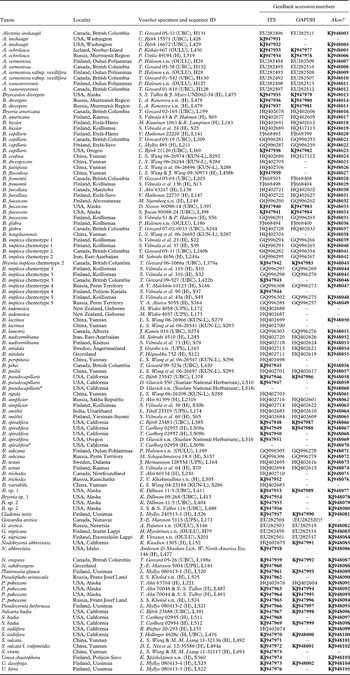
A total of 112 specimens were used in this study (Table 1). Seventy-one of these represented Bryoria (32 species), and eight represented Sulcaria (4 species). Taxa from all five sections of Bryoria were included, though in keeping with the putative placement of B. pseudocapillaris and B. spiralifera (Brodo & Hawksworth Reference Brodo and Hawksworth1977), special emphasis was accorded to section Implexae. In addition to the six Implexae species used in Myllys et al. (Reference Myllys, Velmala, Holien, Halonen, Wang and Goward2011), we also included for the first time B. pikei Brodo & D. Hawksw. in our analyses. That taxon is endemic to North America and was originally classified in section Implexae, as defined by Brodo & Hawksworth (Reference Brodo and Hawksworth1977).
Specimens used in this study with GenBank accession numbers. New sequences produced for this study are marked in bold. Bryoria pseudocapillaris and B. spiralifera specimens were submitted to GenBank as Sulcaria spiralifera(see discussion)

* Mcm7 sequences were obtained from these specimens but not used for analyses because ITS and GAPDH sequences lacking.
† GAPDH sequence (EU282520) for Gowardia arctica specimen L171 was published by Halonen et al. (Reference Halonen, Myllys, Velmala and Hyvärinen2009) but is not included in this study because it lacks the Mcm7 sequence.
In addition to specimens of Bryoria and Sulcaria, we also included representatives of all alectorioid genera (sensu Crespo et al. Reference Crespo, Lumbsch, Mattsson, Blanco, Divakar, Articus, Wiklund, Bawingan and Wedin2007, Reference Crespo, Kauff, Divakar, del Prado, Pérez-Ortega, de Paz, Ferencova, Blanco, Roca-Valiente and Núñez-Zapata2010; Thell et al. Reference Thell, Crespo, Divakar, Kärnefelt, Leavitt, Lumbsch and Seaward2012), that is Alectoria (11 specimens/4 species), Gowardia (4/2) and Pseudephebe (5/2), Bryocaulon divergens (Ach.) Kärnefelt (3) and Nodobryoria (4/3). According to Thell et al. (Reference Thell, Crespo, Divakar, Kärnefelt, Leavitt, Lumbsch and Seaward2012), these last two genera have an uncertain position in the Parmeliaceae but, as they have traditionally been grouped with the alectorioid lichens (Brodo & Hawksworth Reference Brodo and Hawksworth1977), we include them here. Cladonia mitis Sandst. (Cladoniaceae, Lecanorales) was used as outgroup. Pseudevernia furfuracea (L.) Zopf from the Hypogymnioid clade, three Usnea species from the Usneoid clade [see Thell et al. (Reference Thell, Crespo, Divakar, Kärnefelt, Leavitt, Lumbsch and Seaward2012) for definition of these clades] and Platismatia glauca (L.) W. L. Culb. & C. F. Culb. (uncertain position in Parmeliaceae) were also included in the analyses to test the monophyly of the alectorioid group.
Secondary chemistry
All Bryoria and Sulcaria specimens used in our phylogenetic analyses were examined for secondary compounds with thin-layer chromatography (TLC) using solvents A and B (Orange et al. Reference Orange, James and White2001). Methods were as those described in Myllys et al. (Reference Myllys, Velmala, Holien, Halonen, Wang and Goward2011).
Molecular methods
Total genomic DNA was extracted using the methods described in Myllys et al. (Reference Myllys, Velmala, Holien, Halonen, Wang and Goward2011). Sequences from three gene regions were generated for this study: the complete nuclear ribosomal internal transcribed spacer region (ITS), c. 1 kb of the glyceraldehyde-3-phosphate dehydrogenase gene (GAPDH) and c. 0·6 kb of the minichromosome maintenance protein 7 gene (Mcm7). ITS and GAPDH were selected based on our previous studies (i.e. Velmala et al. Reference Velmala, Myllys, Halonen, Goward and Ahti2009; Myllys et al. Reference Myllys, Velmala, Holien, Halonen, Wang and Goward2011), while Mcm7 has been shown to be promising at the species-level and genus-level studies of Spribille et al. (Reference Spribille, Klug and Mayrhofer2011a , Reference Spribille, Goffinet, Klug, Muggia, Obermayer and Mayrhofer b ) and Sadowska-Deś et al. (Reference Sadowska-Deś, Bálint, Otte and Schmitt2013).
PCR profiles for ITS regions and GAPDH gene followed those described in Myllys et al. (Reference Myllys, Velmala, Holien, Halonen, Wang and Goward2011), and PCR profiles for Mcm7 followed those described in Schmitt et al. (Reference Schmitt, Crespo, Divakar, Fankhauser, Herman-Sackett, Kalb, Nelsen, Nelson, Rivas-Plata and Shimp2009).
Sequence alignment and phylogenetic analyses
We aligned our DNA sequences with MUSCLE 3.7 using default parameters (Edgar Reference Edgar2004) on Hippu server system at CSC – IT Center for Science, Finland (http://www.csc.fi/english). We constructed three separate data sets to avoid the introduction of missing data in the analyses: ITS data set included 110 terminals, combined ITS+Mcm7 data set 101 terminals, and combined ITS+Mcm7+GAPDH data set 76 terminals (see Table 1). Each data set was subjected to parsimony and Bayesian analyses. Parsimony analyses were performed in TNT version 1.1 for Windows (Goloboff et al. Reference Goloboff, Farris and Nixon2008) using the option traditional search with the following settings: random addition of sequences with 100 replicates and TBR branch swapping algorithm. Ten trees were saved for each replicate. The bootstrapping method as implemented in TNT was used with 1000 replicates to estimate node support. The program jModelTest2 version 2.1.1 (Guindon & Gascuel Reference Guindon and Gascuel2003; Darriba et al. Reference Darriba, Taboada, Doallo and Posada2012) was used to estimate an optimal evolutionary model for Bayesian analyses by calculating AIC (Akaike Information Criterion) scores for each gene region. For the ITS region, evolutionary model was estimated separately for each partition. Models with the lowest AIC scores were used in the analyses. For ITS1, ITS2, Mcm7 and GAPDH the model GTR+I+G was selected, whereas the model K80 was used for the 5.8S. Bayesian analyses were performed on all three data sets using MrBayes version 3.2.2 (Huelsenbeck & Ronquist Reference Huelsenbeck and Ronquist2001). For the ITS and ITS+Mcm7 data sets two parallel runs of 10 000 000 generations for ITS and 15 000 000 generations for ITS+Mcm7 were performed using four chains and sampling every 500th tree. The first 25% of samples, corresponding to 5000 samples for ITS and 7500 samples for ITS+Mcm7, was discarded as burn-in. For the ITS+Mcm7+GAPDH data set, two parallel runs of 20 000 000 generations were performed, also using four chains but sampling every 1000th tree. The number of samples discarded as burn-in for this data set was 5000. The temperature parameter was set to 0·05 for all three analyses.
Results
We produced 173 new sequences for this study: 46 ITS sequences, 103 Mcm7 sequences and 26 GAPDH sequences. The remaining 114 sequences used in the analyses are from our earlier studies (Halonen et al. Reference Halonen, Myllys, Velmala and Hyvärinen2009; Velmala et al. Reference Velmala, Myllys, Halonen, Goward and Ahti2009; Myllys et al. Reference Myllys, Velmala, Holien, Halonen, Wang and Goward2011).
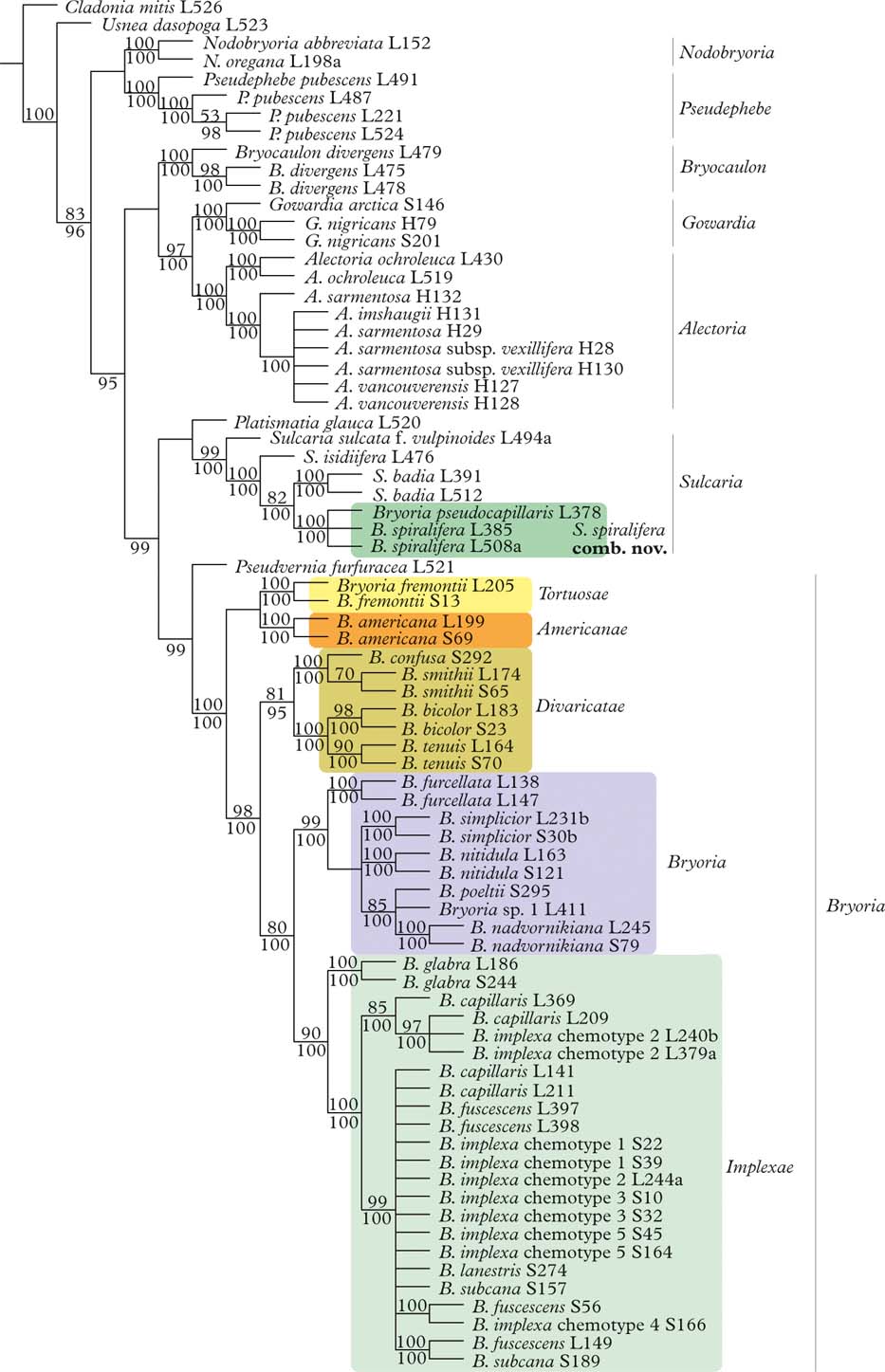
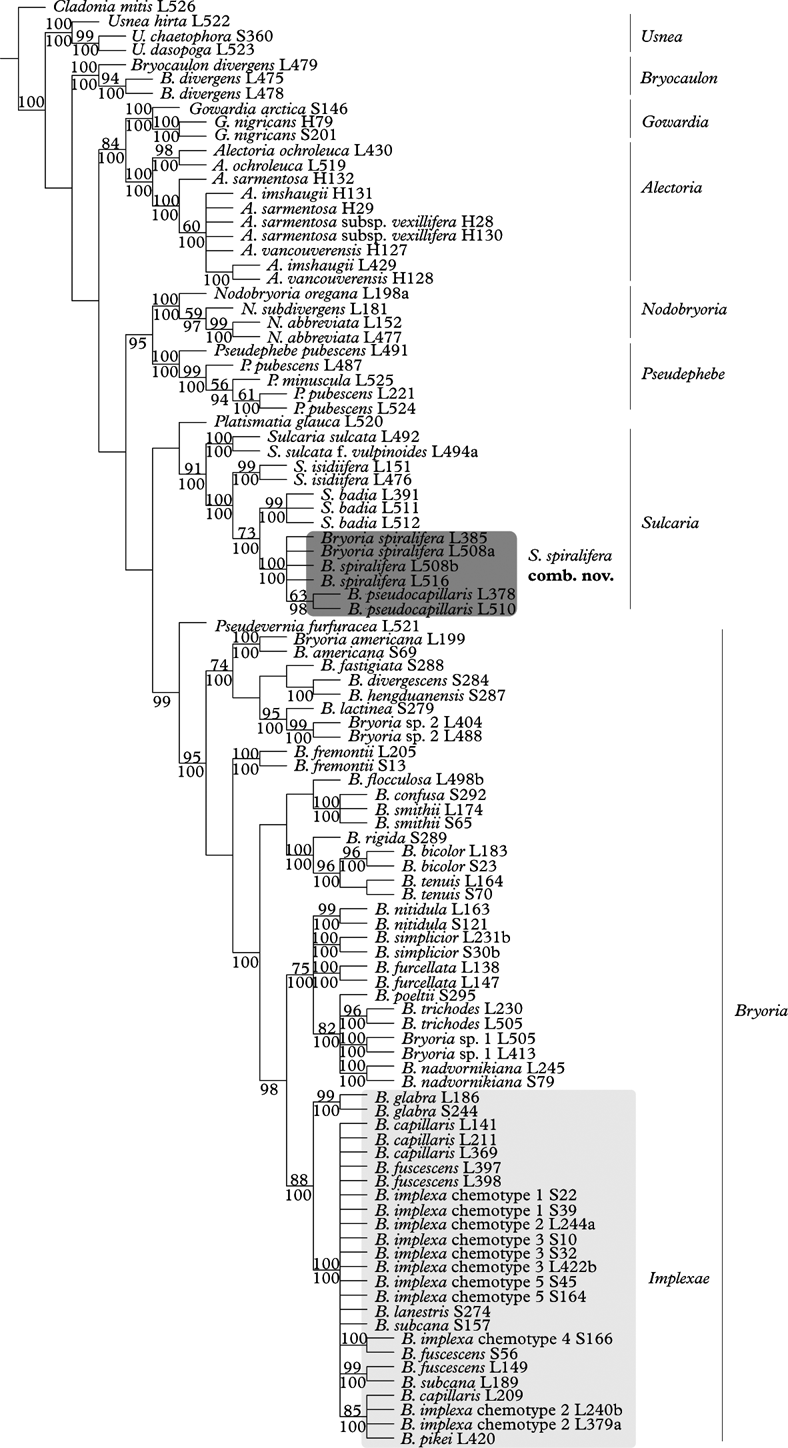
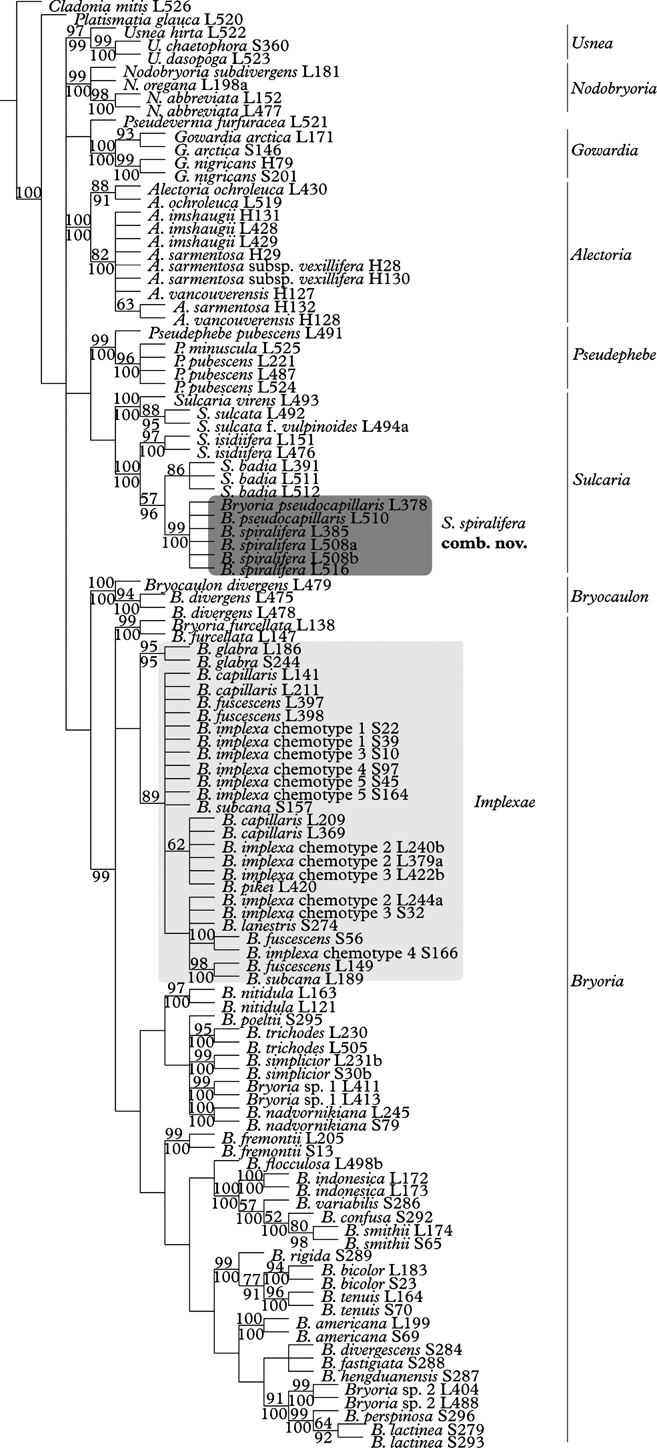
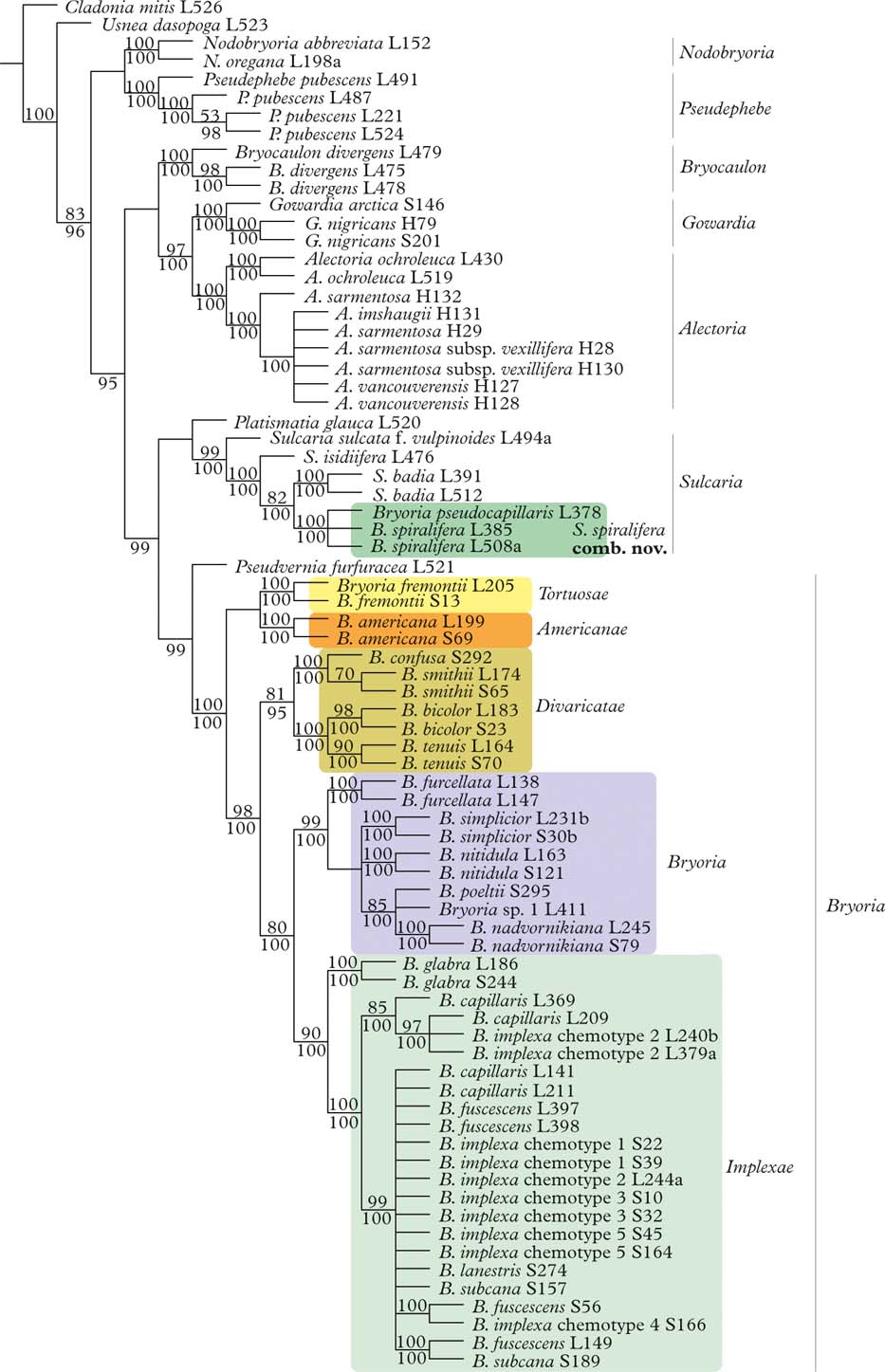
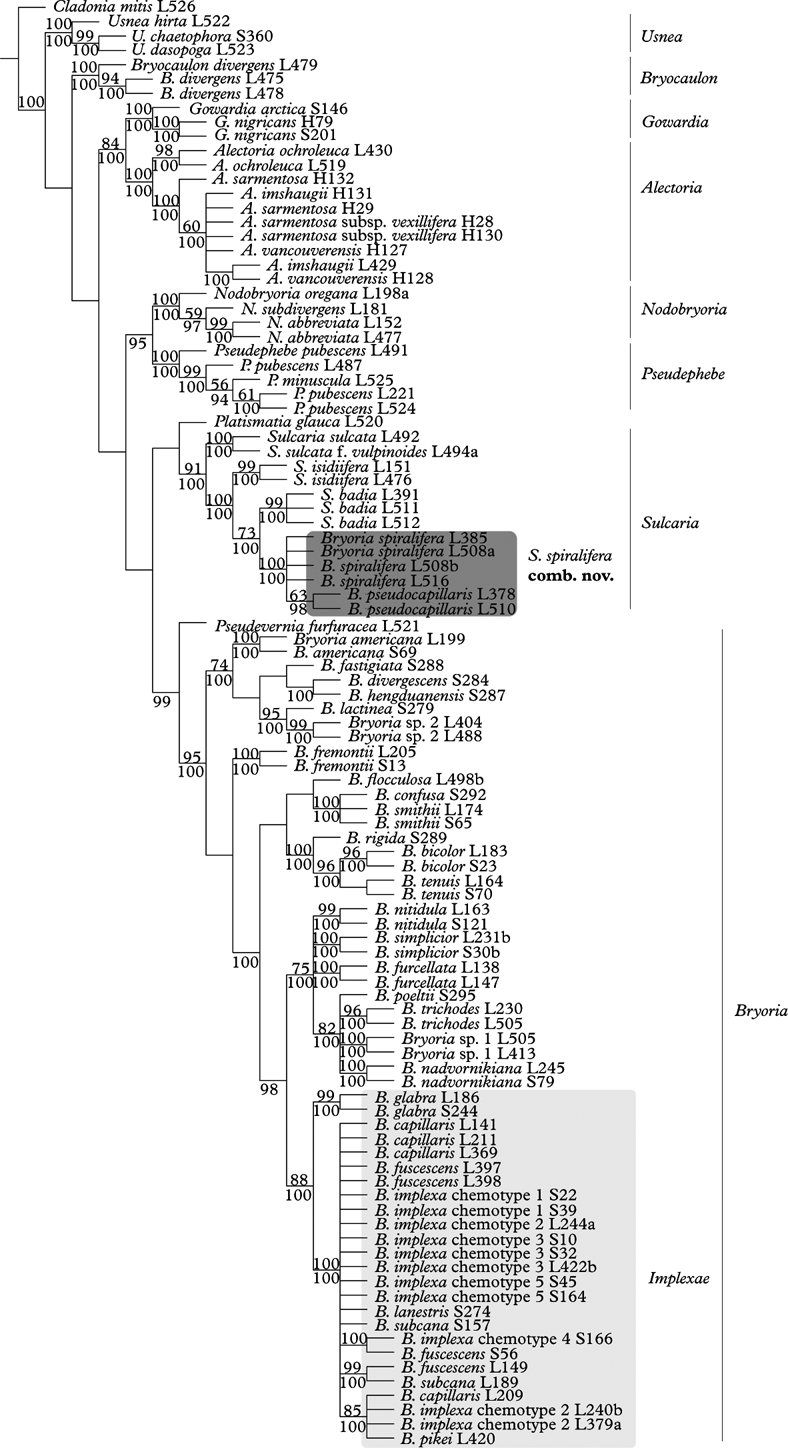
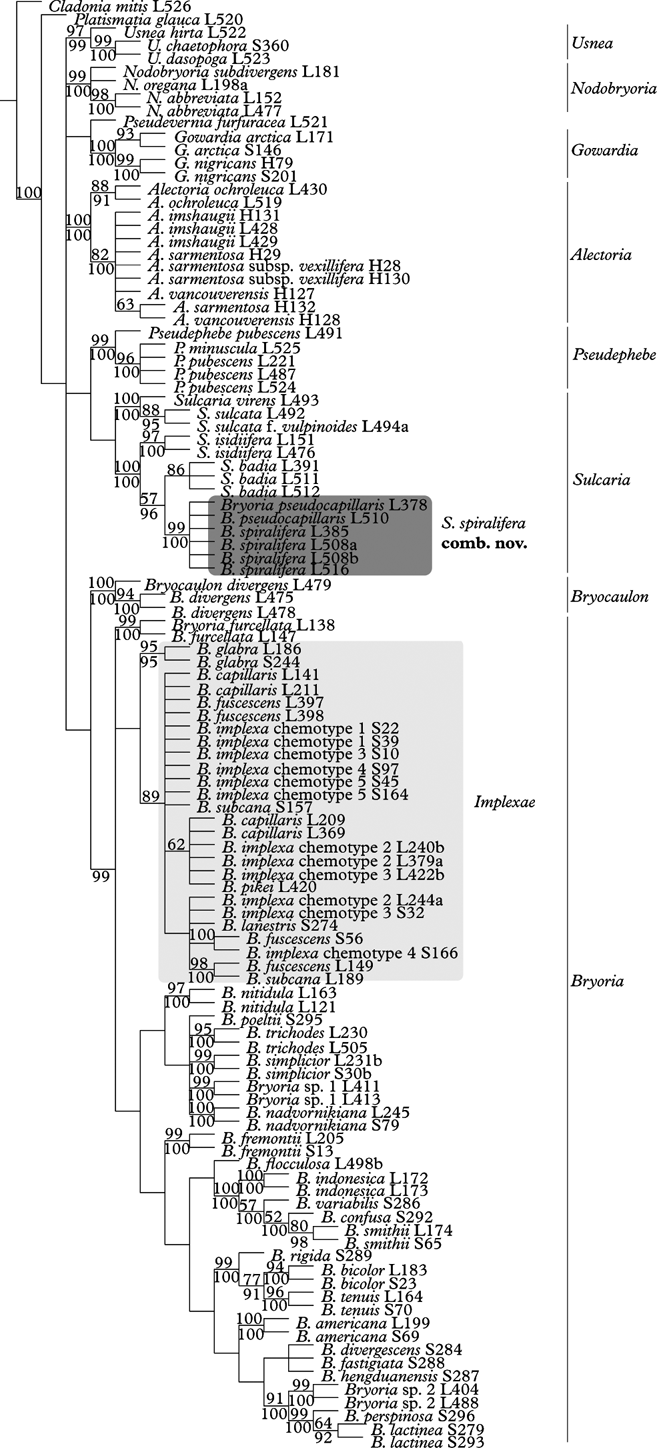
Since the topologies of the TNT and Bayesian analyses did not show any strongly supported conflicts, only the trees obtained from the TNT analyses are shown (Figs 1–3).
Molecular phylogeny of alectorioid lichens focusing on Bryoria and Sulcaria. Strict consensus obtained from TNT analysis based on a combined ITS, Mcm7 and GAPDH data set. Bootstrap values ≥50% obtained from TNT analysis are shown above nodes and BPP values ≥90% obtained from Bayesian analysis are shown below nodes. Five Bryoria sections and positions of B. pseudocapillaris and B. spiralifera are indicated in coloured boxes.
Molecular phylogeny of alectorioid lichens focusing on Bryoria and Sulcaria. Strict consensus obtained from TNT analysis based on a combined ITS and Mcm7 data set. Bootstrap values ≥50% obtained from TNT analysis are shown above nodes and BPP values ≥90% obtained from Bayesian analysis are shown below nodes. Bryoria section Implexae and positions of B. pseudocapillaris and B. spiralifera are indicated in coloured boxes.
Molecular phylogeny of alectorioid lichens focusing on Bryoria and Sulcaria. Strict consensus obtained from TNT analysis based on ITS data set. Bootstrap values ≥50% obtained from TNT analysis are shown above nodes and BPP values ≥90% obtained from Bayesian analysis are shown below nodes. Bryoria section Implexae and positions of B. pseudocapillaris and B. spiralifera are indicated in coloured boxes.
The combined matrix of ITS, Mcm7 and GAPDH data sets with 76 terminals included 2147 characters, of which 663 were parsimony-informative. The strict consensus of the 18 trees obtained from the TNT analysis is given in Figure 1. Usnea dasopoga (Ach.) Nyl. is basal to the remaining taxa, otherwise the intergeneric relationships remain mostly unsupported. Only Gowardia and Alectoria form a strongly supported monophyletic group. The alectorioid group is not monophyletic as Pseudevernia furfuracea forms a sister group to Bryoria, Platismatia glauca groups with Sulcaria, Bryocaulon divergens is sister to the Gowardia-Alectoria clade, and Nodobryoria specimens group with Pseudephebe. The close relationship of Pseudevernia and Bryoria is supported in the Bayesian analyses (see Fig. 1 for BPP values obtained from the Bayesian analysis). Otherwise these relationships receive no support. In contrast, infrageneric relationships are mostly well resolved. All Bryoria sections discussed in Myllys et al. (Reference Myllys, Velmala, Holien, Halonen, Wang and Goward2011) are either strongly supported (i.e. sections Americanae, Bryoria, Implexae and Tortuosae), or moderately supported (i.e. section Divaricatae) monophyletic groups. Interestingly, the specimens of Bryoria pseudocapillaris and B. spiralifera do not group with members of Implexae. Instead, they form a sister group to Sulcaria badia Brodo & D. Hawksw. in the Sulcaria clade.
The parsimony analysis of the combined ITS+Mcm7 data with 101 terminals resulted in 290 trees. Of the aligned 1161 characters, 390 were parsimony-informative. In a strict consensus, three Usnea species form a basal group followed by Bryocaulon, but these relationships received no support (Fig. 2). Pseudevernia furfuracaea, Platismatia glauca and Nodobryoria spp. are nested inside the alectorioid clade as in the tree obtained from ITS+Mcm7+GAPDH analysis. Direct comparison of the trees obtained from different analyses is not possible because of different taxon sampling but generally the relationships within Bryoria are more poorly resolved or more poorly supported than in the ITS+Mcm7+GAPDH tree. All five sections recognized by Myllys et al. (Reference Myllys, Velmala, Holien, Halonen, Wang and Goward2011) are monophyletic except section Bryoria, which is divided into two separate clades, one of which groups with section Americanae. Again, Bryoria is polyphyletic because B. pseudocapillaris and B. spiralifera group with Sulcaria.
The TNT analysis of the ITS data set included 575 characters of which 216 were parsimony informative. In the strict consensus of the 133 equally parsimonious trees, intergeneric relationships remain unresolved with the following exceptions: Pseudevernia furfuracea forms a sister clade to Gowardia, Pseudephebe and Sulcaria group together, and Bryocaulon appears as a sister clade to Bryoria but none of these groupings receives any support (Fig. 3). Relationships within Bryoria are poorly supported and sections Bryoria and Divaricatae of Myllys et al. (Reference Myllys, Velmala, Holien, Halonen, Wang and Goward2011) are not monophyletic. Bryoria pseudocapillaris and B. spiralifera form a strongly supported monophyletic group together with S. badia and S. isidiifera Brodo in the Sulcaria clade.
Discussion
Delimitation of Bryoria and Sulcaria and the phylogenetic position of B. pseudocapillaris and B. spiralifera
The monophyly of the genus Bryoria as traditionally proposed (i.e. Brodo & Hawksworth Reference Brodo and Hawksworth1977) could not be recovered by our analyses. This is due to the position of B. pseudocapillaris and B. spiralifera, which in all three analyses grouped with members of Sulcaria (see Figs 1–3). The results clearly show that both species should be removed from Bryoria and placed in Sulcaria. This finding is based on data for all three data sets of two specimens of B. pseudocapillaris and four of B. spiralifera. Additional Mcm7 sequences were obtained from one B. pseudocapillaris specimen (specimen L518a, see Table 1) and one B. spiralifera specimen (specimen L509a); again, these confirm the position of both species in Sulcaria.
This finding is by no means a surprise as Brodo & Hawksworth (Reference Brodo and Hawksworth1977) had already noted a close resemblance between the pseudocyphellae of Sulcaria and those of B. pseudocapillaris and B. spiralifera. Their decision to place these species in Bryoria section Implexae was prompted by a shared morphological and chemical resemblance to certain forms of B. capillaris and B. kuemmerleana (Gyeln.) Brodo & D. Hawksw. (syn. B. implexa; see Holien Reference Holien1989). On the other hand, B. pseudocapillaris and B. spiralifera differ significantly from other members of section Implexae, for example, in their striking pseudocyphellae, stiff habit and perpendicular side branches (Brodo & Hawksworth Reference Brodo and Hawksworth1977). This last feature especially is characteristic of all four species currently placed in Sulcaria (Brodo & Hawsksworth Reference Brodo and Hawksworth1977; Brodo Reference Brodo1986). Likewise, the restricted occurrence of B. pseudocapillaris and B. spiralifera along the American west coast (Glavich 2003) is more characteristic of Sulcaria than of Bryoria, a genus typical of cool temperate and boreal regions.
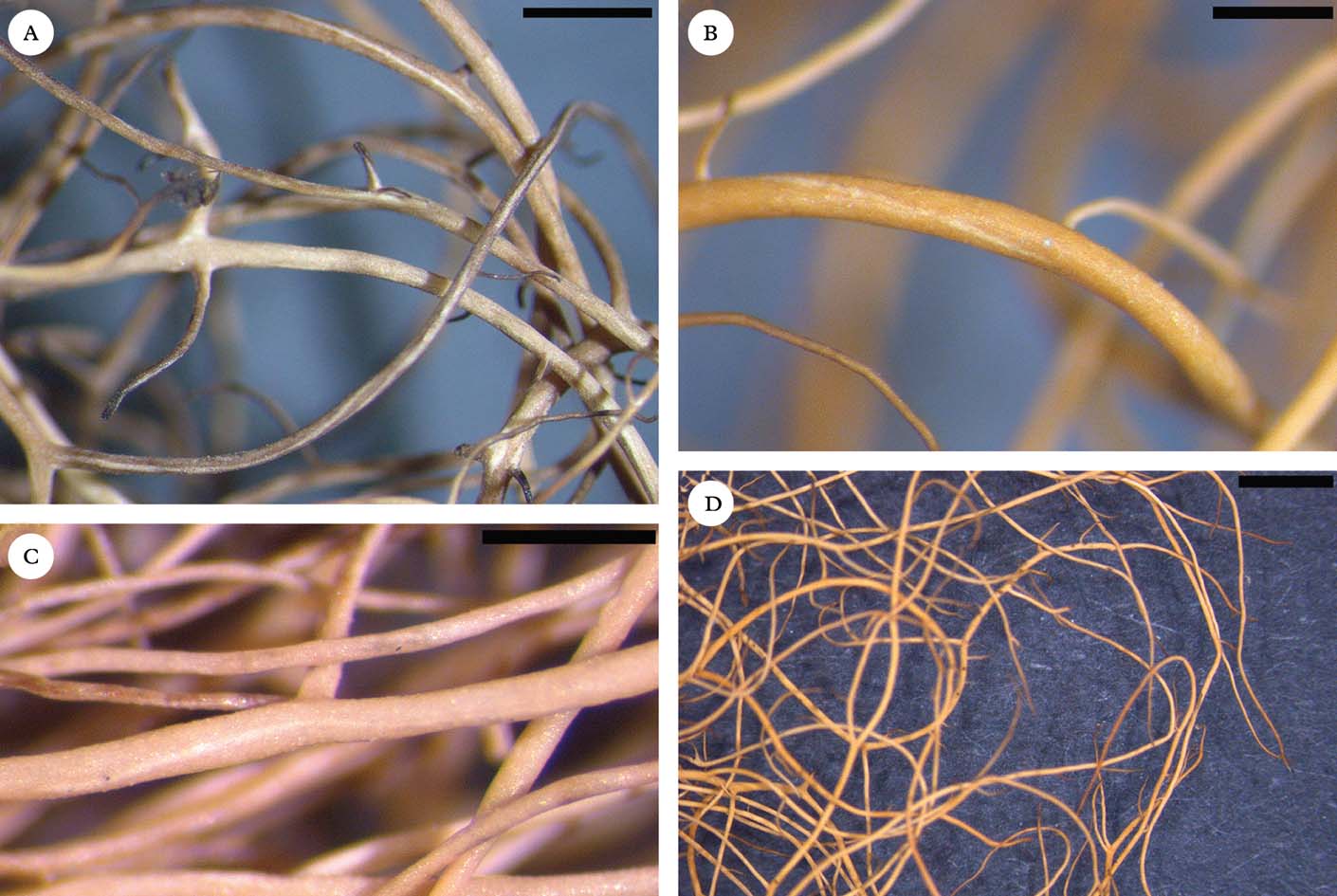
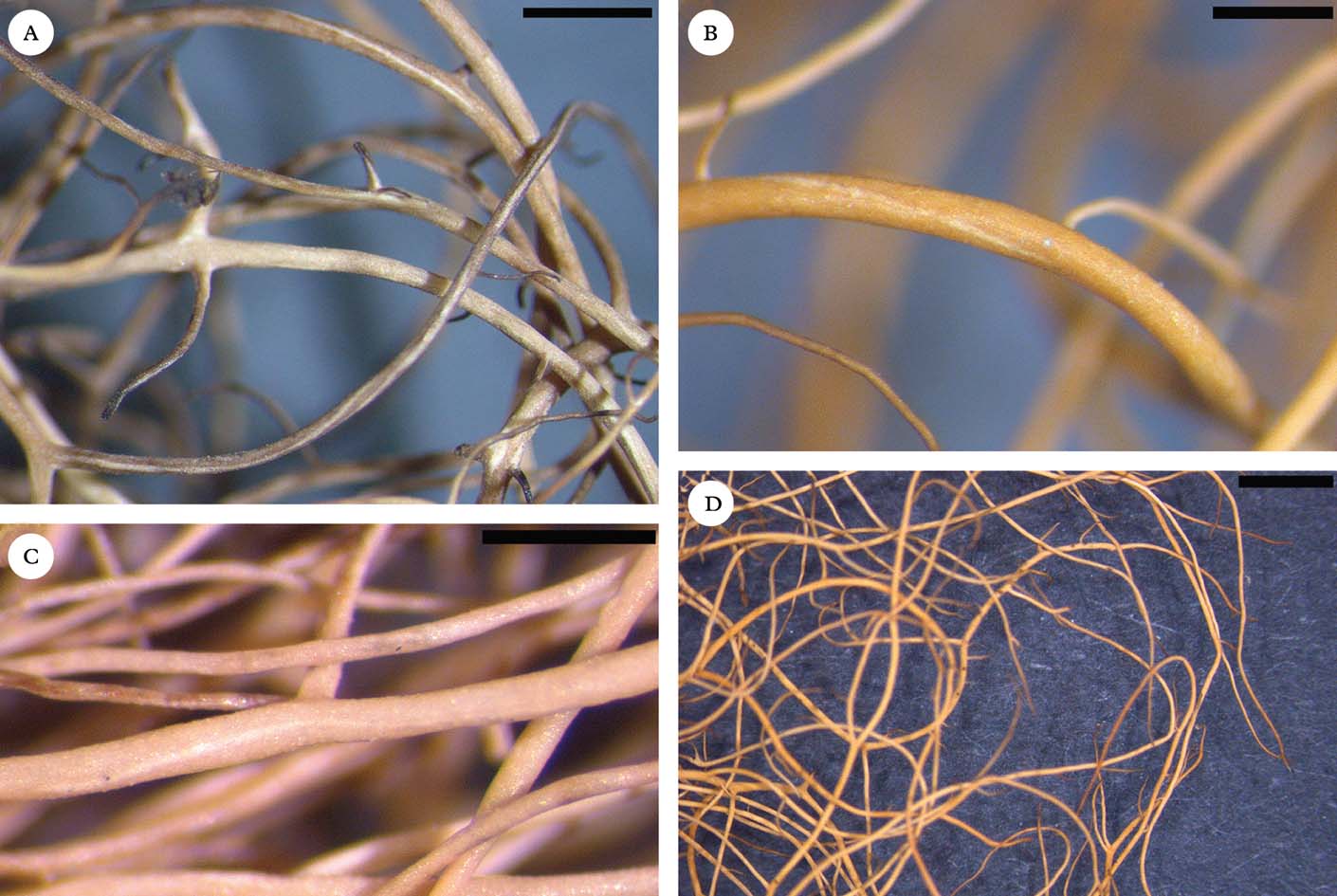
The almost complete lack of genetic variation between Bryoria pseudocapillaris and B. spiralifera specimens (=99–100% similar ITS sequences) raises the question of whether they may in fact belong to a single species. Brodo & Hawksworth (Reference Brodo and Hawksworth1977) identified secondary chemistry as their most reliable diagnostic point of distinction, that is, alectorialic and barbatolic acids and an unknown substance in B. pseudocapillaris versus atranorin and norstictic and connorstictic acids in B. spiralifera. Additionally, B. pseudocapillaris is described as an essentially pale species with long linear pseudocyphellae, while B. spiralifera is characterized by its more variable colour and often spiral pseudocyphellae (Fig. 4A & B). With more extended sampling, Glavich (2003) found that these morphological traits were often good predictors for the identification of the two species, but at the same time noted the existence of intermediate forms. Overlapping characters were observed in both thallus colour (ranging from pale to brown in both species) and morphology of pseudocyphellae (variation ranging from linear to spiralling in both species, see also Fig. 4C). The only exception is a dark brown coloration found only in some B. spiralifera specimens (Glavich 2003). The combination of a similar DNA profile and lack of distinct species boundaries strongly suggests that these two taxa are in fact chemical variants of a single species. In our view, B. pseudocapillaris is more appropriately treated as a synonym of B. spiralifera, and the name Sulcaria spiralifera (Brodo & D. Hawksw.) Myllys, Velmala & Goward is proposed (see below).
Sulcaria spiralifera. A, typical norstictic chemotype, specimen L508a with dark brown, partly pruinose branches and spiral pseudocyphellae; B, typical alectorialic and barbatolic chemotype, specimen L510 with pale branches and spiral pseudocyphellae; C, norstictic chemotype with pale branches and straight pseudocyphellae (specimen L516); D, general habit with spinulose side branches (specimen L510). Scales: A=1 mm; B & C=0·5 mm; D=2 mm.
Our analyses show that Sulcaria is divided into two allopatric subclades (Figs 1–3), the first restricted to Asia and the second to North America. The original treatment of Sulcaria included only the Asian subclade, that is, S. sulcata (Lév.) Bystrek and S. virens (Taylor) Bystrek ex Brodo & D. Hawksw (Bystrek Reference Bystrek1971). Both are widely distributed in the Himalayas and adjacent regions, and have more recently been reported from Japan (Awasthi & Awasthi Reference Awasthi and Awasthi1985; Obermayer & Elix Reference Obermayer and Elix2003).
Brodo & Hawksworth (Reference Brodo and Hawksworth1977) tentatively placed the sterile North American species S. badia in Sulcaria, based on its conspicuous, long, sulcate pseudocyphellae, though these are less well developed than in Asian members of the genus. Our analyses confirm the position of S. badia in Sulcaria and show that it is closely related to S. spiralifera. In fact, ITS sequence comparison revealed 98% sequence similarity between these two species. While we acknowledge that a 3% divergence for ITS sequences has usually been accepted as the minimum threshold for delimiting fungal species (but see Begerow et al. Reference Begerow, Nilsson, Unterseher and Maier2010), our analyses of S. badia consistently form a strongly supported monophyletic group separate from S. spiralifera. Hence we adopted a phylogeny-based approach instead of a similarity-based identification and treat S. badia as a distinct species. In fact, S. badia is usually easily recognized by its distinctive chestnut brown colour, extremely long pseudocyphellae extending the length of the branches, and production of atranorin alone; norstictic and connorstictic acids are lacking (Brodo & Hawksworth Reference Brodo and Hawksworth1977; Peterson et al. Reference Peterson, Greene, McCune, Peterson, Hutten, Weisberg and Rosentreter1998).
In addition to S. badia and S. spiralifera, the North American clade includes S. isidiifera. This species is known only from the type locality in southern California and is distinguished by its caespitose habit, longitudinally split branches, the presence of isidia and soredia, and production of protocetraric acid (Brodo Reference Brodo1986).
Topologies obtained from our three analyses are not directly comparable because of different taxon sampling but generally, as expected, the ITS tree and in part the ITS+Mcm7 tree were less resolved than the combined phylogeny obtained from the three data sets (Figs 1–3). For example, five Bryoria sections appearing in the combined phylogeny of ITS+Mcm7+GAPDH data were not always recovered as monophyletic in the ITS or in the ITS+Mcm7 trees. However, we agree with Nixon & Carpenter (Reference Nixon and Carpenter1996) that phylogenetic hypotheses based on simultaneous analysis of multiple data sets have the highest explanatory value, and consider the combined tree of three data sets the most reliable hypothesis of evolution. For some taxa for which GAPDH sequences could not be obtained, we still have to rely on the results obtained from the ITS and/or Mcm7 sequences. According to our ITS and combined ITS+Mcm7 analyses, for example, Bryoria contains two unidentified specimens (specimens L404 and L488), which most probably represent a new species. A formal species description, however, must await additional collections and a careful study of morphological variation. These specimens, both collected from North America, group with B. lactinea (Nyl.) Brodo & D. Hawksw. in the ITS+Mcm7 tree and form a sister group to the B. lactinea-B. perspinosa clade in the ITS tree (only ITS data available for the latter species) (Figs 2 & 3). Both B. lactinea and B. perspinosa (Bystrek) Brodo & D. Hawksw. are Asian species and were referred to section Bryoria in Myllys et al. (Reference Myllys, Velmala, Holien, Halonen, Wang and Goward2011), but were not present in our ITS+Mcm7+GAPDH analysis.
Here it can also be noted that two other specimens (specimens L411 and L413) collected from North America most probably represent yet another undescribed species. The combined ITS+Mcm7+GAPDH analysis suggests that it belongs in section Bryoria and is most closely related to B. nadvornikiana (Gyeln.) Brodo & D. Hawksw. and B. poeltii (Bystrek) Brodo & D. Hawksw. (Fig. 1).
The addition of Mcm7 data, not used in our previous study on the phylogeny of the genus Bryoria (Myllys et al. Reference Myllys, Velmala, Holien, Halonen, Wang and Goward2011), did not shed any further light on the relationships in section Implexae. Resolution within this section is still low, and two subclades appearing in the combined phylogeny of ITS+Mcm7+GAPDH data (Fig. 1) are partly congruent with secondary chemistry and distribution.
In the combined ITS+Mcm7 tree (GAPDH data not available), the North American endemic B. pikei, not present in our previous study (Myllys et al. Reference Myllys, Velmala, Holien, Halonen, Wang and Goward2011), falls within section Implexae, together with North American specimens of B. capillaris and B. implexa (chemotype 2) (Fig. 2) and close to other specimens of B. capillaris, B. fuscescens (Gyeln.) Brodo & D. Hawksw., B. glabra, B. implexa, B. lanestris (Ach.) Brodo & D. Hawksw., and B. subcana (Nyl. ex Stizenb.) Brodo & D. Hawksw. With the exception, however, of B. glabra, none of these taxa are confirmed as distinct species. We are now examining the taxonomy of section Implexae with extended taxon sampling and suggest that a number of species can be recognized on traditional morphological, chemical and ecological characters notwithstanding the apparent lack of corroborating DNA evidence (Velmala et al. Reference Velmala, Myllys, Goward, Holien and Halonen2014).
Phylogeny of alectorioid lichens
Although this study focused primarily on the delimitation of Bryoria and Sulcaria, it may be useful to briefly discuss the phylogeny of other alectorioid lichens included in our analyses.
As currently defined by Thell et al. (Reference Thell, Crespo, Divakar, Kärnefelt, Leavitt, Lumbsch and Seaward2012), the alectorioid group comprises c. 66 species from five genera (i.e., Alectoria, Bryoria, Gowardia, Pseudephebe and Sulcaria). Our analyses, however, do not support the monophyly of this group. The combined phylogeny of ITS+Mcm7+GAPDH data suggests that Pseudevernia furfuracea (a sister group to Bryoria), Platismatia glauca (sister to Sulcaria), Bryocaulon (sister to Alectoria and Gowardia) and Nodobryoria (sister to Pseudephebe) belong here also (Fig. 1). Our results, however, should be treated with caution as none of the above-mentioned groupings received any support. Clearly more comprehensive taxon sampling, also from parmelioid genera, is needed to assess the relationships among the alectorioid genera. Meanwhile, it is interesting to note a close, although unsupported relationship of Pseudephebe and Nodobryoria. Nodobryoria resembles Pseudephebe in cortical structure, in lacking secondary substances, and in having similar conidia (Common & Brodo Reference Common and Brodo1995). According to Thell et al. (Reference Thell, Crespo, Divakar, Kärnefelt, Leavitt, Lumbsch and Seaward2012), Nodobryoria has an uncertain position in Parmeliaceae, though this is perhaps not surprising given that none of its three species have been represented in the recent large-scale molecular phylogenies. The present study, by contrast, includes all three species: two North American endemics, N. abbreviata (Müll. Arg.) Common & Brodo and N. oregana (Tuck.) Common & Brodo, and N. subdivergens (E. Dahl) Common & Brodo, found also in Greenland (Brodo & Hawksworth Reference Brodo and Hawksworth1977; Brodo & Alstrup Reference Brodo and Alstrup1981).
Alectoria was fairly well represented in our analyses, which included four of the seven species described so far. Diagnostic characters include the presence of conspicuous, white, markedly raised pseudocyphellae and the production of usnic acid, a substance lacking in the recent segregate genus Gowardia (Halonen et al. Reference Halonen, Myllys, Velmala and Hyvärinen2009). Our analyses did not recover the monophyly of A. imshaugii Brodo & D. Hawksw., A. sarmentosa (Ach.) Ach. and A. vancouverensis (Gyeln.) Brodo & D. Hawksw. (Figs 1–3). While A. imshaugii is easily recognized by its caespitose growth form and production of isidia, A. sarmentosa and A. vancouverensis are pendent species differing mainly in their chemistry, thallus anatomy and colour. Brodo & Hawksworth (Reference Brodo and Hawksworth1977) did not question the distinctiveness of the three taxa but acknowledged the presence of intermediate forms. Our results suggest that the species may be conspecific. For now, however, we refrain from venturing any definite taxonomic conclusions pending further study with additional taxon sampling.
Taxonomy
Sulcaria spiralifera (Brodo & D. Hawksw.) Myllys, Velmala & Goward comb. nov.
MycoBank No.: MB809146
Bryoria spiralifera Brodo & D. Hawksw., Opera Bot. 42: 131 (Reference Brodo and Hawksworth1977); type: USA, California, Humboldt County, pine forest near Manila, on Pinus contorta, 1972, S. Dowty 137 (CANL 38403—holotype, seen).
New synonym: Bryoria pseudocapillaris Brodo & D. Hawksw., Opera Bot. 42: 126 (Reference Brodo and Hawksworth1977); type: USA, Oregon, Curry County, Cape Blanco, 8 miles north of Port Orford, headland rocks and isolated trees on windswept summit, on sitka spruce at headland at 100 feet, 1974, I. M. Brodo 20539 (CANL 50596—holotype, seen; BM—isotype, not seen).
Thallus subpendent to pendent, 4–12 cm long, pale brown to dark brown, cortex dull or slightly shiny, often pruinose in norstictic-acid chemotype; branching mostly irregular, without distinct main branches, angles between the branches mainly acute, 0·10–0·35 mm diam., with spinulose side branches near apices; pseudocyphellae usually conspicuous, white, linear, straight or spiralling around branches, sometimes furrowed, abundant or sparse, 1–4 mm long; soralia and isidia lacking.
Apothecia and conidiomata unknown.
Chemistry
Chemotype 1: cortex and medulla K+ yellow, containing alectorialic acid, barbatolic acid and an unknown substance (Rf class 2–3 in solvent A and Rf class 3–4 in solvent B). Chemotype 2: cortex and medulla K+ yellow becoming red, containing norstictic acid, connorstictic acid and atranorin.
Distribution and habitat
Sulcaria spiralifera is a rare but sometimes locally abundant species endemic to the west coast of North America, from northern California to Washington. It grows in open or shady maritime forests on Pinus contorta, Picea sitchensis and on various shrubs and deciduous trees.
Comments
Bryoria pseudocapillaris and B. spiralifera were described in the same publication by Brodo & Hawksworth (Reference Brodo and Hawksworth1977). We chose to use the name B. spiralifera, since it better describes the morphology of this species.
Additional specimens examined. All specimens deposited in Siuslaw National Forest Herbarium unless stated otherwise USA: California: Del Norte County, Lake Earl State Park, on Pinus contorta var. contorta, 41°52′17·76″N, 124°11′56·04″W, sea level, 2000, D. Glavich 592; Humboldt County, Humboldt Bay National Wildlife Refuge, on Pinus contorta var. contorta, 40°52′49·44″N, 124°8′50·28″W, sea level, 2000, D. Glavich 581; Humboldt County, Humboldt Bay National Wildlife Refuge, 40°52′49·40″N, 124°8′50·5″W, 2001, L. Geiser 7075; Humboldt County, Humboldt Bay National Wildlife Refuge, on branch of Picea sitchensis, 41°48′43·56″N, 124°10′46·92″W, sea level, 2000, D. Glavich 546; Humboldt County, Trinidad State beach, 41°4′9·984″N, 124°9′10·08″W, 30 m, 1999, D. Glavich 0004 (hb. D. A. Glavich); Humboldt County, Redwood National Park, on Pinus contorta var. contorta, 41°42′26·28″N, 124°8′32·64″W, 76 m, 2000, D. Glavich 593. Oregon: Coos County, Siuslaw National Forest, on branch of Vaccinium ovatum, 43°16′8·4″N, 124°9′27·72″W, 8 m, 2000, A. Mikulin 1006; Coos County, Siuslaw National Forest, 43°16′8·4″N, 124°9′27·72″W, 8 m, 2000, A. Mikulin 1866; Coos County, Siuslaw National Forest, on branch of Vaccinium ovatum, 43°28′45·48″N, 124°14′54·24″W, 20 m, 2000, A. Mikulin 1030; Coos County, Siuslaw National Forest, on trunk of Pinus contorta var. contorta, 43°28′45·48″N, 124°14′54·24W, 20 m, 2000, A. Mikulin 1031; Coos County, Siuslaw National Forest, on twig of Picea sitchensis, 43°26′32·28″N, 124°16′22·08″W, 21 m, 2000, A. Mikulin 1001; Coos County, Oregon Dunes National Recreation Area, on branch of Pinus contorta var. contorta, 43°28′27·48″N, 124°13′48·36″W, 32 m, 2001, A. Mikulin 1224; Coos County, Oregon Dunes National Recreation Area, on branch of Pinus contorta var. contorta, 43°26″27·60″N, 124°14′49·92″W, 29 m, 2000, A. Mikulin 1051; Curry County, on Picea sitchensis, 42°50′13·20″N, 124°31′54·48″W, 2001, 15 m, D. Glavich 552; Lane County, north of Florence, on Picea sitchensis branch, 44°3′58·32″N, 124°6′52·56″W, 12 m, 2003, D. Glavich 603; Lane County, north of Florence, on Picea sitchensis, 44°3′59·04″N, 124°6′56·52″W, 6 m, 2003, L. Geiser 713 (Siuslaw National Forest Herbarium); Lane County, south of Florence, on Picea sitchensis branch, 43°52′30″N, 124°8′31·20″W, sea level, 2003, A. Ingersoll 953. Washington: Island County, Deception Pass State Park, on Picea sitchensis branch, 48°23′52·44″N, 122°39′47·52″W, 2 m, 2000, A. Mikulin 1260.
We thank Ms. Laura Häkkinen and Ms. Heini Rämä for help with laboratory work, Mr Jason Hollinger for collecting fresh material, and Professor Teuvo Ahti for valuable comments on the manuscript. The study was financially supported by the Academy of Finland (grant 1133858).