Type 1 diabetes (T1D) is one of the most common autoimmune conditions in children. Population-representative studies suggest an annual increase of 80,000 cases in girls and boys under 15 years old across the world (International Diabetes Federation, 2017). Type 1 diabetes often has a serious effect on the psychosocial well-being of both children and their caregivers, as managing the disease requires considerable changes in the lifestyle of the child, which may put the parent–child relationship under considerable strain (Patterson et al., Reference Patterson, Dahlquist, Gyürüs, Green and Soltész2009). In recent years, there has a growing interest in the relationship between T1D and psychosocial well-being. Studies have suggested that this relationship is bidirectional, that is, T1D may negatively affect psychosocial functioning, which in turn may negatively influence the course and prognosis of T1D.
Studies have shown that children with T1D are twice as likely as their peers without diabetes to develop mental health problems (Fazeli Farsani et al., Reference Fazeli Farsani, Souverein, van der Vorst, Knibbe, Herings, de Boer and Mantel-Teeuwisse2016). Research has also consistently shown that mental health problems in these children are associated with decreased treatment adherence (i.e., the extent to which children adhere to the treatment regimen) and metabolic control (i.e., the extent to which children's glycemic levels correspond with target levels), which in turn may increase the risk for complications (i.e., retinopathy, nephropathy, and cardiovascular disease). For example, both depression (Kongkaew et al., Reference Kongkaew, Jampachaisri, Chaturongkul and Scholfield2014) and family conflict (Burroughs et al., Reference Burroughs, Harris, Pontious and Santiago1997; La Greca et al., Reference La Greca, Swales, Klemp, Madigan and Skyler1995) have been associated with poorer adherence to treatment, while disturbed eating behaviors have been associated with poor diabetes control (Helgeson et al., Reference Helgeson, Siminerio, Escobar and Becker2009).
As noted, T1D may also affect caregivers. For example, in a prospective study by Landolt et al. (Reference Landolt, Vollrath, Laimbacher, Gnehm and Sennhauser2005) in a sample of 97 parents of children with T1D, 24% of the mothers and 22% of the fathers met the full diagnostic criteria for post-traumatic stress disorder immediately after the child's T1D diagnosis. Similarly, elevated levels of stress and anxiety in the parents of children with T1D (Horsch et al., Reference Horsch, McManus, Kennedy and Edge2007; Landolt et al., Reference Landolt2002, Reference Landolt, Vollrath, Laimbacher, Gnehm and Sennhauser2005; Northam et al., Reference Northam, Anderson, Adler, Werther and Warne1996; Streisand et al., Reference Streisand, Mackey, Elliot, Mednick, Slaughter, Turek and Austin2008), especially in mothers (Hansen et al., Reference Hansen, Weissbrod, Schwartz and Taylor2012; Jönsson et al., Reference Jönsson, Lundqvist, Tiberg and Hallström2015; Sullivan-Bolyai, Reference Sullivan-Bolyai, Deatrick, Gruppuso, Tamborlane and Grey2003; Wennick & Hallström, Reference Wennick and Hallström2007), have been reported. In turn, parental stress has been shown to be one of the strongest predictors of psychosocial problems in children with diabetes (Drotar, Reference Drotar1997; Hilliard et al., Reference Hilliard, Monaghan, Cogen and Streisand2011; Kovacs et al., Reference Kovacs, Goldston, Obrosky and Bonar1997). As a result, there is increasing consensus that developmental factors, including the caregiving environment of the child, are crucial in diabetes control. However, developmental and relational factors remain poorly integrated in current theoretical approaches to T1D in children (Ciechanowski, Hirsch, & Katon, Reference Ciechanowski, Hirsch and Katon2002; Daneman & Daneman, Reference Daneman and Daneman2012; Lohan, Morawska, & Mitchell, Reference Lohan, Morawska and Mitchell2015).
Contemporary attachment and mentalization-based approaches may provide an important theoretical perspective in this context (Fonagy & Bateman, Reference Fonagy and Bateman2006, Reference Fonagy and Bateman2008; Fonagy & Target, Reference Fonagy and Target2006; Luyten & Fonagy, Reference Luyten, Fonagy, Hunter and Maunder2016). For example, there is now good evidence to suggest that attachment plays a key role in the onset and course of somatoform or functional somatic disorders, a group of disorders that has a strong somatic component, similar T1D (Luyten, Van Houdenhove, Lemma, Target, & Fonagy, Reference Luyten, Van Houdenhove, Lemma, Target and Fonagy2012, Reference Luyten, Van Houdenhove, Lemma, Target and Fonagy2013). Studies have consistently shown the key role of attachment in the regulation of stress and arousal in these disorders. From an attachment perspective, somatic problems, such as T1D, represent an important source of conflict and stress for both child and caregiver. Generally speaking, stress responses are triggered by a threat to the individual's survival, initiating physiological processes that are designed to mobilize and reorganize the body's resources for the sake of maintaining bodily integrity. As a result, both physiological and psychological systems are activated in order to attempt to down-regulate the stress response and restore bodily allostasis (McEwen, Reference McEwen2007; Picard & McEwen, Reference Picard and McEwen2018).
With respect to T1D, the stressful experience mostly comes from within the individual's own body. This threat is also permanent, which means that the individual is confronted with a near-constant activation of the stress response and thus of the attachment behavioral system. Chronic activation of the stress system is known to be associated with several health problems in the general population (Carroll et al., Reference Carroll, Ginty, Der, Hunt, Benzeval and Phillips2012; Gunnar, & Quevedo, Reference Gunnar and Quevedo2007; Muscatell & Eiserberger, Reference Muscatell and Eisenberger2012; Peters, McEwen, & Friston, Reference Peters, McEwen and Friston2017; Picard & McEwen, Reference Picard and McEwen2018). Additionally, in individuals with T1D, stress might cause metabolic dysregulation resulting in negative diabetes outcomes (Hilliard et al., Reference Hilliard, Yi-Frazier, Hessler, Butler, Anderson and Jaser2016; Konen et al., Reference Konen, Summerson and Dignan1993; Lloyd et al., Reference Lloyd, Dyer, Lancashire, Harris, Daniels and Barnett1999), directly through the influence of stress hormones on glucose homeostasis and indirectly by affecting treatment adherence (Hilliard et al., Reference Hilliard, Yi-Frazier, Hessler, Butler, Anderson and Jaser2016).
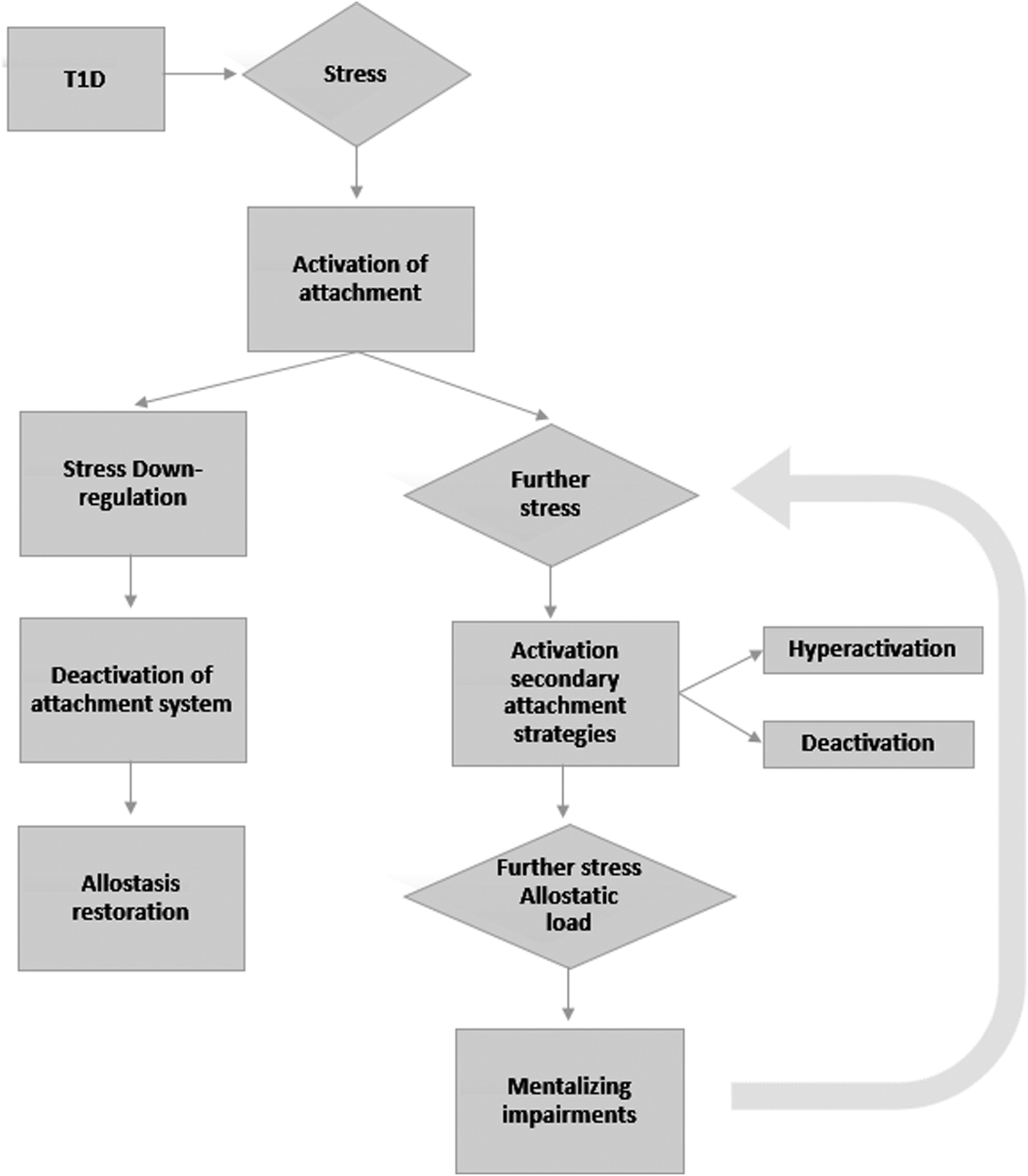
As part of the stress response, an individual's attachment system is activated (Bartholomew & Horowitz, Reference Bartholomew and Horowitz1991; Bowlby, Reference Bowlby1969, Reference Bowlby1973; Collins & Read, Reference Collins and Read1990; Fraley & Shaver, Reference Fraley and Shaver1998; Mikulincer & Florian, Reference Mikulincer and Florian1995; Mikulincer & Shaver, Reference Mikulincer and Shaver2007). The effective management of stress characteristically involves a process of coregulation, which takes place within a relationship with an attachment figure (Diamond & Aspinwall, Reference Diamond and Aspinwall2003; Luyten et al., Reference Luyten, Van Houdenhove, Lemma, Target and Fonagy2013; Sbarra & Hazan, Reference Sbarra and Hazan2008). If this process proceeds successfully, the individual achieves a sense of safety and the attachment system is deactivated. However, the co-regulation of stress through reliance on attachment figures is typically impaired if the magnitude or persistence of the threat is such that the attachment strategies that are usually adopted by the individual are insufficient to down-regulate the stress response, in which case secondary attachment strategies (i.e., attachment hyperactivation and deactivation strategies) are activated. Attachment hyperactivation strategies are characterized by demanding attempts to gain relief from others, generally by using clinging and claiming behavior (Waller & Scheidt, Reference Waller and Scheidt2006). The use of attachment deactivation strategies, by contrast, typically involves a negation of attachment needs, affirming autonomy and independence in the face of stress (Cassidy & Kobak, Reference Cassidy, Kobak, Belsky and Nezworski1988; Mikulincer & Shaver, Reference Mikulincer and Shaver2007). Although potentially adaptive in the short term, in the longer term the use of attachment hyperactivation and deactivation strategies results in a chronic hyperactivation of the stress system, particularly the hypothalamic–pituitary–adrenal (HPA) axis, the main endocrine system involved in stress regulation, which may lead to serious disruptions in the stress response. This in turn produces more stress, creating a second vicious circle that also affects the individual's capacity to reflect or mentalize the self (and particularly the bodily self) and others (Luyten & Fonagy, Reference Luyten, Fonagy, Hunter and Maunder2016; Figure 1).
T1D, stress, and attachment/mentalizing.

Consistent with these assumptions, studies have demonstrated the relevance of attachment in T1D (Bazzazian & Besharat, Reference Bazzazian and Besharat2012; Ciechanowski, Katon, Russo, & Walker, Reference Ciechanowski, Katon, Russo and Walker2001; Ciechanowski et al., Reference Ciechanowski, Russo, Katon, Von Korff, Ludman, Lin and Bush2004; Morris et al., Reference Morris, Berry, Wearden, Jackson, Dornan and Davies2009; Turan, Osar, Turan, Ilkova, & Damci, Reference Turan, Osar, Turan, Ilkova and Damci2003). For example, a population-based study (n = 4,095) in adults with T1D and type 2 diabetes (Ciechanowski et al., Reference Ciechanowski, Russo, Katon, Von Korff, Ludman, Lin and Bush2004) found that patients with secure attachment showed better self-management and better diabetes outcomes than patients with insecure attachment styles did. Similarly, in another study, these authors found that individuals with T1D with avoidant attachment showed poorer treatment adherence than those with secure or ambivalent attachment styles (Ciechanowksi et al., Reference Ciechanowski, Katon, Russo and Walker2001). Furthermore, studies converge to suggest that chronic somatic disorders may lead to serious impairments and distortions in (embodied) mentalizing (Koelen, Eurelings-Bontekoe, van Broeckhuysen-Kloth, Snellen, & Luyten, Reference Koelen, Eurelings-Bontekoe, van Broeckhuysen-Kloth, Snellen and Luyten2014; Luyten & Fonagy, Reference Luyten, Fonagy, Hunter and Maunder2016; Luyten, Van Houdenhove, Lemma, Target, & Fonagy, Reference Luyten, Van Houdenhove, Lemma, Target and Fonagy2012, Reference Luyten, Van Houdenhove, Lemma, Target and Fonagy2013; Malberg, Reference Malberg2013; Schönenberg et al., Reference Schönenberg, Mares, Smolka, Jusyte, Zipfel and Hautzinger2014). Such distortions are, for example, expressed in a tendency to make catastrophic attributions in response to bodily sensations, in the incapacity to reappraise threatening situations, and in the rigid misinterpretation of others’ behaviors. Impairments in (embodied) mentalizing have been demonstrated consistently in other chronic disorders, and there is preliminary evidence to suggest that this is also the case in children with T1D (Fonagy & Moran, Reference Fonagy and Moran1990, Reference Fonagy and Moran1991, Reference Hodes and Moorey1993, Reference Fonagy and Moran1994; Moran & Fonagy, Reference Moran and Fonagy1987; Moran, Fonagy, Kurtz, Bolton, & Brook, Reference Moran, Fonagy, Kurtz, Bolton and Brook1991).
However, further research in T1D is clearly needed, not only given the paucity of studies but also given that little is known about the potential role of parental attachment and mentalizing in explaining the course and prognosis of T1D in children. In this context, there is growing evidence that the caregiver's capacity to think of his/her child in terms of mental states—parental mentalizing or parental reflective functioning (RF)—is linked with the development of affect regulation in the child (Meins, Fernyhough, Fradley, & Tuckey, Reference Meins, Fernyhough, Fradley and Tuckey2001; Oppenheim & Koren-Karie, Reference Oppenheim and Koren-Karie2002; Slade et al., Reference Slade, Grienenberger, Bernbach, Levy and Locker2005; Zeegers et al., Reference Zeegers, Colonnesi, Stams and Meins2017). Parental RF is probably also determined by the child's characteristics. Therefore, evocative person–environment correlations (Klahr & Burt, Reference Klahr and Burt2014) may be involved in the relationship between parental RF and child RF (Luyten, Reference Luyten and Fonagy2015).
The Present Study
Although there is growing evidence for the role of mentalizing or RF in affect regulation in a number of psychological and somatoform disorders (Fonagy & Luyten, Reference Fonagy and Luyten2009; Fonagy & Target, Reference Fonagy and Target2006; Luyten & Fonagy, Reference Luyten and Fonagy2015; Luyten et al., Reference Luyten, Van Houdenhove, Lemma, Target and Fonagy2012; Nolte et al., Reference Nolte, Guiney, Fonagy, Mayes and Luyten2011), no study to date has simultaneously investigated the role of child and parental RF in T1D.
Therefore, the main purpose of the present study was to compare levels of parental and child RF by using state-of-the-art, observer-rated measures in both mothers and male children with T1D. In this study, we specifically focused on mothers and male children, as boys with T1D may be specifically vulnerable to developing psychosocial and medical problems. The prevalence of T1D has been found to be substantially higher in boys than in girls, with a 3:2 ratio (Gale & Gillespie, Reference Gale and Gillespie2001; Wandell & Carlsson, Reference Wandell and Carlsson2013). Moreover, boys with T1D have been shown to have worse treatment adherence (Naar-King et al., Reference Naar-King, Podolski, Ellis, Frey and Templin2006), worse metabolic control (Grey, Lipman, Cameron, & Thurber, Reference Grey, Lipman, Cameron and Thurber1997), and a lower frequency of blood glucose testing (Bearman & La Greca, Reference Bearman and La Greca2002) than girls do.
We compared two different groups of boys and their mothers based on their diabetes control as measured by glycated hemoglobin (HbA1c), which is considered the “gold standard” measure of diabetes control (Delamater et al., Reference Delamater, de Wit, McDarby, Malik, Hilliard, Northam and Acerini2018). Groups were formed based on a median split (see Methods section), with boys in the good diabetes control (GDC) group having HbA1c levels below 7.70 and boys in the poor diabetes control (PDC) group having HbA1c levels above 7.71. These values correspond to international standard cutoff points for defining good versus poor diabetes control, with HbA1c levels below 7 considered to reflect GDC, while values above 7.5 have been consistently associated with an increased risk of complications (American Diabetes Association, 2017; Lind et al., Reference Lind, Pivodic, Svensson, Ólafsdóttir, Wedel and Ludvigsson2019; NICE, 2015). Moreover, diabetes-specific quality of life and children's subjective levels of stress were measured by using self-report measures.
This is the first investigation, to our knowledge, to examine the role of RF in mothers and children with T1D based on observer-rated measures. We expected that (a) mothers and boys in the GDC group would exhibit higher levels of RF than mothers and boys in the PDC group would; (b) boys in the PDC group would present higher levels of stress than boys in the GDC group would; (c) maternal and child RF would be negatively correlated with HbA1c and positively correlated with diabetes-specific quality of life; and (d) children's stress would be negatively correlated with maternal RF, child RF, and diabetes-specific quality of life and positively correlated with HbA1c.
Method
Participants and Procedure
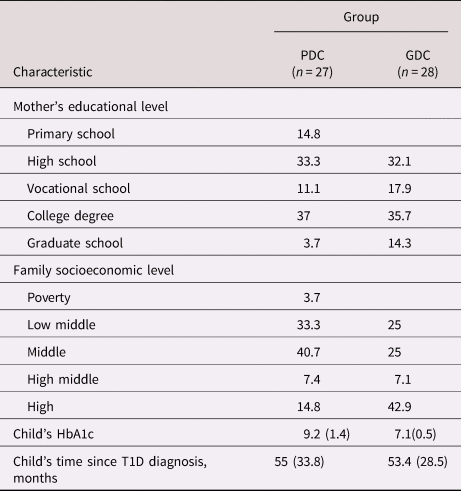
Fifty-five boys aged 8–12 years and their mothers were recruited from the Juvenile Diabetes Foundation of Chile (JDFC; see Table 1 for the sociodemographic characteristics of the sample), comprising 28 dyads with GDC (HbA1c < 7.70) and 27 dyads with PDC (HbA1c > 7.71). The families of the children who had been diagnosed with T1D at least 6 months previously were contacted by the institution via e-mail with an invitation letter containing the study details. Families that showed interest were contacted via telephone to schedule an interview session at the JDFC offices. Approximately 50% of families who were contacted agreed to participate. An interview session for mothers and boys separately was scheduled to be completed in the foundation's offices, and the interviews were carried out by two trained clinical psychologists. At the end of the interview, the participants were asked to complete a series of questionnaires (see below). The mothers were also asked to report the scores for their child's previous three HbA1c measurements, and the mean was used in all of the analyses. Of the recruited families, 85% completed both of the interviews and all of the questionnaires. One family did not complete the two interviews and was excluded from the analyses. This study was approved by the University College London (UCL) Research Ethics Committee.
Mothers’ and children's demographic characteristics as a percentage (standard deviation in parentheses) per group

Note: PDC = Poor diabetes control; GDC = good diabetes control; HbA1c = glycated hemoglobin; T1D = type 1 diabetes.
The mean age of the mothers was 40 years (SD = 7.8) in the GDC group and 38 years (SD = 6) in the PDC group. The children were on average 10 years old in both groups (SD = 1.8 and 2.1 for the GDC and PDC group, respectively). There were no significant differences in the demographic features of mothers and children between the groups (see Table 1). The average time since T1D diagnosis was 54 months in the GDC group and 55 months in the PDC group. The reported HbA1c levels were M = 7.1 (SD = 0.5) in the GDC group and M = 9.2 (SD = 1.4) in the PGC group.
Measures
Mothers’ reflective functioning
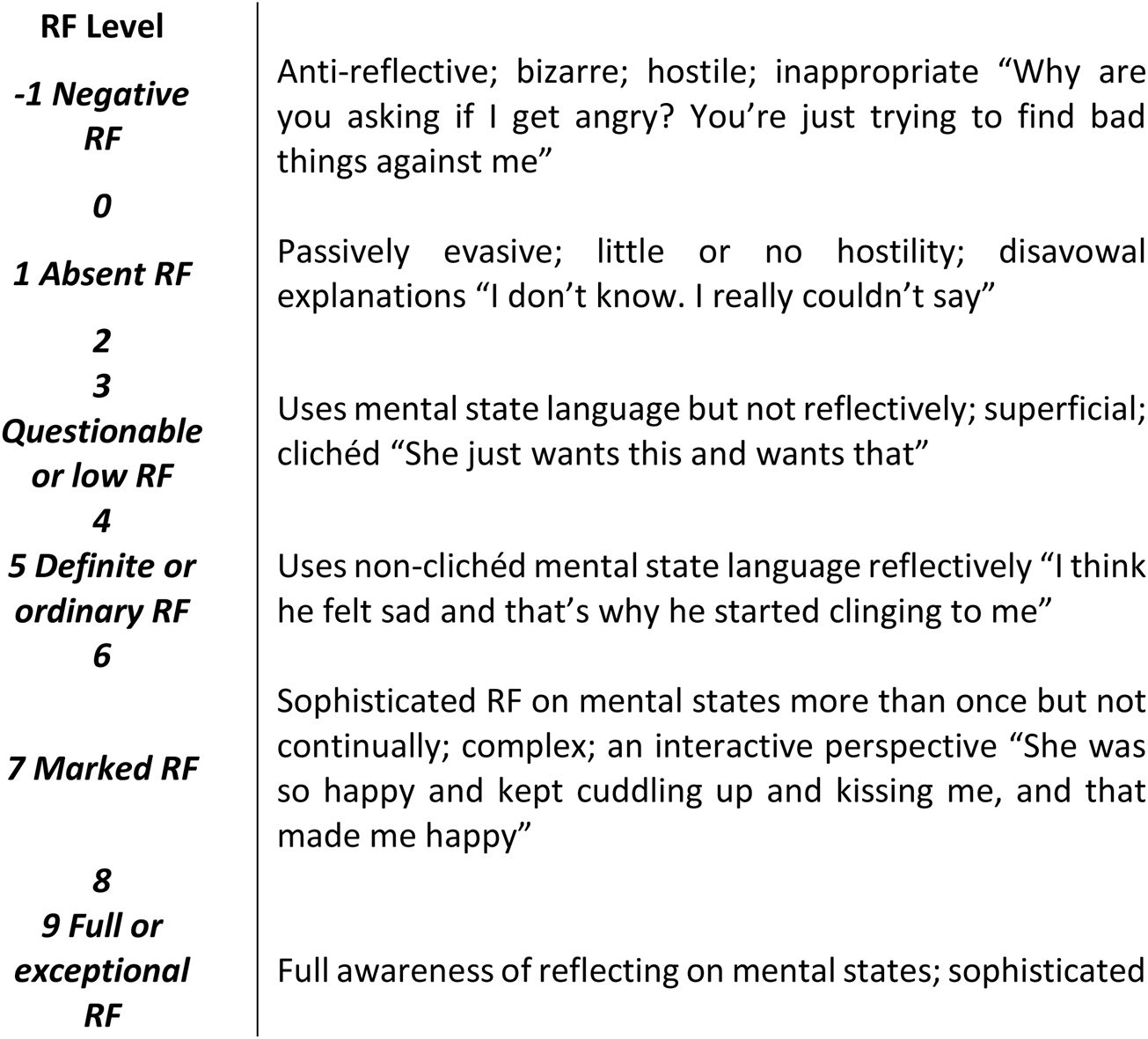
The Spanish version (Golano-Fornells, Perez-Testor, & Salamero-Baro, Reference Golano-Fornells, Pérez-Téstor and Salamero-Baró2018) of the PDI-Reflective Functioning Scale (RFS; Fonagy et al., Reference Fonagy, Target, Steele and Steele1998; Slade et al., Reference Slade, Grienenberger, Bernbach, Levy and Locker2005) as scored on the Parental Development Interview (PDI; Aber, Slade, Berger, Bresgi, & Kaplan, Reference Aber, Slade, Berger, Bresgi and Kaplan1985; Slade, Aber, Bresgi, Berger, & Kaplan, Reference Slade, Aber, Bresgi, Berger and Kaplan2004) was used to assess the mothers’ RF. The PDI is a 45-item interview that examines parents’ representations of their children, themselves as a parent, and their relationship with their children. Interviewees are asked to provide real-life examples of their child's behavior, thoughts, and feelings that illustrate their understanding of their own and their child's internal experience. For the present study, the interviews were carried out by the first and fourth authors (SC and FM); SC is certified in administering the PDI and supervised the other interviewer. Maternal RF was measured by using the PDI-RFS (Fonagy et al., Reference Fonagy, Target, Steele and Steele1998; Slade et al., Reference Slade, Grienenberger, Bernbach, Levy and Locker2005), a coding scale that was adapted from the RFS, which was initially developed to be scored with the Adult Attachment Interview. The RFS employs an 11-point scale, and ratings are made following the guidelines that are provided in a manual that provides illustrations of different types and levels of RF responses, ranging from 1 (avoidance or active refusal to mentalize) to 9 (exceptionally rich, complete, and sophisticated understanding of mental states in interaction). An overall RF score was assigned following the guidelines in the manual (see Figure 2).
Examples of scores on parental reflective functioning. Source: Fonagy, Target, Steele, & Steele (Reference Fonagy, Target, Steele and Steele1998).

The reliability estimates of the RFS as scored on the PDI have been shown to be good, with internal consistencies ranging from .78 to .95 (Slade, Grienenberger, Bernbach, Levy, & Locker, Reference Slade, Grienenberger, Bernbach, Levy and Locker2005). In this study, all of the interviews were coded by two trained and certified Spanish-speaking raters. Both raters were blind to whether the children belonged to the GDC or PDC group. Moreover, the interviews that were carried out by the author were coded by the second rater and vice versa in order to avoid bias.
The inter-rater reliability between the two independent raters was calculated on 10 randomly selected interviews by using the intraclass coefficient (ICC) based on an absolute agreement and a two-way mixed-effect model. The resulting ICC values were .83, 95% CI [.42, .96], for the single measures and .91, 95% CI [.66, .98], for the average measures. These results indicate a good level of reliability (Portney & Watkins, Reference Portney and Watkins2000).
Children's reflective functioning
The Chilean version (Lecannelier, unpublished manuscript) of the Child Reflective Functioning Scale (CRFS; Ensink et al., Reference Ensink, Target and Oandasan2013) was used to rate child RF on the Child Attachment Interview (CAI; Shmueli-Goetz et al., Reference Shmueli-Goetz, Target, Fonagy and Datta2008; Target et al., Reference Target, Fonagy, Shmueli-Goetz, Schneider and Datta2000). The CAI is a semistructured interview for 8- to 12-year-olds consisting of 13 questions. It was developed to assess children's attachment representations of their current relationships with their primary caregivers. Children are asked to give adjectives to describe themselves and their attachment relationships. This is followed by requests for examples to illustrate why they chose these adjectives. For example, children are asked the following questions: “Can you think of three words to describe your relationship with your mum?” For each word that the child gives, they are asked, “Can you give me an example that illustrates why you picked that word, of a time when your relationship was (e.g., loving)?” and “Can you think of a time when your mum got angry with you? Tell me what happened.” After each question children are asked about why they think the parents behaved in the way they did, how that made them feel, and how they think their parents felt.
The CRFS was developed to assess RF in middle childhood, rating the data that were gathered by using the CAI based on the Adult Reflective Functioning Manual that was developed by Fonagy, Target, Steele, and Steele (Reference Fonagy, Target, Steele and Steele1998), with modifications that addressed the developmental characteristics of children aged 8 to 12 years. Children's responses are coded on an 11-point scale ranging from 1 to 9, in terms of the child's ability to give an account of his or her capacity to make meaning of personal and interpersonal behaviors and interactions based on underlying mental states. The CRFS has shown high inter-rater reliability, with a median ICC of .93 (Ensink et al., Reference Ensink, Target and Oandasan2013).
In the present study, child RF was rated by the first (SC) and third (DC) authors, and DC, a certified CRFS rater, supervised the first rater. Inter-rater reliability was calculated between both raters on 10 randomly selected CAIs. Again, both raters were blind to whether the children belonged to the GDC or PDC group, and the interviews that were carried out by the first rater were coded by the second rater and vice versa in order to avoid bias. The ICC estimates and 95% confidence intervals were calculated based on an absolute-agreement and a two-way mixed-effects model. The obtained ICC value was .97, 95% CI [.87, .99], for the single measures and .98, 95% CI [.93, .99], for the average measures, indicating an excellent level of reliability (Portney & Watkins, Reference Portney and Watkins2000). In this study, child RF was highly positively correlated with maternal RF (r = .84, p < .001) in the whole sample.
Subjective stress in children
We used the Chilean version (Caqueo-Urízar, Urzúa, & Osika, Reference Caqueo-Urízar, Urzúa and Osika2014) of the Stress in Children (SiC; Osika et al., Reference Osika, Friberg and Wahrborg2007) scale. The SiC is a 21-item questionnaire for school-age children that is designed to assess perceived distress, levels of well-being, and aspects of coping and social support. The participants were asked to rate how often they felt or thought a certain way during the past month, ranging from never to very often, with higher scores indicating higher levels of stress. The SiC has demonstrated high internal consistency, with a Cronbach alpha coefficient of .79 for the complete test score and .79, .67, and .62 for the three subscales (lack of well-being, distress, and lack of social support), respectively. The SiC has also been shown to be reliable in the Chilean population (Caqueo-Urízar et al., Reference Caqueo-Urízar, Urzúa and Osika2014). In this study, the internal consistencies for each scale were α = .75, .70, and .70, for lack of well-being, distress, and lack of social support, respectively.
Diabetes outcomes
The children's diabetes-specific quality of life was measured by using the Latin-American version of the Pediatric Quality of Life Inventory Diabetes Module 3.2 Parent-Report (PedsQL 3.2 Diabetes Module; Varni et al., Reference Varni, Burwinkle, Jacobs, Gottschalk, Kaufman and Jones2003). This scale assesses the parent's view of how well the illness has been integrated into the child's life, and it concerns several dimensions of diabetes care, which are reflected in each of the subscales. In this sense, the PedsQL can be considered to be an indicator of diabetes outcomes. The PedsQL consists of 28 items that are divided into four subscales: (a) Absence of Symptoms (AS; 11 items; e.g., in the past month “It has been a problem for my child feeling dizzy”); (b) Treatment Adherence (TA; 11 items; e.g., in the past month “It has been a problem for my child to follow his diabetes treatment); (c) Absence of Concerns (ACr; 3 items; e.g., in the past month “It has been a problem for my child being worried about future diabetes complications”); and (d) Diabetes Communication (DCm; 3 items; e.g., in the past month “It has been a problem for my child to explain his illness to other people”). Higher scores reflect higher diabetes-specific quality of life. Studies suggest acceptable to excellent internal consistencies for all four subscales. In the present study, the Cronbach alpha of the PedsQL total score was α = .80 and the subscales’ α coefficients were .77 (AS), .71 (TA), .70 (ACr), and .71 (DCm).
Diabetes control
Measurements of HbA1c were used to assess diabetes control. Each HbA1c measurement indicated the average blood glucose levels during the past 90–120 days, and HbA1c is considered to be the main indicator of glycemic control (DiMeglio et al., Reference DiMeglio, Evans-Molina and Oram2018). A common target level for HbA1c is below 7, and values above 7.5 are considered to represent a risk of complications (American Diabetes Association, 2019; NICE, 2015).
For this study we asked the mothers to report the results of the children's three most recent HbA1c measurements. For the purposes of our analyses, we used the average score across these three measurements as an index of diabetes control.
Analyses
The participants were separated into two groups by using a median split based on HbA1c levels. The GDC group comprised participants with a mean HbA1c level that was below 7.70. The participants with a mean HbA1c level above 7.71 were placed in the PDC group.
First, Pearson correlations between study variables and demographics were computed in order to identify potential covariates. Second, a multivariate analysis of variance (MANOVA) was used to compare maternal RF, child RF, and child stress between the GDC and the PDC groups, followed by univariate analyses of variance (ANOVAs) for each dependent variable. Third, Pearson correlations were performed between the study variables in the total sample.
Results
Group Differences
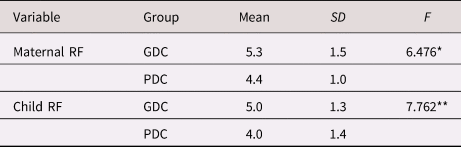
Mothers in the GDC group had significantly higher levels of RF than mothers in the PDC group did, M = 5.3, SD = 1.5; M = 4.4, SD = 1.0, respectively, representing a large effect size, Cohen d = .70, (see Table 2). A score of 5 on the RFS is considered to indicate “ordinary” RF and is often found in community samples (Slade et al., Reference Slade, Grienenberger, Bernbach, Levy and Locker2005), whereas a score of 4 is considered to represent “clichéd” or superficial RF.
Group comparisons for maternal and child reflective functioning (RF) in 55 mother–child dyads

Note: PDC = Poor diabetes control; GDC = good diabetes control; *p < .05 **p < .01.
Similarly, children in the GDC group showed higher levels of RF than children in the PDC group did, M = 5.0, SD = 1.3; M = 4.0, SD = 1.4, respectively, again with a large effect size, Cohen's d = .74 (see Table 2). Yet, although a score of 4 reflects superficial RF, the levels of child RF in the PDC were higher than those that have been found in previous studies in community samples (e.g., M = 3.25 in Ensink et al., Reference Ensink, Berthelot, Bernazzani, Normandin and Fonagy2014, and M = 3 in Ensink et al., Reference Ensink, Bégin, Normandin and Fonagy2016).
The difference between the two groups on the combined dependent variables was statistically significant, F (2, 52) = 4.00, p < .005. The MANOVA results were followed with a univariate one-way ANOVA for each dependent variable, which revealed statistically significant differences between the GDC and PDC groups in child RF and also in maternal RF, F (1, 53) = 7.762, p < .01; partial η2 = .128; F (1, 53) = 6.476, p < .05; partial η2 = .109, for child and maternal RF, respectively. In addition, the univariate ANOVAs revealed, as expected, a significant positive effect of child RF on diabetes-specific quality of life, F (1, 53) = 7.76, p < .01, and of maternal RF on diabetes outcomes, F (1, 53) = 6.47, p < .05. Finally, contrary to our expectations, boys in the PDC group did not report significantly higher scores on stress than boys in the GDC group did (p = 0.6).
Correlations Between Study Variables
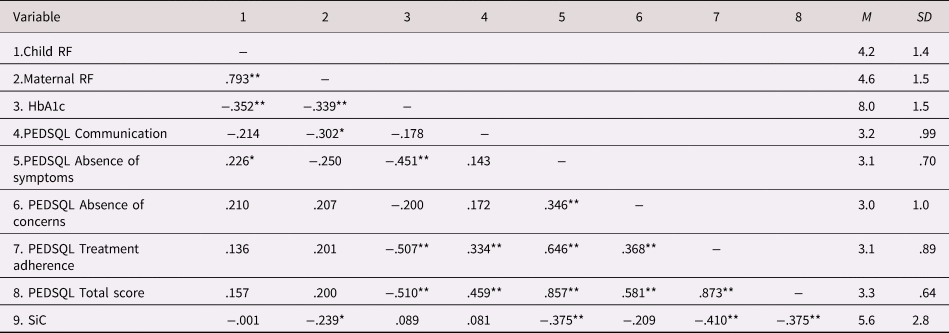
Child RF and maternal RF were highly significantly correlated, r = .793, p < .01. As expected, both child and maternal RF were negatively correlated with HbA1c, r = −.352, p = .005; r = −.339, p = .006, respectively (see Table 3). However, only child RF showed a positive correlation with PedsQL absence of symptoms, r = .226, p =.049. Moreover, maternal RF was negatively correlated with diabetes communication, which was unexpected, r = −.302, p = .013.
Summary of intercorrelations, means, and standard deviations for scores on the RFS, HbA1c, PEDSQL, and SiC in the total sample (n = 55)

Note: For all scales, higher scores are indicative of more extreme responding in the direction of the construct assessed. For HbA1c levels, higher scores are indicative of suboptimal diabetes control. RFS = Reflective Functioning Scale; HbA1c = Glycated Hemoglobin; PEDSQL = Pediatric Diabetes Specific Quality of Life; SiC = Stress in Children. *p < .05 **p < .01.
Children's stress was, as expected, negatively correlated with maternal RF, r = −.239, p = .043, but not with child RF. Finally, stress in children was not correlated with HbA1c, but it was negatively correlated with the absence of symptoms, absence of concerns, treatment adherence, and the total diabetes quality of life score.
Discussion
We investigated the relationships between child RF, maternal RF, and children's stress levels and diabetes outcomes by comparing groups of boys with good and poor diabetes control. Moreover, we examined the associations between maternal RF, child RF, children's levels of stress, and children's diabetes outcomes. We expected to find higher levels of both maternal and child RF and lower children's stress levels in the GDC group than in the PDC group. We also hypothesized that both maternal RF and child RF would be negatively correlated with HbA1c and positively correlated with diabetes-specific quality of life. Finally, we expected children's stress levels to be negatively correlated with maternal RF, child RF, and diabetes-specific quality of life and positively correlated with HbA1c.
The results partially supported our hypotheses. First, the levels of both maternal RF and child RF were significantly higher in the GDC group than the PDC group. Furthermore, both child and maternal RF were negatively correlated with HbA1c, an objective index of diabetes control. Moreover, child RF was associated with lower levels of diabetes-related symptoms.
However, there were no statistically significant differences between the groups in the children's stress levels, which was unexpected, but children's stress was negatively associated with maternal RF and positively with diabetes symptoms, implying that higher maternal RF might be associated with lower levels of stress in the child and that high stress in boys with diabetes may be related to poorer diabetes outcomes. The differences in RF between the two groups suggest that higher RF might be related to better diabetes outcomes. Additionally, the negative association between maternal RF and children's stress suggests a role of parental mentalizing in diabetic children's stress regulation. Nevertheless, it may be that poor diabetes outcomes negatively influence RF in both children and mothers, which in turn affects diabetes control, and the dyad may become trapped in a vicious cycle. Conversely, GDC may foster mentalizing in both mothers and children. Further longitudinal research is needed in this regard to identify causality in the observed association between child and maternal RF and diabetes outcomes. Yet, the findings of this study are consistent with previous studies that have shown that higher levels of mentalizing are associated with resilience (Ensink, Begin, Normandin, & Fonagy, Reference Ensink, Bégin, Normandin and Fonagy2016; Ensink, Normandin, Target, Fonagy, Sabourin, & Berthelot, Reference Ensink, Normandin, Target, Fonagy, Sabourin and Berthelot2014; Fonagy et al., Reference Fonagy, Steele, Steele, Higgitt and Target1994).
Specifically, it has been argued that mentalizing is an important mechanism involved in stress regulation (Luyten & Fonagy, Reference Luyten, Fonagy, Hunter and Maunder2016). Impairments in stress regulation, especially those that are associated with dysregulation of the HPA axis, have been shown to be a key factor in a wide array of somatic and functional somatic conditions (Carroll et al., Reference Carroll, Ginty, Der, Hunt, Benzeval and Phillips2012; Gunnar & Quevedo, Reference Gunnar and Quevedo2007; Muscatell & Eiserberger, Reference Muscatell and Eisenberger2012; Peters, McEwen, & Friston, Reference Peters, McEwen and Friston2017; Picard & McEwen, Reference Picard and McEwen2018). Additionally, parental stress has been reported to be one of the strongest determinants of psychosocial problems in children with diabetes (Drotar, Reference Drotar1997; Hilliard et al., Reference Hilliard, Monaghan, Cogen and Streisand2011; Kovacs et al., Reference Kovacs, Goldston, Obrosky and Bonar1997). The activation of the stress response is likely linked, in part, with the experience of threat that the illness entails.
Therefore, GDC may entail children's ability to reflect on the effects of their illness instead of relating to diabetes as an internal threat that is felt as something that is attacking the self from within (Shahar & Lerman, Reference Shahar and Lerman2013). It may be that this process is supported by the child's (and parent's) ability to mentalize the illness—that is, their ability to reflect on how the experience of diabetes influences mental states. For example, high levels of mentalizing may make it easier to differentiate hyperglycemic states from emotional states that involve high levels of bodily arousal and to be aware of the possible effects of mental states on blood glucose levels.
Moreover, in childhood the understanding of minds develops within attachment relationships (Allen, Reference Allen2013; Fonagy et al., Reference Fonagy, Gergely, Jurist and Target2002; Stern, Reference Stern1985). Similarly, diabetic management in children is also performed in coordination with caregivers. Therefore, good diabetic control may rely not only on children's own capacity for mentalizing but also on that of their caregivers. It has been proposed that the caregiver's ability to regulate his/her own stress level has an important influence on the child's strategies for stress regulation (Nolte et al., Reference Nolte, Guiney, Fonagy, Mayes and Luyten2011). However, even effective strategies for the regulation of stress can fail in the face of chronic activation of stress (Luyten et al., Reference Luyten, Van Houdenhove, Lemma, Target and Fonagy2012), as may occur in a parent that is faced with their child's chronic illness.
Therefore, in order to understand the reflective process by which the child integrates diabetes into his/her internal psychological world, it may be essential to include the caregiver's ability to understand his/her own mind as that of his/her child. The results presented here provide further support for these assumptions, as maternal RF was associated with diabetes outcomes in the children.
Surprisingly, there were no significant differences in the levels of subjective stress that were reported by boys in the GDC and PDC groups. This rather contradictory finding may perhaps be explained by reporting bias, particularly in boys in the PDC group, as denial of distress is commonly observed in children with avoidant attachment strategies, which is the most common insecure attachment pattern among boys (Del Giudice, Reference Giudice2008; Finnegan, Hodges, & Perry, Reference Finnegan, Hodges and Perry1996; Karavasilis, Doyle, & Markiewickz, Reference Karavasilis, Doyle and Markiewicz2003). In contrast, HbA1c values were related to both maternal and child RF. Further research is needed to investigate this assumption.
The findings of this study need to be interpreted in the context of a number of important limitations. First, the study focused only on boys, so research is needed to investigate whether similar findings are obtained in girls. Second, the relatively small sample size and the high education level of most of the mothers may partly explain why the levels of both maternal RF and child RF were higher in our sample than those found in previous studies with community samples were. Third, stress was assessed by using a self-report measure. Future studies should include more objective measures of stress, such as cortisol or heart rate variability. Finally, the present study was conducted in Chile, so the extent to which these findings can be generalized to other samples and cultures is yet to be determined.
Despite these limitations, this study, if replicated, may have important implications for the prevention of complications and intervention. Specifically, the findings of this study suggest that interventions that are designed to improve mentalizing in children with T1D and their caregivers may have a positive effect on diabetic control. Furthermore, the finding that both child RF and maternal RF were related to T1D suggests that the prevention of complications and intervention efforts should focus on both children with T1D and their caregivers.
In conclusion, the present study provides further support for the value of contemporary attachment and mentalization-based approaches in the study and clinical management of T1D, as both maternal RF and child RF were related to diabetes outcomes. However, further longitudinal research is needed to investigate the interplay between RF in diabetic children and their caregivers in relation to diabetes outcomes over time. Furthermore, future research is needed to study the psychological and biological mechanisms that are involved in these associations.
Acknowledgments
We thank the Juvenile Diabetes Foundation of Chile for its contributions to participant recruitment. We are also extremely grateful to all of the mothers and children for their interest in and willingness to contribute to the study.
Financial Support
The first author was supported by CONICYT PhD Scholarship, Chile.