I. INTRODUCTION
The carbon foam is one of the advanced carbon materials which find a lot of applications in various fields due to its combined properties of carbon and cellular structure. Reference Gallego and Klett1–Reference Prieto, Louis and Molina11 Due to the environmental concerns and fast depletion of the fossil fuels, there is a robust attraction in the preparation of carbon materials from the natural renewable precursors. The renewable resources like tannin, sucrose, and olive stone have recently gained attention against the current precursors such as synthetic organic polymers, petroleum- and coal tar pitch for the preparation of carbon foams. Reference Prabhakaran, Singh, Gokhale and Sharma12–Reference Narasimman and Prabhakaran16 Though sucrose is a widely available agricultural product, the carbon foams prepared by foaming aqueous sucrose resin and molten sucrose had low density and compressive strength due to the low carbon yield of sucrose. Reference Prabhakaran, Singh, Gokhale and Sharma12,Reference Jana and Ganesan13,Reference Narasimman and Prabhakaran16 Recently, we have reported the preparation of carbon foam with improved compressive strength by the thermo-foaming of activated carbon (AC) powder dispersions in an aqueous sucrose resin. Reference Narasimman and Prabhakaran17 The AC particles incorporated in the sucrose resin not only increased the carbon content but also retarded the –OH to –OH condensation. Reference Jana and Ganesan13 Further, the AC particles assisted the foaming of low viscous sucrose resins by stabilizing the bubbles by adsorbing on the air–liquid interface. Reference Narasimman and Prabhakaran17 The foam stabilization by particles depends on the wetting characteristics of the powder. Reference Deqing and Ziyuan18–Reference Yang, Wei, Wang and Tong26 It is well known that the wetting of a powder with a liquid depends on the particle size. Reference Dickinson, Ettelaie, Kostakis and Murray19,Reference Binks and Horozov20,Reference Gonzenbach, Studart, Tervoort and Gauckler22 In the present work, we have investigated the effect of the AC particle size on the foaming characteristics of aqueous sucrose resin and the properties such as density, cell size, compressive strength, thermal conductivity, fire resistance, and machinability of the carbon foams.
II. EXPERIMENTAL
A. Preparation of carbon foams
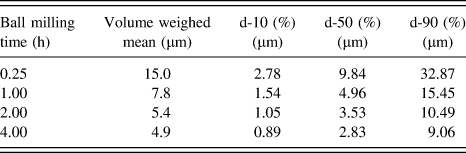
Sucrose, nitric acid, AC powder, and acetone used in this study were of analytical reagent grade and procured from Merck India Ltd., Bombay. The wood derived amorphous AC powder contained particles in the size range of few micrometers to few hundred micrometers. The powders of different average particle sizes were prepared by ball milling the as-received AC powder for various times in an acetone medium using a high energy planetary ball mill (Pulveritz, Germany). The ball milling was performed in zirconia bowls using zirconia grinding media of 10 mm diameter at 300 RPM. The AC powder to ball weight ratio used was 1:6. The particle size distribution of the AC powders was measured using a particle size analyzer (Mastersizer 2000, Malvern, UK). The results of the particle size measurements are given in Table I and the particle size distribution of the AC powders is shown in Fig. S1, Supplementary material.
Particle size data of AC powders.

The procedure for preparation of the carbon foams from AC powder dispersions in aqueous sucrose resin was reported earlier. Reference Narasimman and Prabhakaran17 In brief, a solution prepared by dissolving 300 g sucrose in 300 mL distilled water acidified with 3 mL concentrated nitric acid in a 1 L borosilicate glass beaker was heated on a hot plate to form a honey-like resin. The dispersions of various AC powder to sucrose weight ratios were prepared by mechanically stirring the sucrose resin with the AC powders for 2 h. The AC powder dispersed resin was transferred into 1.5 L borosilicate glass trays and kept at 120 °C for 72 h for foaming and setting. The sucrose polymer – AC powder composite foams obtained were cut into rectangular bodies of 8 cm × 8 cm × 4 cm size and dehydrated by heating in an air oven at the rate of 0.5 °C/min up to 200 °C. A holding time of 3 h was given at 200 °C. The dehydrated samples were carbonized at 900 °C for 2 h in high pure argon atmosphere in a tubular furnace. The heating rate used was 2 °C/min.
B. Characterization
1. Viscosity and foam rise
The viscosity of the AC powder dispersions was measured with a RVT model Brookfield viscometer (Brookfield Engineering Inc.) using a small sample adapter of co-axial geometry and a cylindrical spindle (SC-21). The foam rise, the ratio of the final height of the foam to the initial height of the resin, was measured as reported elsewhere. Reference Narasimman and Prabhakaran16
2. Immersion time measurements
The immersion test of the AC powders was conducted as reported elsewhere to understand the relative wettability of the particles. Reference Binks and Lumsdon27 In this, 50 mg of the AC powder was carefully and evenly dropped on the surface of 20 mL aqueous sucrose resin solution taken in a 30 mL cylindrical glass vial. The time taken for all the powder particles to disappear from the surface by sinking into the resin solution was measured as the immersion time. The immersion times reported were the average of five measurements. The sucrose resin diluted to ten times was used for the immersion time measurement.
3. Scanning electron microscope (SEM) and cell size measurements
The microstructure analysis of the carbon foams was carried out using a SEM (FEI Quanta FEG200, Hillsboro, OR). Samples for the SEM analysis were prepared by cutting the carbon foams using a sharp knife. The average cell size of the various carbon foam samples was measured from the SEM photomicrographs.
4. Compressive strength measurement and thermal conductivity
The compressive strength of the carbon foams was measured using a universal testing machine (Instron 5050, Instron) at a crosshead speed of 0.5 mm/min. The rectangular samples of size 25 mm × 25 mm × 12 mm were used (ASTM standard C365/C365M-05). The maximum stress in the stress–strain graph was noted as the compressive strength.
The thermal conductivity of the carbon foams was measured using modified transient plane source method (C-ThermTCi, Canada) at room temperature. The rectangular samples of 20 mm × 20 mm × 6 mm size were used for the thermal conductivity measurements. The reported thermal conductivity is the average of four measurements.
5. Machinability studies and fire resistance
Machinability of the carbon foams was checked by cutting slots using a universal milling machine (Bharat Fritz Werner Ltd., Bangalore, India) and drilling holes using a drilling machine on the carbon foam bodies of 15 cm × 10 cm × 1.5 cm size. The slots were made using a high speed steel end mill cutter with a diameter of 10 mm at a feed rate of 125 mm/min and at 700 RPM. The holes were made using a drill bit of 8 mm diameter. The evenness of the machined surfaces was observed using a vision inspection system with a CCD color camera (Vision 300 GL, TESA Technologies, Switzerland) at a magnification of 30x.
Fire resistance and ablative property of the carbon foams were tested by exposing the carbon foam samples of 15 cm × 10 cm × 2 cm size to an oxyacetylene ablation torch. Reference Shen, Li, Li, Fu, Li and Deng28 The inner diameter of the nozzle and flow rate of acetylene was 2 mm and 500 L/h, respectively. The distance between the nozzle tip and the specimen surface was 10 mm.
III. RESULTS AND DISCUSSION
A. Foaming characteristics
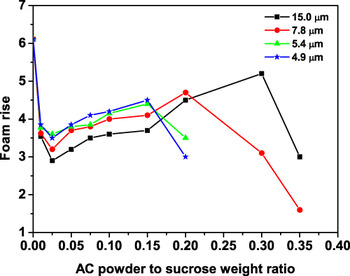
The effect of the AC particle size on the foam volume is shown in Fig. 1. In sucrose resin without the AC powder, the gas bubbles generated due to the water vapor were stabilized by an increase in the viscosity due to faster –OH to –OH condensation resulting in the highest foam volume. Reference Narasimman and Prabhakaran16,Reference Narasimman and Prabhakaran29 In all the studied particle sizes, the foam volume decreased to a minimum when the AC powder to sucrose weight ratio increased from 0 to 0.025 due to the retardation of polymerization through the –OH to –OH condensation. Reference Jana and Ganesan13 Thereafter, the foam volume increased to a maximum and then decreased with further increase in AC powder loading. Hereafter, the AC powder to sucrose weight ratio at which maximum foam volume observed is called as the threshold AC powder to sucrose weight ratio. In all the studied AC powder to sucrose weight ratios, foam volume increased with the decrease in particle size. The increase in the foam volume with a decrease in the AC particle size indicates that the finer particles are better for the stabilization of bubbles. The threshold AC powder to sucrose weight ratio decreased with a decrease in the particle size. It appears that the finer AC powder could form complete particle coverage on the liquid–vapor interface at lower powder loading. That is, AC powder with finer particle size could form stable foams at lower powder loading.
Effect of particle size on the foam rise of AC powder dispersions at various powder loadings.

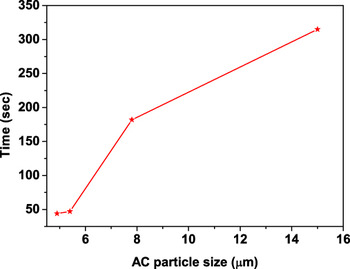
The stability of particle stabilized foams depends on the wetting characteristics of the particles. The particles which are highly and poorly wettable with the liquid phase are unable to adsorb on the liquid–air interface to produce stable foams. It has been reported that the solid–liquid contact angle in the range of 80 to 60° is ideal for forming stable foams. Reference Gonzenbach, Studart, Tervoort and Gauckler21,Reference Gonzenbach, Studart, Tervoort and Gauckler22,Reference Gonzenbach, Studart, Tervoort and Gauckler30 The sucrose resin showed a contact angle of 68° on a carbonized wood surface. As the contact angle measurement on AC particle is not possible with the available facility, the immersion test is used as a qualitative measure of relative wetting characteristics as the sinking of particles in a liquid involves the replacement of the solid–gas interface with a solid–liquid interface. Figure 2 shows the immersion time of the AC powder as a function of the particle size. The increase in the wettability with a decrease in the particle size of AC powders is clearly evidenced from the decrease in immersion time. The increase in foam volume with a decrease in the AC particle size is due to the increase in foam stability achieved by the increase in wettability.
The effect of the AC particle size on the immersion time.

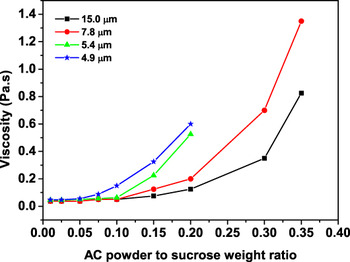
The addition of AC powder beyond the threshold AC powder to sucrose weight ratio resulted in foam collapse as evidenced from the decrease in foam rise. This is due to the agglomeration of the AC particles. It is well known that the agglomeration of powder particles in a liquid medium increases with the decrease in particle size. Reference Parfitt31 This is clearly evidenced from the viscosity of the AC powder dispersions measured as a function of powder loading. In all the studied particle sizes, the viscosity of dispersions increases gradually up to a certain AC powder loading and then rapidly due to the particle agglomeration. It is interesting to note that the rapid increase in viscosity is observed just before the threshold AC powder to sucrose weight ratio. The viscosity of the AC powder dispersions as a function of powder loading is shown in Fig. 3. Thus the particle agglomeration in finer AC powders limits their loading in the sucrose resin for the preparation of carbon foams.
Effect of the AC particle size and powder loading on viscosity of the dispersions.

B. Effect of the AC particle size and powder loading on the microstructure of carbon foams
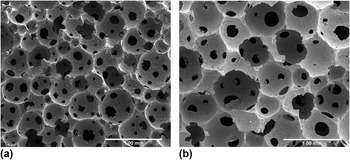
Figure 4 shows the SEM photomicrographs of the carbon foams prepared using AC powder of 15 μm size at AC powder to sucrose weight ratios of 0.025 and 0.15. The carbon foams have interconnected cellular structure. The cells have spherical or near spherical morphology. The carbon foams showed similar microstructures up to the threshold AC powder to sucrose weight ratio except the cell size. The high magnification image of the cell wall surfaces showed an increased adsorption of the AC particles with an increase in the AC powder loading. At the threshold AC powder to sucrose weight ratios, the AC particles form complete coverage on the cell wall surfaces.
The SEM photomicrographs of carbon foams prepared using AC powder of 15 μm size at AC powder to sucrose weight ratios of (a) 0.025 and (b) 0.15.

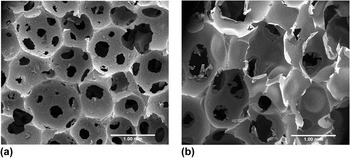
A large distortion of the cells from spherical morphology was observed in the bottom portion of the carbon foams obtained at the threshold AC powder to sucrose weight ratio. The deviation from spherical morphology is attributed to the collapse of bubbles in the bottom due to the sedimentation of agglomerated AC particles. The SEM microstructures of the bottom portion of the carbon foam body prepared using 4.9 μm AC powder at AC powder to sucrose weight ratios of 0.1 and 0.15 are shown in Fig. 5. The carbon foams prepared above the threshold AC powder to sucrose weight ratio have the distorted cell morphology throughout due to extensive particle agglomeration.
SEM photomicrographs of the bottom portion of the carbon foam bodies prepared using 4.9 μm AC powder at the AC powder to sucrose weight ratios of (a) 0.10 and (b) 0.15.

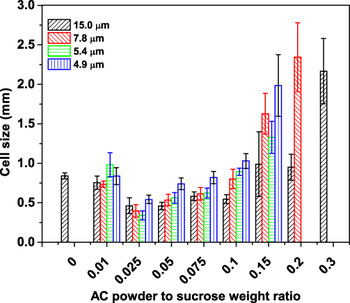
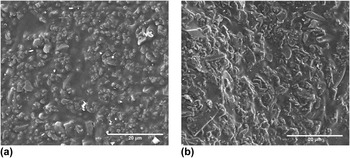
Figure 6 shows the average cell size of the carbon foams prepared using AC powder of various particle sizes at various AC powder to sucrose weight ratios. The average cell size of the carbon foams increased considerably with the AC powder loading in all the studied particle sizes. On the other hand, the cell size showed a marginal increase with a decrease in the AC particle size at all the studied AC powder to sucrose weight ratios. This confirms that the finer AC particles are more effective in stabilizing the bubbles. It is further evidenced from the high magnification SEM images showing the preferential adsorption of the finer fraction of the AC powders on the bubble surfaces. Figure 7 shows the high magnification SEM photographs of the cell wall surface of carbon foams prepared at an AC powder to sucrose weight ratio of 0.15 using powders of average particle sizes 4.9 and 7.8 μm. The approximate estimation of the average size of AC particles on the cell wall surface of carbon foams prepared using AC powder of average particle sizes 4.9 and 7.8 μm are 1.84 and 3.41 μm, respectively. The size of pores connecting the cells also increased with an increase in the AC powder to sucrose weight ratio.
Effect of the AC particle size and powder loading on cell size of the carbon foams.

SEM photomicrographs of cell wall surfaces of carbon foams prepared at an AC powder to sucrose weight ratio of 0.15 using powders of (a) 4.9 μm and (b) 7.8 μm.

C. Foam density and compressive strength
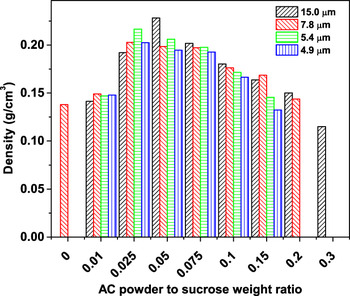
The density variation of the carbon foams with the AC particle size and AC powder to sucrose weight ratio is shown in Fig. 8. The addition of AC powder into the sucrose resin up to the AC powder to sucrose weight ratio of 0.01 showed a slight increase in carbon foam density. A further increase in the AC powder to sucrose weight ratio to 0.025 increased the carbon foam density considerably and to a maximum. The density remains a plateau at AC powder to sucrose weight ratios in the range of 0.025–0.075 and then decreased. At each AC powder to sucrose weight ratio, the difference in density due to the difference in the AC particle size is only marginal. The considerable increase in density observed from the AC powder to sucrose weight ratio from 0.01 to 0.025 is due to the change in the mechanism of bubble stabilization. That is, up to the AC powder to sucrose weight ratio of 0.01 the foaming is mainly by the stabilization of bubbles due to the increase in viscosity by polymerization through –OH to –OH condensation. On the other hand, at AC powder to sucrose weight ratio above 0.01 the foaming is mainly by the stabilization of bubbles by the adsorption of AC particles on the air–liquid interface. A simultaneous increase in cell size and foam density from AC powder to sucrose weight ratio from 0.01 to 0.075 indicates that the bubble stabilization by the AC particles produces carbon foams with thick struts and cell walls compared to the bubble stabilization by viscosity increase through –OH to –OH condensation.
Density variation of carbon foams with the AC particle size and powder loading.

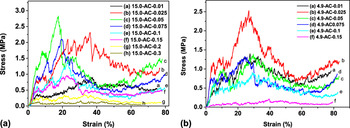
The carbon foams prepared at various AC powder to sucrose weight ratios using AC particles with different particle sizes show typical elastic–brittle behavior during compression loading as evidenced from the stress–strain graphs shown in Fig. 9. Reference Tondi, Fierro, Pizzi and Celzard14,Reference Li, Basso, Braghiroli, Fierro, Pizzi and Celzard15,Reference Gibson and Ashby32 An elastic region followed by a yield point, a plateau region and a region of densification are observed in the stress–strain curves. The foams start their failure due to the fracture of ligaments after reaching the plateau stress. The debris formed by the fracture of the ligaments fills the cells in the carbon foam body resulting in the densification of the foams. The densification of the foam is observed at strain values in the range of 60 to 80%. The foams with higher density and lower cell size starts densification at lower strain values.
Stress–strain graph of the carbon foams prepared using AC powder of average particle sizes (a) 15.0 μm and (b) 4.9 μm.

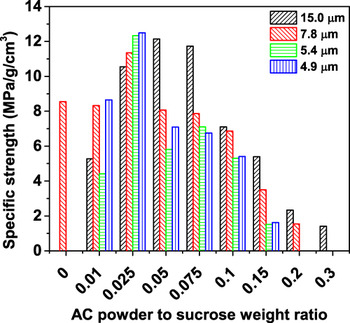
The compressive strength of foam materials generally increases with an increase in foam density and decrease in the cell size. Reference Li, Basso, Braghiroli, Fierro, Pizzi and Celzard15,Reference Gibson and Ashby32 The reinforcement by the AC particles is evidenced from the plot of specific compressive strength as a function of the AC particle size and AC powder loading as shown in Fig. 10. Irrespective of the AC particle size, the carbon foams showed maximum specific compressive strength at the AC powder to sucrose weight ratio of 0.025 even though they have the highest density. At this AC powder to sucrose weight ratio, the carbon foams showed a marginal increase in the specific compressive strength with a decrease in the AC particle size. On the other hand, at higher AC powder to sucrose weight ratios, the specific compressive strength decreased with a decrease in the AC particle size. It is well known that well-dispersed finer particles in the matrix provide better reinforcement by creating more matrix–reinforcement interfaces. It appears that the AC powder disperses without agglomeration at AC powder to sucrose weight ratio up to 0.025 irrespective of the particle size. The particle agglomeration started at AC powder to sucrose weight ratio above 0.025 and increased with an increase in the AC powder to sucrose weight ratio. This resulted in the decrease of specific compressive strength at AC powder to sucrose weight ratio beyond 0.025. The particle agglomeration is severe in finer AC powders as evidenced from the decrease of specific compressive strength with a decrease of the average AC particle size at the AC powder to sucrose weight ratios above 0.025. That is, these particle agglomerates decreased the compressive strength by acting as strength limiting flaws.
Effect of the AC particle size and powder loading on the specific compressive strength of carbon foams.

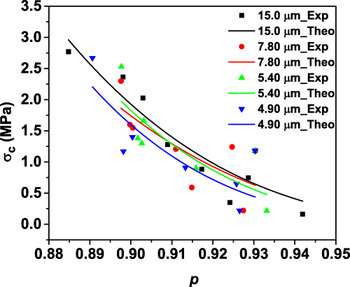
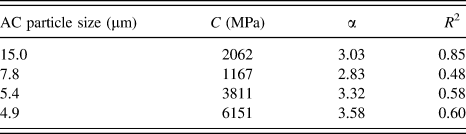
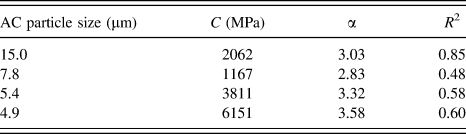
The mechanical properties of brittle foam materials are best explained by the classical “density power law model” developed by Gibson and Ashby. Reference Gibson and Ashby32 Herein, the equation, σc = C (1 − p)α, where σc is the compressive strength, p is the pore fraction, and C and α are material dependent constants, is used to model the compressive strength of the carbon foams. Reference Chen, Baino, Spriano, Pugno and Vitale-Brovarone33 Results of model fitting along with the experimental test results are shown in Fig. 11. The model constants C and α as well as the correlation coefficient R 2 are listed in Table II. The correlation coefficient obtained is poor expect in the case of carbon foams prepared at AC powder of average particle size 15 μm.
Comparison of experimental and model results of compressive strength of carbon foams prepared at different particle sizes.

Compressive strength model parameters and coefficients of determination for carbon foams prepared at various average AC particle sizes.
D. Thermal conductivity
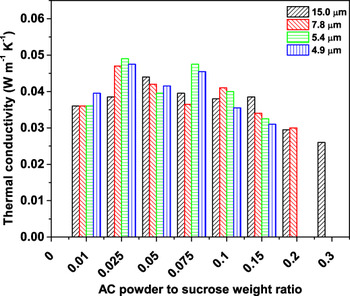
Figure 12 shows the variation of thermal conductivity of the carbon foams with the AC particle size and powder loading. The thermal conductivity of carbon foams depends on the bulk density, cell size, and thickness of the cell wall and strut. Reference Li, Basso, Braghiroli, Fierro, Pizzi and Celzard15,Reference Gibson and Ashby32 The effect of the AC particle size on the thermal conductivity of the carbon foams is insignificant. However, the thermal conductivity of carbon foams increased marginally with the increase in the AC powder to sucrose weight ratio up to 0.025. A further increase in the AC powder concentration marginally decreased the thermal conductivity. The variation of thermal conductivity with the AC powder loading is in line with the variation of density and cell size. The thermal conductivity values obtained are in the range of 0.036–0.049 W m−1 K−1. The thermal conductivity values are lower than that reported for the vitreous carbon foams of similar densities prepared from other precursor materials. Reference Tondi, Fierro, Pizzi and Celzard14,Reference Li, Basso, Braghiroli, Fierro, Pizzi and Celzard15,Reference Gibson and Ashby32
Effect of the AC particle size and powder loading on the thermal conductivity of carbon foams.

E. Machinability and fire resistance
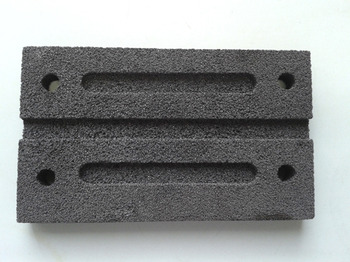
The materials intended for structural applications need to be configured into the required size and shape. In this respect, the machinability of the materials is very important. For the successful machining the work piece should have sufficient strength to hold in a machine and the surfaces and edges produced after machining should have very good evenness. The machinability of carbon foams depends on the AC powder to sucrose weight ratio and AC particle size. The carbon foams prepared using AC powders of average particle sizes 4.9, 5.4, 7.8, and 15 μm showed good machinability characteristics with respect to the evenness of the machined surfaces and edges up to the AC powder to sucrose weight ratios of 0.075, 0.1, 0.15, and 0.2, respectively. The poor machinability at the higher AC powder to sucrose weight ratios is because of the low strength due to low density, large cell size, and heavy agglomeration of the AC particles. Figure 13 is the photograph of a rectangular carbon foam body showing slots made by milling and holes made by drilling using conventional machines and tools.
Photograph of a rectangular carbon foam body showing slots made by milling and holes made by drilling.

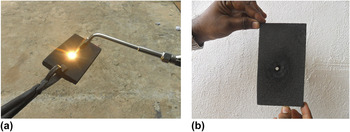
Carbon foams are proposed to be used in fire resistant structures and thermal protection systems based on their excellent fire resistance and ablative property coupled with low thermal conductivity. The carbon foams prepared from sucrose resin and AC powder did not contain sufficient volatile matter to support combustion when exposed to the oxyacetylene flame irrespective of the AC particle size and AC powder to sucrose weight ratios. There were no hazardous fumes or smoke produced. Photograph of the carbon foam during and after exposure to oxyacetylene flame is shown in Fig. 14. Though the carbon foam did not catch fire, the oxyacetylene flame pierces through the carbon foam on prolonged exposure. The oxyacetylene flame took 60–70 s to penetrate 15-mm-thick carbon foam. The time required for the penetration of flame is much higher than that reported for tannin based and bituminous coal extract based carbon foams. Reference Tondi, Fierro, Pizzi and Celzard14,Reference Stansberry, Stiller and Zondlo34 That is, the carbon foams prepared from sucrose resin and AC powder have superior flame resistance and ablative property.
Photograph of carbon foam (a) during and (b) after exposure to oxyacetylene flame.

IV. SUMMARY
The wettability of the AC particles increased with the decrease of particle size that resulted in an increase in the foam volume with a decrease in the AC particle size due to the better stabilization of bubbles by the finer particles. This is evidenced from the preferential adsorption of the finer AC particles on the cell wall surfaces. The foam collapses above a threshold AC powder to sucrose weight ratio is due to the agglomeration of the AC particles. The threshold AC powder to sucrose weight ratio decreases with a decrease in the average particle size of AC powder. The cell size of the carbon foams increased with both the AC particle size and AC powder loading. The AC particle size has a marginal effect on the density and thermal conductivity of the carbon foams. On the other hand, the density, the compressive strength, and the thermal conductivity of the carbon foams increased with an increase in the AC powder to sucrose weight ratio up to 0.025 and then decreased. The thermal conductivity values are lower than that of the vitreous carbon foams of similar densities reported in the literature. The carbon foams are amenable to machining using conventional machines and tools. The AC powder to sucrose weight ratios up to which good evenness of the machined surfaces and edges could be achieved are 0.075, 0.1, 0.15, and 0.2 with the AC powders of average particle sizes 4.9, 5.4, 7.8, and 15 μm, respectively. The carbon foams showed very good fire resistance.
Supplementary Material
To view the supplementary material for this article, please visit http://dx.doi.org/jmr.2014.294.
ACKNOWLEDGMENTS
The authors are thankful to Dr. K.S. Dasgupta, Director; Dr. K.N. Ninan, Emeritus Professor; and Dr. Kuruvilla Joseph, Head of the Department of Chemistry of IIST for their encouragements.