


Introduction
Since the 1960s crop rotations in Northern Germany comprising winter wheat (Triticum aestivum L.) were simplified, i.e. reduced in crop diversity partially through to monoculture, for economic reasons (Christen et al., Reference Christen, Sieling and Hanus1992; Sieling et al., Reference Sieling, Stahl, Winkelmann and Christen2005). In 2010, almost 50% of the arable land in the North German state of Lower Saxony was cultivated with simplified crop rotations (Steinmann and Dobers, Reference Steinmann and Dobers2013). Monoculture of winter wheat is simpler to manage than more diverse crop rotations (Angus et al., Reference Angus, Kirkegaard, Hunt, Ryan, Ohlander and Peoples2015) but can lead to high yield losses in the first years due to occurrence of root diseases caused by the pathogens Gaeumannomyces tritici (Jenkyn et al., Reference Jenkyn, Gutteridge and White2014) and Pseudocercosporella herpotrichoides. Generally, yield losses in wheat grown after wheat can range between 8 and 57% compared to wheat grown after more favourable preceding crops (Sieling and Christen, Reference Sieling and Christen2015). Alternatively, a sequence of continuous wheat may be broken with the cultivation of an unrelated species, a so-called ‘break crop’ (Angus et al., Reference Angus, Kirkegaard, Hunt, Ryan, Ohlander and Peoples2015), by which life cycles of crop-specific pathogens are interrupted (Kirkegaard et al., Reference Kirkegaard, Christen, Krupinsky and Layzell2008).
Generally, within a crop rotation, preceding crops were found to have the largest effect on yield of the subsequent crop, while the effect of pre-preceding crops and the overall crop rotation was lower (Sieling and Christen, Reference Sieling and Christen2015). Preceding crops including their residues remaining in the field may influence root pathogens, other soil organisms, soil water and soil nitrogen, whereby they can affect the yield of the following crop (Angus et al., Reference Angus, Kirkegaard, Hunt, Ryan, Ohlander and Peoples2015). In the case of winter wheat, the incidence and severity of G. tritici is crucial for the yield response after different preceding crops (Christen et al., Reference Christen, Sieling and Hanus1992). Besides preceding crops, sowing date influences infestation by G. tritici or P. herpotrichoides, too: Early sown winter wheat is infested earlier and stronger than late sown (Bateman, Reference Bateman1986; Colbach et al., Reference Colbach, Lucas and Meynard1997; Sieling et al., Reference Sieling, Ubben and Christen2007). Sowing date of wheat may also be affected by the preceding crop through different harvest dates. Moreover, sowing of wheat after Brassica break crops can be earlier than after wheat as weed populations after these break crops are often low; however, this benefit probably goes unnoticed in many experiments as different sowing dates for the same preceding crop are necessary in field studies to detect it (Angus et al., Reference Angus, Kirkegaard, Hunt, Ryan, Ohlander and Peoples2015).
Besides winter wheat, winter oilseed rape (Brassica napus L.), sugar beet (Beta vulgaris L. var. altissima Döll) and maize (Zea mays L.) were the most frequently grown preceding crops of winter wheat in Lower Saxony, Germany, in 2009/2010 (Steinmann and Dobers, Reference Steinmann and Dobers2013). Concerning oilseed rape as preceding crop, Sieling et al. (Reference Sieling, Ubben and Christen2007) found 1 t/ha higher wheat yield than after winter wheat. Angus et al. (Reference Angus, Kirkegaard, Hunt, Ryan, Ohlander and Peoples2015) determined 0.8 t/ha mean increase of wheat yield after preceding crop oilseed rape compared to wheat after wheat considering different experimental locations in Australia, Europe and North America. After cultivation of oilseed rape, soils in southeastern Australia were more porous, had lower shear strength and more stable aggregates than soils after cultivation of field pea (Pisum sativum L.) or barley (Hordeum vulgare L.) (Chan and Heenan, Reference Chan and Heenan1996). Weed populations can be relatively low in wheat following preceding crop oilseed rape, but it is unclear whether allelopathy or the use of persistent herbicides on oilseed rape is the cause for this (Angus et al., Reference Angus, Kirkegaard, Hunt, Ryan, Ohlander and Peoples2015).
Studies with preceding crops sugar beet and (silage) maize before winter wheat are scarce, despite the economic importance and thus widespread cultivation of these crops in rotations with winter wheat. Claupein and Zoschke (Reference Claupein and Zoschke1987) found a higher yield of winter wheat in a rotation with preceding crop sugar beet than in continuous winter wheat cultivation by about 0.65 t/ha at experimental station Rauischholzhausen from 1969 to 1985. However, conditions regarding residue treatment in this trial were far from current common practice. Macholdt and Honermeier (Reference Macholdt and Honermeier2019) noticed a high yield stability in a crop rotation with preceding crop sugar beet, similar to crop rotations with preceding crops winter oilseed rape and field bean, at the same site in a different trial from 1993 to 2017. Berzsenyi et al. (Reference Berzsenyi, Győrffy and Lap2000) found a higher wheat yield in a maize – maize – wheat – wheat rotation compared to wheat monoculture by about 0.38 t/ha in an unfertilized control, while the difference increased to about 0.86 t/ha when averaged over differently fertilized treatments. However, the authors do not mention if maize was grown as silage or grain maize which may severely affect the outcome due to the large difference in aboveground crop residues remaining on the field. Thus, potential benefits of sugar beet and (silage) maize as preceding crops before wheat compared to wheat and other preceding crops require further research.
Beyond the direct impact of preceding crops, diversity of crop rotations was found to affect processing of newly added residues, microbial dynamics and nutrient cycling (McDaniel et al., Reference McDaniel, Grandy, Tiemann and Weintraub2014) and may, thus, ultimately also affect yield of the single crops. However, when winter wheat rotations with different numbers of species (crop diversity) and a wheat monoculture were compared by Smith et al. (Reference Smith, Gross and Robertson2008), there was no effect of crop diversity on wheat yield beside a lower yield in monoculture (by around a third) compared to all other treatments. In contrast, Berzsenyi et al. (Reference Berzsenyi, Győrffy and Lap2000) found an effect of the share of wheat in crop rotations on yield: the lower the share, the higher the yield. Further, crop rotations can affect the soil organic matter (Ellerbrock and Gerke, Reference Ellerbrock and Gerke2016). Although soil organic matter can generally be expected to improve soil fertility, no significant effect on yield could be found in a meta-analysis for Europe (Hijbeek et al., Reference Hijbeek, van Ittersum, ten Berge, Gort, Spiegel and Whitmore2017). Macholdt et al. (Reference Macholdt, Piepho, Honermeier, Perryman, Macdonald and Poulton2020) suppose that a higher soil organic carbon content leads to lower yield variability, but this hypothesis could not be confirmed with the collected data in their study. Thus, the overall crop rotation might have an impact on wheat yield beyond the direct preceding crop.
In this study, a crop rotation trial conducted from 2006 to 2018 in Lower Saxony, Germany, was analysed to answer the following research questions: (1) How do preceding crops sugar beet, winter wheat, silage maize and winter oilseed rape affect grain yield of winter wheat and is this modified by the overall crop rotation? (2) Is there a pre-preceding crop effect on grain yield of winter wheat? (3) Does an early (end of September) or late (end of October) sowing date in combination with different preceding crops influence grain yield and yield components of winter wheat? (4) Is there an effect of the amount of soil organic matter, modified by an increased crop residue input, on grain yield of winter wheat after different preceding crops?
Materials and methods
Site
The study site Harste is located near Göttingen in Lower Saxony, Germany (51°36’23.5”N, 9°51’55.5”E, 155 m a.s.l.). Long-term (1992–2021) mean annual air temperature is 9.5°C and long-term mean sum of annual precipitation is 629 mm (DWD 2022). In 2007–2018, mean air temperature was 9.7°C (range: 8.0–10.6°C) and mean sum of annual precipitation 626 mm (range: 430–892 mm). Soil type at the study site is classified as Stagnic Luvisol (IUSS Working Group WRB, 2014) and soil texture in the upper 30 cm as silty loam (100 g clay/kg soil, 760 g silt/kg soil, 140 g sand/kg soil).
Crop rotations and experimental design
The crop rotation trial Harste was established in 2006 with seven different crop rotations:
1. sugar beet – winter wheat – winter wheat
2. winter wheat monoculture
3. silage maize – winter wheat – winter wheat
4. winter oilseed rape – winter wheat – winter wheat
5. sugar beet – winter wheat – silage maize
6. sugar beet – winter wheat – winter oilseed rape – winter wheat – winter wheat – grain pea
7. sugar beet – winter wheat – winter wheat
Rotation 5 included grain maize instead of silage maize until 2009. As catch crops, mustard (Sinapis alba L.) was grown before sugar beet in all crop rotations except for rotation 5 and before silage maize, while phacelia (Phacelia tanacetifolia L.) was grown before grain pea. Both catch crops were fertilized with 40–50 kg N/ha. Each crop rotation element was cultivated every year in an α-design, i.e. with complete replications (three in our case) each containing incomplete blocks (in our case six blocks of four plots (16.2 m × 14.0 m) each). Plots of rotation 7 were split into subplots (8.1 m × 14.0 m) for the whole study period and residues of sugar beet were moved from one subplot to the adjacent subplot after each sugar beet harvest, resulting in subplots with double the amount of sugar beet residues or none.
Soil tillage was usually done with a cultivator before sowing at a depth of 15–20 cm. Winter wheat cultivar was Cubus throughout the experimental period. Cubus is rated with a medium ear density, medium to high ear number, medium thousand seed weight (TSW) and a medium grain yield (Bundessortenamt, 2022).
Sowing date was chosen according to preceding crop until 2015, similarly to agricultural practice: early (end of September) after winter wheat and winter oilseed rape and late (end of October) after sugar beet and silage maize. Since this way preceding crop and sowing date were confounded, plots of rotation 2 (wheat monoculture) and plots of the second phase in rotations 1, 3 and 4 (first wheat after sugar beet, silage maize and oilseed rape, respectively) were split into subplots (8.1 m × 14.0 m) with early and late sowing date for the growing seasons of 2016 to 2018 to analyse the possible modification of the preceding crop effect by sowing date differences. For the early sowing date, winter wheat seeding rate was 250–270 seeds/m2 and for the late sowing date 350 seeds/m2.
Plant protection was conducted according to the specific growing conditions and occurrence of pests and diseases in each year. Generally, except for rotation 7 as described above, crop residues were left on the field. Mineral nitrogen (N) fertilization was adapted to preceding crop (expected N mineralization) and soil mineral N content in 0–90 cm depth (Nmin) measured in spring each year. Target value as the sum of spring Nmin and mineral fertilizer N was 240 kg N/ha for preceding crops sugar beet and winter oilseed rape and 260 kg N/ha for preceding crops winter wheat and silage maize. The resulting amount was divided into three to five applications with urea ammonium nitrate solution (except for first application in 2018: ammonium sulphate solution). Total amount of nitrogen applied varied strongly among the years with between 80 and 230 kg N/ha, yet, when keeping in mind the different target values of total available N after the different crops, the overall mean in the study years 2008–2018 was similar for the four preceding crops with 181 (oilseed rape), 187 (sugar beet), 197 (silage maize) and 204 kg N/ha (winter wheat).
Grain yield was determined by machine harvesting the grain fresh matter on a subplot of 1.5 m × 14.0 m of which a sample was taken and dried at 105°C to analyse the dry matter content. Additionally, for the study years 2016–2018, the TSW was determined by weighing while ears were counted by hand after harvest in eight rows at a length of 1 m and scaled up to ears/m2. Finally, grains per ear could be calculated from the three aforementioned parameters.
Statistical analyses
All statistical analyses were performed in SAS Version 9.4 (SAS Institute Inc., 2016). Graphs were created in RStudio Version 2022.02.3 (Rstudio, 2022) with R Version 4.2.1 (The R Foundation for Statistical Computing, 2022) and the packages ggplot2 (Wickham, Reference Wickham2016) and ggpubr (Kassambara, Reference Kassambara2020).
For the analysis of rotation, preceding crop and pre-preceding crop effects on grain yield in 2008–2018, rotations 1–6 were considered. In cases where plots were split into subplots with different sowing dates (2016–2018), subplots with early sowing date were selected for preceding crops winter oilseed rape and winter wheat, and subplots with late sowing date for preceding crops sugar beet and silage maize in order to be consistent with sowing dates until 2015.
A linear mixed-effects model was fitted with the GLIMMIX procedure of SAS using residual (restricted) maximum likelihood (REML) for estimation of variance components as follows:

Fixed effects are listed first and separated from random effects by a colon (Piepho et al., Reference Piepho, Büchse and Emrich2003). The year effect was partitioned in a fixed part (TIME) and a remaining random part (YEAR) (Loughin et al., Reference Loughin, Roediger, Milliken and Schmidt2007; Onofri et al., Reference Onofri, Seddaiu and Piepho2016). TIME is a continuous covariate and describes a linear time trend and YEAR models the year-by-year variation around this trend line. Factors A (rotation) and B (phase) are fixed effects, while REP (replication), BLOCK⋅REP (block within replication), and all interactions with YEAR are random effects. Different covariance structures were fitted to account for autocorrelation on the same plot across years. The Akaike information criterion (AIC) value was lowest with compound symmetry structure (Table 1).
Models regarding grain yield 2008–2018 with different within-plot covariance structures
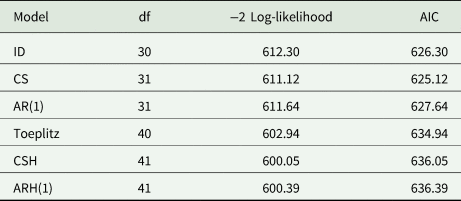
df, degrees of freedom (fixed and random effects); AIC, Akaike information criterion; ID, independent (no within-plot correlation); CS, compound symmetry; AR(1), autoregressive of order 1; CSH, compound symmetry with heteroscedastic errors by year; ARH(1), autoregressive of order 1 with heteroscedastic errors by year.
Variance components BLOCK⋅REP and YEAR⋅A were removed from the model due to values of zero, YEAR⋅ BLOCK⋅REP was removed after likelihood-ratio test. Fixed effects TIME⋅A⋅B and TIME⋅A were removed from the model after fitting models using maximum likelihood (ML) for estimation of variance components and carrying out likelihood-ratio tests. Custom contrasts were defined with the statement ESTIMATE. P values were adjusted by a simulation-based approach using the multivariate t distribution (option ADJUST = SIMULATE).
To analyse the rotation effect, all phases within rotations with preceding crop sugar beet were compared with each other, both phases within rotations with preceding crop winter oilseed rape were compared and all phases within rotations with preceding crop winter wheat were compared pairwise in a first contrast. This contrast includes the analysis of pre-preceding crop effect. Preceding crop effect was investigated by comparing all phases within rotations with a specific preceding crop with phases within rotations with a specific different preceding crop in a second contrast.
For the analysis of preceding crop and sowing date effects on grain yield in 2016–2018, rotations 1–4 were considered. A linear mixed-effects model was fitted with the MIXED procedure using REML for estimation of variance components as follows:

where factors A (preceding crop), B (sowing date) and REP (replication) are fixed effects, while YEAR, SUBPLOT, and all interactions with YEAR are random effects. Different covariance structures were fitted to account for autocorrelation on the same main- and subplot across years. AIC was lowest with autoregressive structure of order 1 with heteroscedastic errors by year (Table 2).
Models regarding grain yield 2016–2018 with different within-main- and subplot covariance structures
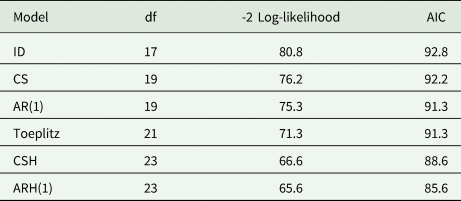
df, degrees of freedom (fixed and random effects); AIC, Akaike information criterion; ID, independent (no within-plot correlation); CS, compound symmetry; AR(1), autoregressive of order 1; CSH, compound symmetry with heteroscedastic errors by year; ARH(1), autoregressive of order 1 with heteroscedastic errors by year.
Variance components YEAR⋅A⋅B and YEAR⋅REP were removed from the model due to values of zero. Model (2) was fitted for the dependent variables ear density, grains per ear and TSW, too, with independent uncorrelated plots (lowest AIC).
The effect of removing or adding aboveground sugar beet residues, representing differences in soil organic matter content, was analysed considering rotation 7 in the MIXED procedure using REML for estimation of variance components with the following linear mixed-effects model:

The year effect was partitioned in a fixed and a random part as in model (1). TIME is a continuous covariate and describes a linear time trend and YEAR models the year-by-year variation around this trend line. Factors A (preceding crop) and B (residues) are fixed effects, while REP, SUBPLOT and all interactions with YEAR are random effects. AIC was lowest for autoregressive structure of order 1 for main- and subplots. Variance components REP, YEAR⋅REP and YEAR⋅B were removed from the model due to values of zero. Fixed effects TIME⋅A⋅B and TIME⋅A were removed from the model after fitting models using ML for estimation of variance components and carrying out likelihood-ratio tests.
Denominator degrees of freedom in Wald-type F tests were approximated after Kenward and Roger (Reference Kenward and Roger1997). Mean values of model (2) were compared with the statement LSMEANS (option ADJUST = TUKEY) for significant main effects. If interactions of model (2) or (3) were significant (P < 0.05), custom contrasts were defined with the statement LSMESTIMATE and mean values were compared separately for each preceding crop. P values were adjusted by a simulation-based approach using the multivariate t distribution (option ADJUST = SIMULATE). For all models, normality of residuals and homogeneity of variance were checked using residual plots.
Results
Crop rotation, preceding crop and pre-preceding crop effects
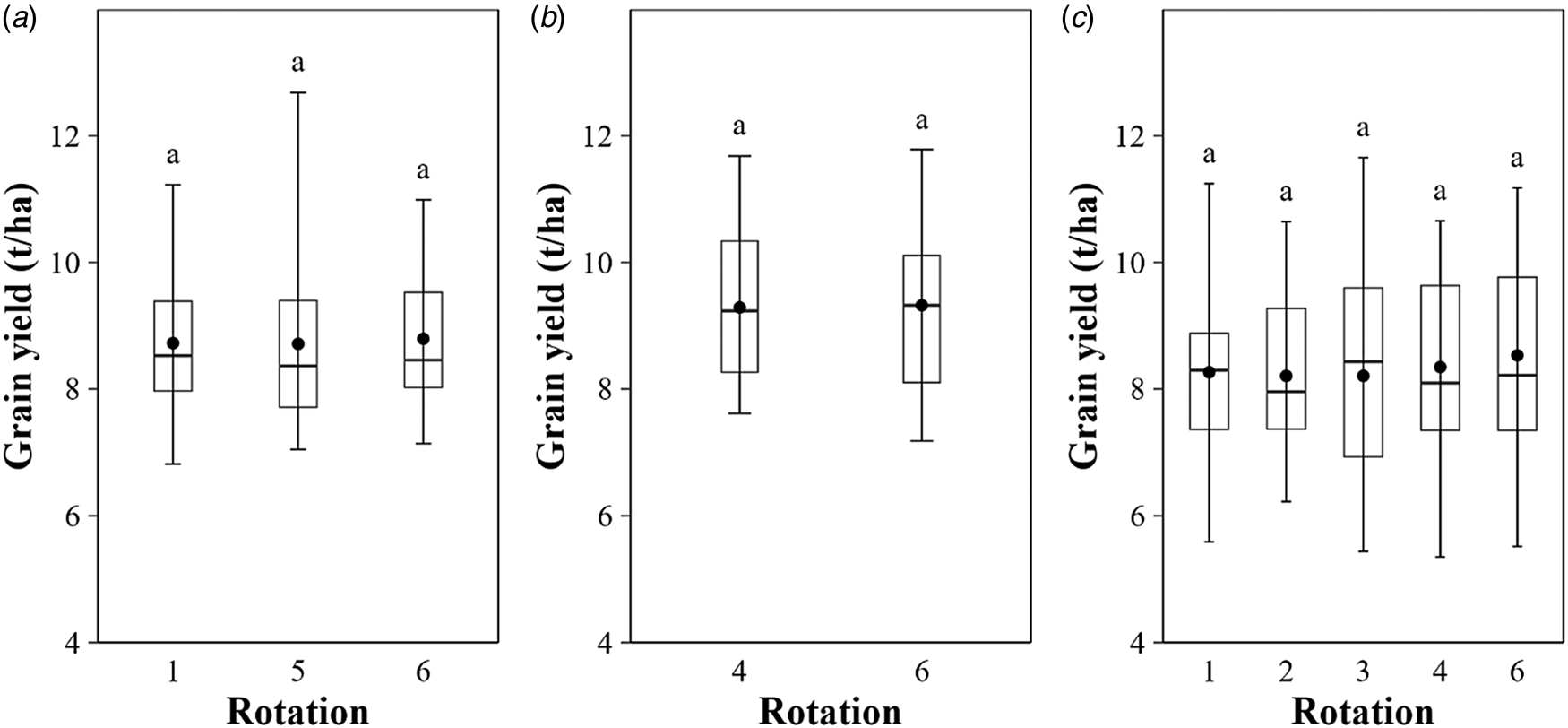
The overall crop rotation did not significantly modify the effect of the preceding crop on wheat yield (Fig. 1). Wheat yield after sugar beet ranged between 8.7 ± 0.28 t/ha (standard error) and 8.8 ± 0.28 t/ha across three different crop rotations, while wheat yield after wheat ranged between 8.2 ± 0.28 t/ha and 8.5 ± 0.28 t/ha in five different crop rotations, and wheat yield after oilseed rape was 9.3 ± 0.28 t/ha in both studied crop rotations. In any case, differences between the wheat yield after a given preceding crop across different crop rotations were not significant. Thus, wheat yields after the same preceding crop were averaged across crop rotations for the following analyses.
Crop rotation effect on wheat grain yield (cv. Cubus) in long-term crop rotation trial Harste, 2008–2018, with preceding crops (a) sugar beet, (b) winter oilseed rape and (c) winter wheat. •: Least squares means. n = 33, preceding crop sugar beet in rotation 1: n = 32. Means with the same preceding crop marked with a common letter are not significantly different (P > 0.05, multiple t tests with adjusted P values). 1: SB – WW – WW, 2: WW continuous, 3: SM – WW – WW, 4: WR – WW – WW, 5: SB – WW – SM, 6: SB – WW – WR – WW – WW – GP, SB: sugar beet, WW: winter wheat, SM: silage maize, WR: winter oilseed rape, GP: grain pea.
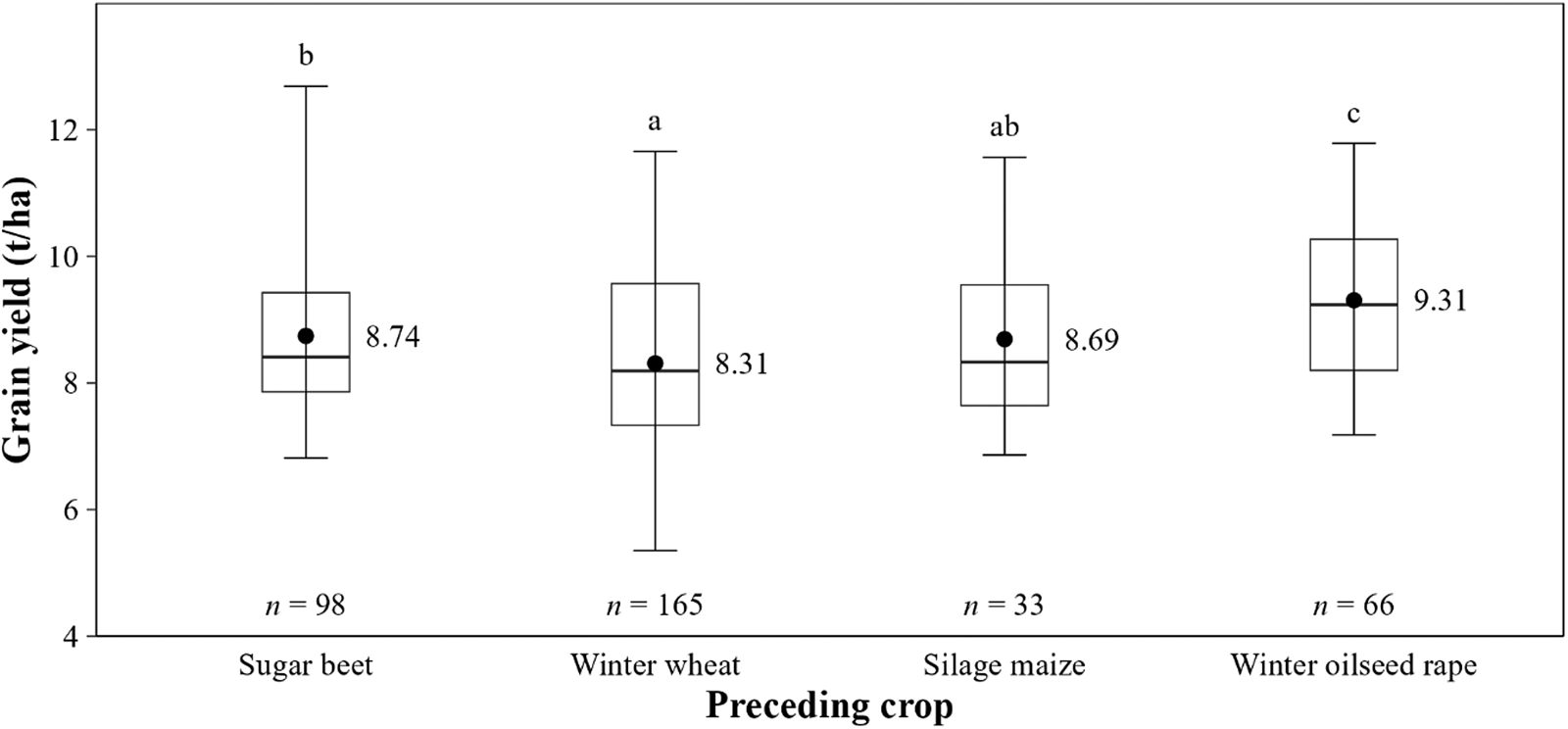
Averaged over all crop rotations considered and for the typical wheat sowing dates after the single preceding crops, yield of winter wheat was significantly (P < 0.01) higher after preceding crop winter oilseed rape than after all other preceding crops (Fig. 2). Yield was significantly higher than after sugar beet by about 0.6 ± 0.13 t/ha (P < 0.001), than after winter wheat by about 1.0 ± 0.12 t/ha (P < 0.001), and than after silage maize by about 0.6 ± 0.17 t/ha (P < 0.01) on average. After sugar beet, yield was significantly higher than after winter wheat by about 0.4 ± 0.10 t/ha (P < 0.001) on average, while wheat yield after maize was on tendency (P = 0.0567) higher than after wheat.
Preceding crop effect in 2008–2018 on yield of winter wheat (cv. Cubus) in the long-term crop rotation trial in Harste with wheat sown early after oilseed rape and wheat and late after silage maize and sugar beet. •: Least squares means, also shown by numbers next to boxes. Means with no letter in common are significantly different (P < 0.05, multiple t tests with adjusted P values).
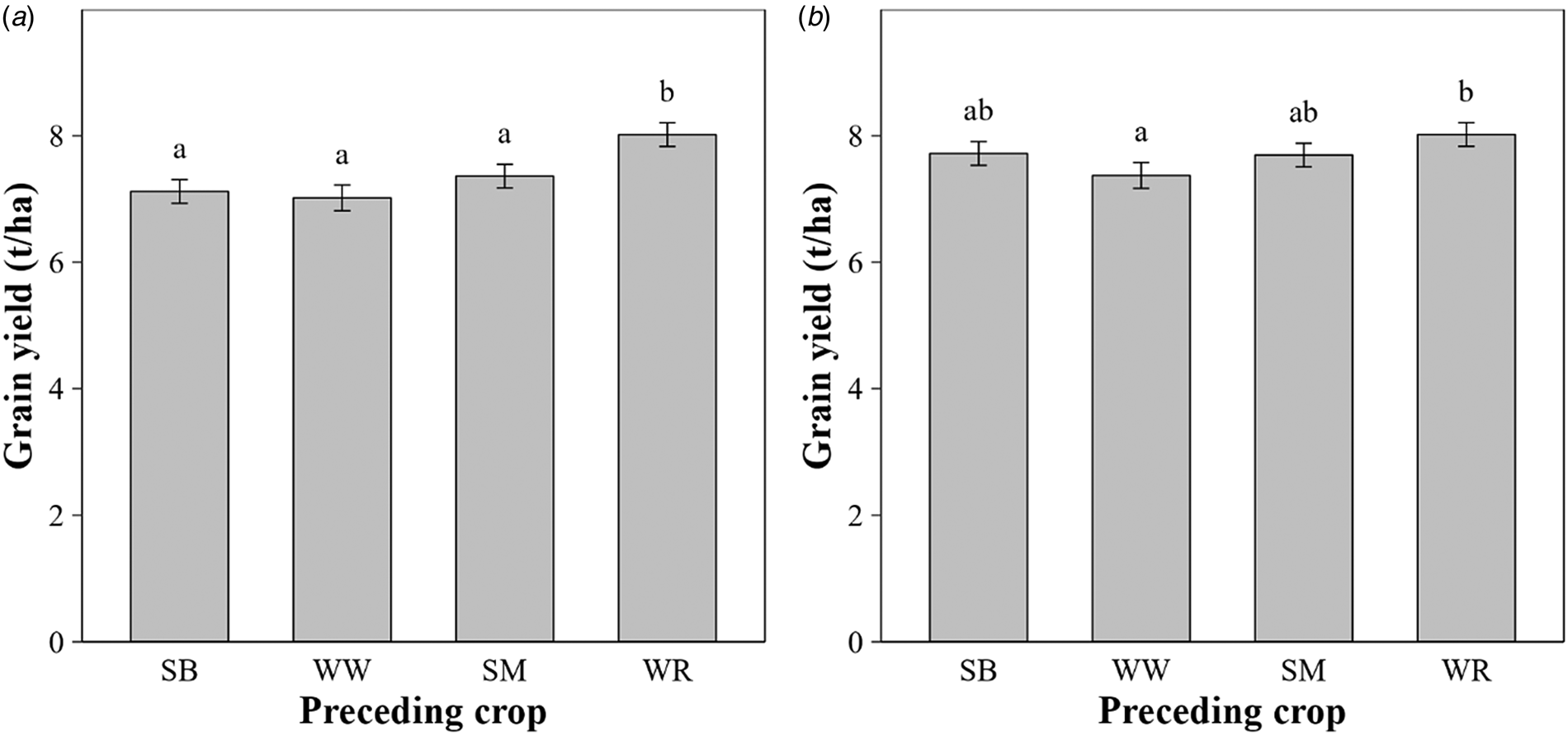
If sown at the same sowing date, differences in wheat yield after the single preceding crops varied for the two sowing dates. For an early sowing (end of September), wheat yield was higher after oilseed rape than after the other preceding crops, while among the other preceding crops no differences were found (Fig. 3). For a late sowing (end of October), wheat yield after oilseed rape was higher than after wheat, while yields after sugar beet and silage maize were not statistically different than yields after either wheat or oilseed rape.
Preceding crop effect in 2016–2018 on yield of winter wheat (cv. Cubus) in the long-term crop rotation trial in Harste for (a) an early sowing date (end of September) and (b) a late sowing date (end of October). Least squares means with standard errors from a linear mixed-effects model. Means with no letter in common are significantly different (P < 0.05, multiple t tests with adjusted P values). SB: sugar beet, WW: winter wheat, SM: silage maize, WR: winter oilseed rape.
Sowing date and crop residue effects
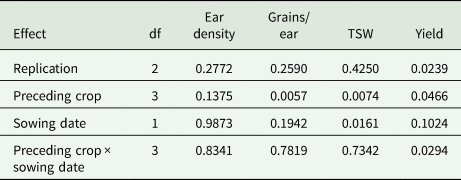
The effect of sowing date on yield was dependent on preceding crop (Table 3). After sugar beet, wheat yield was significantly (P < 0.01) higher for the late sowing date than for the early sowing date by about 0.6 ± 0.17 t/ha on average (Fig. 4a). After the other preceding crops, sowing date did not significantly affect wheat yields, although yields were numerically higher for the late sowing date after silage maize and winter wheat, while there was no difference at all after winter oilseed rape.
P values from Wald-type F tests for preceding crop and sowing date effect on yield and yield components ear density, grains per ear and thousand seed weight (TSW) from 2016 to 2018
df, numerator degrees of freedom.
Sowing date effect as dependent on preceding crop in 2016–2018 on yield of winter wheat (cv. Cubus) in the long-term crop rotation trial in Harste. Least squares means with standard errors from a linear mixed-effects model. P values from t tests for sowing date effect separated by preceding crop (adjusted by a simulation-based approach using the multivariate t distribution). early: end of September, late: end of October.

Interaction between preceding crop and sowing date was not significant for yield components ear density, grains per ear and TSW (Table 3). On average across sowing dates, grain number was significantly (P < 0.05) higher after winter wheat than after silage maize by about 4 grains/ear (Table 4). TSW after preceding crops sugar beet and silage maize was about 3.6 g and 3.8 g higher than after winter wheat, respectively (P < 0.05 and <0.01), while TSW after winter oilseed rape was intermediate (Table 4). The difference of TSW between early sowing date and late sowing date was 1.5 g (P < 0.05) on average across preceding crops (Table 4), while ear density and grains per ear were not affected by sowing date.
Preceding crop and sowing date effects in 2016–2018 on yield structure components of winter wheat (cv. Cubus) in the long-term crop rotation trial Harste

TSW, thousand seed weight.
Least squares means with standard errors from a linear mixed-effects model.
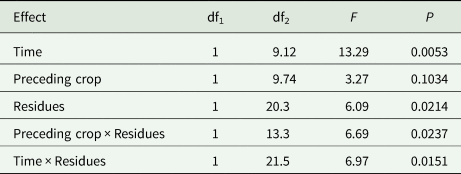
In the sugar beet – winter wheat – winter wheat rotation with artificially created differences in sugar beet residues, yield of winter wheat after winter wheat was significantly (P < 0.01) higher on the subplot with doubled sugar beet residues by about 0.3 t/ha on average (Table 5, Fig. 5). Wheat yield after preceding crop sugar beet was not affected by the residue treatment. Also, yield decrease over time for wheat after wheat was significantly (P < 0.05) lower with doubled residues compared to no residues on average (Table 5).
Wald-type F tests for time trend, preceding crop effect, and residues effect (type III sums of squares) for crop rotation 7 in 2008–2018
df1, numerator degrees of freedom; df2, denominator degrees of freedom. Degrees of freedom with Kenward-Roger approximation.
Effect of sugar beet residue management in 2008–2018 after preceding crops (a) sugar beet and (b) winter wheat on yield of winter wheat (cv. Cubus) in a sugar beet – winter wheat – winter wheat rotation in the long-term crop rotation trial in Harste. •: Least squares means, also shown by numbers next to boxes. n = 33 (preceding crop winter wheat, residues doubled: n = 31). Means with the same preceding crop with no letter in common are significantly different (P < 0.05, multiple t tests with adjusted P values).

Discussion
Preceding crop and sowing date effects
Yield of winter wheat after preceding crop winter oilseed rape was significantly (P < 0.001) higher than after preceding crop winter wheat by about 1.0 t/ha or 10.7% on average, when considering the usual sowing dates of wheat after these crops, which would be rather early. This positive effect of winter oilseed rape is in line with results of Sieling et al. (Reference Sieling, Ubben and Christen2007) and Sieling and Christen (Reference Sieling and Christen2015) from German study sites but higher than the mean increase of wheat yield (0.8 t/ha) after preceding crop oilseed rape determined in the review by Angus et al. (Reference Angus, Kirkegaard, Hunt, Ryan, Ohlander and Peoples2015). However, Angus et al. (Reference Angus, Kirkegaard, Hunt, Ryan, Ohlander and Peoples2015) considered different experimental locations in Australia, Europe and North America in their review, thus site conditions were probably diverse and not necessarily comparable to the study site Harste. For Germany, Weiser et al. (Reference Weiser, Fuß, Kage and Flessa2018) found a break crop benefit of winter oilseed rape of 0.56 t/ha (7.3%) in a dataset containing randomly selected farms. However, Weiser et al. (Reference Weiser, Fuß, Kage and Flessa2018) compared yield after preceding crop winter oilseed rape to yield after cereals in general (mainly (82%) wheat, but also winter and spring barley, rye, triticale and further cereals other than wheat, without maize and oats), in contrast to yield after wheat in this study. After other cereals than wheat, severity of G. tritici and P. herpotrichoides can be lower than in continuous cultivation of wheat and therefore the negative impact on yield may not be as high (Schönhammer and Fischbeck, Reference Schönhammer and Fischbeck1987a).
Another possible difference to the other mentioned studies might be the sowing date. While a sowing date difference of around four weeks did not affect the wheat yield after oilseed rape in the present study, wheat grown after wheat showed a (non-significantly) higher yield for the later sowing date, resulting in a lower relative yield benefit for wheat after oilseed rape for later sowing dates. Thus, even if wheat after oilseed rape and after wheat were sown on the same date in the other studies, differences might have been lower if wheat sowing took place later than in this study.
Regarding potential mechanisms leading to the observed benefits, no continuous measurement programme was in place throughout the study years in our trial. However, another study on the same trial for the study year 2018 found a positive effect of oilseed rape as preceding crop on the soil microbial biomass of subsequent wheat when compared to the other preceding crops considered here (Hamer et al., Reference Hamer, Meyer, Meyer, Radermacher, Götze, Koch and Scherber2021). For later years of the trial beyond the temporal scope of this study, Arnhold et al. (Reference Arnhold, Grunwald, Braun-Kiewnick and Koch2023a) further found a higher subsoil (30–120 cm) root length density of wheat grown after oilseed rape than after wheat which was also independent of take-all occurrence. However, this positive effect was not connected to soil structural benefits of oilseed rape as preceding crop as might have been expected, at least not in the upper 45 cm of soil by spring, as found in a separate study on the same plots (Arnhold et al., Reference Arnhold, Grunwald, Kage and Koch2023b). Also, N benefits by oilseed rape as preceding crop might have been low since soil mineral N levels in spring were taken into account for the calculation of N fertilization as was also an expected higher N mineralization, resulting in a lower N target value after oilseed rape than after wheat. Thus, N benefits after oilseed rape might primarily occur in the growth period before fertilization.
After silage maize, yield was on tendency higher than after winter wheat by about 0.38 t/ha when considering the usual sowing dates of wheat after these crops (early after wheat, late after maize). This yield advantage corresponds well to the 0.38 t/ha higher yield of wheat after maize compared to wheat after wheat found by Berzsenyi et al. (Reference Berzsenyi, Győrffy and Lap2000) without N fertilization. However, Berzsenyi et al. (Reference Berzsenyi, Győrffy and Lap2000) did not specify whether grain or silage maize was cultivated in their study. As the maize benefit in their study was even higher for regularly fertilized treatments (0.86 t/ha) and Berzsenyi et al. (Reference Berzsenyi, Győrffy and Lap2000) speculate that the reason for the benefit might be related to soil physical and biological improvements following supplemental C sources from crop residues, the higher benefit of regularly fertilized maize as preceding crop to winter wheat compared to the present study seems to be connected to the cultivation as grain maize. In the case of silage maize cultivation, as in this trial, aboveground maize residue input is reduced to low amounts which can be expected to lead to a decrease in soil organic C, as also found in the studied trial (Grunwald et al., Reference Grunwald, Götze and Koch2021), which may ultimately lead to negative effects on crop yields. In agricultural practice, this is often mitigated by organic fertilization; in the studied trial, however, no organic fertilizer was used. The benefit of silage maize as preceding crop before winter wheat under practical conditions with organic fertilization may thus be higher than found in this study.
Nonetheless, when sown at the same date, wheat after wheat and after silage maize showed lower and non-significant yield differences, as shown for the subplots with different sowing dates from 2016 to 2018 in this study. This suggests that at least part of the benefit of silage maize as a preceding crop in contrast to wheat is owed to the later harvest of the former and the resulting later sowing of wheat which would be a rather indirect effect in contrast to an effect based directly on traits of the contrasting crops. In future studies this needs to be addressed, either by including several sowing dates for all preceding crops or by setting one sowing date for all treatments in order to understand the mechanisms leading to differences in wheat yield.
Preceding crop sugar beet led to a significantly (P < 0.001) higher yield of winter wheat compared to wheat after wheat of about 0.43 t/ha or 4.9%. Although sugar beet is known as beneficial preceding crop, published studies reporting yield of wheat after sugar beet in comparison to other preceding crops are scarce. In a long-term trial at experimental station Rauischholzhausen near Gießen, Claupein and Zoschke (Reference Claupein and Zoschke1987) found a higher wheat yield of about 0.65 t/ha or 13% after sugar beet compared to a winter wheat monoculture over 17 years. However, in that study the straw management also differed between the two rotations with considerable benefits for the crop rotation with sugar beet which might have superimposed the pure preceding crop effect. Concerning yield stability, Macholdt and Honermeier (Reference Macholdt and Honermeier2019) found benefits for a crop rotation with sugar beet before winter wheat in a long-term trial which were comparable to rotations with oilseed rape and field bean before wheat. Although no yield values were included in that study, this underlines the apparently beneficial effect of sugar beet before wheat. However, similar to maize, the positive yield effect of wheat grown after sugar beet compared to wheat grown after wheat is considerably lower and non-significant when the same sowing date for wheat is chosen after both preceding crops. Thus, future studies need to clear up if there are advantages of sugar beet related to certain crop traits or if the positive effect found here is rather an indirect one connected mainly to the choice of wheat sowing date.
As mentioned above, the split-up of the plots in 2016–2018 to investigate the effect of an early (end of September) and a late (end of October) sowing date after each preceding crop led to contrasting results. Concerning sugar beet, winter wheat and silage maize, the late sowing date led to a higher yield of subsequent winter wheat, but the difference was only significant after sugar beet (Fig. 4). After preceding crop winter oilseed rape, sowing date did not affect yield of wheat. Winter oilseed rape may improve the soil structure (Schönhammer and Fischbeck, Reference Schönhammer and Fischbeck1987b; Chan and Heenan, Reference Chan and Heenan1996; Sieling et al., Reference Sieling, Ubben and Christen2007; Kirkegaard et al., Reference Kirkegaard, Christen, Krupinsky and Layzell2008) and is harvested earlier than silage maize and sugar beet. Therefore, time for cultivation and seedbed preparation is longer after oilseed rape than after the latter. Additionally, weed populations can be low after winter oilseed rape, whereby an earlier sowing of wheat without detrimental effects on yield, such as for the other preceding crops in this study, is possible (Angus et al., Reference Angus, Kirkegaard, Hunt, Ryan, Ohlander and Peoples2015). A later sowing date, therefore, possibly had no advantages regarding root development and competition with weeds in wheat following winter oilseed rape. The early sowing date after preceding crops winter wheat, silage maize and sugar beet, however, led to a shorter time for cultivation and seedbed preparation. In combination with non-inversion tillage and possibly a generally poorer soil structure compared to oilseed rape as preceding crop, this may have caused comparatively poorly developed wheat roots, which can increase vulnerability to stress and root diseases, and consequently cause yield losses. This seems to be most clear for the early wheat sowing date after sugar beet which took place immediately after the typically rather late harvest of sugar beet. However, these assumed mechanisms need to be confirmed by accordingly planned studies.
Regarding the yield components, TSW in 2016–2018 was significantly (P < 0.05) higher after preceding crops sugar beet and silage maize than after winter wheat but not after winter oilseed rape. TSW of wheat was significantly (P < 0.01) higher after an early sowing date than after a late sowing date after all preceding crops (Table 4). An earlier sowing generally prolongs the grain filling period and leads to a higher TSW (Ortiz-Monasterio et al., Reference Ortiz-Monasterio, Dhillon and Fischer1994; Ozturk et al., Reference Ozturk, Caglar and Bulut2006; Koppensteiner et al., Reference Koppensteiner, Kaul, Piepho, Barta, Euteneuer, Bernas, Klimek-Kopyra, Gronauer and Neugschwandtner2022). Also, the slightly (non-significantly) lower grain number per ear after an early sowing date seems to be balanced out by a the higher TSW later in the season. Despite this, early sowing is one of the biggest risk factors for an infection with G. tritici in wheat after wheat (Jenkyn et al., Reference Jenkyn, Gutteridge and White2014), which can reduce TSW (Sieling et al., Reference Sieling, Stahl, Winkelmann and Christen2005). The higher TSW after early sowing in this study possibly indicates that no considerable infection with G. tritici occurred in the observed years, including wheat grown after wheat (see also below).
Crop rotation and crop residue effects
The diversity of different crop rotations had no significant effect on grain yield of winter wheat in this trial. There was neither a difference of wheat yield between wheat after wheat within crop rotations and wheat monoculture nor between wheat after sugar beet or winter oilseed rape in simpler and in more diverse crop rotations. Contrastingly, Berzsenyi et al. (Reference Berzsenyi, Győrffy and Lap2000) found that yield of wheat decreased with an increasing share of wheat (25% to 100%) in the crop rotation. However, this effect on yield could possibly rather be attributed to the preceding crop than to the share of wheat in the rotation. This view would confirm the observation of Sieling and Christen (Reference Sieling and Christen2015) that the preceding crop effect superimposes a possible crop rotation effect. Nonetheless, Sieling and Christen (Reference Sieling and Christen2015) also found a lower yield of wheat in short rotations with a high share of cereals. The most diverse rotation in Harste, rotation 6, consisted of four different crops (sugar beet, winter wheat, winter oilseed rape and field pea) and two catch crops (mustard and phacelia). Share of winter wheat was 50% in this rotation. Rotation 5 consisted of three different crops (sugar beet, winter wheat and silage maize) and one catch crop (mustard). This rotation had the lowest share of winter wheat (33.3%), while continuous cultivation of winter wheat had the highest (100%). The lack of an effect of these large differences in wheat share in the total rotation might be connected to the relatively high use of pesticides in all rotations in Harste. Andert et al. (Reference Andert, Bürger, Stein and Gerowitt2016) assume that more diverse crop rotations can reduce use of herbicides and fungicides. Although reduction of pesticides was not investigated in this study as all rotations were treated in the same way, the cultivation of spring crops in a crop rotation, like sugar beet, silage maize or field pea, could potentially be beneficial in the control of annual grass weeds and thus offer possibilities regarding wheat yield maintenance at lower pesticide inputs.
In contrast to previous studies from Kirkegaard and Ryan (Reference Kirkegaard and Ryan2014) and Sieling and Christen (Reference Sieling and Christen2015), no pre-preceding crop effect could be found in this study. Angus et al. (Reference Angus, Kirkegaard, Hunt, Ryan, Ohlander and Peoples2015) compared data from experiments in Australia, Canada, Sweden and the United Kingdom and found that the yield effect of break crops like oilseed rape, oats or grain legumes on the second wheat after a break-crop was less pronounced than the preceding crop effect on the first wheat (Angus et al., Reference Angus, Kirkegaard, Hunt, Ryan, Ohlander and Peoples2015). After oilseed break-crops, the preceding crop effect was less persistent in Sweden than in Australia, leading to the assumption that the persistence of the preceding crop effect (which is similar to pre-preceding crop effect) is higher under arid conditions and more inconsistent in humid and semi-arid conditions. This could be due to longer suppression of pathogens after a single break-crop under dry conditions, or the longer pathogen persistence after wheat (Angus et al., Reference Angus, Kirkegaard, Hunt, Ryan, Ohlander and Peoples2015). In a humid climate, Sieling and Christen (Reference Sieling and Christen2015) found an effect of the pre-preceding crop in wheat after winter oilseed rape but not in wheat after wheat. This indicates that under central European conditions the preceding crop effect is clearly more important than the pre-preceding crop effect (Sieling and Christen, Reference Sieling and Christen2015).
The take-all disease caused by G. tritici can lead to high yield losses in the first years of continuous winter wheat cultivation (Jenkyn et al., Reference Jenkyn, Gutteridge and White2014) but yield losses can decrease subsequently through the take-all decline phenomenon (Gerlagh, Reference Gerlagh1968). Yield data from the studied trial does not suggest that take-all decline occurred in continuous winter wheat cultivation, although G. tritici was not rated or analysed in this study. Typically, yield decreases until the third to fourth year after a high incidence of G. tritici and increases slightly in following years due to a decrease of G. tritici incidence without reaching the yield level of the first year again (Gerlagh, Reference Gerlagh1968; Sieling and Hanus, Reference Sieling and Hanus1990; Jenkyn et al., Reference Jenkyn, Gutteridge and White2014). However, in the studied trial, yield of the wheat monoculture decreased and increased over the years without a clear trend hinting at take-all decline (data not shown). One requirement for the occurrence of take-all decline phenomenon is a heavy infection with G. tritici (Jenkyn et al., Reference Jenkyn, Gutteridge and White2014). Hence, if there had been no heavy infection with G. tritici in the continuous cultivation of winter wheat, a take-all decline might in turn have not occurred. This might explain the lack of a difference in wheat yield between the long-term wheat monoculture and the second wheat grown after a pre-preceding break crop.
Interestingly, however, for later years in the same trial (2021 and 2022), Arnhold et al. (Reference Arnhold, Grunwald, Braun-Kiewnick and Koch2023a) rated the occurrence of G. tritici and correlated these data with grain yield for the first and second wheat grown after oilseed rape as well as wheat monoculture. They found a strong disease severity in rotational wheat grown after wheat and a substantially lower severity in wheat monoculture in a wet year (2021), hinting at the occurrence of a take-all decline, at least in later years of the trial. For the study year in question, take-all severity correlated well with grain yield which was significantly lower for the more strongly infested rotational wheat after wheat than for the wheat monoculture. In a dry study year (2022), without the occurrence of take-all, no difference in yield was found. This may further highlight the strong differentiation between single study years in terms of weather conditions for pathogens and the dependence of a beneficial effect of monoculture cultivation on weather conditions of a single year.
In rotation 7 (sugar beet – winter wheat – winter wheat), sugar beet residues were moved from one subplot to the adjacent subplot after harvest. This higher amount of organic input (doubled sugar beet residues) led to a significantly (P < 0.05) higher yield in winter wheat after winter wheat by about 0.30 t/ha on average over eleven years compared to a lower organic input (sugar beet residues removed). For these plots, Grunwald et al. (Reference Grunwald, Götze and Koch2021) found that doubled sugar beet residues caused significantly higher soil organic carbon stocks in 0–10 cm soil depth by 2018/19. Soil organic carbon is an important indicator of soil quality (Reeves, Reference Reeves1997). However, despite the general improvement of numerous soil properties by an increased soil organic matter, Hijbeek et al. (Reference Hijbeek, van Ittersum, ten Berge, Gort, Spiegel and Whitmore2017) found no yield increment of winter wheat in Europe through organic input in a meta-analysis. In contrast, wheat yield responded positively to soil organic matter or soil organic carbon increases in China (Pan et al., Reference Pan, Smith and Pan2009), Uruguay (Rubio et al., Reference Rubio, Diaz-Rossello, Quincke and van Es2021) and in a global meta-analysis (Oldfield et al., Reference Oldfield, Bradford and Wood2019). The higher soil organic carbon stocks in the rotation with doubled sugar beet residues in Harste found by Grunwald et al. (Reference Grunwald, Götze and Koch2021) and the higher yield found in this study in this rotation potentially indicate a yield benefit of soil organic carbon on yield of winter wheat. However, this benefit seems to occur solely after an unfavourable preceding crop such as winter wheat and not after sugar beet. Thus, the rather positive preceding crop effect of sugar beet possibly superimposed the benefit of a higher soil organic matter content. Still, an even stronger effect for wheat after wheat and possibly also a positive effect on wheat after sugar beet might be expected after a longer period than considered here, as soil organic matter levels in the soil need to build up over time. Thus, in the first few years of this treatment, there might have been no effect at all while the benefit found here might be caused by advantages in the latter half of the sampling period.
Practical considerations
In Lower Saxony in 2009/10, 30.0% of winter wheat was cultivated after winter wheat, 19.3% was grown after winter oilseed rape, 15.4% after sugar beet and 12.5% after maize on average (Steinmann and Dobers, Reference Steinmann and Dobers2013). As cultivation of wheat after wheat will be restricted in the European Union (EU 2021/2115), wheat after wheat must be substituted in crop rotations if the farmer wants to receive direct payments from the European Union. European farmers generally prefer changes in crop rotation to other management practices like growing cover crops or wildflower strips to contribute to biodiversity enhancement (Kleijn et al., Reference Kleijn, Bommarco, Fijen, Garibaldi, Potts and van der Putten2019), indicating a certain potential to an increased cultivation of wheat after beneficial break crops. Beyond the studied preceding crops in this study, other possible alternatives to wheat grown after wheat in crop rotations like other cereals (barley, oat or rye) or grain legumes (pea or bean) might be considered in future studies. Nevertheless, in this study, sugar beet and winter oilseed rape were found to be favourable preceding crops for winter wheat under current site conditions in southern Lower Saxony and can be seen as reasonable choices and beneficial alternatives to wheat in crop rotations as preceding crops before winter wheat.
Conclusion
In this study on a long-term trial, preceding crop was the crucial factor influencing grain yield of winter wheat, while crop rotation diversity, different shares of winter wheat and pre-preceding crop were less important. Sugar beet and winter oilseed rape were beneficial preceding crops for winter wheat and should be cultivated in crop rotations containing winter wheat. However, this may be influenced by the chosen wheat sowing date which should be taken into account in future studies. In general, under favourable conditions for arable cropping in Northern Germany, a late sowing date in the second half of October seems to be beneficial, except after oilseed rape for which no such effect was found. A further positive effect on wheat yield by possibly manageable factors was found to be a higher soil organic matter content, in particular for wheat after wheat. However, the reasons for the effects of preceding crop, sowing date and soil organic matter on wheat grain yields were not investigated in this study and need to be clarified in further studies. For the studied trial, an investigation into the mechanisms involved in the preceding crop effects is currently ongoing, focusing on above- and particularly belowground crop residues and how different preceding crops may affect the growing conditions of subsequent wheat, especially in the rhizosphere.
Acknowledgements
We sincerely thank Ines Wiese, Fritz Evers, Wilfried Hübener, Michael Gerhardy, Marten Steinke, Kristina Winkelbach and Christina Jung for excellent technical assistance.
Author contributions
HJK designed and supervised the field experiment including data gathering. MG conducted the statistical data analysis which was supervised by HPP and wrote the original draft which was supervised by DG. All authors contributed to the discussion and interpretation of the results, reviewed the manuscript and approved the final version.
Funding statement
This research received no specific grant from any funding agency, commercial or not-for-profit sectors.
Competing interests
None.
Ethical standards
Not applicable.



