Introduction
Intensive animal production conditions are thought to be a source of chronic stress (Dantzer and Mormède, Reference Dantzer and Mormède1979). Although a minimum level of stress would be beneficial to generate good adaptation capacity (Zulkifli and Siegel, Reference Zulkifli and Siegel1995; Jensen and Toates, Reference Jensen and Toates1997), acute or chronic stress can result in poor welfare (Dobson et al., Reference Dobson, Tebble, Smith and Ward2001). For this reason, many studies have been conducted in various husbandry systems to assess causes and subsequent effects of stress (Zulkifli and Siegel, Reference Zulkifli and Siegel1995; Jensen and Toates, Reference Jensen and Toates1997; Dobson et al., Reference Dobson, Tebble, Smith and Ward2001). Moreover, aversive handling of farm animals can result in man avoidance, a behavioural response of fear that is considered as a response to a stress (Rushen et al., Reference Rushen, Taylor and de Passillé1999).
Stress remains difficult to evaluate. Several behavioural and physiological parameters have to be used to characterise stress responses under different experimental conditions (Siegel, Reference Siegel1971). Previous studies on responses to fear were realised in Japanese quails divergently selected for tonic immobility (TI) duration or sociability (Mills and Faure, Reference Mills and Faure1991). Results have shown that the different behavioural and physiological stress indicators measured were only partially linked (Mignon-Grasteau et al., Reference Mignon-Grasteau, Roussot, Delaby, Faure, Mills, Leterrier, Guémené, Constantin, Mills, Lepape and Beaumont2003; Hazard et al., Reference Hazard, Couty, Richard and Guémené2008). Consequently, a variety of experimental tests must be used in order to take into account the multifactorial nature of stress response. Physiological response to acute stress includes activation of the hypothalamo–pituitary–adrenocortical axis (HPA) and the subsequent release of corticosterone (CORT) from the adrenal gland. This corticosteroid plays a key role in maintaining homoeostasis and contributes to behavioural adaptation (Mormède et al., 2007). For example, restraint in a net has been shown to be one among the physical stresses, promoting the highest corticosterone responses in ducks (Faure et al., Reference Faure, Val-Laillet, Guy, Bernardet and Guémené2003). Injection of a high dose of 1-24 ACTH allows to assess maximal secretion capacity from the adrenal glands (Harvey et al., Reference Harvey, Merry and Phillips1980). Conversely, initial CORT level is very sensitive to environmental condition (Noirault et al., Reference Noirault, Guémené, Guy and Faure1999) and may partly result from a sensibility to capture. Behavioural tests involved different features including coping with new environment, social isolation, specific response towards human and antipredator strategy. Openfield (OF) test lead the animal first to cope with an unknown environment, then to face social isolation (Faure et al., Reference Faure, Jones and Bessei1983). A long latency to first immobilisation, a high level of mobility, exploratory behaviour and vocalisation activities could reflect a low level of fearfulness of the novel environment and an important social motivation (Suarez and Gallup, Reference Suarez and Gallup1980). However, an intensive locomotor activity right at the beginning of the test can also be interpreted as a result of a panic behaviour. Panic is characterised by hyper excitability, violent escape reactions and ‘pile ups’ under the feeders or against the walls (Mills and Faure, 1990). In test involving the presence of human (RH), the same dilemma between fear of the novel environment and social isolation stress occurs. But moreover, the distance from human and the direction of the first displacement (to the opposite or towards human) correspond to a specific response to human presence (Guémené et al., 2002). The antipredator strategy is assessed through the TI test. This innate behavioural response induces physical immobility similar to a catatonic-like state, resulting in decreased predator’s attention. The number of attempts to induce TI and the duration of TI are both indicators of the level of human fear (Jones and Faure, Reference Jones and Faure1981). The higher the number of attempts and the longer the TI duration, the stronger the fear (Gallup, Reference Gallup1977).
The hypothesis of a genetic determinism of fear responses has been evidenced in birds through divergent selection experiments: Japanese quails selected on behavioural responses as TI duration or sociability (Mills and Faure, Reference Mills and Faure1991) or selected on physiological traits as the CORT level after social stress for the three first generations then the CORT level after 10 min restraint for the next generations (Satterlee and Johnson, Reference Satterlee and Johnson1988). However, genetic approach using specific crosses has brought novel information on the transmission of such traits in other species (Leroy, 1964; Manning and Dawkins, Reference Manning and Dawkins1998; Boujard et al., Reference Boujard, Ramezi, Vandeputte, Labbé and Mambrini2007; Gironi Carnevale et al., Reference Gironi Carnevale, Vitullo, Varriale, Ruocco and Sadile2007; Roy et al., Reference Roy, Merali, Poulter and Anisman2007). Mule duck, an interspecific hybrid between a Muscovy drake and a Pekin duck, is reported to express man avoidance in rearing systems. Fear reactions were characterised in Muscovy and Pekin ducks, as well as in mule ducks (Faure et al., Reference Faure, Val-Laillet, Guy, Bernardet and Guémené2003). Mule ducks showed responses similar to one parent or intermediate between the two parents, for most of the behavioural traits studied and CORT measurements performed. When the two parental genotypes differed significantly, Pekin ducks exhibited higher fearfulness than Muscovy ducks. Interestingly, a heterosis effect appeared on the distance from human. Due to the absence of the reciprocal intercross in this experiment, it was not possible to distinguish between the superiority of the Pekin in additive effects and specific maternal effects. For this, Pekin and Muscovy drakes as well as males from the two intercrosses, mule and hinny ducks, were submitted to several fear assessment tests. Both behavioural and physiological parameters were measured to assess and characterise fear responses of each genotype.
Material and methods
Animals and rearing conditions
Male Muscovy ducks (Md = Cairina moschata, n = 30), Pekin ducks (Pd = Anas platyrhynchos, n = 31), mule hybrid ducks (Mh = intercross between a Muscovy drake and a Pekin female, n = 31) and hinny hybrid ducks (Hh = intercross between a Pekin drake and a Muscovy female, n = 28) were reared in four independent pens, each pen measuring 12 m2. Pekin and Muscovy ducks used to produce their respective offspring and their hybrid ducks were from the same genetic origin (Grimaud Frères Sélection, La Corbière, 49450 Roussay, France). They were given ad libitum access to a standard diet. The animals were maintained under natural photoperiod (December 2003 to February 2004, 44°N France) in a windowed barn, except during the first 3 days of life during which ducks received continuous artificial lighting. Animals were kept indoors during the whole experiment.
Experimental measures
Ducks were submitted to the following physiological and behavioural tests during the 8th week of age in the following order: initial CORT level, CORT level after placement in a net, CORT level after challenge with 1-24 ACTH, OF, CORT after OF, response to man (RM) presence, TI and CORT after TI. For each test, ducks were alternatively taken from each pen in order to limit any possible effect of the testing order. Tests were performed in a separate room lit and maintained at the same ambient temperature as the rearing room.
Behavioural measures
Videos from openfield and RM tests were analysed by focal sampling using The Observer 3.0 program (Noldus Information Technology, 1989–1990, Business & Technology Center, Costerweg 5, 6702 AA Wageningenn, NL).
Openfield (OF) test
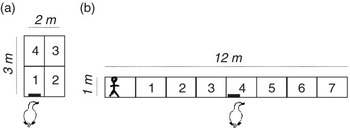
Birds were tested individually in an OF measuring 2.0 × 1.5 m2, sub-divided into four equal zones by two perpendicular fictive lines (Figure 1a). Ducks were first placed in Zone 1 and behaviour was video recorded during 5 min. Behaviour patterns were scored in focal sampling as follows: latency to the first immobilisation, number of zones visited, duration of mobility, number of pecks directed to the floor or the walls, vocalisations and body shaking.
Experimental set-up of the openfield test lasting 5 min (a) and the response to the man test lasting 1 min (b).

Response to the presence of man (RM) test
The experimental set-up for this test consisted of a plain wall corridor, measuring 12 × 1 m2, longitudinally sub-divided in seven equal zones numbered 1 to 7 (Figure 1b). A man was placed in Zone 1 and ducks were introduced individually through a trap located between Zones 4 and 5. The test, lasting one minute, was video recorded and several parameters were later monitored: direction of the first displacement (towards or away from the man), latency to the first immobilisation, number of zones visited, duration of mobility, time spent in each zone. An avoidance index (AI) was calculated using the following formula:

where ti is the time in seconds spent in the ith zone and zi the zone identification number (i = 1 to 7) (Faure et al., Reference Faure, Val-Laillet, Guy, Bernardet and Guémené2003). Therefore, AI could theoretically range to just above 60 (all time spent in Zone 1) to just below 480 (all time spent in Zone 7). The number of vocalisations, body shaking and pecks directed to the floor or the walls were measured.
Tonic immobility (TI) test
Each bird was placed on its back in a cradle (Jones and Faure, Reference Jones and Faure1981) and held in this position for 10 s before being released. Time elapsing before birds stood on their own was measured. If the bird did not stay at least 10 s after release, the TI attempt was considered as unsuccessful and another attempt was performed. The number of TI attempts was noted. If five attempts were unsuccessful, TI was scored 0 and the number of inductions was considered equal to 5. If the duck was still in TI after 8 min, the test was interrupted.
Physiological measures
Blood was collected at the occipital sinus (Vuillaume and Tournut, 1975) from all ducks under five experimental conditions: (i) before any assessment (CORT Initial), (ii) after 10 min of restraint in a net (CORT Net), (iii) 10 min after an intramuscular injection of 5 μg/kg BW of 1-24 ACTH (CORT ACTH) (Synacthène immédiat, Novartis Pharma, Rueil-Malmaison, France), (iv) 10 min after initiation of the OF test (CORT OF) and (v) after the TI test (CORT TI). The 10 min delay after ACTH treatment was chosen because it has been previously shown that it allowed maximal CORT level to be reached in ducks (Noirault et al., Reference Noirault, Guémené, Guy and Faure1999). Plasma was separated by centrifugation and kept at −20°C prior to analysis. CORT levels were measured using the previously described specific RIA (Etches, Reference Etches1976). Ratio of CORT TI and CORT OF relative to CORT Net was calculated. These specific ratios were chosen in order to assess the physiological response to these behavioural tests in comparison with CORT Net, which induces among the highest corticosterone levels measured in ducks in response to physical stress (Guémené et al., 1998), which involved the whole HPA as well as the sensorial and cognitive mechanisms, contrary to the 1-24 ACTH challenge that only involved the adrenal glands level. Also, the ratio of CORT Net to CORT ACTH was calculated to assess the relative amplitude of this response in comparison with the maximum capacity of adrenal glands.
Genetic effect estimation
Genetic effects were estimated by linear combinations of genotype means as described by Dickerson (Reference Dickerson1969). They were standardised as follows:
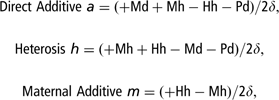
where Md, Pd, Mh and Hh are the mean for each genotype and δ the standard deviation of the character. A positive (negative) value reflects respectively a genetic superiority (inferiority) of Muscovy for direct additive effects, a positive (negative) heterosis and superiority (inferiority) of Muscovy for maternal additive effects.
Statistical analysis
Data were first analysed using non-parametric statistical tests by overall comparison of the four genotypes (χ 2 test or Kruskal–Wallis test). When significant (P < 0.05), data were further analysed by multiple pair comparisons tests (Mann–Whitney associated with a sequential Bonferroni correction procedure (Holm, Reference Holm1979)). CORT values after the different treatments for each genotype were compared with a non-parametric test for not independent data (Wilcoxon test). Analyses were performed using the StatView program (SAS 5.0, Institute Inc., 1992–1998; Cary, NC, USA). In order to test for a preferential orientation of the ducks, the first direction in the corridor (towards or away from the man) was tested using a simple binomial test in each genotype. Because the TI test generated censored data, a survival analysis was done according to the Weibull model of the Survival Kit program (Ducrocq and Sölkner, 1998). Statistical significance of the estimated genetic effect was tested by using the CBE program (Wolf et al., Reference Wolf, Zavadilová and Nemcová2005).
Results
Behavioural recordings
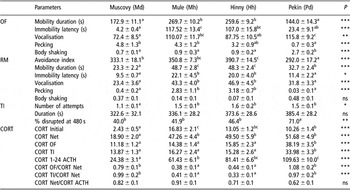
In the OF test, the two hybrids did not differ significantly from each other for any of the measurements performed. Mule and hinny ducks did not differ significantly from Muscovy ducks for pecking and body shaking behaviour. For vocalisation, mule ducks and hinny ducks did not differ significantly from their maternal genotype. Duration of locomotor activity and latency to first immobilisation of the mule ducks were significantly longer than those of the parental species (Table 1).
Behavioural and physiological results (means ± s.e.) for muscovy ducks (Md), pekin ducks (Pd), mule hybrid duck (Mh) and hinny hybrid duck (Hh) submitted to the openfield test (OF), response to man test (RM), tonic immobility test (TI) and various corticosterone measures (CORT, ng/ml plasma): before restraint in a net (CORT Initial), after 10 min restraint in a net (CORT Net), after OF (CORT OF), after TI (CORT TI) and 10 min after injection of 1-24 ACTH (CORT ACTH)

Within a line, means with different superscript letters differed significantly (P < 0.05).
In the RM test, the two hybrids did not differ significantly from each other for the different measures, except for first direction. Muscovy and hinny ducks oriented preferentially away from the man (66.7% and 71.4%, respectively, binomial test P > 0.05), whereas Pekin and mule ducks oriented randomly at first (54.8% and 62.1%, respectively, binomial test P < 0.05). Except for this first direction and body shaking, the two hybrids showed significantly higher values than Pekin ducks. The situation was similar between hybrids and Muscovy ducks, even if the difference between mule and Muscovy ducks was not significant for the avoidance index. Overall, all genotypes showed higher avoidance index than the theoretical average index of avoidance (IE corresponding to all the time spent in the middle of the corridor: 3.5 × 60 = 210) (Table 1).
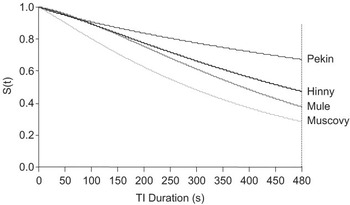
In the TI test, the number of attempts required to induce TI differed significantly according to the genotype. Significantly fewer attempts were needed to induce TI in Muscovy ducks as compared to the other genotypes. Duration of TI did not differ significantly between genotypes, but around 50% of the ducks were still in TI by the end of the 8 min test (Table 1). The survival analysis showed that Pekin ducks had a probability of still being in TI at a specific time S(t), significantly higher than ducks from the three other genotypes (Figure 2) (χ 2 test, 4 d.f., χ 2 test = 6.80, P < 0.01).
The estimated probability S(t) of being in tonic immobility (TI) as affected by time since induction for the four genotypes.

Physiological measures
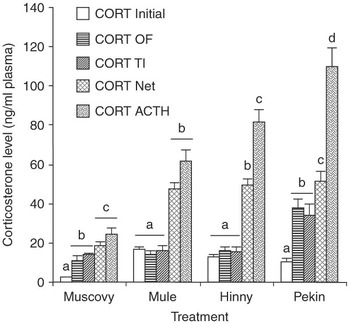
CORT ACTH and CORT Net were significantly higher than the initial levels for all genotypes (Figure 3). CORT Net was significantly lower than CORT ACTH for Pekin and hinny ducks, whereas they did not differ significantly for Muscovy and mule ducks (Figure 3). The two hybrids did not differ significantly for any of the CORT measures (Table 1). Their CORT OF and CORT TI were not significantly different from CORT Initial (Figure 3). For CORT Initial and CORT ACTH, hybrids showed significantly higher concentration than Muscovy ducks, but only mule duck levels differed significantly from those of the Pekin ducks (Table 1). For levels measured following the behavioural tests, the two hybrids differed significantly from the Muscovy ducks for CORT Net and from the Pekin ducks for CORT OF and CORT TI (Table 1).
Corticosterone levels (ng/ml plasma) in non-treated ducks (CORT Initial), following restraint in a net (CORT Net), openfield (CORT OF) and tonic immobility (CORT TI) tests and 10 min after an injection of 1-24 ACTH (5 μg/kg BW, CORT ACTH) for each genotype. Within a genotype, means without a common superscript letter differ significantly (P < 0.05).

Ratios of CORT OF or CORT TI relative to CORT Net were significantly lower for hybrids than for the parental lines, and the two hybrids did not differ significantly from each other (Table 1). No significant difference was found between the four genotypes for the ratio of CORT Net relative to CORT ACTH (Table 1).
Genetic effect estimation
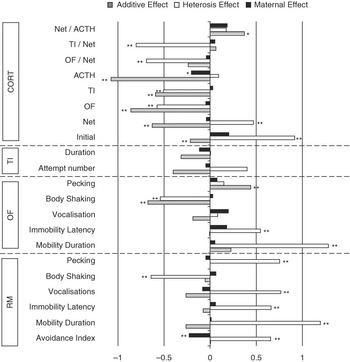
Two maternal effects for CORT ACTH and avoidance index in the RM test were slightly significant. Numerous direct additive and heterosis effects were found significant. Negative direct additive and positive heterosis effects were significant for CORT Initial and CORT Net (Figure 4). Negative direct additive and heterosis effects were significant for both CORT OF and CORT TI (Figure 4). Negative direct additive effect was significant for CORT ACTH (Figure 4). Negative heterosis effects were significant for both the ratio CORT OF/CORT Net and CORT TI/CORT Net (Figure 4). Positive direct additive effect was significant for the ratio CORT Net/CORT ACTH (Figure 4).
Genetic effects estimated for the basal level of corticosterone (CORT Initial), after placement in a net (CORT Net), openfield (CORT OF) and tonic immobility (CORT TI) and 10 min after 1-24 ACTH injection (CORT ACTH); for the ratio of corticosterone levels after openfield to level after placement in a net (CORT OF/CORT Net), ratio of corticosterone levels after tonic immobility to level after placement in a net (CORT TI/CORT Net) and ratio of corticosterone levels after placement in a net to levels after ACTH injection (CORT Net/CORT ACTH), and for parameters measured during tonic immobility (TI), openfield (OF) and in response to man (RM) tests.

No significant genetic effect was found for the number of induction or duration of TI.
For the OF test, positive direct additive effect was significant for pecking. Negative direct additive and heterosis effects were significant for body shaking. Positive heterosis effects were significant for immobility latency and mobility duration.
For the RM test, positive heterosis effects were significant for pecking, vocalisations, immobility latency, mobility duration and avoidance index. Negative heterosis effect was significant for body shaking (Figure 4).
Discussion
The present study supports and expands the knowledge found in earlier experiments describing the differences between the parental genotypes in responses to the behavioural and physiological tests. The maximal response of the adrenal glands, as illustrated by the result to the 1-24 ACTH challenge, and the level of corticosterone after restraint in a net, were lower in Muscovy ducks compared to Pekin ducks, which is in agreement with what was observed in a previous study (Faure et al., Reference Faure, Val-Laillet, Guy, Bernardet and Guémené2003). Muscovy ducks also showed a lower physiological sensibility to stress induced by the OF and TI tests than Pekin ducks. No differences were found, however, in responses relative to maximal reactivity as shown by the calculation of the ratio between HPA activation from an acute stress (restraint in a net) and adrenal maximal reactivity assessed by the 1-24 ACTH challenge. Likewise, no difference was observed for the ratio of levels measured after the OF and TI behavioural tests relative to the level after restraint in a net. Interestingly, the two parental genotypes showed different overall responses in terms of HPA, as indicated by the absolute levels measured, but their relative adrenal reactions were similar. Regarding behavioural responses, Pekin and Muscovy genotypes showed the same locomotor activity during the OF test; however, it probably resulted from different underlying mechanisms. Pekin ducks probably look for a social reinstatement as shown by a high level of vocalisation (Faure et al., Reference Faure, Jones and Bessei1983) and the expression of a higher rate of body shaking that can be interpreted as a moderate level of fear in a novel environment. On the other hand, Muscovy ducks’ locomotion activity during the OF test is likely to correspond to an exploration of the novel environment as illustrated by a higher rate of pecking activity (Suarez and Gallup, Reference Suarez and Gallup1980). In the RM test, behaviours expressed were different from those observed in the OF test, thus specific responses to human presence were assessed in this test. Although body shaking, pecking or vocalisations were similar for both parental genotypes, Pekin ducks moved more than Muscovy ducks, which in turn showed a higher avoidance index. Therefore, both genotypes expressed significant fear of man but the response patterns differed: Pekin ducks appeared to exhibit panic behaviour, whereas Muscovy exhibited avoidance. The results for the TI test suggested the hypothesis that Pekin and Muscovy ducks react differentially to predation. Muscovy ducks required a lower number of attempts to induce TI but the survival analysis revealed that Pekin ducks had a longer TI duration than the other genotypes. Altogether, these data indicate the fact that both genotypes are very sensitive to stress and are fearful, especially to human presence or handling, but express different response strategies. The non-significant correlations (data not shown) between behavioural and physiological parameters are in agreement with previously published results in duck (Faure et al., Reference Faure, Val-Laillet, Guy, Bernardet and Guémené2003) or in quail (Mignon-Grasteau et al., Reference Mignon-Grasteau, Roussot, Delaby, Faure, Mills, Leterrier, Guémené, Constantin, Mills, Lepape and Beaumont2003).
These important differences in the physiological and behavioural response patterns between Pekin and Muscovy ducks resulted in interesting effects in hybrids, allowing the investigation of further genetic transmission mechanisms. The initial CORT level was higher for mule genotype compared to the parental lines. This over-dominance was confirmed by the fact that a positive significant estimated heterosis effect was found for this measure and is further supported by the fact that mule ducks have previously been shown to be very sensitive to capture and handling (Guémené et al., Reference Guémené, Guy, Noirault, Destombes and Faure2006). On the other hand, hinny’s initial level did not differ significantly either from the mule’s or from the Pekin ones, and consequently estimated that maternal effect was not significant for this parameter. Following the 1-24 ACTH challenge, maximal response reactivity for mule ducks was intermediate between the parental responses and a significant negative additive effect was estimated for this parameter, which was associated with the absence of heterosis effect. This negative additive effect revealed a superiority of the Pekin genetic level in this cross for maximal adrenal reactivity. Moreover, hinny’s response to the 1-24 ACTH challenge did not differ significantly either from mule or from Pekin ones, and consequently estimated that maternal effect for this parameter was slightly significant. After restraint in a net, hybrids showed higher responses than the Muscovy’s but they did not differ from the Pekin one. Interestingly, the specific stress response associated with the restraint in a net seems to result from a Pekin genetic dominance in both hybrids as indicated by the findings of significant estimated heterosis effect for this trait. The OF and TI tests did not induce significant increases in CORT levels in the hybrids. It can be interpreted because there was no physiological response to these specific experimental situations or because initial levels were already elevated due to an extreme sensibility of these genotypes to the experimental and sampling procedure. Nevertheless, hybrids CORT levels following OF or TI were comparable with those of the Muscovy genotype. These results argued for a dominance of the Muscovy genotype in its genetic transmission. Indeed, significant heterosis effects were estimated for both parameters. Interestingly, when ratios of corticosterone levels measured following the OF or TI test relative to the measured level following a placement in a net were calculated, hybrid ratios were significantly lower than those of both parental species. This result suggested an over-dominance, which is supported by the fact that significant negative heterosis effects were estimated for these ratios. Alternatively, whereas maximal capacities of the HPA differ significantly between genotypes, the ratios of levels after net relative to the subsequent 1-24 ACTH challenge did not. This result is interesting from a physiological point of view because it might reveal a strong regulation mechanism upon acute stress physiological responses. A hypothesis that is in agreement with the absence of heterosis or maternal effects for this ratio. A slightly significant positive direct additive effect was revealed, suggesting a small superiority of the Muscovy genetic level for this ratio.
In this study, behavioural results from the OF test suggested that, for hybrids, social isolation stress was more important than fear of the novel environment compared to parental genotypes (Suarez and Gallup, Reference Suarez and Gallup1980). Hybrids latency to first immobilisation appeared to be longer and hybrids moved, pecked and body shaked more than Pekin or Muscovy ducks. This result is not in contradiction with the observation that hybrids had low CORT response following OF, since it has been previously shown that bird’s HPA reactivity to social stress is low in relation to other stressors like manual restraint or others, as found in quail (Hazard et al., Reference Hazard, Couty, Richard and Guémené2008). Other results have been reported for behavioural responses during OF in a previous study in which Pekin ducks expressed responses similar to those of mule ducks (Faure et al., Reference Faure, Val-Laillet, Guy, Bernardet and Guémené2003). This previous study was carried out with different genotypes than those used in this study, which may explain the difference observed. The over-dominance found in the present study was further confirmed by the estimation of significant heterosis effects, especially with regard to mobility duration and latency to first immobilisation. In the RM test, panic and social stress behavioural responses of the hybrids were clearly confirmed by long mobility duration and latency to first immobilisation, high rate of vocalisation and pecking. Furthermore, presence of man revealed a specific oriented fear response, illustrated by the high values measured for the avoidance index. Hybrids, as well as Muscovy ducks, showed higher avoidance to human than Pekin ducks, which is in agreement with previous findings (Guémené et al., 2004). From a genetic point of view, differences between genotypes were due to heterosis effects only. Direct additive effect levels were found to be similar for Pekin and Muscovy genotypes for all RM parameters. Half of the ducks of each genotype were still in TI by the end of the 8 min test period, which emphasised the fact that our hybrids, like our parental genotypes, showed a very important level of fear to predation restraint.
To conclude, Mule and hinny’s responses were comparable in most of the behavioural and physiological tests. The present results also allowed the conclusion that hybrid responses were only genetically determined by direct additive and heterosis effects. Thus from the genetic analyses, out of the eight physiological traits measured, direct additive effects were significant for six traits (i.e. CORT Initial, CORT Net, CORT OF, CORT TI and CORT Net/CORT ACTH) and heterosis effects were significant for six traits (i.e. CORT Initial, CORT Net, CORT OF, CORT TI, CORT OF/CORT Net and CORT TI/CORT Net). Out of the 14 behavioural traits measured, direct additive effects were significant for three traits (i.e. body shaking in the OF test, pecking and body shaking in the RM test) and heterosis effects were significant for nine traits (i.e. body shaking, latency of first immobilisation and mobility duration in the OF test; all RM test measures). Heterosis effects were limited in hybrid ducks for growth or muscle traits (Tai and Rouvier, Reference Tai and Rouvier1998; Chartrin et al., Reference Chartrin, Méteau, Juin, Bernardet, Guy, Larzul, Rémignon, Mourot, Duclos and Baéza2006; Larzul et al., Reference Larzul, Imbert, Bernardet, Guy and Rémignon2006), but the present work provided further evidence that over-dominance effects were involved in the genetic expression of most of the behavioural responses to stress in this interspecific cross. Indeed, hybrids showed stronger panic behaviour and avoidance of man than the two parental genotypes. Likewise, they also appeared to be more sensitive to social stress than the parental species. As mentioned by Faure et al. (Reference Faure, Val-Laillet, Guy, Bernardet and Guémené2003), heterosis effects are expected on traits related to fitness, but genetic distance between Pekin and Muscovy ducks, species from two different tribes in the Anatinae classification (Johnsgard, Reference Johnsgard1965), could explain the finding of significant heterosis effects even for traits with moderate or high heritability values, such as fear reactions. On the contrary, most of the CORT responses were submitted to negative direct additive effects, suggesting the superiority of the Pekin genetic level in the transmission of the HPA functionality in relation to stress response. To further investigate HPA functionality and the link of physiological responses to stress on behavioural responses of fear in this intercross, it would be fruitful to investigate the physiological and behavioural consequences of a divergent selection program on corticosterone response to stress in Pekin ducks in both parental genotype and mule ducks. Indeed, it was shown in a previous study that quails, divergently selected for high or low level of corticosterone after immobilisation, expressed divergent responses to fear in various behavioural tests (Jones et al., Reference Jones, Satterlee and Ryder1992a, Reference Jones, Satterlee and Ryder1992b and Reference Jones, Satterlee and Ryder1994).
Acknowledgements
We greatly acknowledge Michel Couty for his technical contribution, the technicians of the experimental station Unité Expérimentale des Palmipèdes à Foie-Gras, especially Isabelle Meyer, for their expert animal care and help during tests, Grimaud Frères Sélection for providing ducks from the different genotypes, as well as Clara Bureau for improving the quality of the manuscript. This study was financially supported by the Institut National de la Recherche Agronomique (INRA) and the Comité Interprofessionel des palmipèdes à FOie Gras (CIFOG). IA is employed by the SYndicat des Sélectionneurs Avicoles et Aquacoles Français (SYSAAF) and financially supported by a PhD CIFRE grant attributed by the Agence Nationale de la Recherche Technique (ANRT) and by the Office des Viandes.