Introduction
Production and consumption of organic foods are seeing double-digit annual increases on the global market as well as the Danish market (IFOAM, 2015; Statistics Denmark, 2016). Worldwide sales of organic food and drink reached 80 billion USD in 2014, which was an increase of 16.8% compared with 2013. Organic food accounts for about 8% of the total food market in Denmark (Statistics Denmark, 2016), which is eight times higher than the world average. Sales of organic fruits and vegetables in Denmark increased by 28% between 2014 and 2015 and now make up 26% of the organic food market (Statistics Denmark, 2016). This increasing demand for organic products provides a great opportunity for Danish organic vegetable growers to increase their production. However, productivity in organic farming is often lower than in conventional systems. A key yield-limiting factor in organic production systems is the lack of suitable organic fertilizers that can be approved and certified according to Danish rules on organic greenhouse production. In Denmark, Sweden, Finland, South and North America including Canada, organic greenhouse production in demarcated beds is allowed and liquid fertilizer is used to supplement solid fertilizer incorporated in or placed on top of the growing medium. One challenge is the variability in nutrient content and complexity of the raw materials used for organic fertilizers (Treadwell et al., Reference Treadwell, Hochmuth, Hochmuth, Simonne, Davis, Laughlin, Li, Olczyk, Sprenkel and Osborne2007).
Organic greenhouse producers often incorporate solid organic fertilizer into the growing medium prior to planting and supplement with liquid and/or solid fertilizers (Burnett et al., Reference Burnett, Mattson and Williams2016). For example, the use of a peat-based substrate mixed with 50% compost and combined with organic liquid fertilizers gave the highest yield in a tomato crop and similar to that obtained in a conventional system (Zhai et al., Reference Zhai, Ehret, Forge, Helmer, Lin, Dorais and Papadopoulos2009). Therefore, liquid fertilizers applied through fertigation can provide the nutrients required for satisfactory crop growth during the different developmental stages of plant growth. Liquid fertilizers for greenhouse herbs can be applied through drip-feed or flood-and-drain irrigation (fertigation). Many organic liquid fertilizers are available globally, but only a few of these are certified for use in Denmark. Organic liquid fertilizers can be produced locally by methods such as extraction, fermentation and anaerobic digestion of plant- and animal-based biomass (Succop and Newman, Reference Succop and Newman2004; Martínez-Alcántara et al., Reference Martínez-Alcántara, Martínez-Cuenca, Fernández, Legaz and Quiñones2016). The concentration and composition of nutrients and their availability in an organic liquid fertilizer depend on the type of biomass and the production method used (Hartz et al., Reference Hartz, Smith and Gaskell2010; Martínez-Alcántara et al., Reference Martínez-Alcántara, Martínez-Cuenca, Fernández, Legaz and Quiñones2016). Available nitrogen (N) in the liquid fraction of anaerobically digested chicken manure can be about 60–80% of total N (Bujoczek et al., Reference Bujoczek, Oleszkiewicz, Sparling and Cenkowski2000), however, can be as low as 46–53% of total N in water extract (Gross et al., Reference Gross, Arusi, Fine and Nejidat2008). Nutrients can be extracted more efficiently from manure when using alkaline extraction rather than pure water (Tortosa et al., Reference Tortosa, Alburquerque, Bedmar, Ait-Baddi and Cegarra2014).
The yield and quality of crops given organic liquid fertigation depend on the nutrient composition and concentration in the fertilizer, crop species, type of growing medium used and root zone conditions (Succop and Newman, Reference Succop and Newman2004; Pokhrel et al., Reference Pokhrel, Laursen and Petersen2015). Balancing the supply of essential nutrients from plant-based liquid fertilizers to meet crop demand is a challenge because the concentrations of potassium (K), chloride (Cl) and sodium (Na) in plant-based liquid fertilizers are often excessive compared with N (Pokhrel et al., Reference Pokhrel, Laursen and Petersen2015; Martínez-Alcántara et al., Reference Martínez-Alcántara, Martínez-Cuenca, Fernández, Legaz and Quiñones2016). An optimal supply of N for crop growth, therefore, creates suboptimal growing conditions in the root zone because of low N : K and N : Cl ratios and high K : Ca ratio and electrical conductivity (EC) (Martínez-Alcántara et al., Reference Martínez-Alcántara, Martínez-Cuenca, Fernández, Legaz and Quiñones2016; Pokhrel et al., Reference Pokhrel, Sorensen, Kristensen and Petersen2017a; Reference Pokhrel, Sorensen and Petersenb). In demarcated beds and pots, chemical properties (pH, EC and nutrient concentrations) can change quickly as the growing medium is often peat based and the volume of the growing medium restricted. Therefore, following growing medium pH, EC and nutrient concentrations at regular intervals is important to adjust and avoid unfavorable root zone conditions. The unfavorable conditions could be overcome by combining plant-based fertilizers with N-rich fertilizers, which will reduce K and Cl concentrations in the fertigation solution and thereby reduce EC and create more favorable root zone conditions for plant growth.
In this experiment, liquid organic fertilizers were produced from red clover and white mustard silage using either acidic extraction, anaerobic digestion or both. Red clover was included as N-fixing crop and white mustard because it is a common, fast-growing catch crop in Denmark. Anaerobic digestion is commonly used for waste recycling and bioenergy production and the liquid fraction has potential as a high-value by-product for crop nutrition (Bujoczek et al., Reference Bujoczek, Oleszkiewicz, Sparling and Cenkowski2000). Acidic extraction of plant biomass for production of liquid fertilizer requires less time compared with anaerobic digestion and is currently used by one Danish company (GreenF Aps, Denmark).
In this study, we hypothesized that: (1) the nutrient concentration and composition of liquid organic fertilizers are influenced by the type of raw material and extraction method used, and (2) supplementing plant-based fertilizers with N-enriched water improves the nutrient composition and EC in the growing medium and thereby increases yield. To test these hypotheses, we applied liquid fertilizers derived from acidic extraction, anaerobic digestion or both of red clover and white mustard either alone or in combination with N-enriched water (produced by flushing acidic water with ammonia) to greenhouse-grown parsley for 21 days. Growing medium pH, EC and nutrient concentrations, biomass yield parameters and shoot mineral nutrient concentrations were quantified.
Materials and methods
Plant materials and growing conditions
A greenhouse study was conducted between March and April, 2015, at the Department of Food Science, Aarhus University, Denmark. A growing medium of blond peat moss (0–20 mm with 2.7 kg m−3 limestones, 40 kg m−3 granulated clay (2–6 mm) and pH 6.0; Pindstrup Mosebrug A/S, Denmark) was used for all treatments. Parsley was used as an experimental crop because yield and quality quickly respond to nutrient deficiency and it has a short growth cycle. Twelve seeds of parsley (Petroselinum crispum Mill. cv. Felicia, Rijk Zwaan, the Netherlands) were sown directly in 11 cm diameter pots. Pots were kept in a climate-controlled room and subjected to an 18-h photoperiod of 150 µmol m−2 s−1 artificial light (Green Power LED deep red & white, Philips, Poland) and a 20°C day and night temperature to secure a good germination rate. Prior to transferring plants to the greenhouse for fertigation treatments the number of plants in each pot was adjusted to 8 by removing excess plantlets. The greenhouse temperature set point was 18°C and roof vents were opened when the temperature went beyond 21°C. Plants were grown at 18 h photoperiod (6–24) and supplementary lighting was switched on or off when the outdoor solar intensity was below 110 or above 150 µmol m−2 s−1, respectively. The greenhouse screen was closed during sunny periods when the outdoor light intensity was above 1200 µmol m−2 s−1. Plants were fed nutrient solutions through flood-and-drain fertigation starting 19 days after sowing, and the drainage water was recirculated to individual fertilizer tanks for each treatment. Acid-extracted fertilizers, anaerobically digested fertilizers and N-enriched water were prepared prior to the experiment. Once a week fertigation solutions were prepared from these stock solutions as well as chicken manure extract from composted chicken manure and used to replace fertigation solutions in individual fertilizer tanks. All fertigation solutions were replaced once a week with fresh once prepared from stock solutions except chicken manure extract, which was freshly prepared each week. Plants were fertigated according to need, which was every 2 days at the beginning and three times daily at the end of the experiment.
Production of organic liquid fertilizer stocks
Four plant-based organic liquid fertilizer stocks and N-enriched water were prepared for this experiment at GreenF Aps, Denmark and at the Department of Engineering, Aarhus University, Denmark. Two fertilizer stocks were prepared by extraction of ensiled red clover (Rex) and white mustard (Mex) with acidic water (pH 4.2) (Fig. 1). Acidic water was produced by malting germinating seeds of broad bean (Vicia faba), triticale (× Triticosecale) and weeds (GreenF acid, GreenF Aps). Two fertilizer stocks were the liquid fractions from anaerobic digestion of a 1 : 3 mixture of either ensiled red clover and ensiled white mustard (RMdi) or the solid fraction from the acidic extraction of red clover and white mustard (RMex+di). Biomass was mixed with tap water at a ratio of 1 : 22 (based on dry weight) before digestion. RMex+di was therefore produced by a two-step treatment (acidic extraction followed by anaerobic digestion) to see if a better use efficiency of the original biomass was possible. The inoculum used for reactor start-up was collected from an anaerobic reactor located at Research Centre Foulum (Aarhus University, Denmark) treating cattle manure, grass and straw at thermophilic conditions (53°C). Two continuous stirred tank reactors were used in this work, each with a 100 L working capacity. The two reactors used were similar in design and operated at a temperature of 50°C with an average hydraulic retention time of 30 days. The temperature was controlled by heating tubes. The reactors were operated for 65 days before the digestates were collected for this experiment. The fifth stock, N-enriched water was produced by flushing acidic water with ammonia produced by ammonia stripping of the solid fraction from anaerobically digested cattle manure at Research Centre Foulum (Aarhus University, Denmark). The ammonia could in a commercial setting come from stripping of the solid part after anaerobic digestion of mustard and clover as indicated in Figure 1. The stripping was done by drying the solid digestate in a grain drier and leading the steam to a 10-m3 tank with acidic water where the ammonia in the steam was trapped. An overview of fertilizer production and fertilizer treatments is shown in Figure 1 and the obtained EC, pH and nutrient concentrations in the fertilizer stocks are shown in Table 1.
Raw materials, fertilizer production methods and resulting liquid fertilizers. Acidic extraction of red clover (Rex) and white mustard (Mex), anaerobic digestion of red clover and white mustard (RMdi), anaerobic digestion of the solid fraction from Rex and Mex (RMex+di) and N-enriched water (N). Different colors indicate  raw material used,
 method employed and
 liquid fertilizer.

Nutrient concentrations (mg L−1), pH and EC (dSm−1) of liquid fertilizer stocks produced with anaerobic digestion of red clover and white mustard (RMdi), anaerobic digestion of solid product after acidic extraction (RMex+di), acidic extraction red clover (Rex) and white mustard (Mex) and ammonia flushing in acidic water (N-enriched water).

Experimental design and fertilizer treatments
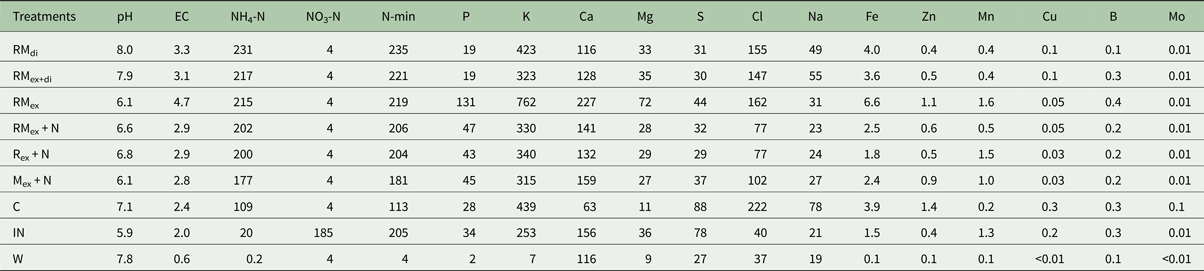
For all treatments, 20 kg composted chicken manure (2–1–2 NPK, powdered, Farmergødning, Denmark) per cubic meter was mixed in the peat before filling pots. Nine treatments (six organic and three controls) with four replicates and 12 pots per replicate were established in a completely randomized design, where pots were randomly selected from within each replicate for later plant or growing medium analyses (described below). The control treatments were: (1) water (W), to determine the effect of only solid composted chicken manure mixed in before sowing and no liquid fertilizer was applied during growing period; (2) liquid inorganic fertilizer (IN) prepared from individual salts; and (3) chicken manure extract (3-1-2 NPK, granulated, Farmergødning, Denmark, soaked in water for 24 h 1 : 10 (w/w)] and filtered through a filter with mesh size 0.3 mm as organic control (C). Six organic treatments were prepared from the five plant-based organic liquid fertilizer stocks produced. Fertigation solutions RMdi and RMex+di were the original digestates diluted with water in the ratios 1 : 3 and 1 : 2.5 (v/v), respectively, before application. Rex and Mex (3 : 1 v/v) were mixed and diluted with water (1 : 2.1 v/v) to give RMex. All liquid fertilizers were filtered through a filter with mesh size 0.3 mm before being mixed with water. In order to increase the N concentration and dilute the high K and Cl concentrations, Rex, Mex and RMex were individually mixed with N-enriched water to give Rex + N (2 : 1.8 v/v), Mex + N (2 : 1.7 v/v) and RMex + N (2 : 1.9 v/v) and then diluted with water (1 : 4.2 v/v) before application. A mixture of 75% tap water and 25% rainwater was used to prepare all fertigation solutions including W. Fertigation solutions were prepared to give a similar total-N in all fertigation treatments. An overview of nutrient concentrations in the given fertigation solutions is shown in Table 2.
Nutrient concentrations (mg L−1), pH and EC (dS m−1) of applied fertigation solutions from anaerobic digestates of red clover and white mustard (RMdi), anaerobic digestion of the solid product after extraction with acidic water (RMex+di), acidic extraction of red clover (Rex) + white mustard (Mex) (RMex), RMex + N-enriched water (RMex + N), Rex + N-enriched water (Rex + N), Mex + N-enriched water (Mex + N), chicken manure extract (C), inorganic fertilizer (IN) and water (W).

EC, pH and nutrient content in fertilizers and in fertigation and peat solutions
The EC and pH of the growing medium solution were measured once a week from 0 days after fertigation start (DAF) to 21 DAF for each replicate by a pH and EC meter (Model no. HI 9813, HANNA Instruments Inc., Romania). Samples of fertilizers, fertigation solutions immediately following the preparation and growing medium solutions were taken on 21 DAF and analyzed for NH4, NO3, P, K, Ca, Mg, S, Cl, Na, Fe, Zn, Mn, Cu, B and Mo (Eurofins, Denmark). Growing medium solution samples were collected from one to two randomly selected pots (10–20 ml) for pH and EC measurements and from six to nine pots (150 ml) for nutrient analysis by suction of individual pots with a vacuum 1h after running a fertigation treatment.
Biomass yield and nutrient content in plant materials
Growth parameters were determined on plants from two pots per replicate at 24 DAF. Eight young fully developed leaves from each pot (one per plant) were harvested and leaf area, fresh weight and dry weight were determined to calculate the specific leaf area (SLA, cm2 g−1 DM). The remaining aboveground biomass was harvested and the number of leaves, fresh weight and the total leaf area were recorded (LI-3100, Li-Cor Inc., Lincoln, NE, USA). The fresh biomass was oven-dried at 70°C for 48 h to determine dry weight. Plant material from another four pots per replicate was harvested, dried and mixed with the dry matter from the two pots above, and analyzed for total N, P, K, Ca, Mg, S, Cl, Na, Fe, Zn, Mn, Cu and B (Agrolab, Germany).
Statistical analysis
The statistical data analysis was done using the GLM procedure of SAS (Statistical Analysis System, version 9.2, SAS Institute, Cary, CN, USA). Mean values were used in the statistical analysis if measurements on several pots were taken within a replicate. Biomass yield, leaf area, water content, SLA and nutrient concentration in the growing medium and plant material were analyzed using one-way ANOVA. For pH and EC two-way interaction between treatment and day of measurement was identified by two-way ANOVA and multiple comparisons of means were done by using proc PLM (partial linear model). Tukey's studentized range test was applied to determine significant differences between treatments at the P < 0.05 level of significance.
Results
Nutrient concentrations in fertilizers
Both the source materials (red clover and white mustard) and production methods used (acidic extraction and anaerobic digestion) influenced the concentrations of nutrients in the resulting plant-based liquid fertilizer stocks (Table 1). Apart from N-enriched water, plant-based fertilizer stocks had high K concentrations compared with N irrespective of source material and production method used. Fertilizer stocks prepared by acidic extraction had higher concentrations of K, P, Ca, Mg, S, Mn and B and lower concentrations of N, Cl, Na and Cu than with RMdi and RMex+di fertilizer stocks, and the pH in RMdi and RMex+di fertilizer stocks was 2–3 units higher than after acidic extraction (RMex). Higher concentrations of Ca, Mg, S, Cl, Na, Zn and Mn were found in fertilizer stocks prepared from white mustard compared with red clover, whereas the concentration of other nutrients was similar in all fertilizer stocks.
Plant growth parameters
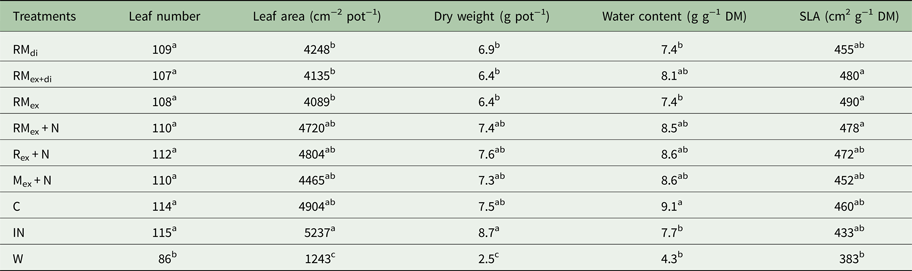
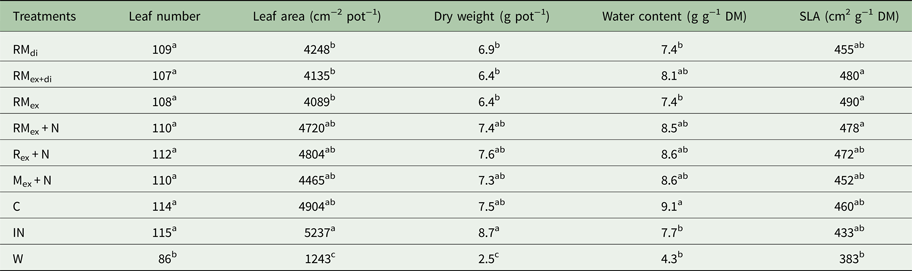
Parsley shoot dry weight (P < 0.001) and total leaf area (P < 0.001) were higher in IN than RMex, RMdi and RMex+di (Table 3). However, when Rex, Mex or RMex were combined with N-enriched water (Rex + N, Mex + N or RMex + N), dry weight and leaf area were not different than IN, though values were numerically intermediate between IN and organic treatments without N-enriched water. The number of leaves and the specific leaf area did not differ significantly between fertigation treatments (Table 3). Neither did the production method for red clover and white mustard fertilizer (RMex versus RMdi and RMex+di) significantly influence plant growth parameters. The shoot dry weight, leaf area, leaf number and specific leaf area were found to be lower in W than in all fertigation treatments (P < 0.001).
Leaf number, leaf area, dry weight, leaf water content and specific leaf area of parsley grown with liquid fertilizers from anaerobic digestion of red clover and white mustard (RMdi), anaerobic digestion of the solid product after extraction with acidic water (RMex+di), acidic extraction of red clover (Rex) + white mustard (Mex) (RMex), RMex + N-enriched water (RMex + N), Rex + N-enriched water (Rex + N), Mex + N-enriched water (Mex + N), chicken manure extract (C), inorganic fertilizer (IN) and water (W). Means (n = 4) within each row followed by different letters are statistically different between fertigation strategies (P < 0.05).
pH and EC in growing medium solutions
The pH and EC of growing medium solutions were affected by the type of fertilizer and date of measurement (Fig. 2; P < 0.001). The pH increased gradually throughout the experimental period in all treatments (Fig. 2a and b) but the dynamics differed. For example, in all organic treatments and W, pH increased by one unit between 0 and 7 DAF, further increased by 0.2–0.5 units at 14 DAF and subsequently stabilized, except in W where it continued to increase until the end of the experiment. In IN, the pH increased continuously throughout the experiment. Although the pH of the acidic extracted fertilizer RMex was lower than in RMdi and RMex+di, this was not reflected in the pH of the growing medium solution (Fig. 2a).
The pH (a, b) and EC (c, d) in growing medium solutions after the application of liquid organic fertilizers prepared by different extraction methods of different raw materials. Acidic extraction of red clover (Rex) and white mustard (Mex) combined to give (RMex), anaerobic digestion of red clover and white mustard (RMdi) or of the solid product after acidic extraction (RMex+di), RMex + N (N = N-enriched water), Rex + N, Mex + N, chicken manure extract (C), inorganic fertilizer (IN) and water (W). Vertical bars indicate standard error of the mean (n = 3) and different letters indicate statistical difference between fertigation strategies within individual dates (P < 0.05).

Fertigation with RMex resulted in a higher EC than with the other treatments (Fig. 2c and d), and the addition of N-enriched water (RMex + N) significantly reduced EC. During the first 14 days the EC in the growing medium solutions of Rex + N and RMex + N was similar to IN and lower than in the other organic treatments. EC in RMdi, RMex+di and N-enriched treatments was similar to C and generally a little higher than IN. The EC in W remained between 0.45 and 0.71 dS m−1 throughout the experimental period.
Nutrient concentrations in growing medium solutions
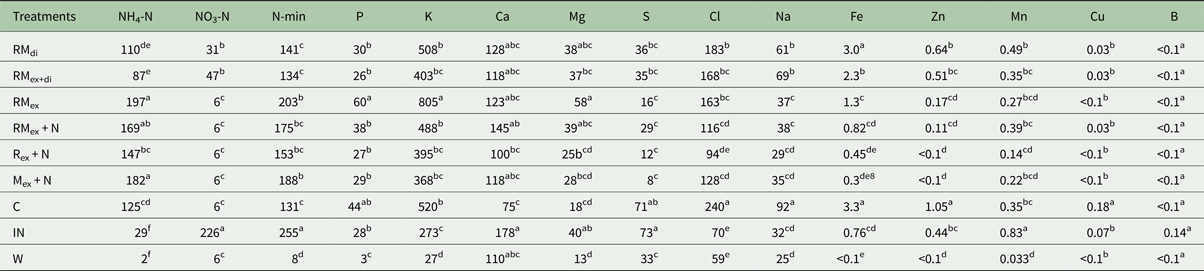
The liquid fertilizers had a large influence on the nutrient composition of the growing medium (Table 4). The standard inorganic fertilizer prepared according to crop need from individual salts resulted in high N-min, NO3-N, Ca, S, Mn and B concentrations and low K and Cl concentrations compared with the organic fertilizers. The organic control treatment based on an extract from composted chicken manure (C) was very high in Cl, Na, Fe, Zn and Cu and low in Ca and Mg compared with both the other organic treatments and IN. Of the plant-based organic fertilizers, RMdi and RMex+di were relatively high in NO3-N, S and Na and low in N-min and NH4-N. RMdi also had a high Fe concentration similar to C. RMex resulted in very high concentrations of P, K and Mg compared with IN, C, RMdi and RMex+di.
Concentrations (mg L−1) of nutrients in the growing medium solution 21 days after application of liquid fertilizers from anaerobic digestion of red clover and white mustard (RMdi), anaerobic digestion of solid product after extraction with acidic water (RMex+di), acidic extraction of red clover (Rex) + white mustard (Mex) (RMex), RMex + N-enriched water (RMex + N), Rex + N-enriched water (Rex + N), Mex + N-enriched water (Mex + N), chicken manure extract (C), inorganic fertilizer (IN) and water (W). Means (n = 4) within each row followed by different letters are statistically different between fertigation strategies (P < 0.05).

Nutrient concentrations in leaves
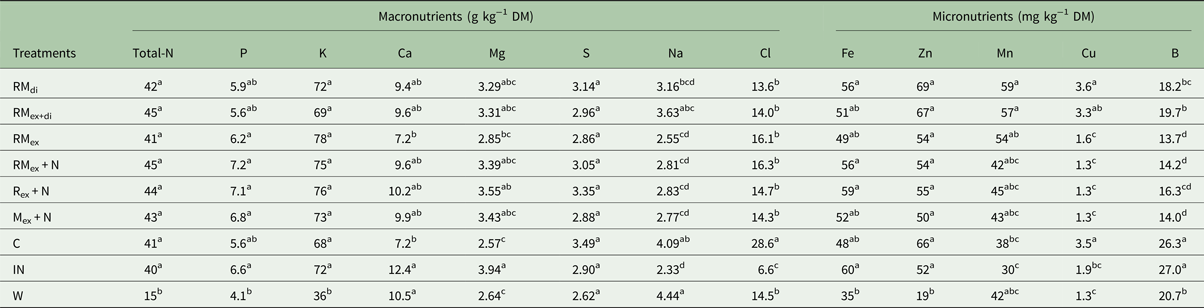
At the end of the experiment, the leaf concentrations of total-N, P, K, Fe and Zn were similar in all treatments receiving fertigation and generally higher than in W (Table 5). Despite differences in nutrient concentrations in the growing medium, the leaf concentrations did not vary much with the type of applied organic fertilizers. Fertigation with RMdi and RMex+di resulted in high leaf concentrations of only B and Cu compared to RMex, but high concentrations of B and Cu were also found in leaves from C. The leaf Mn concentration was generally higher in the treatments receiving plant-based organic fertilizers than with IN. The leaf Ca and Mg concentrations were about 1.5 times higher in IN than in C and RMex, but their concentrations did not differ significantly in the organic treatments. The Cl concentration in C was 4.5 times higher than in IN and twice as high as in the other organic treatments and W. The Na concentration was furthermore high in C and W (Table 5).
Concentrations (mg L−1) of nutrients in parsley leaves after application of liquid fertilizers from anaerobic digestion of red clover and white mustard (RMdi), anaerobic digestion of the solid product after extraction with acidic water (RMex+di), acidic extraction of red clover (Rex) + white mustard (Mex) (RMex), RMex + N-enriched water (RMex + N), Rex + N-enriched water (Rex + N), Mex + N-enriched water (Mex + N), chicken manure extract (C), inorganic fertilizer (IN) and water (W). Means (n = 4) within each row followed by different letters are statistically different between fertigation strategies (P < 0.05).

Discussion
The effect of extraction method on stock fertilizer nutrient content
In this study, organic liquid fertilizer stocks were produced from ensiled red clover and white mustard by either acidic extraction, anaerobic digestion or both. Many plant- and animal-based sources have previously been used to produce organic liquid fertilizers using extraction, fermentation, anaerobic digestion or other methods (Bujoczek et al., Reference Bujoczek, Oleszkiewicz, Sparling and Cenkowski2000; Gross et al., Reference Gross, Arusi, Fine and Nejidat2008; Martínez-Alcántara et al., Reference Martínez-Alcántara, Martínez-Cuenca, Fernández, Legaz and Quiñones2016) and variations in composition and concentration of nutrients in the resulting liquid fertilizers have been observed (Gross et al., Reference Gross, Arusi, Fine and Nejidat2008; Hartz et al., Reference Hartz, Smith and Gaskell2010). Generally, N-min (sum of ammonium and nitrate) in plant-based liquid fertilizers is low compared with the concentrations of available K and Cl (Martínez-Alcántara et al., Reference Martínez-Alcántara, Martínez-Cuenca, Fernández, Legaz and Quiñones2016; Pokhrel et al., Reference Pokhrel, Sorensen, Kristensen and Petersen2017a), which reflects their biochemical function in plant tissue. Most of the N in plant tissue is bound in organic form, mainly as amino acids and proteins, and needs microbial breakdown (mineralization) to become available in ionic form. In contrast, most of the K and Cl is held in ionic forms in plant cells and is therefore easily extractable (Römheld and Kirkby, Reference Römheld and Kirkby2010; Marschner, Reference Marschner2011). The higher N-min to K ratio in RMdi than RMex fertilizer stocks could be due to a more extensive microbial degradation of N during anaerobic digestion than with acidic extraction (Table 1). In contrast to N; P and Ca were higher in fertilizer stocks derived from acidic extraction than anaerobic digestion could be due to easier to the breakdown of carbon bound P and Ca than N by acidic water. Only the K and Fe concentrations were lower in RMex+di than in RMdi even though nutrients had already been extracted from the biomass once during the preparation of RMex. This can be explained by the two-step treatment (acidic extraction followed by anaerobic digestion) facilitating the breakdown of more complex compounds in the plant tissue than by either method alone.
The N:K ratio in fertigation solutions was higher than in the fertilizer stock before dilution, which could be due to mineralization of some organic N during the preparation of the solutions and during fertilizer stock storage (Tables 1 and 2). Martínez-Alcántara et al. (Reference Martínez-Alcántara, Martínez-Cuenca, Fernández, Legaz and Quiñones2016) reported that more than 80% of the N content in newly extracted liquid fertilizers is in the organic form, which can be easily mineralized. Fertigation solutions prepared from fertilizer derived from acidic extraction (RMex) contained higher concentrations of most macro- and micronutrients (except N, Na and Cu) and higher EC than fertigations solutions prepared from RMdi and RMex+di stocks. This was due to a low concentration of N relative to other nutrients in RMex because fertigation solutions were prepared to supply similar concentrations of total N. Although the NO3 concentration in the growing medium solutions of RMdi and RMex+di was higher than in the respective fertigation solutions, the N-min was lower compared with RMex (Tables 2 and 4). This could be attributed to the high pH (ca. 8) of both RMdi and RMex+di fertilizer stocks and fertigation solutions, which may have increased both the ammonia volatilization rate and nitrification after the preparation of fertigation solutions (Robinson et al., Reference Robinson, Di, Cameron, Podolyan and He2014). The NO3 concentration in the fertigation solutions was slightly higher than in fertilizer stocks, which was probably due to nitrification during storage of fertilizer stocks because the stocks were only analyzed at the start of the experiment.
The effect of extraction method on plant growth
Compared with IN and C the application of RMex, RMdi and RMex+di reduced dry weight and total leaf area (Table 3). The lower biomass yield from RMex was likely due to an elevated EC in the growing medium solution, caused by an excess concentration of K. High K concentrations and EC previously been reported when using organic liquid fertilizer to meet crop total-N requirements (Pokhrel et al., Reference Pokhrel, Sorensen, Kristensen and Petersen2017a). In this study, the root zone EC for plants receiving RMex was approximately twice as high as the upper threshold for optimal parsley growth reported by Álvaro et al. (Reference Álvaro, Lao, Urrestarazu, Baghour and Abdelmajid2015). It is well known that a high EC has negative effects on water and nutrient uptake due to lower water potential, resulting in reduced crop growth (Ouni et al., Reference Ouni, Mateos-Naranjo, Lakhdar, Andrades-Moreno, Abdelly and Barhoumi2014; Rameshwaran et al., Reference Rameshwaran, Tepe, Yazar and Ragab2016). Moreover, excessive K and NH4 concentrations influence the cation balance and result in reduced Ca and Mg uptake, which was supported from the numerically lower concentration of Ca and Mg in the plant materials in organic treatments (Li et al., Reference Li, Qin, Mattson and Ao2013). The lower N-min in the growing medium, potentially resulting from high pH-related N losses after fertigation preparation, could also partly explain the reduced yield of RMdi and RMex+di compared with IN and N-enriched treatments. High pH has previously been found to lead to ammonia volatilization, at the expense of plant uptake (Kai et al., Reference Kai, Pedersen, Jensen, Hansen and Sommer2008). High EC and imbalance nutrient compositions in the root zone, and low root growth (data not shown) may also be responsible for lower yield from plant-based fertilizers without combined N-enriched water compared to with N-enrich water combined treatments.
The effect of N-enriched water on plant growth
The fresh weight, dry weight and leaf area increased by up to 35% when Rex, Mex and RMex were combined with N-enriched water compared with RMex alone, which was likely due to an improved nutrient composition and reduced EC in the growing medium. N-min levels in fertigation solutions and growing medium solutions were similar for RMex and N-enriched treatments, but the concentration of K was reduced by ca. 50% in N-enriched treatments, which not only reduced EC but also increased Ca/K and Mg/K ratios.
Despite significantly higher pH and NH4 concentrations in the growing medium in C and N-enriched water treatments compared with IN, parsley plants had similar fresh biomass, dry weights and leaf areas. This indicates that the lower yield in RMex, RMdi and RMex+di may not be due only to negative effects of a high pH and high NH4 concentration in the growing medium. This argument is supported by the lower yield in RMdi and RMex+di despite a higher NO3 concentration in the growing medium solution compared with C and the N-enriched treatments. It could be that when high pH and NH4 concentrations occur simultaneously, the negative individual impact of these factors is reduced. Previous studies have demonstrated that acidification of the rhizosphere is one of the fundamental causes of NH4 toxicity to plant growth, and may be counteracted by applying fertigation solutions with a high pH (Dijk and Eck, Reference Dijk and Eck1995; Britto and Kronzucker, Reference Britto and Kronzucker2002). Therefore, high pH in fertigation solutions concomitant with high NH4 concentrations may be beneficial. Achieving similar yields with C and IN is inconsistent with a previous study where a lower yield was found in C than IN (Pokhrel et al., Reference Pokhrel, Sorensen, Kristensen and Petersen2017a), but could be explained by the slightly higher concentrations of most of the macro- and micronutrients in the applied and growing medium solutions in the present experiment.
Conclusion
Acidic extraction of red clover and white mustard silage resulted in higher concentrations of most of the macro- and micronutrients, except N, than anaerobic digestion of the same biomasses leading to high EC in the RMex fertigation and growing medium solutions. Fertigation solutions prepared from anaerobic digestates had a high pH of ca. 8. Both types of fertilizer resulted in low biomass yield of parsley compared with chicken manure extract and inorganic fertigation. Our results demonstrate that the yield of organic greenhouse parsley achieved with a chicken manure extract or a combination of plant-based fertilizers with N-enriched water was similar to that in a conventional system. In order to meet an increasing demand for organic fruits and vegetables grown in a greenhouse, liquid fertilizers are necessary, but only a few commercially available liquid fertilizers approved for organic production in Denmark. Finding of this study could be increased selection options of liquid fertilizers for organic growers because some fertilizers producers have been already started to produce acidic extracted plant-based fertilizers in Denmark. N-enriched has a potential to being approved as organic if produced from organic sources. The combinations of plant-based fertilizers and N-enriched water resulted in excellent plant growth of parsley, which widening the choice of certified liquid organic fertilizers in the market.