INTRODUCTION
The final stage of cancer can be accompanied by physical, psychosocial, and existential distress for a person who is dying as well as for family and loved ones (Breitbart & Payne, Reference Breitbart, Payne, Chochinov and Breitbart2000; Chochinov et al., Reference Chochinov, Hack and Hassard2005; Block, Reference Block2006; Cooper et al., Reference Cooper, Kinsella and Picton2006). A clear linkage has been found between the numbers of concerns (e.g., loss of independence, pain) and levels of anxiety and depression in late-stage illness (Heaven & Maguire, Reference Heaven and McGuire1998). Hospices provide comprehensive, high-quality care that eases suffering and prepares individuals and families for loss; it is available for cancer patients who have ended curative treatment and are expected to die within 6 months. However, a majority of hospice admissions occur only during the final days of a terminal illness, and 30% of all patients die within 7 days of admission (National Hospice and Palliative Care Organization, 2006; Teno et al., Reference Teno, Shu and Casarett2007). Nearly two thirds of all patients receive hospice for less than 30 days (National Center for Health Statistics, 2004).
Hospice admissions that occur during the late stages of cancer and result in short utilization have been viewed as providing minimal opportunity for accomplishing important end-of-life care goals of life closure, comfortable dying, and effective grieving (Miller et al., Reference Miller, Kinzbrunner and Pettit2003a, Reference Miller, Weitzen and Kinzbrunner2003b; Teno et al., Reference Teno, Shu and Casarett2007). Conceptualized as “hyper-acute death care,” short-term hospice utilization has been seen as a challenge for professionals who manage symptoms (e.g., pain, nausea, delirium) without the time to gain an understanding of individuals' unique preferences (Christakis, Reference Christakis1994). Hospice admissions that occur only shortly before death may reflect an end-stage crisis (Andershed & Ternestedt, Reference Andershed and Ternestedt2000; Andershed, Reference Andershed2004; Taylor, Reference Taylor2004) or they may be a function of the interrelationship between illness-related factors such as the patient's rate and level of decline and the family's history of managing distressing situations. Certainly, whether hospice is involved at all as well as the timing and length of this care influence the end-of-life experience. However, whether short hospice enrollment is perceived by family members as difficult and stressful or positive and beneficial is largely unknown.
Guided by salutogenic principles and Antonovsky's Sense of Coherence Theory (Antonovsky, Reference Antonovsky1987; Strang & Strang, Reference Stang and Strang2001; Milberg & Strang, Reference Milberg and Strang2003), which underscore the importance of understanding whether a potentially stressful event might serve an adaptive function and be a way of coping for some people, this study aimed to answer three questions: (1) Do hospice professionals and family caregivers view short hospice utilization similarly? (2) Are short hospice enrollments a physical and emotional crisis or natural timing for this transition in cancer care? (3) Do families struggle during later hospice admissions or feel relief that situation-specific end-of-life care becomes available exactly when it is needed? We recognize that, although earlier hospice admission may be preferable to hospice professionals, short periods of utilization may or may not be distressing for those who experience them. The study objective was to compare the perspectives of hospice professionals and the family caregivers about the psychosocial dynamics that accompany short enrollment. Following a brief review of the literature on psychosocial dynamics in end-stage cancer, we present a conceptual thematic matrix of psychosocial dynamics in late-stage hospice admissions.
Psychosocial Dynamics in End-Stage Cancer
People with cancer have been found to experience a more predictable disease trajectory than those with other terminal conditions and one that frequently involves a sharp decrease in functional abilities such as ambulation and transferring from bed to chair (Andershed & Ternestedt, Reference Andershed and Ternestedt1998; Teno et al., Reference Teno, Weitzen and Fennell2001). Pain is also associated with cancer (estimates indicate approximately 70% of all have severe pain), especially in the advanced stages (Breitbart & Payne, Reference Breitbart, Payne, Chochinov and Breitbart2000; McGuire, Reference McGuire2004). Families often experience caregiving and financial demands that can be severe, (Grbich et al., 2001; Milberg et al., Reference Milberg, Strang and Jakobsson2004) as well as new responsibilities and the need for knowledge, communication, and support from a knowledgeable professional (Andershed, Reference Andershed2006). Caregivers have been found to experience depression, decreased quality of life, lower well-being, and difficulty coping (McMillan, Reference McMillan2005). Three important family issues in palliative care have been identified as (1) maintaining homeostasis, (2) preserving family bonds, and (3) attending to the family system during times of illness-related changes (Wellisch, Reference Wellisch, Chochinov and Breitbart2005).
A salutogenic orientation, opposite one that is pathogenic, offers guidelines for considering how late-stage hospice admissions may contribute to a sense of coherence. A salutogenic orientation posits that people and situations exist on a continuum from health (or ease) to disease (or distress) rather than in one state or the other and focuses on understanding the factors that contribute to an active and effective adaptation in stressful situations. Antonovsky (Reference Antonovsky1987) found that some people maintain both physical and mental well-being during the process of dying. The salutogenic approach illuminates the importance of recognizing that some people may intuitively manage the uncertainty of an approaching death with little or no formal assistance.
The Sense of Coherence Theory is built from three constructs: comprehensibility or the perception that the challenge is understood, manageability or the perception that the resources to cope are available, and meaningfulness or the belief that these challenges and demands are worthy of investment and engagement (Antonovsky, Reference Antonovsky1987). Building on findings that suggest that family members' involvement in and ways of coping with an approaching death are influenced by their sense of coherence, these concepts were used to explore and describe the psychosocial dynamics of late-stage hospice enrollment (Andershed & Ternestedt, Reference Andershed and Ternestedt1998; Cowley & Billings, Reference Cowley and Billings1999; Milberg & Strang, Reference Milberg and Strang2003, Reference Milberg and Strang2004, Reference Milberg and Strang2007; Johnson, Reference Johnson2004; Lindstrom & Eriksson, Reference Lindstrom and Eriksson2005; Gustavsson-Lilius et al., Reference Gustavsson-Lilius, Julkunen and Keskivaara2007).
The hospice philosophy and focus of care involve the provision of comfort and support to terminally ill people and their families when a life-limiting illness no longer responds to cure-oriented treatments. Previous studies have explored barriers to hospice utilization and characterized short enrollments as undesirable; however, they remain common. Because hospice professionals bring specialized skill and knowledge that focuses on the amelioration of physical, psychosocial, and spiritual pain, they may believe that without this assistance families suffer, and, as a result, they may view the appropriate timing for the transition to palliative care as earlier than do people who are terminally ill and their families (Hospice Foundation of America, 2006; National Hospice and Palliative Care Organization, 2006). There is growing evidence that it is possible to achieve a positive psychological state in stressful situations, including life's end (Folkman, Reference Folkman1997; Grbich et al., Reference Grbich, Parker and Maddocks2001; Milberg & Strang, Reference Milberg and Strang2003) but families' experiences of short hospice utilization and their perspectives on the timing of admission are largely unknown. This study aimed to explore how hospice professionals and family caregivers experience the dynamics of short enrollments. Understanding the interrelationship between the perspectives of hospice professionals and families is an important aspect of the transition from curative to palliative care that has implications for improving care in late-stage illness.
METHODS
Overall Project Design
This exploratory, descriptive study involved a developmental design whereby Phase I results informed Phase II. Methodological triangulation or the deployment of multiple qualitative methods in an equal status sequential design was used for the purpose of data triangulation and analytic rigor (Lincoln & Guba, Reference Lincoln and Guba1985; Padgett, Reference Padgett1998). During Phase I, hospice professionals were asked about family dynamics they observe during short, late-stage admissions. The findings were analyzed and used to develop a list of psychosocial factors that characterize the dynamics that hospice professionals observe during short enrollments. Phase II involved in-depth interviews with the family caregivers of people who died from cancer within 2 weeks of hospice admission. The list of psychosocial factors that emerged from hospice professionals' descriptions was used to determine if family caregivers experienced the dynamics named by hospice professionals. Institutional Review Board approval was received for each phase separately.
Phase I: Hospice Professionals' Perspectives
The purpose of Phase I was to explore the hospice professionals' perspectives about psychosocial dynamics in short hospice enrollment. Focus groups were selected because they generate dynamic interaction between participants (Berg, Reference Berg1995). However, because some interested participants had scheduling conflicts with the focus groups, we offered them the opportunity to complete the questions in writing and return them by mail. The rationale was to seek maximal participation. All Phase I participants were asked both team- and individual-level questions. Team-level questions were designed to explore their views on the patient–family dynamics they observe in short, later-stage hospice utilization. Individual-level questions were about participants' educational level, hospice experience, and professional perspectives on family dynamics.
Recruitment and Sample
Purposeful sampling was employed to gather in-depth description from a homogenous group for in-depth study (Patton, Reference Patton2002), in this case, of hospice professionals. The participating hospice provides care in numerous environments that include nursing homes, an inpatient unit, and at home. For this study, only hospice staff members who had direct care responsibilities on a home care team were invited to participate. Hospice professionals on the nursing home, inpatient, and hospital teams were excluded. Invitation letters and response forms were mailed to 106 home care team members. A total of 53 professionals participated, including nurses, social workers, chaplains, physicians, and clinical secretaries. Clinical secretaries provide frontline communication to people who call with inquiries about hospice, families, and physicians; because they often become involved in crisis intervention their participation was key. Multidisciplinary focus groups (3–10 participants) were convened on the Hospice campus either before or after working hours. Thirty-five participants attended focus groups, and 18 answered all questions in writing, returning them by mail. Participants' professional experience ranged from 3 to 38 years (M = 16.6 years) and experience with hospice ranged from 3 months to 25 years (M = 6.25 years).
Analysis
All quantitative data (e.g., age, years of experience) were entered into SPSS for the calculation of descriptive statistics. Focus groups were audiotaped, transcribed, and labeled with a letter-number code (e.g., FG-1). Written answers to the open-ended individual survey questions were typed as a text document and labeled with a participant code (e.g., RN-1). The focus group and individual survey answers were considered to be distinct data sets and were submitted to separate analyses. Individual level questions from all participants were entered into a third data set. Each data set was entered into Atlas ti software, which was used as a tool for systematic data management and coding because it allows the simultaneous display of primary text, codes, and annotations. The Phase I analysis focused on describing the ways that hospice professionals view the psychosocial dynamics in families with short, late-stage admissions through an iterative process. First, the transcripts from each data set were submitted to open coding or the line-by-line examination textual data to identify central concepts (Padgett, Reference Padgett1998). “Free codes” or phrases that capture the meaning of a text passage were assigned to illuminating concepts. Two examples of free codes were “crisis” and “chaos.”
Next, codes were merged into categories and compared through a process of axial coding, or fitting the categories together to distill a list of terms that characterize characterized the distinct psychosocial features associated with short enrollments. Initially, a list of 33 descriptive terms was distilled that were merged into three categories: (1) family dynamics, (2) family needs for specific assistance, and (3) a sense of coherence (manageability, comprehensibility, and meaningfulness). The list was referred to the Psychosocial Factors Checklist (PFC).
Phase II: Family Caregivers
The purpose of Phase II was to explore and describe the perceptions of family caregivers during short hospice enrollments. In-depth interviews were used to gather participants' accounts of their experiences, needs, and the family dynamics that occurred during this time period.
Recruitment and Sample
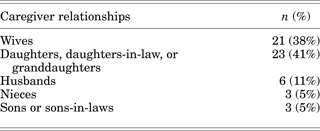
Purposeful sampling, specifically typical case sampling, was employed to gather descriptive data about people who had similar experiences (Patton, Reference Patton2002), in this case, families who cared for people who were over age 65 and died from cancer within 2 weeks of admission to hospice. Informational letters about the overall project were placed in all hospice admission packets during the recruitment period. Invitation letters and response forms were mailed to all potential participants. Follow-up telephone calls were made if the response form had not been returned in 2 weeks. A sample size of 50 was sought for the purpose of maximizing heterogeneity in the sample. Six collateral family members participated (Table 1).
Family caregiver relationships
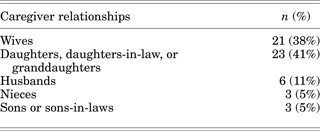
N = 50 patients, 56 caregivers.
In-Depth Interviews
Interviews were scheduled at a time and place of participants' choice. Interviews began with a series of open-ended questions about the trajectory of the illness, decline, and death. Participants were asked if the words on the PFC described their experience and responses were recorded as “yes” (1) or “no” (0). Participants were asked if the hospice stay was too short, too long, or just long enough.
Analysis
Qualitative data analysis was again iterative. First, a start list of codes that included manageability, comprehensibility, and meaningfulness, service needs and family dynamics was used to section the data into subsets or “bins” in Atlas ti (Miles & Huberman, Reference Miles and Huberman1994). The purpose for using an a priori system for analyzing the data was to identify and describe the concepts from the sense of coherence theory as they were present in late-stage admissions. Next, the “output” that listed each text passage in the bins was retrieved. A summarizing concept was attached to each selection. Finally, similar summarizing concepts were grouped by identifying the overarching themes that emerged within the categories (e.g., manageability [category]/physical challenges [theme]). The process of constant comparative analysis or recoding qualitative data with emergent themes was incorporated to assure that all data was coded with the emerging themes.
Quantitative data (e.g., demographics, PFC responses) were entered in SPSS. Initially, the PFC items were grouped in three categories: (1) as elements of the sense of coherence and clustered with manageability, comprehensibility, or meaningfulness; (2) as family dynamics; or as (3) service needs.
Sense of Coherence
A series of interitem correlations was used to test the associations within the subgroups of terms (N = 27). Items with weak interitem correlations and overlapping meaning were discarded. Seven concepts were related to manageability, three to comprehensibility, and six to meaningfulness (N = 17). Subscale scores were calculated for each participant on the comprehensibility, manageability, and meaningfulness dimensions. An overall sense of coherence (SOC) score was calculated by summing the 17 items that demonstrated statistical association with the constructs.
Family Dynamics (N = 3)
These items were used as single discrete measures of family-level dynamics: family cohesion, withdrawal, and emotional distance.
Service Needs (N = 3)
These items (also single discrete measures) referred to specific unmet needs: legal concerns, financial concerns, and funeral plans.
Summary of Analysis from Phases I and II
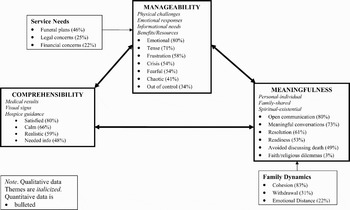
The concepts that hospice professionals use to describe the psychosocial dynamics that characterize late-stage hospice admissions were distilled into the PFC. During in-depth interviews with caregivers about their experiences during the end stage of a loved one's illness, the PFC was incorporated to ask family members whether or not specific descriptive terms matched their experiences. The results from analysis of both professionals' and family members' perspectives are presented sequentially and compared for similarities and differences. Family members' perspectives were used to modify and refine the terms on the PFC. The final list of items and their frequencies appear in Figure 1. The qualitative themes and quantitative responses were combined into a thematic conceptual matrix (Miles & Huberman, Reference Miles and Huberman1994) that, in this case, illuminates the dimensions of a sense of coherence in end-stage cancer care.
Thematic conceptual matrix: Sense of coherence in late-stage hospice admissions.

RESULTS
The sense of coherence concepts of manageability, comprehensibility, and meaningfulness are exemplified by emergent themes from the perspectives of family caregivers that are illustrated through participants' words.
Manageability
The manageability of care for advanced cancer was described as challenging when functional abilities become diminished by the disease and symptoms (e.g., pain, shortness of breath, nausea) become exacerbated by the dying process. Four central themes described manageability: (1) physical challenges, (2) emotional responses, (3) informational needs, and (4) the use of benefits/resources.
Physical Challenges
Caregivers described managing symptoms such as nausea, pain, bleeding, the aftereffects of chemo- or radiation therapy, and the dying process, which can involve delirium, hallucinations, cognitive decline, confusion, and labored breathing. A son's words illustrate some of the physical challenges of his mother's end-stage care:
When I was with her she was in pain. I would say “Mom, do you feel any pain?” She'd say, “Uh huh.” I said, “On a scale of 1 to 10, how much.” And she mumbled, “9 or so.” So I asked, “Can you give her some medication? She's in severe pain.” She couldn't get comfortable. I would adjust her pillows every 5 minutes. She was feeling pain that she's never felt before—I don't know what that pain was like and she can take pain. So about 5 p.m. we were giving her full shots and breathing treatments, it started out two or three times a day, and then it was every hour. It seemed to be the only thing that made her feel better, the breathing treatment. Hospice said if she needs it every 20 minutes, give it to her. So we knew the end was coming.
Other caregivers described physical challenges that included the increasing need for assistance with personal care, ambulation, the loss of independence, the need for 24-h care, and the potential complications of preexisting chronic conditions.
Emotional Responses
Participants described many emotional responses to caregiving at life's end, which included feeling overwhelmed, the need to “stay strong” for others, feeling hopeful, and episodes of panic, grief, denial, or avoidance in the person who is ill or other family members. Caregivers also described managing the exhaustion, fatigue, and uncertainty that accompany end-stage cancer care. A husband's words illustrate:
Wednesday night she said, “I love you.” I told her, “I love you too.” [Participant is choking back tears and pauses.] Then I says, “You can go when you're ready—just don't hang around though.” She closed her eyes and that was the last time she spoke to me.
Participants described the interrelationship between managing physical challenges and emotional responses during the dying process as intense and intimate.
Informational Needs
Participants described their need for information about the dying process. However, in the absence of sufficient information, family members described fragmented care from hospitals and/or providers and uncertainty about what was happening and what to do. The words of a daughter illustrate:
At the hospital, she was confused. They came in said, “You can take her home now.” She was still getting fed through a tube in her nose, had a tube in her mouth, and they were pumping her stomach. She also had a catheter. I said, “I can't take her home. I'm not a nurse.” I didn't know what to do.
Participants explained that accurate information about the person's diagnosis, prognosis, and care needs helped them manage caregiving by understanding what to expect.
Resources/Benefits
Participants gave examples of managing a loved one's benefits for health care, medical equipment, rehabilitation, or the transition to hospice. A participant's aunt lived in an assisted living facility (ALF). During her decline, Mrs. D was placed on oxygen, but she could not return to the ALF with it; her niece managed her benefits skillfully:
I knew if we placed her in a nursing home she would die quicker. But she was able to be covered under Medicare A for therapy for all but 3–4 days, and of those I think she was there 27 or 28 days so the last 4–5 days she wasn't covered; I paid. Of the 23 days that she was covered there were 2 days that she didn't go to therapy because she wasn't feeling good. She finished up her Medicare days and the next day she was on hospice.
Participants described how the availability of resources directly informed the manageability of each situation. Resources were used to supplement informal caregiving and to provide options when physical care became difficult.
Comprehensibility
Participants gave numerous examples of the ways that the comprehensibility of an illness and its progression evolves through the stages of an illness and changes when there remains no hope for a cure. Three emergent themes described how the transition from living with to dying from cancer becomes comprehensible: (1) medical results, (2) visual signs, and (3) hospice guidance.
Medical Results
Results can range from being unmistakable to uncertain, and providers can describe results explicitly or vaguely. An example of how medical results influenced comprehensibility was provided by a patient's son who said simply, “When the doctor saw the X rays he told me that Dad's lungs were gone.” The results of medical tests and how they are explained become a major focus for individuals and families.
Visual Signs
Physical signs such as the way a person's looks are changing (e.g., skin color, physical markers such as weight loss, “looking sick”) or increased fatigue were described as telltale signs of disease progression that informed comprehensibility. A patient's wife described the signs she saw:
His weight had always been low because of his Crones Disease. But at 114–113 pounds, bones showed up on his face that I never knew existed. I felt the life literally draining out of him. I've been with him for 46 years. It was like he was leaving. I was getting frantic. I thought I must be going crazy because they're not talking about this. They say he's gonna perk up. I don't see perking up, here.
The unmistakable visual signs of advanced illness contribute to comprehensibility by providing concrete indicators that the person's physical self is changing.
Hospice Guidance
Participants described the ways that hospice professionals act as educators and coaches through the last days before death by helping family members recognize the reality of the situation. One participant's example illustrates:
I called Hospice because I was upset. I didn't understand why they didn't have him on IVs; everything happened so fast. The woman I talked to was very good with me, she said, “don't try to force him to eat because it's more painful if they eat than if they don't eat. His body is shutting down.” I was upset because he wasn't eating. After I talked to the nurse and she explained it, I read the book and I didn't want to deal with it, because it tells you straight. After I read it, I sat and cried.
Participants reported the importance of being able to receive straightforward information about the dying process from the hospice team. Many explained that they did not understand how quickly death was approaching until hospice professionals explained the signs that death was near.
Meaningfulness
Three themes emerged to illustrate meaningfulness: (1) individual or personal, (2) familial or shared, and (3) spiritual or existential meaningfulness.
Individual-Personal Meaningfulness
The individual or personal meaning of a loved one's decline emerged through shared experiences that were changing the relationship. These situations helped a family member make sense of both the person's approaching death and how life was changing. A patient's daughter illustrates:
I said to her, “We are going to make perogies. I'll have to get the potatoes and we will make them.” She said, “oh yea, great,” so this is when I knew it was the end ‘cause she sat down, I gave her an onion, she cut off the end, and said, “I don't want to do this.” I said, “that's it.” I knew she was done.
Individual recognition of terminality was intense and contributed to a sense of coherence.
Familial-Shared Meaningfulness
A shared meaning of terminality, the approaching death, and of how life would change with the loss was developed by family members and others in close or intimate relationships with the person who was dying. A hospice patient's niece described how her aunt's death became meaningful for her daughters:
Stephie, my 5-year-old said, “You spend more time with Aunt Mary than with me.” I told her, “Aunt Mary is sick and she isn't going to be with us for very much longer, she is going to heaven, and she needs me; she doesn't have any children.”
Shared understanding increased meaningfulness and guided family care at life's end.
Spiritual–Existential Meaning
Participants expressed recognition that the end stage of care was transitional between life and death, and it was directly linked to spiritual beliefs and practices for many. Participants described spiritual awareness that gave comfort and contributed meaning. A dying woman's husband described such an experience:
The aide woke her up and says, “We're gonna give you a bath.” She says, “I don't need a bath . . . an exceptionally beautiful young man gave me a bath—a shampoo and everything. The water was as soft as I've ever felt in my life. It was so beautiful.” The aide then went out in the hallway and says, “She's hallucinating.” I said, “No she's not; call the nurse and tell her what she just told you.” She said, “What was it?” I said, “It was a heavenly bath. The angels are coming.”
Spiritual beliefs informed the meaning that many caregivers attributed to being present with a loved one at their death and contributed to a sense of coherence.
PFC
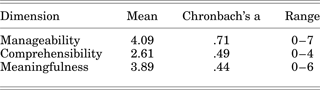
The range of the overall scores was 6–15 (M = 10). The range of the manageability score was 0–7 (M = 4.09). The range of the comprehensibility score was 0–3 (M = 1.95). The range of the meaningfulness score was 1–6 (M = 3.89). The results of the inter-item correlations are presented in Table 2. Figure 1 presents the thematic conceptual framework that integrates the qualitative and quantitative results. In addition, participants identified the length of hospice involvement as “too long,” N = 1(2%); “too short,” N = 27 (49%); “just long enough,” N = 27 (48%); and “I don't know,” N = 1 (2%).
Sense of coherence
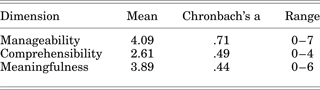
N = 56.
DISCUSSION
Hospice professionals described the psychosocial dynamics that they observe during late-stage, short hospice utilization primarily from a deficit perspective and in terms that illuminate distress and urgency. Family caregivers’ perspectives present a different view of this dynamic time period and one that embodies significant need for assistance, powerful emotions, meaningful interactions, and important transitions. Comparison of these differential perspectives provides important insight about the mindset that each brings to the interaction and suggests that hospice professionals and family caregivers do not view short hospice utilization similarly.
Divergent Perspectives on Late-Stage Admissions
Overall, hospice professionals view short hospice utilization as a missed opportunity for providing people who are dying and their families with formal support during the sometimes tenuous final phase of life. The hospice professionals in this study placed a particular emphasis on the difficulty they observe caregivers having with managing the end stage of an illness. Family caregivers were asked about the themes that emerged from hospice professionals' perspectives, and they offered a somewhat different experience of the psychosocial dynamics and short hospice utilization before death. Results suggest that only some of the concepts matched participants' experiences. A majority of participants described this time period as emotional, but it was also described as a time of open communication, meaningful conversations, and family cohesion. Simultaneously, about half described this time period as tense, a crisis, and chaotic. Notably, about half of the family caregivers said that their loved one's hospice utilization of 2 weeks or less was just long enough.
Salutogenic principles guided this exploratory inquiry and illuminated the sense of coherence in late-stage hospice admissions. Clustering individual items around the central SOC constructs suggests that there are correlations among some items. Manageability demonstrates the strongest associations, indicating the clearest association between how hospice professionals and family caregivers view the situation-specific needs that accompany the terminal decline. Analysis of the manageability scores also suggests that the caregivers in this study had moderate difficulty managing the situation and that they did not have all of the resources needed to meet the challenges they faced.
The constructs of comprehensibility and meaningfulness were more difficult to evaluate with the quantitative measures that emerged from the qualitative data; the clustered items did not demonstrate strong associations with caregivers' experiences. However, the themes that emerged from the qualitative analysis of participants' responses describe late-stage admissions. The comprehensibility of an approaching death develops from a combination of the results of medical tests and procedures, the visual signs of physical decline, and from the coaching and guidance provided by hospice professionals. In many situations, the medical results and visual signs informed family members that the situation was not improving, but almost half reported that they needed information and only after hospice became involved did they fully comprehend that death was approaching. Participants' descriptions illustrate that the meaningfulness of caregiving at the end of a loved one's life is experienced on three levels—individually, as a family, and spiritually. Although participants' descriptions provide vivid elucidation of these intimate experiences, they were not measured accurately by the four items on the PFC.
A Sense of Coherence in Short Hospice Utilization
Results from the qualitative analysis of family caregivers' experiences present a deeper view of the sense of coherence as it is experienced during the final phase of a loved one's life. The emergent themes suggest that the congruence of the end-stage caregiving experience depends on the interrelationship among the constructs of manageability, comprehensibility and meaningfulness.
This study builds on and contributes to literature about psychosocial dynamics that accompany late stage cancer care and about how the sense of coherence is experienced by families when hospice utilization is short. The results of this study describe manageability and build on the findings of Teno et al. (Reference Teno, Shu and Casarett2007), whose results indicate that later admissions are associated with the increased possibility of unmet needs, and others (Milberg et al., Reference Milberg, Strang and Jakobsson2004; Schockett et al., Reference Schockett, Teno and Miller2005; Milberg & Strang, Reference Milberg and Strang2007), who have documented the importance of controlling physical symptoms. Exploring concepts from the sense of coherence in palliative care, Milberg and Strang (Reference Milberg and Strang2004) found that manageability and comprehensibility are critical to the development of an inner congruity about an approaching death and toward developing shared experience. Similar to the results of White (Reference White2004), this study illustrates that meaningfulness in end-of-life care is a powerful and profound element that is difficult to measure. Using a checklist to determine the number of unmet needs, Heaven and Maguire (Reference Heaven and McGuire1998) found a strong association between the number of concerns that patients expressed and the level of distress; they used a checklist to determine the number of concerns. Although the subscales of the PFC did not demonstrate strong internal reliability, this study suggests the utility of a checklist for quick assessment of the manageability factors when hospice professionals become involved late in the illness.
Limitations
This exploratory study has several limitations. First, descriptions of manageability, meaningfulness, and comprehensibility were developed inductively rather than deductively. Asking caregivers directly about the concepts may have yielded additional data about these constructs. The study involved retrospective data collection, which introduces a level of bias. Participants' recall of events may have changed during the 2 months after the person's death. Although large for a qualitative study, the sample size is small overall and gathered from only one hospice. Exploring the sense of coherence with family members whose loved ones received care from other organizations may provide additional insight. Finally, the study was conducted with caregivers, both formal (hospice professionals) and informal (family members), but lacks hospice patients' voices. Additional research that involves perspectives from people who are dying would yield important information about later hospice admissions. The limitations inherent in this first attempt to explore and describe the psychosocial dynamics at the end of life can be considered steps in the process and ultimately used to inform the further development of tools to advance the inquiry about and our understanding of families' experiences as someone is dying.
Late-stage hospice admissions remain common, and they are a crisis for some but not all families; thus, learning how to help families during these intense time periods is imperative. The approaching and imminent death of a family member can be conceptualized as a crisis or as a normal life phase. Recognizing that late-stage admission is a natural transition that is consistent with a sense of coherence and congruity for other families is equally important. At hospice admission, some families are struggling with rapid and dramatic changes whereas others feel relief that situation-specific information and care is provided when needed.
Clearly, there is a need for end-of-life care research that explores hospice utilization patterns and how programs can deliver a high quality of care in short periods of time (Teno et al., Reference Teno, Shu and Casarett2007). It is also important to recognize that “one size (of end-of-life care) does not fit all (King & Quill, Reference King and Quill2006); further research inquiry can advance our understanding of differential ways to meet families' needs at life's end. Finally, a greater understanding of family history and psychosocial dynamics in late-stage admissions is central to improving patient-centered and family-focused care as well as supporting the sense of coherence at life's end.
Implications
The problem of late-stage admissions to hospice and palliative care are and always will be unavoidable and a phenomenon that needs to be understood as inherent to the uncertainty of the dying process. Short hospice utilization also emerges from the nature of the current health care system, which structures the use of hospice and palliative care only after a curative approach has been relinquished. People comprehend information about an approaching death only when they can, typically at the last possible moment; thus it is of no value to focus solely on the desire to have earlier admissions. The results of this study suggest that end-of-life care providers need to become accustomed to later admissions and respond by developing programs that address the needs and urgency of end-stage scenarios. It is unlikely that providers can oblige people to begin thinking about dying sooner. However, it is possible to make change such that hospice teams can work quickly and effectively once late-stage situations are identified and admitted. Comparing the perspectives of professionals and family caregivers underscores the importance of recognizing how distinctly different perceptions of the same event can be. Short hospice utilization offers an opportunity for hospice professionals to intervene in an immediate, comforting, and supportive way, despite the fact that they expect and are prepared for longer term interventions that build a deep rapport with families. The use of a quick assessment tool such as a future adaptation of the PFC could focus the assessment process and aid professionals in identifying a family's immediate needs. In addition, the results suggest the importance of helping hospice professionals prepare for care planning that may involve only a few visits. The use of a quick assessment tool for late-stage hospice admissions presents the potential for meaningful and effective intervention when time is of the essence.
ACKNOWLEDGMENTS
We gratefully acknowledge the funding and support of the John A. Hartford Foundation Faculty Scholars Program. We thank Dr. Nancy Hooyman and Dr. Deborah Padgett for their research mentorship and consultation on the design, data collection, and analysis phases of the project.