Most contemporary theories of motivation propose that human beings tend to initiate and persist at behaviors to the extent that they believe the behaviors will lead to desired outcomes or aspirations (Deci & Ryan, Reference Deci, Ryan and Ryan2012). Empirical evidence began to accumulate showing that aspirations is an important aspect of human`s life that help determine people`s meaning of life (e.g., Deci & Ryan, Reference Deci, Ryan and Ryan2012). Aspirations refer to people’s life goals, i.e, personal goals that people view as important in life (Kasser, Reference Kasser, Deci and Ryan2002; Kasser & Ryan, Reference Kasser and Ryan1993). Aspirations reflect not what people think they will achieve, but what would like to achieve. Aspirations have been underlined as an important factor in the regulation of behavior and integration of personality, i.e., in the determination of multiple behavioral and emotional outcomes (e.g., Deci & Ryan, Reference Deci, Ryan and Ryan2012). Furthermore, aspirations and higher levels of self-determined motivation are related to several positive outcomes, such as well-being (Rijavec et al., Reference Rijavec, Brdar and Miljković2011; Romero et al., Reference Romero, Gómez-Fraguela and Villar2012), health (Deci & Ryan, Reference Deci and Ryan2008), education/academic achievement (e.g., Niemiec & Ryan, Reference Niemiec and Ryan2009; Reeve, Reference Reeve, Deci and Ryan2002; Ryan & Deci, Reference Ryan and Deci2000), regulation of behavior and integration of personality (e.g. Little et al., Reference Little, Salmela-Aro and Phillips2007), and optimal relational functioning (Knee et al., Reference Knee, Patrick, Vietor, Nanayakkara and Neighbors2002). According to self-determination theory, aspirations reflect people needs, desires, awareness of those needs, and the consequent authenticity of choices and behaviors that are congruent with one’s needs. Thus, individuals` actions and behaviors are relatively autonomous, freely chosen in order to reach their aspirations and expectations (Deci & Ryan, Reference Ryan and Deci2000, Reference Deci and Ryan2008). Aspirations research has refined the measurement of the construct and has illustrated the importance of aspirations in understanding human life. The Aspiration Index is a self-report scale broadly used to assess aspirations of life. The main goal of this study is to validate the Portuguese version of the Aspiration Index, AI, for adolescents (Grouzet et al., Reference Grouzet, Kasser, Ahuvia, Dols, Kim, Lau, Ryan, Saunders, Schmuck and Sheldon2005).
Some lines of investigation have been focused not only on how aspirations are established and achieved but also on the type of aspirations that people pursue. Self-Determination Theory proposes differentiation between intrinsic and extrinsic aspirations (Deci & Ryan, Reference Deci, Ryan and Ryan2012). Intrinsic goals are defined as a natural tendency to pursue own interests and overcome challenges (Reeve, Reference Reeve, Deci and Ryan2002), and include self-acceptance, affiliation, community feeling, and physical health (Deci & Ryan, Reference Deci, Ryan and Ryan2012). Studies showed that intrinsic goals are associated with a higher likelihood of positive outcomes, such as, positive emotions and self-esteem (e.g., Kasser, Reference Kasser, Deci and Ryan2002), well-being and positive mental health indicators (Kasser & Ryan, Reference Kasser and Ryan1993) and less vulnerability to feelings of despair, to sense of failure, and to helplessness (Reeve, Reference Reeve, Deci and Ryan2002). Also, individuals high in intrinsic aspirations treat their mistakes or failures as valuable experiences and opportunities to learn (Simons et al, Reference Simons, Dewitte and Lens2000). Furthermore, intrinsic goals are inherently rewarding, because they directly satisfy innate basic psychological needs as regards to autonomy, competence and relatedness (Deci & Ryan, Reference Deci, Ryan and Ryan2012; Kasser, Reference Kasser, Deci and Ryan2002). Intrinsic aspirations have been also associated with beneficial relationship outcomes. Studies have revealed that intrinsic aspirations are associated with more positive, open and authentic social interaction and less use of strategies that defend self-esteem (La Guardia & Patrick, Reference La Guardia and Patrick2008). Regarding the link with attachment, studies suggested that maternal responsiveness was associated with the development of intrinsic goals (e.g., personal growth) and that intrinsic aspirations were predicted by attachment security (La Guardia et al., Reference La Guardia, Ryan, Couchman and Deci2000).
By contrast extrinsic motivation involves obtaining reward or social praise, such as a positive evaluation from others (Deci & Ryan, Reference Deci, Ryan and Ryan2012), and includes goals such as financial success, image and popularity. Research showed that extrinsic goals do not directly satisfy basic psychological needs, i.e, people with strong extrinsic aspirations have more difficulty fulfilling their needs for competence, relatedness, and autonomy (e.g., Kasser, Reference Kasser, Deci and Ryan2002). Extrinsic aspirations are highly related with the opinion of others and individuals are more likely to engage in stressful interpersonal comparisons (Patrick et al, Reference Patrick, Neighbors and Knee2004). Thus, the consequences can be negative for development in general and for well-being and satisfaction in life in particular (Deci & Ryan, Reference Deci, Ryan and Ryan2012).
Adolescence is marked by a period of exploration, self-discovery and beginning of decision-making regarding future goals and life aspirations (La Guardia & Ryan, Reference La Guardia, Ryan, Pajares and Urban2002). Differently from adulthood, adolescents are confronted with a number of choices and alternatives. Their increasing self-awareness lead them to select life aspirations and goals, determine strategies to achieve them and evaluate the results of their own efforts (Croll et al., Reference Croll, Attwood and Fuller2010; Deci & Ryan, Reference Deci, Ryan and Ryan2012; Massey et al., Reference Massey, Gebhardt and Garnefski2008).
Despite empirical evidence showing that aspirations are an important aspect of human`s life that help determine people`s meaning of life, studies that address these aspects in adolescents in Portugal are still scarce. One reason for this is the lack of valid and reliable instruments. The Purpose in Life Test (PIL) (Crumbaugh & Maholick, Reference Crumbaugh and Maholick1969) assess the purpose and life meaning and it was validated for Portuguese participants from Peralta and Silva (Reference Peralta, Silva, Gonçalves, Simões, Almeida and Machado2003). However, the use of the PIL on early adolescents can be problematic. Some items are too abstract and can be beyond the lived experience of early adolescents, such as, reason for existence, death and the clarity of life goals (Bering & Bjorklund, Reference Bering and Bjorklund2004). Furthermore, this measure does not allow assessing different goals that people pursuit in life and goal content distinctions concerning the differentiation between intrinsic and extrinsic aspirations. Therefore we choose another scale with acceptable psychometric properties, especially because we wanted to examine the purposes/goals in life among early adolescents. The Aspiration Index (AI) is a widely used screening tool to assess adults’ aspirations developed by Grouzet et al. (Reference Grouzet, Kasser, Ahuvia, Dols, Kim, Lau, Ryan, Saunders, Schmuck and Sheldon2005) and developed for research based on self-determination theory. The first version was developed by Kasser and Ryan (Reference Kasser and Ryan1993) to measure 7 different goals domains, namely: Financial success, image, popularity, self-acceptance, affiliation, community feeling and physical health, assessing how important each goal is. However, this earlier version was incomplete and did not represent other the aims for which people strive in life. In this sense, four other goals subscales were developed by Grouzet et al. (Reference Grouzet, Kasser, Ahuvia, Dols, Kim, Lau, Ryan, Saunders, Schmuck and Sheldon2005): Conformity, safety, hedonism and spirituality to represent a more complete taxonomy of the aspirations that people pursuit in life. The structure of the Aspiration Index was estimated for a cross-cultural sample in a group of 1854 undergraduates from 15 cultures around the world, namely Australia, Bulgaria, Canada, China - Beijing, China – Hong Kong, Colombia, Dominican Republic, Egypt, France, Germany, India, Romania, South Korea, Spain and United States (Grouzet et al., Reference Grouzet, Kasser, Ahuvia, Dols, Kim, Lau, Ryan, Saunders, Schmuck and Sheldon2005). The results confirm that the 11 types of goals were consistently organized in a circumplex fashion across the 15 cultures. The circumplex combined the variations within intrinsic versus extrinsic and self-transcendent versus physical. Thus, spirituality and hedonism aspirations none could be classified as typically intrinsic or extrinsic. Intrinsic aspirations include: Self-acceptance, affiliation, community feeling, and physical health; safety goals also clustered here, in line with predictions derived from Maslovian theory (Maslow, Reference Maslow1954). Extrinsically aspirations involved: financial success, image and popularity; conformity was also added to this list, as predicted by Kasser (Reference Kasser, Deci and Ryan2002). Self-transcendent dimension involves spirituality and physical dimension includes hedonism. As such, spirituality and hedonism represent a self-transcendent and physical dimension of aspirations, respectively (Grouzet et al., Reference Grouzet, Kasser, Ahuvia, Dols, Kim, Lau, Ryan, Saunders, Schmuck and Sheldon2005). According to literature neither self-transcendent nor physical aspirations were as strongly consistent within themselves as were intrinsic and extrinsic aspirations (Grouzet et al., Reference Grouzet, Kasser, Ahuvia, Dols, Kim, Lau, Ryan, Saunders, Schmuck and Sheldon2005). The confirmatory factor analysis revealed acceptable fit indices χ2(979) = 4,643.93, p < .001; CFI = .87; SRMR = .050; RMSEA = .045. The results also showed that the model was invariant for each subscale across the 15 samples exclude of the community feeling, hedonism and popularity, that were not tested. Regarding internal consistency results demonstrated acceptable levels of internal consistency with Cronbach’s alphas ranging from .67 to .90.
This structure was also tested for the Brazilian youth aged from 18 to 30 years old. The confirmatory factor analysis revealed good fit indices χ 2(978) = 3,318.64, p < .001; CFI = .95; RMSEA = .053; TLI = .95. The internal consistency of the subscales ranged from .57 to .94. Results also showed that the model was invariant across different socio-economic groups (Núñez-Rodriguez, de Souza, & Koller, Reference Núñez-Rodriguez, de Souza and Koller2016).
Although the AI is broadly used to assess aspirations of life, there is, to the best of our knowledge, no validation study for use with adolescents in Portugal. The main objective of this study was to investigate the psychometric characteristics of the Portuguese version of the Aspiration Index (i.e. construct validity, reliability, measure invariance across gender) in a sample of adolescents.
Method
Participants
The sample comprised 1,359 adolescents, girls (n = 759) and boys (n = 600), aged 12 to 18 (M = 15.27 years, SD = 1.56) from public schools (from 7th grade to secondary students). In reference to the participants’ schooling, 437 (32.2 %) adolescents were from 7th to 9th grade, while 922 (67.8 %) were in secondary school (10th to 12th grade). The sample included adolescents from North and Center of Portugal. All participants were native and fluent Portuguese speakers.
At Time 2, 264 adolescents, girls (n = 150) and boys (n = 114), aged 12 to 18 (M = 15.81 years, SD = 1.49) were retested on the AI.
Instruments
Sociodemographic information (e.g., age, gender), family constitution (e.g., number of siblings, parent`s employment status) and school information (e.g., school grade) were collected.
The Aspiration Index (AI) is a self-report scale that measures personal aspirations (Grouzet et al., Reference Grouzet, Kasser, Ahuvia, Dols, Kim, Lau, Ryan, Saunders, Schmuck and Sheldon2005). This scale allows assessment on how important each goal is across 11 different domains. The subscales measure the following domains: Financial success (4 items), image (5 items), popularity (4 items), self-acceptance (8 items), affiliation (6 items), community feeling (4 items) and physical health (5 items), conformity (5 items), hedonism (5 items), safety (5 items) and spirituality (6 items). The scale contains 57 items, answered on a 9-point Likert scale, ranging from 1 (not at all) to 9 (extremely).
The Satisfaction with Life Scale (SWLS; Diener et al., Reference Diener, Emmons, Larsen and Griffin1985; Portuguese version from Neto et al., Reference Neto, Barros, Barros, Almeida, Santiago, Silva, Caetano and Marques1990) is a 5-item self-report measure that evaluates global cognitive judgments of satisfaction with one’s life. Items are answered using a 7-point Likert scale, ranging from 1 (totally in disagreement) to 7 (totally in agreement). Cronbach’s alpha: .79.
Father and Mother Attachment Questionnaire (FMAQ) - (Matos & Costa, Reference Matos and Costa2001) is a self-report measure that evaluates attachment representations of adolescents and young adults regarding their parental figures (father and mother, separately), across three dimensions (each consisting of 10 items), namely: The quality of emotional bond (QLE), separation anxiety (AS) and inhibition of exploration and individuality (IEI). Items are answered with a 6-point Likert scale, ranging from 1 (strongly disagree) to 6 (strongly agree). Cronbach`s alpha: The quality of emotional bond .94, separation anxiety .87, inhibition of exploration and individuality .79.
Procedure
The translation and adaptation to Portuguese language followed the guidelines provided by the American Educational Research Association et al. (1999). The items of the original questionnaire were translated from English to Portuguese by the first author and two independent researchers. The second step was to achieve full consensus for the lexical and cultural equivalence, from the three initial translations and the assistance of two senior researchers with expertise in psychology and adolescent’s development. This version was then back-translated by a fluent psychologist and professional translator (any discrepancy between the translation sense and the original questionnaire was identified).
After lexical equivalence and content validity were defined, a cognitive debriefing analysis was performed with 21 adolescents representing the focus group in terms of age and school level (M = 15; SD = 2.07, range 12–18 years). This debriefing allowed examining the intelligibility of the items, instructions, and response scheme for the general population and to test for the face validity of the translated version. Participants were asked to answer about the difficulties and the meaning of the items and their comments or suggestions were considered to improve the scale. The final version was refined taken into account comments and suggestions of the participants. These 21 students were not incorporated into the sample of the present study.
The study was approved by the Ethical Committee of the Faculty of Psychology and Education Sciences at the University of Porto, the Northern Regional Education Directorate and the School Executive Boards. After approval to collect data was provided by students and their parents, all participants completed a set of instruments voluntarily and anonymously, with no financial compensation involved. The students completed the psychological instruments and then the demographic survey. It should be noted that the order of the questionnaires was inverted randomly by groups in order to avoid bias in the results. The time of administration was 30–40 min. One researcher was available during all administration sessions to answer questions and ensure confidentiality. The analyses were run with IBM SPSS Statistics 24, IBM SPSS Amos v.24, and the CFAs with (Mplus 6.1, Muthén & Muthén, Reference Muthén and Muthén2010). A post hoc power analysis was conducted using the software package, GPower (Faul et al., Reference Faul, Erdfelder, Buchner and Lang2009).
Results
Descriptive Analyses
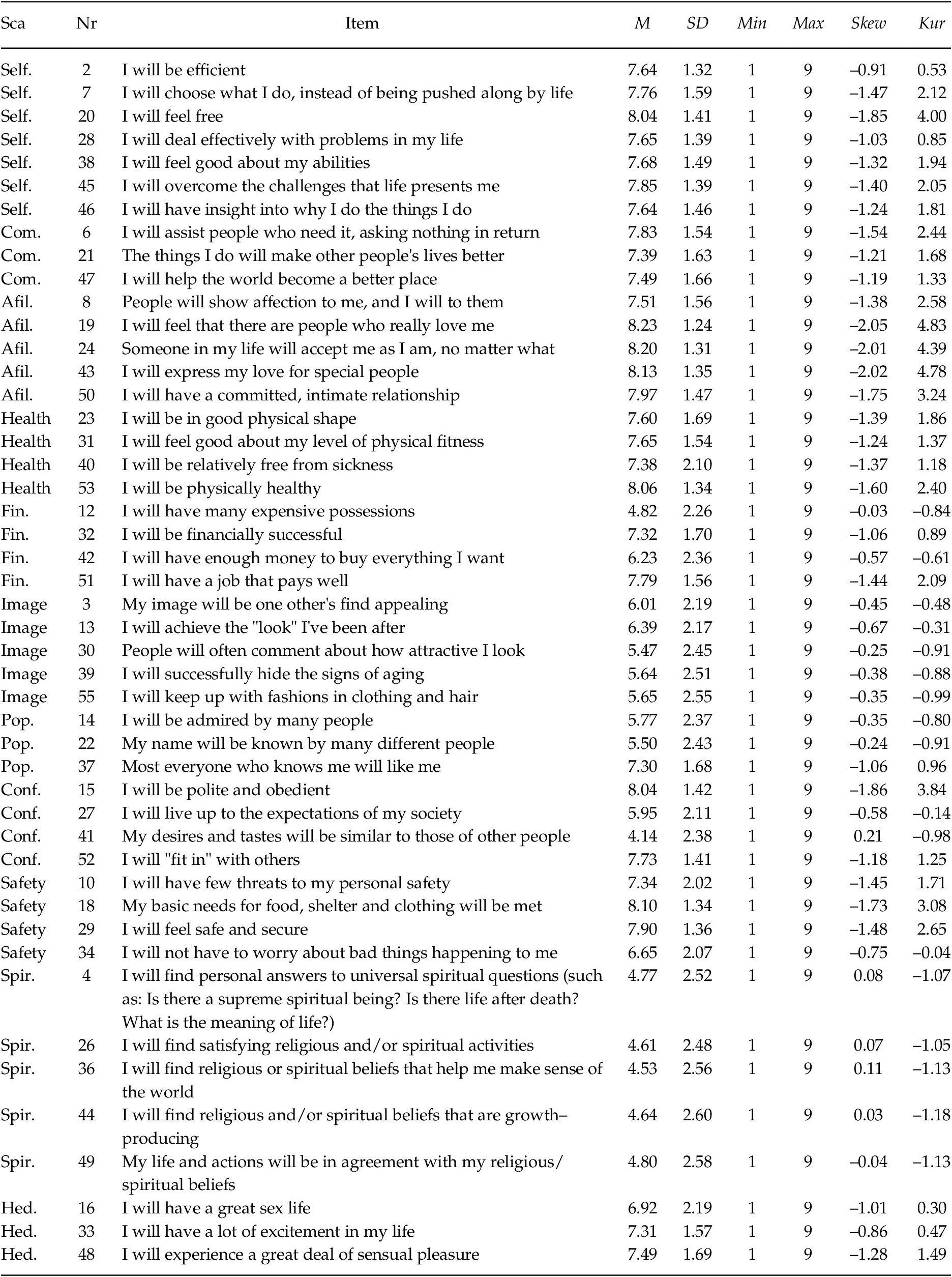
Results concerning descriptive statistics are presented for each AI item in Table 1. Severe violation of normality was not found for AI items (Curran et al., Reference Curran, Harford and Muthén1996). Thus, any item was dropped on the basis of violation of the normality assumption.
Descriptive Data of IA Items (N = 1,359)

Note. The missing items (1, 5, 9, 11, 17, 25, 35, 54, 56 and 57) were never used by the original authors of the scale. Sca = subscale in the original AI; Nr = item number in the original AI; Self = self-acceptance; Com = community feeling; Afil = affiliation; Fin = financial success; Pop = popularity; Conf = conformity; Spir = spirituality; Hed = hedonism.
Factor Analysis
Confirmatory Factor Analysis
The factorial structure was tested through confirmatory factor analysis (CFA), which was conducted to test the eleven-factor model proposed by Grouzet et al. (Reference Grouzet, Kasser, Ahuvia, Dols, Kim, Lau, Ryan, Saunders, Schmuck and Sheldon2005). Factor analyses were performed using the Mplus program (Muthén & Muthén, Reference Muthén and Muthén2010), with a weighted least squared means and variance adjusted (WLSMV) estimator that is designed for ordinal data (Flora & Curran, Reference Flora and Curran2004). The models were evaluated using the chi-square test, comparative fit index (CFI), Tucker-Lewis fit index (TLI), and root mean square error of approximation (RMSEA). We assumed the chi-square/df statistic < 5 to indicate acceptable model fit (Marôco, Reference Marôco2014); CFI and TLI values between .90 and .95 to signify acceptable model fit, and good fit above .95; and that RMSEA values less than .08 indicate acceptable model fit, and below .05 suggest good model fit (Brown, Reference Brown2015).
The resulting model did not show satisfactory fit indices for an eleven-factor solution, χ2(934) = 6,714.656; p = .000; χ2/df = 7.189; CFI = .92, TLI = .91, RMSEA = .06. Results showed high covariance between several factors, namely: popularity and financial success (.85), popularity and image (.87), conformity and self-acceptance (.91), conformity and affiliation (.90), self-acceptance and affiliation (.90), conformity and community feeling (.88), self-acceptance and community feeling (.87), affiliation and community feeling (.86), conformity and hedonism (.87), self-acceptance and hedonism (.84), affiliation and hedonism (.82), conformity and safety (.89), self-acceptance and safety (.97), affiliation and safety (.91), hedonism and safety (.85). Consequently, a second-order model was performed in accordance with past work from the self-determination theory tradition (e.g., Kasser, Reference Kasser, Deci and Ryan2002; Kasser & Ryan, Reference Kasser and Ryan1993). We listed four second-order factors. One included intrinsic aspirations. Another included extrinsic aspirations. A third factor was self-transcendent dimension that involved spirituality and a fourth factor related with a physical dimension that included hedonism (Grouzet et al., Reference Grouzet, Kasser, Ahuvia, Dols, Kim, Lau, Ryan, Saunders, Schmuck and Sheldon2005). This model also failed to reach an acceptable fit to the data χ2(976) = 14,885.676; p < .001; χ2/df = 15,251; CFI = .80, TLI = .79, RMSEA = .10. As fit indices were still not satisfactory we analyzed the data using an exploratory factor analysis.
Exploratory Factor Analysis
The total sample was randomly divided into two groups. The first sample (657 participants) was used to perform an EFA and the second (702 participants) was used to test with a CFA the validation of the AI found structure.
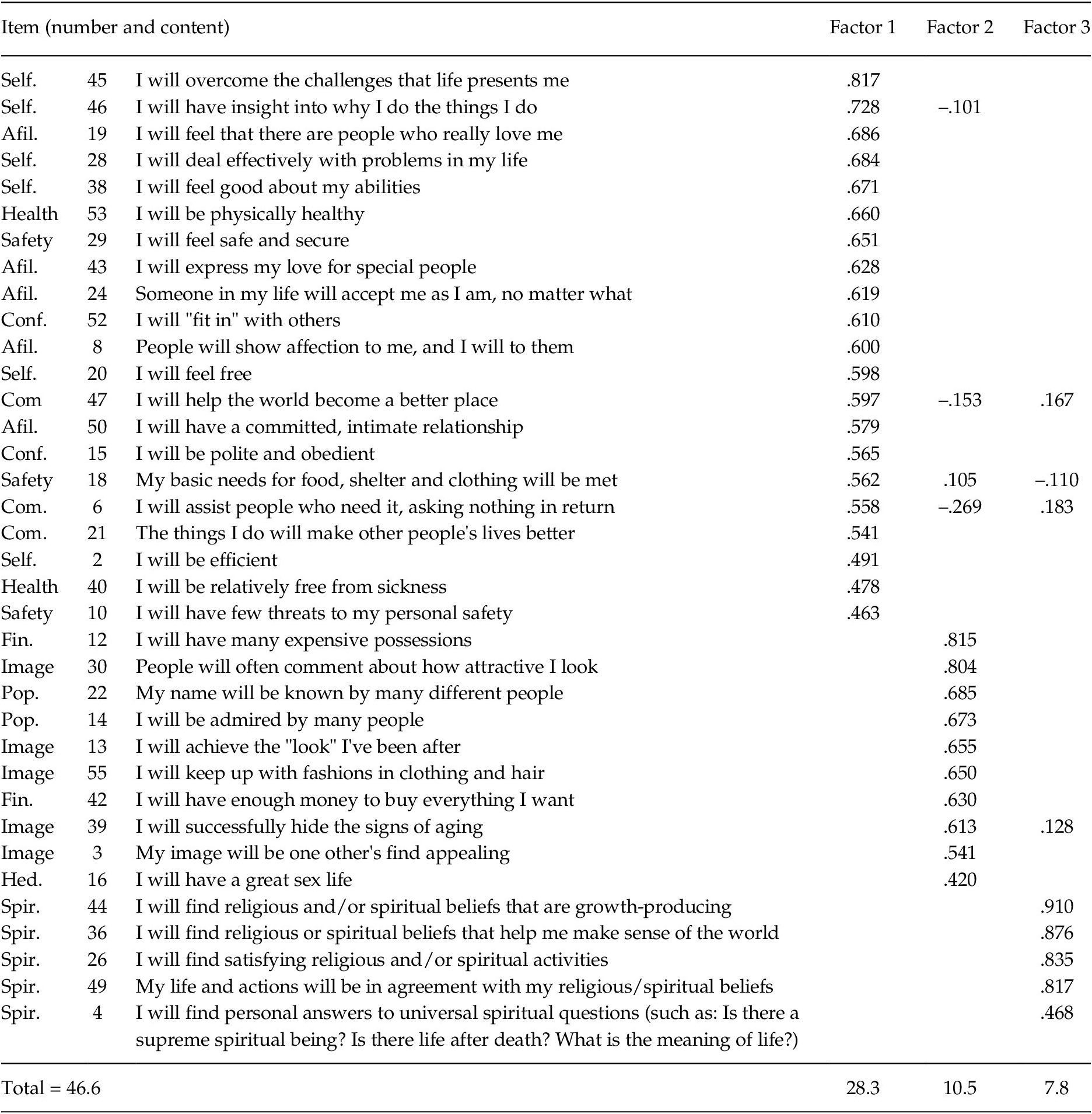
The Kaiser-Meyer-Olkin Measure of Sampling Adequacy (KMO = .95) and Bartlett’s test of Sphericity, χ2(1081) = 14,524.452; p < .001, indicated that the data were adequate for conducting an exploratory factor analysis. Both values indicated that our sample satisfies the requirement assumptions for proceeding with EFA (Hatcher, Reference Hatcher2013). We performed an exploratory factor analysis with no rotation and found 7 factors with eigenvalues greater than one. We also looked at the scree plot and used parallel analysis (Patil et al., Reference Patil, Singh, Mishra and Donavan2007), and both supported the retention of three factors. We therefore conducted an exploratory factor analysis (EFA) extracting three factors, using principal axis factoring. An oblique promax rotation (Cureton & Mulaik, Reference Cureton and Mulaik1975) was used to assess the theoretical and empirical hypothesis of correlation between AI factors. The cumulative explained variance by this three-factor solution was 46.6%. The factor loadings for a three-factor solution are presented in Table 2. Items 34, 7, 23, 48, 37, 51, 33, 31, 32, 41 and 27 were deleted after the three-factor solution, because they presented low loadings (below .40) or high cross loadings. Items included in Factor 1 correspond to the intrinsic aspirations, while items of Factor 2 and 3 correspond to the extrinsic aspirations and spirituality, respectively. However, two extrinsic aspiration items were organized on intrinsic factor. Through a semantic analysis of Item 52 (I will "fit in" with others) and of Item 15 (I will be polite and obedient) we suggest that Items 52 and 15 are better-suited to the intrinsic dimension, as suggested by Schwartz’s (Reference Schwartz and Zanna1992). According to his research results conformity was most close and has much in common with affiliation aspirations, given that conformity values are related to benevolence values.
Factor Loadings for the Three-Factor Solution

Note. Self = self-acceptance; Com = community feeling; Afil = affiliation; Fin = financial success; Pop = popularity; Conf = conformity; Spir = spirituality; Hed = hedonism.
The retained 36 items were then analyzed in a confirmatory factor analysis in the second independent sample.
Confirmatory Factor Analysis
The resulting model showed satisfactory fit indices for a three-factor solution χ2(591) = 1,957.451; p < .001; χ2/df = 3.31 CFI = .96, TLI = .95, RMSEA = .05. Results showed the following covariance between the factors: Intrinsic and extrinsic (.44), intrinsic and spirituality (.19), extrinsic and spirituality (.23).
Internal Consistency
Internal consistencies of the new subscales using Cronbach’s alpha were as follows: α = .92 for Intrinsic Aspirations (21 items), α = .87 for Extrinsic Aspirations (10 items), and α = .89 for Self-transcendent Aspirations (5 items).
Correlations between the test and retest scores on each subscale of AI were estimated using the ICC (Intraclass correlation coefficient: Two-way random effect model; absolute agreement definition) statistics. The one month test–retest reliability coefficient for the AI was .78, 95% CI [.71, .83] for intrinsic aspirations, .81, 95% CI [.75, .85] for extrinsic aspirations and .84, 95% CI [.79, .88] for spirituality, reflecting good reliability.
Validity
Predictive Validity
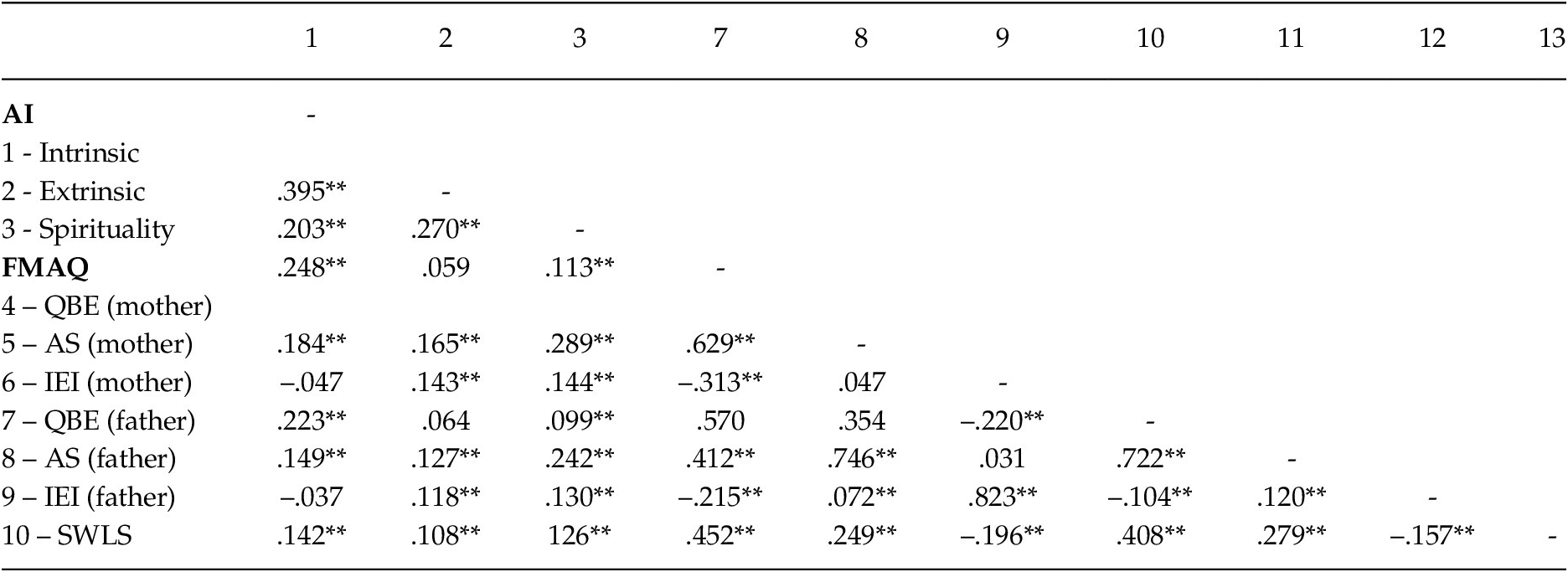
To evaluate the predictive validity of the AI we performed Pearson correlations between the AI subscales and the Satisfaction with Life Scale and FMAQ. The results showed that satisfaction with life is significant and positively correlated with all AI subscales. The results also showed significant and positive correlations between AI subscales and attachment to parents. Table 3 shows these correlations. The results show that AI does not lose predictive power.
Standardized Regression Coefficients between the Subscales of the Portuguese Aspiration Index and FMAQ and SWLS

Note. AI = Aspiration Index; FMAQ = father and mother attachment questionnaire; QBE = Quality of the emotional bond; Sa = Separation Anxiety; IEI = Inhibition of exploration and individuality; SWLS = satisfaction with life scale.
*p < .005. ** p < .001.
Invariance of the AI
We also tested if the AI was invariant for boys and girls. Equivalence of measurement for boys and girls was evaluated with multigroup analysis (IBM SPSS Amos v.24). The analyses involved three nested models corresponding to different levels of equivalence across gender: Configural invariance, metric invariance and scalar invariance. Configural invariance was found χ2(1,174) = 2,433.220; χ2/df = 2.073; CFI = .89, TLI = .88, RMSEA = .03. The CFI index is not sensitive to sample size or non-normal data. So, in these analyses Cheung and Rensvond (Reference Cheung and Rensvold2002) recommend using the difference in the comparative fit index (ΔCFI) as an index to assess invariance between nested models and the baseline model. They suggest that a ΔCFI of less than or equal to .01 indicate a similar model fit. So, comparing the unconstrained model with the measurement weights and compare the estimates of the two groups, we found that they are invariant (CFI <= .01 and RMSEA < .015). Comparisons of the metric versus scalar invariance models CFI <= .01 and RMSEA < .015, the difference in CFI was above the recommended cutoff of .01: ΔCFI = .02. We therefore follow a sequential process of freeing the intercepts of four items (Items 3, 12, 16 and 55). Having carried out these changes, we found partial scalar measurement invariance (CFI <= .01 and RMSEA < .015). Table 4 shows chi-square statistics and overall fit indices for each of the three models testing configural, metric, and scalar invariance, as well as comparative fit indices between nested models.
Fit Indexes for the Different Tested Models

Discussion
The purpose of the current study was to adapt and validate the Aspiration Index to Portuguese adolescents. In general, the results of the present study suggest that the Aspiration Index is a reliable measure to assess adolescents’ aspirations contents in the Portuguese population. The results showed that the original 11 aspirations structure does not fit the current adolescent sample. However, the new structure of the instrument suggesting that the aspirations differ in terms of whether they are intrinsically or extrinsically oriented, is consistent with results from previous research (Deci & Ryan, Reference Deci, Ryan and Ryan2012; Grouzet et al., Reference Grouzet, Kasser, Ahuvia, Dols, Kim, Lau, Ryan, Saunders, Schmuck and Sheldon2005; Kasser, Reference Kasser, Deci and Ryan2002; Kasser & Ryan, Reference Kasser and Ryan1993). The present data confirmed that the intrinsic aspirations factor includes self-acceptance, affiliation, community feeling, and physical health items as hypothesized, and are supported by previous studies (Deci & Ryan, Reference Deci, Ryan and Ryan2012; van Hiel & Vansteenkiste, Reference van Hiel and Vansteenkiste2009) safety aspiration also added here, in line with predictions derived from Maslovian theory (Maslow, Reference Maslow1954). As such, safety aspiration is much in common with intrinsic pursuits, because they are inherently rewarding and directly satisfy innate basic psychological needs had by all people (Maslow, Reference Maslow1954; see also Kasser, Reference Kasser, Deci and Ryan2002).
On the other hand, consistent with previous studies the extrinsic aspirations factor includes financial success, image, popularity and conformity (Kasser, Reference Kasser, Deci and Ryan2002). Regarding spirituality and hedonism aspirations it was expected that none could be classified as typically intrinsic or extrinsic. As such, spirituality and hedonism represented a self-transcendent and physical dimension of aspirations, respectively (Grouzet et al., Reference Grouzet, Kasser, Ahuvia, Dols, Kim, Lau, Ryan, Saunders, Schmuck and Sheldon2005). However, the results of the present study are not in accordance with previous research (Grouzet et al., Reference Grouzet, Kasser, Ahuvia, Dols, Kim, Lau, Ryan, Saunders, Schmuck and Sheldon2005), i.e, in our sample, hedonism presented a more extrinsic aspiration. Hedonism is related to the pursuit of a variety of pleasures, namely, sensual pleasure. These results suggest that for adolescents this type of aspirations could generate admiration, sense of power and self-esteem (Vansteenkiste et al., Reference Vansteenkiste, Lens and Deci2006), such as extrinsic aspirations. In this sense, in our sample the results confirmed that the Aspiration Index assesses adolescents` aspirations of three distinct aspects well organized by intrinsic, extrinsic and self-transcendent (spirituality) aspirations (Grouzet et al., Reference Grouzet, Kasser, Ahuvia, Dols, Kim, Lau, Ryan, Saunders, Schmuck and Sheldon2005).
The results also showed that the construction of aspirations and the meaning of each aspiration for adolescents are different from adults. According to developmental theories adolescence is a particular phase characterized by exploration. The initial phase of the stage begins with the adolescents’ awareness of meaning, goals and aspirations, however, as the name implies, the key behavior of this stage is exploration and the choices of young people are mostly unrealistic and do not have much meaning in the long term for them (Savickas, Reference Savickas and Brown2002). However, as they get older, adolescents tend to manifest more realistic aspirations (Croll et al., Reference Croll, Attwood and Fuller2010).
The analysis also allowed us to detect problems with some items, suggesting the removal of eleven items. Two of the four items of conformity clustered in the intrinsic factor in EFA. In the literature conformity varies with regard to their placement on the intrinsic-extrinsic dimension. Schwartz’s model suggests that conformity is associated with affiliation aspirations, in that conformity values are related to benevolence values in his research. In contrast, conformity could have much in common with extrinsic pursuits, given that conformity aspirations are concerned with obtaining external praise (Kasser, Reference Kasser, Deci and Ryan2002). Conformity is related to peoples` efforts to be framed socially, i.e., people’s attempts to fit in with others in their social environment. According to attachment theory, Bowlby (Reference Bowlby1980) postulated the universal need to establish affective bonds. During adolescence social world expands quantitatively and qualitatively and acquires particular relevance, given that fit in with others may constitute a barometer of psychological adaptation. Thus, to be socially accepted seems to be more closely with affiliation aspirations and inherently satisfying to pursue, congruent with intrinsic aspirations (see Kasser, Reference Kasser, Deci and Ryan2002). Furthermore, through a semantic analysis of item 52 (I will "fit in" with others) and of item 15 (I will be polite and obedient) we suggest that item 52 and 15 are better-suited to intrinsic dimension.
The criterion validity of the scale was considered to examine the relationship of the AI to several different, but related measures. AI scores were correlated positively with scores on measures of satisfaction with life and attachment. Thus aspirations are associated with higher likelihood of positive outcomes, such as, satisfaction with life. Similarly, aspirations have been related with basic psychological needs, i.e., given that intrinsic aspirations are closely related to fulfillness of needs for competence, relatedness and autonomy (Kasser, Reference Kasser, Deci and Ryan2002). Finally, consistent with earlier works attachment with significant figures contributes to the formulation and projection of adolescents’ life aspirations and well-being. Therefore, secure attachment helps to pursuit intrinsic and healthy aspirations (e.g., self-acceptance and personal growth, intimacy and friendship). Supportive relationships provide the foundation of the development of adolescents` aspirations and subsequent engagement in activities and maintenance of behaviors (La Guardia & Patrick, Reference La Guardia and Patrick2008). On the other hand, extrinsic aspirations are associated with more difficult and less satisfying relationships (Knee et al., Reference Knee, Hadden, Porter and Rodriguez2013; La Guardia & Patrick, Reference La Guardia and Patrick2008). These findings indicate that AI is related with satisfaction with life and attachment representations, providing additional support for the criterion validity of the AI for adolescents.
The multigroup analysis reveals that the three-factor structure of the AI is similar across gender. We found evidence of configural invariance, which indicates that boys and girls conceptualize life aspirations in the same three-dimensional structure. We also found evidence of metric invariance, which attests that the latent variable is related to the items in the same way for boys and girls. However, we did not find evidence of full scalar invariance, which indicates that item intercepts were not invariant for boys and girls. Results suggest that item intercept for Item 3, 12, 16 and 55 were not invariant. The lack of full scalar invariance has also been obtained in Grouzet et al. (Reference Grouzet, Kasser, Ahuvia, Dols, Kim, Lau, Ryan, Saunders, Schmuck and Sheldon2005) study that tested the measurement equivalence of each goal subscale across cultures. It should be emphasized that it is unlike to hold in practice full measurement invariance, however appropriate crossgroup comparisons can be made with partial measurement invariance (Milfont & Fischer, Reference Milfont and Fischer2010).
The Cronbach’s alphas of the subscales indicated that the Aspiration Index dimensions are internal consistent and reliable across one month interval. Thus, the results suggest that Portuguese version of the AI proved to be valid for evaluating aspirations of life and can be administered to adolescents.
Although our results provide some important information about adolescents` aspirations, this study is limited in some respects. The first limitation of the study concerns exclusive use of self-report instruments, which increases common method variance and is more susceptible to social desirability biases. A second limitation of the study concerns the sample, only composed by adolescents. Thus, future research with the Portuguese version should consider AI scores of various groups, ages and demographic regions and analyze the invariance across these groups. Furthermore, it would be relevant in the future to include longitudinal and other assessment methods such as interviews to infer causality and to further establish the validity of the AI.
Conflicts of Interest:
None.
Funding Statement:
This work was supported by a PhD Scholarship from the Portuguese Foundation for Science and Technology granted to the first author (SFRH/BD/101391/2014).