Acute elevation of pulmonary artery pressure after cardiopulmonary bypass after intra-cardiac repair in patients with left-to-right shunt continues to represent a source of important morbidity and mortality.Reference Lindberg, Olsson and Jogi1, Reference Bando, Turrentine and Sharp2 Different mechanisms are important for the pathogenesis of post-operative pulmonary hypertension, but the precise mechanism is not known at present and is probably multifactorial. Nitric oxide has been introduced in clinical post-operative care for severe pulmonary hypertensive patients.Reference Miller, Tang and Keech3 Intrinsic nitric oxide is produced from the L-arginine by nitric oxide synthase.Reference Palmer, Rees, Ashton and Moncada4 Two of the three major isoenzymes are known to exist in the lung: endothelial nitric oxide synthase exists in the pulmonary vascular endothelium, whereas nitric oxide synthesis by inducible nitric oxide synthase is involved when the alveolar macrophages are activated. Nitric oxide produced with the help of endothelial nitric oxide synthase mainly controls the pulmonary vascular tone.
Previous studies showed that a polymorphism of Glu298Asp of endothelial nitric oxide synthase plays an important role in the development of a number of vascular diseases associated with endothelial dysfunction. It is known that patients with high-altitude pulmonary oedema presented more often with the Glu298Asp allele.Reference Droma, Hanaoka and Ota5, Reference Ahsan, Mohd, Norboo, Baig and Qadar Pasha6 Glu298Asp polymorphism was observed in patients with arterial hypertension,Reference Lacolley, Gautier, Poirier, Pannier, Cambien and Benetos7 coronary spasm,Reference Yoshimura, Yasue, Nakayama, Shimasaki, Sumida and Sugiyama8 myocardial infarction, and coronary artery disease.Reference Shimasaki, Yasue, Yoshimura, Nakayama, Kugiyama and Ogawa9, Reference Hingorani, Liang and Fatibene10
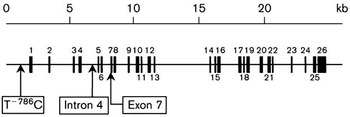
Marsden et alReference Marsden, Heng and Scherer11 identified the gene encoding endothelial nitric oxide synthase on chromosome 7q35-3 (Fig 1). Since then several endothelial nitric oxide synthase encoding deoxyribonucleic acid sections were discovered and tested on their clinical relevance concerning different diseases, including vascular diseases with endothelial dysfunction. Limited data exist as to what extent ethnic differences might contribute to the genetic distribution of the Glu298Asp polymorphism and whether this might explain for differences in Glu298Asp polymorphism observed in different disease entities.Reference Tanus-Santos, Desai and Flockhart12
Organisation of the endothelial nitric oxide synthase gene and localisation of the most important polymorphisms;Reference Marsden, Heng and Scherer11 exon 7 = Glu298Asp polymorphism; top line = scale in kilobases; second line = location of the 26 numbered exons (boxes).

This study aimed to analyse whether the endothelial nitric oxide synthase polymorphism is associated with acute elevation of pulmonary artery pressure immediately after cardiopulmonary bypass and focused on the importance of the Glu298Asp polymorphism of the endothelial nitric oxide synthase gene in the pathogenesis of post-operative pulmonary hypertension in patients with congenital cardiac disease.
Materials and methods
Study population
We enrolled all patients that underwent intra-cardiac repair for left-to-right shunt from May, 1997 to March, 2004 at our centre. Excluded were neonates and patients with cyanotic congenital cardiac disease. In addition, 136 healthy controls without cardiovascular disease were analysed. This study was approved by an institutional ethics review committee (number 232/2000) and the patients/parents gave informed consent.
Haemodynamic assessment
All patients with congenital cardiac defects were investigated with cardiac catheterisation. Pre-operative pulmonary hypertension was defined as pulmonary artery mean pressure of more than 25 millimetres of mercury.Reference Galiè, Torbicki and Barst13 The patient population was assigned to two groups depending on the presence or absence of pre-operative pulmonary hypertension.
Pulmonary and systemic blood flow and the ratio of pulmonary-to-systemic vascular resistance were calculated according to standard formula with the help of oxymetry.Reference Wilkinson14 Patients with haemodynamic findings and/or angiographic signs consistent with significant left-to-right shunt – that is, pulmonary-to-systemic blood flow at 1.5 or more, angiographic signs of pulmonary hyperperfusion – were found to be eligible candidates for intra-cardiac repair. It has been our policy to measure the pulmonary artery pressure in all patients after weaning from cardiopulmonary bypass. In all patients with an acute elevation of pulmonary artery pressure after weaning from cardiopulmonary bypass – that is, mean pulmonary artery pressure of more than 25 millimetres of mercury, a pulmonary artery pressure line was placed. Pulmonary artery pressure lines at our institution were used for the first 3 days post-operatively in these high-risk patients.
Identification of the Glu298Asp polymorphism of the endothelial nitric oxide synthase gene
The deoxyribonucleic acid was extracted and quantified from ethylenediaminetetraacetic acid blood sample photometrically (Protocol QIAamp DNA Blood Mini Kit, QIAGEN Inc, Valencia, California, United States of America). The Glu298Asp polymorphism was identified using polymerase chain reaction and restriction fragment length polymorphism. For the amplification of a 182 base-pair fragment, which includes the suspect segment of the missense mutation, Glu298Asp, the following polymerase chain reaction primers were used.Reference Shoji, Tsutaya, Saito, Takamatu and Yasujima15
Primers:
Endothelial nitric oxide synthase h for: 5′-CCC CAC AG TCT GCA TTC AG-3′
Endothelial nitric oxide synthase h rev: 5′-TCC ATC CCA CCC AGT CAA TC-3′
The polymerase chain reaction contained 25 microlitres – 1.6 milligrams per litre DNA; 0.4 micromole per litre of each primer; 1.6 millimole per litre dNTP; 6.4 millimole per litre Taq polymerase (1 unit).
The polymerase chain reaction was performed according to the following protocol on (Genes Amp PCR System Thermat Cycler; Bio-Rad Laboratories, Philadelphia, Pennsylvania, United States of America):
• Initial denaturation: 94°C for 1 minute.
• Denaturation: 95°C for 2 minutes.
• Annealing: 62°C for 1 minute.
• Extension: 72°C for 2 minutes.
• Cycle (30×).
• Final extension: 72°C for 5 minutes.
• Cooling at 4°C.
To perform restriction fragment length polymorphism the restriction enzymes, Mbo I and Eco24I (=BanII) were used.Reference Miyamoto, Saito and Kajiyama16 Eco 24I cuts only in the presence of guanine in nucleotide place 894 producing two fragments with sizes 94 and 88 base pairs. In the presence of thymine at that position, MboI restrictase generates two products with sizes of 99 and 83 base pairs.Reference Droma, Hanaoka and Ota5
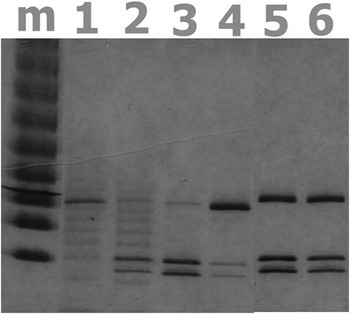
The restriction fragment length polymorphism products were separated using electrophoresis on 4% agarose gel (Neeo, Fa. Roth, Carl Roth GmbH, Karlsruhe, Germany) with a tension of 100 volt and an amperage of 400 milliampere (Fig 2).
Glu298Asp polymorphism on Gel by using polymerase chain reaction and restriction fragment length polymorphism with Eco 24I; m = DNA marker: 1, 4 = homozygous Asp298Asp; 2, 3 = homozygous Glu298Glu; 5, 6 = heterozygous Glu298Asp.

Statistical analysis
Descriptive statistics were analysed with SigmaStat version 3.0 (SPSS Inc. Chicago, Illinois, United States of America). Clinical data are given as median and range. The genotype and allele frequency are indicated in percentage. Genotype distribution was tested with chi-square test for deviation from the Hardy–Weinberg equilibrium.Reference Sasieni17 Differences in clinical and haemodynamic findings in patients with and without an acute elevation of pulmonary artery pressure immediately after cardiopulmonary bypass were analysed using the t-test.
The primary analyses compared genotypes using the Armitage trend test, which tests the null hypothesis: p2 + 1/2(p1) = q2 + 1/2(q1), where p1 and q1 are a heterozygous case and control patients, respectively, and p2 and q2 are rare homozygous case and control patients, respectively. The test, which is distributed as chi-square with one degree of freedom, retains the power of an allelic association, but remains valid in the presence of deviations from the Hardy–Weinberg equilibrium. We considered an uncorrected two-sided p less than 0.05 to be nominally significant. Secondary exploratory analyses of genotypic association were conducted under additive, dominant, and recessive models using chi-square or Fisher’s exact tests. Tests of association and the Hardy–Weinberg equilibrium were conducted using the DeFinetti program.Reference Storm and Wienker18
The predictive values for the association between the endothelial nitric oxide synthase polymorphism and acute post-operative pulmonary hypertension was calculated as described.Reference Sackett, Richardson, Rosenberg and Haynes19 Differences were considered statistically significant at p 0.05 or less.
Results
Clinical data
The study group included 80 patients, 41 male and 39 female patients, at the median age of 3.8 years, ranged 0.1–36.2 years, with congenital cardiac diseases – Atrial septal defects: 22 patients; ventricular septal defects: 35 patients including five children with Down syndrome; atrioventricular septal defects: 16 patients including 12 children with Down syndrome; aorto-pulmonary window: one patient; persistent ductus arteriosus: six patients including one child with Down syndrome.
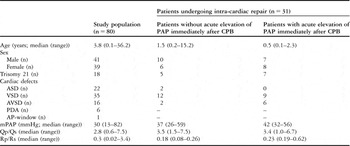
In all, 31out of these 80 patients with left-to-right shunt underwent intra-cardiac repair according to the given criteria for selection of operability – presence of increased pulmonary blood flow, pulmonary hypertension associated with high pulmonary blood flow, and absence of signs for irreversible pulmonary vascular disease such as right-to-left-shunt on pulmonary angiography. One patient presented with an unusual high ratio of pulmonary-to-systemic vascular resistance; however, as this patient did not present as an Eisenmenger patient clinically, we took the exemption from current recommendations and performed intra-cardiac repair successfully.Reference Lopes, Rabinovitch and Chang41 In the remaining patients, intra-cardiac repair was either not necessary, for example, those that underwent device closure of atrial septal defect, or it was not feasible, for example, in Eisenmenger’s patients. In all patients with post-operative pulmonary hypertension after weaning from cardiopulmonary bypass, that is, with mean pulmonary artery pressure more than 25 millimetres of mercury, the pulmonary artery pressure was monitored continuously (pulmonary artery pressure line) thereafter for 3 days. Fifteen out of these 31 patients – seven male and eight female patients – at a median age of 0.5 years, ranged 0.1–2.3 years, with ventricular septal defects (nine patients) and atrioventricular septal defects (six patients) presented with acute pulmonary hypertension after cardiopulmonary bypass and these patients received continuous recording of pulmonary artery pressure post-operatively in the intensive care unit. The remaining 16 patients who underwent intra-cardiac repair for atrial septal defect (two patients), ventricular septal defect (12 patients), and atrioventricular septal defects (two patients) did not show post-operative pulmonary hypertension immediately after weaning from cardiopulmonary bypass and therefore were not monitored with pulmonary artery pressure lines. They did not differ with respect to age (p = 0.316), pre-operative pulmonary artery pressure (p = 0.102), pulmonary-to-systemic blood flow (p = 0.864), pulmonary vascular resistance (p = 0.195), and pulmonary-to-systemic vascular resistance (p = 0.529) from patients that showed acute pulmonary hypertension after intra-cardiac repair (t-test). In most patients with pulmonary hypertension, the maximum peak of pulmonary hypertension pressure was observed at 24 hours after weaning from cardiopulmonary bypass. Mean pulmonary artery pressure as measured at 24 hours after weaning from cardiopulmonary bypass was 39 millimetres of mercury, with a range form 26–48 millimetres of mercury. It was our policy to administer inhaled nitric oxide only in patients presenting with pulmonary artery pressure-to-systemic pressure ratio exceeding two of three of systemic pressure. This was the case in two of our patients. The clinical and demographic data are given in Table 1.
Clinical and demographic data.

AP-window = aortopulmonary window; ASD = atrial septal defect; AVSD = atrioventricular septal defect; CPB = cardiopulmonary bypass; mPAP = mean pulmonary artery pressure; PDA = patent ductus arteriosus; PH = pulmonary hypertension; Qp/Qs = ratio of pulmonary-to-systemic blood flow; Rp/Rs = ratio of pulmonary-to-systemic vascular resistance; VSD = ventricular septal defect
Verification of the Hardy–Weinberg equilibrium
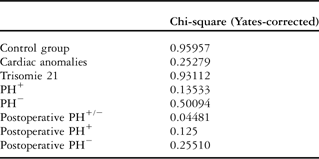
The distribution of the genotypes was examined and it was analysed whether it would correspond to the Hardy–Weinberg equilibrium (Table 2). Both in the control and patient groups the genotype distribution corresponded to the Hardy–Weinberg equilibrium (chi-square = 0.96 and 0.25). Null hypothesis: distribution in the population corresponds to the Hardy–Weinberg equilibrium (to reject whether chi-square is more than 3.84; chi-square goodness-of-fit test). In addition, all other groups corresponded to the Hardy–Weinberg equilibrium. Yates-corrected chi-square test was used because of a small number of patients in some groups.
Testing for Hardy–Weinberg equilibrium.

PH = pulmonary hypertension
Glu298Asp polymorphism of the endothelial nitric oxide synthase genes in the control and the patient groups
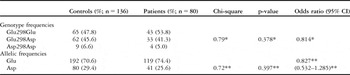
The Glu298Asp polymorphism of the endothelial nitric oxide synthase gene in the control and patient groups and allele distribution in both groups are presented in Table 3.
Distribution of the Glu298Asp polymorphism of the eNOS gene.

eNOS = endothelial nitric oxide synthase
*Armitage’s trend test
**Pearson’s goodness-of-fit chi-square (degree of freedom = 1)
The gene frequency for Glu298Glu, Glu298Asp, and Asp298Asp was in the control group 47.8%, 45.6%, and 6.6% compared with 53.8%, 41.3%, and 5.0% in the patient group. By comparison, no significant difference was found with regard to the gene frequencies for both groups (chi-square = 0.79, degree of freedom = 1, p = 0.37; Armitage trend test).
The allele frequencies in the control group for Glu and Asp were 70.6% and 29.4% respectively; and in the group of patients 74.4% and 25.6%. There was no significant difference in the allele frequencies (chi-square = 0.72, degree of freedom = 1, p = 0.397).
Glu298Asp polymorphism of the endothelial nitric oxide synthase genes in terms of pulmonary hypertension in children with congenital cardiac diseases and left-to-right shunt
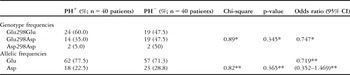
The genotypic and allelic frequencies in children with left-to-right shunt with and without pulmonary hypertension are shown in Table 4. Neither the genotype distribution nor the distribution of the allele frequencies showed a significant difference in the two groups – genotype frequencies: chi-square = 0.89, degree of freedom = 1, p = 0.345; allele frequencies: chi-square = 0.82, degree of freedom = 1, p = 0.365). In addition, there was no correlation between endothelial nitric oxide synthase genotype and pulmonary vascular resistance in both groups.
Pulmonary hypertension and distribution of the Glu298Asp polymorphism of eNOS gene.

eNOS = endothelial nitric oxide synthase
*Armitage’s trend test
**Pearson’s goodness-of-fit chi-square (degree of freedom = 1)
Glu298Asp polymorphism of the endothelial nitric oxide synthase genes in children with and without acute elevation of pulmonary artery pressure after intra-cardiac operations
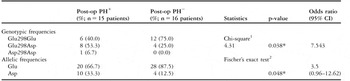
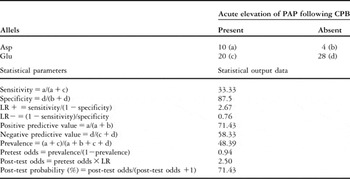
The genotype and allele frequencies of the Glu298Asp polymorphism of the endothelial nitric oxide synthase gene in children with and without acute elevation of pulmonary artery pressure are presented in Table 5. The genotype frequencies for Glu298Glu, Glu298Asp, and Asp298Asp in the group with acute elevation of pulmonary artery pressure were 40.0%, 53.3%, and 6.7%, compared with 75.0%, 25.0%, and 0% in the group without acute elevation of pulmonary artery pressure. The potential association between acute elevation of pulmonary artery pressure after cardiopulmonary bypass and the presence of Glu298Asp allele were examined with the Armitage trend test. The test showed a significant correlation (chi-square = 4.31, p = 0.038) with a probability of error of less than 0.05. The allele frequencies for Glu and for Asp were in the group with and without acute elevation of pulmonary artery pressure immediately after cardiopulmonary bypass as follows: Glu: 66.7% with acute elevation of pulmonary artery pressure versus 87.5% without; Asp: 33.3% with acute elevation of pulmonary artery pressure versus 12.5% without. In addition, a significant difference in the allele frequencies for the two groups was determined with the Fischer’s exact test (p = 0.048, one-sided). The positive predictive value, that is, the proportion of patients with positive test results who are correctly diagnosed, of the occurrence of the Asp allele for developing acute elevation of pulmonary artery pressure immediately after cardiopulmonary bypass in children with congenital cardiac diseases with left–right shunt was calculated as 71.43%. The negative predictive value was calculated as 58.33% (Table 6).
Acute elevation of PAP immediately after CPB and Glu298Asp polymorphism of eNOS gene.

CPB = cardiopulmonary bypass; eNOS = endothelial nitric oxide synthase; PAP = pulmonary artery pressure
1Armitage’s trend test
2One-sided Fisher’s exact test due to small number of patients
*p < 0.05
Predictive values for eNOS gene polymorphism (Glu298Asp) and acute elevation of PAP immediately after CPB.

CPB = cardiopulmonary bypass; eNOS = endothelial nitric oxide synthase; LR = likelihood ratio; PAP = pulmonary artery pressure
By reviewing our clinical data we could not detect any difference with respect to the occurrence of pulmonary hypertensive crises or other problems in post-operative management between the two groups.
Discussion
This study was designed as a pilot study. To the best of our knowledge, this showed for the first time that acute elevation of pulmonary artery pressure immediately after cardiopulmonary bypass after intra-cardiac repair is associated with the Glu298Asp polymorphism of the endothelial nitric oxide synthase gene in children with surgically corrected left-to-right shunt. As we did not measure pulmonary artery pressure in all children, but only in those children believed to be at risk for post-operative pulmonary hypertension, we cannot exclude the possibility that some children with transient increases in pulmonary artery pressure may have been missed. However, we can rule out clinically relevant pulmonary hypertension in these patients. Others studying the incidence of post-operative pulmonary hypertension crises have faced the same problem.Reference Lindberg, Olsson and Jogi1 It is by this finding that our data are relevant only for one subgroup of patients, that is, those that present with increased pulmonary artery pressure immediately after weaning from cardiopulmonary bypass and continue to have high pulmonary artery pressure thereafter. At present, we can conclude that endothelial nitric oxide synthase polymorphism likely contributes to this elevation. As a hypothesis, endothelial nitric oxide synthase polymorphism may increase the likelihood for increased pulmonary artery pressure after cardiopulmonary bypass and – on top of that – other factors may be of equal importance in the pathogenesis. Our pilot study proposes to study these and other genetic and non-genetic factors in future by enrolling more patients presenting with congenital cardiac disease and left-to-right shunt undergoing intra-cardiac repair.
Functional impacts of the Glu298Asp polymorphism
The functional importance of the Glu298Asp polymorphism remains to be elucidated. Godfrey et alReference Godfrey, Chan and Cassidy20 showed that endothelium-dependent vasodilatation was decreased in healthy volunteers, who were homozygous for aspartate in comparison with the Glu298Glu carriers. This finding supports the assumption that the endothelial dysfunction is modulated by genetic factors. Intracellular cleavage mechanisms are unlikely to account for the associations between the exon 7 polymorphism and cardiovascular diseases and further in vitro studies did not find evidence for the disturbed enzyme activity of the Glu298Asp endothelial nitric oxide synthase.Reference Tesauro, Thompson, Rogliani, Qi, Chaudhary and Moss21–Reference McDonald, Alp and Channon24
Associated diseases
Different endothelial nitric oxide synthase polymorphisms were examined for their association with different vascular diseases. Several studies reported a positive association between the Glu298Asp polymorphism and myocardial infarction, whereas others were unable to find a correlation with coronary artery disease.Reference Hibi, Ishigami and Tamura25–Reference Poirier, Mao and Mallet30 Yoshimura et alReference Yoshimura, Yasue and Nakayama31 showed that the Glu298Asp polymorphism was related to coronary spasm. The association of systemic arterial hypertension with the Glu298Asp polymorphism is unsettled.Reference Miyamoto, Saito and Kajiyama16, Reference Lacolley, Gautier and Poirier32–Reference Kato, Sugiyama and Morita34
One reason for the contradictory results in previous studies addressing the nitric oxide polymorphism in different disease entities known to be associated with endothelial dysfunction may be found in differences in the ethnic distribution of the study population. Tanus-Santos et alReference Tanus-Santos, Desai and Flockhart12 searched for the reason of this phenomenon and examined the ethnic distribution of endothelial nitric oxide synthase gene polymorphism. They showed that the genotype and allele distribution among Asians, Afro-Americans, and Caucasians differed considerably. The Asp298 variant was significantly more frequently present in the Caucasian population than in the Afro-Americans and the Asians.Reference Tanus-Santos, Desai and Flockhart12 The aspartate allele frequency in our control group corresponds well with that observed by Tanus-Santos et alReference Tanus-Santos, Desai and Flockhart12 for the Caucasian population and our study group did not differ with respect to ethnic distribution.
In patients with erectile dysfunction, the Glu298Asp polymorphism of endothelial nitric oxide synthase has been identified as an independent risk factor for erectile dysfunction.Reference Lee, Huang and Wang35, Reference Rosas-Vargas, Coral-Vazquez and Tapia36 Moreover, the response to sildenafil in patients with erectile dysfunction is lower in those patients with the Glu298Asp polymorphism, when there were cardiovascular co-morbidities.Reference Eisenhardt, Sperling and Hauck37 Therefore, it might be worth studying the relationship of Glu298Asp polymorphism of endothelial nitric oxide synthase to sildenafil response in patients with acute post-operative pulmonary hypertension after intra-cardiac repair. High-altitude pulmonary oedema has been associated with polymorphisms of the endothelial nitric oxide synthase gene and our data in patients with left-to-right shunt and pulmonary hypertension concur with that finding.Reference Droma, Hanaoka and Ota5
Experimental data have shown that pathologically high flow attenuates endothelial release of nitric oxide and prostaglandin F1α, whereas the release of endothelin-1 is enhanced.Reference Li, Stenmark, Shandas and Tan38 This is associated with decreased nitric oxide signalling,Reference Sud, Sharma and Wiseman39 increased oxidative stress, and loss of mitochondrial function. L-arginine metabolism is altered and may play a role in the development of the endothelial dysfunction, which has been associated with pulmonary hypertension in the left-to-right shunt.Reference Sharma, Kumar and Sud40 The endothelial nitric oxide synthase polymorphism might interact with these critical changes in L-arginine–nitric oxide metabolism.
Limitations
One limitation of our study is the small number of children developing post-operative pulmonary hypertension, but the number was sufficient to allow for a proper statistical analysis. Patients who initially show low pulmonary artery pressure after intra-cardiac repair could subsequently develop pulmonary hypertension later in the post-operative course. This would not be detected because no pulmonary artery pressure lines were placed in these patients. Therefore, our data analyse the role of endothelial nitric oxide synthase Glu298Asp polymorphisms in the high-risk patients versus a group of patients not at risk for relevant pulmonary hypertension.
In addition, repetitive measurement of pulmonary vascular resistance – calculated after measuring pulmonary artery pressure, left atrial pressure, and cardiac output with thermodilution catheters – was not used as a standard procedure in this series. Another limitation is the possibility of the presence of another locus that could be causative. The mutation in exon 7 (Glu298Asp) would then rather be associated with genetic disequilibrium. However, our study shows that the mutation in Glu298Asp might potentially be used as a marker for post-operative pulmonary hypertension, which deserves further study.
Summary
We examined the correlation between the Glu298Asp polymorphism of the gene endothelial nitric oxide synthase and pulmonary hypertension in children with congenital cardiac diseases. Aspartate carriers are more likely to develop acute post-operative pulmonary hypertension after intra-cardiac repair. The Glu298Asp polymorphism of the endothelial nitric oxide synthase gene could be used as genetic marker for predisposition for the development of acute elevation of pulmonary artery pressure immediately after cardiopulmonary bypass.
Acknowledgement
This study was supported by a grant of the German Heart Foundation to Matthias Gorenflo (F 02/02).