INTRODUCTION
Sea urchins are the most charismatic and well known organisms of the phylum Echinodermata. Puerto Rico currently accounts for 15 species of shallow water echinoids (Benavides-Serrato, Reference Benavides-Serrato2006). The genus Cassidulus is an ancient group with species recorded since the upper Eocene while having a circumtropical distribution restricted to shallow waters (Mortensen, Reference Mortensen1948; Kier, Reference Kier1962). The irregular sea urchin Cassidulus caribaearum has been reported in Belize, the US Virgin Islands (excluding St Croix), San Marteen, Panama (Kier, Reference Kier1975; Gladfelter, Reference Gladfelter1978), the Mexican and the Costa Rican Caribbean (Bravo-Tzompantzi et al., Reference Bravo-Tzompantzi, Solís-Marín, Laguarda-Figueras, Abreu-Pérez and Durán-González1999; Laguarda-Figueras et al., Reference Laguarda-Figueras, Solís-Marín, Durán-González, Ahearn, Buitrón-Sánchez and Torres-Vega2005; Alvarado et al., Reference Alvarado, Solís-Marín and Ahearn2008; Alvarado & Cortés, Reference Alvarado, Cortés, Wehrtmann and Cortés2009). The species is encountered at depths ranging from 0.5 to 197 m and it aggregates at densities up to 100 ind./m2 while burying in coarse sand (Gladfelter, Reference Gladfelter1978; Bravo-Tzompantzi et al., Reference Bravo-Tzompantzi, Solís-Marín, Laguarda-Figueras, Abreu-Pérez and Durán-González1999). This new report increases the number of shallow water echinoids identified in Puerto Rican waters to sixteen species.
SYSTEMATICS
MATERIAL EXAMINED
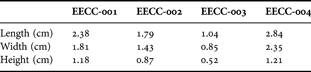
The species was encountered at two localities of the Puerto Rican Archipelago including Playa Los Tubos in the municipality of Manatí (18°28′17.93″N and 66°26′59.35″W) on the north coast at a depth of 3 m and the Luis Peña Key (18°18′42.88″N and 65°19′57.34″W) in the municipality of the Culebra Island at a depth of 2 m. The data are consistent with its previously recorded range. Both localities are characterized by fine calcareous sand in concurrence with its natural habitat. Two organisms and two endoskeletons were collected in October 2011. All specimens were preserved in alcohol at 90% and deposited in the collection of the Zoology Museum of the University of Puerto Rico, Río Piedras Campus under the following codes: EECC-001, EECC-002, EECC-003 and EECC-004. Measurements are available in Table 1.
Measurements of the four individuals collected of Cassidulus caribaearum. Caliper error +/− 0.05 cm.

All specimens tested have white coloration and are shaped oval. Their dorsal side holds five ambulacral petals (pentagonal) equal in length and four gonopores. The periproct is supramarginal and located close to the posterior edge. The ventral side is flat and presents the peristome. Yet, one individual possesses an additional small circular hole close to the peristomal region, probably related to drilling predation. In previous research, similar holes have been detected in irregular echinoids related to predation (Nebelsick & Kowalewski, Reference Nebelsick and Kowalewski1999). On the other hand, the skeleton of individual EECC-001 appears laterally compressed. This kind of test abnormality has been reported before for many regular and irregular sea urchin species (Jangoux, Reference Jangoux1987).