In the bare uplands of inner Anatolia, the struggle for hegemonic status between different strands of Christianity in the third and fourth centuries a.d. can be mapped with a precision possible in no other part of the Mediterranean world. In recent years, we have learned to see ‘orthodoxy’ and ‘heresy’ in Late Antiquity as categories constructed within polemic disputes; the unparalleled richness of the late antique epigraphical evidence from Phrygia, Galatia and Lycaonia allows us to catch glimpses of the early Christian ‘heretical’ communities of the region as they saw themselves, rather than through the totalizing and distorting lens of heresiological writing.Footnote 1 Recent studies have shown how profoundly a close reading of the documentary and archaeological evidence can transform our understanding of, for example, Phrygian Montanism.Footnote 2 Yet very little work has been done on the character of other non-orthodox Christian communities in inland Asia Minor in the third and fourth centuries a.d.
The aim of this paper is to assemble and interpret the evidence for the ascetic movements which flourished in the late Roman province of Lycaonia in the latter half of the fourth century a.d. Contemporary orthodox writers classified Lycaonian asceticism under various headings (‘Encratites’, ‘Apostolics’, ‘Apotactites’, and so on); four of these categories, Enkratitai, Apotaktitai, Sakkophoroi, and Hydroparastatai, were eventually canonized by anti-heretical imperial legislation of the early 380s a.d. There is, of course, no a priori reason to suppose that this polemical taxonomy accurately reflects the ways in which members of these groups thought about themselves. Just as there is no such thing as a self-defined ‘Wahhabi’ movement within Islam, so we need not necessarily subscribe to the notion of a clear self-defined ‘Encratite’ sect within Anatolian Christianity. I shall focus in particular on a remarkable and under-exploited text, the polemical treatise Against False Asceticism of Amphilochius of Iconium, expressly directed against the beliefs and practices of the ‘Encratites’ and ‘Apotactites’ of rural Lycaonia.Footnote 3 What gives this text its peculiar interest and importance within the corpus of heresiological literature is its specificity in place and time: it represents a highly focused intervention by an orthodox bishop struggling to maintain ecclesiastical hegemony over the diocese of Lycaonia in the mid- to late 370s a.d. We are fortunate to be able to set this text against a relatively large corpus of Greek inscriptions (three of which are published here for the first time) produced by the various ascetic communities of fourth-century Lycaonia. As we shall see, the gap between representation and reality was wide.
I BASIL AND AMPHILOCHIUS
The ancient city of Iconium, modern Konya, was situated on the fringe of the inner Anatolian plateau, in the northern foothills of the Taurus mountains. Its dependent territory comprised the whole of the modern Konya plain, stretching east as far as the shallow Boz Dağ mountain range.Footnote 4 In the first three centuries a.d., Iconium had lain within the vast Roman province of Galatia, before being transferred to the new Diocletianic province of Pisidia at the end of the third century. In the early 370s, a new province of Lycaonia, with Iconium as its metropolis, was carved out from the Diocletianic provinces of Pisidia, Isauria and Galatia. The earliest reference to the new province comes in a letter of a.d. 373 from Basil of Caesarea to Eusebius of Samosata:
Iconium is a city of Pisidia, formerly the first city of the region after the greatest (i.e. Pisidian Antioch); today she is herself the chief city of a new administrative division, which has been pulled together from various strips of territory and has been granted the administration of its own province. The city now invites me to visit, in the hope that I might provide them with a bishop, for Faustinus has died.Footnote 5
Basil goes on to express some scruples over whether or not it was appropriate for him to interfere in ecclesiastical appointments outside the province of Cappadocia. In fact, it appears that Faustinus of Iconium had already consulted Basil on putative successors the previous year.Footnote 6 In the event, the man who took up the post early in a.d. 374 was a young protegé of Basil, Amphilochius the Younger, a Cappadocian ascetic then in his early thirties.
The early life of Amphilochius is relatively well known, thanks primarily to the writings of his older cousin Gregory of Nazianzus.Footnote 7 Born around a.d. 340, Amphilochius was the elder of the two sons of Amphilochius the Elder, a native of Diokaisareia in Cappadocia and a successful advocate and teacher.Footnote 8 In a.d. 361, Amphilochius and his younger brother Euphemius travelled to Antioch to study with Libanius, an old friend and fellow-student of their father.Footnote 9 Euphemius died in the mid-360s at the age of twenty, as we learn from several funerary epigrams composed by Gregory in his honour.Footnote 10 In the late 360s, Amphilochius seems to have spent some years as an advocate in Constantinople, where he became involved in a financial scandal of some kind, known to us through the letters which Gregory sent to various imperial magistrates on his behalf.Footnote 11 Around a.d. 370, Amphilochius returned to Cappadocia to look after his aging father. For three years, he lived an ascetic existence on his father's estate at Ozizala near Diokaisareia; it was probably during this period that he first came in touch with Basil of Caesarea.Footnote 12
As we have seen, it may well have been through Basil's influence that Amphilochius was offered the see of Iconium in a.d. 374. The post was, to say the least, a challenging one, and it took the combined efforts of Gregory and Basil to overcome the reluctance of both Amphilochius and his father.Footnote 13 The ecclesiastical organization of the Lycaonian diocese appears to have been in a chaotic state. As in the neighbouring region of Phrygia to the north-west, the spread of Christianity in Lycaonia had been early and undirected; the autonomous development of local communities of belief had effectively left the orthodox church as a minority sect in many rural parts of the province. Soon after Amphilochius’ arrival at Iconium, Basil wrote him a lengthy letter suggesting various ways to ensure that vacant ecclesiastical positions at Isaura and in the surrounding countryside could be assigned to sound orthodox clergy.Footnote 14 Dissident clergy seem also to have been causing problems in the mountainous regions of eastern Pisidia.Footnote 15 In summer a.d. 375, Basil himself visited Lycaonia to assist Amphilochius with the continuing difficulties in the Isaurian churches.Footnote 16
Exactly what kinds of ecclesiastical non-conformism was Amphilochius faced with in rural Lycaonia? The earliest evidence comes from the first two of Basil's three ‘canonical’ epistles to Amphilochius, which probably date to early a.d. 375 and summer 375 respectively, the second year of Amphilochius’ episcopate.Footnote 17 The epistles take the form of a series of replies to doctrinal enquiries by Amphilochius, most of which have evidently arisen directly out of practical problems in his diocese. The very first canon begins with a lengthy discussion of whether or not the orthodox church ought to recognize the baptism of various heretical and schismatic groups (katharoi or Novatians, Pepouzenoi or Montanists, and ‘encratites’). In fact it rapidly emerges that the principal focus of Basil's discussion — and hence, I presume, Amphilochius’ original appeal — is the status of ‘encratite’ baptism in particular. Since the province of Lycaonia formed part of the diocese of Asia, Amphilochius was bound to abide by the decisions of the synod of Laodicea, which had distinguished between repentant Montanists, who, as heretics, required re-baptism, and repentant Novatians, who, as schismatics, were not re-baptised but merely anointed.Footnote 18 The question at hand was whether repentant ‘encratites’ — who, we infer, were one of the chief non-orthodox groups with whom Amphilochius had dealings — ought to be treated as schismatics or heretics: should their baptism be accepted, like the Novatians, or ought Amphilochius to demand re-baptism, as for the Montanists?
Basil begins by remarking, not entirely helpfully, that the decisions of the Laodicean synod are in themselves questionable, since ‘the Ancients’, namely Cyprian and Firmilian of Caesarea, had considered re-baptism necessary even for schismatics such as the katharoi, the ‘encratites’ and the hydroparastatai. However, as Basil concedes, Amphilochius is bound by the decisions of the Laodicean synod, and hence has no choice but to admit repentant Novatians without re-baptism. As for the ‘encratites’, Basil takes the view that re-baptism would be highly desirable, not merely because ‘nothing has been clearly established concerning them’ (i.e. there is no explicit canonical authority as to their status), but because of their underhand behaviour over baptism in general. ‘We must be aware of the wickedness of the Encratites, who, in order to make their re-admission to the Church impossible, have tried to forestall this with their own particular mode of baptism, whereby they have breached even their own customary usage.’Footnote 19 By employing a form of baptism which was superficially identical to orthodox baptism — Basil himself admits at Ep. 199 §47 that they baptised in the name of the Father, the Son and the Holy Ghost — the ‘encratites’ were, according to Basil, maliciously trying to ensure that even apostates from their sect could not be genuinely received into the orthodox church, since orthodox bishops would not feel the need to re-baptise them. In Basil's view, the fact that the ‘encratites’ accepted orthodox baptism ought not to influence the orthodox church's position on the matter: it is certainly not incumbent on Amphilochius to return the favour. The weakness of Basil's argument here is very striking: it is evident from this passage that ‘encratite’ baptism was effectively indistinguishable from orthodox baptism, and so Basil is reduced to criticizing the ascetics for their very compatibility with orthodox practice!Footnote 20 Basil concludes, with some reluctance, that demanding re-baptism would be contrary to the logic of indulgence demanded by the Laodicean synod, and hence Amphilochius ought to ‘resort to customary practice’, and thus (as the reader is left to infer) not insist on re-baptism.
By the time of his second canonical epistle, later in a.d. 375, Basil's attitude towards the Lycaonian ascetics had hardened. The ‘Encratites’, ‘Sakkophoroi’ and ‘Apotactites’ are now unambiguously stigmatized as heretical, and specifically as offshoots of the Marcionite heresy, in that they abominate marriage, reject wine, and claim that God's creation is polluted. In considering God to be a creator of evils, they are repeating the dualist teachings of Marcion.Footnote 21 Accordingly, Basil now firmly takes the view that indulgence towards ‘encratite’ baptism would be unacceptable, since their understanding of the divine persons is so perverted that their ‘correct’ use of the Trinitarian formula is irrelevant: ‘Let them not say “We have been baptised into the Father, the Son and the Holy Ghost”, since they regard God as the creator of evils, just as Marcion and other heresies do.’
As we shall see, the alleged connection with Marcion has a superficial plausibility, given the views held by the Lycaonian ascetics on marriage. However, it is striking that the accusation of dualism (God as ‘creator of evils’) does not appear at all in Amphilochius’ more detailed assault on ‘encratite’ and ‘apotactite’ practices in Against False Asceticism (see further below).Footnote 22 Nor does Amphilochius make any mention of Marcion in his account of the origins of the Lycaonian ascetic sects, instead tracing their origins to Gemellus, the disciple of Simon the Magus in the apocryphal Acts of Peter. As is now widely recognized, spurious heretical genealogies represent a characteristic rhetorical strategy within heresiological polemic, with two distinct objects. First, genealogical discourse serves to collapse a constellation of different religious groups into a single coherent and self-contained ‘heretical’ tradition, which was by definition entirely separate from a supposed unitary ‘orthodox’ tradition. Second, by assimilating a given religious group to Marcion, Tatian, Valentinus or some such, it became easier to attribute patently unacceptable doctrines to them by association.Footnote 23 Basil's association of the Lycaonian ‘encratites’ with Marcion should be understood as a rhetorical move of exactly this kind, designed to pin on them the charge of dualism and thereby establish their heretical character once and for all.Footnote 24
Whatever he made of this particular genealogy of Lycaonian ‘encratism’, Amphilochius seems to have been won round to Basil's basic position that no accommodation with the ascetics ought to be contemplated. Basil concluded by suggesting that ‘if this line of argument [i.e. against encratism] is acceptable, then several bishops ought to assemble and publish a canon, so that one can act [i.e. in demanding re-baptism] without danger, and your question can be answered by someone who has authority to speak on such matters’. Between May a.d. 381 and July a.d. 383, three pieces of imperial legislation were promulgated against ‘the Encratites, the Apotactites, and the Sakkophoroi or Hydroparastatai’, all of whom were explicitly branded as heretics by means of a (no less questionable) association with the Manichaeans. It is very likely that the prime mover behind this legislation was Amphilochius himself, who was at the peak of his influence in this period; in July a.d. 381 he was named by Theodosius as one of the official guarantors of orthodoxy in the Asianic diocese.Footnote 25
It is possible that Basil's conception of the Lycaonian ascetics as quasi-Marcionites directly influenced the presentation of the ‘Encratites’ and ‘Apotactics’ in Epiphanius’ Panarion, compiled in the mid-370s. Epiphanius characterizes both the ‘Encratites’ and the ‘Apotactics’ as late and perverted outgrowths of the heresy of Tatian, whom Irenaeus had spuriously associated with the Marcionites.Footnote 26 Both groups, he claims, were concentrated in ‘Pisidia’, that is to say in the former province of Pisidia, which included Iconium and much of Lycaonia. The ‘Encratites’ ‘are even today numerous in Pisidia and the so-called “Burnt” Phrygia’ (i.e. Phrygia Paroreios, around Laodicea Combusta), while the ‘Apotactics’ ‘also inhabit Pisidia … they are confined to a small area, around Phrygia and Cilicia and Pamphylia’.Footnote 27 Epiphanius’ actual knowledge of the doctrines of the two groups seems, however, to be very limited. Of the ‘Encratites’, he says that ‘they consider marriage to be the work of the devil; they abominate animal foodstuffs (ἔμψυχα) … and they practise their mysteries with water; they have nothing to do with wine, claiming that it is diabolical, and that those who drink and use it are lawless sinners’. Of the ‘Apotactics’ (whom he calls Apotaktikoi or Apostolikoi rather than Apotaktitai throughout), he merely states that ‘they are similar to the Encratites, though in other respects they have their own views’.Footnote 28 Epiphanius’ evident lack of information about the ‘Apotactics’ ought to make us more than a little suspicious of the basis of his statements about the fourth-century ‘Encratites’; it is quite possible that his whole account of ‘Encratite’ practices is based on a questionable presumption of continuity with earlier, entirely independent ascetic groups.
II AMPHILOCHIUS, AGAINST FALSE ASCETICISM
The picture of the fourth-century Lycaonian ascetic communities provided by Basil and Epiphanius ultimately tells us more about the flexibility of heresiological rhetoric than about the ascetic groups themselves. For polemical reasons, both authors engaged in a deliberate blurring of distinctions between contemporary Lycaonian ascetics (‘encratites’ and ‘apotactites’) and earlier ascetic ‘sects’, with whom they may in truth have had very little in common. A fragmentary treatise by Amphilochius, conventionally known as Against False Asceticism, brings us a little closer to fourth-century Lycaonian realities.Footnote 29 The text is preserved in a single manuscript, begins and ends mid-sentence, and lacks title or attribution. That the treatise was written in Iconium emerges from a reference to the visit of the apostle Paul to the house of Onesiphoros, said to have taken place ‘in our city’ (ἐπὶ τῆς ἡμετέρας πόλεως); the source for this is the opening chapters of the apocryphal Acts of Paul and Thecla, in which Thecla hears Paul preaching in the house-church of Onesiphoros at Iconium.Footnote 30 The author of the work is all but certain to be Amphilochius: the ascetic groups criticized (the ‘encratites’ and ‘apotactites’) appear to be the same as those mentioned in Basil's first two canonical epistles to Amphilochius, and there are various similarities of language and argument with the surviving fragments of Amphilochius’ On the Pseudepigrapha used by Heretics.Footnote 31 Since one of the chief aims of Against False Asceticism is precisely to establish the heretical character of the encratite and apotactite ‘sects’, the treatise ought to postdate Basil's second canonical epistle of summer a.d. 375 (Ep. 199 §47), in which Basil first explicitly argued against indulgence towards the Lycaonian ascetics. The imperial legislation of May a.d. 381 provides a firm terminus ante quem, since, if the ‘encratites’ and ‘apotactites’ had already been officially condemned as heretics, it is hard to imagine that Amphilochius would have failed to mention it. Whether the work was written before or after Basil's death in a.d. 378 is impossible to say.
In chapters 10–13 of Against False Asceticism, after making the conventional claim that the ascetic heresies originated with Simon the Magus — regarded since Irenaeus as the ‘father of all heresies’ — Amphilochius gives his own account of the origin of the alleged Lycaonian heretical groups.Footnote 32
They preserve a book among themselves that they call the Acts of Peter, in which it is written that a certain Gemellus was the genuine disciple of Simon, and that he stayed with Simon until his final shame and death; moreover, his name is still now carried by the heresy of the pseudo-Apotactites, for they are called Gemellitai. After the fall and bitter death of Simon, this Gemellus … finding no opportunity for harming or deceiving anyone in Rome, as the text itself shows (for there is no heresy of this kind in Rome), travelled to these parts (τὰ μέρη ταῦτα, i.e. inner Anatolia) and, finding the local race to be simple and gullible and unaccustomed to deceitful behaviour, he was the first to teach and elect and corrupt all the Christian mysteries, giving himself the name of Apotactite.Footnote 33
This appears to be the only text in which Gemellus, a minor figure in the apocryphal Acts of Peter (a friend of Simon the Magus, who transferred his loyalty to Peter just before Simon's death), is accused of being a heresiarch. The Gemellitai themselves are unattested elsewhere, and hence it is impossible to judge whether this genealogy bears any relation to reality.
Amphilochius goes on to describe how two offshoots of the Gemellitai emerged: those who, unlike the ‘orthodox’ Gemellitai, were prepared to rear livestock (ζῷα ἔχοντες), who came to be known as the ‘Apotactites’, and those who wore sackcloth rather than woollen cloaks (οἱ σάκκινα φοροῦντες, the ‘Sakkophoroi’).Footnote 34 The ‘Encratites’, in his view, represent merely ‘another form’ of the ‘Apotactites’ (ἄλλο σχῆμα).Footnote 35 Of the actual doctrinal differences between these various groups, however, he tells us nothing, and elsewhere in Against False Asceticism he explicitly treats the ‘Encratites’ and ‘Apotactites’ as if they represented a single heresy.Footnote 36
The surviving part of Against False Asceticism begins mid-way through a denunciation of the behaviour of the Lycaonian ascetics: ‘… but they do not even have any ordinary human pride, nor do they dare to come forth into the light of day or converse with any thinking man, or approach any city of Christians, as do the leaders of the other heresies, who try to lead people astray through philosophizing and empty trickery.’Footnote 37 Amphilochius seems here to be suggesting both that Lycaonian asceticism was primarily a rural phenomenon (or at least that it was not prevalent in the orthodox city of Iconium itself) and that its adherents were not given to evangelizing activities — not, one might have thought, a particularly offensive characteristic from an orthodox perspective. Amphilochius goes on to expose the real character of the chaste and continent companionship between men and women promoted by the Lycaonian ascetics: ‘one can see among their gatherings a great number of deluded little women, following after men who are not their husbands and living with them indiscriminately; and what follows from that, it is shameful even to recount.’ Much later in the work, Amphilochius repeats these prurient insinuations, declaring that such companionships between unmarried couples would be forbidden ‘even if’ the participants were chaste. Epiphanius similarly claims that the encratites ‘pride themselves on their supposed self-restraint (ἐγκράτεια), but everything they do is slippery, since they are to be found in the midst of women, deceiving women in every way, travelling and eating with women and being served by them’. This critique of ‘encratite’ continence (part of a wider polemical assault on communal asceticism by the Cappadocian Fathers in the 370s and 380s) conceals the fact that communal asceticism on the ‘encratite’ model, in which men and women lived together in chastity, was in fact probably the norm, rather than the exception, among the ascetic communities of fourth-century Asia Minor.Footnote 38
In subsequent chapters (Haer. §2–9), Amphilochius argues that the fine-sounding notions of the ‘Apotactites’ and ‘Encratites’ are in fact an ingenious deception introduced by the devil: ‘for when what is proclaimed is self-restraint (ἐγκράτεια) and renunciation (ἀπόταξις), who would not easily be led astray by this trickery?’Footnote 39 The devil has persuaded them to renounce even the blood of Christ (specifically, the use of wine in the Eucharist):
they call themselves ‘just’ (δίκαιοι) and superior to all other men — did I say men? They consider themselves more holy even than the blood of Christ itself … this is the success to which your self-restraint and renunciation has led you, that it has taught you nothing else but to renounce only that which is holy. Αre you pure (καθαρός), who claim that the blood of Christ is impure?Footnote 40
They reject their fathers and mothers, acknowledging only their ‘spiritual’ parents:
they call the fathers that begat them adulterers, and consider their mothers to be prostitutes, breaching God's ordinance that states Let he who curses his father or mother die a death. But perhaps they will plead by way of excuse ‘It is only my fleshly parents that I am abusing’. Here too you are doing wrong, for it is precisely this that the law forbids, and our Lord Jesus Christ laid his seal upon it.Footnote 41
Finally, in a passage of central importance for our understanding of Lycaonian asceticism, Amphilochius turns their central tenets against them to argue that they would be free to practise their ‘self-restraint and renunciation’ on an elective basis within the Church:
It is open to me as a Christian, while remaining in the Church and preserving the mysteries, to renounce (ἀποτάξασθαι) possessions, renounce wickedness, renounce all the world, that is to say all worldly concerns; if necessary, even to practise self-restraint (ἐγκρατεύεσθαι) with regard to food and all carnal pleasure; and to sum it all up, if I find it necessary to preserve virginity and holiness (παρθενία καὶ ἁγνεία), then it is open to me as a Christian, while preserving my faith, to bring all these things about … If you return to the Church, no-one will force you to eat and drink fleshly nourishment, nor to marry or be given in marriage (οὐδὲ γαμεῖν ἢ ἐκγαμίζεσθαι), and if it is what you want, not even to eat bread or anything that fattens your body. Only you must not deprive yourself of the body and blood of Christ, nor abominate God's works.Footnote 42
Although Against False Asceticism represents by far the most important statement by Amphilochius on the character of local ascetic practices and doctrines, it is very likely that parts of Amphilochius’ second homily, on the subject of Luke 2:21–38 (the occursus domini, or meeting of Jesus with Simeon and Anna in the Temple), ought also to be read as polemic against the Lycaonian ascetics. The homily begins with an extended encomium of virginity and marriage:
Many great men marvel at virginity, and indeed it is a marvellous thing, being as it is kindred with the angels, associate of the higher powers, companion of the incorporeal natures, torch-bearer of the holy church … but honourable marriage is superior to all earthly gifts, like a fruitful tree, the most charming plant, the root of virginity, the farmer of rational and animate branches, the eulogy of the world's increase … If you remove honourable marriage, you will not find the flower of virginity; for it is from marriage, and from nowhere else, that the flower of virginity is gathered. In saying this, we are not introducing a conflict between virginity and marriage; we marvel at both, as being dependent one upon the other. Since the Lord cares for each of them, he does not weigh one up against the other, for both aspects depend entirely upon the fear of God; for without pious fear of God, neither is virginity holy (σεμνή) nor is marriage honourable.Footnote 43
From these reflections, Amphilochius turns (rather awkwardly) to the exegesis of Luke 2:21–3, the circumcision, naming, and presentation of Jesus in the Temple, in which he is particularly concerned to defend the doctrine of Mary's virginitas in partu.Footnote 44 He concludes the first section of the homily as follows:
And so virginity is to be marvelled at, that true virginity, since there are differences even among virgins: some slumbered, others were vigilant. Marriage too is to be marvelled at, that true and honourable marriage; for many have preserved their marriage, but many have undermined it. And widowhood, too, is to be marvelled at; for it is good to make mention of all three orders.Footnote 45
This leads him on to the main subject of the homily, the praise of the widow Anna, who had been virgin, wife, and widow in sequence. Neither passage sits particularly easily with the general theme of the occursus or the specific virtues of the widow Anna, and both are probably best read as polemic against the ascetic groups at Iconium who rejected marriage entirely and proclaimed perpetual virginity.
III ‘THEY NEITHER MARRY NOR ARE GIVEN IN MARRIAGE’
What have we learned about the character of the alleged ‘Encratite’ and ‘Apotactite’ heresies? That they rejected marriage, but that their ascetic communities were not segregated by gender; that they used water rather than wine in the Eucharist; that they were vegetarians; that they laid particular emphasis on self-restraint, renunciation, and holiness. We have also learned that they were predominantly rural rather than urban; that they used an orthodox baptismal formula, and accepted orthodox baptism; and, perhaps most significantly, that the doctrinal distinction between ‘Encratites’ and ‘Apotactites’ was vague at best. What is not yet clear is whether the ascetics described by Amphilochius as ‘Encratites’ and ‘Apotactites’ in fact perceived themselves as a single movement consciously at odds with other Christians. Even assuming that the ascetics were a distinct and recognizable group within Lycaonian rural society, the profession of ‘self-restraint’ (enkrateia) or ‘renunciation’ (apotaxis) need not have had a consciously sectarian character.
The epigraphic evidence ought to be particularly helpful in answering questions of this kind. Take, for example, the case of the Novatians or katharoi, certainly the largest non-orthodox ecclesiastical community in fourth-century Lycaonia. Numerous Novatian tombstones from the territory of Laodicea Combusta refer explicitly to deacons and presbyters of ‘the holy church of God of the katharoi’, ‘the holy church of God of the Novatians’, and suchlike. The phraseology of these documents renders it quite certain that the Novatians constituted a self-identifying group, consciously distinct from the ‘orthodox’ church and other communities of belief.Footnote 46 In other words, the Novatians knew that they were a ‘sect’. In a context of intense competition between different doctrinal strands of Christianity, the choice between describing oneself on a tombstone as (say) ‘presbyter’, ‘presbyter of the holy church of God’ or ‘presbyter of the holy church of God of the Novatians’ can never have been an innocent one: if an individual regarded him- or herself as an adherent of the dominant cultural or ecclesiastical group, there would be little incentive to signal doctrinal affiliation in this way.Footnote 47
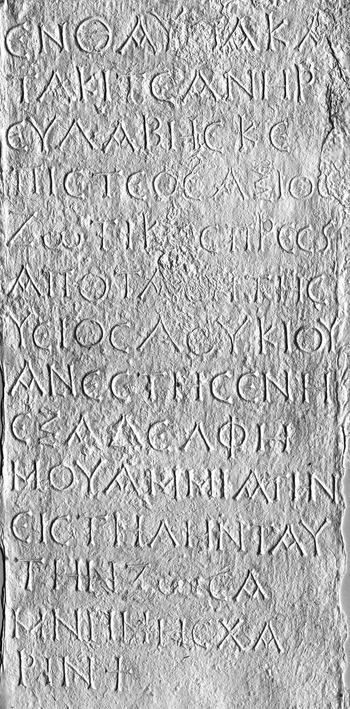
By contrast, the eight surviving tombstones from rural Lycaonia in which men and women expressly or implicitly indicate their adherence to ‘encratite’ or ‘apotactite’ beliefs or practices are far less explicitly sectarian in character. Individuals are explicitly described as ‘apotactites’ in three funerary inscriptions, all from rural parts of northern Lycaonia. From the remote village of Kara Tepe, near ancient Bardaetta in the steppe north of Laodicea Combusta, we have the tombstone of a certain Aniketos, ‘presbyter of the apotactites’, set up by his heirs Eugraphios and Diophantos, both also described as presbyters.Footnote 48 An ‘apotactite’ monastery existed near the modern village of Beykavağı, in the highlands south-west of Laodicea, as we learn from a funerary inscription set up by ‘Gaius the presbyter and his fellow presbyters of the holy monastery of the apotactites’.Footnote 49 Another apotactite presbyter is attested in an unpublished inscription recorded by Michael Ballance in 1957 at the village of Ortakonak (formerly Zivecik) in the plain of Konya, some 20 km north-east of Iconium.
1. Ballance archive no. 1957/52 (Ortakonak, formerly Zivecik, in front of a house). Grey limestone stele with moulded panel. Ht. 1.33 m (panel 1.20 m); W. 0.37 m (panel 0.32 m); Th. 0.20 m; letters 0.025–0.040 m. Record: MB notebook copy, squeeze (Fig. 1).

Funerary stele of the presbyter Zotikos, ‘apotactite’ (Ortakonak, formerly Zivecik): squeeze.

It is notable that the authors of all three of these inscriptions use the same term ‘apotactite’ (ἀποτακτίτης) employed by their orthodox opponents.Footnote 50 By contrast, we have no single instance in which a man or woman self-identifies as an ‘encratite’ (ἐγκρατίτης). The strongest indications that at least some adherents of enkrateia regarded themselves as a distinct ecclesiastical movement occur in two funerary inscriptions from the vicinity of Laodicea Combusta.Footnote 51 A funerary inscription from Bahçesaray, 8 km south-east of Laodicea Combusta, refers to a deaconess of the ‘religion/worship’ (θρησκεία) of the enkrateis:
I, Elaphia, deaconness of the worship of the enkrateis, set up (this tombstone) for the presbyter Petros and his brother Polychronios, in memoriam.Footnote 52
Still more combative is a tombstone of the late third or early fourth century from Kındıras, the ancient village of Kindyria, which reads:
Meiros, son of <Va>lentinus, of the enkrateis (τῶν ἐνκρατῶν), set this up while living and in his right mind for himself and his cousin Tatis and his brother Paulos and his brother Pribis, in memoriam. If any of the Winebibbers (τῶν Oἰνοποτῶν) inters (another body), he will have to reckon with God and Jesus Christ.Footnote 53
The contemptuous reference to the ‘Winebibbers’ is a reminder of one of the few absolutely clear doctrinal differences between ‘encratite’ Christians and the orthodox and Novatian churches in Lycaonia, namely their use of water rather than wine in the Eucharist, repeatedly criticized by Amphilochius and Epiphanius.Footnote 54
Three further funerary monuments from this region make prominent reference to the virtue of enkrateia as a central element in the deceased's character. An inscription from the village of Dedeler, in the steppe north-east of Laodicea on the main ancient highway from Iconium to Ankyra, commemorates a priest named Athanasius, who ‘handed down (an example of) holy self-restraint’ (ἐνκράτιαν σεμνὴν παρέδωκε); a tombstone from Kadınhanı, west of Laodicea, declares:
I, Gaius Iulius Patrikios, set this up for my sweetest aunt Orestina, who lived with self-restraint (ἐνκρατευσαμένῃ), in memoriam.Footnote 55
Most informative of all is a verse inscription from the village of Dineksaray, situated in the Isauro-Lycaonian borderlands near ancient Isauropolis, the region whose clergy are known to have given Amphilochius trouble in the early years of his episcopate. Here a local bishop by the name of Nestor is described as ‘the strong protector of modest widows, the deacon of virginal self-restraint (παρθέ[νου ἐν]κρατίης ὁ διάκονος), the faithful servant of Christ, the select strong-room of the whole province, the tutor of heavenly dogma to the unmarried (ἠϊθέοισιν), a wise and faithful judge among men’. His sister Mammeis, who was buried alongside him, is praised as a ‘faithful steward of self-restraint’ (πισ[τ]ὴν ἐνκρατίης οἰκονόμον).Footnote 56
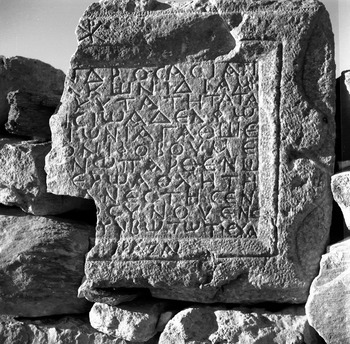
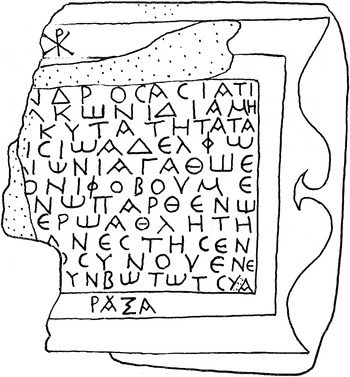
So far as I know, these eight monuments are the only inscriptions in which individuals explicitly indicate their religious affiliations by means of the ascetic vocabulary of enkrateia and apotaxis.Footnote 57 However, one further funerary monument from northern Lycaonia can be fairly confidently attributed to members of a similar non-orthodox ascetic community. The inscription in question was copied by Michael Ballance in 1956 at the village of Maydos, in the north Lycaonian steppe.
2. Ballance archive no. 1956/151 (Maydos, in the wall of the cemetery). Grey marble sarcophagus fragment, broken left, right and below, with inscription in tabula ansata. Ht. 0.48+ m; W. 0.45+ m; Th. 0.14 m; letters 0.017–0.022 m. Record: MB notebook copy, photograph (Fig. 2), line drawing (Fig. 3).

Sarcophagus of the mother and brother of the deacon Alexandros (Maydos): photograph.

Sarcophagus of the mother and brother of the deacon Alexandros (Maydos): line drawing.

The sequence of epithets applied to Alexandros’ brother — described in line 4 as γνήσιος, ‘legitimate’, to indicate that they are blood-relatives, and not (merely) spiritual brothers — has no close parallels in the Christian epigraphy of Lycaonia.Footnote 59 The term ἐχέϕρων, ‘prudent’, is also found in a Christian funerary inscription from Kadınhanı, on the territory of Laodicea; the term ϕοβούμενος should presumably be taken simply to mean ‘reverent’ rather than in the technical sense of ‘God-fearer’.Footnote 60 The description of Alexandros’ brother as a ‘strong athlete of Christ’ is particularly striking, since the phrase ἀθλητὴς τοῦ Xριστοῦ is normally used only with reference to martyrs.Footnote 61 However, the phrase is given no particular prominence or emphasis in this inscription, and it seems more likely that it is used here in a weak sense of ‘one who fought for his (persecuted) faith’, presumably against orthodox oppressors rather than pagans.Footnote 62
The most striking and unusual aspect of the inscription is the description of Alexandros’ brother as a ‘holy virgin’ (ἁγνὸς παρθένος).Footnote 63 I know no other epigraphical instances of a man being praised for his virginity, and the use of the phrase here, combined with the implication of persecution in the phrase ‘athlete of Christ’, strongly suggests that the two sons of Asiatikos were members of one of the Lycaonian ascetic churches attacked by Amphilochius.Footnote 64 In Against False Asceticism, Amphilochius insists that ‘virginity and holiness’ (παρθενία καὶ ἁγνεία) are not incompatible with orthodoxy; Amphilochius may well be deliberately employing the precise terminology used by the ascetics themselves.Footnote 65 It may be significant that the find-spot of the inscription (Maydos) lies in the close vicinity of the village of Dedeler, the find-spot of the epitaph of the ‘encratite’ bishop Athanasius.Footnote 66
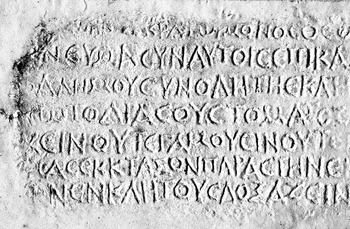
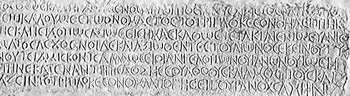
By some distance the most important item of documentary evidence for the doctrines of the non-orthodox ascetic churches of Lycaonia is a hitherto unpublished inscription recorded by William Calder in 1954 at Gene Yaylası, the site of the ancient city of Kana, east of Iconium in the foothills of the Boz Dağ mountain range. The text does not explicitly record any doctrinal affiliation, but, as we shall see, its origin in an ‘encratite’ or ‘apotactite’ community is not in serious doubt.
3. Ballance archive no. 1954/50 (Gene Yaylası). Red marble slab with a narrow rim around the edge of the upper surface (W. 0.030 m, depth 0.030 m); inscription on one of the long side faces. Ht. 0.16 m; W. 0.76 m; Th. 0.61 m; letters 0.012–0.025 m. Record: WMC notebook copy, squeeze (Figs 4–5).
[ὁ παντο]κράτωρ μόνος θεὸς κα [ὁ] ἠ
 α
 ημένος αὐτοῦ υἱὸς Ἰησοῦς X
 ειστὸς κα
 ὸ ἅιο

[π]νεῦμα σὺν αὐτοῖς.· ἐπικαλοῦμε ἐγὼ Ὀνόμαστος τὸ τριπλοκὲς ὄνομα ἐπὶ τῇ κ[ε]-
 αλῇ μου σὺν ὅλῃ τῇ ἐκλησίᾳ ὅπως ἀξιώσεις ἡμᾶς, καθὼς τέτακται ἐν τῷ εὐανγ
 [λ]-
[ί]ῳ τὸ διά σου στόματος λεχθέν.· οἱ δὲ καταξιωθέντες τοῦ αἰῶνος ἐκείνου τυ-
5 χεῖν οὔτε γαμοῦσιν οὔτε γαμίσκοντε, ἀλλὰ ὡσεὶ οἱ ἄνγελοι τῶν οὐρανῶν. οὕτως ἡ-
 ᾶς ἐκκτάξον παραστῆνε κατέναντι τῆς δόξης σου ἀθόους καὶ ἀμέμπτους καὶ
[ἀ]νενκλήτους δοξάζειν τὸ τριπλοκὲς ὄνομα ἀπὸ γῆς εἰς οὐρανούς, ἀμήν.
The all-powerful one God and his beloved son Jesus Christ and the Holy Spirit along with them. I, Onomastos, call the threefold name upon my head along with the whole church, that you may consider us worthy, just as it is laid down in the Gospel, that which was spoken through your own mouth: ‘And those who are considered worthy of receiving that world do not marry, nor are they given in marriage, but (are) just like the angels of the heavens.’ Thus draw us up in ranks to stand before your glory, guiltless and blameless and without reproach, to glorify the threefold name from earth to the heavens, Amen.
Encratite or Apoctactite prayer (Gene Yaylası): squeeze (left-hand side).

Encratite or Apoctactite prayer (Gene Yaylası): squeeze (right-hand side).

This stone appears to be the base of an altar; its dimensions and physical form are almost identical to those of a late antique altar-base from Pazarcık, on the territory of Aizanoi in Phrygia.Footnote 67 The non-orthodox character of the prayer inscribed on it is evident from the gospel citation in lines 4–5. This is a slightly abbreviated quotation from Luke 20:34–6, ‘the sons of this world marry and are given in marriage, but those who have been considered worthy of receiving that world and resurrection from the dead do not marry, nor are they given in marriage; for they can no longer die, since they are like the angels’ (οἱ υἱοὶ τοῦ αἰῶνος τούτου γαμοῦσιν καὶ γαμίσκονται, οἱ δὲ καταξιωθέντες τοῦ αἰῶνος ἐκείνου τυχεῖν καὶ τῆς ἀναστάσεως τῆς ἐκ νεκρῶν οὔτε γαμοῦσιν οὔτε γαμίσκονται. οὐδὲ γὰρ ἀποθανεῖν ἔτι δύνανται, ἰσάγγελοι γάρ εἰσιν). This passage contains several obscurities which made it a notorious doctrinal crux in the early Church, and one of the foundational texts of early Christian asceticism.Footnote 68 The immediate context in Luke is a question by the Sadducees concerning the status of marriage in the resurrection. In the parallel accounts in Mark and Matthew, it is clearly stated that once people have been raised from the dead, they are similar to angels in that they neither marry nor are given in marriage.Footnote 69 The passage implies no prohibition on marriage in this world; it merely states that marriage does not exist after the resurrection.
The Lukan passage, however, contains three ambiguities which are absent from the other synoptic gospels:
(1) The phrase οἱ καταξιωθέντες τοῦ αἰῶνος ἐκείνου τυχεῖν, ‘those who have been considered worthy of receiving that world’, does not make clear when the process of ‘being considered worthy’ occurs: during the present life, or at the time of the resurrection;
(2) The causal connection between ‘being considered worthy’ and ‘not marrying’ is ambiguous: refraining from marriage could be taken either as a precondition or as a consequence of being considered worthy of ‘that world’.
(3) It is not clear whether the distinction between ‘the sons of this world’ and ‘those who have been considered worthy of that world’ has a temporal dimension: do both classes in fact already exist in this world?
In order to remove these ambiguities, several patristic authors transpose the final clauses of the Lukan passage to the future tense, so as to render the eschatological context explicit.Footnote 70 However, the Lukan passage, read in isolation, could legitimately be taken as stating that two classes of men already exist in the present world: the ‘sons of this world’, who continue to marry, and ‘those who have been considered worthy of that world’, precisely by dint of the fact that they refrain from marriage. This sentence in Luke therefore provided scriptural authority for the extreme ascetic practices of several early Christian rigorist groups. Tertullian informs us that Marcion interpreted the Lukan passage as representing a normative requirement in this life for those who wish to be considered worthy of the resurrection:
On the subject of marriage, they (the Marcionites) misrepresent his answer, so as to make out that the phrase The children of this world marry and are given in marriage refers to the Creator's men whom he allows to marry, whereas they themselves, whom the god of that world, that other god, has counted worthy of the resurrection, even here and now do not marry, because they are not the children of this world — although it was the marriage of that world he was asked about, not this, and the marriage which he said did not exist was the one he had been asked about.Footnote 71
The same view was held by Tatian, whose interpretation of Luke 20:34–6 was criticized by Clement of Alexandria:
Similarly they quote the saying The children of that world neither marry nor are given in marriage. But when one considers carefully this question concerning the resurrection of the dead and those who asked it, he will find that the Lord is not rejecting marriage, but curing them of the expectation that there will be carnal desire in the resurrection. The saying The children of this world is not in contrast with the children of some other world, but is the same as saying Those who are born in this world. Footnote 72
That the Lycaonian ascetic churches followed the same interpretation of the Lukan passage is indicated by Amphilochius in the ninth chapter of Against False Asceticism. Amphilochius here states that ‘if you return to the Church, no-one will force you to eat and drink fleshly nourishment, nor to marry or be given in marriage’.Footnote 73 This final clause should be taken as an allusion to the ascetic interpretation of Luke 20:34–6, which understood refraining from marriage as a normative precondition for salvation.
This radical ‘ascetic’ interpretation was evidently the one followed by the religious community responsible for the inscription from Gene Yaylası. For Onomastos and his congregation, the Lukan passage prescribes the behavioural norms which they were expected to follow in order to be considered worthy of the kingdom of heaven: it was the ascetics’ hope and expectation (lines 3–5) ‘that you may consider us worthy (ἀξιώσεις ἡμᾶς), just as it is laid down in the Gospel… “Those who are considered worthy (οἱ καταξιωθέντες) of receiving that world do not marry, nor are they given in marriage”’.
IV CONCLUSION
None of the ten monuments discussed here can be dated precisely. It is unlikely that any of the texts which explicitly declare commitment to ‘encratite’ or ‘apotactite’ virtues postdate the anti-heretical legislation of the early 380s a.d., although it is possible that the ‘crypto-ascetic’ funerary inscription of Alexandros’ brother, the ‘athlete of Christ’ (2 above, from Maydos), should be placed in a context of increased persecution in the Lycaonian diocese following the imperial legislation.
I have argued that Novatian self-identification in fourth-century rural Lycaonia was, as it were, fully determinate and consciously exclusive: to describe oneself as a katharos or a Novatian was to proclaim oneself as ‘a member of the Novatian church (and therefore not a member of the orthodox church)’. The key question for us in assessing the character of Lycaonian asceticism is whether self-identification as an ‘apotactite’ or ‘encratite’ was similarly determinate. As we have seen, although the term ἀποτακτίτης is used explicitly in all three of the ‘apotactite’ funerary monuments discussed above, in no case can we be certain that the term signifies much more than ‘monk who has entirely renounced the world’. Moreover, in not one instance do we find an individual actually applying the term ‘encratite’ (ἐγκρατίτης) to him- or herself. Indeed, the extreme variation in the ways in which the principle of self-restraint is indicated in the five ‘encratite’ inscriptions (διακόνισσα τῆς ἐνκρατῶν θρισκίας, τῶν ἐνκρατῶν, διάκονος ἐνκρατίης, οἰκονόμος ἐνκρατίης, ἐνκρατευσαμένη, ἐνκράτιαν παρέδωκε) strongly suggests that the polemical characterization of one particular group of non-orthodox Lycaonian ascetics as ‘Encratites’ with, so to speak, a capital ‘E’ is likely to be profoundly misleading.Footnote 74 That is not to say that the Lycaonian ‘encratites’ shared no sense of collective identity or doctrinal affiliation — Amphilochius and Basil were evidently talking about a well-known and readily identifiable group — but rather that in identifying them as a sharply distinct and organized sect we may be making a simple category-error, as if we were to try to identify a distinctive rigorist sect of Regular Churchgoers within the modern Anglican congregation.
Herein, we might suppose, lay the most serious obstacle for Amphilochius in establishing orthodox authority in his Lycaonian diocese. It is clear from Basil's first two canonical epistles that ‘encratite’ baptismal practices were effectively identical to those of the orthodox churches of the region, and Basil strongly implies that ‘encratite’ economic and ontological theology was soundly Trinitarian.Footnote 75 The group of rural churches categorized by Basil and Amphilochius as ‘Encratite’ and ‘Apotactite’ was, I suggest, not a unified, hierarchically organized ecclesiastical bloc, so much as a relatively diffuse and widespread ascetic ‘militant tendency’, with distinctive opinions on (at the most) marriage, meat-eating, and the use of wine in the Eucharist. In that case, the project undertaken by Amphilochius in the mid-370s would not so much have been combating Lycaonian asceticism as defining Lycaonian asceticism as a coherent sectarian phenomenon. Amphilochius’ Against False Asceticism should be understood as a totalizing classificatory grid of Lycaonian Christianity: the text is concerned to agglomerate and segregate those Lycaonian Christians who had chosen to practise self-restraint (ἐγκρατευσάμενοι) or who had entirely renounced the secular world (apotaktitai) under the polemical orthodox categories ‘Encratite’ and ‘Apotactite’.Footnote 76 The primary aim of Amphilochius’ project was not persuasion or conversion, but terminological capture.
The fiction of fourth-century orthodox polemic — seen in its most extreme form in Epiphanius’ Panarion — was that all Christians could be classified under one, and only one, of a series of distinct taxonomic headings, all but one of which (‘Orthodoxy’) would eventually be consigned to the dustbin of history. Non-affiliation or denominational pluralism was not an option. For Amphilochius, as the chief representative of orthodoxy in the Lycaonian diocese, the chief task was simply to make the ‘Encratite’ and ‘Apotactite’ labels stick. The magnitude of his achievement can be judged from the Theodosian legislation of the early 380s a.d., which outlawed the Lycaonian ascetics altogether. Orthodox heresiology claimed to be an attempt to interpret the world; in fact the point was to change it. Few succeeded so well as Amphilochius.