Is it possible to change basal cortisol levels in young children through a preventive parent training program focusing on parental sensitivity and sensitive discipline? From the literature on the influence of early deprivation in children growing up in residential care (orphanages) it has become clear that child maltreatment and neglect may alter biobehavioral functioning of the children and drastically change their diurnal pattern of cortisol secretion even several years after the adverse experiences (Cicchetti & Rogosh, Reference Cicchetti and Rogosh2001a, Reference Cicchetti and Rogosh2001b; Gunnar, Morison, Chrisholm, & Schruder, Reference Gunnar, Morison, Chisholm and Schuder2001; Gunnar & Vazquez, Reference Gunnar and Vazquez2001). The complementary issue is whether deleterious effects of early deprivation on the neuroendocrine stress system can be reversed through positive changes in the child rearing environment (Dozier, Albus, Fisher, & Sepulveda, Reference Dozier, Albus, Fisher and Sepulveda2002; Fisher, Gunnar, Dozier, Bruce, & Pears, Reference Fisher, Gunnar, Dozier, Bruce and Pears2006).
Here, we address the question of whether it is possible to change the diurnal cortisol pattern in children with externalizing behaviors at risk for a deviating cortisol secretion pattern through enhancing the quality of the care they experience from their parents. In their review of the extant animal and human literature on early experience and stress regulation Gunnar et al. (Reference Gunnar and Fisher2006) suggest that in early childhood caregiver sensitivity may play the role that maternal licking and grooming in rodents do (Meaney, Reference Meaney2001; Meaney & Szyf, Reference Meaney and Szyf2005) to maintain a relatively buffered or hyporesponsive neuroendocrine stress system. In a randomized controlled trial we test the effectiveness of a brief, attachment-based intervention, Video-Feedback Intervention to Promote Positive Parenting and Sensitive Discipline (VIPP-SD; Juffer, Bakermans-Kranenburg, & Van IJzendoorn, Reference Juffer, Bakermans-Kranenburg and Van IJzendoorn2008; Van Zeijl, Mesman, Van IJzendoorn, et al., Reference Van Zeijl, Mesman, Van IJzendoorn, Bakermans-Kranenburg, Juffer and Stolk2006) in changing young children's basal cortisol secretion through enhancing their parents' sensitivity. We also investigate whether the effectiveness is moderated by a specific genetic polymorphism, the dopamine receptor D4 (DRD4) gene, which has been found to moderate parenting effects in previous studies (Bakermans-Kranenburg & Van IJzendoorn, Reference Bakermans-Kranenburg and Van IJzendoorn2006; Bakermans-Kranenburg et al., Reference Bakermans-Kranenburg, Van IJzendoorn, Pijlman, Mesman and Juffer2008; Van IJzendoorn & Bakermans-Kranenburg, Reference Van IJzendoorn and Bakermans-Kranenburg2006). The 1- to 3-year-old children involved in this intervention were selected on the basis of their high scores on the Child Behavior Checklist (CBCL) Externalizing Problems Scale.
Basal Cortisol
The basic function of the physiological stress system is to help the organism maintain homeostasis in an ever-changing environment. The stress system includes two components: the locus ceruleus/noradrenergic sympathetic system and the hypothalamic–pituitary–adrenal (HPA) axis (for an overview, see Gunnar & Quevedo, Reference Gunnar and Quevedo2007). The first system reacts quickly to threatening stimuli in the environment, whereas the HPA axis responds somewhat later and functions as a “backup” and balancing system (Sapolsky, Romero, & Munck, Reference Sapolsky, Romero and Munck2000). This system can be considered a cascade of hormones. It starts in the paraventricular nucleus of the hypothalamus, which releases corticotropin-releasing hormone (CRH) in response to activation by limbic or cortical inputs. In turn, CRH activates the production of adrenocorticotropin hormone (ACTH) by the pituitary, which travels to the adrenal gland, and triggers the production of cortisol (Chrousos & Gold, Reference Chrousos and Gold1992). When cortisol secretion reaches a certain level, it binds to receptors (glucocorticoid receptors) that function to inhibit the production of CRH, ACTH, and cortisol, in order to return the system to a prestress or basal state (Sapolsky et al., Reference Sapolsky, Romero and Munck2000). Cortisol is also produced during normal, nonstress situations. These basal levels of cortisol normally follow a diurnal rhythm, with highest levels approximately 30 min after wakeup, followed by a decline throughout the rest of the day (Kirschbaum & Hellhammer, Reference Kirschbaum and Hellhammer1989). This (low) basal HPA activity is regulated by mineralocorticoid receptors. Individual differences exist in the functioning of every step in the cascade, including the sensitivity to the feedback signals. The effect of stress on the functioning of the HPA axis has been amply documented (for a review, see De Kloet, Joëls, & Holsboer, Reference De Kloet, Joëls and Holsboer2005).
Externalizing Behaviors and Cortisol
During the past few decades HPA-axis functioning has been frequently studied in children and adolescents with externalizing behavior problems. Several studies suggested that lower basal cortisol levels and lower cortisol reactivity are associated with higher rates of externalizing behaviors (e.g., Cicchetti & Rogosch, Reference Cicchetti and Rogosh2001b; Kariyawasam, Zaw, & Handley, Reference Kariyawasam, Zaw and Handley2002; McBurnett, Lahey, Capasso, & Loeber, Reference McBurnett, Lahey, Capasso and Loeber1996; Pajer, Gardner, Rubin, Perel, & Neal, Reference Pajer, Gardner, Rubin, Perel and Neal2001; Scerbo & Kolko, Reference Scerbo and Kolko1994; Schulz, Halperin, Newcorn, Sharma, & Gabriel, Reference Schulz, Halperin, Newcorn, Sharma and Gabriel1997; Wright, Reference Wright2000). However, some empirical evidence points in a different direction. For example, Van Bokhoven et al. (Reference Van Bokhoven, Van Goozen, Van Engeland, Schaal, Arseneault and Seguin2005) concluded that basal levels of cortisol are positively related to aggression, and Hart, Burock, London, Atkins, and Bonilla-Santiago (Reference Hart, Burock, London, Atkins and Bonilla-Santiago2005) reported that enhanced basal cortisol and cortisol reactivity to a stressor were both associated with elevated levels of externalizing behavior.
The divergence of empirical findings on the association between HPA-axis functioning and externalizing behaviors has been addressed in a recent meta-analysis (Alink et al., in press). In a set of more than 70 studies on basal cortisol in more than 5,000 participants a significant but small relation between basal levels of cortisol and externalizing behavior was found, whereas cortisol reactivity was not consistently associated with externalizing behavior. The only significant moderator of the relation between basal cortisol and externalizing behavior in the meta-analysis was the age of the children. Higher levels of externalizing behavior were associated with higher basal levels of cortisol (hyperactivity) in preschoolers, and with lower basal levels of cortisol (hypoactivity) in school-aged children. Thus, the expected inverse relation found for school-aged children was absent in younger children. In the current study our intervention focuses on families with 1- to 3-year-old children at risk for externalizing behavior problems, and on the basis of the meta-analytic evidence our hypothesis is that the VIPP-SD intervention may lower basal cortisol levels in these young children.
Previous Interventions
In various ways researchers have tried to change cortisol levels in children and adults through relaxation techniques such as abbreviated progressive relaxation training (Pawlow & Jones, Reference Pawlow and Jones2005), cognitive behavioral stress management (Cruess, Antoni, Kumar, & Schneiderman, Reference Cruess, Antoni, Kumar and Schneiderman2000), Hatha yoga (West, Otte, Geher, Johnson, & Mohr, Reference West, Otte, Geher, Johnson and Mohr2004), transcendental meditation (Kamei et al., Reference Kamei, Torui, Kimura, Ohno, Kumano and Kimura2000), Qi-training (Lee, Kang, Lim, & Lee, Reference Lee, Kang, Lim and Lee2004), a therapy dog (Barker, Knisely, Mccain, & Best, Reference Barker, Knisely, Mccain and Best2005), guided imagery and music therapy (McKinney, Antoni, Kumar, Tims, & McCabe, Reference McKinney, Antoni, Kumar, Tims and McCabe1997), or a simple music intervention (Lindblad, Hogmark, & Theorell, Reference Lindblad, Hogmark and Theorell2007), with varying degrees of success. Most relevant for parenting and child development may be the massage or “touch” approach by Field et al. (Reference Field, Hernandez-Reif, Diego, Feijo, Vera and Gil2004). Urizar et al. (Reference Urizar, Milazzo, Le, Delucchi, Sotelo and Munoz2004) proved that stress reduction interventions based on massage led to lower depression scores, less negative affect, and lower cortisol levels in depressive, pregnant women. Field et al. (Reference Field, Hernandez-Reif, Diego, Feijo, Vera and Gil2004) showed that pregnant women had lower levels of anxiety and depressed mood and less leg and back pain after massage therapy. In addition, they had higher dopamine and serotonin levels and lower levels of cortisol and norepinephrine by the end of the study. The authors speculate that these changes may have contributed to better neonatal outcome for the massage group: fewer infants were born prematurely or with low birth weight, and the newborns in the massage group scored higher on the Brazelton Neonatal Behavior Assessment Scales (Field, Diego, & Hernandez-Reif, Reference Field, Diego and Hernandez-Reif2006; Field et al., Reference Field, Hernandez-Reif, Diego, Feijo, Vera and Gil2004).
The relaxation and massage interventions have been evaluated in terms of their effectiveness in lowering the basal cortisol secretion of the participants undergoing these therapies. In parent training interventions the focus is on changing the children's basal cortisol as a consequence of the changes in parenting. Only few parent training experiments to influence cortisol secretion of the children have been published thus far, and they show diverging but promising outcomes. The broadband intervention by Field et al. (Reference Field, Scafidi, Pickens, Prodromidis, Pelaez-Nogueras and Torquati1998) included young mothers with cocaine addiction during pregnancy. Children of drug-abusing mothers had lower cortisol at the start of the intervention compared to a nondrug-using comparison group, and the intervention children showed normal cortisol levels after the intervention. Because of the specific influences of drug use on cortisol we will not discuss this pioneering study in detail here (Field et al., Reference Field, Scafidi, Pickens, Prodromidis, Pelaez-Nogueras and Torquati1998).
Fisher, Gunnar, Chamberlain, and Reid (Reference Fisher, Gunnar, Chamberlain and Reid2000) studied the effects of an intervention on cortisol in maltreated preschool children who were in enriched or regular foster care. The enriched foster care consisted of an Early Intervention Foster Care (EIFC) program in the period immediately following a child's placement in a new foster home, including intensive pre- and in-service training of foster parents, and playgroup and therapeutic support of the children. Salivary cortisol was sampled three times at a regular day from the EIFC group, a regular foster care group, and a community comparison group, each with 10 participants. EIFC foster parents adopted and maintained positive parenting strategies, EIFC children's behavioral adjustment improved, but significant changes in the children's salivary cortisol secretion did not occur.
Dozier et al.'s (Reference Dozier, Peloso, Lindhiem, Gordon, Manni and Sepulveda2006) Attachment and Biobehavioral Catch-up (ABC) intervention program aims at affecting foster infants' and toddlers' biobehavioral dysregulation in three ways. The first component is a sensitivity training; it supports caregivers to follow the child's lead. The second component is similar to Field's touch therapy, and supports foster parents appreciating the value of touching, cuddling, and hugging their child. The third component helps caregivers to allow their children to express (negative) emotions, and to learn to recognize and understand emotions. Dozier et al. (Reference Dozier, Peloso, Lindhiem, Gordon, Manni and Sepulveda2006) presented preliminary data about the effectiveness of ABC compared to a control intervention, Developmental Education for Families. Children were randomly assigned to the experimental intervention or to the control group. In both conditions, the foster parents received in-home training in 10 weekly sessions. Postintervention measures were collected 1 month after the training. Outcome measures included children's diurnal production of cortisol, based on two cortisol samples on a regular day. Children in the experimental intervention group had lower cortisol values than children in the control group. To our knowledge, this is the first experimental proof of the influence of sensitive and responsive care on HPA-axis functioning in (maltreated) children. As the authors conclude, their results provide preliminary evidence of the effectiveness of an intervention that targets children's regulatory capabilities through changing their (foster) parents' interactive behaviors.
Fisher's (Fisher et al., Reference Fisher, Gunnar, Dozier, Bruce and Pears2006) Multidimensional Treatment Foster Care for Preschoolers (MTFC-P) study is designed for 3- to 5-year-old foster children who are involved in the intervention immediately after their entrance into the foster homes. Although the treatment differs from Dozier's ABC intervention, the goal of supporting foster parents to become a reliable resource for modulating stress is similar. Dozier's study focuses on improving the caregivers' sensitive responsiveness, whereas Fisher's approach emphasizes supporting caregivers to respond contingently to positive and negative behavior. Preliminary evidence from Fisher's randomized trial with (part of) 117 foster children and 60 comparisons is promising. The foster children were randomly divided among a Foster Care Intervention (FCI) group receiving the MTFC-P treatment, and the Regular Foster Care group (RFC) without this special treatment. The nonfoster comparison group (CC) was matched for age and socioeconomic status. Among a subgroup of MTFC-P children with very low (blunted) morning cortisol levels (<0.30 µg/dl) Fisher et al. (Reference Fisher, Gunnar, Dozier, Bruce and Pears2006) found a significant Condition × Time interaction for morning cortisol levels measured at entry into the study and at 8–9 months postentry. At posttest, the FCI and CC groups had significantly higher cortisol levels than the RFC group. Thus, it should be noted that in this study the treatment led to higher cortisol levels (instead of lower levels as in Dozier's study). It is important that the effect was reported among children with very low (blunted) cortisol levels. Dysregulation of the HPA system associated with physical pathologies or resulting from experiences of abuse and neglect involves both chronically elevated and chronically suppressed levels of cortisol (see Cicchetti & Rogosch, Reference Cicchetti and Rogosh2001a; Fries, Hesse, Hellhammer, & Hellhammer, Reference Fries, Hesse, Hellhammer and Hellhammer2005; Gunnar & Vazquez, Reference Gunnar and Vazquez2001). Hypocortisolism, characterized by low morning cortisol, flat daytime production patterns, and blunted cortisol responses to stressors (Heim, Ehlert, & Hellhammer, Reference Heim, Ehlert and Hellhammer2000; Heim, Newport, et al., Reference Heim, Newport, Heit, Graham, Wilcox and Bonsall2000), has been reported for human and animal subjects living under chronic stress. In these cases the goal of affecting the HPA axis functioning is to bring cortisol levels within the range of those of typically developing children, and the Fisher et al.'s (Reference Fisher, Gunnar, Dozier, Bruce and Pears2006) MTFC-P treatment appears to have been successful in this respect for children with very low morning cortisol levels. No treatment effects were reported for children with average or high morning cortisol levels at entry into the study.
Clearly, more intervention studies in clinical and nonclinical groups with varying ages are needed to settle the issue whether basal cortisol can be altered by enhanced parental care. In clinical groups the aim of such interventions would be to (re-)establish a diurnal pattern with cortisol values within the normal range and declining over the day (whether departing from extremely high levels, extremely low levels, or a deviant diurnal rhythm). For nonclinical groups interventions may aim at decreasing cortisol levels within the normal range, at least when infants and toddlers are targeted (Alink et al., in press).
VIPP
The effectiveness of Dozier et al.'s (Reference Dozier, Peloso, Lindhiem, Gordon, Manni and Sepulveda2006) brief and focused ABC intervention concurs with the results of a meta-analysis on 70 attachment-based intervention studies. Contrary to expectation, it was found that rather brief and focused interventions proved to be most effective in enhancing the quality of parenting (“less is more”; Bakermans-Kranenburg, Van IJzendoorn, & Juffer, Reference Bakermans-Kranenburg, Van IJzendoorn and Juffer2003). The approach used in the current intervention study (VIPP; Juffer et al., 2007), is also a brief and focused program in which parent and child are videotaped during daily situations at home, and feedback is provided to stimulate parents' sensitive interactive skills. To prevent a further increase of externalizing problems in our sample of young children screened for externalizing behaviors, the VIPP approach has been extended with a focus on parental sensitive discipline (VIPP-SD). Sensitive discipline includes child-oriented discipline methods, such as induction (Hoffman, Reference Hoffman, Gewirtz and Kurtines1984), empathy for the child when frustrated or angry (Lieberman, Reference Lieberman, Sameroff, McDonough and Rosenblum2004), and avoidance of coercive cycles (Patterson, Reference Patterson1982).
Studies using the VIPP approach documented positive effects on parental sensitivity or attachment security in nonclinical groups, for example, in adoptive families (Juffer, Bakermans-Kranenburg, & Van IJzendoorn, Reference Juffer, Bakermans-Kranenburg and Van IJzendoorn2005), and in at risk and clinical groups, such as mothers with an insecure representation of attachment (Klein Velderman, Bakermans-Kranenburg, Juffer, & Van IJzendoorn, Reference Klein Velderman, Bakermans-Kranenburg, Juffer and Van IJzendoorn2006), mothers screened for low sensitive responsiveness (Kalinauskiene, Cekuoliene, VanIJzendoorn, Bakermans-Kranenburg, & Juffer, Reference Kalinauskiene, Cekuoliene, Van IJzendoorn, Bakermans-Kranenburg and Juffer2007), and mothers with eating disorders and their infants (Stein et al., Reference Stein, Woolley, Senior, Hertzmann, Lovel and Lee2006). In a previous report on the current sample, Van Zeijl, Mesman, Van IJzendoorn, et al. (Reference Van Zeijl, Mesman, Van IJzendoorn, Bakermans-Kranenburg, Juffer and Stolk2006) showed that VIPP-SD was effective in promoting maternal sensitive discipline in the intervention group compared to the control group. Here we report on the influence of the VIPP-SD on the children's basal cortisol secretion.
We also examine the role of the DRD4 gene in explaining differential effectiveness of VIPP-SD in changing basal cortisol secretion. In a previous study Bakermans-Kranenburg and Van IJzendoorn (Reference Bakermans-Kranenburg and Van IJzendoorn2006) targeted the DRD4 gene in relation to insensitive parenting as predictive of externalizing behaviors at a later stage in development. The exon III DRD4 7-repeat allele has been associated with several forms of externalizing problems across the lifespan, such as aggression and attention-deficit/hyperactivity disorder (ADHD; Ebstein, Benjamin, & Belmaker, Reference Ebstein, Benjamin, Belmaker, Plomin, DeFries, Craig and McGuffin2002; Schmidt, Fox, Rubin, Hu, & Hamer, Reference Schmidt, Fox, Rubin, Hu and Hamer2002). The 7-repeat allele has been linked to lower dopamine reception efficiency; the dopaminergic system is engaged in attentional, motivational, and reward mechanisms (Robbins & Everitt, Reference Robbins, Everitt, Zigmond, Bloom, Landis, Roberts and Squire1999). In the Field et al. (Reference Field, Hernandez-Reif, Diego, Feijo, Vera and Gil2004) study the massage therapy not only appeared to have lowered the cortisol secretion of the participants but also to have increased the levels of dopamine, which might point to relations between the HPA axis and the dopamine system (Pivonello et al., Reference Pivonello, Ferone, Lombardi, Colao, Lamberts and Hofland2007; see also Meaney, Reference Meaney2007, for evidence of this relation in rats). In the study conducted by Bakermans-Kranenburg and Van IJzendoorn (Reference Bakermans-Kranenburg and Van IJzendoorn2006), parental insensitivity was found to be associated with externalizing behaviors in preschoolers, but only in the presence of the DRD4 7-repeat polymorphism. The increase in externalizing behaviors in children with the 7-repeat allele exposed to insensitive care compared to children without these combined risks was sixfold. The dopamine system may affect the susceptibility to environmental influences, and may thus play an important role in gene–environment (G × E) interactions (see also Bakermans-Kranenburg et al., Reference Bakermans-Kranenburg, Van IJzendoorn, Pijlman, Mesman and Juffer2008; Bakermans-Kranenburg & Van IJzendoorn, Reference Bakermans-Kranenburg and Van IJzendoorn2007; Van IJzendoorn & Bakermans-Kranenburg, Reference Van IJzendoorn and Bakermans-Kranenburg2006).
Hypotheses
In the current randomized controlled trial, we expect a lower basal cortisol level in children of mothers who are involved in our VIPP-SD compared to the control group receiving only a dummy treatment. Furthermore, we expect the VIPP-SD to be most effective in the subgroup of children with the DRD4 7-repeat alleles associated with a less efficient reuptake of dopamine.
Method
The Screening and Intervention of Problem Behavior in Toddlerhood (SCRIPT) study
The Dutch SCRIPT study investigated the effectiveness of an early intervention program aimed at enhancing maternal sensitivity and adequate discipline strategies. It consisted of a screening phase in a general population sample and a randomized case–control intervention phase in a selected subsample of children with relatively high levels of externalizing behavior problems. The study was conducted in compliance with the guidelines of the Leiden University Medical Center internal review board.
Sample
Participants were recruited from community records of several cities and towns in the western region of The Netherlands (see Van Zeijl, Mesman, Van IJzendoorn, et al., Reference Van Zeijl, Mesman, Van IJzendoorn, Bakermans-Kranenburg, Juffer and Stolk2006). Parents of 4,615 1-, 2-, and 3-year-old children were sent questionnaires by mail (screening phase). We obtained 2,408 questionnaires from primary caregivers (response rate 52%). There were no child age or child gender differences between responding and nonresponding families (p = .11 and .38, respectively). Children with scores above the 75th percentile on the CBCL Externalizing Problems Scale (age 1 year: scores ≥13; age 2 years: scores ≥19; age 3 years: scores ≥20) were selected for the intervention study (N = 237, see Van Zeijl, Mesman, Van IJzendoorn et al., Reference Van Zeijl, Mesman, Van IJzendoorn, Bakermans-Kranenburg, Juffer and Stolk2006). About 2 years after the intervention the intervention study sample was contacted to take part in the collection of DNA material. Cheek cells were collected from 171 children; 130 of them had complete cortisol data. These children did not significantly differ from the intervention study sample on experimental group membership (intervention versus control), age, gender, number of siblings, and level of externalizing behavior at screening, pretest, and posttest assessments (ps = .21–.96).
Procedure
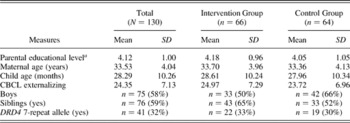
Four months after the screening, families were invited for a pretest in the laboratory. Mother and child completed several tasks (coded afterward from videotapes by independent coders, unaware of experimental condition and other data concerning the participants) and mothers were asked to complete some questionnaires. The mean age of the children at the pretest was 28.29 months (SD = 10.26, range = 13.58–41.91). After the pretest, a computer-generated list randomly assigned families, stratified for age group, to either the control group (n = 64) or the intervention group (n = 66). There were no differences between groups regarding initial level of child externalizing behavior, DRD4 genotype, parental educational level, child and maternal age, and presence of siblings (ps > .12). The percentage of boys was somewhat higher in the control group (66%) compared to the intervention group (50%), but the difference was not significant, χ 2 (1, N = 130) = 3.25, p = .07 (see Table 1). Families in the intervention group received six home visits and, parallel in timing, families in the control group received six telephone calls. Approximately 1 year after the pretest families from both the intervention and control group visited the laboratory for the posttest, using the same procedures as in the pretest. Two weeks before the posttest we introduced the collection of saliva samples to the parents by phone. Instructions and materials for collecting saliva were sent by mail. Parents collected children's saliva samples at home on a typical day within a week before the posttest assessment. The samples were frozen and stored at the parents' homes until the posttest assessment, when they brought the samples along to the lab.
Background variables: Intervention and control group

aRange = 1–5.
p < .05.
VIPP-SD intervention program
The SCRIPT study applied the video-feedback method known as VIPP-SD, which is aimed at parental sensitivity and sensitive parental discipline (Juffer et al., 2007). A female intervener went into the families' homes to provide personal feedback on parenting, using videotaped mother–child interactions as well as information on the development of young children in general (see Mesman et al., Reference Mesman, Stolk, Van Zeijl, Alink, Juffer, Bakermans-Kranenburg, Juffer, Bakermans-Kranenburg and van IJzendoorn2008; Van Zeijl, Mesman, Van IJzendoorn, et al., Reference Van Zeijl, Mesman, Van IJzendoorn, Bakermans-Kranenburg, Juffer and Stolk2006). The duration of each home visit was approximately 1.5 hr. The first four intervention sessions took place every month, the last two sessions every other month. In between home visits, the interveners selected specific video fragments and prepared comments based on the themes of each specific intervention session. Themes of the intervention included the importance of adequate and prompt responses to the child's signals, sharing emotions, using noncoercive responses to difficult child behavior such as distraction and induction (explaining why the child is not allowed to do something or pointing at the consequences of the child's behavior), positive reinforcement, the use of a “sensitive time out,” and consistent and adequate discipline strategies. Sessions 5 and 6 were “booster sessions,” aimed at consolidating intervention effects by integrating the tips and feedback given in the previous sessions. At the end of the program, the mothers received a brochure with tips and exercises on the key issues of the intervention.
Parallel to the intervention sessions, the mothers in the control group received six telephone calls as a dummy intervention, to ensure comparable motivation and attention in the intervention and control group and to prevent selective attrition. During these telephone calls mothers were asked to talk about general child development issues (e.g., sleeping, eating, playing), but no advice was given at any time.
Instruments
Difficult temperament
Child temperament was measured during the screening phase with the Infant Characteristics Questionnaire (ICQ; Bates, Freeland, & Lounsbury, Reference Bates, Freeland and Lounsbury1979). The Dutch ICQ (translated and validated by Kohnstamm, Reference Kohnstamm1984) contains 33 items, describing concrete behaviors in well-defined situations. The items were rated on a 5-point scale, ranging from 0 (not true) to 4 (true). Because the ICQ was used in combination with the CBCL (Achenbach & Rescorla, Reference Achenbach and Rescorla2000), five items in the ICQ were discarded because of content overlap between items of both questionnaires. Next, a one-component analysis was carried out in each age group to derive an overall difficultness factor. The difficultness factor consisted of 14 items in 1-year-old children, 18 items in 2-year-olds, and 16 items in 3-year-olds. Internal consistencies (Cronbach alphas, based on the general population screening sample with N = 2,408) were .68, .76, and .75, respectively. Scale scores for difficult temperament were computed by averaging item scores.
Externalizing problems
The CBCL for 1.5- to 5-year-old children (Achenbach & Rescorla, Reference Achenbach and Rescorla2000) was completed by the mothers during the screening phase. The mothers indicated whether their child displayed any of the 100 behavioral descriptions in the last 2 months on a 3-point scale (0 = not true, 1 = somewhat or sometimes true, and 2 = very true or often true). Van Zeijl, Mesman, Stolk, et al. (Reference Van Zeijl, Mesman, Stolk, Alink, Van IJzendoorn and Bakermans-Kranenburg2006) showed that the broadband Externalizing Problems scale reported for 2- and 3-year-olds by Koot, Van den Oord, Verhulst, and Boomsma (Reference Koot, Van den Oord, Verhulst and Boomsma1997) was also applicable to 1-year-old children.
DRD4 genotyping
DNA samples were incubated in lysis buffer and genomic DNA was isolated using the Chemagic buccal swab kit. The average yield of DNA was 4 µg per sample. For amplification primers 5′-GCGACTACGTGGTCTACTCG-3′ and 5′-AGGACCCTCATGGCCTTG-3′ were used. The DRD4 exon 3 fragments were amplified by an initial denaturation step of 5 min at 95°C, followed by 38 cycles of 45 s at 95°C, 30 s at 60°C, 1 min at 72°C, and a final extension step of 5 min at 72°C. The number of repeats for each sample was determined by size fractionating the exon 3 PCR products on a 2% agarose gel. The main DRD4 genotypes in the sample were in Hardy–Weinberg equilibrium (see Bakermans-Kranenburg et al., Reference Bakermans-Kranenburg and Van IJzendoorn2006). Children were grouped in subgroups with long DRD4 (at least one 7-repeat allele, n = 41) versus short DRD4 (both alleles shorter than 7-repeat), which is common practice in this area of molecular genetics (D'souza & Craig, Reference D'souza and Craig2006). Long DRD4 was present in 32% of our sample.
Cortisol
The procedures for collecting and assaying salivary cortisol followed an established protocol. Parents collected and stored children's saliva samples at home, on a “typical” day without day care, within a week before the posttest assessment. Three saliva samples were collected: the first when the child woke up, the second before lunch, and the third at bedtime (at about 7 p.m.), at least 0.5 hr after dinner. Parents were instructed to place the cotton roll used for saliva sampling in the child's mouth and to encourage the child to chew it for about 45 s, until it was wet with saliva. Mothers were provided with a cotton roll for themselves to provide an example for the child and to encourage the child to imitate her chewing. The parent placed the wet cotton roll into the provided prelabeled salivette and stored the sample in the freezer until the posttest assessment, when they brought the three samples along to the lab. We asked the parents to have the child not eat or drink anything in the 30 min prior to sampling, and to have the children rinse their mouth with plain water but not to brush their teeth with tooth paste before sampling. Parents registered children's time of wake up and the exact time of sampling for each saliva sample, and they completed a questionnaire on issues known to affect cortisol levels, including the child's mood and health condition, food and medication intake, and unexpected stressful events on the day of sampling. The summed presence of these factors was not related to cortisol production over the day (r = −.08, p = .39). The length of the time period between wake up and the first cortisol sampling was related to morning cortisol levels (r = −.19, p = .04), but not to levels of cortisol in the afternoon (r = .06, p = .54) or in the evening (r = .06, p = .54), or to total cortisol production over the day (r = −.09, p = .34).
To determine the cortisol concentration in the saliva samples a time-resolved fluorescence immunoassay was used. The saliva samples that the parents brought to the lab were stored at −20°C until analysis. Because all families lived within an hour traveling from our lab, samples arrived frozen and were stored immediately in the lab freezer. Assays were performed at the biochemical laboratory of the University of Trier. After thawing, saliva samples were centrifuged at 2000 g for 10 min, which resulted in a clear supernatant of low viscosity. One hundred microliters of saliva were used for duplicate analysis. Cortisol levels were determined employing a competitive solid phase time-resolved fluorescence immunoassay with fluorometric end-point detection (DELFIA). Ninety-six well Maxisorb microtiterplates (Nunc) were coated with rabbit-antiovine immunoglobulin. After an incubation period of 48 hr at 4°C, plates were washed three times with wash buffer (pH 7.4, containing sodium phosphate and the Tween-40). In the next step the plates were coated with an ovine anticortisol antibody and incubated for 48 hr at 4°C. Synthetic saliva mixed with cortisol in a range from 0 to 100 nmol/l served as standards. Standards, controls (saliva pools) and samples were given in duplicate wells. Fifty microliters of biotin-conjugated cortisol was added and after 30 min of incubation the nonbinding cortisol/biotin-conjugated cortisol was removed by washing (three times). Two hundred microliters of europium–streptavidin (Wallac, Turku, Finland) was added to each well. After 30 min and six washings, 200 µl of enhancement solution was added (Pharmacia, Freiburg, Germany). Within 15 min on a shaker the enhancement solution induced the fluorescence, which can be detected with a DELFIA-Fluorometer (Wallac). With a computer-controlled program a standard curve was generated and the cortisol concentration of the samples was calculated. The intraassay coefficient of variation was between 4.0 and 6.7%, and the corresponding interassay coefficients of variation were between 7.1 and 9.0%.
To assess the overall daily cortisol production, the computation of the area under the curve with respect to ground (AUCG) derived from the trapezoid formula was employed (Pruessner, Kirschbaum, Meinlschmid, & Hellhammer, Reference Pruessner, Kirschbaum, Meinlschmid and Hellhammer2003). Formula (1) incorporates multiple time points, with ti denoting the individual time distance between measurements, mi the individual measurement, and n the total number of assessments:

Note that Formula (1) is independent of the number of assessments and that the time distance between the measurements need not be identical. Application of Formula (1) to our study leads to Formula (2):

where t 2–1 and t 3–2 denote the individual time distances between the morning and noon and the noon and evening assessments, respectively; and cort1, cort2, and cort3 indicate the child's cortisol values at the morning, noon, and evening assessments, respectively.
Missing data
There were some missing values (<2% of all data). Because these missing values were randomly distributed across items and subjects, missings were substituted with the mean score on the variable for children with the same gender, age, and experimental condition, as a conservative imputation method (Tabachnick & Fidell, Reference Tabachnick and Fidell2001). When one of the morning, noon, or evening cortisol samples were missing, the missing values were estimated individually on the basis of the two available measurements.
Results were similar when missing data were excluded.
Results
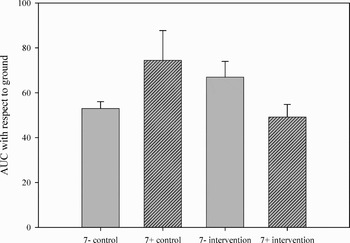
To assess intervention effects on cortisol production, we conducted a univariate analysis of variance with the total daily cortisol production (AUCG) as the dependent variable and experimental condition, long versus short allele of the DRD4 gene and the interaction between DRD4 and experimental condition as predictors. The main effects for intervention, F (1, 126) = 0.06, p = .80, and the presence of the DRD4 7-repeat allele, F (1, 126) = 0.61, p = .44, were not significant. The interaction of experimental condition and DRD4 was significant, F (1, 126) = 7.24, p < .01, partial η2 = .05. Contrasting the intervention children with the 7-repeat DRD4 allele with the other three groups a significant contrast was found, t (47.79, unequal variances) = −2.05, p = .045. Intervention children with the 7-repeat DRD4 allele showed the lowest area under the curve/cortisol production after the intervention (see Figure 1). Whereas intervention children with the 7-repeat DRD4 allele had significantly lower values for cortisol production after the intervention than control children with the 7-repeat DRD4 allele (mean difference = 25.32, SE = 12.09, p = .04), the intervention did not make a significant difference for children without the 7-repeat DRD4 allele (mean difference = 13.94, SE = 8.18, p = .09). The interaction effect of the experimental condition and the presence of the DRD4 7-repeat allele on cortisol was independent of child gender (p = .68), age (p = .81), difficult temperament (p = .61), externalizing behavior (p = .42), and time between wake up and the first cortisol sampling (p = .61).
The cortisol production (area under the curve with respect to ground) of intervention and control children with and without the DRD4 7-repeat allele.

To test whether differences in cortisol production could be ascribed specifically to differences in cortisol production during the morning or during the afternoon we computed the AUC separately for morning and afternoon, employing Pruessner et al.'s (Reference Pruessner, Kirschbaum, Meinlschmid and Hellhammer2003) formula for the two parts of the day separately. A multiple analysis of variance showed a significant multivariate interaction effect, F (2, 125) = 3.60, p = .03; the interaction between experimental condition and DRD4 genotype was significant for cortisol production during the morning, F (1, 126) = 5.96, p = .02, but not during the second half of the day, F (1, 126) = 3.48, p = .07.
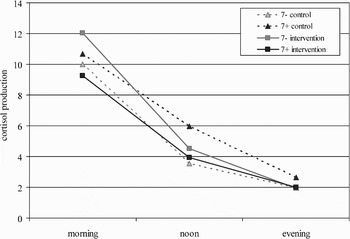
Exploring cortisol levels at the various times of assessment we found a significant interaction effect of experimental condition and DRD4 for cortisol level at noon, F (1, 126) = 4.94, p = .03, partial η2 = .04, indicating that for children with the DRD4 7-repeat allele (but not for children without the 7-repeat allele) the intervention group showed lower levels of cortisol than the control group (see Figure 2). Morning and evening cortisol levels did not show significant main or interaction effects.
The cortisol production (daily curve) of intervention and control children with and without the DRD4 7-repeat allele.

Discussion and Conclusions
In the current randomized controlled trial with 130 1- to 3-year-old children screened for their externalizing behavior, we found an effect of our VIPP-SD program on child basal cortisol level. Intervention children with a DRD4 7-repeat allele showed lower basal cortisol levels compared to the control group receiving only a dummy treatment. Our findings demonstrate that the VIPP-SD affected biobehavioral functioning most in those children who were genetically characterized by a less efficient reuptake of dopamine.
Convergence with previous interventions?
Our VIPP-SD is a brief intervention (about 9 hr of home-based sessions in total) focused on enhancing the quality of parents' interactive behavior toward their children. In this respect, the VIPP-SD is comparable with the ABC program that Dozier et al. (Reference Dozier, Peloso, Lindhiem, Gordon, Manni and Sepulveda2006) showed to be effective in lowering basal cortisol secretion in foster infants and toddlers. Compared to our VIPP-SD intervention experiment and the study by Dozier et al. (Reference Dozier, Peloso, Lindhiem, Gordon, Manni and Sepulveda2006), two other intervention studies on the malleability of basal cortisol through parent training have produced diverging evidence. The intervention studies by Fisher et al. (Reference Fisher, Gunnar, Chamberlain and Reid2000; Fisher & Kim, Reference Fisher and Kim2007) did not show clear-cut and significant overall decreases in cortisol secretion in their samples of formerly maltreated foster children in preschool age. In the Fisher and Kim (Reference Fisher and Kim2007) study the treatment seems to have led to higher cortisol levels instead of lower levels. It is important that the effect was reported among children selected for very low cortisol levels, and only morning cortisol was taken into account. The Fisher and Kim (Reference Fisher and Kim2007) paper is a preliminary report and the final results might be different. Their intervention based on social learning principles emphasized contingent parental responses to positive and negative child behavior. It should be noted that in the De Wolff and Van IJzendoorn (Reference DeWolff and Van IJzendoorn1997) meta-analysis contingent responsiveness differed from sensitivity in the sense of attachment theory, with lower effect sizes for the association with attachment security. If the absence of a lowering effect is replicated, we speculate that the discrepancy in outcome is not so much caused by the deprived background of the children (which is similar to Dozier et al.'s sample) but by the different intervention methods. The attachment-based content of ABC and VIPP-SD might be crucial in enhancing parents' capacity to buffer a hyporesponsive neuroendocrine stress system, comparable to the effectiveness of increased maternal licking and grooming in rodents (Gunnar, Fisher, and the Early Experience, Stress, and Prevention Network, Reference Gunnar and Fisher2006; Kaffman & Meaney, Reference Kaffman and Meaney2007; Meaney, Reference Meaney2001; Meaney & Szyf, Reference Meaney and Szyf2005).
The moderating role of DRD4
In our investigation on infants and toddlers living with their biological parents we did find an important genetic moderator: children with the DRD4 7-repeat alleles profited most from the VIPP-SD intervention. In previous studies the dopamine system has been associated with deficits in attention, state regulation, and orienting responses, and with aggression and ADHD in children, and also with alcohol and drug addiction in adults (Benjamin, Ebstein, & Belmaker, Reference Benjamin, Ebstein and Belmaker2002; Ebstein et al., Reference Ebstein, Benjamin, Belmaker, Plomin, DeFries, Craig and McGuffin2002). Its influence on human functioning seems to be broad and rather nonspecific. State regulation may influence cognitive processes involved in the emergence of attachments, as well as other aspects of socioemotional development, and it may also be associated with the neuroendocrine stress system (Pivonello et al., Reference Pivonello, Ferone, Lombardi, Colao, Lamberts and Hofland2007). The finding of Field et al. (Reference Field, Hernandez-Reif, Diego, Feijo, Vera and Gil2004) that massage therapy did lead to a decrease in cortisol production in pregnant women, and at the same time to an increase in dopamine might point in that direction. In Meaney's work on rat models for stress (dys-)regulation a similar connection between the dopamine system and corticosterone production seems to be present (Meaney, Reference Meaney2007). If further research would confirm that the dopamine system is important for state regulation in infants and connected to HPA-axis functioning (Savitz, Solms, & Ramesar, Reference Savitz, Solms and Ramesar2006), one interpretation of its moderating role in the VIPP-SD intervention effects may be that infants with less adequate state regulatory abilities profit most from the sensitive structuring of their environment and the responsive regulation of their behaviorally overactive and oppositional interactions, with buffered basal cortisol secretion as corollary.
Indirect evidence for such a moderating role of DRD4 was found in an earlier, descriptive study. Maternal insensitivity was associated with externalizing (oppositional, aggressive) behaviors, but only in the presence of the DRD4 7-repeat polymorphism. Moreover, in addition to the increase in externalizing behaviors in children with the 7-repeat allele exposed to insensitive care, children with the 7-repeat allele exposed to sensitive care showed the lowest levels of externalizing behavior (Bakermans-Kranenburg & Van IJzendoorn, Reference Bakermans-Kranenburg and Van IJzendoorn2007). Thus, children were differentially susceptible to both sensitive and insensitive parenting dependent on the presence of the 7-repeat DRD4 allele, which supports the idea that genetic and environmental effects on child development may be contingent upon G × E co-action (Rutter, Reference Rutter2006). In a similar vein, greater susceptibility to the VIPP-SD of children with the long variant of DRD4 might also imply differential openness for experimentally induced changes in the child rearing environment that lead to a better fit between parent and child, and to more adequate modulation of the stress system.
In a previous report on a larger sample (without analyses of cortisol and therefore not excluding about 17% of the cases for whom cortisol was not collected) we presented evidence for a larger intervention effect on externalizing behaviors in toddlers with a 7-repeat allele of the DRD4 gene (Bakermans-Kranenburg et al., Reference Bakermans-Kranenburg, Van IJzendoorn, Pijlman, Mesman and Juffer2008). Children with the 7-repeat allele showed the largest decrease of externalizing behaviors after the intervention, and they did so even more when we observed substantial increase in the use of parental-positive discipline. These findings indicate that children are differentially susceptible to experimentally induced changes in the environment depending on genetic differences. The advantage of experimentally manipulated G × E interactions is that they leave little room for alternative interpretations in terms of G × E correlations. Unfortunately, in the current study on a smaller subset of the same sample, we did not find associations between (change in) basal cortisol and (change in) parent or child behavior, which leaves open the question as to what exact mechanism is responsible for the experimentally induced decrease in cortisol secretion.
Why is a brief, focused intervention effective?
What might explain the effectiveness of sensitivity-focused interventions such as the VIPP-SD and ABC? It is remarkable that in both cases the intervention sessions lasted only 9–10 hr in total for each family, and that in both interventions most emphasis was on changing parenting instead of child behavior. We feel that the following reasons might count for the effectiveness of brief and behaviorally focused attachment-based parent training programs (Van IJzendoorn, Bakermans-Kranenburg, & Juffer, Reference Van IJzendoorn, Bakermans-Kranenburg, Juffer, Berlin, Ziv, Amaya-Jackson and Greenberg2005). First, long-term and broadly focused parent support programs may take too much time and energy away from a potentially effective, goal-directed intervention approach. Second, sensitivity-focused interventions are characterized by well-defined and relatively modest aims. Such interventions may not change parents' general unfavorable life circumstances, but they may equip parents with better parenting and discipline skills despite their untoward situation. Third, the “average” intervener may more easily understand and learn the protocol of sensitivity-focused interventions, and focused interventions thus may capitalize on the intervener's expertise. Fourth, treatment adherence is easier to accomplish. Whereas interveners may be able to stick to the protocol of a sensitivity-focused program, it may be much more difficult to implement a long-term broadband intervention in a “standard” way. Fifth and finally, interveners may easily become overburdened, and staff turnover may increase with the duration of the intervention (see Spieker, Nelson, DeKlyen, & Staerkel, Reference Spieker, Nelson, DeKlyen, Staerkel, Berlin, Ziv, Amaya-Jackson and Greenberg2005). In addition, long-term interventions may create unfeasible obligations for the participating families, resulting in high and selective attrition.
The most powerful aspect of sensitivity-focused interventions might be that the parent is taught to closely observe the child's signals and responses. Video-feedback intervention stimulates the parent to have an eye for the feedback from the child rather than from an intervener. When the parent begins to see the grateful smile on the face of their child as a reaction to sensitive parenting, the child takes the intervener's place. This mechanism of the children's reinforcement of their parents' successful interactive behaviors may partly explain the long-term effects of relatively brief interventions (Klein Velderman, Bakermans-Kranenburg, Juffer, Van IJzendoorn, Mangelsdorf, et al., Reference Klein Velderman, Bakermans-Kranenburg, Juffer, Van IJzendoorn, Mangelsdorf and Zevalkink2006), because the process of feedback may continue after the intervener leaves the home. The child develops into a “co-intervenor” and the parent is thus blessed with the most continuous support (Juffer et al., Reference Juffer, Bakermans-Kranenburg and Van IJzendoorn2008). The child, in contrast, experiences anticipatory modulation of stress and distress responses by a more dependable parent who prevents or mediates situations of overstimulation and excessive stresses that may go beyond the child's self-regulatory capabilities.
Limitations
The size of our sample is substantial but the power to find replicable (G × E) interactions remains of course modest, even with a sample size of N = 130. Experimental proof for the importance of (measured) G × (measured) E interactions is crucial as it may illuminate how genetics contribute to both the dynamics and the outcome of development (Michel & Moore, Reference Michel and Moore1995; Moffitt, Reference Moffitt2005; Moffitt, Caspi, & Rutter, Reference Moffitt, Caspi and Rutter2005; Rutter, Reference Rutter2006). But the assumption that large samples will be needed to study the interplay between nature and nurture (Luan, Wong, Day, & Wareham, Reference Luan, Wong, Day and Wareham2001; Colhoun, McKeigue, & Davey Smith, Reference Colhoun, McKeigue and Davey Smith2003) may not be correct if the effects are as strong as they seem to be, at least in some cases. It should be noted that both the human and animal findings on G × E interactions were derived from modest sample sizes. Better measurement of the environment and its experimental manipulation is crucial (Rutter, Reference Rutter2003; Wong, Day, Luan, Chan, & Wareham, Reference Wong, Day, Luan, Chan and Wareham2003). In addition, the choice of few candidate genes is important to prevent capitalization on chance through a fishing expedition. Until now we have focused only on the DRD4 polymorphisms as a consequence of previous findings pointing to their importance for emotion regulation. Nevertheless, our finding of a DRD4 moderator effect should be replicated.
In the current investigation we were unable to find a mediating factor to explain the greater change in cortisol production in the group of experimental children with the long DRD4 variant. We did not measure the experimentally induced change in parenting or wider aspects of the child rearing environment that was responsible for the resulting decrease in cortisol secretion, in particular in this specific, more susceptible subgroup. The parenting measures for sensitivity and discipline used in the current study may have been insufficiently sensitive to uncover the mediating mechanism. Therefore, it remains to be seen what change in their rearing environment the experimental children did experience exactly as more supportive of their stress regulatory capacity. Similarly, in the current sample daily cortisol production appeared to be unrelated to child behavior, so it is unclear what the behavioral concomitants of the decrease in cortisol secretion happen to be. Future investigations should focus on parental mediators and child behavior correlates of induced changes in basal cortisol. Moreover, in future studies the accuracy of the assessment of basal cortisol levels might be further enhanced by including more than 1 day of sampling, and the use of Trak Caps automatically recording the exact timing of cortisol sampling.
Conclusion
Attachment-based interventions focusing on parents' interactions with their infants and toddlers may lower their children's basal cortisol level, not only in maltreated children but also in children with high levels of externalizing behavior. Some children may be more susceptible to the influence of the intervention than others, and we found that the DRD4 gene may be responsible for (part of) the differential effectiveness of the VIPP-SD program. Because the program is relatively brief, with six 1.5-hr sessions, this randomized control trial supports the concept of the plasticity of young children's neuroendocrine stress system through the buffering influence of sensitive parenting, parallel to Meaney's (Kaffman & Meaney, Reference Kaffman and Meaney2007) findings on the impact of increased licking and grooming in rats. As we know from studies on adopted children who were in orphanages for a substantial period of their first years of life, the same neuroendocrine stress system might be negatively affected (Gunnar et al., Reference Gunnar, Morison, Chisholm and Schuder2001). Growing up in the deprived and sometimes neglectful group setting of orphanages may lead to a dysregulated stress system.
The plasticity of basic neurobiological processes in young children, for better or for worse, may make behavioral scientists as well as clinicians more optimistic about the effectiveness of interventions to promote children's well-being. Our interventions might be more effective than is usually assumed for two reasons: first, their effects might be substantial but only in some of the children because of the influence of G × E interactions, and second, because behaviorally focused interventions may have hidden effects on the neurobiological level that we are just beginning to unravel.