Introduction
The prevalence of anxiety among persons with dementia is conservatively estimated to be 35% (Seignourel et al., Reference Seignourel, Kunik, Snow, Wilson and Stanley2008). Anxiety coexistent with dementia is associated with increased behavioral problems and limitations in activities of daily living (Teri et al., Reference Teri1999), decreased independence (Porter et al., Reference Porter2003), and increased risk of nursing-home placement (Gibbons et al., Reference Gibbons2002). Despite the serious impact and challenge that coexistent anxiety poses for dementia care, no controlled clinical trials have specifically addressed treatment for anxiety among people with dementia. In fact, randomized controlled trials (RCTs) of late-life anxiety treatments typically exclude persons with cognitive impairment (Wetherell et al., Reference Wetherell, Gatz and Craske2003).
Several lines of evidence make a compelling case for the potential effectiveness of CBT for anxiety in persons with dementia. First, CBT is an effective treatment for anxiety in older adults without cognitive impairment (Thorp et al., Reference Thorp, Ayers, Nuevo, Stoddard, Sorrell and Wetherell2009). Second, CBT's effectiveness may be less dependent on the presence of abstract reasoning abilities in comparison to less structured forms of therapy (Doubleday et al., Reference Doubleday, King and Papegeorgio2002). Third, case reports support the use of CBT for anxiety and depression in persons with dementia (e.g. Koder, Reference Koder1998). Fourth, RCTs support the effectiveness of the behavioral techniques of CBT for depression in persons with dementia (e.g. Teri et al., Reference Teri, Logsdon, Uomoto and McCurry1997). Fifth, research indicates that individuals with dementia can learn new skills (Camp et al., Reference Camp, Koss, Judge and Lichtenberg1999).
On the basis of these lines of evidence, our group developed Peaceful Mind, a form of CBT for anxiety in persons with dementia. Procedures were drawn from cognitive-behavioral interventions with demonstrated efficacy for treating anxiety and depression in cognitively intact older adults (Quijano et al., Reference Quijano2007; Stanley, et al., Reference Stanley2009). Modifications were made to meet the needs of participants with dementia, informed by a review of the empirical literature (Snow et al., Reference Snow, Powers, Liles, Hyer and Intrieri2006). The Peaceful Mind protocol was developed, piloted and modified over two years, using a case series of seven participants. During treatment development, feedback was sought from experts in the field, clinicians, clinical supervisors, and participants themselves. These preparations resulted in the final design of the open trial, for which a consistent assessment and intervention protocol was implemented. Herein we describe the intervention, results of an open trial evaluating the feasibility and utility of the intervention, and assessment procedures.
Methods
Peaceful Mind Treatment
Structure
Treatment was provided over six months. During the first three months, up to 12 weekly in-person sessions, lasting 30 to 60 minutes, were provided in the participant's home. Each session was followed by a brief telephone call. Over the second three months of treatment, telephone booster sessions occurred weekly for four weeks and biweekly for eight more weeks for a total of 12 weeks. Telephone appointments were used to review and reinforce skill practice, problem-solve skill-implementation difficulties, provide encouragement, and answer questions while speaking with the participant and the collateral separately.
A collateral, defined as a friend or family member who spent at least eight hours a week with the participant, attended each session to learn the skills and coach participant practice between sessions. The clinician worked with the dyad to determine the collateral's involvement in homework, based on both individuals’ levels of skill and understanding, collateral availability, and participant comfort. The plan for the role of the collateral in coaching the week's daily practice was discussed during the in-person session and recorded in workbooks. The nature and intensity of collateral involvement in coaching fluctuated over the course of treatment, depending on the type of skill and duration of prior practice, the availability of the collateral, and the ability of the participant to practice skills between sessions without collateral assistance.
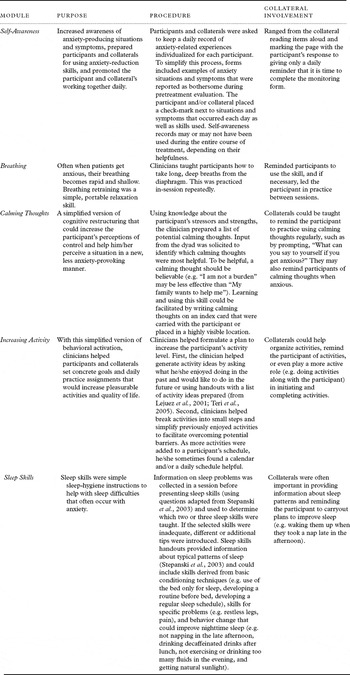
The clinician manual included modules teaching self-awareness, breathing, calming statements, increasing activity, and sleep skills. See Table 1 for a full description of the modules. The clinician could decide with input from the dyad which skills best fit the participant's symptoms and abilities. Though not all skills had to be taught to all participants, in most cases, treatment began with self-awareness and breathing. The participant and collateral received workbooks with an introduction to the treatment, as well as information and material to help them learn, carry out, and plan for use of each skill that was taught. Handouts were added to the workbooks as treatment progressed
A description of the purpose, contents, and collateral involvement in each module of the Peaceful Mind program

Each session began with review of a printed agenda for the session, which included the clinician's name, name and purpose of the program, date, session number, and goal of the meeting. The clinician then reviewed homework and prior skills. Next, a new skill was taught and practiced in-session. Lastly, the clinician guided the participant and collateral in formulating a plan for practicing the skills over the next week, including how the collateral would be involved.
Several structural aspects of the treatment were incorporated to help increase participant and collateral motivation to learn and use the skills. First, the participant was the identified target, and initial instructions were always directed toward him or her. Second, the collateral's efforts were supported by the clinician and, if clinically indicated, collaterals were given brief handouts (1–2 pages) about how to obtain more information about dementia (e.g. talk with their medical provider, contact the Alzheimer's Association, etc.), communicate with the person with dementia (Alzheimer's Association, 2005b), and increase their own self-care (Alzheimer's Association, 2005a). Third, participants and collaterals could voice their concerns privately via the between-session telephone check-ins.
Techniques to enhance learning
Several modifications to traditional CBT for late-life anxiety were made to enhance learning. First, skills emphasized behavioral rather than cognitive interventions. Second, only one skill was introduced at a time; and fewer total skills were offered. Third, a significant portion of each session was spent in repetition and practice. If possible, the practice in-session was performed exactly as it would be performed between sessions (e.g. with collaterals prompting the participant in the agreed-upon manner). Fourth, clinicians used visual cues to help the participant remember to practice and use the skills. These cues included note cards (carried with the participant or left in visible places), calendars, or notebooks. Fifth, the collateral was important in reminding the participant to use the skills, with the participant deciding what kinds of reminders would be helpful. Lastly, clinicians used spaced retrieval (SR) to improve memory for use of new skills.
SR is an evidence-based, restorative method for improving encoding and retrieval (Camp, Reference Camp, Koss, Judge and Lichtenberg1999). As SR relies primarily on procedural memory (which remains intact late into the progression of dementia), motor activity is incorporated into the learning process whenever possible. For example, when practicing the use of cueing materials (e.g. note cards), participants are instructed to pick up the cueing material and use it appropriately (e.g. repeat the calming thought). The SR technique consists of repeated trials of retrieving target information at increasing intervals of time. When retrieval failure occurs, the clinician gives the participant the correct information and asks him/her to repeat it immediately. The next retrieval interval is shortened to the most recent successful retrieval interval. The interval continues to decrease until the participant provides the correct answer. At this point, expansion between intervals continues until another error occurs (Camp, Reference Camp, Koss, Judge and Lichtenberg1999). When participants displayed difficulty remembering to use skills, Peaceful Mind used these basic tenets of SR. For example, if participants had difficulty remembering calming thoughts, they were written on a note card and the participant was asked, “What should you do if you feel anxious?” The participant was taught to respond by picking up the note card and reading the calming statement. This process was repeated at increasing intervals of time.
Procedures
Recruitment
Participants were recruited from the geriatric, neurology, and psychiatry clinics at a large Veterans’ Affairs (VA) medical center and through the geriatrics and neurology clinics affiliated with a medical school. Potential participants were recruited via screening at VA clinic appointments (n = 33), direct provider referrals (n = 25), or self-referrals from brochures located in clinic waiting rooms (n = 9).
Screening
Brief telephone or in-person interviews (10 minutes) were conducted following referral. Of the 67 referrals, 54 potential participants were excluded because they had insufficient documentation of dementia in their medical record (n = 8); could not communicate with the interviewer, indicating too much impairment to participate in the treatment (n = 8); were younger than 60 years (n = 2); were not interested in participating (n = 30); were unable to be contacted (n = 3); or collaterals reported that anxiety was not a problem for the participants (n = 3).
During the first in-person assessment session with the 13 remaining potential participants, clinicians obtained informed consent from both participants and collaterals, gathered demographic information, and administered measures to determine whether or not participants met inclusion criteria. All 13 participants met the following inclusion criteria: (i) collateral and participant were fluent in English; (ii) collaterals spent at least eight hours per week with participant; (iii) the participant had a Neuropsychiatric Inventory – Anxiety (NPI-A) subscale (Cummings et al., Reference Cummings, Mega, Gray, Rosemberg-Thompson, Carusi and Gornbein1994) score ≥ 4; (iv) Clinical Dementia Rating scale (CDR; Morris, Reference Morris1993) was between 0.5 and 2.0, indicating mild-to-moderate levels of dementia (the Dementia Rating Scale-2 (Mattis, Reference Mattis2001) was administered to help determine cognitive functioning scores on the CDR); (v) primary psychiatric diagnosis was not major depression (from the Mini International Neuropsychiatric Inventory (MINI) taking into account input about the participant's behaviors, thoughts, and feelings from both the participant and collateral (Sheehan et al., Reference Sheehan1998) – if multiple diagnoses were given, the primary psychiatric diagnosis was recorded as the one that was reported as the most bothersome and interfering in the participant's life, and, in the case of coexistent generalized anxiety disorder and major depression, generalized anxiety disorder was diagnosed only if the symptoms preceded onset of depression); and (vi) there were no reports of current psychosis or bipolar disorder, suicide intent, or recent verbal or physical aggression. Four participants were training cases for clinicians and independent evaluators, leaving nine participants for inclusion in the open trial.
Assessment of anxiety
As there is no standard for the assessment of anxiety among individuals with dementia, several different measures with varying methods of administration were used.
The seven-item NPI-A scale was designed to measure anxiety in persons with dementia (Cummings et al., Reference Cummings, Mega, Gray, Rosemberg-Thompson, Carusi and Gornbein1994). It was administered to the collateral alone, requesting information about the frequency and severity of the participant's anxiety symptoms, as well as the collateral's distress caused by anxiety symptoms over the previous week.
The Rating Anxiety in Dementia scale (RAID; Shankar et al., Reference Shankar, Walker, Frost and Orrell1999) consists of 18 anxiety-related items rated 0 (absent) to 3 (severe) over the previous week. Items assess symptoms in four categories: worry, apprehension and vigilance, motor tension, and autonomic hyperactivity. The RAID uses input from all available sources (participants, collaterals, providers).
The Penn State Worry Questionnaire-Abbreviated (PSWQ-A; Crittendon and Hopko, Reference Crittendon and Hopko2006) is an eight-item self-report inventory designed to measure the severity of worry. Though no known studies have used this measure in populations with dementia, among older adults in general, the PSWQ-A has strong psychometric properties and significant correlation with the full PSWQ (Crittendon and Hopko, Reference Crittendon and Hopko2006), which is used widely in clinical trials of late-life anxiety (Stanley et al., Reference Stanley2003; Wetherell et al., Reference Wetherell, Gatz and Craske2003).
The Geriatric Anxiety Inventory (GAI; Pachana et al., Reference Pachana, Byrne, Siddle, Koloski, Harley and Arnold2007) contains 20 agree/disagree items. It was developed as a brief assessment instrument to measure the severity of anxiety, specifically, in an older-adult population (Pachana et al., Reference Pachana, Byrne, Siddle, Koloski, Harley and Arnold2007).
Assessment of depression
Coexistent depressive symptoms and diagnoses occur frequently in older adults with and without dementia (Teri et al., Reference Teri1999; Porter et al., Reference Porter2003). Moreover, many of the coping strategies provided in Peaceful Mind may reduce severity of both anxiety and depressive symptoms. For these reasons, this study included participants with anxiety and coexistent depression and measured depressive symptoms consistent with other outcome studies of anxiety treatment in later life (Thorp et al., Reference Thorp, Ayers, Nuevo, Stoddard, Sorrell and Wetherell2009). The Geriatric Depression Scale (GDS; Yesavage et al., Reference Yesavage1983) is a self-report measure of depression with 30 yes/no items related to how the participant has felt over the past week.
Assessment of behavior problems and collateral response
The Revised Memory and Behavior Problems Checklist (RMBPC; Teri et al., Reference Teri, Truax, Logsdon, Uomoto, Zarit and Vitaliano1992) contains 24 items on which collaterals use a 0–4 scale to rate the memory, behavior and mood problems in persons with dementia, as well as the degree to which each bothers the collateral.
Assessment of treatment satisfaction
The Client Satisfaction Questionnaire (CSQ; Larsen et al., Reference Larsen, Attkisson, Hargreaves and Nguyen1979) is an eight-item, empirically derived, self-report measure that is used to assess patient satisfaction with services. Ratings are given on a Likert scale from 1 to 4, with 1 indicating dissatisfaction and 4 indicating complete satisfaction.
Independent evaluation
Independent evaluators (IEs) who had no other involvement with the participant administered outcome measures at baseline, three months (after in-person sessions), and six months (post-treatment), with the exception of the CSQ, administered only at three and six months. IEs administered the RAID, asking for input from both participant and collateral. Alone with the participants, IEs administered the PSWQ, GAI, GDS, and CSQ orally to eliminate any potential impact of reading problems. Separately, the collaterals reported on their own feelings by completing the RMBPC and CSQ.
Treatment clinicians
Clinicians administering the treatment were advanced clinical psychology doctoral graduate students. All sessions were audiotaped, and supervision was provided by clinical psychologists and a social worker with expertise in the treatment of anxiety among older adults (MS, NW or CK).
Assessment of use of skills
At the start of each session, clinicians collected feedback about which skills were used since the last meeting. Skills were classified as being used over the course of treatment if use was reported between two or more treatment sessions.
Analyses
As this was a small pilot study designed to assess the feasibility and potential usefulness of a treatment protocol, we did not include enough participants to detect statistically significant changes. Thus, we report on numbers of individuals who improved or worsened over the course of treatment by considering improvement to be a 20% or more reduction from the baseline score. This figure is commonly used as an index of response in late-life anxiety-treatment studies (Stanley et al., Reference Stanley2003; Wetherell et al., Reference Wetherell, Gatz and Craske2003).
Results
Participants
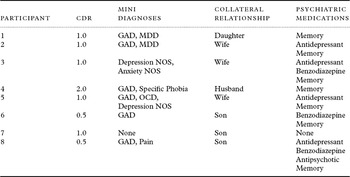
Nine participants were included in the open trial, but one dropped out after only one session. Of the eight participants who completed the treatment protocol, the average age was 77 years (range 67–89), there were five male and three female participants, and ethnicities were Caucasian (n = 6), Hispanic (n = 1), and African-American (n = 1). Types of dementia included Alzheimer's (n = 5), vascular (n = 2), and not otherwise specified (n = 1). Seven participants reported taking psychiatric medications. Dementia severity, MINI diagnoses, collateral relationships, and types of psychiatric medications for individual participants are presented in Table 2.
Dementia severity, MINI diagnosis, collateral relationship, and psychiatric medication data on the eight participants who completed the treatment protocol

CDR = Clinical Dementia Rating scale; MINI = Mini International Neuropsychiatric Inventory; GAD = generalized anxiety disorder, MDD = major depressive disorder; NOS = not otherwise specified; OCD = obsessive-compulsive disorder.
Treatment involvement
Treatment involvement was high overall (see Table S1 for individual participant data; published online as supplementary material to the electronic version of this paper at http://www.journals.cambridge.org/ipg). Three-quarters (6/8) of the participants completed at least nine of the 12 possible sessions, with the average number of sessions completed being 9.5 (range 5–12). The average session length was 53 minutes, with means for individual participants ranging from 38 to 60 minutes. During the second three months of study involvement, participants completed an average of 6.9 out of the eight possible booster calls. Most participants and collaterals were taught and used self-awareness (100% taught; 88% used), breathing (100% taught; 100% used), calming thoughts (100% taught; 75% used), and activity planning (88% taught; 88% used) skills. However, sleep skills were only infrequently used (63% taught; 25% used).
Outcome measures
Results are reported as percentages of individuals with baseline and follow-up data whose scores suggested improvement (see Tables S2 and S3 for individual patient data at baseline, 3 months, and 6 months for the eight participants who completed treatment; published online as supplementary material to the electronic version of this paper at http://www.journals.cambridge.org/ipg). Several participants did not complete all measures at all time points: Participant 1 did not complete a three-month NPI-A; Participant 6 did not complete a six-month NPI-A; and Participant 8 did not complete the six-month assessment because of illness.
Anxiety
Most participants improved their anxiety symptoms (i.e. had a 20% or more reduction from baseline), according to the NPI-A, at three months (86%; 6/7) and at six months (66%; 4/6). According to the RAID, 25% of patients (2/8) were improved at three months and 57% (4/7) at six months. On the PSWQ-A, 50% (4/8) of the participants reported improvement at three months and 43% (3/7) at six months. On the GAI, 38% (3/8) of participants reported improvement at three months and 43% (3/7) at six months. However, three of the participants scored 0 on this measure at baseline, so no positive changes were possible.
Secondary outcomes
Most participants reported reduced depressive symptoms according to the GDS; 75% (6/8) at three months and 57% (4/7) at six months. At three and six months, 71% (5/7) and 50% (3/6) of collaterals, respectively, reported that their distress over the patient's anxiety had decreased (NPI-A distress question). On the RMBPC, only one collateral reported improvement in participant memory, behavior, and mood problems at each time-point, 13% (1/8) at three months and 14% (1/7) at six months. However, 38% (3/8) of collaterals reported decreased distress over the client's memory, behavior, and mood problems at three months and 57% (4/7) at six months.
At three months, the average satisfaction (CSQ) rating for participants was 28.9 (range 24–32) and for collaterals was 29.1 (range 26–32), indicating high satisfaction with treatment. Satisfaction ratings remained high at six months (participant M = 28.8; collateral M = 29.7).
Discussion
Overall, data from this open trial suggest that there are potential benefits of Peaceful Mind, a cognitive-behavioral intervention for anxiety among persons with dementia. The high completion rate indicates that the treatment and assessment protocol is feasible in this population. The average number of sessions completed (9.5) is notable given the frequent physical illnesses experienced by this population; and the average length of each session indicated that participants were able to maintain attention and involvement in the treatment. Overall, participants and collaterals reported that they were satisfied with and benefited from the treatment in terms of anxiety, depression and collateral distress, which indicates that the intervention has potential utility.
Participants and collaterals reported using almost all skills with only sleep skills being infrequently used. Although sleep problems commonly occur in older people, particularly those with anxiety and depression (Mallon et al., Reference Mallon, Broman and Hetta2000), sleep disturbances may be low on the list of bothersome symptoms for individuals with dementia and anxiety and their caregivers (Ferretti et al., Reference Ferretti, McCurry, Logsdon, Gibbons and Teri2001). Sleep problems also may have been addressed by other skills, such as breathing, calming thoughts, and activity planning, which reduced anxiety and/or left less time for daytime naps.
Anxiety did not improve for all participants on all measures, but the only participant who did not improve on any measure of anxiety was unable to complete the treatment protocol because of significant health problems and an extended hospitalization. Most collaterals reported decreased participant anxiety on the NPI-A, but results were more mixed for other measures. The most consistent decrease may have been shown on the NPI-A because this was the measure by which participants were screened and a minimal score was required for study inclusion. The mixed results for other measures may have occurred because each assesses different symptoms, resulting in low correlations between measures of anxiety in persons with dementia (Gibbons et al., Reference Gibbons, Teri, Logsdon and McCurry2006). Additionally, the different sources of information from which measures were obtained may have further lowered consistency between measures (i.e. NPI-A: collateral report alone; RAID: participant and collateral report together and final rating by clinicians; GAI and PSWQ-A: participant report alone).
Although not a focus of treatment, depression, problematic participant behaviors and collateral distress were measured as previous studies have found that behavioral interventions are effective for these problems (e.g. Teri et al., Reference Teri, Logsdon, Uomoto and McCurry1997; Reference Teri, McCurry, Logsdon and Gibbons2005). Participants reported reduced depression, indicating that the intervention may be beneficial in treating both anxiety and depression in this population. Treatment did not seem to affect problematic participant behaviors; and it is not surprising that there was some report of increases in this area, given the typically degenerative nature of dementia. Reduction in collateral distress about anxiety symptoms and general problematic participant behaviors indicate that, though this treatment is demanding of the collateral, collaterals seem to benefit.
For many outcomes, positive effects decreased from the three-month assessment to the six-month assessment, indicating that the effects of the treatment may decrease after in-person sessions are completed. Effects of the treatment might be maintained better with intermittent in-person follow-ups to help apply the skills to new problems that arise (e.g. new medical problems, further cognitive decline).
This population was heterogeneous in several ways, including the nature of anxiety, level of cognitive impairment and functional status, and manner in which participants and collaterals wanted to work together (e.g. practicing skills together or just providing reminders). This heterogeneity required significant clinician flexibility with regard to how to integrate collaterals, what skills to teach, and how to use memory aids. Though the treatment avoided focusing on relationship issues, these often arose, and at times the skills built into the treatment protocol were used to help with relationship problems. Greater standardization of this component of treatment may be needed for further investigations of treatment effects. Increased attention to the decisions that underlie variations in treatment also might be useful.
This study has several limitations, foremost of which are small sample size and lack of a control group. These factors, coupled with the population's heterogeneity, hinder our ability to draw specific conclusions. Second, results for different measures were not consistent even within participants, which, though consistent with prior studies (e.g. Gibbons et al., Reference Gibbons, Teri, Logsdon and McCurry2006), creates concerns about the validity of measures of anxiety in this population. Third, there were problems with several measures, including the floor effect of the GAI. Fourth, should this therapy be shown effective in further trials, it may be difficult to disseminate as it is time-intensive and was administered within the home. Less time-intensive interventions that may be administered by paraprofessionals, such as relaxation therapy, may be as effective as time-intensive CBT in this population, as has been indicated for older adults without cognitive impairment (Thorp et al., Reference Thorp, Ayers, Nuevo, Stoddard, Sorrell and Wetherell2009).
Regardless of limitations, the overall trend of the results was favorable and participants and collaterals were mostly satisfied with the treatment. This study is unique, given the focus on anxiety and attention to working directly with persons who have dementia and their collaterals/caregivers rather than intervening primarily through caregivers as in other treatment studies (e.g. Teri et al., Reference Teri, Logsdon, Uomoto and McCurry1997). Focusing treatment on the participant and conceptualizing the collateral as a coach may encourage a sense of control in the person with dementia, which is theorized to be central to decreasing anxiety (Alloy et al., Reference Alloy, Kelly, Mineka, Clements, Maser and and Cloninger1990). Additionally, this approach to treatment might help participants accept help from the collateral by encouraging them to work with loved ones to make decisions about how they want help to cope with problems.
Conclusions
Peaceful Mind, a cognitive-behavioral treatment for anxiety in persons with dementia, has potential utility for treating anxiety among persons with dementia. This open trial demonstrated that it is feasible to implement and test its effects and, thus, that it warrants future study in an RCT with some changes from the open trial protocol. First, as sleep skills were rarely used, it is suggested that focus on them be reduced. However, because sleep problems can be very disruptive, sleep skills should remain available to participants who report sleep as a central problem. Second, as participants’ and collaterals’ reports of improvement were not consistent across measures, additional validation work is needed to establish standards for outcome assessment in this population. Third, more information about potential moderators should be gathered to determine their effect on treatment outcome, including medical comorbidities and the effects of supplementary handouts. With these changes and the knowledge gained from this open trial, an RCT will help determine whether this promising new treatment approach has a significant impact on anxiety in this population.
Conflict of interest
None.
Description of authors’ roles
A. Paukert was a study therapist and assisted in treatment and assessment protocol development and implementation, and led preparation of the paper. J. Calleo assisted in assessment and treatment implementation, was a study therapist, supervised data entry, completed data analysis, managed institutional review board issues, and assisted in writing the paper. C. Kraus-Schuman assisted in assessment and treatment design and implementation, supervised study therapists, and helped to edit the paper. A. Snow led the assessment design and implementation, supervised independent evaluators, and helped to edit the paper. N. Wilson assisted in assessment and treatment design, recruitment of participants, supervision of treatment and inclusion/exclusion assessments, treatment implementation, and helped to edit the paper. N. Petersen was responsible for the statistical design, analysis of the study, and helped to edit the paper. M. Kunik assisted in participant recruitment and assessment, treatment design, treatment implementation, and helped to edit the paper. M. Stanley designed the study, supervised study implementation and staff, assisted with therapy and inclusion/exclusion assessments, and assisted in writing the paper.
Acknowledgments
The authors thank the following individuals who served as consultants for this study: Patricia Arean, Ph.D., University of California – San Francisco; Cameron Camp, Ph.D., Hearthstone Alzheimer Care; Laura Gitlin, Ph.D., Thomas Jefferson University; and Linda Teri, Ph.D., University of Washington. These individuals received financial compensation from the grant for their contributions. This work was supported in part by a grant from the National Institute of Mental Health (R34-MH078925) to M.S. and by the Houston VA HSR&D Center of Excellence (Houston Center for Quality of Care and Utilization Studies [HFP90-020]).