1 Introduction
Increasing human life time has put great pressure on public old age pension systems in many countries. Governments face a challenge of inspiring citizens to save for retirement, thereby reducing longevity issues for the national economies. As a consequence, economically attractive retirement savings programs have been introduced. The most characteristic features of these programs are (1) reduced investment return tax on retirement savings and (2) exempt labour income tax on contributions to retirement savings, where benefits are subsequently taxed at a lower tax rate. The latter feature is often criticized for favouring people with high labour income (due to progressive income taxation, see Gale et al., Reference Gale, Orszag and Gruber2006), and for being excessively costly for governments (costs for various OECD countries are estimated in Antolín et al., Reference Antolín, de Serres and de la Maisonneuve2004, Yoo & de Serres, Reference Yoo and de Serres2004 and Caminada & Goudswaard, Reference Caminada and Goudswaard2004). For these reasons, substituting tax exempt contributions with bonuses on contributions is proposed in Gale et al. (Reference Gale, Orszag and Gruber2006), and tax regimes with this feature are now introduced (e.g. the German Riester scheme has this feature, see Börsch-Supan et al., Reference Börsch-Supan, Reil-Held and Schunk2008 and Corneo et al., Reference Corneo, Keese and Schröder2008).
Tax treatment of life insurance comes in several varieties. Even within a country there are different schemes allowing for different tax treatment of premiums and benefits (sum paid out upon death). In general, premiums are either paid by income-taxed money and benefits are tax free, or premiums are exempt from labour income tax and the benefits taxed. For the latter case, the benefits taxation is typically done by a tax rate that depends on the income of the inheritor, which potentially leads to tax favouring or even disfavouring of life insurance. Several studies of the relation between bequest motives, tax incentives and life insurance purchase has been carried out, this list is not complete: Sauter et al. (Reference Sauter, Walliser and Winter2010) provide a study of tax incentives and bequest motives on demand for life insurance, based on data from Germany. Sweeting (Reference Sweeting2009) investigates the tax treatment of pensions and saving incentives in the UK. Jappelli & Pistaferri (Reference Jappelli and Pistaferri2003) analyze data on the tax treatment of life insurance and the introduction of incentives for life insurance in Italy. Finally, Bernheim (Reference Bernheim1991) presents empirical evidence that savings are motivated by a desire to leave bequests.
In this paper we consider a model for decision of optimal consumption, investment and life insurance purchase for an individual that is subject to different tax regimes. The model is based on Richard (Reference Richard1975), who considers the same problem without taxationFootnote 1. For the numerical investigation performed here, we parameterize our model in terms of a household model in the notion of Bruhn & Steffensen (Reference Bruhn and Steffensen2011). They develop a model for optimal consumption, investment and life insurance purchase for a general household consisting of multiple members. A similar model is developed in Huang & Milevsky (Reference Huang and Milevsky2008) for a two-person household with stochastic income, and Kwak et al. (Reference Kwak, Shin and Choi2011) for parents with children, with separate risk preferences of parents and children.
Compared to Richard (Reference Richard1975), our model extensions addresses the introduction of relevant taxes and tax regimes. The taxes introduced are on consumption, investment returns, labour income, retirement benefits (with a related tax exemption of contributions) and life insurance (with a related tax deduction on premiums). Any tax/tax exemption arising from housing costs and mortgage are omitted in the modeling in this paper, and we refer to Amromin et al. (Reference Amromin, Huang and Sialm2007) for comments on that. We model taxation of investment returns as symmetric non-progressive mark-to-market. In general, non-progressive mark-to-market taxation of investment returns is the most common for retirement savings with reduced investment return taxation. For non-favoured savings, most countries have deferred capital gains taxation, but we omit this feature in our modelsFootnote 2. The symmetric assumption on the tax on investment returns is not entirely realistic. In reality, most countries do not offer an immediate tax refund of capital losses. Instead they allow for building of a negative tax reserve that is later deductible from tax on capital gains. We make the simplifying assumption of symmetric taxation of investment returns in order to allow for tractable analytical solutions.
The contribution of this paper is the following: We formulate and solve the problem of optimal consumption, investment and purchase of life insurance under two different tax regimes, (1) immediate taxation of all labour income and bonus on savings contributions and (2) tax exempted contributions to retirement savings. When bonuses are set equal to zero, the first regime also serves as a non-favoured regime. The optimization problem has explicit solutions for both regimes, which allows for explicit analysis of the tax effects on the optimal controls in both cases. For realistic parameterizations of the model (where taxes are inspired by the US and Danish tax rates), we find the tax rates which make an ‘average’ person/household indifferent between saving under the different regimes. We further investigate the expected optimal behaviour of the person over time under these indifference-regimes. Finally, we compute the expected present value of future tax incomes and expenditures for a government under the different regimes.
This paper proceeds as follows: In Section 2 we present and solve the classical optimization problem originally presented in Richard (Reference Richard1975). In Section 3 we present the two different tax regimes and solve the optimization problems related to them, and in Section 4 we present a numerical investigation of the results. The numerical investigation considers the values of different tax regimes (both for the person/household facing the optimization problem and for the tax authorities), and the expected behaviour of the person/household under these regimes. Section 5 concludes.
2 Classical results
In this section we reproduce the classical results on optimal consumption, investment and purchase of life insurance. We need these results for comparison of tax effects in Section 3.
Classical continuous time utility optimization is formalized in Richard (Reference Richard1975) as the problem of optimizing expected future utility. The utility stems from consumption, bequest and a terminal utility from having wealth left at a specified future point in time. Here we think of this point in time as the time of the optimizer's retirement.
For a mathematical formulation of the problem we let
 $$N\, = \,{{({{N}_t})}_{t\,\geq \,0}},$$
be the indicator process for the person being alive. Thereby N takes values in {0,1}, such that Nt = 0 corresponds to the person being alive at time t and Nt = 1 corresponds to the person being dead.
The person has access to an investment market and a life insurance market. We model a Black-Scholes investment market that consists of a risk free asset, Z 1, and a risky asset, Z 2, with dynamics
 $${ dZ_{t}^{1} \, = \,rZ_{t}^{1} dt,\,\,Z_{0}^{1} \, = \,{{z}^1} \, \gt \,0, \cr dZ_{t}^{2} \, = \,\alpha Z_{t}^{2} dt\, + \,\sigma Z_{t}^{2} d{{W}_t},\,\,Z_{0}^{2} \, = \,{{z}^2} \, \gt \,0, \cr}$$
where W is a standard Brownian motion. The results that we derive in this paper can be generalized to more advanced investment market modelsFootnote 3. Since we are mainly concerned with the savings/consumption behaviour of the person, this simple market is sufficient for our analysis.
The processes N and W are assumed to be independent. We define them on the measurable space  $$$ (\Omega, {\cal F}) $$$, where
 $$$ {\cal F} $$$ is the natural filtration of (N, W). On
 $$$ (\Omega, {\cal F}) $$$ we define the equivalent probability measures
 $$$ {\Bbb P} $$$ and
 $$$ {{{\Bbb P}}^\ast} $$$. We refer to
 $$$ {\Bbb P} $$$ as the objective measure and
 $$$ {{{\Bbb P}}^\ast} $$$ as the pricing measure. The pricing measure is used for pricing both market risk (W) and life insurance risk (N) by the insurance company.
As in e.g. Richard (Reference Richard1975), Bruhn & Steffensen (Reference Bruhn and Steffensen2011) among others, we assume that N has intensity μ under  $$$ {\Bbb P} $$$ and μ* under
 $$$ {{{\Bbb P}}^\ast} $$$, and refer to them as the objective mortality intensity and the pricing intensity.
In the life insurance market the person buys life insurance with a sum insured at time t, St, and for that coverage he pays premium at the rate  $$$ \mu _{t}^{\ast} {{S}_t} $$$, where μ* is the natural premium intensity decided by the life insurance company. Any premium loading that the company demands to cover general expenses for the contract is included in the pricing intensity.
Based on the introduced investment and life insurance market, the wealth process, X, follows the dynamics
 $${ d{{X}_t}\, = \, r{{X}_t}dt\: + \:{{\pi }_t}(\alpha {\rm{ − }}r){{X}_t}dt\: + \:{{\pi }_t}\sigma {{X}_t}d{{W}_t} \cr \quad+ \:{{a}_t}dt{\rm{ − }}{{c}_t}dt{\rm{ − }}\mu _{t}^{\ast} {{S}_t}dt\: + \:{{S}_t}d{{N}_t}, \cr}$$
 $$\!\!\!\!\!\!\!\!\!\!\!\!\!\!\!\!\!\!\!\!\!\!\!\!\!\!\!\!\!\!\!\!\!\!\!\!\!\!\!\!\!\!\!\!\!\!\!\!\!\!\!\!\!\!\!\!\!\!\!\!\!\!\!\!\!\!\!\!\!\!\!\!\!\!\!\!{{X}_0}\, = \,{{x}_0},$$
where a is the rate of income, c is the rate of consumption and π is the proportion of wealth invested in the risky asset. The fraction of income that is not immediately consumed, a – c, is the savings premium of the person, which is paid into a savings account in a financial institution. The life insurance sum, S, is continuously adjustable and paid for by a natural premium intensity. The premium is paid out of the savings account, and we note that this savings vehicle replicates a Variable Universal Life InsuranceFootnote 4. This type of contract is widely sold in the US and in many European countries, though under different names.
Given the dynamics of the wealth process, X, the classical utility optimization problem is mathematically formulated as
 $$\displaylines{ & \mathop {\rm sup}\limits_{c,\pi, S} {{{\Bbb E}}_{0,{{x}_0}}}\left( {{\int}_{\!\!\!\!0}^{T} {{\Bbb1}_{\{ {{N}_{s{\rm{ − }}}}\, = \,0\} }}{\big[}u(s,{{c}_s})ds\, + \,U(s,{{X}_s}\, + \,{{S}_s})d{{N}_s}\, + \,\tilde{U}(s,{{X}_s})d{{{\epsilon}}_T}(s){\big]}} \right) \cr = & \,\mathop {\rm sup}\limits_{c,\pi, S} {{{\Bbb E}}_{0,{{x}_0}}}\left( {{\int}_{\!\!\!\!0}^{T} {{{\rm{e}}}^{{\rm{ − }}{\int}_{\!\!0}^{s} {{\mu }_\tau }d\tau }} \big[\left( {u(s,{{c}_s})\, + \,{{\mu }_s}U(s,{{X}_s}\, + \,{{S}_s})} \right)ds\, + \,\tilde{U}(s,{{X}_s})d{{{\epsilon}}_T}(s)\big]} \right), \cr}$$
where  $$$ {{{\epsilon}}_T}( \cdot )\, = \,{{\Bbb1}_{\{ T\,\leq \, \cdot \} }} $$$ and
 $$$ {{{\Bbb E}}_{t,x}} $$$ is the conditional expectation under
 $$$ {\Bbb P} $$$, given that the person is alive at time t and holds wealth Xt = x. The functions u, U and
 $$$ \tilde{U} $$$ denote utility of consumption, bequest and terminal wealth.
For the remainder of this paper we work with power utility with deterministic and time dependent weights. This type of utility is characterized by a constant relative risk aversion, which in our parametrization is 1 – γ, and constant elasticity of intertemporal substitution (EIS) which is (1 – γ)−1. We parameterize the utility functions as
 $${ u(t,c)\, = \,\tfrac{1}{\gamma }{{w}^{1{\rm{ − }}\gamma }} (t){{c}^\gamma }, \cr U(t,x)\, = \,\tfrac{1}{\gamma }{{F}^{1{\rm{ − }}\gamma }} (t)(x\, + \,G(t{{))}^\gamma }, \cr \tilde{U}(t,x)\, = \,\tfrac{1}{\gamma }{{{\tilde{F}}}^{1{\rm{ − }}\gamma }} (t)(x\, + \,\tilde{G}(t{{))}^\gamma }, \cr}$$
with  $$$ \gamma \, \in \,({\rm{ − }}\infty, 1]\,\backslash \,\{ 0\} $$$, t ≥ 0 and w, F,
 $$$ \tilde{F} $$$, G and
 $$$ \tilde{G} $$$ being the deterministic time dependent weights. The case γ = 0 corresponds to logarithmic utility since
 $$$ {{\rm{lim}}}_{\gamma \rightarrow 0} ({{c}^\gamma } {\rm{ − }}1)/\gamma \, = \,{\rm{ln}}(c) $$$. This particular case of unit relative risk aversion and EIS will not be dealt with explicitly in this paperFootnote 5.
The form of the utility functions regarding bequest and retirement savings, U and  $$$ \tilde{U} $$$, is highly inspired by the results of Bruhn & Steffensen (Reference Bruhn and Steffensen2011). For now we think of G and
 $$$ \tilde{G} $$$ as measuring a financial value of future expected income of the inheritor and a financial value of public retirement payments for the person. The functions w, F and
 $$$ \tilde{F} $$$ represent the individual's relative weights for the three different sources of utility (consumption, bequest and retirement savings). Note, that since F and G are deterministic functions, they can not capture a sudden change in the bequest motive at a future point in time, e.g. in case of death of the inheritor. We disregard this possibility in the models, as it is common in related literature. For a model with possible early death of the inheritor (spouse) see Bruhn & Steffensen (Reference Bruhn and Steffensen2011).
Based on the power utility functions, the optimal value function for the classical optimization problem is
 $$no{ \qquad \qquad V(t,x)\, = \, \mathop {\rm sup}\limits_{c,\pi, S} {{{\Bbb E}}_{t,x}}\Big({\int}_{\!\!\!\!t}^{T} {{{\rm{e}}}^{{\rm{ − }}{\int}_{\!\!t}^{s} {{\mu }_\tau }d\tau }} \big[\big(\tfrac{1}{\gamma }{{w}^{1{\rm{ − }}\gamma }} (s)c_{s}^{\gamma } \, + \,{{\mu }_s}\tfrac{1}{\gamma }{{F}^{1{\rm{ − }}\gamma }} (s)({{X}_s}\, + \,G(s) + {{S}_s}{{)}^\gamma } \big)ds \cr\, + \,\tfrac{1}{\gamma }{{{\tilde{F}}}^{1{\rm{ − }}\gamma }} (s)({{X}_s}\, + \,\tilde{G}(s{{))}^\gamma } d{{{\epsilon}}_T}(s)\big]\Big), $$
where X follows the dynamics (2.1)–(2.2). We solve this stochastic optimization problems via the Hamilton-Jacobi-Bellman (HJB) equation. For the problem described by (2.1)–(2.3), the HJB-equation is
 $${ {{V}_t}\, + \,\mathop {\rm sup}\limits_{c,\pi, S} \big[\tfrac{1}{\gamma }{{w}^{1{\rm{ − }}\gamma }} {{c}^\gamma } \, + \,\mu \big(\tfrac{1}{\gamma }{{F}^{1{\rm{ − }}\gamma }} {{\left( {x\, + \,G\, + \,S} \right)}^\gamma } {\rm{ − }}V\big) \cr & + \,[rx\, + \,\pi (\alpha {\rm{ − }}r)x\, + \,a{\rm{ − }}c{\rm{ − }}{{\mu }^\ast} S]{{V}_x}\, + \,\tfrac{1}{2}{{\pi }^2} {{\sigma }^2} {{x}^2} {{V}_{xx}}\big]\, = \,0, \cr & V(T,x)\, = \,\tfrac{1}{\gamma }{{{\tilde{F}}}^{1{\rm{ − }}\gamma }} (T)(x\, + \,\tilde{G}(T{{))}^\gamma } . \cr}$$
The problem is solved in e.g. Richard (Reference Richard1975), and in our parametrization the solution is
 $$V(t,x)\, = \,\tfrac{1}{\gamma }{{f}^{1{\rm{ − }}\gamma }} (t)(x\, + \,g(t{{))}^\gamma }, $$
where
 $${ f(t)\, = \,{\int}_{\!\!\!\!\!t}^{T} {{{\rm{e}}}^{{\rm{ − }}\tfrac{1}{{1{\rm{ − }}\gamma }}{\int}_{\!\!\!t}^{s} {{\mu }_\tau }{\rm{ − }}\gamma (\mu _{\tau }^{\ast} \, + \,\varphi )d\tau }} \left[ {\Big(w(s)\, + \,{{{\left( {\frac{{{{\mu }_s}}}{{\mu _{s}^{{\ast\gamma }} }}} \right)}}^{\tfrac{1}{{1{\rm{ − }}\gamma }}}} F(s)\Big)ds\, + \,\tilde{F}(T)d{{{\epsilon}}_T}(s)} \right], \cr g(t)\, = \,{\int}_{\!\!\!\!\!t}^{T} {{{\rm{e}}}^{{\rm{ − }}{\int}_{\!\!\!t}^{s} r\, + \,\mu _{\tau }^{\ast} d\tau }} \left[ {({{a}_s}\, + \,\mu _{s}^{\ast} G(s))ds\, + \,\tilde{G}(T)d{{{\epsilon}}_T}(s)} \right], \cr}$$
with
 $$\varphi \, = \,r\, + \,\frac{{{{{(\alpha {\rm{ − }}r)}}^2} }}{{2{{\sigma }^2} (1{\rm{ − }}\gamma )}}.$$
As in Kraft & Steffensen (Reference Kraft and Steffensen2008) we introduce the mortality intensity
 $$\mu ^{\prime}\, = \,{{\left( {\frac{\mu }{{{{\mu }^{\ast\gamma }} }}} \right)}^{\tfrac{1}{{1{\rm{ − }}\gamma }}}}, $$
and the adjusted interest rate
 $$r^{\prime}\, = \, \minus \tfrac{1}{{1 − \gamma }}(\mu − \gamma ({{\mu }^\ast} + \varphi )) − \mu ^{\prime}.$$
Letting N have intensity μ′ under the probability measure  $$$ {\Bbb P}^{\prime} $$$, f and g have the following Feynman-Kač representations:
 $$\displaylines{ & f(t)\, = \,{{{\Bbb E}}^{\prime}} \left( {{\int}_{\!\!\!\!t}^{T} {{{\rm{e}}}^{{\rm{ − }}{\int}_{\!\!\!t}^{s} {{{r^{\prime}}}_\tau }d\tau }} {{\Bbb1}_{\{ {{{\rm{N}}}_{{\rm{s - }}}}\,{\rm{ = }}\,{\rm{0}}\} }}[w(s)ds\, + \,F(s)d{{N}_s}\, + \,\tilde{F}(s)d{{{\epsilon}}_T}(s)]|{{N}_t}\, = \,0} \right), \cr & g(t)\, = \,{{{\Bbb E}}^\ast} \left( {{\int}_{\!\!\!\!t}^{T} {{{\rm{e}}}^{{\rm{ − }}{\int}_{\!\!\!t}^{s} {{r}_\tau }d\tau }} {{\Bbb1}_{\{ {{{\rm{N}}}_{{\rm{s - }}}}\,{\rm{ = }}\,{\rm{0}}\} }}[a(s)ds\, + \,G(s)d{{N}_s}\, + \,\tilde{G}(s)d{{{\epsilon}}_T}(s)]|{{N}_t}\, = \,0} \right). \cr}$$
We see that f has the interpretation of an expected present value of the future utility weights. Similarly, g is expected present value of future labour income and public pension for the person, where it also, through G, takes into account the human wealth of the inheritor. We refer to g as the human wealth of the person and x + g as the total wealth of the person.
Optimal controls
The optimal controls in this classical model without taxes (see also Richard, Reference Richard1975, Kraft & Steffensen, Reference Kraft and Steffensen2008 among others) are
 $$c_{t}^{\ast} \, = \,\frac{{w(t)}}{{f(t)}}({{X}_t}\, + \,g(t)),\qquad\qquad\qquad\qquad\quad$$
 $$\pi _{t}^{\ast} \, = \,\frac{{\alpha {\rm{ − }}r}}{{{{\sigma }^2} (1{\rm{ − }}\gamma )}}\frac{{{{X}_t}\, + \,g(t)}}{{{{X}_t}}},\qquad\qquad\qquad\qquad$$
 $$\ \ S_{t}^{\ast} \, = \,{{\left( {\frac{{{{\mu }_t}}}{{\mu _{t}^{\ast} }}} \right)}^{\tfrac{1}{{1{\rm{ − }}\gamma }}}} \frac{{F(t)}}{{f(t)}}({{X}_t}\, + \,g(t)){\rm{ − }}({{X}_t}\, + \,G(t)).$$
Based on the interpretations of f and g, the optimal controls have the following interpretations: The consumption is a fraction of the total wealth of the person, where the fraction is the weight for immediate consumption relative to expected present value of future utility weights. The investment strategy dictates that a constant fraction of total wealth relative to present wealth must be invested in the risky asset, and the optimal life insurance sum is found from weighting human wealth of the person relative to human wealth of the inheritor.
3 Models with taxes
In this section we present the two models including tax, and solve the related optimization problems. Furthermore we comment on tax effects on the optimal controls.
Taxes
We restrict our modelling to constant relative taxes. Thus, the relation between gross (before tax) values and net (after tax) values are  $$$ \bar{a}(1{\rm{ − }}\tau )\, = \,a $$$, where τ is the proportional tax rate,
 $$$\bar{a} $$$ the gross value and a the net value. As a general rule, gross values are represented by barred variables, while the corresponding net values are without bars.
In general we introduce the following tax parameters:
– τc for the consumption tax (VAT and other consumption taxes)
– τL for the labour income tax
– τB for the retirement benefits tax (when contributions are tax exempted)
– τI for the tax deduction on life insurance premium
– τD for the tax paid on the life insurance sum upon death
– τ 1 for the tax on return from the risk free asset
– τ 2 for the tax on return from the risky asset
3.1 Immediate labour income taxation with bonus on contributions
First we focus on the situation where all labour income is taxed immediately at pay-day, and a proportional bonus is added to the savings contributions. We assume that benefits from retirement savings are not subject to any tax, and that investment returns are taxed immediately upon realization, regardless of whether they are positive or negative.
In this case the wealth, X, follows the dynamics
 $$no{ \qquad \qquad \qquad d{{X}_t}\, = \,\bar {r}(1{\rm{ − }}{{\tau }_1}){{X}_t}dt\, + \,{{\pi }_t}(\bar{\alpha }(1{\rm{ − }}{{\tau }_2}){\rm{ − }}\bar{r}(1{\rm{ − }}{{\tau }_1})){{X}_t}dt\, + \,{{\pi }_t}\bar{\sigma }(1{\rm{ − }}{{\tau }_2}){{X}_t}d{{W}_t} \cr & \quad + \,{{{\bar{a}}}_t}(1{\rm{ − }}{{\tau }_L})(1\, + \,\beta )dt{\rm{ − }}{{{\bar{c}}}_t}(1\, + \,\beta )dt{\rm{ − }}\mu _{t}^{\ast} {{{\bar{S}}}_t}(1{\rm{ − }}{{\tau }_I})dt\, + \,{{{\bar{S}}}_t}(1{\rm{ − }}{{\tau }_D})d{{N}_t} \cr= \,r{{X}_t}dt\, + \,{{\pi }_t}(\alpha {\rm{ − }}r){{X}_t}dt\, + \,{{\pi }_t}\sigma {{X}_t}d{{W}_t} \cr & \quad + \,{{a}_t}(1\, + \,\beta )dt{\rm{ − }}\frac{{{{c}_t}}}{{1{\rm{ − }}{{\tau }_C}}}(1\, + \,\beta )dt{\rm{ − }}\mu _{t}^{\ast} {{S}_t}\tfrac{{1{\rm{ − }}{{\tau }_I}}}{{1{\rm{ − }}{{\tau }_D}}}dt\, + \,{{S}_t}d{{N}_t}, $$
 $$\!\!\!\!\!\!\!\!\!\!\!\!\!\!\!\!\!\!\!\!\!\!\!\!\!\!\!\!\!\!\!\!\!\!\!\!\!\!\!\!\!\!\!\!\!\!\!\!\!\!\!\!\!\!\!\!\!\!\!\!\!\!\!\!\!\!\!\!\!\!\!\!\!\!\!\!\!\!\!\!\!\!\!\!\!\!\!\!\!\!\!\!\!\!\!\!\!\!\!\!\!\!\!\!\!\!\!\!\!\!\!\!\!\!\!\!\!\!\!\!\!\!\!\!\!\!\!\!\!\!\!\!\!\!\!\!\!\!\!\!\!\!\!\!\!\!\!\!\!\!\!\!\!\!\!\!{{X}_0}\, = \,{{x}_0}.$$
Here  $$$\bar{a} $$$ denotes gross income,
 $$$\bar{c} $$$ is the gross consumption (before VAT and other consumption taxes), and
 $$$\bar{S} $$$ is the gross life insurance sum, while a, c and S are the corresponding net values. Analogously,
 $$$\bar{r} $$$,
 $$$\bar{\alpha } $$$ and
 $$$\bar{\sigma } $$$ are gross-return parameters of the investment market, and r, α and σ are the corresponding net values. The proportional bonus received on the savings contributions is given by β, and the special case β = 0 corresponds to non-favoured savings.
Under this regime where savings contributions are made after taxation of all labour income, we assume that no taxation of savings takes place upon death. The accumulated contributions bonus is in particular not paid back. Since we model utility from net consumption, c, and the net life insurance sum, S, the optimal value function for this problem with immediate taxation of all labour income is
 $$no{ \quad\quad\quad\quad\quad\quad\quad\quad{{V}^\lambda } (t,x)\, = \,\mathop {\rm sup}\limits_{c,\pi, S} {{{\Bbb E}}_{t,x}}\Big({\int}_{\!\!\!\!t}^{T} {{{\rm{e}}}^{{\rm{ − }}{\int}_{\!\!\!t}^{s} {{\mu }_\tau }d\tau }} \big[\big(\tfrac{1}{\gamma }{{w}^{1{\rm{ − }}\gamma }} (s)c_{s}^{\gamma } \, + \,{{\mu }_s}\tfrac{1}{\gamma }{{F}^{1{\rm{ − }}\gamma }} (s) \cr \times{{((1{\rm{ − }}{{\tau }_C})({{X}_s}\, + \,G(s)\, + \,{{S}_s}))}^\gamma } \big)ds \cr \, + \,\tfrac{1}{\gamma }{{{\tilde{F}}}^{1{\rm{ − }}\gamma }} (s)((1{\rm{ − }}{{\tau }_C})({{X}_s}\, + \,\tilde{G}(s{{)))}^\gamma } d{{{\epsilon}}_T}(s)\big]\Big). $$
Here G and  $$$ \tilde{G} $$$ measure the financial values of the net future income of the inheritor and net public pension for the person. Note that utility from bequest and from retirement savings is adjusted for consumption tax, since the amounts left for the inheritor and at the time of retirement are (sooner or later) used for consumption.
The HJB-equation for the problem described by (3.1)–(3.3) is
 $${ & V_{t}^{\lambda } \, + \,\mathop {\rm sup}\limits_{c,\pi, S} \Big[\tfrac{1}{\gamma }{{w}^{1{\rm{ − }}\gamma }} {{c}^\gamma } \, + \,\mu {{\big(\tfrac{1}{\gamma }{{F}^{1{\rm{ − }}\gamma }} \left( {(1{\rm{ − }}{{\tau }_C})(x\, + \,G\, + \,S} \right))}^\gamma } {\rm{ − }}{{V}^\lambda } \big) \cr & + \,\big[rx\, + \,\pi (\alpha {\rm{ − }}r)x\, + \,a(1\, + \,\beta ){\rm{ − }}\tfrac{c}{{1{\rm{ − }}{{\tau }_C}}}(1\, + \,\beta ){\rm{ − }}{{\mu }^\ast} S\tfrac{{1{\rm{ − }}{{\tau }_I}}}{{1{\rm{ − }}{{\tau }_D}}}\big]V_{x}^{\lambda } \, + \,\tfrac{1}{2}{{\pi }^2} {{\sigma }^2} {{x}^2} V_{{xx}}^{\lambda } \Big]\, = \,0, \cr & {{V}^\lambda } (T,x)\, = \,\tfrac{1}{\gamma }{{{\tilde{F}}}^{1{\rm{ − }}\gamma }} (T)((1{\rm{ − }}{{\tau }_C})(x\, + \,\tilde{G}(T{{)))}^\gamma }, \cr}$$
which is solved by
 $${{V}^\lambda } (t,x)\, = \,\tfrac{1}{\gamma }f_{\lambda }^{{1{\rm{ − }}\gamma }} (t)((1{\rm{ − }}{{\tau }_C})(x\, + \,{{g}_\lambda }(t{{)))}^\gamma }, $$
with
 $${ \qquad{{f}_\lambda }(t)\, = \, {\int}_{\!\!\!\!t}^{T} {{{\rm{e}}}^{{\rm{ − }}\tfrac{1}{{1{\rm{ − }}\gamma }}{\int}_{\!\!t}^{s} {{\mu }_\tau }{\rm{ − }}\gamma ({{{\hat{\mu }}}_\tau }\, + \,\varphi )d\tau }} \Big[\Big(w(s)(1\, + \,\beta {{)}^{{\rm{ − }}\tfrac{\gamma }{{1{\rm{ − }}\gamma }}}} \, + \,{{\left( {\frac{\mu }{{{{{\hat{\mu }}}^\gamma } }}} \right)}^{\tfrac{1}{{1{\rm{ − }}\gamma }}}} F(s)\Big)ds\, + \,\tilde{F}(T)d{{{\epsilon}}_T}(s)\Big] \cr = \,{{{\Bbb E}}^\lambda } \left( {{\int}_{\!\!\!\!t}^{T} {{{\rm{e}}}^{{\rm{ − }}{\int}_{\!\!t}^{s} r_{\tau }^{\lambda } d\tau }} {{\Bbb1}_{\{ {{{\rm{N}}}_{{\rm{s - }}}}\,{\rm{ = }}\,{\rm{0}}\} }}\Big[w(s)(1\, + \,\beta {{)}^{{\rm{ − }}\tfrac{\gamma }{{1{\rm{ − }}\gamma }}}} ds\, + \,F(s)d{{N}_s}\, + \,\tilde{F}(s)d{{{\epsilon}}_T}(s)\Big]|{{N}_t}\, = \,0} \right), \cr {{g}_\lambda }(t)\, = \, {\int}_{\!\!\!\!t}^{T} {{{\rm{e}}}^{{\rm{ − }}{\int}_{\!\!t}^{s} r\, + \,{{{\hat{\mu }}}_\tau }d\tau }} \big[({{a}_s}(1\, + \,\beta )\, + \,{{{\hat{\mu }}}_s}G(s))ds\, + \,\tilde{G}(T)d{{{\epsilon}}_T}(s)\big] \cr = \,\hat{{\Bbb E}}\limits{\left( {{\int}_{\!\!\!\!t}^{T} {{{\rm{e}}}^{{\rm{ − }}{\int}_{\!\!t}^{s} {{r}_\tau }d\tau }} {{\Bbb1}_{\{ {{{\rm{N}}}_{{\rm{s - }}}}\,{\rm{ = }}\,{\rm{0}}\} }}[{{a}_s}(1\, + \,\beta )ds\, + \,G(s)d{{N}_s}\, + \,\tilde {G}(s)d{{{\epsilon}}_T}(s)]|{{N}_t}\, = \,0} \right). $$
Here, ϕ given by (4) and
 $$\quad\quad\quad\quad\quad\quad\quad\quad\quad\quad\quad\quad\quad\quad\quad\quad\quad\quad{ \hat{\mu }\, = \,{{\mu }^\ast} \tfrac{{1{\rm{ − }}{{\tau }_I}}}{{1{\rm{ − }}{{\tau }_D}}}, \quad\quad\quad\quad\quad\quad\quad\quad\quad\quad\quad\quad\quad\quad\quad\quad\quad\!\!(3.5)\cr {{\mu }^\lambda } \, = \,{{\left( {\frac{\mu }{{{{{\hat{\mu }}}^\gamma } }}} \right)}^{\tfrac{1}{{1{\rm{ − }}\gamma }}}}, }$$
 $$\,\qquad\qquad\qquad\ {{r}^\lambda } \, = \,{\rm{ − }}\tfrac{1}{{1 − \gamma }}(\mu {\rm{ − }}\gamma (\hat{\mu }\, + \,\varphi )){\rm{ − }}{{\mu }^\lambda } .$$
where for the Feynman-Kač representations, N has intensity μ λ under  $$$ {{{\Bbb P}}^\lambda } $$$ and
 $$$\hat{\mu } $$$ under
 $$$ \hat{{\Bbb P}} $$$.
The function fλ is an expected value of the future utility weights. The function gλ is expected present value of future net labour income including bonus and public pension for the person, where it also takes into account the human wealth of the inheritor. The expected values are calculated under different measures compared to the classical case, due to the fact that the pricing mortality intensity μ* is tilted with the tax/tax deduction on life insurance/life insurance premium.
The bonus parameters influence the person's willingness to postpone consumption from the savings period to the retirement period, by changing the marginal utility of gross consumption until retirement. In fλ, the bonus parameter therefore only affects the weight on the person's utility from consumption, w, relative to the weight on bequest and retirement savings. For a more risk averse person (low EIS), γ < 0, the weight on consumption is increasing in β, and vice versa for a less risk averse person (high EIS). The human capital, gλ, is increasing in β and the contribution to human capital from income increases relative to the contribution from the two other sources (human capital of the inheritor and public pension).
Contributions to the savings account are made after labour income tax is paid, so that the present wealth, x, can be thought of as a net value. Since gλ measures the net human capital (expected value of future net income including bonus), we refer to x + gλ as net total wealth.
Optimal controls
The optimal controls are
 $${ & c_{t}^{\ast} \, = \,\frac{{w(t)}}{{{{f}_\lambda }(t)}}\frac{{1{\rm{ &#x2212; }}{{\tau }_C}}}{{{{{(1\, + \,\beta )}}^{\tfrac{1}{{1 &#x2212; \gamma }}}} }}({{X}_t}\, + \,{{g}_\lambda }(t)), \cr & \pi _{t}^{\ast} \, = \,\frac{{\alpha {\rm{ &#x2212; }}r}}{{{{\sigma }^2} (1{\rm{ &#x2212; }}\gamma )}}\frac{{{{X}_t}\, + \,{{g}_\lambda }(t)}}{{{{X}_t}}}\, = \,\frac{{\bar{\alpha }(1{\rm{ &#x2212; }}{{\tau }_2}){\rm{ &#x2212; }}\bar{r}(1{\rm{ &#x2212; }}{{\tau }_1})}}{{{{{\bar{\sigma }}}^2} {{{(1{\rm{ &#x2212; }}{{\tau }_2})}}^2} (1{\rm{ &#x2212; }}\gamma )}}\frac{{{{X}_t}\, + \,{{g}_\lambda }(t)}}{{{{X}_t}}}, \cr & S_{t}^{\ast} \, = \,{{\left( {\frac{{{{\mu }_t}}}{{{{{\hat{\mu }}}_t}}}} \right)}^{\tfrac{1}{{1{\rm{ &#x2212; }}\gamma }}}} \frac{{F(t)}}{{{{f}_\lambda }(t)}}({{X}_t}\, + \,{{g}_\lambda }(t)){\rm{ &#x2212; }}({{X}_t}\, + \,G(t)). \cr}$$
The optimal consumption, c*, is the only control involving the consumption tax, τC, and it is linear in it. Especially we find that the optimal gross consumption
 $$ \bar{c}_{t}^{\ast} \, = \,\frac{{c_{t}^{\ast} }}{{1{\rm{ &#x2212; }}{{\tau }_C}}}\, = \,\frac{{w(t)}}{{{{f}_\lambda }(t)}}\frac{{{{X}_t}\, + \,{{g}_\lambda }(t)}}{{{{{(1\, + \,\beta )}}^{\tfrac{1}{{1{\rm{ &#x2212; }}\gamma }}}} }}, $$
is independent of the consumption tax, which in particular means that the optimal savings ratio is independent of the consumption tax. Taxes relating to the investment and life insurance market affect the values of fλ and gλ and thus influence both gross and net consumption.
The optimal investment proportion and net life insurance sum have the same form as in the classical case, except that all investment and life insurance market parameters are tilted with their corresponding taxes. The investment proportion is calculated as a constant fraction of net total wealth relative to net present wealth, and the tax parameter for the returns on the risky asset, τ 2, is squared in the nominator of the fraction. The amount invested in the risky asset is therefore highly dependent on the investment return taxes, and especially on τ 2, such that higher investment return taxes lead to more risky investments. Since the human capital is increasing in β, a higher proportional bonus leads to more risky investments.
The net life insurance sum is found by weighting net human capital of the person against net human capital of the inheritor. The weighting explicitly takes the taxes and tax deductions related to life insurance into account.
3.2 Deferred labour income taxation of contributions
For the optimization problem under this second tax regime, we assume that contributions to retirement savings are exempt from immediate labour income taxation. Instead, benefits are subject to taxation upon withdrawal. Beside this change, the person is subject to the same taxes as under the previous regime.
Until retirement, the person's savings evolve according to the dynamics
 $$no{ \qquad \qquad \qquad d{{X}_t}\, = \, \bar{r}(1{\rm{ &#x2212; }}{{\tau }_1}){{X}_t}dt\, + \,{{\pi }_t}(\bar{\alpha }(1{\rm{ &#x2212; }}{{\tau }_2}){\rm{ &#x2212; }}\bar{r}(1{\rm{ &#x2212; }}{{\tau }_1})){{X}_t}dt\, + \,{{\pi }_t}\bar{\sigma }(1{\rm{ &#x2212; }}{{\tau }_2}){{X}_t}d{{W}_t} \cr & \quad+ {{{\bar{a}}}_t}dt{\rm{ &#x2212; }}\tfrac{{{{{\bar{c}}}_t}}}{{1{\rm{ &#x2212; }}{{\tau }_L}}}dt{\rm{ &#x2212; }}\mu _{t}^{\ast} {{{\bar{S}}}_t}\tfrac{{1{\rm{ &#x2212; }}{{\tau }_I}}}{{1{\rm{ &#x2212; }}{{\tau }_L}}}dt\, + \,{{{\bar{S}}}_t}(1{\rm{ &#x2212; }}{{\tau }_D})d{{N}_t} \cr = \,r{{X}_t}dt\, + \,{{\pi }_t}(\alpha {\rm{ &#x2212; }}r){{X}_t}dt\, + \,{{\pi }_t}\sigma {{X}_t}d{{W}_t} \cr\quad+ \,{{{\bar{a}}}_t}dt{\rm{ &#x2212; }}\tfrac{{{{c}_t}}}{{(1{\rm{ &#x2212; }}{{\tau }_L})(1{\rm{ &#x2212; }}{{\tau }_C})}}dt{\rm{ &#x2212; }}\mu _{t}^{\ast} \tfrac{{{{S}_t}}}{{1{\rm{ &#x2212; }}{{\tau }_D}}}\tfrac{{1{\rm{ &#x2212; }}{{\tau }_I}}}{{1{\rm{ &#x2212; }}{{\tau }_L}}}dt\, + \,{{S}_t}d{{N}_t}, $$
 $$ \!\!\!\!\!\!\!\!\!\!\!\!\!\!\!\!\!\!\!\!\!\!\!\!\!\!\!\!\!\!\!\!\!\!\!\!\!\!\!\!\!\!\!\!\!\!\!\!\!\!\!\!\!\!\!\!\!\!\!\!\!\!\!\!\!\!\!\!\!\!\!\!\!\!\!\!\!\!\!\!\!\!\!\!\!\!\!\!\!\!\!\!\!\!\!\!\!\!\!\!\!\!\!\!\!\!\!\!\!\!\!\!\!\!\!\!\!\!\!\!\!\!\!\!\!\!\!\!\!\!\!\!\!\!\!\!\!\!\!\!\!\!\!\!\!\!\!\!\!\!\!\!\!\!{{X}_0}\, = \,{{x}_0}.$$
Note that the life insurance premium is paid out of the savings account, where contributions are exempt from labour income tax. Therefore the life insurance premium is subject to labour income tax before tax deduction by τI (an appealing special case is τI = τL).
The optimal value function for this problem concerning retirement saving with deferred labour income taxation of contributions is
 $$no{ \qquad\qquad\qquad{{V}^\delta } (t,x)\, = \, \mathop {\rm sup}\limits_{c,\pi, S} {{{\Bbb E}}_{t,x}}\Big({\int}_{\!\!\!\!t}^{T} {{{\rm{e}}}^{{\rm{ &#x2212; }}{\int}_{\!\!\!t}^{s} {{\mu }_\tau }d\tau }} \big[\big(\tfrac{1}{\gamma }{{w}^{1{\rm{ &#x2212; }}\gamma }} (s)c_{s}^{\gamma } \, + \,{{\mu }_s}\tfrac{1}{\gamma }{{F}^{1{\rm{ &#x2212; }}\gamma }} (s) \cr \times \, {{((1{\rm{ &#x2212; }}{{\tau }_C})({{X}_s}(1{\rm{ &#x2212; }}{{\tau }_D})\, + \,G(s)\, + \,{{S}_s}))}^\gamma } \big)ds \cr & \, + \,\tfrac{1}{\gamma }{{{\tilde{F}}}^{1{\rm{ &#x2212; }}\gamma }} (s){{\left( {(1{\rm{ &#x2212; }}{{\tau }_C})({{X}_s}(1{\rm{ &#x2212; }}{{\tau }_B})\, + \,\tilde{G}(s))} \right)}^\gamma } d{{{\epsilon}}_T}(s)\big]\Big). $$
As above G and  $$$\tilde{G} $$$ measure the financial values of the inheritor's expected net lifetime income and the net public pension payments during retirement for the person. Compared to the optimization problem under the previous tax regime, the retirement savings are subject to taxation by τD upon death of the person or τB upon withdrawal at retirement. This feature is written directly in the utility from bequest and retirement savings in (3.9), and that enables us to use the same weight functions, w, F, G,
 $$$\tilde{F} $$$ and
 $$$\tilde{G} $$$, as under the previous regime.
The HJB-equation for the problem described by (3.7)–(3.9) is
 $$ { V_{t}^{\delta } \, + \,\mathop {\rm sup}\limits_{c,\pi, S} \Big[\tfrac{1}{\gamma }{{w}^{1{\rm{ &#x2212; }}\gamma }} {{c}^\gamma } \, + \,\mu \big(\tfrac{1}{\gamma }{{F}^{1{\rm{ &#x2212; }}\gamma }} {{\left( {(1{\rm{ &#x2212; }}{{\tau }_C})((1{\rm{ &#x2212; }}{{\tau }_D})x\, + \,G\, + \,S)} \right)}^\gamma } {\rm{ &#x2212; }}{{V}^\delta } \big) \cr \, + \,\big[rx\, + \,\pi (\alpha {\rm{ &#x2212; }}r)x\, + \,\bar{a}{\rm{ &#x2212; }}\tfrac{c}{{(1{\rm{ &#x2212; }}{{\tau }_L})(1{\rm{ &#x2212; }}{{\tau }_C})}}{\rm{ &#x2212; }}{{\mu }^\ast} \tfrac{S}{{1{\rm{ &#x2212; }}{{\tau }_D}}}\tfrac{{1{\rm{ &#x2212; }}{{\tau }_I}}}{{1{\rm{ &#x2212; }}{{\tau }_L}}}\big]V_{x}^{\delta } \, + \,\tfrac{1}{2}{{\pi }^2} {{\sigma }^2} {{x}^2} V_{{xx}}^{\delta } \Big]\, = \,0, \cr & {{V}^\delta } (T,x)\, = \,\tfrac{1}{\gamma }{{F}^{1{\rm{ &#x2212; }}\gamma }} (T){{\left( {(1{\rm{ &#x2212; }}{{\tau }_C})((1{\rm{ &#x2212; }}{{\tau }_B})x\, + \,\tilde{G}(T))} \right)}^\gamma }, \cr} $$
and the solution to the equation is
 $${{V}^\delta } (t,x)\, = \,\tfrac{1}{\gamma }f_{\delta }^{{1{\rm{ &#x2212; }}\gamma }} (t)((1{\rm{ &#x2212; }}{{\tau }_C})(1{\rm{ &#x2212; }}{{\tau }_L})(x\, + \,{{g}_\delta }(t{{)))}^\gamma }, $$
where
 $$\openup 3pt { {{f}_\delta }(t)\, = \, & {\int}_{\!\!\!\!t}^{T} {{{\rm{e}}}^{ &#x2212; \tfrac{1}{{1{\rm{ &#x2212; }}\gamma }}{\int}_{t}^{s} {{\mu }_\tau }{\rm{ &#x2212; }}\gamma ({{{\breve{\mu }}}_\tau }\, + \,\varphi )d\tau }} \Big[\Big(w(s)\, + \,{{\left( \,{\frac{{{{\mu }_s}}}{{\vskip -5pt&#x02C7;\hskip -3pt{\mu }_{s}^{\gamma } }}} \right)}^{\tfrac{1}{{1{\rm{ &#x2212; }}\gamma }}}} {{\left( {\frac{{1{\rm{ &#x2212; }}{{\tau }_D}}}{{1{\rm{ &#x2212; }}{{\tau }_L}}}} \right)}^{\tfrac{\gamma }{{1{\rm{ &#x2212; }}\gamma }}}} F(s)\Big)ds \cr & \, + \,{{\left( {\frac{{1{\rm{ &#x2212; }}{{\tau }_B}}}{{1{\rm{ &#x2212; }}{{\tau }_L}}}} \right)}^{\tfrac{\gamma }{{1{\rm{ &#x2212; }}\gamma }}}} \tilde{F}(T)d{{{\epsilon}}_T}(s)\Big] \cr = & \,{{{\Bbb E}}^\delta } \Big({\int}_{\!\!\!\!t}^{T} {{{\rm{e}}}^{{\rm{ &#x2212; }}{\int}_{\!\!\!t}^{s} r_{\tau }^{\delta } d\tau }} {{\Bbb1}_{\{ {{{\rm{N}}}_{{\rm{s - }}}}\,{\rm{ = }}\,{\rm{0}}\} }}\Big[w(s)ds\, + \,{{\left( {\frac{{1{\rm{ &#x2212; }}{{\tau }_D}}}{{1{\rm{ &#x2212; }}{{\tau }_L}}}} \right)}^{\tfrac{\gamma }{{1{\rm{ &#x2212; }}\gamma }}}} F(s)d{{N}_s} \cr & \, + \,{{\left( {\frac{{1{\rm{ &#x2212; }}{{\tau }_B}}}{{1{\rm{ &#x2212; }}{{\tau }_L}}}} \right)}^{\tfrac{\gamma }{{1{\rm{ &#x2212; }}\gamma }}}} \tilde{F}(s)d{{{\epsilon}}_T}(s)\Big]|{{N}_t}\, = \,0\Big), \cr {{g}_\delta }(t)\, = \, & {\int}_{\!\!\!\!t}^{T} {{{\rm{e}}}^{{\rm{ &#x2212; }}{\int}_{\!\!t}^{s} r\, + \ {{{\vskip -3pt&#x02C7;\hskip -2pt{\mu }}}_\tau }d\tau }} \Big[\Big({{{\bar{a}}}_s}\, + \,{{{\vskip -5pt&#x02C7;\hskip -3pt{\mu }}}_s}\frac{{G(s)}}{{1{\rm{ &#x2212; }}{{\tau }_D}}}\Big)ds\, + \,\frac{{\tilde{G}(T)}}{{1{\rm{ &#x2212; }}{{\tau }_B}}}d{{{\epsilon}}_T}(s)\Big] \cr = \, & \ \vskip -7.5pt&#x02C7;\hskip -3pt{{\Bbb E}}\Big({\int}_{\!\!\!\!t}^{T} {{{\rm{e}}}^{{\rm{ &#x2212; }}{\int}_{\!\!t}^{s} rd\tau }} {{\Bbb1}_{\{ {{{\rm{N}}}_{{\rm{s - }}}}\,{\rm{ = }}\,{\rm{0}}\} }}\Big[\bar{a}(s)ds\, + \,\frac{{G(s)}}{{1{\rm{ &#x2212; }}{{\tau }_D}}}d{{N}_s}\, + \,\frac{{\tilde{G}(s)}}{{1{\rm{ &#x2212; }}{{\tau }_B}}}d{{{\epsilon}}_T}(s)\Big]|{{N}_t}\, = \,0\Big). \cr} $$
Here, ϕ is given by (2.4) and
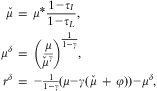 $$ { \vskip -5pt&#x02C7;\hskip -3pt{\mu }\, & = \,{{\mu }^\ast} \frac{{1{\rm{ &#x2212; }}{{\tau }_I}}}{{1{\rm{ &#x2212; }}{{\tau }_L}}}, \cr {{\mu }^\delta } \, & = \,{{\left( \,{\frac{\mu }{{{{{\vskip -5pt&#x02C7;\hskip -5pt{\,\,\mu }}}^\gamma } }}} \right)}^{\tfrac{1}{{1{\rm{ &#x2212; }}\gamma }}}}, \cr {{r}^\delta } \, & = \,{\rm{ &#x2212; }}\tfrac{1}{{1{\rm{ &#x2212; }}\gamma }}(\mu {\rm{ &#x2212; }}\gamma (\,\,\vskip -5pt&#x02C7;\hskip -2pt{\mu }\, + \,\varphi )){\rm{ &#x2212; }}{{\mu }^\delta }, \cr} $$
and N has intensity μ δ under  $$$ {{{\Bbb P}}^\delta } $$$ and
 $$$\ \vskip -5pt&#x02C7;\hskip -3pt{\mu } $$$ under
 $$$ \ \vskip -7.5pt&#x02C7;\hskip -3pt{{\Bbb P}} $$$.
The function fδ has the interpretation of an expected present value of the future utility weights. Compared to the first tax regime, the weights F and  $$$\tilde{F} $$$ are adjusted by tax quotients. For the weight on bequest, F, the adjustment is by a ratio of tax on the life insurance sum relative to labour income tax. For the weight on retirement savings,
 $$$\tilde{F} $$$, it is by the ratio of tax on retirement benefits relative to tax on labour income. Both adjustments also involve γ, such that the effect is opposite for high risk aversion / low EIS, γ < 0, and low risk aversion/high EIS, γ > 0.
We note that gδ is a measure of gross future income,  $$$\bar{a} $$$, and that the functions G and
 $$$\tilde{G} $$$ are ‘grossified’ to make them comparable in size to gross income. We refer to gδ as gross human wealth and x + gδ as gross total wealth of the person.
Optimal controls
The optimal controls are
 $$ { c_{t}^{\ast} \, & = \,\frac{{w(t)}}{{{{f}_\delta }(t)}}(1{\rm{ &#x2212; }}{{\tau }_L})(1{\rm{ &#x2212; }}{{\tau }_C})({{X}_t}\, + \,{{g}_\delta }(t)), \cr \pi _{t}^{\ast} \, & = \,\frac{{(\alpha {\rm{ &#x2212; }}r)}}{{{{\sigma }^2} (1{\rm{ &#x2212; }}\gamma )}}\frac{{{{X}_t}\, + \,{{g}_\delta }(t)}}{{{{X}_t}}}, \cr S_{t}^{\ast} \, & = \,{{\left( {\frac{{{{\mu }_t}}}{{{{{\hat{\mu }}}_t}}}} \right)}^{\tfrac{1}{{1{\rm{ &#x2212; }}\gamma }}}} \frac{{F(t)}}{{{{f}_\delta }(t)}}(1{\rm{ &#x2212; }}{{\tau }_L})({{X}_t}\, + \,{{g}_\delta }(t)){\rm{ &#x2212; }}((1{\rm{ &#x2212; }}{{\tau }_D}){{X}_t}\, + \,G(t)). \cr} $$
The optimal controls under this regime are in general in the same form as under the regime with immediate taxation of all labour income. Since x + gδ is gross total wealth, the optimal consumption, c*, and the optimal life insurance sum, S*, now directly involve the labour income tax, τL. Furthermore, the optimal proportion invested in the risky asset is a fraction of gross total wealth relative to gross wealth. The fraction is the same as under the first tax regime.
4 Numerical analysis
In this section we perform a numerical analysis based on the results derived in Section 3. The parametrization of the models and the parameter values are presented in Section 4.1 and Section 4.2, and the results are presented in Section 4.3 and Section 4.4.
4.1 Utility weights
Here we motivate and present the utility weights used in the numerical analysis. The utility weights for bequest and for pension savings at the time of retirement are highly inspired by Bruhn & Steffensen (Reference Bruhn and Steffensen2011), which takes the approach of deciding on the weights by solving the related optimization problems faced by the inheritor and the retired person.
Utility from consumption
For the weight on consumption, w, we take the classical approach as to model a constant rate of impatience that puts more weight on present than expected future consumption. Since we also want to incorporate constant inflation into the numerical calculations, we end up with
 $${{w}^{1{\rm{ &#x2212; }}\gamma }} (t)\, = \,{{{\rm{e}}}^{{\rm{ &#x2212; }}(\rho \, + \,\gamma i)t}}, \,\,t\,\geq \,0,$$
where ρ is the impatience factor and i is the inflation rate.
Utility from bequest
One obvious way of deciding on utility from bequest is inspired by the utility that the inheritor experiences from consuming the heritage. If the inheritor faces a similar optimization problem as the one we are interested in, except for that the inheritor has no bequest motive (utility from leaving money upon death is zero), this leads to
 $$ { F(t)\, & = \,{\int}_{\!\!\!\!t}^{\infty } {{{\rm{e}}}^{{\rm{ &#x2212; }}\tfrac{1}{{1{\rm{ &#x2212; }}\gamma }}{\int}_{\!\!\!t}^{s} {{\mu }_\tau }{\rm{ &#x2212; }}\gamma (\mu _{\tau }^{\ast} \, + \,\varphi )d\tau }} W(s)ds, \cr G(t)\, & = \,{\int}_{\!\!\!\!t}^{\infty } {{{\rm{e}}}^{{\rm{ &#x2212; }}{\int}_{\!\!t}^{s} (r\, + \,\mu _{\tau }^{\ast} )d\tau }} {{(\Bbb1}_{\{ s\, \lt \,T\} }}{{A}_s}\, + {{\Bbb1}_{\{ s\,\geq \,T\} }}{{{\tilde{A}}}_s})ds. \cr} $$
Here W is the weight that the optimizer puts on the inheritor's utility from consumption, A is the net income stream and  $$$\tilde{A} $$$ the net public pension of the inheritor.
In accordance with the weight for the person's own consumption, w, we write
 $$ {{W}^{1{\rm{ &#x2212; }}\gamma }} (t)\, = \,\bar{\theta }{{w}^{1{\rm{ &#x2212; }}\gamma }} (t),\,\,\,t\,\geq \,0, $$
where  $$$\bar{\theta } $$$ is the weight that the person puts on the heir's consumption relative to his own. If the heir is the spouse of the person, θ may reflect aspects such as decreased costs and an expected different consumption pattern for the widow(er). Since the weight must change the marginal utility of consumption for the person and the heir, it depends on γ, and we reparametrize the model such that
 $$$ \bar{\theta }\, = \,\tfrac{1}{2}{{\theta }^\gamma } $$$ (this parametrization is also used in Hong & Ríos-Rull, Reference Hong and Ríos-Rull2012 and Bruhn & Steffensen, Reference Bruhn and Steffensen2011).
Utility upon retirement
Utility from pension savings is based on an optimization problem regarding the retirement period. We propose these weights for utility at the time of retirement:
 $$ { \tilde{F}(T)\, & = \,{\int}_{\!\!\!\!T}^{\infty } {{{\rm{e}}}^{{\rm{ &#x2212; }}\tfrac{1}{{1{\rm{ &#x2212; }}\gamma }}{\int}_{\!\!T}^{s} {{\mu }_\tau }{\rm{ &#x2212; }}\gamma (\mu _{\tau }^{\ast} \, + \,\varphi )d\tau }} \Big[w(s)\, + \,{{\left( {\frac{\mu }{{\mu _{s}^{{\ast\gamma }} }}} \right)}^{\tfrac{1}{{1{\rm{ &#x2212; }}\gamma }}}} F(s)\Big]ds, \cr \tilde{G}(T)\, & = \,{\int}_{\!\!\!\!T}^{\infty } {{{\rm{e}}}^{{\rm{ &#x2212; }}{\int}_{\!\!\!T}^{s} r\, + \,\mu _{\tau }^{\ast} d\tau }} ({{{\tilde{a}}}_s}\, + \,\mu _{s}^{\ast} G(s))ds, \cr} $$
where  $$$\tilde{a} $$$ is the net public pension rate. These weights correspond to the post retirement wealth dynamics
 $$ { d{{X}_t}\, = & \,\bar{r}(1{\rm{ &#x2212; }}{{{\tilde{\tau }}}_1}){{X}_t}dt\, + \,{{\pi }_t}(\bar{\alpha }(1{\rm{ &#x2212; }}{{{\tilde{\tau }}}_2}){\rm{ &#x2212; }}\bar{r}(1{\rm{ &#x2212; }}{{{\tilde{\tau }}}_1})){{X}_t}dt\, + \,{{\pi }_t}\bar{\sigma }(1{\rm{ &#x2212; }}{{{\tilde{\tau }}}_2}){{X}_t}d{{W}_t} \cr & + {{{\tilde{a}}}_t}dt{\rm{ &#x2212; }}{{c}_t}dt{\rm{ &#x2212; }}\mu _{t}^{\ast} {{S}_t}dt\, + \,{{S}_t}d{{N}_t} \cr = & \,r{{X}_t}dt\, + \,{{\pi }_t}(\alpha {\rm{ &#x2212; }}r){{X}_t}dt\, + \,{{\pi }_t}\sigma {{X}_t}d{{W}_t} \cr & + {{{\tilde{a}}}_t}dt{\rm{ &#x2212; }}{{c}_t}dt{\rm{ &#x2212; }}\mu _{t}^{\ast} {{S}_t}dt\, + \,{{S}_t}d{{N}_t}, \cr} $$
 $$\!\!\!\!\!\!\!\!\!\!\!\!\!\!\!\!\!\!\!\!\!\!\!\!\!\!\!\!\!\!\!\!\!\!\!\!\!\!\!\!\!\!\!\!\!\!\!\!\!\!\!\!\!\!\!\!\!\!\!\!\!\!\!\!\!\!\!\!\!\!\!\!\!\!\!\!\!\!\!\!\!\!\!\!\!\!\!\!\!\!\!\!\!\!\!\!\!\!\!\!\!\!\!\!\!\!\!\!\!\!\!\!\!\!\!\!\!\!\!\!\!\!\!\!\!\!\!\!\!\!\!\!\!\!\!\!\!\!\!\!\!\!\!\!\!\!\!\!\!{{X}_0}\, = \,{{x}_0},$$
and the retiree solves the optimization problem given by these dynamics and the optimal value function
 $$ V(t,x)\, = \,\mathop {\rm sup}\limits_{c,\pi, S} {{{\Bbb E}}_{t,x}}\left( {{\int}_{\!\!\!\!t}^{\infty } {{{\rm{e}}}^{{\rm{ &#x2212; }}{\int}_{\!\!\!t}^{s} {{\mu }_\tau }d\tau }} \big[\tfrac{1}{\gamma }{{w}^{1{\rm{ &#x2212; }}\gamma }} (s)c_{s}^{\gamma } \, + \,{{\mu }_s}\tfrac{1}{\gamma }{{F}^{1{\rm{ &#x2212; }}\gamma }} (s)({{X}_s}\, + \,G(s)\, + \,{{S}_s}{{)}^\gamma } \big]ds} \right). $$
Note that the optimal controls related to this problem is given by (2.5)–(2.7) with f and g substituted by  $$$\tilde{F} $$$ and
 $$$\tilde{G} $$$.
We have deliberately avoided tax parameters on public pension and life insurance after retirement, since these taxes are not considered in our numerical analysis. Furthermore the tax on consumption after retirement is taken care of in the utility functions in (3.3) and (3.9). In the case of tax exempt contributions to retirement savings, the taxation of benefits is also taken care of in the utility function in (3.9). Thereby this formulation of utility from retirement savings is meaningful under both tax regimes.
The parameters  $$${{\tilde{\tau }}_1} $$$ and
 $$${{\tilde{\tau }}_2} $$$ are the tax rates on investment returns from risk free and risky investments. We equip the parameters with tildes to highlight that they might be different from those faced until retirement. This is especially the case with reduced investment return taxation until retirement and a lump sum benefit.
Household finance interpretation
All models so far are presented in terms of personal finance, taking into account the behaviour of one single person. The models, though, are easily generalized to cover an optimization problem for married couples that file their tax reports jointly.
In order for the optimization problems to be household finance related (a married couple), interpretations of some model elements are slightly changed. The wealth process is the total wealth of the household, the income stream,  $$$\bar{a} $$$, is the total gross labour income of the married couple, and A the net income stream of the widow(er) after death of the spouse. Also
 $$$\tilde{a} $$$ is the net public pension of the couple and
 $$$\tilde{A} $$$ is the net public pension of the widow(er). Thereby the functions gλ and gδ quantify the household's human wealth.
The intensities μ and μ* are the intensities by which one of the spouses dies, except for those used in F and G which represent the intensities by which the widow(er) dies. Therefore it seems reasonable to expect that the intensities used in the household optimization problem are two times the intensities used in F and G. All in all this means that the optimal life insurance sum is the amount paid out to the widow(er) upon death of the spouse, which means that identical amounts of life insurance is bought on both lives.
In general this way of introducing a household model denies us the possibility of imposing differences on the spouses. For a model with this possibility see Bruhn & Steffensen (Reference Bruhn and Steffensen2011).
4.2 Model parameter estimates
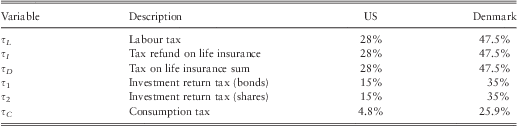
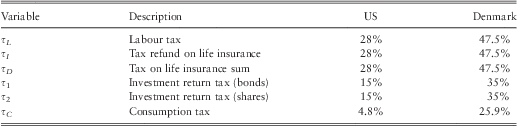
For a basic set of non-favoured tax parameters we rely on values from current tax codes in the US and Denmark. For the consumption tax we use the estimate from Trabandt & Uhlig (Reference Trabandt and Uhlig2009), since this includes both general VAT as well as consumption taxes on e.g. energy/fat/sugar/tobacco etc.Footnote 6 All tax parameters are shown in Table 1.
Basic model tax parameter values for numerical results.
In the numerical investigation performed in this section, we restrict the analysis to the case of constant real income streams, such that nominal income grows by inflation. Non-constant income would in general blur the over-time effects of the tax regimes investigated, and constant real income is in line with the estimates of Cocco et al. (Reference Cocco, Gomes and Maenhout2005) (they find that life cycle income streams are in general not constant, but rather flat from ages around 30–65).
We assume that the mortality intensities are the same under  $$$ {\Bbb P} $$$ and
 $$$ {{{\Bbb P}}^\ast} $$$. This special case corresponds to zero market price of insurance risk, and is relevant due to a reference to diversification of risk in the insurance portfolio of the life insurance company.
The mortality intensities are of Gompertz-Makeham form such that
 $${{\mu }_t}\, = \,\mu _{t}^{\ast} \, = \,2({{M}_1}\, + \,{{10}^{{{M}_2}\, + \,{{M}_3}(z\, + \,t){\rm{ &#x2212; }}10}} ),$$
where z is the age at time zero. Since the numerical analysis is performed in terms of a household (married couple) optimizing expected lifetime utility, z is the age of each of the spouses at time zero. Furthermore, the mortality intensities in the functions F and G are half these intensities (see Section 4.1).
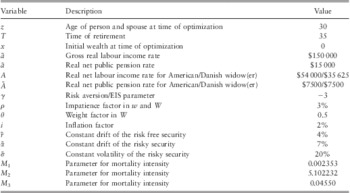
In the following we present results for both an American and a Danish couple of initial age 30 with 35 years to retirement. The remaining parameter values for the studies are found in Table 2. Notice especially that the value γ = −3 corresponds to a risk aversion of 4 and that the value θ = 0.5 implies that the couple's marginal utility from spending $1.36 together equals the the marginal utility from spending $1 for either of the widows. This level of shared costs is based on a study of American data performed in Hong & Ríos-Rull (Reference Hong and Ríos-Rull2012).
Basic parameter values for numerical results. The mortality intensity parameters are estimated based on deaths of people over the age of 50 in America in 2006.

4.3 Personal preferences – indifference utility and related controls
We want to quantify the effect of introducing tax favoured pension savings accounts, and for that we compare the expected lifetime utility under different tax regimes.
Since indifference between two tax regimes does not imply identical behaviour under the two regimes, we also take a closer look at the related optimal controls and their expected development over time.
Tax regimes of interest
The most common tax favoured retirement saving vehicles in the US are IRAs and 401(k)s (and to some extent Universal Life Insurance and Deferred Life Annuities). All programs allow for tax exempt contributions (up to a certain amount per year), and tax free accumulation of savings. Taxation of benefits from the saving vehicles is progressive, which often leads to favourable benefit taxation compared to the exempt labour income taxation of contributions.
The Danish saving vehicles Kapitalpension, Ratepension and Livrente have the same properties as the American vehicles, except that investment returns on savings are not tax free but only favourably taxed. Taxation of benefits is linear for the benefits from a Kapitalpension (which must be paid out as a lump sum at the time of retirement), and progressive for the annuity benefits from the Ratepension and Livrente. The latter often leads to favourable benefit taxation as in the US. The annuity benefits are, though, accounted for when the citizens apply for public benefits as e.g. housing subsidies, medicine subsidies etc., and that makes the annuity benefit taxation less favourable.
Inspired by the American and Danish retirement savings regimes, we restrict our numerical analysis to the following two scenarios:
– The American couple face a tax regime where contributions to retirement savings are tax exempt, and benefits are taxed at same rate as labour income. Investment returns are tax free, and benefits are either paid out as a lump sum at the time of retirement or as an annuity.
– The Danish couple also face a tax regime where contributions to retirement savings are tax exempt and investment returns are favourable taxed (by 15% tax). Benefits (paid out as a lump sum at the time of retirement or as an annuity) are taxed at a lower rate than labour income. We set the rate to be 5%-points lower than the labour income tax.
Indifference measures
In order to compare the two tax regimes, we calculate the values of certain parameters for an alternative tax regime, which makes the American and Danish couples indifferent between saving under the regimes.
One benchmark is given by a regime without any favouring of retirement savings. In order to be indifferent between the two regimes, the couples each demand an indifference sum, ψ, that solves
 $$ {{V}^\lambda } (t\, = \,0,\psi )\, = \,{{V}^\delta } (t\, = \,0,0), $$
where V λ and V δ are given by (3.4) and (3.10), V λ is calculated with β = 0 and V δ is calculated based on the favoured tax values. In line with common practice we report the indifference sums in terms of percentage of total wealth, x + gλ.
Similarly we define the indifference bonus as the bonus that the households demand on contributions to retirement savings, in order to be indifferent between the two retirement saving regimes. Mathematically we define the indifference bonus as the β that solves
 $${{V}^\lambda } (t\, = \,0,0)\, = \,{{V}^\delta } (t\, = \,0,0),$$
where V λ and V δ are given by (3.4) and (3.10), and V δ is calculated based on the favoured tax values.
Finally, since retirement savings for the Danish couple are favoured both due to favourable benefit taxation and investment returns taxation, we define a third indifference measure for the Danes. This is the investment return taxation, τ, that makes the couple indifferent between the favoured tax regime and a tax regime where contributions are not tax exempt, but investment returns (irrespective of origin) are subject to taxation by τ. With abuse of notation, τ solves
 $$ {{V}^\lambda } (t\, = \,0,0,\tau )\, = \,{{V}^\delta } (t\, = \,0,0). $$
where again V λ and V δ are given by (3.4) and (3.10), V λ is calculated with β = 0 and V δ is calculated based on the favoured tax values.
No investment return taxation – ‘the American dream’
To investigate the effects of the absence of tax on investment returns for retirement savings, we turn to the married American couple introduced above. They are given the opportunity to save in a tax deferred savings account where there is no investment return taxation, and benefits are paid out as either a lump sum at the time of retirement or an annuity. When paid out as a lump sum, investment return taxation during retirement is 15% ( $$$ {{\tilde{\tau }}_1}\, = \,{{\tilde{\tau }}_2}\, = \,15\% $$$), while it is 0% when benefits are paid out as an annuityFootnote 7.
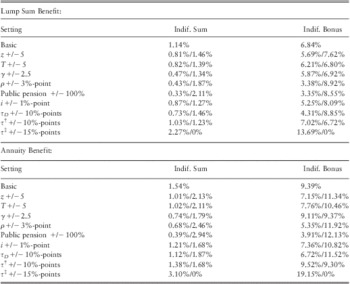
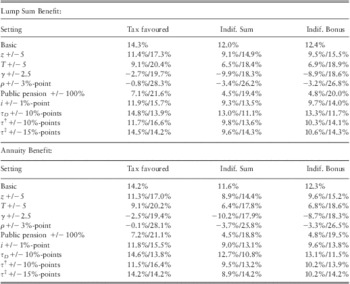
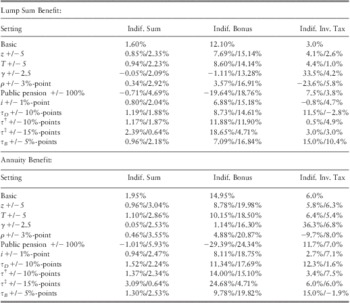
Table 3 shows the indifference sum/bonus demanded by the couple in order to be indifferent between saving under the different regimes. For a robustness-check of the results, further indifference sums/bonuses are shown for other values of parameters than those in Table 1 and Table 2. Table 4 shows the related initial saving ratios for the couple.
Indifference sums and bonuses for American couple. Top panel is the case of benefits paid out as a lump sum at the time of retirement (equal investment return taxes for all 3 regimes during retirement), bottom panel for annuity payments during retirement (no investment return taxation under favoured regime during retirement). †Change of τL, τB, τI and τD by +/−10%-points. ‡Change of non-favoured τ 1,  $$$ {{\tilde{\tau }}_1} $$$, τ 2 and
 $$$ {{\tilde{\tau }}_2} $$$ by +/−15%-points.

Initial savings ratio for American couple. Top panel is the case of benefits paid out as a lump sum at the time of retirement (equal investment return taxes for all 3 regimes during retirement), bottom panel for annuity payments during retirement (no investment return taxation under favoured regime during retirement). †Change of τL, τB, τI and τD by +/−10%-points. ‡Change of non-favoured τ 1,  $$$ {{\tilde{\tau }}_1} $$$, τ 2 and
 $$$ {{\tilde{\tau }}_2} $$$ by +/−15%-points.

For a lump sum benefit, the indifference sum for the American couple of 1.14% (1.54% for annuity benefits) of human wealth corresponds to a net sum of just over $36000 ($49000). The value of annuity benefits in this setup is thereby 35% higher than that of lump sum benefits, since the couple have more time to exploit the favourable investment return taxation.
The indifference bonus for a lump sum benefit of nearly 7% (9.39% for annuity benefits) corresponds to a first year bonus of around $1000 ($1250). Due to preferences and a stochastic investment market, consumption and saving contributions vary over time, and these amounts are not constant over the savings period.
The life insurance premium is paid out of the savings, and is not reported in the tables. The net life insurance sum under the different regimes are very similar and initially the premium paid is around 5%-points of the savings-ratios.
Robustness values
The assumed investment return tax of 15% is based on temporary tax rules that are to expire in 2011, and holds only for specific tax brackets. The robustness-check in Table 3 shows that the value of the retirement savings regime without investment return taxation doubles when investment return taxation is doubled.
Increasing the mortality intensities of the persons (z + 5), decreases the indifference sum and bonus since the couple have a smaller probability of staying alive until retirement, and expect less years of retirement. The values on the other hand increase when time to retirement is increased (T + 5), since there are now more years to take advantage of the low tax.
Increasing γ has two major effects. It decreases the risk aversion and the couple invest more in the risky asset, which in general has a positive effect on the indifference sum/bonus. The consumption also increases with γ and the savings ratio gets low, such that the couple's retirement savings are mainly generated by the investment return (no short-selling constraint allows for generating savings by shorting bonds and investing in the risky asset). This way the couple miss the tax exemption of contributions (since they are low), but pay taxes on the benefits, which in total decrease the value of the favoured regime.
Changing the life insurance tax, τD, has more effect on the favoured regime than the other two, since wealth upon death is also taxed by τD in the favoured regime. The initial savings ratios are not very influenced by a change in τD, while the initial purchase of life insurance changes by 15–20% when changing τD by 10%-points (values not shown in tables).
The remaining robustness values also show expected effects on the indifference sums and bonuses as well as on the initial savings ratios.
Behaviuor over time
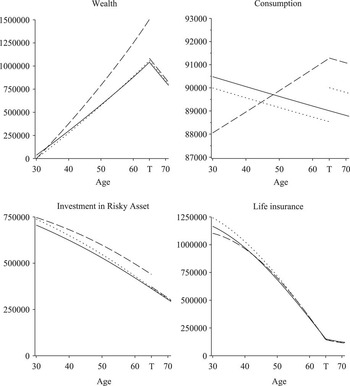
As we have already seen on the initial savings ratios in Table 4, indifference between saving under the different regimes does not mean acting identically under them. In Figure 1 we show, for all three tax regimes, the expected development of the optimal controls and the wealth of the household, given that both persons are aliveFootnote 8. We only illustrate the case of a lump sum benefit at the time of retirement, and values are in real terms (corrected for inflation).
Expected development of real values of wealth, consumption, investment and life insurance for American couple. Dashed line is the favoured regime (no investment return tax during savings period), the full line is the regime with indifference sum and the dotted line the regime with bonus on contributions.

The regime with the initial indifference sum as starting wealth has no tax regulations encouraging more or less retirement saving at any time until retirement. This regime is therefore referred to as the baseline regime. Under this regime we find that consumption (in real terms) decreases over time, mainly due to the values of the impatience factor, ρ, the risk aversion/EIS parameter, γ, and the expected rate of net returns on investments.
The value of not paying investment return tax is higher, if savings are made while young rather than old. Therefore consumption under the favoured regime starts relatively lower than under the baseline regime. The consumption is increasing over time, again mainly due to the value of the impatience factor, the risk aversion/EIS parameter and the expected rate of net returns on investments (lower taxation of investment returns than in baseline regime).
Adding bonus on the savings premium impose an incentive for retirement saving for the household that remains stable over the savings period (since the bonus-percentage is constant). The effect of this is that the savings ratio is higher (consumption until retirement lower) than under the baseline regime. At the time of retirement the net consumption jumps to a higher level. The size of the jump is  $$$ {{(1\, + \,\beta )}^{1/(1{\rm{ &#x2212; }}\gamma )}} {\rm{ &#x2212; }}1 $$$, which is the change in the marginal utility of consumption when the retirement savings motive disappears.
The net life insurance sum for the household saving under the bonus regime is higher than under the baseline regime, since the bonus regime reduces motive for consumption during the savings period relatively to the bequest motive. Remember that the household under the baseline regime starts out with an initial wealth of just over $36000, and that explains some of the difference in the first years.
Favourable benefit and investment return taxation – ‘the Danish double advantage’
The Danish couple's retirement savings are tax favoured in two ways, by tax exempt contributions with a favourable benefit taxation and by reduced investment return taxation. For the numerical results presented here, we let the benefit taxation, τB, be 42.5%, and the favoured investment return taxation be 15%. In Table 5 we show the indifference sum, bonus and investment return tax (equal for risk free and risky investments), that the couple demands in order to be indifferent between the tax favoured regime, and the three alternative regimes. We show the results both for lump sum and annuity benefits (for the favoured regime, lump sum benefits means  $$$ {{\tilde{\tau }}_1}\, = \,{{\tilde{\tau }}_2}\, = \,35\% $$$ and annuity benefits means
 $$$ {{\tilde{\tau }}_1}\, = \,{{\tilde{\tau }}_2}\, = \,15\% $$$), along with robustness checks for several parameters. The related initial savings ratios are shown in Table 6.
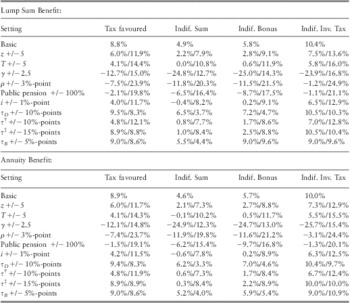
Indifference sums, bonuses and investment return taxes for Danish couple. Top panel is the case of benefits paid out as a lump sum at the time of retirement (equal investment return taxes for all 3 regimes during retirement), bottom panel for annuity payments during retirement (15% investment return taxation under favoured regime during retirement). †Change of τL, τB, τI and τD by +/−10%-points. ‡Change of non-favoured τ 1,  $$$ {{\tilde{\tau }}_1} $$$, τ 2 and
 $$$ {{\tilde{\tau }}_2} $$$ by +/−20%-points.

Initial savings ratio for Danish couple. Top panel is the case of benefits paid out as a lump sum at the time of retirement (equal investment return taxes for all 3 regimes during retirement), bottom panel for annuity payments during retirement (15% investment return taxation under favoured regime during retirement). †Change of τL, τB, τI and τD by +/−10%-points. ‡Change of non-favoured τ 1,  $$$ {{\tilde{\tau }}_1} $$$, τ 2 and
 $$$ {{\tilde{\tau }}_2} $$$ by +/−20%-points.

For the Danish couple, the value of the favoured regime is an indifference sum of 1.60% of human wealth (1.95% for annuity benefits), which is a net sum of roughly $44000 ($53500). The indifference bonus of 12.10% (14.95%) corresponds to a first year bonus of $600 ($750), which is substantially lower than for the Americans, despite a higher bonus-percentage. Higher labour income taxation and a lower optimal savings ratio for the Danes accounts for the difference.
The indifference tax on investment returns is 3.0% (6.0%) or a reduction of taxation by 80% (60%) compared to the favoured regime. When benefits are paid out as an annuity, the indifference tax is then assumed paid on investment returns both before and after retirement. That gives the couple a longer expected time to take advantage of the favourable tax, and that accounts for the higher value.
The initial savings ratios are very different for the four regimes. The regime with the indifference sum has the lowest initial savings ratio, since nothing motivates extraordinary savings compared to the three other regimes (and the indifference sum is already added to the savings). The bonus regime has a savings ratio that is lower than that of the regimes with reduced investment return taxation, since bonus does not motivate early savings. The highest savings ratio comes with the lowest investment return taxation.
Robustness values
The initial savings ratios are almost equal for the favoured and the bonus regime when investment return taxation is even (they are different in the fourth decimal, not shown in Table 6). This occurs since bonus and favourable benefit taxation motivates retirement savings in the same manner. The small difference in the savings ratios occurs since bonus is not paid back if one spouse dies before retirement.
The indifference measures are very sensitive to changes in the public pension, and in fact doubling the public pension leads to a negative indifference sum and bonus. This may seem counter-intuitive, but arises since the high level of public pension leads to negative savings contributions over most of the savings period for the favoured regime. The retirement savings are thereby mainly generated by shorting bonds and investing in stocks. The fact that savings benefits in the favoured regime are subject to taxation by τB at retirement thereby has a negative value that exceeds the value of the low investment return taxation. The same explanation holds for the negative indifference sum and bonus in the case of an increase in γ.
Behaviour over time
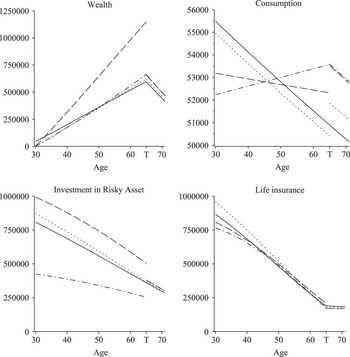
In Figure 2, we present the expected development over time for the wealth and the controls for all four regimes, given that both persons stay alive.
Expected development of real values of wealth, consumption, investment and life insurance for Danish couple. Dashed line is the favoured regime (low investment return tax during savings and favoured tax of lump sum benefit), the dash-dotted line is regime with low investment return tax during savings, the full line is the regime with indifference sum and the dotted line the regime with bonus on contributions.

As expected, the regime with the lowest investment return taxation has the lowest initial consumption and the steepest increase until retirement. The jumps of the optimal consumption at retirement for the regimes with bonus or favourable benefit taxation are due to the change in marginal utility of consumption, when the savings period ends.
The optimal investment and life insurance sums evolve as expected over time.
4.4 Non-indifference from a government's point of view
Despite the fact that we can formulate several tax regimes that the American and Danish couples are indifferent between, the couples behave differently under the regimes. One consequence of that is different tax cash flows experienced by the tax authorities.
In order to investigate the preferred regime for the tax authorities, we compute the expected present value of tax income and expenditures for a government. We only take into account the taxes introduced in this paper. For the regime with immediate labour income taxation and no retirement savings favouring, we include the taxes τL (labour income), τC (consumption), τ 1, τ 2 (investment return) and τI and τD (life insurance). An indifference sum paid out at time zero is a lump sum expenditure for the tax authorities, and bonus paid during the savings period is a continuous expenditure. For the regime with tax exempt contributions to retirement savings, only the part of the salary that is spent on immediate consumption generates a labour tax income during the saving period. Instead, a lump sum tax income at the time of retirement is generated by τB. We do not take the public pension into account, since its value is the same for all regimes.
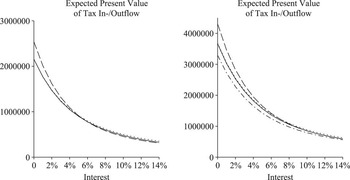
In Figure 3 we show the expected present values of the tax streams generated by the different investigated regimes. Retirement savings are assumed paid out as a lump sum in the favoured regimes.
Expected value of future income and expenditure for tax authorities for different rates of discounting. Lifetime of the household members is calculated by the objective mortality in (4.1). American data to the left, Danish to the right. Dashed line is the favoured regime (tax exempt savings contributions and low investment return tax), the dash-dotted line (in Danish data) is regime with low investment return tax during savings, the full line is the regime with indifference sum and the dotted line the regime with bonus on contributions.

For low values of the discount factor, the favoured regimes (tax exempt contributions) are most favourable for the tax authorities. This is due to the retirement savings tax, τB, that generates a large revenue if both persons are alive upon retirement. If one of the persons dies before the retirement age, and contributions are tax exempt, both the life insurance sum and the retirement savings are taxed by the life insurance tax, τD. That also adds to the value of the favoured regimes.
Tax exempt contributions to retirement savings on the other hand generates less labour income tax for the tax authorities. Therefore the regimes with indifference sums or bonuses are preferable for tax authorities when the discounting factor is high. This is, though, also due to the higher investment return taxation in the regimes of indifference sums and bonuses. In addition we see that the Danish regime with immediate labour income taxation and very low investment return tax (3.0%) is not preferable even at high values of the discount factor.
5 Conclusion
In this paper we investigated the problem of optimizing lifetime utility with bequest motive under two different taxation regimes. We quantified the tax impact under the different regimes and found that this was not identical, some taxes matter more in one regime than another. The regimes each motivated retirement savings in different ways, and the numerical analysis showed that this led to savings of different size. Moreover, the contributions to savings were made at different times during the savings period.
The indifference values calculated indicates that governments wanting to shift retirement savings incites from tax exempt contributions to bonus on contributions can do that for reasonable values of the proportional bonus. The effect of that is generally a larger tax revenue during the savings period, and for sufficiently high values of the discounting-factor, also larger expected present value of the future tax flows.