Introduction
The family Scincidae, with more than 100 genera and roughly 1400 species, is the most speciose of recent saurian groups. The genus Chalcides of the Scincidae family consists of 25 representatives that inhabit countries of the southern Palaearctic and northern Ethiopian realms. While some of these species have an endemic distribution, the host species of Oochoristica chalcidesi, the ocellated or eyed skink (C. ocellatus), can be found in southern Europe, northern Africa and western Asia, including countries of the Arabian peninsula (Schmidt, Reference Schmidt1953; Hornby, Reference Hornby1996; Gardner, Reference Gardner2009).
When Lühe (Reference Lühe1898) established the genus Oochoristica (from the Greek χωρíζɛιυ = chorizein = scatter, diffuse, disperse – to describe the pattern of the eggs embedded in the parenchyma of the mature segments) for reptile cestodes, only two species that fit into this definition were known. Both cestodes were decribed by Rudolphi (Reference Rudolphi1819) under the name of Taenia tuberculata and T. amphisbaenae, respectively. While T. tuberculata was chosen as type species for the genus Oochoristica, T. amphisbaenae was later transferred by Spasskij (Reference Spasskij1951) into the genus Semenoviella. The genus Oochoristica expanded during the following years, and Meggitt (Reference Meggitt1934) listed 33 species, 19 of which were found in reptiles. Hughes (Reference Hughes1940) counted 45 species, of which 26 were of reptile origin. Spasskij (Reference Spasskij1951) excluded other hosts and reduced the genus Oochoristica to reptile hosts. He listed 33 representatives and added ten incompletely described species. The most recent revision of the genus was made by Bursey et al. (Reference Bursey, Goldberg and Woolery1996). According to these authors the genus Oochoristica consisted of 75 species. To date, ten more species have been found, bringing the total number to 85.
The aim of this paper is to add a further species found in ocellated skinks (C. ocellatus) in the United Arab Emirates (UAE).
Materials and methods
In connection with a survey on reptile parasites in Dubai, 14 yellow-bellied geckoes (Hemidactylus flaviviridus) and ten ocellated skinks (C. ocellatus) were caught at the premises of the Central Veterinary Laboratory in Dubai and examined for parasites between 2007 and 2010. The lizards were caught by hand and euthanized with ethylether. The necropsy was performed under a stereoscopic microscope. The body was opened with scissors starting from the anal opening until the lower jaw. The internal organs were removed, placed into normal saline and examined separately. Only five skinks were infected with intestinal cestodes of the genus Oochoristica, with a burden of 1, 2, 2, 8 and 25, respectively. Only seven of 38 specimens were fully developed and were used for description. All 25 specimens found in one skink resulted from a fresh infection and consisted just of the scolex and some immature segments with primordial female reproductive organs. For their complete relaxation, patent tapeworms were kept overnight in tap water at room temperature, stained with lactic carmine, dehydrated in increasing concentrations of alcohol and embedded temporarily in glycerin. Drawings were made from photographs taken with a digital camera (Olympus DP71) connected to a microscope (Olympus BX61).
Oochoristica chalcidesi n. sp.
Description
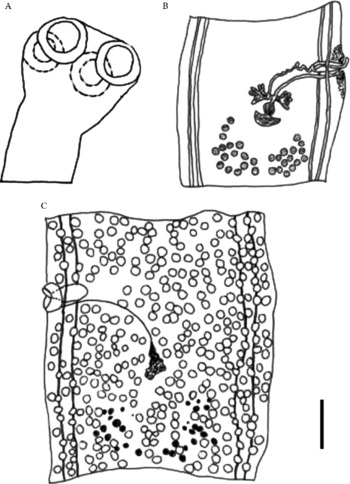
Oochoristica chalcidesi (fig. 1) with the characteristics of the genus Oochoristica, Lühe, Reference Lühe1898. Strobila (n = 7) acrasoedote, 16 (15–20) mm long and up to 1 mm wide, consisted of 63 (59–69) segments. Scolex 450 (420–480) μm wide with four acetabular, slightly oval suckers 165 (138–200) μm long and 156 (138–195) μm wide. Unsegmented neck 474 (270–700) μm long, 310 (280–330) μm wide. Immature segments wider than long. Primordia of female reproductive glands occur in the 23 (21–26) segment, while testes can be seen starting from segment 34 (31–36). There are only 4–5 fully developed mature segments, wider than long: 750 (600–880) μm × 630 (550–810) μm. Genital pore opens irregularly in the anterior half of the gravid segment, at 30% (23–37%). Testes between 25 and 35 in two clusters in the posterior half of the segment between excretory canals. The diameter of the testes in mature segments varies between 25 and 35 μm. Cirrus sac elongate, piriform 161 (150–170) μm long and 57 (50–70) μm wide, extending between the lateral excretory canals, not reaching the level of the poral lobe of the ovary. Vas deferens coiled, directed posteriomedian and crosses the centre of the ovary ventrally. Ovary bilobed, in the centre of the segment, slightly shifted to the poral side, 164 (158–175) μm. Each lobe is subdivided into 4–5 lobuli. The oval to half-moon shaped vitellarium is 94 (88–100) μm wide and 43 (33–50) μm long and is situated between the ovary and the complex of ootype and Mehli's gland. After reaching its full development in hermaphrodite segments the ovary disintegrates quickly in the following segments, being replaced by developing eggs while remnants of testes can be observed in the final segments. Gravid segments 1015 (1000–1050) μm long and 935 (950–1000) μm wide, containing numerous round uterine capsules embedded in two layers into the parenchyma of the entire segment, including the space laterally from excretory vessels. Round capsules measure 64 (63–70) μm in diameter and each contains one oval shaped oncosphere 35 × 38 μm. Six embryonal hooks arranged in three pairs are 20 μm in length.
Oochoristica chalcidesi n. sp. (A) scolex; (B) mature segment; (C) gravid segment (scale bar 200 μm).

Taxonomic summary
Type specimens. Holotype (Catalogue No. E.7494) and three paratypes (Catalogue No. E.7495) deposited in the Museum für Naturkunde Berlin, Germany.
Type host. Ocellated skink, Chalcides ocellatus (Forskal, 1775) (Reptilia, Scincidae).
Site of infection. Small intestine.
Type locality. Dubai, United Arab Emirates (25°12′38.35″; 55°17′20.40″).
Prevalence. 5/10.
Intensity. 1–25.
Etymology. The specific epiphet is derived from the genus of the host, Chalcides.
Remarks
To date the genus Oochoristica comprises 85 representatives and, because most of them have never been recorded again since their description, their status remains questionable. Little is known about morphological variations within species of this genus. A study by Criscione & Font (Reference Criscione and Font2001) with O. javaensis in Hemidactylus turcicus showed that metric parameters can be highly variable, depending on fixation techniques and worm burden. These authors also studied paratypes of cestodes described from reptiles after in situ fixation and raised concerns about the validity of their species. For this reason numeric parameters were used in the first place to discriminate O. chalcidesi from other species.
One of these parameters is the number of testes and their arrangement. The occurrence of testes in two clusters is one of the main striking features of O. chalcidesi. So far only 17 Oochoristica species with this special character have been described (Bursey et al., Reference Bursey, Goldberg and Woolery1996). Taking into account that the number of testes range between 25 and 35, only six of these 17 species need to be considered, none of them was detected in a skink. These species are O. theileri, O. ubelakeri found in agamas in Africa, O. hemidactyli in a gecko and O. mandapamensis in an agama from India, O. bezyi in a wall lizard from the USA and O. nupta in an agama from Iraq. In addition, Garcia-Adell & Roca (Reference Garcia-Adell and Roca1988) pictured Oochoristica sp. with 30 testes in two clusters found in Podarcis muralis in Spain without further description.
A second important feature is the division of the ovary lobe into lobules. In the case of O. chalcidesi each uterus lobe is subdivided into 4–5 lobules. While O. theileri, O. mandapamensis and O. nupta have compact, undivided ovary lobes, and in the case of O. bezyi they consist of 6–8 lobules, only O. ubelakeri described from Agama atra in Namibia (Bursey et al., Reference Bursey, McAllister, Fred and Fred1994) shows an ovary structure comparable to that of O. chalcidesi. Also in other parameters, such as the number of segments, body size, size of the scolex and suckers, both cestodes are similar. There are four differences and these include the presence of a neck in O. chalcidesi; 15–20 mature segments in O. ubelakeri versus 4–5 in O. chalcidesi; the cirrus sac of O. chalcidesi does not reach the level of the ovary; egg capsules in gravid segments of O. chalcidesi are not restricted to the field bordered by excretory vessels. These striking differences are the basis on which the description of O. chalcidesi as a new species is justified.
Previously only one Oochoristica species had been reported from the Arabian Peninsula. Oochoristica najdej was originally described from Uromastyx aegyptica in Saudi Arabia (Magzoub et al., Reference Magzoub, Kasim and Shawa1980) but was also found in Mabuya brevicollis in the UAE (Kardousha, Reference Kardousha2002).
Until now the type host for O. chalcidesi, C. ocellatus, was known only as a host for O. tuberculata (Rudolphi, Reference Rudolphi1819; Ibrahim et al., Reference Ibrahim, Fadiel and Nair2005). Al-Deen et al. (Reference Al-Deen, Al-Shareef and Saber1995) reported O. fibrata in ocellated skinks in Egypt. However, this finding is very doubtful since O. fibrata is 7–8 cm long and was originally described in a green cat snake in Myanmar.