Introduction
The 2011 Great East Japan Earthquake and Fukushima Daiichi Nuclear Power Plant accident demonstrated that a nuclear accident can occur as part of a compound disaster involving infrastructure disruption, evacuation, radiation anxiety, and long-term health and social consequences.Reference Hasegawa, Tanigawa and Ohtsuru 1 International emergency preparedness standards also emphasize that response systems for nuclear or radiological emergencies require predefined roles, trained response organizations, and resources sufficient for both radiological and non-radiological consequences. 2 , 3
Japan reorganized its nuclear emergency medical care system after the Fukushima accident. Nuclear Emergency Core Hospitals (NECHs) are expected to function as central medical institutions in affected regions and to maintain nuclear emergency medical assistance teams that can provide emergency care for contaminated or potentially exposed patients. 4 , 5 The designation requirements include the placement of at least 1 nurse with specialized knowledge and skills in emergency or disaster nursing and at least 1 nurse capable of providing necessary nursing care while implementing radiation protection. 5
A previous national survey of Japanese NECHs, published in this journal, described hospital-level institutional preparedness and identified issues such as business continuity planning, risk communication, and regional planning.Reference Nagata, Arishima and Yamaguchi 6 However, that survey did not characterize the nursing workforce dimension of preparedness. It did not describe which departments provide nurses for nuclear emergency medical care, what qualifications these nurses hold, how facilities expose them to recurrent training, or what educational and organizational support is needed to sustain their participation. This distinction is important because hospital designation alone does not ensure that bedside care can be operationalized during a nuclear emergency.
The nursing workforce gap is also clinically relevant. Previous research among emergency nurses in Japanese NECHs reported deficits in radiation health-effects knowledge and a high desire for further training.Reference Kawaoka, Yamaguchi and Yanagida 7 Nuclear disaster medical assistance teams in Japan include nurses and are closely linked to the broader disaster medicine system.Reference Ochi, Hasegawa and Hirohashi 8 At the same time, radiation nursing expertise is a recently developing advanced practice field in Japan, and the pipeline of nurses with radiation-specific advanced certification remains limited relative to the national preparedness mission. 9 , 10 More broadly, disaster nursing literature supports the need to strengthen disaster preparedness education within nursing curricula and continuing professional development.Reference Achora and Kamanyire 11 , Reference Labrague, Hammad and Gloe 12
This study aimed to describe nursing workforce arrangements, qualifications, recent training exposure, educational needs, and perceived organizational or policy support needs for nuclear emergency medical care among NECHs in Japan. The objective was to generate facility-level evidence to inform sustainable nursing workforce preparedness for low-frequency, high-consequence technological disasters.
Methods
Study Design and Reporting
This was a national, facility-level, cross-sectional web-based survey. The manuscript was prepared with reference to the STROBE reporting guideline for observational studies and published guidance for survey research.Reference von Elm, Altman and Egger 13 , Reference Kelley, Clark, Brown and Sitzia 14 The facility, rather than the individual nurse, was the analytic unit.
Setting and Target Population
The target population comprised all 51 NECHs in Japan. The survey was designed as a census of designated facilities rather than as a sample survey. According to the approved study protocol, the intended respondents were nursing administrators or equivalent personnel responsible for preparing nursing systems for nuclear emergency medical care, such as deputy directors of nursing or personnel responsible for disaster response.
Recruitment and Consent
A web-based questionnaire URL or QR code was distributed to all target facilities after institutional approval. The response deadline was November 30, 2025. The questionnaire was configured so that respondents had to indicate consent before entering data. No recruitment reminders were sent. A separate nonrespondent survey was not conducted, and information about nonresponding facilities was not collected in the analytic dataset.
Questionnaire Development and Variables
Draft questionnaire items were generated from the NECH designation requirements, international emergency preparedness standards, the prior NECH preparedness survey by Nagata et al, and the objectives specified in the approved protocol. 2 , 5 , Reference Nagata, Arishima and Yamaguchi 6 The questionnaire was then finalized through consensus discussion among 3 study-team members who were nurses or public health nurses with expertise in radiological nursing or radiation emergency medicine. This internal consensus review focused on item relevance, clarity, and completeness for a facility-level descriptive survey, and items were refined based on qualitative discussion. No external content-validation panel was convened, and no item-level content validity index was calculated. The instrument was not intended as a psychometric scale, and formal pilot testing, cognitive interviewing, and psychometric reliability testing were not performed. The questionnaire item summary is provided in Supplementary File 1.
Items captured facility ownership, bed-size category, nurse-count categories by sex, representative or median age category by sex, departments to which nurses engaged in nuclear emergency medical care belonged, qualifications, training exposure since April 2025, training sponsors or hosts, educational content considered necessary, and free-text support needs. The department item asked facilities to select all departments to which nurses engaged in nuclear emergency medical care currently belonged. Response options included emergency department including emergency outpatient care, intensive care unit, general ward, radiology department, general outpatient or testing department, and other department.
Several variables were multiple-response items, including departments, qualifications, training sponsors or hosts, and educational needs. Nurse-count responses were collected as categories, including an upper-censored category of >3 nurses. Age responses represented facility-level representative or median age categories, not individual nurse age distributions.
Educational-needs items were analyzed at the individual item level as the primary descriptive result. A post hoc domain aggregation was prepared as a secondary descriptive summary to support interpretation of conceptually related items, not to replace item-level results. Domains were defined according to conceptual similarity, including radiological knowledge, hands-on protective practice, and clinical emergency management, and were not derived from observed response patterns. The radiation basics/protection domain included radiation basics, radiation protection basics, and health effects of radiation exposure. The monitoring/PPE practice domain included radiation monitoring practice and PPE donning/doffing practice. The emergency exposure medicine/disaster nursing domain included principles of radiation emergency medicine and basics of disaster nursing. Tabletop exercise and risk communication were retained as single-item domains. A facility was counted once within a domain if it selected at least 1 component item.
Data Management and Quantitative Analysis
Responses were screened for consent. All 22 consented facility responses were retained in the final analytic dataset. Timestamps, email addresses, municipality information, and geographic identifiers contained in free-text responses were excluded from analytic outputs or redacted. Sequential anonymized facility identifiers were assigned. No duplicate facility records were excluded, and all consented responses had nonmissing values for the prespecified analytic variables. Unknown responses were retained as analytic categories where reported.
Facility-level categorical variables were summarized as counts and percentages. Exact 2-sided 95% confidence intervals for facility proportions were calculated using the Clopper-Pearson method with R stats::binom.test. Percentages and confidence limits were rounded to 1 decimal place. For multiple-response items, the numerator was the number of facilities selecting a category, and the denominator was the number of facilities with a valid response to that item; percentages based on total selections were not used. Confidence intervals were not calculated for qualitative meaning-unit counts. Because nurse-count variables included an upper-censored category (>3 nurses), exact totals, mean numbers of nurses, and sex ratios were not calculated. Because the study objective was descriptive and the facility-level sample was small, no formal hypothesis testing was performed.
Qualitative Analysis
Free-text responses were analyzed using inductive qualitative content analysis informed by Hsieh and Shannon and by Elo and Kyngas.Reference Hsieh and Shannon 15 , Reference Elo and Kyngas 16 One author first segmented responses into meaning units in Japanese and performed initial open coding. Codes were grouped into subcategories and categories by comparing similarities and differences across units. The draft coding framework, category boundaries, and representative quotations were then reviewed by 2 radiological nursing specialists and 1 radiological nursing researcher. Category-level disagreements and wording differences were resolved through discussion until consensus was reached. Formal independent dual coding was not performed, and no inter-coder agreement statistic was calculated. Representative quotations were de-identified, retained in Japanese for auditability, and translated into English for manuscript presentation. Given the brevity of structured survey free-text responses, the qualitative findings are reported as practical themes rather than as a comprehensive interpretive account, and saturation was not formally claimed.
Ethical Approval
This study was approved by the Kagoshima University Sakuragaoka Campus Epidemiological Research Ethics Committee on November 13, 2025 (approval No. 250178-Epi). Participation was voluntary. The web-based questionnaire required respondents to indicate consent before data entry, and responses were anonymized before analysis.
Results
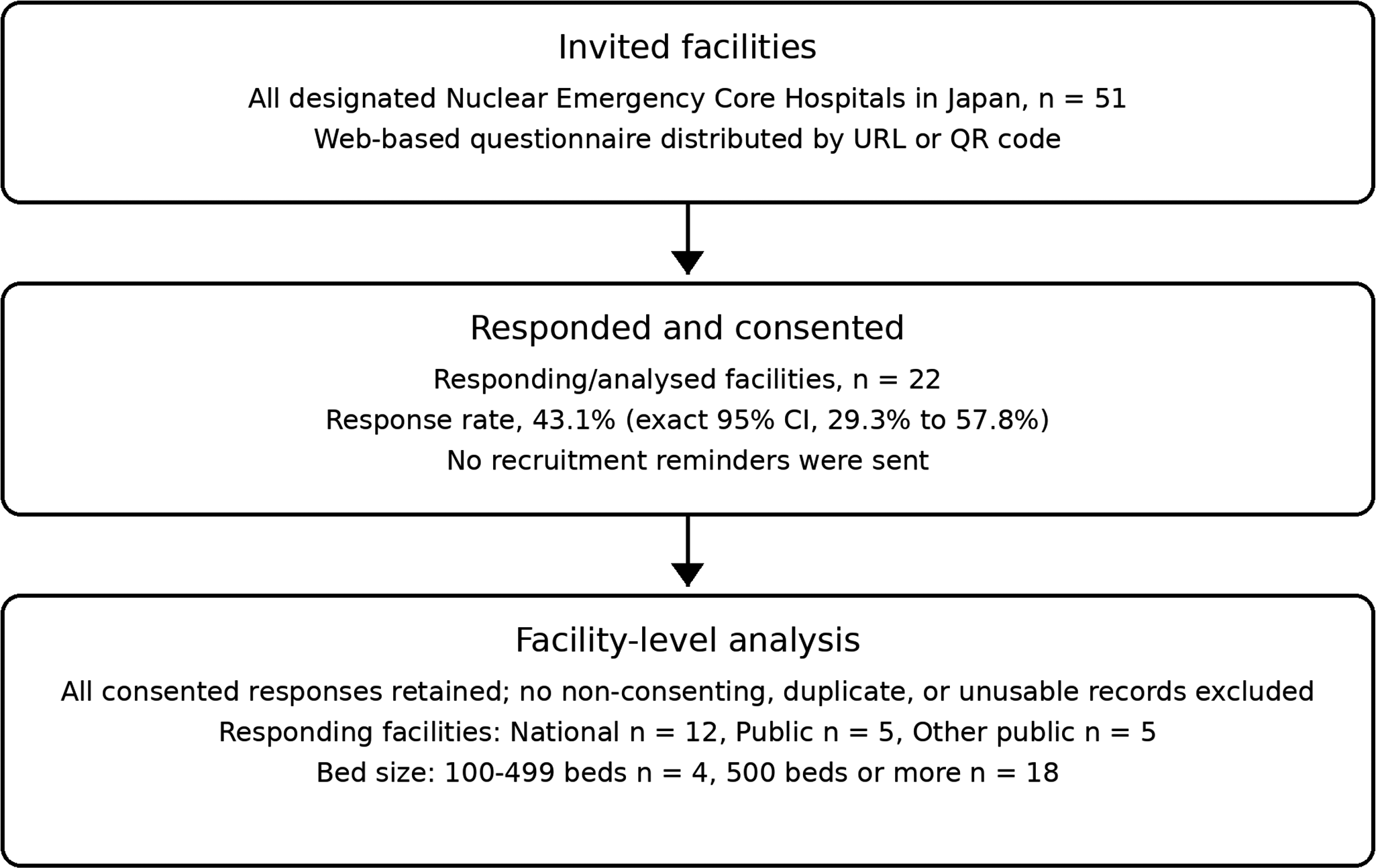
Of the 51 invited NECHs, 22 provided consented responses and were included in the facility-level analysis (response rate, 43.1%; exact 95% CI, 29.3-57.8%) (Figure 1). Most responding facilities were national institutions (12/22, 54.5%; exact 95% CI, 32.2–75.6%) and had 500 beds or more (18/22, 81.8%; exact 95% CI, 59.7–94.8%) (Table 1). Exact bed counts were not available in the analytic dataset, and bed size was therefore summarized categorically.
Facility survey flow and analytic sample. The figure shows that 51 Nuclear Emergency Core Hospitals were invited, 22 facilities provided consented responses, and all 22 were retained in the final facility-level analysis. The response rate was 43.1%; no recruitment reminders were sent, and no item-level missing values were present for prespecified analytic variables. NECH, Nuclear Emergency Core Hospital; CI, confidence interval.

Figure 1. Long description
A vertical flowchart with three rectangular boxes connected by downward-pointing arrows.
1. Top box: Invited facilities. All designated Nuclear Emergency Core Hospitals in Japan, n equals 51. Web-based questionnaire distributed by U R L or Q R code.
2. Middle box: Responded and consented. Responding forward slash analysed facilities, n equals 22. Response rate, 43.1 percent (exact 95 percent C I, 29.3 percent to 57.8 percent). No recruitment reminders were sent.
3. Bottom box: Facility-level analysis. All consented responses retained; no non-consenting, duplicate, or unusable records excluded. Responding facilities: National n equals 12, Public n equals 5, Other public n equals 5. Bed size: 100-499 beds n equals 4, 500 beds or more n equals 18.
Footer text defines initialisms: N E C H equals Nuclear Emergency Core Hospital. C I equals confidence interval.
Responding facility characteristics

Table 1. Long description
The table consists of seven columns: Section, Characteristic, n, N, percent, Exact 95 percent C I, and Note.
1. Survey participation section:
- Invited facilities: n equals 51, N equals 51, 100.0 percent. Note: National nuclear emergency medical care base hospitals invited.
- Responding or analyzed facilities: n equals 22, N equals 51, 43.1 percent, C I 29.3 to 57.8. Note: All responding facilities consented and were retained.
2. Facility ownership section (N equals 22 for all):
- National: n equals 12, 54.5 percent, C I 32.2 to 75.6.
- Public: n equals 5, 22.7 percent, C I 7.8 to 45.4.
- Other public: n equals 5, 22.7 percent, C I 7.8 to 45.4.
3. Bed size section (N equals 22 for all):
- 100 to 499 beds: n equals 4, 18.2 percent, C I 5.2 to 40.3. Note: Only categorical bed-size data were available.
- 500 beds or more: n equals 18, 81.8 percent, C I 59.7 to 94.8. Note: Only categorical bed-size data were available.
Note: Exact 95% confidence intervals are Clopper-Pearson intervals for facility proportions and are descriptive only. The sampling-frame row (51 invited facilities) is not an estimated proportion, and no confidence interval was calculated for that row. “Public” includes prefectural and municipal hospitals. “Other public” follows Japan’s institutional classification and includes public-interest medical organizations such as Japanese Red Cross Society, social insurance-related organizations, and Japan Agricultural Cooperatives hospitals where applicable.
The reported nurse-count category for nurses engaged in nuclear emergency medical care was most often >3 for both women (14/22, 63.6%; exact 95% CI, 40.7–82.8%) and men (13/22, 59.1%; exact 95% CI, 36.4–79.3%) (Table 2). Because the staffing variables were category-based and upper-censored, these values were not converted into exact facility nurse counts, totals, means, or sex ratios. The most common representative age category was the 40s for both women and men (11/22, 50.0%; exact 95% CI, 28.2–71.8% for each). These age values represent facility-level median or representative age categories and not individual nurse age distributions.
Nursing staffing categories, departments, and qualifications for nuclear emergency medical care

Table 2. Long description
Panel A. Facility-reported nurse-count categories by sex. For females, 1 nurse was reported by 4.5 percent of facilities, 2 nurses by 31.8 percent, and greater than 3 nurses by 63.6 percent. For males, 1 nurse was reported by 22.7 percent, 2 nurses by 18.2 percent, and greater than 3 nurses by 59.1 percent.
Panel B. Facility-level representative or median age category by sex. For females, the representative age was 20s (4.5 percent), 30s (31.8 percent), 40s (50.0 percent), and 50s (13.6 percent). For males, the representative age was 30s (45.5 percent), 40s (50.0 percent), and 50s (4.5 percent).
Panel C. Departments to which nurses belonged (multiple responses). Emergency department (86.4 percent), Intensive care unit (54.5 percent), General ward (50.0 percent), Radiology department (36.4 percent), General outpatient or testing (22.7 percent), and Other (27.3 percent).
Panel D. Qualification categories reported by facilities (multiple responses). D M A T member (90.9 percent), Certified nurse specialist in radiation nursing (22.7 percent), I V R-certified nurse (9.1 percent), Disaster support nurse (27.3 percent), and Other specialist or certified nurse qualification (40.9 percent). All panels use a total sample size N of 22.
Note: Nurse-count categories were not converted into exact nurse counts. Age categories are facility-level representative or median categories. Department and qualification rows are multiple-response facility percentages. Qualification rows indicate facilities reporting each category, not numbers of individual nurses. Exact 95% CIs are Clopper-Pearson intervals.
Facilities most frequently reported emergency departments, including emergency outpatient care, as departments to which nurses engaged in nuclear emergency medical care belonged (19/22, 86.4%; exact 95% CI, 65.1–97.1%). Intensive care units were reported by 12 facilities (54.5%; exact 95% CI, 32.2–75.6%), general wards by 11 (50.0%; exact 95% CI, 28.2–71.8%), radiology departments by 8 (36.4%; exact 95% CI, 17.2–59.3%), other departments by 6 (27.3%; exact 95% CI, 10.7–50.2%), and general outpatient or testing departments by 5 (22.7%; exact 95% CI, 7.8–45.4%) (Table 2).
The most frequently reported qualification category was Disaster Medical Assistance Team (DMAT) membership (20/22, 90.9%; exact 95% CI, 70.8–98.9%). Other specialist or certified nurse qualifications were reported by 9 facilities (40.9%; exact 95% CI, 20.7–63.6%), disaster support nurses by 6 (27.3%; exact 95% CI, 10.7–50.2%), certified nurse specialists in radiation nursing by 5 (22.7%; exact 95% CI, 7.8–45.4%), and interventional radiology-certified nurses by 2 (9.1%; exact 95% CI, 1.1–29.2%) (Table 2). These rows describe facilities reporting a category and not the number of individual nurses with each qualification.
Training exposure from April 2025 to the response date was reported as 1 time by 13 facilities (59.1%; exact 95% CI, 36.4–79.3%), 2 times by 4 facilities (18.2%; exact 95% CI, 5.2–40.3%), and unknown by 5 facilities (22.7%; exact 95% CI, 7.8–45.4%) (Table 3). The most commonly reported training sponsors or hosts were prefectural governments (10/22, 45.5%; exact 95% CI, 24.4–67.8%), Nuclear Emergency Medical Care and General Support Centers (8/22, 36.4%; exact 95% CI, 17.2–59.3%), and Advanced Radiation Emergency Medical Support Centers (8/22, 36.4%; exact 95% CI, 17.2–59.3%).
Training exposure, training sponsors/hosts, and educational needs

Table 3. Long description
The table is divided into four panels, each with columns for Item, Category, n, N, percentage, and Exact 95 percent C I.
Panel A. Training exposure since April 2025:
- 1 time: n=13, N=22, 59.1 percent, C I 36.4 to 79.3.
- 2 times: n=4, N=22, 18.2 percent, C I 5.2 to 40.3.
- Unknown: n=5, N=22, 22.7 percent, C I 7.8 to 45.4.
Panel B. Training sponsor or host (multiple responses allowed):
- Prefectural government: n=10, 45.5 percent.
- Nuclear Emergency Medical Care and General Support Center: n=8, 36.4 percent.
- Advanced Radiation Emergency Medical Support Center: n=8, 36.4 percent.
- Responding facility: n=3, 13.6 percent.
- National Institutes for Quantum Science and Technology (Q S T): n=2, 9.1 percent.
- Electric power company: n=2, 9.1 percent.
- Before F Y 2025 or no F Y 2025 sponsor reported: n=1, 4.5 percent.
- Unknown: n=1, 4.5 percent.
- Japanese Red Cross Society: n=1, 4.5 percent.
Panel C. Educational content considered necessary (multiple responses allowed):
- Radiation basics: n=21, 95.5 percent.
- P P E donning and doffing practice: n=21, 95.5 percent.
- Health effects of radiation exposure: n=20, 90.9 percent.
- Radiation protection basics: n=19, 86.4 percent.
- Principles of radiation emergency medicine: n=17, 77.3 percent.
- Basics of disaster nursing: n=16, 72.7 percent.
- Tabletop exercise for nuclear emergency medicine: n=15, 68.2 percent.
- Radiation monitoring practice: n=15, 68.2 percent.
- Risk communication skills: n=1, 4.5 percent.
Panel D. Post hoc aggregated educational-needs domains:
- Radiation basics or protection: n=21, 95.5 percent.
- Monitoring or P P E practice: n=22, 100.0 percent.
- Emergency exposure medicine or disaster nursing: n=20, 90.9 percent.
- Tabletop exercise: n=15, 68.2 percent.
- Risk communication: n=1, 4.5 percent.
Note: Multiple responses were allowed for sponsors/hosts and educational needs. Individual educational items are the primary descriptive results. Post hoc aggregated educational-needs domains were created according to conceptual similarity to support interpretation, not from response patterns. For aggregated domains, a facility was counted once if it selected at least 1 component item in the domain. Radiation basics/protection includes radiation basics, radiation protection basics, and health effects of radiation exposure. Monitoring/PPE practice includes radiation monitoring practice and PPE donning/doffing practice. Emergency exposure medicine/disaster nursing includes principles of radiation emergency medicine and basics of disaster nursing. Exact 95% confidence intervals are Clopper-Pearson intervals for facility proportions and are descriptive only.
Educational needs were broad at the individual item level (Table 3 and Figure 2). Radiation basics and PPE donning/doffing practice were each selected by 21 facilities (95.5%; exact 95% CI, 77.2–99.9%), followed by health effects of radiation exposure (20/22, 90.9%; exact 95% CI, 70.8–98.9%), radiation protection basics (19/22, 86.4%; exact 95% CI, 65.1–97.1%), principles of radiation emergency medicine (17/22, 77.3%; exact 95% CI, 54.6–92.2%), basics of disaster nursing (16/22, 72.7%; exact 95% CI, 49.8–89.3%), tabletop exercise for nuclear emergency medicine (15/22, 68.2%; exact 95% CI, 45.1–86.1%), radiation monitoring practice (15/22, 68.2%; exact 95% CI, 45.1–86.1%), and risk communication skills (1/22, 4.5%; exact 95% CI, 0.1–22.8%).
Educational content considered necessary for nurses engaged in nuclear emergency medical care. Multiple responses were allowed. The figure presents individual educational items rather than post hoc aggregated domains. Radiation basics and PPE donning/doffing practice were selected by 21 of 22 responding facilities each.

Figure 2. Long description
The X-axis represents the percentage of responding facilities selecting an item, ranging from 0 to 100. The Y-axis lists nine educational items. From top to bottom, the data points are as follows.
* Radiation basics: 21 forward slash 22 facilities.
* P P E donning or doffing practice: 21 forward slash 22 facilities.
* Health effects of radiation exposure: 20 forward slash 22 facilities.
* Radiation protection basics: 19 forward slash 22 facilities.
* Principles of radiation emergency medicine: 17 forward slash 22 facilities.
* Basics of disaster nursing: 16 forward slash 22 facilities.
* Tabletop exercise for nuclear emergency medicine: 15 forward slash 22 facilities.
* Radiation monitoring practice: 15 forward slash 22 facilities.
* Risk communication skills: 1 forward slash 22 facilities.
The chart shows a high consensus for technical radiation knowledge and P P E practice, with a significant drop-off for risk communication skills.
The 22 free-text responses yielded 43 meaning units. Five qualitative categories were identified: education and training system gaps, workforce development and staffing constraints, organizational and management system issues, policy and financial support needs, and recognition and motivation needs (Table 4). The most frequent category was education and training system gaps, which included the need for recurrent practice, follow-up, practical training content, external training infrastructure, and training materials. Respondents also emphasized staffing and skill maintenance, managerial understanding, financial support, and more explicit policy or regulatory standards for the number of trained nurses. Several subcategories were supported by 3 or fewer meaning units and were therefore interpreted as exploratory practical themes.
Qualitative categories from free-text responses

Table 4. Long description
The table consists of four columns: Category, Subcategory, Meaning units n, and Representative quotation.
* Education and training system gaps:
- Continuous/recurrent training and follow-up. 9 units. Quotation: Zoning and donning/doffing are practiced only once a year; staff forget them, so regular practice is needed.
- Training content breadth and practical relevance. 5 units. Quotation: Support is needed so nurses can learn nuclear disaster knowledge together with the disaster-response knowledge taught in D M A T training.
- Training opportunities, external infrastructure, and materials. 4 units. Quotation: Because it is difficult to provide nuclear disaster training within our own hospital, we would like to develop staff through external training organizations.
* Workforce development and staffing constraints:
- Developing and securing nurses. 6 units. Quotation: Securing and developing personnel.
- Skill maintenance, assignment, and work arrangements. 5 units. Quotation: Support systems are needed to maintain skills, including department assignment, work arrangements, and financial assistance for training.
* Organizational and management system issues:
- Managerial and organizational understanding/cooperation. 4 units. Quotation: A challenge is ensuring understanding and dissemination at the managerial level as a designated base hospital.
* Policy and financial support needs:
- Policy/regulatory standards and national support. 5 units. Quotation: Although hospitals are expected to have nurses who have completed training, the required number is not specified; a realistic registered staffing standard is needed.
- Financial support for training and care. 2 units. Quotation: Subsidies for training expenses.
* Recognition and motivation needs:
- Raising awareness and motivation. 3 units. Quotation: First, it is important to raise nurses’ awareness.
Note: Meaning-unit counts are counts of coded meaning units, not counts of facilities. Representative quotations were de-identified and translated from Japanese.
Limitations
This study has several limitations. First, only 22 of 51 invited facilities responded. No recruitment reminders were sent, which may have contributed to the modest response rate. Facilities with more developed nuclear emergency nursing structures, stronger institutional engagement with preparedness, or greater interest in training may have been more likely to respond. If so, the results may overestimate nursing workforce preparedness across all NECHs. Conversely, facilities experiencing substantial preparedness deficits may also have responded to signal unmet needs; therefore, the direction of nonresponse bias cannot be determined definitively.
Second, the analytic unit was the facility. Results should not be interpreted as individual nurse-level characteristics, individual qualification rates, or individual age distributions. Third, nurse-count variables were upper-censored categories. Exact totals, means, sex ratios, and comparisons with national nurse workforce statistics were not inferred. Fourth, departments, qualifications, training sponsors, and educational needs were multiple-response variables. Percentages are facility percentages, not proportions of individual nurses or proportions of total selections.
Fifth, the questionnaire was developed for this descriptive survey through an internal consensus process among 3 study-team members who were nurses or public health nurses with expertise in radiation nursing or radiation emergency medicine. No external content-validation panel, formal pilot testing, cognitive interviewing, item-level content validity indexing, or psychometric reliability testing was performed. Item interpretation may therefore have varied across facilities. Sixth, the qualitative analysis was based on 43 meaning units from structured survey free-text responses. Initial coding was conducted by 1 author and reviewed at the framework level rather than through formal independent dual coding; no inter-coder agreement statistic was calculated. Several subcategories were supported by 3 or fewer meaning units. These qualitative findings should therefore be considered exploratory and hypothesis-generating rather than confirmatory. Seventh, the educational-needs domains were aggregated post hoc to support interpretation. Individual educational items should therefore be considered the primary descriptive results. Finally, the study was conducted within Japan’s NECH system, and direct transferability to other countries depends on local hospital designation systems, nuclear emergency response structures, and nursing credentialing systems.
Discussion
This national facility-level survey adds a nursing workforce perspective to previous work on Japanese NECH preparedness. Whereas Nagata et al described hospital-level institutional preparedness, including business continuity planning, risk communication, and regional planning, the present study focused on the personnel layer that operationalizes preparedness at the bedside.Reference Nagata, Arishima and Yamaguchi 6 The response rate in the present survey was lower than that of the prior NECH preparedness survey (36/43, 83.7%), likely reflecting differences in recruitment strategy, including the absence of recruitment reminders in the present study.Reference Nagata, Arishima and Yamaguchi 6 Therefore, all findings should be interpreted as patterns among responding facilities rather than as definitive national prevalence estimates. Among responding NECHs, nurses engaged in nuclear emergency medical care were commonly linked to emergency departments, intensive care units, general wards, and DMAT-related qualifications, suggesting that preparedness is built largely on existing emergency and disaster medicine infrastructure.
The findings also identify an implementation gap. A hospital designation requirement can establish a minimum structural expectation, but it cannot by itself ensure that nursing competencies are maintained over time. Nuclear emergencies are low-frequency but high-consequence events, and routine clinical experience does not provide repeated opportunities to practice radiological triage, contamination control, PPE use, radiation monitoring, and communication with anxious patients or evacuees. These descriptive findings suggest that recurrent exercises, protected training time, external education infrastructure, and managerial support may be necessary to keep designation requirements operational.
DMAT membership was common, whereas radiation-specific advanced nursing expertise was reported less frequently. This asymmetry is a central finding. DMAT-affiliated nurses are well positioned to integrate emergency and disaster nursing into compound disaster response, but general disaster training should not be assumed to cover radiation-specific competencies. Prior work has shown radiation knowledge gaps among emergency nurses in NECHs, reinforcing the need to integrate radiation protection and emergency exposure medicine into disaster nursing education.Reference Kawaoka, Yamaguchi and Yanagida 7 Only 5 responding facilities reported certified nurse specialists in radiation nursing, while DMAT membership was reported by 20. Radiation nursing CNSs represent advanced radiation-specific nursing expertise and a recently developing workforce in Japan. 9 , 10 Consultation systems linking CNSs with facilities that lack such specialists, role clarification within NECH staffing standards, and strategic development of advanced radiation nursing education may strengthen preparedness.
The educational-needs results reinforce the dual-competency model expected of nurses in NECHs. Radiation basics, PPE donning and doffing, health effects of radiation exposure, radiation protection, and principles of radiation emergency medicine were selected by most responding facilities. These item-level findings map directly onto the need to combine emergency and disaster nursing with radiation protection.
Risk communication deserves particular attention. Only 1 facility selected risk communication as a multiple-response educational item, yet free-text responses included calls for exercises on risk communication and mental health care. This discrepancy may indicate that risk communication is not consistently recognized as a core nursing training domain. Alternatively, it may reflect a measurement artifact: in a multiple-response list dominated by concrete skill-based options such as PPE donning/doffing and monitoring practice, an abstract competency such as risk communication may be under-selected. Nagata et al previously identified risk communication as an institutional preparedness gap at the hospital level.Reference Nagata, Arishima and Yamaguchi 6 The present finding extends that observation by suggesting that this gap may also be reflected in how risk communication is positioned within nursing training curricula and educational-needs frameworks.
Policy and organizational support were prominent in the free-text analysis. Respondents noted the need for national policy support, realistic staffing standards for trained nurses, financial assistance, work assignment arrangements, follow-up after training, and managerial understanding. These themes indicate that preparedness cannot depend solely on individual nurses’ motivation. This interpretation is consistent with broader nursing workforce literature, which frames workforce sustainability as a systems issue involving education, retention, leadership, working conditions, and opportunities for professional development rather than individual willingness alone. 17 –Reference Yamamoto, Nasu and Nakayoshi 19 The State of the World’s Nursing 2025 report emphasizes that an adequate and fully supported nursing workforce requires attention to education capacity, advanced practice nursing, remuneration, and country-level investment. 17 Similarly, international nursing workforce guidance has emphasized that retention depends on organizational and policy conditions, including staffing, career structures, protection, support, and manageable workloads. 18
In the context of NECHs, the free-text themes identified in this study, including recurrent training, protected time and financial support for training, managerial understanding, and clearer staffing standards, can therefore be interpreted as the workforce infrastructure needed to maintain low-frequency, high-consequence nursing competencies. Preparedness for nuclear emergencies should thus be evaluated not only by whether nurses are designated or motivated, but also by whether hospitals and policy systems can retain trained nurses, protect time for competency maintenance, and connect nurses to advanced radiation nursing expertise. Facilities may need protected time for training, staffing coverage during training attendance, mechanisms for recurrent skills maintenance, and clearer expectations regarding how many trained nurses are needed to sustain a deployable response system.
Together, these results indicate that preparedness assessment for technological disasters should include workforce maintenance systems in addition to equipment, designation status, and written plans. The present facility-level findings suggest that this maintenance layer may be uneven across responding Japanese NECHs.
Conclusions
Among responding Japanese NECHs, nursing preparedness for nuclear emergencies relied primarily on emergency departments and DMAT-related qualifications, while specialized radiation nursing expertise was reported infrequently. Facility-reported educational needs centered on practical radiation protection skills, monitoring, and PPE use. These descriptive findings suggest that sustainable preparedness should be approached as a workforce-system issue that may benefit from recurrent practical training, broader access to radiation nursing expertise, organizational support, and clearer policy-level staffing standards.
Supplementary material
The supplementary material for this article can be found at http://doi.org/10.1017/dmp.2026.10435.
Data availability statement
Aggregate facility-level results are provided in the manuscript and tables. De-identified individual facility-level data are not publicly available because the informed consent process did not include public data sharing and the small number of designated NECHs creates a realistic risk of facility re-identification even after de-identification. Requests for collaborative re-analysis under appropriate data-sharing agreements can be directed to the corresponding author.
Acknowledgments
The authors thank the facilities that participated in this survey and the nursing administrators and personnel who provided responses.
Author contribution
Conceptualization, M.T., T.Y., and Y.M.; data curation, M.T. and Y.M.; formal analysis, T.Y.; investigation, M.T.; methodology, M.T., T.Y., and Y.M.; project administration, Y.M.; supervision, H.M., K.O.; visualization, T.Y.; writing—original draft, M.T., T.Y.; writing—review and editing, T.Y., H.M., K.O., and Y.M. All authors read and approved the final manuscript.
Funding statement
This study was conducted with internal departmental funds; no external funding was received.
Competing interests
None.
Use of Artificial Intelligence Tools
During manuscript preparation, the authors used ChatGPT (OpenAI, GPT-5.5 Pro, accessed in May 2026) to assist with language editing. Manuscript contents were reviewed, verified, and finalized by the authors, who take full responsibility for the submitted work.